The Echo of Five Years
Arthur Pendelton wakes from a five-year coma following a catastrophic car crash on a rain-slicked highway in Oregon, only to find the world he knew has completely dissolved. Upon opening his eyes in the sterile quiet of St. Jude’s Memorial Hospital, he learns that the woman he was weeks away from marrying, Clara Vance, has wed his childhood best friend and best man, Julian Vance-Miller, and the two have relocated across the country to Boston. What follows is Arthur’s grueling journey through physical rehabilitation and severe emotional disorientation as he confronts the artifacts of his former life, navigates the suffocating guilt of his mother, and eventually travels east to face the two people he loved most. Through a tense, inevitable reunion in a quiet Massachusetts coastal town, Arthur must untangle the narrative of betrayal from the complicated reality of shared grief, ultimately discovering how to let go of a ghost life and inhabit the future that remains.
Chapter 1: The White Ceiling
The first thing to return was not sight, nor the sharp, medicinal smell of chlorhexidine that permeated the walls of St. Jude’s Memorial, but the low, rhythmic mechanical sigh of a machine breathing on his behalf, followed by the sudden absence of it. Actually, the tube had been removed forty-eight hours prior, though Arthur’s mind had failed to register the event in the muddy trench between sedation and waking. What he registered now was the ceiling.
It was composed of perforated acoustic tiles, each one peppered with tiny, irregular grey craters that looked like miniature lunar maps. He counted twelve craters in the corner of the tile directly above his nose before his eyes dried out, forcing a slow, sandpaper blink.
"Arthur?"
The voice came from his left. It belonged to a woman who sounded remarkably like his mother, if his mother had spent the last several decades smoking unfiltered cigarettes in a cellar.
Arthur tried to turn his head. The muscles in his neck responded with the enthusiasm of rusted iron hinges. A sharp, localized heat bloomed behind his ear, and his chin barely cleared the valley of his collarbone.
"Don't pull," the voice said, closer now. A hand touched his forearm. The skin of her fingers was cool, dry, and papery. When she stepped into his narrow field of vision, Arthur felt a strange, vertiginous drop in his stomach—the kind one gets when missing the bottom step in the dark.
It was Helen, his mother. Yet someone had taken an eraser to the woman he remembered and redrawn her with a heavier, shakier hand. Her hair, which she had dyed a stubborn, glossy chestnut since her forties, was the color of pewter, pulled back into a loose, utilitarian clip. Deep parentheses flanked her mouth, and the skin beneath her eyes hung in soft, violet-tinted folds.
"Mom?" he tried to say. What came out was a dry click of the tongue followed by a wheeze that tasted of stale copper.
Helen didn’t cry immediately. She had cried out her reserves sometime during the Carter administration—or so it seemed to Arthur’s scrambled sense of time—and what remained was a fierce, trembling efficiency. She reached for a plastic cup with a bent flexible straw, dipped a small pink sponge on a stick into the water, and pressed it against his lower lip.
"Wet your mouth, sweetheart. Don't try to swallow too much at once. Dr. Aris said your throat is going to be very sore from the tube."
Arthur sucked at the sponge. The cold water hit his tongue like an electric shock, waking up dormant nerve endings. He closed his eyes, let the moisture sit, and swallowed. It felt like swallowing a handful of gravel.
"Car," he rasped.
"Yes," Helen said, her thumb tracing the prominent blue vein on the back of his pale, wasted hand. "The truck crossed the median on Highway 99. Near Junction City. Do you remember the rain?"
He remembered headlights. Not two, like a normal car, but a high wall of amber and white lights descending on his little Honda Civic like a falling building. He remembered the wet slap of the wiper blades—thwack-thwack, thwack-thwack—and the smell of the cedar coasters he and Julian had bought at a roadside stand in Eugene for the wedding favors. They were in a cardboard box on the backseat. Three hundred slices of sanded Oregon cedar, stamped with A & C, October 14.
"Clara," Arthur breathed. His eyes fluttered open, searching the space behind his mother’s shoulder, where a beige curtain hung half-drawn on a ceiling track. "Was she... in the car?"
"No, darling. No, you were alone. You were coming back from the printer's."
A massive, leaden weight lifted off his sternum, though the physical act of breathing remained difficult. He looked at the small window past the curtain. The light outside was thin, pearlescent, and cold. It looked like October light.
"How many days?" he asked. The words were clearer now, though his voice sounded high and thin, like a boy’s. "The wedding's Saturday."
Helen stopped rubbing his hand. Her fingers went entirely still against his skin. It was a stillness so complete that even through the thick fog of atrophy and post-coma confusion, Arthur’s nervous system registered a threat. The monitor beside his bed gave a slightly quicker bip-bip-bip.
"Mom?"
"Arthur," she said, and she looked down at the white hospital blanket, smoothing a crease that wasn't there. "We need to wait for Dr. Aris. He’s down the hall. He told me not to—"
"What day is it?"
"It’s Tuesday, Arthur."
"October tenth?"
Helen looked up. Now the tears came, not in a rush, but as a slow, glassy pooling along her lower lids that refused to spill over. She looked at his thin wrist, where the white plastic hospital band was loose enough to slide halfway up his forearm.
"It’s November, sweetheart," she whispered.
"November?" Panic, weak and fluttering like a trapped moth, beat against his ribs. "The wedding. We missed it? Why didn't... where is she? Is she at work?"
"Arthur, look at my hair," Helen said softly. It was a strange, terrible mercy in her voice. She reached up and touched the pewter waves at her temple. "Look at me, son."
He looked. He really looked. He saw the liver spots near her knuckles that hadn't been there when they had dinner at her house the Sunday before the crash. He looked down at his own hand when she lifted it slightly off the mattress. His fingers were long, yellowed rods of bone wrapped in translucent skin. His wedding band—which he hadn't worn yet, of course, because the ceremony hadn't happened— wasn't there, nor was the thick callus on his right middle finger from ten years of drafting with a mechanical pencil. His forearm was no thicker than a broom handle. Muscle doesn't vanish in three weeks.
"How long?" The question didn't have enough air behind it to be a shout.
"Five years," Helen said. A single tear finally broke the dam of her eyelid and tracked crookedly down the crease of her cheek. "Five years and three weeks. It’s November, Arthur. You've been asleep for five years."
Chapter 2: The Geometry of Atrophy
Time in the neurological step-down unit of St. Jude’s did not move in hours; it moved in regimens.
During the first two weeks after his waking, Arthur’s universe shrunk to the dimensions of his own failing body. Dr. Aris, a small, precise man with a neat silver beard and eyes that always seemed to be calculating probabilities, explained the miracle in dry clinical terms. Diffuse axonal injury. A sheared corpus callosum that had, through some unmapped quirk of neuroplasticity, slowly rerouted its signals across sixty months of vegetative silence and minimal consciousness.
"You are an outlier, Mr. Pendelton," Dr. Aris said on the fourth day, shining a tiny sun into Arthur’s left pupil. "Most patients who remain in your state past twelve months do not emerge. Those who do past thirty-six months usually have profound cognitive deficits. Your memory, your speech centers—they are remarkably intact. Your body, however, has been in dry dock."
Dry dock was a polite way of saying he was a skeleton draped in linen.
His physical therapist was a woman named Big Maria, who stood six feet tall, smelled of peppermint gum, and possessed a cheerful, absolute immunity to self-pity. Every morning at nine, she would crank his bed upright, swing his wasted, bruised-looking legs over the edge of the mattress, and force him to stand between parallel bars while his blood pressure plummeted and the room turned grey around the edges.
"Lock the knees, Artie," she would bark, her hands like iron clamps around his gait belt. "Don't look at your feet. Your feet know where the floor is. Look at the clock."
He hated looking at the clock. Beneath the round face of the wall clock was a digital calendar display that showed the date in glowing red LEDs. The year at the end of the line looked like something from a paperback science fiction novel he might have read in middle school.
He didn't ask about Clara during the first four days. He didn't ask about Julian, either.
He told himself this was because he was too tired, which was partially true. After twenty minutes with Maria, he would sleep for four hours, his body ravenous for energy as it tried to rebuild tissues that had eaten themselves over half a decade. When he was awake, a speech therapist named Kevin made him swallow thickened apple juice that had the consistency of wallpaper paste and read paragraphs about the Lewis and Clark expedition out loud to strengthen his vocal cords.
Yet beneath the exhaustion lay a cold, instinctive cowardice.
His mother was in the room from eight in the morning until eight at night. Beside her chair sat a large canvas tote bag filled with knitting she rarely touched and a sleek, borderless rectangle of black glass that he realized, with a dull shock, was a telephone. Whenever it buzzed, she would glance at it, her face tightening, and silence it quickly.
There were no flowers in the room except for a modest arrangement of yellow chrysanthemums from his mother’s church group. There were no cards taped to the wall. The whiteboard opposite his bed listed his nurse’s name (Tasha), his doctor’s name (Aris), and his daily goal (Stand for 90 seconds). Under the section labeled Visitors/Family Contact, there was only one name written in faded blue dry-erase marker: Helen Pendelton (Mother).
On the eighth day, after he had successfully transferred himself from the bed to a wheelchair without Maria lifting his hips, he sat by the window while his mother peeled an orange at the bedside table. Outside, rain was streaking the glass, turning the parking lot seven stories below into a grid of wet black asphalt and glistening car roofs.
"Where are they, Mom?"
Helen’s thumb paused under the rind of the navel orange. A tiny spray of citrus oil hung in the air between them.
"Who, sweetheart?" It was a pathetic stall, and they both knew it. Her shoulders curled inward, as if bracing for a blow from behind.
"Clara," Arthur said. His voice was stronger now, reclaimed from the gravel pit, deeper than it had been on the first day. "And Jules. Even if... even if five years was too long for her to wait. Jules would have knocked the door down by now. He’d have snuck in a six-pack of Rainier and tried to bribe the nurses."
Helen set the half-peeled orange down on a paper napkin. She wiped her fingers carefully on a second napkin, folded it into a neat square, and placed it beside the fruit. Her deliberation was agonizing.
"They came," she said, looking at the napkin. "For a very long time, Arthur, they were here every single day."
"Define a long time."
"Two years." She looked up at him, her chin lifting with a sudden, protective fierceness—though whether she was protecting him or them, he couldn't tell. "Clara didn't miss a single day for the first eighteen months. She lost her job at the architectural firm because she was spending her lunches and her afternoons here. She used to read to you. She read the entire Patrick O'Brian series because Julian told her you’d been meaning to start them. She brushed your teeth, Arthur. She put lotion on your hands so the skin wouldn't crack."
A strange ache, sharp and sweet and entirely unbearable, opened in Arthur’s chest. Yesterday, Clara had been sitting on their living room floor in her oversized grey sweatshirt, arguing with him about whether they should serve salmon or prime rib at the reception. To him, that was twenty-four hours ago. To the world, it was eighteen hundred days ago.
"And Julian?"
"Julian paid the difference on this room when your disability insurance tried to move you to the county facility in Salem," Helen said quietly. "His software company—the one he was starting in his garage with those boys from OSU? They bought it. Some big firm in California. He made a great deal of money in the second year after your accident. He made sure you stayed at St. Jude’s."
Arthur stared out at the rain. "You're using the past tense."
"Yes."
"Did she meet someone?" He braced his hands on the cold rubber rims of the wheelchair wheels. He thought he was ready for the answer. He had been preparing himself during the dark hours between two and four in the morning, when the floor was quiet save for the squeak of rubber soles and the distant chime of call buttons. Five years was an eternity for a twenty-seven-year-old woman. Dr. Aris had told them all the first year that Arthur’s brain activity was little more than static. You cannot stay engaged to a houseplant. He knew that. He was a rational man; he had been a structural engineer. He understood load limits and the point at which materials shear under continuous stress.
"She didn't meet someone, Arthur," Helen said, her voice dropping so low he had to lean forward in the chair to catch it.
The phrasing was peculiar. He turned his head—his neck worked better now, mostly just a dull pull along the trapezius—and frowned at her. "What does that mean?"
"After the second year, Dr. Aris had a conference with us," Helen said. She was pleating the paper napkin now, her fingernails making dry little creases in the white paper. "He showed us the scans. There had been no change in fourteen months. You had pneumonia twice that winter, and both times we thought... well, we were told to prepare. I told her to stop coming."
"You told her to leave?"
"She was twenty-nine years old and she looked like a ghost, Arthur! She was living in that little apartment on Alder Street surrounded by wedding gifts she hadn't had the heart to send back. She was drowning. And Julian was the only person in the world who understood what the water felt like."
The silence that followed didn't just fill the room; it seemed to suck the oxygen out of the ventilation ducts.
Arthur looked at his mother’s hands. The pleated napkin looked like a tiny paper fan. His brain, which Dr. Aris had praised for its remarkable preservation, began to assemble the pieces with the cold, mechanical precision of a drafting computer.
They came. Clara and Julian. She didn't meet someone.
"No," Arthur said. It wasn't an argument; it was a rejection of a mathematical proof that contained a fatal error.
"It wasn't like what you're thinking," Helen said quickly, rising from her chair to kneel beside his wheelchair. Her knees popped loudly in the quiet room. She grabbed his thin hands, though he didn't close his fingers around hers. "Arthur, please. I watched it happen. There was nothing ugly about it. They were two people left behind in a wrecked house. For two years, the only thing they talked about was you. You were the whole world to both of them."
"They're together?" The words tasted like the copper tube again.
"They moved to Boston three years ago," Helen whispered. "Julian’s company opened an office there, and Clara got into a master's program at MIT for urban planning. They got married the spring after they moved."
Arthur pulled his hands away from his mother. It took nearly all the strength in his deltoids to lift his arms clear of her grasp and fold them across his concave stomach, but he managed it.
He thought of Julian. Julian, who had broken his collarbone when they were eleven trying to build a bicycle ramp out of scavenged plywood behind the Pendelton garage. Julian, who had stood in Arthur’s kitchen three days—five years—ago, drinking a warm IPA and practicing his best man speech while Clara laughed so hard she had to sit on the linoleum. “I’ve known Artie since he had a bowl cut and thought girls were a government conspiracy,” Julian had begun, waving the bottle like a microphone.
"Does he know I'm awake?" Arthur asked. His voice had gone entirely flat.
Helen sat back on her heels, looking up at him with terrified eyes. "I called him the first night. When you opened your eyes."
"And?"
"He wanted to get on a plane that night. Both of them did. Julian was at Logan Airport when he called me back from the car."
"Where are they?"
"I told them not to come," Helen said. "Dr. Aris agreed with me. Your blood pressure was unstable, you were barely off the ventilator, and the shock... Arthur, the shock could have given you a stroke. Julian called Dr. Aris directly every morning at seven o'clock for the last week to get the medical update. There is a box of letters at my house—not letters, printouts of emails—that Julian told me to give you when you were strong enough."
Arthur looked back out the window. A white delivery van was backing up toward the hospital loading dock below, its amber hazard lights flashing rhythmically against the wet blacktop. Flash. Pause. Flash. Pause. Like the headlights on Highway 99.
"Tell Dr. Aris to take him off the call list," Arthur said.
"Arthur—"
"I'm thirty-two years old, Mom. Under HIPAA, I can decide who gets my medical information, can't I? Tell them to take Julian Miller off the list."
"He’s been paying for—"
"Then move me to the county ward," Arthur said, his teeth clenching so hard his jaw muscles spasmed. "Or put it on my credit card. Or let them sue me. I don't care. Take his name off the chart."
Chapter 3: Artifacts of a Dead Man
Arthur was discharged from St. Jude’s five weeks before Christmas.
He did not walk out of the hospital, which had been his private, furious goal during the grueling double-sessions he demanded from Big Maria. Instead, he walked from the elevator to the automatic sliding glass doors using a four-pronged aluminum cane, his left leg dragging slightly in its molded plastic ankle-foot orthosis—a "drop foot" souvenir from the right-hemisphere bruising that refused to fully clear.
The air outside was thirty-eight degrees and smelled of woodsmoke, wet fir needles, and diesel exhaust. After forty-two days of triple-filtered, seventy-two-degree hospital atmosphere, the cold hit his lungs like shards of peppermint glass. He stopped just past the doors, gripping the foam handle of the cane until his knuckles turned white, dizzy from the sheer scale of the sky. Inside, the ceiling had always been nine feet away. Out here, there was nothing above him for miles but grey Oregon cloud cover.
Helen brought the car around. It was a silver Subaru Forester he didn't recognize.
Getting into the passenger seat was an engineering problem that took three minutes to solve: turn back to the seat, lower hips while keeping the stiff left leg extended, duck head, pivot torso, lift the dead-weight left calf over the sill with both hands. By the time he pulled the door shut, sweat had broken out along his hairline despite the chill.
The drive to his mother’s house in South Eugene was an exercise in low-grade science fiction.
The streets were the same, mostly, yet everything had been subtly resurfaced or replaced while he wasn't looking. The old doughnut shop on Franklin Boulevard where he and Clara used to get maple bars on Sunday mornings was gone, replaced by a five-story student apartment building made of corrugated metal and lime-green panels. The cars at the stoplights were rounder, quieter, their headlights lined with sharp, aggressive strips of white LEDs. Everyone on the sidewalks was looking down at their hands, their faces illuminated from below by the pale blue glow of their phones.
"The apartment on Alder," Arthur said as they turned onto his mother’s street, a quiet lane of 1950s ranches lined with bare liquidambar trees. "What happened to my stuff?"
"We kept the lease for a year," Helen said, keeping her eyes carefully on the driveway as she pulled in beneath the carport. "After that, Julian rented a climate-controlled unit out on West 11th. Then, before they moved east, we moved the important things into your old bedroom and the garage here. We didn't throw anything of yours away, Arthur. Not a pencil."
His boyhood bedroom had been converted into a sewing room when he went to college, and now it had been converted back into an infirmary-museum hybrid.
Helen had rented an adjustable twin bed with a half-rail, which took up the space where his desk used to be. Stacked neatly against the far wall, however, were twenty-four identical U-Haul boxes, each labeled in thick black Sharpie with an architect’s precise, squared-off block lettering.
LIVING ROOM — BOOKS (A-M) ARTHUR — WINTER CLOTHES DRAFTING EQUIPMENT / TUBES KITCHEN — EVERYDAY
Arthur stood in the doorway, leaning heavily on the quad-cane. He didn't have to ask who had written the labels. Clara had been the only person he knew who crossed her Zs and put serifs on her capital Is even on moving boxes.
"I'll heat up some of that chicken tortilla soup," Helen said from the hallway behind him. "The bathroom has the grab bars installed by the shower and the toilet, just like the occupational therapist showed me. Call out if you need help with your shoes."
"I'm fine, Mom. Thanks."
When her footsteps faded toward the kitchen, Arthur limped over to the stack of boxes. His left foot made a rhythmic scuff-thump, scuff-thump on the low-pile carpet.
He didn't open the clothes boxes—he was currently wearing a pair of his father’s old flannel-lined chinos cinched around his twenty-eight-inch waist with a belt that had two extra holes punched into the leather with an awl, and a fleece pullover that hung off his collarbones like a tent. Instead, he reached behind the stack where a smaller, unmarked banker's box sat wedged between his old leather portfolio tube and the wall.
He lowered himself onto the edge of the mattress, dragged the banker's box between his feet, and lifted the lid.
It was the shrapnel of October 14th.
On top lay a thick cream-colored envelope, unsealed. Inside was the heavy cotton-rag invitation they had agonized over for three weeks in August.
Together with their families, Clara Elizabeth Vance and Arthur Thomas Pendelton request the honor of your presence...
Beneath the invitation was his wallet, sealed inside a clear plastic hospital property bag labeled PENDELTON, A. - TRAUMA 1 - 10/10. The leather of the wallet was warped and stiff with five-year-old dried rainwater and something darker along the seam that had turned the color of rust. Beside it was his Seiko watch, the crystal cracked diagonally from ten to four, the hands frozen at 6:14.
Beneath the plastic bag was a cedar coaster. One of the three hundred. The bark around the edge had dried and flaked off into the bottom of the box like cinnamon dust, but the wood still held a faint, ghosts-of-the-forest scent when he lifted it to his nose.
And at the very bottom of the box sat a blue three-ring binder.
Arthur set the coaster aside and lifted the binder onto his knees. On the spine, written in Helen’s looping cursive, was a label: Messages.
He opened it. There were nearly two hundred pages inside, printed from an email account Helen had apparently set up after the third year. They were in chronological order, reversing from the most recent on top.
The top page was dated six weeks ago—the day after he woke up.
From: Julian Miller
<jmiller@vancemiller-tech.com>
To: Helen Pendelton<hpendelton48@comcast.net>
Subject: ArtieHelen,
We are respecting what you and Dr. Aris asked, though it is the hardest thing I have ever done. We came back from Logan tonight and Clara hasn't stopped shaking since four o'clock. Please, if he asks for us—or even if he just wants someone to yell at—tell us and we will be on the next flight. I wired fifty thousand into the trust account at US Bank this morning so you don't have to worry about the private rehab therapists when they discharge him. Don't tell him where it came from if you think it will make him refuse the care. Just tell him it’s his long-term disability policy.
Tell him I love him. Tell him I’m sorry.
—J
Arthur’s hand trembled so violently the paper rattled like dry leaves. He didn't read the rest of the email. His eyes stayed locked on the address line at the top.
<jmiller@vancemiller-tech.com>
Vance-Miller.
Julian hadn't just married her. He had hyphenated her name into his company, or into his own last name, welding them together into a single corporate and legal entity while Arthur lay in a darkened room in Oregon with a tube in his stomach and a machine inflating his lungs twelve times a minute.
Arthur flipped backward through the binder, his thumb catching clusters of pages.
October 10 (One year ago): > Hey Artie. Four years today. It’s raining in Cambridge, which feels right. Clara planted some of those Oregon ferns behind the townhouse last spring and they actually survived the summer. I still have your ’72 Norton in the storage shed in Back Bay—I had it shipped out here because I couldn't stand the thought of selling it, and I clean the carbs every spring just in case. I had a dream last week that we were back at Detroit Lake and you were yelling at me for dropping the cooler off the dock...
June 14 (Two years ago): > Helen, please don't read this one to him if you don't want to, I just needed to write it down somewhere. Clara and I went to city hall today. It was just us and a witness from my office. Afterward we went to a bar on Charles Street and ordered three bourbons and left the third one in the middle of the table until the bartender thought we were crazy. I don't know if God exists, Helen, or if Artie is somewhere where he can see us, or if he’s just gone. If he can see us, I hope he knows we didn't steal anything that was still there. We just kept each other from walking into the ocean.
Arthur slammed the binder shut. The metal rings snapped like a trap.
He threw it toward the stack of U-Haul boxes, though with his ruined shoulder strength, the heavy binder only flew four feet before hitting the carpet with a dull thud, spilling a dozen loose pages across the floor.
We didn't steal anything that was still there.
"I was there," Arthur whispered to the empty sewing room. His voice cracked, high and raw. He looked down at his pathetic, stick-like legs in his dead father’s oversized pants. "I was still there, you bastard."
Chapter 4: The Mechanics of Walking
Rage, as Big Maria discovered at the outpatient clinic the following Tuesday, was a significantly better fuel than hope.
"Easy, killer," she said, catching his elbow as he lunged too aggressively on the treadmill, his braced left foot catching the moving belt with a loud rubbery slap. "You're trying to run before your hip flexors know they're invited to the party. Slow the belt down to one-point-eight."
"Leave it at two-point-two," Arthur grunted. Sweat was stinging his eyes. His grey t-shirt was soaked through the chest.
"Artie, if you tear a hamstring because you're mad at the universe, you go back in the chair for a month. One-point-eight." She tapped the console, and the machine hummed down to a gentler crawl. She leaned her hip against the guardrail, folding her massive arms and studying his profile. "You look different this week."
"I'm out of the hospital."
"No, most people get out of the hospital and they get scared. The house is too big, the shower is slippery, nobody brings them Jell-O at four o'clock. They shrink a little. You look like you're getting ready to rob a bank."
Arthur kept his eyes fixed on his reflection in the tall mirror at the end of the gym. He looked terrible—pale, hollow-cheeked, his dark hair grown out into a ragged, uneven mop that he had finally allowed a barber to buzz down to a severe half-inch the day before. The buzz cut made his cheekbones and the slight scar above his left temple where they had placed the intracranial pressure monitor stand out in stark relief. He looked like a prisoner of war.
"How long until I can get on a plane?" he asked, his breathing rhythmic and ragged. Step, scuff, step, scuff.
Maria raised an eyebrow. "Where you going? Hawaii?"
"Boston."
"That's a six-hour flight, Artie. With a layover, eight or nine hours in cramped seats. At your current risk for deep vein thrombosis, Dr. Aris would have a stroke himself if you got on a Boeing right now. Plus, have you tried navigating an airport with a quad-cane? People are animals at the gate."
"How long?"
She chewed her peppermint gum, watching the way his right hip hitched to compensate for the weak left ankle. "Give me three months. We get you off the quad-cane and onto a standard single-point cane. We get thirty pounds of muscle back on your frame so you don't look like a strong wind in Logan Airport will blow you into the harbor. And we get your stamina up so you can walk half a mile without looking like you're about to code."
"Eight weeks," Arthur said.
"Ten, and you drink three of those disgusting high-protein shakes a day without whining to your mama."
"Deal."
Winter in the Willamette Valley settled in with its usual sodden, grey permanence, and Arthur turned his life into a monastic routine of physical violence against his own weakness.
He woke at six. He ate four eggs and two bowls of oatmeal, forcing the food down even when his shrunken stomach rebelled. He spent two hours at the clinic with Maria or in the heated therapy pool, where the water took the weight off his joints and allowed him to march back and forth across the shallow end until his lungs burned.
In the afternoons, while Helen was at her volunteer shift at the library, he learned how to exist in the modern world.
He bought an iPhone at the mall near the river, enduring the twenty-year-old salesman’s barely concealed confusion when Arthur had to ask how to swipe between screens without a physical button. He sat at his mother’s kitchen table for hours, his stiff fingers learning the muscle memory of tapping glass.
The internet had changed while he was gone. In his memory, it was a place you went on a desktop computer to check building codes, read the news, or send an email. Now, it was an omniscient, terrifying archive of everyone’s existence.
It took him less than ten minutes to find them.
He didn't use Google at first; he was weirdly afraid that typing their names into the search bar would somehow alert them, as if a bell would ring in Boston. When he finally did, the results were surprisingly sparse on a personal level—Julian had always been paranoid about digital privacy—but professionally, they were everywhere.
There was a photograph of Julian on the website of a venture capital panel at MIT from the previous autumn.
Arthur zoomed in on the two-inch screen until the pixels blurred. Julian looked older, too, though time had been kinder to him than to Helen—or Arthur. He had filled out slightly in the shoulders, wearing a dark navy sport coat over a grey button-down with no tie. There was silver at his temples, and he wore tortoiseshell glasses now. He was smiling that familiar, slightly crooked half-smile he used when he was about to explain why someone else’s code wouldn't compile.
Finding Clara took forty minutes longer.
She wasn't on social media, or if she was, it was locked behind privacy walls. He finally found her on the staff directory of a non-profit urban land trust in Somerville, Massachusetts, and then in a gallery of photos from a municipal parks ribbon-cutting ceremony in June.
When her face loaded on the screen, Arthur had to put the phone down on the kitchen laminate and press the heels of his hands against his eyes until he saw red stars.
She was standing near a newly planted maple tree, holding a pair of oversized ceremonial scissors with a city councilman. Her dark blonde hair was shorter than he remembered—cut just above her shoulders in a neat bob that curled under her jaw—and she was wearing a trench coat belted over a dark dress.
She looked happy. Not the radiant, manic happiness of a bride on a wedding website, just the settled, quiet competence of a thirty-two-year-old woman who liked her job and had slept well the night before.
Arthur picked the phone back up and zoomed in on her left hand, which was resting on the wooden handle of the big scissors.
There was a simple platinum band on her fourth finger. Above it sat a diamond—not the vintage emerald-cut sapphire surrounded by tiny baguettes that Arthur had spent four months of overtime pay to buy from an estate jeweler in Portland. That ring, he knew, was in a small velvet box inside his mother’s lockbox at the bank; Helen had told him Clara returned it four years ago when she finally moved out of the Alder Street apartment.
He stared at the photo until the screen automatically dimmed and went black, reflecting only his own gaunt, buzzed head in the dark glass.
That night, he went into the garage where his father’s old workbench stood beneath a pegboard of dusty hand tools. He opened the banker's box again. He didn't touch the blue binder. Instead, he took out the cracked Seiko watch and the dried cedar coaster.
He also went into his mother’s desk in the hallway while she was asleep, found the checkbook for the trust account at US Bank, and looked at the register.
Helen had been meticulous. Every dollar Julian had wired over the last three years—nearly a hundred and eighty thousand dollars in total, covering private nursing shifts, the copays the insurance denied, the ramp built onto the back porch of the house, the fifty thousand deposited the week he woke up—was recorded in her neat handwriting.
Arthur didn't have a hundred and eighty thousand dollars. Before the crash, he had thirty-four thousand in a 401(k) that had actually grown decently while he was comatose due to a booming stock market, and twelve thousand in savings.
The next morning, he called the real estate agent who had handled his parents' estate planning and asked what a 1972 Norton Commando motorcycle in pristine, restored condition was worth to a collector. Then he called the county assessor to find out the value of the five-acre parcel of timberland near McKenzie Bridge that his grandfather had left him when he turned twenty-one—the land where he and Clara had once talked about building an A-frame cabin.
"You're selling the river lot?" Helen asked three days later when the notary came to the house to witness his signature. His handwriting was still shaky, the A and the P jagged because the fine motor control in his right index finger was only at eighty percent, so the notary had to watch him closely to make sure he was of sound mind.
"Yes," Arthur said, handing the pen back.
When the notary left, Helen stood by the front window, watching the woman’s car back out of the driveway. "Julian doesn't want that money back, Arthur. It meant nothing to him financially, and it meant everything to him to help you."
"It means something to me," Arthur said from the armchair. A black aluminum single-point cane leaned against the upholstery beside his knee. He had graduated from the four-pronged monster the day before.
"Why are you doing this?" she asked, turning to face him. "You work yourself until you can barely walk down the hall at night. You won't see Pastor Mark when he comes by. You won't call any of the guys from your old firm, even though Tom Henderson called twice to say they’d find a desk for you whenever you're ready. You're just... sharpening yourself, Arthur. Like a knife."
"I'm getting my life back in order, Mom. Isn't that what Dr. Aris said I should do? Re-establish agency."
"You're going to Boston."
He didn't deny it. There was no point. He had used his new phone that morning to book a one-way ticket on JetBlue out of Portland International for the fourteenth of February. Ten weeks to the day from his bargain with Big Maria.
"Arthur, what do you think is going to happen when you get there?" Helen’s voice broke. "Do you want her to leave him? Do you think she can just pack a bag and come back to 2018 with you? That world isn't there anymore, honey. Even if she came back tomorrow, she wouldn't be the girl who left."
"I don't want her back," Arthur said.
And as he said it, sitting in the pale winter sunlight of his mother’s living room, he realized it was true. The girl he loved was twenty-seven years old, wore an oversized Oregon State sweatshirt, and smelled like vanilla almond milk and drafting ink. That girl had died on October 10th on Highway 99, right alongside the twenty-seven-year-old boy driving the Honda Civic. The woman in the trench coat holding the ceremonial scissors in Somerville was a stranger.
"Then why go?" Helen pleaded.
"Because everyone keeps talking about me like I died," Arthur said softly, looking down at the scarred knuckles of his right hand. "Julian wrote in that book that they left a glass of bourbon on the table for my ghost at their wedding. I'm not a ghost. I want them to look at me so they know I'm not a ghost."
Chapter 5: Altitude and Pressure
The flight from Portland to Boston took five hours and forty minutes, propelled by a strong winter jet stream.
Arthur had booked an aisle seat so he could stand up every forty-five minutes to flex his calves, obeying Dr. Aris’s furious parting instructions regarding blood clots. He wore compression socks under his jeans, a new wool coat he had bought off the rack at Macy’s—size medium now, up from the swimming smalls of November, though still loose in the chest—and carried only a canvas weekender bag that the flight attendant lifted into the overhead bin for him after glancing at his cane.
He didn't watch the movie on the seatback screen. He spent the flight watching the tiny digital airplane crawl across the map of North America.
For five years, his maximum velocity had been the speed of a hospital gurney being wheeled down three floors to the MRI suite in the basement of St. Jude’s. Now he was moving at five hundred and六十 miles an hour at thirty-seven thousand feet above South Dakota, Minnesota, Michigan, New York. The sheer physics of it made his palms sweat.
When he landed at Logan Airport at four-thirty in the afternoon, it was already almost dark.
Boston was in the grip of a February thaw-and-freeze cycle. Dirty, crusted piles of grey snow lined the curbs outside the terminal, and the air smelled of salt water, jet fuel, and freezing slush. It was twenty-two degrees—colder than anything Arthur had felt in Oregon—and the wind coming off the harbor cut straight through his new trousers, making the tendons around his bad left ankle ache with a deep, toothache throb.
He took a cab to a boutique hotel near Copley Square.
In the hotel room, he sat on the edge of the king-sized bed and took two ibuprofen with a glass of tap water. His heart was beating too fast, a dry, fluttering thump-thump-thump against his ribs that had nothing to do with the walk through the terminal.
He hadn't told them he was coming.
He had their address, of course. It was on the return label of a Christmas card from two years ago that he had found tucked into the back of his mother’s recipe box, and he had verified it through the Suffolk County property registry online. They lived on a brick side street in Charlestown, across the bridge from the center of the city, not far from the old Navy Yard.
At six o'clock, Arthur stood up, checked his reflection in the bathroom mirror, and adjusted the collar of his coat.
In his right coat pocket was a cashier’s check from US Bank made out to Julian Miller in the amount of one hundred and eighty-two thousand, four hundred dollars—the exact sum of the ledger, plus the proceeds of the river lot and a personal loan he had taken out against his 401(k). In his left pocket was the cracked Seiko watch and the single cedar coaster.
He didn't know why he had brought the coaster. It felt like evidence in a trial where he was both the prosecutor and the corpse.
The cab ride to Charlestown took fifteen minutes through heavy evening traffic. As they crossed the bridge, the driver—an older man listening to Celtics pre-game talk radio at low volume—glanced in the rearview mirror at Arthur’s pale, rigid face.
"First time in Boston, pal?"
"Yes," Arthur said.
"Bad month for it. Come back in May. Right now everything’s just ice and potholes."
The cab pulled over on a narrow, steep street lined with three-story brick rowhouses that looked like they had been built when Thomas Jefferson was president. Warm yellow light spilled from tall, multi-paned windows onto the brick sidewalks, which were salted with white chemical pellets that crunched under Arthur’s boots when he stepped out of the car.
Number 42 was halfway up the hill. It had a black painted door with a brass lion's-head knocker and two wrought-iron window boxes filled with decorative winter pine boughs and dried red berries.
Arthur stood across the street, beneath the bare branches of a linden tree, leaning both hands on the curved wooden handle of his cane.
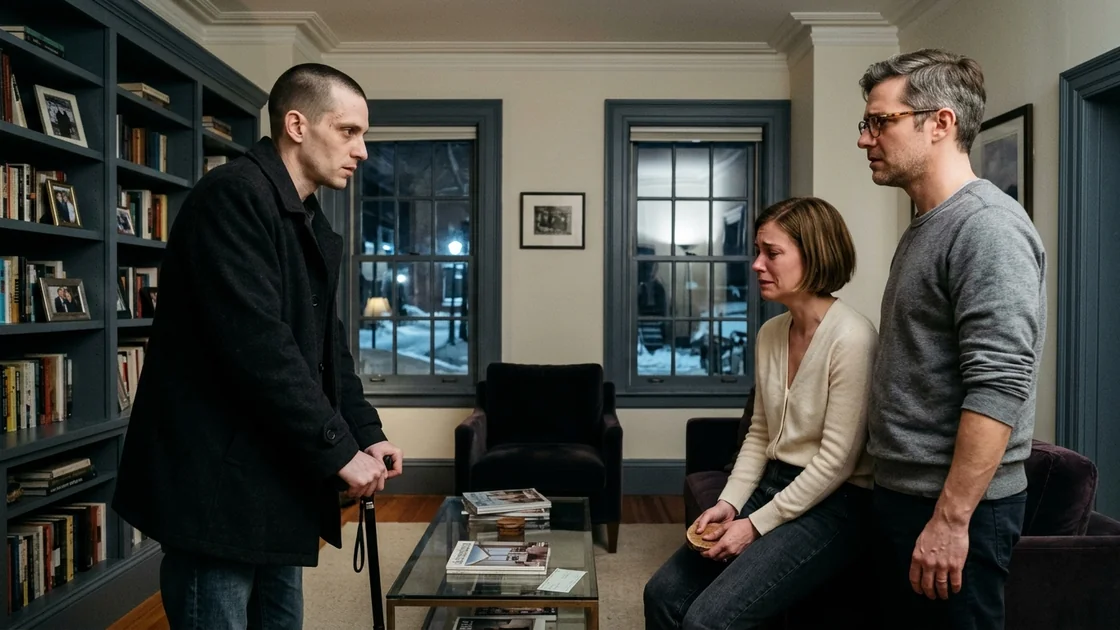
The curtains on the ground-floor parlor windows weren't drawn. Through the wavy, antique glass, he could see a high ceiling with crown molding, a wall of built-in bookshelves painted a dark, moody slate blue, and the edge of a kitchen island at the back of the room.
For three minutes, the room was empty. The cold was beginning to numb Arthur’s toes inside his leather boots, especially the left foot, where the circulation was always sluggish. He was just about to step off the curb when someone walked into the frame of the window.
It was Julian.
He was wearing a grey crewneck sweater with the sleeves pushed up to his elbows, holding a wooden spoon in one hand and a glass of red wine in the other. He was talking to someone out of sight toward the back of the kitchen. As Arthur watched, Julian laughed, tipped his head back slightly, and took a sip of the wine.
It was the exact posture Julian had stood in a thousand times in Arthur’s kitchen on Alder Street, or at their shared house near campus during senior year at Oregon State. The familiarity of the movement—the slight lift of the left shoulder when he laughed, the way he gestured with the spoon—hit Arthur with a violence that nearly buckled his good knee.
A second later, Clara walked past the island.
She was wearing dark jeans and a cream-colored cardigan, her shorter hair tucked behind her ears. As she passed Julian to set a stack of plates toward the dining table, Julian reached out with his free hand and caught her lightly by the hip, leaning in to kiss her temple. She didn't even look up from the plates; she just leaned her head into his shoulder for half a second, a gesture so practiced, so deeply worn into the floorboards of their daily life, that it spoke of a thousand quiet Tuesdays just like this one.
Arthur couldn't breathe. The cold air in his throat felt solid.
For ten weeks, sitting on rowing machines and walking on Maria’s treadmill until he tasted blood at the back of his tongue, he had imagined this moment as an invasion. He had imagined kicking open the door of a lie. He had imagined finding two guilty people flinching at shadows, drinking third glasses of bourbon in dark bars and weeping over his photograph.
Instead, he was looking at a marriage.
It wasn't a stolen marriage. It wasn't his life with Clara with Julian’s face pasted over his own. Arthur would never have painted bookshelves dark blue; he liked white oak and clean mid-century lines. Clara, when she was with Arthur, had never cooked on weeknights; they had eaten takeout Thai food out of cardboard boxes while watching baseball. This warm, brick-walled room in Massachusetts had nothing to do with him. It had been built from scratch out of the rubble after the bomb went off.
Arthur looked down at the brick sidewalk. He could walk back down the hill. He could find an avenue, hail a cab back to Logan, change his ticket to the red-eye, and put the cashier’s check in a mailbox at the airport. They would never know he had stood under the linden tree.
His left leg throbbed. The plastic brace inside his pant leg rubbed against his shinbone, a raw, constant reminder of the sixty months he had spent rotting in the dark while they learned how to cook dinner together in Charlestown.
He stepped off the curb.
His cane tapped loudly on the salted bricks as he climbed the four stone steps to the black door with the brass lion. His hand, inside its black leather glove, looked steady enough when he reached out, though Instead of using the knocker, he pressed the small illuminated brass button beside the frame.
Inside the house, a two-tone chime sounded.
Through the frosted sidelight beside the door, Arthur saw a shadow detach itself from the kitchen light and walk down the narrow front hall. Footsteps—heavy, booted, not slippers—approached the wood. The deadbolt clicked back with a solid, well-oiled snap.
The door swung inward.
"Sorry, if you're looking forNumber 44, the delivery guys always—" Julian began, looking down as he fumbled with the porch light switch.
Then he looked up.
The porch light clicked on, flooding the small stone stoop with yellow halogen glare.
Julian didn't make a sound. Every drop of blood seemed to drain out of his face in a single heartbeat, leaving his skin the color of the dirty snowbanks along the curb. His mouth opened slightly, his hand frozen against the light switch on the interior wall. Behind his tortoiseshell glasses, his eyes went wide, darting from Arthur’s buzzed, scarred head down to the thin neck inside the wool collar, down further to the black cane planted between Arthur’s boots.
"Artie?"
The name didn't even have air behind it. It was just the shape of the word formed by Julian’s lips.
"Hey, Jules," Arthur said. His voice sounded loud, slightly hoarse from the recycled airplane air and the cold.
"Who is it, Jules?" Clara’s voice floated down the hallway from the kitchen, accompanied by the smell of garlic, rosemary, and roasting chicken. "Did you order wine?"
Julian didn't answer her. He couldn't take his eyes off Arthur’s face. He took a half-step forward onto the threshold, his hand rising halfway from his side as if he were about to grab Arthur by the coat, then stopping in mid-air as if he remembered he had no right to touch him.
"Helen didn't..." Julian swallowed hard, his throat clicking. "She didn't tell me you were coming. God, Artie. You're standing up."
"Who's at the door?"
Clara appeared at the back of the hallway, wiping her hands on a striped linen dish towel. The hallway was narrow, lined with framed architectural prints and a mirror over a small console table. She walked toward Julian’s back, squinting past his shoulder into the dark of the porch.
Then she stopped.
She was six feet behind Julian, standing beneath the brass hallway pendant light. The striped dish towel slipped from her fingers and fell silently onto the Persian runner rug at her feet.
Her hand went to her throat, her fingers pressing flat against her collarbone, right where a small silver necklace sat against her skin. For three seconds, nobody on the stoop or in the hallway breathed. The only sound was the distant rumble of the Tobin Bridge traffic half a mile away and the sizzle of something in a pan at the back of the house.
"Arthur," she whispered.
Chapter 6: The Parlor in Charlestown
They didn't hug him. That was the first small mercy of the evening, because Arthur knew with complete certainty that if either of them had put their arms around him on that doorstep, he would have either swung his cane at Julian’s head or collapsed onto the salted stone steps and vomited.
Instead, Julian stepped back, pulling the door wide with a trembling hand. "Come in. It’s—it’s twenty degrees out, Artie. Please come in."
Arthur stepped over the brass threshold. His bad foot caught the edge of the weather-stripping with a loud clack of the plastic brace, and both Julian and Clara flinched forward instinctively to catch him before freezing themselves in place.
"I've got it," Arthur said coldly, righting himself with the cane.
He didn't take off his coat. He walked past Julian, who smelled of expensive soap and the red wine from the kitchen, and turned into the parlor with the slate-blue bookshelves. He didn't sit on the leather sofa. He turned his back to the empty marble fireplace, planted his cane in front of his toes, and waited for them like an auditor.
Julian closed the front door slowly, as if afraid a loud noise would cause Arthur to vanish into smoke.
When they came into the parlor together, the visual reality of them standing side by side nearly took Arthur’s breath away again. In his mind, even after seeing the photographs on the phone, they had still existed in separate compartments: My best friend and My fiancée. Seeing them occupy the same physical space—seeing the way Julian automatically stood six inches closer to her than a friend ever would, his elbow brushing the sleeve of her cream cardigan as if trying to shield her—made the five-year gap collapse into a sharp, jagged point in Arthur’s chest.
Clara looked at him as if she were seeing a miracle and a horror at the exact same time. Tears were running freely down her face now, wetting her cheeks, though she wasn't sobbing. She looked older up close than in the Somerville photograph. There were fine lines around her eyes—eyes he had once known better than his own face—and her hands were clasped together in front of her waist so tightly her knuckles were white.
"Your hair," she whispered, her voice shaking violently. "You cut your hair."
"They shaved part of it for a shunt in the first year, apparently," Arthur said, his tone conversational, almost pleasant, which seemed to terrify them more than if he had screamed. "And when I woke up, it looked like a bird’s nest. It was easier to buzz it."
"Let me—let me turn the stove off," Julian stammered, backing toward the kitchen without taking his eyes off Arthur. "Stay right there. Sit down, Artie, please, you just flew across the country—"
"Leave the stove, Julian. I'm not staying for dinner."
Julian stopped at the edge of the rug. His face was still grey, a sheen of sweat visible under the recessed ceiling lights. "Artie, you can't just stand here for five minutes after five years. Please. Helen told us Dr. Aris said you couldn't travel until spring."
"I worked hard," Arthur said. He looked at Clara. "You look well, Clara. I saw the pictures from the land trust in Somerville. You finally got into urban planning. Remember how you used to hate doing commercial bathroom layouts for Henderson?"
Clara made a small, broken sound in the back of her throat and covered her mouth with both hands. Her knees seemed to give out slightly, and she sank onto the arm of a velvet chair near the doorway, staring at him through her fingers.
"Arthur, I'm so sorry," she choked out. "God, Arthur, you’re alive. I used to pray—every day on the drive down I-5, I used to bargain with God that if you just opened your eyes, I would give up everything. I would live in that hospital room forever."
"For eighteen months," Arthur corrected gently. "Mom told me. Eighteen months every day, and six months after that on weekends. That's seven hundred days. It’s a lot of days, Clara. More than most people give."
"Don't," Julian said, his voice dropping, raw with anguish. "Don't talk to her like that, Artie. Talk to me. Yell at me. Hit me with that fucking cane if you want to, I won't put my hands up. It was me. After the second winter, when you had the sepsis and Aris told us your cortex wasn't responding to pain stimuli anymore—I was the one who packed up her apartment. I was the one who made her stop going to Eugene on Tuesdays and Thursdays."
"No, you didn't," Clara cried, turning on Julian fiercely before looking back at Arthur, her face wet and contorted. "Don't let him do that, Arthur. He always tries to take the blame for it when we talk about you. I wanted to leave Eugene. I couldn't breathe in Oregon anymore. Every time it rained, I saw your car. Every time I walked past a bakery or a florist, I wanted to die. You were in that bed, and you looked like you were made of wax, and your hands were curled up toward your chest—" She sobbed openly now, curling forward over her knees. "Your hands were curled up, and the nurses had to put rolled-up washcloths in your palms so your fingernails wouldn't dig into your skin. You weren't in there, Arthur! Everyone told us you weren't in there!"
Arthur looked down at his hands on top of the cane handle. When he had woken up, his left hand had indeed been stiff, the tendons shortened from years of spastic flexion; Maria had spent hours with hot wax baths and painful stretching to get his fingers to lie flat again.
"I wasn't in there," Arthur agreed quietly. "At least, I don't think I was. I don't remember the washcloths. As far as my brain is concerned, Clara, I bought three hundred cedar coasters in Eugene at four o'clock in the afternoon, and at four-fifteen I woke up in St. Jude’s and my mother was an old woman."
He looked up from his hands, letting his gaze move from Clara’s bowed head to Julian’s agonized face.
"That’s the problem, isn't it?" Arthur said. "You two had five years. You had funerals without a body. You had two years of sitting by a bed, and a year of packing boxes, and two years of moving to Massachusetts and buying bookshelves and learning how to make roast chicken on Valentine's Day. You got to grieve me in real time. For me, Julian, you were in my kitchen drinking my beer three months ago."
Julian closed his eyes, a muscle jumping violently in his jaw. "I know," he whispered. "When Helen called me in November... after I hung up the phone at the airport, I threw up in the parking garage. Not because I wasn't grateful you were alive—Artie, I swear on my life, waking up in a world where Arthur Pendelton is alive again was like the sun coming back out. I threw up because I realized what waking up was going to feel like for you."
"Did you?" Arthur asked, his voice rising for the first time, sharp and thin against the high ceilings of the parlor. "Did you think about that when you put your last name next to hers on your letterhead? Or when you shipped my motorcycle across the country like a war trophy?"
"I kept the Norton because nobody in Eugene knew how to keep the Lucas electrics from rotting!" Julian shouted back, the composure cracking, his hands balling into fists at his sides. "I kept your drafting table in my office in Back Bay! Every single person who works for me knows who Arthur Pendelton is! Do you think we erased you? Do you think we came out here and pretended we met on a dating app? You are in every room of this house, Artie! We couldn't have been with anyone else because nobody else on earth knew who you were!"
The words hung in the warm, garlic-scented air.
Clara was looking up at Arthur now, her eyes swollen and red, nodding slowly as if Julian had finally spoken the sole, terrible truth of their marriage.
We couldn't have been with anyone else because nobody else on earth knew who you were.
Arthur looked at them. Really looked at them.
He saw theframed photograph on the slate-blue bookshelf just behind Julian’s left shoulder, half-hidden behind a small brass lamp. He hadn't noticed it from the street.
It was an eight-by-ten black-and-white photo from six years ago. The three of them were sitting on the tailgate of Julian’s old Ford Ranger at Cape Kiwanda, wrapped in wool blankets with the Pacific surf foaming behind them. Arthur was in the middle, one arm around Clara’s shoulders, the other raised to hold a beer bottle in a toast toward Julian, who was grinning at the camera.
It wasn't hidden in a drawer. It was sitting on the shelf at eye level in their living room.
Julian had been telling the truth in his email to Helen. They hadn't buried him to build this house. They had built the house around his grave. Every day, Julian walked past a picture of the man his wife had intended to marry, and every day, Clara looked across the breakfast table at the man who had been supposed to hold the rings while she married someone else.
It wasn't a betrayal. It was something much stranger, sadder, and more claustrophobic than betrayal. They were survivors of a shipwreck who had lashed their rafts together in the dark, and now the captain had walked out of the sea, dripping saltwater onto their rug.
The rage that had carried Arthur across three thousand miles and ten weeks of brutal physical therapy didn't evaporate, exactly, but it suddenly lost its target, leaving behind a vast, hollow exhaustion that made his knees tremble.
He reached into his right coat pocket.
He pulled out the pale blue rectangular slip of the US Bank cashier’s check and tossed it onto the glass coffee table between them. It slid across a stack of architecture magazines and stopped near the edge.
Julian looked down at the paper, squinting through his glasses at the numbers. His face darkened with a new kind of pain. "Artie, what is this?"
"One hundred and eighty-two thousand, four hundred dollars," Arthur said. "Every dime from the ledger my mother kept."
"Where did you get a hundred and eighty thousand dollars?" Julian asked, horrified. "You didn't sell Helen’s house?"
"I sold the river lot on the McKenzie," Arthur said, glancing briefly at Clara, who flinched as if he had slapped her. She knew that lot; they had camped under the Douglas firs there the night he asked her to marry him. "And I cashed out part of my pension. I don't want your money, Julian."
"That money was yours!" Julian stepped toward the coffee table, picking up the check as if he intended to rip it in half, then stopping himself because he knew how much a bank check cost to cancel. "When I started the company in my garage, whose server rack was I using? Who loaned me four thousand dollars for the patent lawyer in 2016 when my credit cards were maxed out? You did! Without that four grand, there wasn't a company to sell, Artie! In my head, you owned ten percent of that firm!"
"We didn't have a contract," Arthur said flatly. "You paid my hospital bills because you felt guilty that you were sleeping with my fiancée while I had a feeding tube in my stomach."
Julian went rigid. Clara let out a low, wounded gasp and turned her face toward the velvet cushions of the chair.
It was the cruelest thing Arthur had ever said to another human being. It felt like poison coming out of his mouth, burning his own tongue as much as it burned them, yet for ten weeks he had needed to say it out loud in the room where they lived.
Julian stood very still holding the check. A tear finally spilled over his lower lid, tracking down behind his glasses, though his voice when he spoke was steady and quiet.
"We didn't touch each other until three years after your crash, Artie," Julian said, looking straight into Arthur’s eyes. "Not once. Not until we were already living in Boston in separate apartments. You don't have to believe that. If it helps you stay upright to think we were sneaking around behind the curtain while you were in the ICU, then think it. You've earned the right to hate us however you need to hate us. And I won't cash this check, so it's just going to sit in a drawer until the bank voids it, or I'll put it in an account with your name on it."
Arthur’s hand was shaking on the cane now. The adrenaline was draining out of his bloodstream, leaving his under-muscled body shivering inside his damp wool coat.
He reached into his left pocket.
He pulled out the dried cedar coaster. The wood was pale, the bark completely gone from the edges now after bouncing around in his pocket through two airports. The purple ink stamp in the center was faded, but still legible: A & C, October 14.
He set it on the coffee table beside the stack of magazines. He didn't drop his cracked watch beside it; at the last second, his fingers closed back around the cold metal of the Seiko in his pocket. The watch was his. The time it had stopped belonged to him.
"There were three hundred of these in the back of the Civic," Arthur said, looking at the little disk of wood. "I was coming back from the guy in Junction City who had the wood-burning stamp. He gave me a discount because twenty of them had knots in the grain."
Clara rose slowly from the velvet chair. She walked over to the coffee table—the closest she had come to him since he walked through the door. She was only three feet away now. He could smell her—not vanilla almond milk anymore, just something clean and floral, like white tea.
She reached down and picked up the cedar coaster with trembling fingers, holding it by the edges like a communion wafer.
"I have the rest of them," she whispered, looking up at him through wet eyelashes. "The state police gave the box from your backseat to Julian when they released the car from the impound lot. I kept them in a shoebox in the closet upstairs."
She looked at his face, her eyes tracing the scar above his temple, the hollowness of his cheeks, the fierce, exhausted misery in his eyes.
"What do we do, Arthur?" she asked, and she sounded twenty-seven again—lost, terrified, asking him how to fix a leaking pipe under the sink or what to do when her father got sick. "Tell me what to do. There isn't a book for this. Nobody knows what you're supposed to do when someone comes back from the dead."
Arthur looked at her. He looked at the platinum ring on her left hand holding the piece of Oregon cedar. He looked at Julian standing beside her, grey-faced, holding a check for a hundred and eighty thousand dollars he would never spend.
For five years, they had been trapped in October 10th just as surely as he had been. He had been trapped in the bed; they had been trapped in the waiting room, even after they moved three thousand miles away and changed their names.
He realized then why he had really come to Boston. It wasn't to collect a debt, or to smash their blue parlor into pieces. He had come because the cord tying the three of them to that rainy highway in Junction City was strangling him, and he was the only one holding the knife that could cut it.
"You go eat your dinner," Arthur said softly. "The chicken’s burning."
Clara’s lower lip trembled. "Arthur—"
"I mean it, Clara." His voice didn't have the cold, theatrical edge anymore; he was just a very tired thirty-two-year-old man whose left leg hurt. "You didn't kill me. A guy in a logging truck with worn-out brakes killed the guy you were going to marry. I'm somebody else now. I don't even know who he is yet, because I've spent the last three months just learning how to walk up stairs without falling on my face."
He turned slightly toward Julian.
"Keep the Norton," Arthur said. "My left ankle doesn't have the dorsiflexion to kick-start a British bike anymore anyway, and it would just rust in Mom’s garage."
Julian let out a ragged breath that sounded like a sob, his head dropping forward onto his chest. "Artie, please stay in Boston for a few days. Let us—I don't know, let me come to your hotel tomorrow. Even if we just sit there and don't talk."
"No," Arthur said. And for the first time since November, the word didn't feel like a weapon; it just felt like a boundary. "I can't be your friend right now, Jules. Maybe when I'm forty. Maybe never. I don't know. Right now, looking at the two of you together feels like looking directly at the sun after being in a cave. It hurts too much."
Nobody argued with that. How could they?
Arthur took a step back toward the hallway. Clara took a half-step after him, clutching the cedar coaster against her cardigan.
"Will you be okay?" she asked.
Arthur paused with his hand on the doorframe between the parlor and the hall. He thought of his mother’s house in Eugene, and Tom Henderson’s offer of a desk at the engineering firm, and the vast, unmapped territory of the years stretching out ahead of him—years that didn't have a wedding on Saturday, or an A-frame on the McKenzie River, or a best friend in the next room. It was a terrifyingly empty landscape, like the sky outside the doors of St. Jude’s on the day he was discharged.
"Dr. Aris says I'm an outlier," Arthur said. "Apparently I'm pretty hard to kill."
He turned and walked down the narrow hallway over the Persian runner. Neither of them followed him to the door; they gave him the dignity of letting him handle the heavy brass knob and the four stone steps himself.
Chapter 7: The Eastward Light
Outside on the stoop, the cold air hit his face like clean water.
Arthur didn't look back through the wavy glass of the parlor window as he descended the steps, taking them one at a time—good foot down, bring the braced foot to meet it, cane on the brick.
When he reached the sidewalk at the bottom of the hill, he pulled his phone from his pocket. His fingers were stiff from the twenty-degree air, but he managed to open the ride-share app he had downloaded at the airport—another marvel of the new world that still felt slightly magical—and summoned a car to the corner of Main Street.
While he waited under the amber glow of a streetlamp near an old brick tavern, he reached into his left pocket and pulled out the broken Seiko watch.
In the yellow light, he looked at the cracked crystal. Six-fourteen.
Fourteen minutes past six on a Tuesday evening five years ago. The exact moment the logging truck’s front bumper had sheared through the driver’s side pillar of his Civic, stopping the tiny quartz oscillator inside the steel case while his own heart stubbornly kept beating.
Next to the streetlamp stood a cast-iron municipal trash can, its lid encrusted with a rim of frozen grey slush.
Arthur looked at the watch for a long moment. He had thought earlier about keeping it, about having a jeweler in Eugene replace the crystal and put a new battery in it to see if it would tick again.
Instead, he reached out and dropped it through the rectangular slot in the top of the iron bin. It hit a plastic coffee cup at the bottom with a dull, insignificant rattle.
A black sedan pulled up to the curb, its hazard lights blinking twice against the wet asphalt. This time, the flashing amber lights didn't make his heart race. It was just a Toyota Camry with a Massachusetts license plate and a driver waiting to take him back across the river.
Arthur opened the back door, sat down on the vinyl seat, and lifted his left leg in over the sill before pulling the door shut behind him.
"Back to Copley Square?" the driver asked, glancing at his phone mounted on the dashboard.
"Actually," Arthur said, leaning his cane between his knees and looking out at the dark, ice-flecked water of the harbor as the car pulled away from the curb, "can I change the destination to Logan Airport? I want to see if I can catch the late flight home."