The Echo in the Green Room
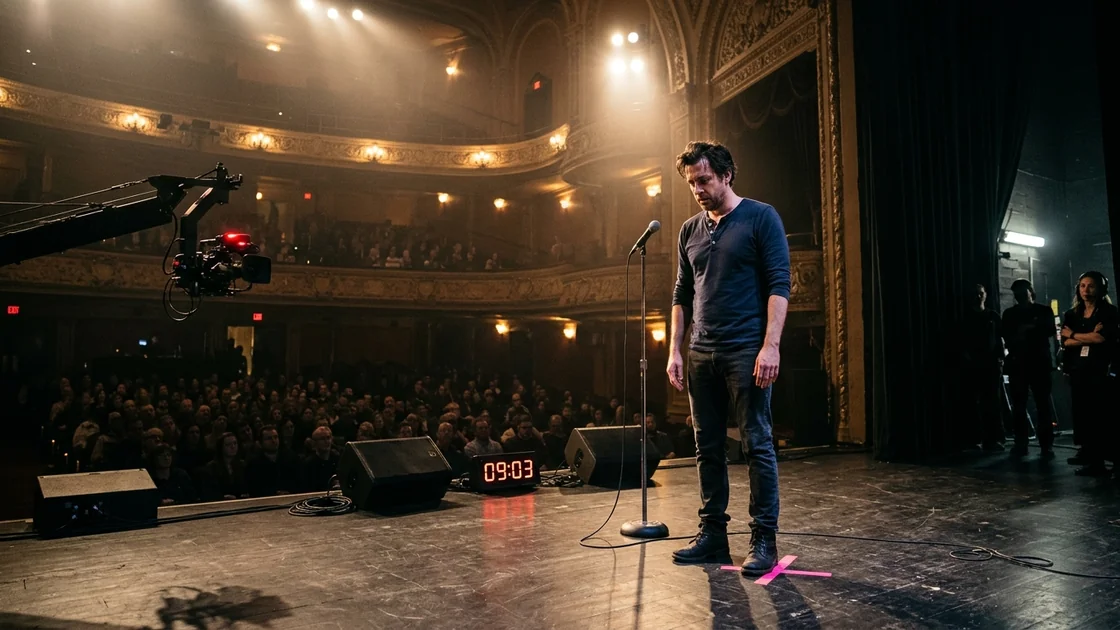
This is the story of Arthur Pendelton, a rising stand-up comedian whose career thrives on making sold-out audiences roar with laughter every night while he battles crippling, unspoken loneliness in sterile hotel rooms across the country. Through a grueling twelve-city winter tour across the American Midwest, Arthur navigates the surreal chasm between the electric adoration of strangers in darkened theaters and the suffocating silence of three-star accommodations after the curtain falls. As his professional star ascends toward a career-defining television special in Chicago, his personal tether frays completely, leaving him to confront the hollow realities of a life spent turning personal pain into a consumable commodity for people he will never truly know, ultimately leading him to a quiet breaking point under the blinding stage lights where the jokes finally run out.
The laughter hit him like a physical wave, warm and thick, smelling faintly of stale domestic beer, overly buttered popcorn, and wet winter wool. Arthur stood at the center of the plywood stage at the Chuckle Hut in Des Moines, his right hand gripping the cold iron neck of the microphone stand while his left hung loose at his side, fingers twitching in time with the cadence of the room. He was thirty-four years old, dressed in a meticulously rumpled flannel shirt and dark jeans that his manager, Brenda, had termed "relatably exhausted."
"And so I told the guy at the pharmacy," Arthur said into the Shure SM58, dropping his voice an octave so the four hundred people crammed into the low-ceilinged basement had to lean forward over their sticky Formica tables, "if I wanted a lecture on my dietary habits at two in the morning, I wouldn't be buying frozen lasagna and Pepto-Bismol at the same counter. I'd just call my ex-wife and chew tinfoil into the receiver."
The room detonated. It wasn't his best joke—it was hackneyed, structured on a classic rule-of-three rhythm he had learned ten years ago in the back rooms of bowling alleys in New Jersey—but the delivery was surgical. Arthur knew precisely how long to hold the pause before "Pepto-Bismol," how to widen his eyes just enough for the people in the back row by the fire exit to catch the whites of them in the amber spotlight, and how to let his shoulders slump in defeat just as the punchline landed.
A man in the second row, wearing a heavy canvas Carhartt jacket he hadn't bothered to take off, slapped the table so hard an empty pint glass jumped and tipped onto its side. His wife, a woman with tightly curled blonde hair, wiped a tear from the corner of her eye and looked at Arthur as if he were the most delightful, mischievous nephew in the world.
Arthur smiled at her. It was a broad, boyish, crooked smile that showed his slightly overlapping front teeth. It was the smile on his posters outside in the lobby, the ones laminated and taped to the brick walls beside the neon Miller Lite signs.
"Thank you, Des Moines," Arthur said, raising a hand to quiet the applause while simultaneously milking it for another four seconds. "You guys have been incredible. Drive safe out there on the ice. I’m Arthur Pendelton. Goodnight!"
He bowed quickly, unplugging the microphone from the clip only to snap it right back in—a nervous habit he had never broken—and stepped backward through the heavy black velvet curtain as the house music, an overly bass-heavy remix of a ninety's hip-hop track, roared to life through the overhead speakers.
The transition from the stage to the hallway behind it was always violent in its abruptness. Out there, the air was seventy-eight degrees, vibrating with four hundred heartbeats and the chemical euphoria of shared amusement. Back here, the hallway was fifty-five degrees, smelling of bleach, damp concrete, and the sour fryer oil leaking from the kitchen vents thirty feet away.
"Murdered, man. Absolute bloodbath out there."
Arthur blinked, his eyes adjusting from the amber wash of the stage lights to the buzzing fluorescent tubes overhead. Rick, the local feature act—a twenty-four-year-old kid with a patchy beard and twenty minutes of material about living in his parents' basement—was leaning against the cinderblock wall, nursing a bottle of Bud Light.
"Thanks, Rick," Arthur said. His voice sounded strange to his own ears, flat and reedy now that it wasn't being run through two thousand watts of amplification. "Your set was tight tonight. That bit about the golden retriever is coming along."
"Yeah? I shortened the setup like you said after the early show." Rick beamed, standing up straighter. To Rick, Arthur was a god. Arthur had a Comedy Central half-hour, three appearances on late-night talk shows, and a podcast that occasionally cracked the top fifty on the comedy charts. Arthur was making a living. He wasn't working at a tire shop during the day anymore. "Me and the emcee are heading over to Mulligan's down the street. Kitchen’s open till one. A couple of the waitresses are coming too. You in?"
Arthur felt the familiar, heavy curtain drop behind his eyes. The adrenaline was already draining out of his bloodstream, leaving behind a cold, metallic sludge in his veins. The thought of sitting in a brightly lit sports bar, shouting over jukebox rock, pretending to be the funny guy from the stage while twenty-somethings waited for him to say something quotable, made his stomach tighten into a hard knot.
"Ah, man, I appreciate it," Arthur said, reaching up to rub the back of his neck, executing the "relatably exhausted" gesture with practiced ease. "I gotta catch an early flight to Omaha tomorrow, and my voice is starting to go. Gonna go gargle some salt water and pass out."
"You're driving to Omaha, aren't you?" Rick asked, tilting his head. "It's only two hours down I-80."
Arthur didn't miss a beat. "Yeah, meant drive. Early drive. Brain's fried, man. Two shows a night will do that to you. Have a beer for me, alright? Tell the waitresses I'm secretly a millionaire."
Rick laughed, clapped Arthur on the shoulder, and wandered off toward the front of the club to collect his fifty-dollar check.
Arthur retreated into the green room. It wasn't green; it was painted a dull, institutional beige and furnished with a sunken leather sofa that had black duct tape crisscrossing the cushions like surgical sutures. On the wall, generations of touring comics had signed their names in black Sharpie alongside crude drawings and defunct website URLs. Arthur found his own signature from three years ago near the thermostat, faded and half-covered by a sticker for a local metal band.
He packed his canvas messenger bag: a yellow legal pad filled with half-legible scribbles, three chewed Bic pens, a bottle of generic ibuprofen, and a portable phone charger. The club manager, a bald man named Gary who always looked like he had just lost a large bet on a horse, poked his head through the door.
"Here's the settlement, Artie," Gary said, handing over a thick white envelope stuffed with twenties and fifties, along with a printed spreadsheet showing the door splits. "Did good on the late show. Merch girl says you sold twelve t-shirts and four mugs."
"Wait, I don't have mugs," Arthur said, frowning as he stuffed the cash into his front pocket without counting it.
"Oh. Right. That was the hypnotist last week. Well, you sold twelve shirts. Boxes are by the back door. You need help loading them into your rental?"
"I got it, Gary. Thanks."
"See you next year, pal. Keep killing it."
Arthur carried the two cardboard boxes of black t-shirts—each emblazoned with a cartoon silhouette of his own face and the words I’m Fine, Everything is Fine—out the heavy steel fire door into the Des Moines alley. The cold hit him instantly, freezing the sweat that had soaked through the collar of his flannel shirt. It was 12:45 in the morning. The sky was a low, bruised purple, reflecting the sodium streetlights off a thick blanket of midwestern clouds.
His rental car, a silver Nissan Altima that smelled faintly of someone else's coconut air freshener, sat solitary under a flickering security lamp. It was covered in a thin crust of gray road salt. Arthur popped the trunk, dropped the boxes inside alongside his rolling suitcase, and got into the driver's seat.
He didn't start the engine right away. He just sat there in the dark, watching his breath plume in the freezing air of the cabin. Five minutes ago, four hundred people had been hanging on his every syllable. They had loved him. When he talked about his failed marriage, they had groaned in sympathy; when he pivoted to the absurdity of trying to buy a single banana at a grocery store without looking like a pervert, they had howled with recognition. For fifty-five minutes, he had been the center of a small, warm universe.
Now, the silence in the car was so absolute he could hear the ticking of the cooling engine block from the pizza delivery car parked three spaces down.
He turned the key. The dashboard lit up in harsh blue and red LEDs. His phone, mounted on the air vent, automatically connected to the Bluetooth stereo and began playing the exact second of the history podcast he had paused five hours earlier on his way to the venue. He reached out and clicked the volume knob off. He couldn't bear the sound of another human voice right now, not even a dead historian talking about the Peloponnesian War.
The Fairfield Inn & Suites was located six miles outside the city center, wedged between a sprawling John Deere dealership and a twenty-four-hour Perkins restaurant near the interstate on-ramp. It was an architecture of pure transience: four stories of beige stucco and synthetic stone, designed to look exactly the same whether it was dropped into the cornfields of Iowa, the pine barrens of Georgia, or the arid scrubland outside Albuquerque.
Arthur parked in the back lot, near the dumpster, and pulled his hood up against the wind. The automatic sliding doors parted with a mechanical wheeze, admitting him into a lobby that was aggressively warm and smelled of artificial cinnamon and lemon floor polish.
The night auditor, a young woman with thick glasses and a textbook open on the counter, didn't look up as he crossed the patterned carpet toward the elevator. She didn't know he had just murdered at the Chuckle Hut. She didn't know he had eighty-four thousand followers on Instagram. To her, he was just Room 314, a guy in a salt-stained coat walking past the complimentary infused-water station at one in the morning.
The elevator ride to the third floor took nineteen seconds. Arthur knew this because he counted them, staring at his own reflection in the brushed bronze laminate of the doors. He looked older in elevator lighting. The deep grooves around his mouth—laugh lines, people called them, though they had been carved just as deeply by grimacing into oncoming headlights on interstate highways—looked like fissures in dry clay. His eyes were bloodshot, ringed with dark, bruised hollows.
He walked down the long, carpeted corridor. Hotel hallways at night possessed a specific, pressurized quiet. Behind every heavy wooden door, strangers were sleeping, dreaming, watching television with the volume turned down low, or staring at the ceiling just like he was about to do. Sometimes, passing a door, he would hear the muffled cadence of a sitcom laugh track or the rhythmic thrum of a CPAP machine. He felt like a ghost haunting a purgatory of beige wallpaper.
He slid his keycard into the slot of Room 314. The little light blinked green, the lock clicked, and he pushed the door open.
The room was cold. Housekeeping had turned the PTAC unit under the window down to sixty degrees while he was gone. The heavy blackout curtains were drawn tight, sealing out the view of the John Deere parking lot. The king-sized bed sat in the center of the wall like a massive, white altar, its four over-stuffed pillows propped rigidly against the faux-mahogany headboard.
Arthur dropped his keys and the envelope of cash onto the laminate desk beside the single-cup coffee maker. He didn't take off his coat. Instead, he walked over to the window unit, switched the fan from Auto to Constant On, and cranked the heat up to seventy-two. The machine shuddered, clanked, and began to blow out a loud, steady stream of dry, dusty air.
That was rule number one of the road: never let the room go completely quiet. The white noise of a cheap air conditioner was the only thing that kept the walls from creeping inward toward the bed.
Next came the television. He picked up the remote, which was encased in a washable plastic sleeve for hygiene, and hit the power button. The fifty-inch screen flared to life, displaying the hotel’s welcome channel. A relentlessly cheerful guitar riff played on a thirty-second loop while stock photos of smiling business travelers eating waffles and swimming in an indoor pool slid across the screen. Welcome to the Fairfield Family, Mr. Pendelton! a graphic at the bottom read.
He muted the welcome channel, switched the input to regular cable, and flipped until he found Law & Order reruns on a basic cable network. He set the volume to twelve—loud enough to register as human presence in the room, quiet enough that he couldn't quite make out the dialogue about DNA evidence and grand jury indictments.
Only then did he take off his coat and boots.
He sat on the edge of the bed. The mattress was firm and slightly bouncy, covered in a crisp white duvet that felt like heavy butcher paper. From his coat pocket, he pulled out a plastic bag from the gas station he had stopped at on the way back from the club. Inside was a turkey and cheddar sub on soggy white bread, a bag of jalapeño kettle chips, and two tallboys of Miller High Life.
This was the feast of the conquering hero.
He cracked open the first tallboy. The hiss of the can was the sharpest sound in the room. He drank half of it in four long swallows, the cold, cheap lager cutting through the chalky dust of the stage that still coated the back of his throat. He unwrapped the sandwich, took two bites, and chewed slowly while watching Jerry Orbach interview a bartender on the television screen. The bread stuck to the roof of his mouth. He wasn't hungry, he realized; he was just empty. There was a profound difference between the two, though after six years on the road, he frequently confused them.
He set the sandwich back on its wax paper and pulled out his phone.
Since turning off airplane mode after the show, notifications had accumulated like snowdrifts. Forty-two likes on the photo the club had posted of him onstage. Six mentions in people's stories: "@ArthurPendelton killed it tonight!" "So funny my face hurts!" "Date night with the hubby watching @ArthurPendelton!"
He tapped through the stories. One of them had been taken from the third row. It was a blurry five-second video of him doing the pharmacy bit. In the bottom corner of the frame, he could see the back of the head of the guy in the Carhartt jacket and his blonde wife. They were leaning into each other, her hand resting on his forearm as they laughed. They were going home now, probably already in their own bed under a quilt they had bought together at Target, their dog sleeping at their feet, still chuckling about the frozen lasagna joke before they drifted off.
Arthur locked the phone and tossed it onto the vast, empty expanse of the left side of the king-sized bed.
Why did they always give solo travelers king-sized beds? It felt like an insult, a deliberate architectural reminder that there was supposed to be another warm body occupying the forty square inches of mattress to his left. He always slept on the far right edge, nearest the bathroom, leaving the rest of the bed untouched so that in the morning, half the room still looked as though no one had ever checked in.
He opened the second tallboy and walked into the bathroom. The fluorescent mirror light was merciless. He leaned over the granite-composite sink and looked at himself.
"You're doing great," he said aloud. His voice bounced off the fiberglass shower stall, tinny and pathetic. "Twelve shirts, Artie. Twelve shirts in Des Moines."
He thought about calling Claire. The impulse hit him almost every night between one-thirty and two-thirty in the morning, right when the first beer started to fuzz the edges of his vision. They had been divorced for two years, and she lived in Chicago with a guy named Greg who designed ergonomic office furniture and was home by six o'clock every evening.
If he called her right now, the phone wouldn't even ring on her end; he knew for a fact she kept it on Do Not Disturb from ten to six. It would go straight to her voicemail—the same voicemail greeting she’d had when they were married, the one where she sounded slightly out of breath because she had recorded it while walking up the stairs of their old walk-up in Ravenswood. Sometimes, six months ago, during a brutal two-week run through the Pacific Northwest where it had rained every single day, he had called her from a Red Lion Inn in Spokane just to hear that three-second intake of breath before she said, Hi, you've reached Claire. He had hung up before the beep, terrified that if he left a message, she would change the greeting, and then he wouldn't even have that anymore.
Instead of calling Claire, he sat back down at the desk, opened his yellow legal pad, and picked up a Bic pen.
Hotel room is so quiet, he wrote in block letters at the top of a fresh page. How quiet is it? It’s so quiet I can hear my hair turning gray. It’s so quiet the Gideon Bible in the drawer just sighed and asked me if I want to watch porn.
He stared at the words. They weren't funny. They were desperate disguised as irony, which was the entirety of his act, really, when you stripped away the voice inflections and the boyish grin. The trick to stand-up comedy was taking the thing that was actively killing you, dressing it up in a clown suit, and beating it with a plastic bat until strangers gave you money. If you did it well enough, they thought you were in on the joke. They thought you had conquered the pain because you could make it rhyme. They never realized that the joke was just a flair fired up from a sinking ship, and they were standing on the shore clapping at the pretty red light in the sky.
He crossed out the line about the Gideon Bible, drank the rest of the warm beer, and crawled under the stiff white sheet with his jeans still on. He didn't turn off the television. He didn't turn off the bathroom light; he just pulled the door mostly shut so a thin, yellow wedge of illumination cut across the dark carpet, telling him where the door was in case he woke up at four in the morning—as he always did—with no idea what state he was in.
The next morning began at ten-thirty with the sound of a vacuum cleaner bumping repeatedly against the outside of his door.
Arthur surfaced from a shallow, dehydrated sleep, his mouth tasting of copper and stale hops. For five terrifying seconds, looking at the generic watercolor print of a sailboat hanging on the wall opposite the bed, he thought he was in Toledo. Then he remembered the guy in the Carhartt jacket, the spilled pint glass, the twelve t-shirts. Des Moines. Right. And today was Thursday, which meant Omaha wasn't until tomorrow. He had another two shows at the Chuckle Hut tonight. He had lied to Rick about driving to Omaha just to get out of having a beer with him.
He groaned, rolled out of bed, and walked to the window. He pulled back the stiff curtain an inch. The sun was out, glaring blindingly off the snow-packed lot of the John Deere dealership. A row of forty-foot green combines sat lined up like prehistoric insects frozen in amber.
He took a shower that lasted forty minutes, sitting on the floor of the tub for the last twenty with his knees pulled up to his chest while the scalding water beat against the back of his neck until the hotel's hot water heater began to falter and turn lukewarm.
By noon, he was dressed in the same jeans and a slightly different flannel shirt. He walked down to the lobby, which was now empty except for a man in a high-visibility vest mopping near the entrance. The breakfast buffet had been cleared away hours ago, leaving only a silver urn of lukewarm decaf and a basket of bruised red delicious apples wrapped in individual plastic film.
Arthur took an apple he had no intention of eating and pushed out into the freezing sun.
The hours between noon and seven p.m. on the road were known among comics as "The Dead Zone." When you first start touring, you think you're going to see the country. You tell yourself you'll go to the art museums, hike the state parks, find the quirky local diners featured on the Food Network. By year three, the exhaustion is so bone-deep that the world shrinks to a half-mile radius around whatever exit ramp your hotel sits on.
Across a six-lane highway divided by a concrete jersey barrier sat a strip mall anchored by a Target, a Marshall's, an Applebee's, and a Planet Fitness.
Arthur didn't drive across the highway; he walked, waiting four minutes at the crosswalk in the biting wind while eighteen-wheelers roared past, throwing up fine mists of slush that coated his jeans to the knee. He needed to walk. If he didn't move his legs, he felt as though he might calcify into the shape of a bucket seat.
He spent an hour and forty minutes inside the Target.
There was something profoundly soothing about a Target when you were losing your mind on the road. Every Target in America had the exact same layout, the same cherry-red carts, the same bright, shadowless lighting, the same faint smell of popcorn and new polyester near the entrance. In a Target in Des Moines, he could pretend he was in the Target on Elston Avenue in Chicago.
He didn't need anything, so he pushed a red basket up and down every single aisle, starting with electronics and working his way slowly toward groceries. He looked at Dutch ovens in the housewares section, running his thumb over the smooth enameled cast iron, imagining a kitchen where he stayed long enough to braise a short rib for four hours. He stood in the candle aisle for ten minutes, unscrewing the lids of glass jars and smelling Mahogany Teakwood, Fresh Linen, and Vanilla Bean. Fresh Linen smelled almost exactly like the detergent Claire used to buy before she switched to the unscented eco-friendly pods during the last year of their marriage.
Around him, regular life was happening at a Tuesday-afternoon pace, even though it was Thursday. Mothers with toddlers strapped into cart seats debated over brands of fruit snacks; elderly couples walked slowly side-by-side, holding lists written on the backs of envelopes; college kids in sweatpants bought cheap microwaves and thirty-packs of ramen.
Arthur watched them with the anthropological detachment of a visitor from another planet. They all had somewhere to take this stuff. Every single person in this store had a set of keys in their pocket that unlocked a door where their things lived permanently—where there were spice racks with half-used jars of cumin from 2019, and stacks of mail on a counter, and a specific creaky floorboard in the hallway you had to step over if someone else was sleeping.
Arthur had a ten-by-ten climate-controlled storage unit in Skokie, Illinois, that cost him a hundred and eighty dollars a month, and a sublet studio apartment in Los Angeles he had slept in for a grand total of nineteen nights over the past calendar year.
His phone buzzed in his pocket. The screen read BRENDA (MGMT).
He stepped into the greeting card aisle—the quietest aisle in any big-box store—and answered. "Hey, Brenda."
"Artie! Tell me you're sitting down," Brenda’s voice barked through the speaker. She was in her office in Century City; he could hear the faint espresso machine hiss from her assistant's desk in the background. Brenda was fifty, chain-smoked menthol vapes, and spoke at the speed of an auctioneer having a manic episode.
"I'm standing between 'Sympathy for Your Loss' and 'Happy 8th Birthday, Grandson,'" Arthur said. "What's up?"
"Netflix bit."
Arthur stopped looking at a card with a golden retriever wearing a party hat. "They bit on what? The multi-cam pitch?"
"No, screw the multi-cam, the multi-cam is dead, nobody's buying sitcoms till the strike dust settles," Brenda said dismissively. "The hour! The special! Everything is Fine. We got the green light an hour ago. They want to tape it in six weeks. The Vic Theatre in Chicago. Two tapings, one night, March fourteenth. Eighty-five grand budget plus licensing fee. Artie? You breathing?"
Arthur leaned his shoulder against the rack of anniversary cards. A tiny metal rack of novelty envelopes clattered slightly under his weight. "The Vic," he repeated softly. "That's fourteen hundred seats, Brenda. Two tapings is nearly three thousand people."
"And you're gonna pack it to the rafters, baby! It's your hometown! Well, your comedy hometown, whatever, the press release is gonna say hometown hero returns. Once this hour drops in the fall, your club days are over. No more Chuckle Huts, Artie. No more two-drink minimums with some jackass yelling 'Freebird' from the back while a blender runs at the bar. We're talking theater tours. The Wilbur in Boston. The Paramount in Austin. Five-thousand-dollar guarantees just to walk through the door."
Arthur stared down at his salt-stained boots on the polished white linoleum. This was it. This was the thing he had sacrificed his twenties, his thirties, his marriage, his credit score, and his sanity to achieve. For twelve years, the "Hour Special" had been the North Star hanging in the black sky above every dismal open mic in every damp basement bar from Hoboken to Sacramento.
He waited for the rush of triumph. He waited for his heart rate to spike, for the urge to pump his fist in the air and shout in the middle of the Target.
Instead, he felt a strange, hollow vertigo, as if the floor of the greeting card aisle had suddenly dropped six inches. Theater tours. He knew what theater tours looked like. He had opened for bigger comics on theater tours. In clubs, at least you did six shows over four days in the same town; you got to know the bartender's name by Saturday night, you found a coffee shop you liked by Friday afternoon. On a theater tour, it was one night per city. Fly into Cleveland, do the show, sleep at the Westin, fly to Cincinnati at seven a.m., do the show, sleep at the Hilton, fly to Indianapolis. The dressing rooms in theaters were bigger—they had private bathrooms and full-length mirrors bordered by thirty-watt vanity bulbs—which only meant there was more empty space for your voice to echo in before you walked out on stage.
"Artie? Seriously, did I lose you in a tunnel? Where are you, Iowa?"
"I'm here, Brenda," Arthur said, forcing his voice up three notes into the register he used when he did morning radio interviews. "That's... God, Brenda, that's incredible. The Vic. I saw Bill Burr at the Vic when I was twenty-five. I sat in the very last row of the balcony."
"And now some twenty-five-year-old kid who lives on hot dogs is gonna sit in that exact seat and watch you," Brenda said warmly, or as warmly as Brenda was capable of sounding. "Listen, the hour is ninety percent there, right? The divorce chunk, the pharmacy chunk, the stuff about the aging parents?"
"Yeah," Arthur said. "Yeah, it's solid. I just need a closer. Something big for the last ten minutes."
"You got six weeks on the road between now and Chicago to hammer it out. Work it every night. Tonight, Omaha, Kansas City, St. Louis, Indy, Minneapolis. By the time you hit Chicago, you'll be a razor blade. I'm sending the deal memo to your email now. Buy yourself a steak tonight, Artie! No more gas station sandwiches!"
The line went dead.
Arthur stood in the greeting card aisle for another five minutes after she hung up. A woman in a puffy blue down coat squeezed past him, murmuring, "Excuse me," as she reached for a Get Well Soon card.
He looked at his phone. He wanted to text someone. I got the special. The Vic Theatre. March 14th.
His thumb hovered over his messages thread. The top five conversations were:
- Brenda (Mgmt)
- Automated text from Hertz Rental Car about his toll pass.
- Dave Miller (a comic from New York he hadn't seen in eight months, who had sent him a link to a weird news story three weeks ago with the caption Your act lol).
- His mother, who lived in Florida and only texted him photos of her neighbor's orchids and warnings about recalls on bagged romaine lettuce.
- Rick (Des Moines feature), who had texted at 2:15 a.m. last night: Dude you missed out, Mulligans was wild lol see u at 7.
If he texted Dave Miller, Dave would reply Congrats man well deserved!! while secretly feeling a sharp, nauseating spike of professional jealousy that would ruin his whole afternoon in Queens. If he texted his mother, she would ask if Netflix was the one she got for free with her T-Mobile plan and then remind him that his cousin Kevin just made partner at his dental practice in Boca.
He put the phone back in his pocket without texting anyone. He walked over to the housewares section, picked up a six-dollar travel mug he didn't need just so he wouldn't feel weird walking out of the store empty-handed, paid for it at the self-checkout machine without speaking to a single employee, and walked back across the six-lane highway to the Fairfield Inn.
The next three weeks blurred into a single, continuous strip of gray asphalt, beige drywall, and blinding tungsten light.
In Omaha, the hotel was a Hampton Inn where the elevator smelled permanently of wet dog. The club was inside a converted bowling alley in a gentrifying warehouse district. During the Friday late show, a bachelorette party in the front row got so drunk on bright blue margaritas that the bride-to-be threw up into her own purse during Arthur’s bit about the death of his childhood dog. The audience laughed harder at the vomiting than they had at anything Arthur said all night. He improvised ten minutes on the spot about the tragedy of holding your puke in a Michael Kors bag, and the room gave him a standing ovation. After the show, he sat on the radiator in his room eating cold pad thai out of a styrofoam container with a plastic fork that broke two tines off in the noodles, watching a documentary about deep-sea thermal vents until four in the morning.
In Kansas City, he stayed at a boutique hotel that Brenda had booked as a celebration for the Netflix deal. It was worse than the Fairfield Inn. Instead of beige stucco, it had exposed brick walls and industrial Edison bulbs that gave off an oppressive, jaundiced glow, and the lobby was a trendy cocktail lounge packed every night until two a.m. with attractive thirty-somethings on Tinder dates. To get to his room after the show, Arthur had to walk through a sea of cologne, laughter, and clinking coupe glasses, carrying his plastic bag of CVS provisions like a goblin scurrying under a bridge.
On Saturday afternoon in Kansas City, the loneliness reached a pitch so acute it felt like a physical illness—a dull, radiating ache behind his sternum that made him wonder briefly if he was having a mild cardiac event.
Desperate for human contact that didn't involve a microphone, he went to a barber shop three blocks from the hotel even though he had gotten his hair cut ten days ago in Milwaukee.
He sat in the vintage leather chair and let an older man named Sal drape a striped cape over him and fasten the warm paper strip around his neck.
"Just a cleanup around the ears and the back," Arthur said.
Sal worked in silence for a few minutes, the electric clippers humming soothingly against the bone behind Arthur’s ear. When Sal used his left hand to tilt Arthur’s head forward, his warm, calloused fingers resting lightly on the crown of Arthur’s skull, Arthur had to close his eyes hard to keep from crying.
He realized, with a sudden, terrifying clarity, that aside from brief, back-slapping half-hugs from male comedians in dark hallways and handshakes from club owners holding envelopes of cash, nobody had touched him in nearly four months. Not a hand resting casually on his shoulder while passing behind his chair; not a foot brushing against his calf under a table; certainly not skin against skin in the dark. He was untouched, preserved in sterile vacuum packaging as he was shipped from one zip code to the next.
When Sal finished the cut and took a hot, menthol-scented towel from the steamer, wrapping it firmly around Arthur’s face and pressing down gently on his cheekbones and forehead, a single tear leaked out of Arthur’s left eye and soaked instantly into the terrycloth.
"Passing through on business?" Sal asked, lifting the towel away and dusting Arthur’s neck with talcum powder and a soft bristle brush.
"Yeah," Arthur said, clearing his throat and blinking rapidly at himself in the mirror. "Sales. Regional sales." He never told civilians on the road that he was a comedian anymore. If you told a barber or an Uber driver you were a comedian, their eyes lit up with a predatory glee and they said, Oh yeah? Tell me a joke. Or worse, they told you one of theirs.
"Tough racket, living out of a suitcase," Sal said, whipping the cape off with a practiced flourish. "My brother did pharmaceuticals across the plains for twenty years. Ended up talking to mannequins in department stores just to keep his vocal cords loose. That'll be twenty-five, pal."
Arthur handed him a fifty-dollar bill. "Keep it, Sal. Really. Thanks."
He walked out into the cold Missouri wind with his neck freezing where the hair had been shaved away, feeling slightly more tethered to the earth for about forty-five minutes, until the sun went down behind the highway overpass and the neon signs of the comedy club flickered on.
By the time he reached Minneapolis in late February, the winter had turned vicious. It was twelve below zero without the windchill. The snow piled along the edges of the downtown streets wasn't white anymore; it was black and stratified like coal shale.
Arthur was staying at the Marquette Hotel, connected to the rest of downtown by the Skyway—an endless, enclosed network of glass bridges suspended two stories above the streets so the citizens of Minneapolis never had to touch the outside air between November and April.
The Skyway fascinated and horrified him. During his afternoon walks, he drifted through miles of climate-controlled carpeted tubes that connected bank towers to shopping malls to parking garages to apartment complexes. It was an entire city living inside a terrarium. You could go to the dentist, buy a suit, eat a gyro, and go to the gym without ever feeling the wind on your face.
It occurred to him on Wednesday afternoon, as he stood inside a glass bridge watching a solitary snowplow scrape sparks off the empty asphalt of Nicollet Mall twenty feet below, that his entire life had become a Skyway. He moved from the bubble of the rental car to the bubble of the green room to the bubble of the spotlight to the bubble of the Marriott, insulated by four inches of safety glass from the messy, freezing, unpredictable friction of actual human existence.
That night at the club—a pristine, four-hundred-seat showroom where every comic wanted to work—he tried out the new closer for the special.
He had written it on the back of a room-service menu in St. Louis at three in the morning. It wasn't really a bit with setups and punchlines; it was a long, winding story about the Target in Des Moines, and the hotel beds that were too big, and the time he had accidentally left the television on the Spanish language network all night in Albuquerque and woken up convinced he had had a stroke that made him fluent in telenovelas.
He dressed it up with jokes, of course. He did a physical act-out of himself sleeping on a six-inch strip of mattress like a vampire balanced on a fence rail. He made a voice for the housekeeping staff finding his stash of gas-station beef jerky wrappers.
The Minneapolis crowd laughed, because he was Arthur Pendelton and they had paid thirty-two dollars a ticket plus service fees to laugh at him, and because his timing was so ingrained that he could have read the user manual for a Honda Civic and gotten chuckles on the maintenance schedule by raising an eyebrow in the right place.
Wait, though. Toward the end of the bit, something slipped.
"You know the weirdest part about living in hotels two hundred and fifty nights a year?" Arthur said, leaning his forearm on top of the mic stand. He wasn't doing the voice anymore. His shoulders weren't slumped in the "relatably exhausted" posture; they were just slumped. "Is that nobody in a hotel room ever leaves anything behind. You open every drawer in the dresser, and it’s completely empty. Not a stray paperclip, not a receipt from dry cleaning, not an old battery that might be dead or might be good so you just leave it in the drawer for five years because who has a battery tester? Just smooth, varnished wood. And you realize after a while that if you died in that bed at four in the morning, by two o'clock the next afternoon, a guy from Ohio would be putting his socks in that exact same drawer, and the room wouldn't even remember your name."
He stopped. He had forgotten to write the tag. There was supposed to be a punchline right there—something about how the guy from Ohio would at least get to keep his leftover jalapeño kettle chips.
Instead, he just looked out into the dark beyond the edge of the stage.
The silence that fell over the showroom wasn't the electric, anticipatory silence of an audience waiting for the twist. It was the heavy, uncomfortable silence of four hundred people realizing that the man on the stage wasn't performing anymore. Somewhere near the back by the sound booth, a waitress dropped a tray of plastic ramekins, and the clatter sounded like gunshots.
A woman in the front row let out a nervous, high-pitched titter, thinking the silence itself was the joke—a bold, deadpan pause.
Arthur blinked. The amber spotlight felt suddenly like a heat lamp over a carving station. He pulled his lips back into the crooked, boyish grin from the lobby posters, snapped the microphone out of the clip, and bounced on the balls of his feet.
"Anyway, the guy from Ohio can have my kettle chips, because my doctor says my blood pressure is basically just nacho cheese at this point! You guys have been amazing! I'm Arthur Pendelton, get home safe!"
The applause was loud, relieved, and immediate. They wanted to forgive him for that ten-second dip into the freezing water; they wanted to help him pull the boat back up onto the sunny shore.
Back in the green room, the club owner, a sharp-eyed woman named Diane who had been booking comics since the eighties, stood by the mini-fridge with her arms crossed.
"Interesting closer, Artie," she said mildly.
Arthur was wiping his face with a small white bar towel. His hands were shaking slightly. "Yeah. Working it out for the taping in a couple weeks. Needs a punchier tag at the end."
Diane looked at him for a long moment. She had seen three generations of road comics pass through this room. She had seen the ones who drank themselves into pancreatitis by forty, the ones who put shotguns in their mouths in Motel 6 bathrooms in Bakersfield, and the ones who got famous and turned into hollow, vicious monsters who screamed at nineteen-year-old sound techs when the monitor mix was two decibels too low.
"How long have you been out on this leg?" she asked softly.
"Since January fourth," Arthur said. "Seven weeks."
"Go home for a few days before Chicago, Artie."
"Home is an empty studio near La Brea with no furniture in it, Diane," he said, trying to make it sound like a breezy, self-deprecating line. "At least the Marquette has room service and HBO."
Diane didn't laugh. She just reached out, patted his arm once—the second time someone had touched him since Sal the barber in Kansas City—and walked out of the room to settle the register.
That night at the Marquette, the white noise of the air conditioner didn't work.
He turned the fan to Constant On. He turned the television to Law & Order at volume twelve. He drank three tallboys instead of two, and when those were gone, he opened the miniature glass bottles of Tito's vodka from the hotel minibar that cost fourteen dollars apiece.
At three-fifteen in the morning, sitting cross-legged on the floor between the bed and the window because the bed felt too elevated and exposed, he unlocked his phone and dialed Claire's number.
He was ready for the breath. He had his eyes closed, waiting for the four digital rings to click over into the recording of her walking up the stairs of the Ravenswood apartment in 2018. Hi, you've reached Claire.
It rang once. Twice.
Then the line clicked, and there was the rustle of bedsheets and a confused, sleep-thick voice.
"Hello?"
Arthur froze. The miniature vodka bottle slipped from his fingers and rolled noiselessly across the thick industrial carpet. It was three-fifteen. Her Do Not Disturb was supposed to be on. Why wasn't her Do Not Disturb on?
"Hello?" Claire said again, sharper now, the alarm rising in her throat—the universal terror of a phone call in the dead of night, which only ever meant someone was in an emergency room or a morgue. "Arthur? Is that you?"
He hadn't thought about the fact that her phone would still have his name programmed into it. Of course it did.
"Hey," he whispered. His voice was a dry rasp. "I'm sorry. I thought... your phone usually goes straight to voicemail after ten."
"My mom's having hip surgery tomorrow morning in Evanston, I took the filter off in case the hospital called," Claire said. In the background, Arthur heard a deeper, muffled voice—Greg, the ergonomic furniture guy—murmuring something inquisitive from the other pillow. "It's fine, Greg, go back to sleep, it's just... hang on."
Arthur heard the rustle of fabric, the soft pad of bare feet on hardwood—was it the same hardwood from their old place? No, she and Greg had bought a townhouse in Lincoln Square—and the quiet click of a bedroom door shutting.
"Arthur, what's going on?" she asked, her voice dropping to an urgent whisper so she wouldn't wake her life up. "Are you okay? Where are you?"
"Minneapolis," he said. He leaned the back of his head against the stiff edge of the box spring. "I'm at the Marquette. It's connected to the Skyway. You don't even have to go outside if you don't want to."
There was a long pause on the other end of the line. He could hear the faint, rhythmic ticking of a wall clock somewhere near where she was standing—probably the kitchen. He remembered that clock; it was shaped like a yellow vintage sunburst. They had bought it together at a flea market in Michigan on their second anniversary.
"Have you been drinking, Artie?" she asked. She hadn't called him Artie since the day they signed the mediation papers at the lawyer's office on Wacker Drive. The sadness in her voice wasn't angry; it was worse than angry. It was pitying.
"A little," he admitted. "I got the hour, Claire. Netflix. We're taping it at the Vic in two weeks. March fourteenth."
"Oh," she breathed. And because Claire was fundamentally a good, generous person who had only left him because you cannot be married to a man who treats your shared home like an airport terminal between flights to Cincinnati, she sounded genuinely happy for him. "Artie, that's wonderful. I know how hard you worked for that. The Vic... God, remember when we saw Bill Burr there and we couldn't afford the drinks so we snuck a pint of Jameson in my coat pocket?"
"Yeah," Arthur said, his throat closing up so tight he could barely force the syllable out. "I told Brenda about that when she called me. I was in a Target in Des Moines when she told me. I was looking at birthday cards for eight-year-olds."
"Well. You did it. You got everything you wanted."
There was no malice in the way she said it. She meant it as a congratulation. You got everything you wanted.
"Claire," he said, and to his horror, his voice cracked down the middle like cheap plywood. "The drawers are empty."
"What?"
"In the dressers. In all the rooms. Nobody leaves anything in them. And I don't think I'm funny anymore, Claire. I think I'm just making noises with my mouth so they don't turn the lights off and send me back to the room."
On the other end of the line, three hundred and fifty miles southeast, standing barefoot on a cold kitchen floor in Lincoln Square while another man slept in her bed, Claire sighed. It was a long, tremulous sound that carried ten years of shared history, broken promises, missed birthdays, lonely holidays where she had eaten dinner with her parents while he was doing two-item-minimum shows in Tampa, and a deep, residual grief for the boy he had been before the road hollowed him out with an ice cream scoop.
"I can't be the person you call at three in the morning anymore, Arthur," she said softly. "You know that, right? It's not fair to Greg, and it's not fair to me."
"I know," he whispered, squeezing his eyes shut as the tears finally spilled over his lashes, hot and salty against his cold cheeks. "I know. I'm really sorry. I really thought the voicemail was gonna pick up. I just wanted to hear you walking up the stairs."
Silence stretched between Minneapolis and Chicago, humming with fiber-optic static.
"I'm going to change the greeting tomorrow, Artie," she said gently. "Take care of yourself. Call a doctor when you get to Chicago, okay? Talk to somebody. Good luck at the Vic."
The call ended. The screen of his phone dimmed for five seconds, showing his own tear-streaked, gray face reflected in the black glass, and then went dark.
He arrived in Chicago four days before the taping.
Brenda had pulled out all the stops. He wasn't staying at a Fairfield Inn near an interstate exit; the production company had put him up in a corner suite at the Peninsula on Magnificent Mile. The room was eight hundred square feet of cream silk wallpaper, marble tubs, and floor-to-ceiling windows looking out over the historic Water Tower and the gray expanse of Lake Michigan beyond. There was a gift basket on the dining table from his agency containing artisanal cheeses, imported crackers, a bottle of Dom Pérignon, and a printed card signed by four agents he had only ever met on Zoom: To the next king of Netflix! Crush it, Artie!
For three days, the machine whirred around him at a frantic, dizzying pace.
There were morning radio shows where he sat in soundproof booths at seven a.m. wearing oversized headphones while three hosts named things like "Big Dog," "T-Bone," and "Sassy Sarah" played slide-whistle sound effects and laughed uproariously at everything he said.
"So, Arthur, single guy on the road, living the dream!" Big Dog barked into his condenser mic during the Wednesday morning drive-time slot on WDRV. "Must be like shooting fish in a barrel out there in the heartland, huh? Comedy groupies lining up by the merch table?"
Arthur looked at Big Dog—a fifty-two-year-old man with gout and a wedding ring embedded so deeply into his swollen fourth finger it looked like a tourniquet—and switched on the automatic pilot.
"Oh, yeah, Big Dog, if by 'comedy groupies' you mean divorced dads in cargo shorts who want to tell me for forty-five minutes why their brother-in-law should do stand-up because he does a great impression of Christopher Walken at Thanksgiving, I am drowning in it," Arthur said, hitting the rhythm effortlessly.
Big Dog slammed his hand on the console, wheezing with laughter. Sassy Sarah hit the "rimshot" button on her soundboard.
In the afternoons, there were wardrobe fittings with a stylist flown in from New York who spent three hours debating between three nearly identical dark blue henley shirts because one of them might cause a moiré pattern on the 4K cameras. There were soundchecks and lighting tests at the Vic, where forty crew members in black hoodies ran miles of thick rubber cable across the worn wooden stage while the director, a guy with a man-bun named Julian who had directed specials for three of Arthur’s idols, walked him through his camera blocking.
"So when you hit the pharmacy bit, Artie, try not to drift too far stage left," Julian said, pointing toward the jib crane mounted near the orchestra pit. "Camera B is gonna be sweeping in for a tight profile shot right when you do the ex-wife tinfoil line, and we want that backlit glow from the warm spots behind you."
"Got it," Arthur said, standing on the piece of neon pink gaffer tape that marked center stage. He looked out at the fourteen hundred empty red velvet seats rising up in steep tiers toward the ornate plaster ceiling. "Stay on the pink tape."
Even with forty people in the building shouting into walkie-talkies and hammering set pieces together, he felt completely invisible. They weren't talking to Arthur Pendelton; they were calibrating a piece of biological equipment that needed to stand on a pink X and emit ninety decibels of structured irony for sixty-two minutes so they could edit it into a file and upload it to a server in Los Gatos.
If he wanted to read more about the history of the theater he was standing in, he could have checked The Vic Theatre's official history archive, which Brenda had sent him in a media prep packet so he could drop local trivia in his podcast interviews, though he hadn't bothered to click it beyond skimming the date it opened in 1912. Everything felt like trivia now. His own life felt like a Wikipedia entry written by someone who had only skimmed the footnotes.
On Friday night—the night before the taping—Brenda flew in from Los Angeles and took him to dinner at a steakhouse in River North where the ribeyes cost ninety dollars and the waiters wore white dinner jackets.
She brought two executives from the streaming network: a twenty-eight-year-old vice president of original stand-up named Chloe, and her boss, a forty-year-old man named Marcus who wore white sneakers with a three-thousand-dollar suit and didn't eat anything except three spears of grilled asparagus the entire night.
"The buzz is insane, Arthur," Chloe said, swirling a glass of cabernet that cost more than Arthur’s monthly storage unit in Skokie. "Our algorithm projections have you tracking right in the sweet spot between the thirty-to-forty-five millennial burnout demographic and the midwestern blue-collar dad vertical. The clip your team put on TikTok from the Omaha show—the one with the bride throwing up in the purse? Four million views since Tuesday."
"Yeah," Arthur said, cutting into a piece of rare beef he couldn't taste. "She really left it all out on the field."
Marcus laughed, a dry, two-note bark, and checked his Apple Watch. "We're thinking billboards on Sunset by October. Maybe a billboard in Times Square for opening weekend. Once the numbers come in from the first twenty-eight days, we want to talk about locking you into a two-special deal. Keep the pipeline moving. You're a machine, Artie. Everyone in the industry says it. Nobody works the road like Pendelton. Three hundred shows a year. You're a throwback."
"He's a shark," Brenda beamed, spearing a shrimp from the seafood tower between them. "If he stops moving, he dies. Right, Artie?"
Arthur looked around the table. He looked at Brenda, who got fifteen percent of every drop of sweat that rolled down his spine under the stage lights; he looked at Chloe and Marcus, who saw him as a tile on a user interface that kept subscribers from canceling their sixteen-dollar monthly recurring charge; he looked at the couples sitting at the surrounding booths in the dimly lit restaurant, clinking glasses, sharing desserts with two spoons, leaning across white tablecloths to whisper things that weren't meant for four hundred people to hear.
"Yeah," Arthur said quietly, setting his fork down parallel to his knife. "If I stop moving, I die."
"See?" Marcus pointed a finger gun at him across the seafood tower. "Even his table talk is dark. Love the brand, man. Never break character."
When he got back to the Peninsula at eleven-thirty, the eight-hundred-square-foot suite was waiting for him. Turn-down service had come while he was at dinner. They had drawn the heavy silk drapes over the view of the Water Tower, folded the corner of the Egyptian cotton duvet back at a precise forty-five-degree angle, placed a single square of dark Belgian chocolate on the pillow, and turned on a classical music station at a whisper-quiet volume through the recessed ceiling speakers.
A violin concerto was drifting through the living room like smoke.
Arthur walked around the suite and turned off the classical music. He tried to turn on the air conditioner for the white noise, but the Peninsula didn't have a clunky PTAC unit under the window; it had a central, whisper-silent HVAC system controlled by an iPad mounted on the wall. Even when he dropped the temperature to sixty degrees, no sound came out of the vents—just an imperceptible, ghostly chill that settled over the room without a murmur.
He turned on the massive seventy-inch television in the bedroom, muted it, and sat on the edge of the bed. He picked up the square of Belgian chocolate, looked at it, and set it on the nightstand.
He didn't drink tonight. He couldn't afford to be hungover tomorrow; 4K cameras showed every broken capillary in your sclera, every microscopic tremor in your knuckles as you held the mic.
So he lay down on the far right edge of the massive California King bed, fully clothed in his ninety-dollar-steakhouse button-down and jeans, and stared at the recessed lighting fixtures in the ceiling for eight straight hours while the sun crept slowly across the Atlantic, over the Appalachians, and finally spilled gray and cold across the surface of Lake Michigan.
Saturday, March fourteenth.
The marquee outside the Vic Theatre on Sheffield Avenue was lit up by four in the afternoon against the overcast Chicago sky:
ARTHUR PENDELTON EVERYTHING IS FINE LIVE TAPING - BOTH SHOWS SOLD OUT
Inside, the green room at the Vic was downstairs, beneath the stage. Unlike the Chuckle Hut in Des Moines, there was no black duct tape on the couch here. The production crew had brought in new velvet armchairs, a Dyson humidifier to keep his vocal cords moist, and a full catering spread arranged on a white-draped table corresponding to a rider Arthur didn't even remember approving: Fiji water at room temperature, throat coat tea, local honey, a platter of sliced turkey and Swiss cheese with the crusts cut off the bread, and a bowl of green M&Ms.
At six-thirty, thirty minutes before the early show doors opened, the floor above his head began to vibrate.
It was a sound he knew better than the sound of his own mother's voice: the low, rumbling thunder of fourteen hundred people filing into a room at once. Thousands of winter boots stomping snow off in the lobby; fourteen hundred coats rustling as they were draped over the backs of velvet seats; the rising, beehivelike hum of seven hundred simultaneous conversations as couples settled in with their plastic cups of two-hearted ale and bucket-sized tubs of popcorn, waiting for the sad man to come out and make them feel better about their week.
Brenda came down at seven-fifteen. She was wearing an all-black pantsuit and a headset with a microphone boom that made her look like a Secret Service agent guarding a head of state.
"Rick's doing ten minutes to warm up the crowd and let the stragglers get seated," she said, checking her clipboard. She had flown Rick in from Des Moines at Arthur’s request to be the warm-up act—a bone thrown to a kid who was still at the beginning of the meat grinder, before the grinder reached the bone. Up through the ceiling floorboards, Arthur could hear the muffled bass of Rick’s voice and a polite, rolling wave of laughter from the house. "He's doing great. Crowd is electric, Artie. Sold out to the walls. Chloe and Marcus are in the VIP box stage right. Julian says remember the pink tape on the pharmacy bit."
Arthur sat in the velvet armchair, staring at his hands clasped between his knees. He was wearing the dark blue henley that wouldn't cause a moiré pattern on Camera B. A makeup artist had spent twenty minutes putting matte powder under his eyes to hide the eight hours of staring at the ceiling at the Peninsula, so his face felt tight and masklike, as if he had dipped his head in plaster of Paris.
"Brenda," Arthur said quietly.
"Yeah, baby? Need more hot water for your tea?"
"What happens after the second show tonight?"
Brenda looked up from her clipboard, blinking rapidly. "What do you mean? We have the wrap party at the Godfrey rooftop! Open bar till two, Netflix is picking up the tab. Half the Chicago comedy scene is coming out to kiss the ring."
"No, I mean after that," Arthur said, looking up at her. His eyes were remarkably clear beneath the layer of concealer. "Tomorrow. Next week."
Brenda laughed, a short, nervous sound, and adjusted her headset. "Tomorrow you sleep till noon at the Peninsula! Then Monday you fly back to LA, we do a pass on the rough cut with Julian in two weeks, and in April you've got that four-night run at Helium in Portland, followed by Phoenix, Austin, and Denver. Why? You feeling sick? Don't tell me you're getting strep right now, Artie, I swear to God I will inject you with cortisone myself."
"I'm not sick," Arthur said.
He stood up, walked over to the full-length mirror bordered by thirty-watt vanity bulbs, and looked at the man in the dark blue henley.
The man in the mirror looked exactly like a guy who had a Netflix special. He looked sharp, slightly weathered in an appealing, cable-drama sort of way, his hair neatly trimmed around the ears from a barbershop in Kansas City three weeks ago. Nobody looking at that man on a billboard on Sunset Boulevard in October would ever see the floor of the Marquette Hotel at three-fifteen in the morning. Nobody would see the forty-minute showers where he sat on the fiberglass drain until the hot water ran out. Nobody would know that he smelled candles in Target just to remember what a house smelled like.
And that was the product. The product wasn't the jokes. The product was the illusion that you could be this broken, this untethered, this completely alone in the universe, and still turn it into a tight sixty-two minutes with a callback at the end so everyone could go get tacos afterward without feeling bad.
Above them, the laughter rose to a crescendo and broke into applause as Rick finished his ten-minute warm-up set.
A production assistant in a black hoodie poked his head into the green room, holding up five fingers. "Five minutes to walk, Mr. Pendelton. House lights are going down for the intro reel."
Brenda walked over, grabbed Arthur by both shoulders, and looked him dead in the eye. "This is your night, Artie. Everything you bled for is sitting upstairs in those seats. Go murder them."
She walked out, heading up the narrow concrete stairs to the wings.
Arthur stayed in the green room alone for three of his five minutes. He looked at the bowl of green M&Ms. He looked at the crustless turkey sandwiches. He looked at his yellow legal pad sitting on the table beside his canvas messenger bag, open to the page with the closer about the empty dresser drawers—now rewritten with three new punchlines at the bottom so the audience wouldn't get uncomfortable like they had in Minneapolis.
He reached down, closed the legal pad, and slid it into his bag.
Then he climbed the concrete stairs to the side of the stage.
In the wings, it was pitch black except for the glowing blue screens of the soundboards and the little red tally lights on the four massive 4K cameras positioned around the auditorium. The intro music—a driving, custom-composed blues-rock track that Netflix had paid five thousand dollars to license—was thumping so loudly through the line arrays hanging from the ceiling that the plywood floor beneath Arthur’s boots vibrated like the deck of an aircraft carrier.
A voice boomed over the PA system, prerecorded by a professional voiceover artist with a gravel-deep baritone:
"Ladies and gentlemen... live from the historic Vic Theatre in Chicago, Illinois... please welcome... ARTHUR PENDELTON!"
The roar that came from the fourteen hundred people in the dark wasn't like the roar at the Chuckle Hut. It was a deafening, concussive wall of sound that blew back the heavy velvet curtains and hit him square in the chest. Whistles, stomps, fourteen hundred pairs of hands slapping together in the dark—all of it aimed at the empty six-foot circle of light around the pink piece of gaffer tape at center stage.
Julian, standing beside the monitor board in the wings, pointed aggressively at the stage and mouthed: GO! GO!
Arthur walked out into the light.
The glare was blinding. With the television lighting rigs rigged to the balcony rails, he couldn't even see the front row anymore; beyond the edge of the stage was just a vast, roaring abyss of white haze and floating dust motes, punctuated by the glowing red eyes of the camera lenses sweeping toward him on hydraulic arms.
He walked to the microphone stand. He put his right hand on the cold iron neck. He waited as the applause rolled on for ten seconds, fifteen seconds, twenty seconds—the hometown hero returning, the guy who made it out of the open mics at the subterranean bars on Lincoln Avenue.
He pulled the microphone out of the clip. He stepped directly onto the neon pink tape.
"Thank you," he said into the mic, and his voice came back to him from the massive cavern of the theater, ten times larger than life, booming and resonant and utterly foreign. "Thank you, Chicago. Sit down, please, you're making me nervous—usually when this many people in Illinois are screaming at me, it's because I tried to merge onto the Kennedy Expressway without signaling."
The abyss roared with laughter. A fácil, local reference to grease the wheels. Camera A zoomed in tight on his crooked, boyish grin.
He launched into the first chunk. Five minutes on air travel. Seven minutes on the indignities of turning thirty-four and having to stretch before you reach for a dropped sock. Ten minutes on the pharmacy in Des Moines at two in the morning, hitting his mark precisely as Camera B swept in from stage left to catch his profile on the "ex-wife and tinfoil" punchline.
It was effortless. It was the best set of his life. He wasn't even thinking about the words; a separate, mechanical entity inside his skull was operating his vocal cords, raising his left eyebrow by two millimeters, dropping his shoulders, timing the pauses to the exact millisecond when the laughter began to crest and recede. He was watching himself do it from twenty feet above the stage, floating near the plaster cherubs on the proscenium arch.
Forty-five minutes in, he checked the digital countdown clock mounted at the base of the stage monitors. 15:12 remained in black red numbers.
It was time for the closer. The bit about the hotels, the Target in Des Moines, the empty dresser drawers, and the new, hilarious tag about the guy from Ohio stealing his jalapeño kettle chips and dying of sodium poisoning.
"So I've been on the road a lot this winter," Arthur said, leaning his forearm on the mic stand, dropping into the conversational cadence that signaled the final, thematic movement of the hour.
Out in the wings, he could dimly see Brenda nodding her head in time with his setup, mouthing the words along with him because she had heard him run this bit six times over the last three weeks.
"Two hundred and fifty nights a year in hotels," Arthur continued, looking out into the blinding white glare of the television lights. "And people always think the road is glamorous, right? They think it's like Almost Famous, like I'm throwing televisions out the window of the Chateau Marmont with a supermodel. Folks, last Tuesday I was at a Fairfield Inn in Iowa eating a cold turkey sub over a trash can so I wouldn't get mayonnaise on the bedspread, watching a rerun of Law & Order I've seen four times just so I could hear another human voice before I went to sleep."
The crowd laughed—a warm, rolling wave of recognition and sympathy. They loved the pathetic imagery. They loved how honest he was being with them.
"And you start losing your mind a little bit in those rooms," Arthur said.
He was supposed to go into the Target bit here. He was supposed to do the voice of the self-checkout machine yelling at him about an unexpected item in the bagging area.
He looked down at the pink tape between his boots. He thought about the wrap party at the Godfrey rooftop in three hours, where fifty comedians would slap his back and ask if he could get their tape in front of Brenda. He thought about the Peninsula suite at three a.m. tomorrow, with its silent air conditioning and its square of Belgian chocolate on the untouched pillow. He thought about Portland in April, and Phoenix in May, and the second special in the two-special deal, and the forty years stretching out ahead of him like I-80 through Nebraska in the dead of winter—flat, frozen, and endless.
He looked back up into the red eye of Camera A, hovering four feet from his face on the end of the jib arm.
"Actually, no," Arthur said into the microphone.
In the wings, Brenda’s head snapped up from her clipboard.
"That's not true," Arthur said. His voice had lost the stage projection. It was quiet, flat, and conversational, the same voice he had used in the bathroom mirror in Des Moines. "I didn't watch Law & Order because it was on. I leave the television on every night in every room because if I turn it off, the silence is so loud I think I might walk into the bathroom and swallow the whole bottle of ibuprofen in my bag just to have something to do with my hands."
Nobody laughed.
The silence that hit the Vic Theatre was instantaneous and absolute. Fourteen hundred people stopped breathing at once. The plastic cups stopped clinking; the popcorn buckets stopped rustling. They waited for the twist. They leaned forward in their red velvet seats, smiling uncertainly, waiting for him to pull the chute, to make the funny face, to tell them why swallowing a bottle of ibuprofen at a Fairfield Inn was hilarious because the generic brand gets stuck in your throat.
The digital clock at his feet ticked down: 12:45... 12:44... 12:43...
"Artie," Julian’s voice hissed faintly from the headset of the camera operator ten feet away, audible in the dead quiet of the front row.
"I called my ex-wife from the floor of a hotel room in Minneapolis last week at three in the morning," Arthur said to the blinding white light. He wasn't moving anymore. His left hand hung limp at his side; his right hand held the microphone lightly against his chin. "Not because I wanted to talk to her. I knew she was asleep with her new husband. I just called because I knew her phone would go to voicemail, and on her voicemail recording, you can hear her walking up the stairs of our old apartment on Paulina Street. And she takes a little breath before she says her name. And I haven't heard anyone breathe next to me in two years."
A woman in the fourth row slowly lowered her hand from her mouth. In the VIP box stage right, Marcus leaned over to Chloe and whispered something frantic behind his hand.
In the wings, Brenda was making a frantic cut-throat gesture followed by a rolling circle with her hands—wrap it up, get to the tag, get to the kettle chips.
"And the crazy thing is," Arthur said, looking out across the invisible sea of fourteen hundred strangers who had bought his t-shirts, who had tagged him in their Instagram stories, who had given him everything he had ever asked the world to give him, "you guys think we're friends right now. Because you're laughing, and I'm smiling, and we're all in this room together. You think you know me. And in twelve minutes, you're all going to put your coats back on, and you're going to walk out onto Sheffield Avenue holding hands with the person you came here with, and you're going to talk about where to get a drink, and you're going to go home to a house where your stuff is in the drawers. And I'm going to go downstairs and eat a turkey sandwich with the crusts cut off by myself, and then I'm going to go back to a hotel room where the air conditioner doesn't even make a sound, and I'm going to lie on six inches of the mattress until it's time to get on a plane to Portland."
The clock read 10:15.
The camera jib had stopped moving. The operator was just standing there with his hands on the controls, looking over his shoulder at the director's booth for instructions.
Arthur looked down at the Shure SM58 in his hand. It was warm from his palm. For twelve years, this six-inch piece of brushed steel and wire mesh had been the only thing he knew how to hold onto. He had traded his wife for it; he had traded his thirties for it; he had traded the ability to sit in a quiet room without wanting to claw his own skin off for it.
He waited to see if a joke would come. After ten thousand hours on stage, his brain was supposed to generate a defensive punchline automatically, the way white blood cells rush to a puncture wound. Anyway, how about those Bears? So if anybody has a noisy air conditioner they want to sell me, hit me up at the merch table!
Nothing came. His mind was as smooth, varnished, and empty as the top drawer of Room 314.
"I don't have a punchline for that," Arthur said softly into the mic. "I'm sorry. I know you paid forty bucks for tickets and parking around here is a nightmare. You seem like really nice people. I just... I don't think I want to do this anymore."
He leaned forward, slid the microphone carefully back into the plastic clip on the stand, and took his hands away from it.
The digital clock on the stage floor blinked: 09:04... 09:03...
No music played, because the sound engineer didn't know whether this was performance art—some brilliant, Kaufmann-esque meta-ending that would win an Emmy—or a genuine breakdown. Nobody clapped. Fourteen hundred people sat frozen in the dark, looking up at the solitary figure in the dark blue henley standing on the piece of pink tape under twenty thousand watts of tungsten light.
Arthur didn't bow. He didn't do the crooked grin. He just turned around, walked past the stationary camera crane, and pushed through the heavy black velvet curtain into the wings.
Brenda was standing there, her face the color of sour milk, her mouth open to scream at him about the second show at nine-thirty, about the eighty-five-thousand-dollar production budget, about Marcus and Chloe in the VIP box.
"Artie, what the fuck did you just—" she started, grabbing for his sleeve.
He stepped past her without breaking stride. He didn't go down the concrete stairs to the green room to get his canvas messenger bag, or his legal pad, or his coat. He left them down there beside the green M&Ms and the Dyson humidifier.
Instead, he walked thirty feet down the narrow, bleach-smelling cinderblock hallway behind the stage, straight to the heavy steel fire door with the red illuminated EXIT sign glowing above it. A sign on the push-bar read: EMERGENCY EXIT ONLY - ALARM WILL SOUND.
He pushed the bar with both hands.
The latch gave way with a heavy metallic clunk, and instantly, a piercing, mechanical klaxon began to shriek through the backstage hallway.
Arthur stepped out into the alley behind Sheffield Avenue, and the heavy steel door swung shut behind him, muffling the alarm, muffling Brenda’s shouting voice, muffling the confused, rising murmur of fourteen hundred people inside the theater who were just beginning to realize that the show was over.
It was snowing.
Not the bitter, black, horizontal sleet of Minneapolis, just wide, heavy, wet March flakes drifting straight down between the brick walls of the buildings, catching the orange glow of the alley sodium lamps as they fell.
It was thirty degrees out, and he was only wearing a thin cotton henley shirt, and the cold hit his chest and arms like a shock of cold lake water, raising goosebumps along his forearms instantly. He could feel his heart hammering against his ribs—not the sick, hollow flutter of stage adrenaline draining away, just the hard, steady thump of a human animal standing in the cold air.
He didn't have his rental car keys; they were in his coat downstairs. He didn't have his phone; it was on the table beside the throat coat tea. Nobody could call him. Nobody could text him a link to a clip with four million views.
He shoved his hands deep into the front pockets of his jeans, turned left at the mouth of the alley onto Belmont Avenue, and started walking east through the falling snow toward the lake, watching his footprints fill up with white behind him on the pavement, leaving something of himself on the ground with every step he took.