The Dying of the Spectrum
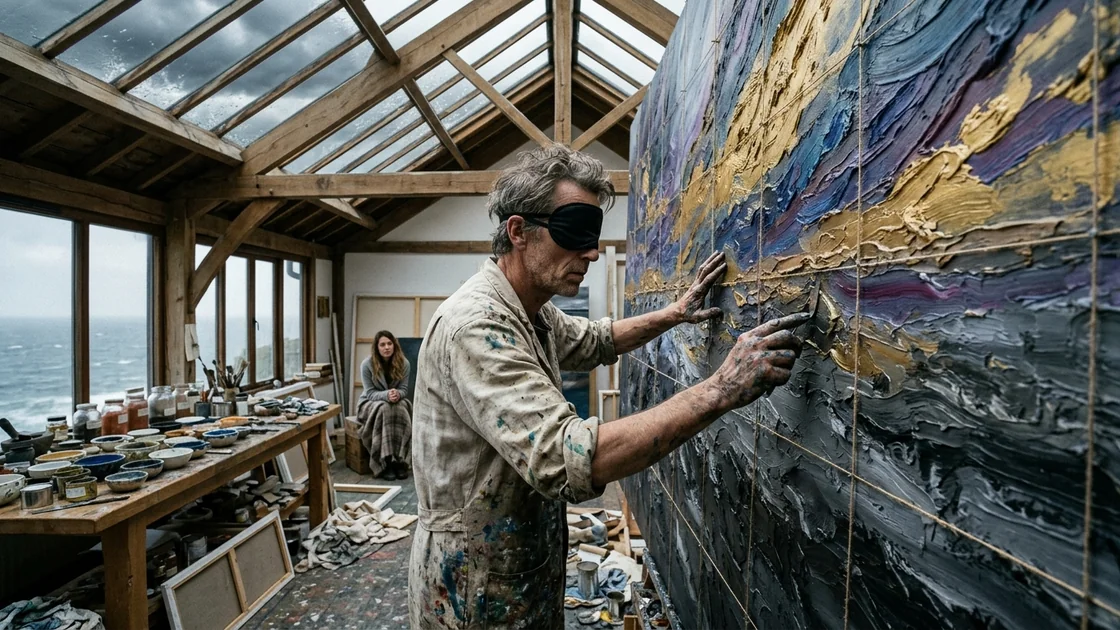
Julian Vance, a renowned contemporary oil painter celebrated for his hyper-saturated landscapes, discovers he is suffering from a rare, rapid-onset retinal degeneration that strips away his ability to perceive color before plunging him into total darkness. As the vibrant world he worshiped decays into a monotonous expanse of indistinguishable grays, Julian experiences devastating psychological and emotional distress, leading him to isolate himself in his cliffside studio while destroying his past masterpieces in fits of rage and grief. The narrative follows his harrowing descent through denial, violent mania, and profound depression as he attempts to paint one final commission by relying on memory, scent, and physical texture, ultimately documenting the death of his vision on a canvas he will never truly see.
The studio on the crags of Clovelly smelled of linseed oil, turpentine, and the sharp, mineral tang of the Atlantic Ocean crashing three hundred feet below. For forty years, this vast, glass-ceilinged room had been Julian Vance’s sanctuary, an altar built to the worship of light. Now, it felt like an observation ward where the patient was slowly being suffocated.
It was a Tuesday in late October when the vermilion died.
Julian was standing before an eight-foot canvas, working on a piece titled Autumnal Pyre. He had loaded his hog-bristle brush with a thick impasto of cadmium red light and genuine vermilion—a pigment he had ground himself from cinnabar imported from China. He loved the weight of it, the toxic, ancient authority of the hue. It was the color of arterial blood, of dying stars, of absolute vitality. He dragged the palette knife across the wet surface, expecting that familiar, visceral shock of warmth against the cool Prussian blue of the underlying wash.
Nothing happened.
The stroke went down, thick and ridges-deep, catching the angled northern light coming through the skylights. The texture was there—the buttery, stiff peaks of the heavy-body oil. The sheen was there. Better yet, the smell was there, metallic and earthy.
The color was gone.
In its place was a muddy, indeterminate ochre, rapidly cooling into the shade of wet cement.
Julian froze, the bone-handled knife poised inches from the linen. His breath hitched, a dry, rattling sound in the cavernous quiet of the studio. He blinked hard, squeezing his eyelids shut until phosphenes danced in the dark, then snapped them open. He leaned in so close the tip of his nose nearly grazed the tacky paint.
"No," he whispered. The word was small, fragile, instantly swallowed by the high timber rafters.
He looked down at his wooden palette. It was a mahogany board he had used for two decades, seasoned with a thousand dried layers of residue. Around the outer rim, he had squeezed out his morning spectrum: titanium white, cadmium yellow pale, yellow ochre, vermilion, alizarin crimson, ultramarine blue, viridian, and burnt umber.
The yellow was still there, though it looked sickly, like tallow or old teeth. The blue remained, stubborn and cold. The white was bright, the umber dark. Keep going, his mind begged. Look at the red.
Where the mounds of vermilion and alizarin crimson sat, there were only two identical piles of sludge. One looked like dark wet ash; the other like slightly lighter wet ash.
A cold sweat broke out across Julian’s collarbone, soaking instantly into the linen of his smock. His heart began to hammer against his ribs, a frantic, trapped bird. He dropped the palette knife—it clattered loudly against the floorboards, smearing a gray-red scar across the pine—and stumbled toward his worktable.
With trembling hands, he knocked over jars of brushes and tins of damar varnish until his fingers closed around a fresh tube of Winsor & Newton Cadmium Scarlet. He unscrewed the cap, his thumb slipping on the ridges, and squeezed violently. A thick worm of paint coiled onto the back of his left hand.
He held his hand up to the skylight, where the noon sun was breaking through the maritime clouds.
Gray. It was the color of a dead mouse. It was the color of a November puddle. It was nothing.
"Elena!" he screamed. His voice cracked, tearing at his vocal cords. "Elena!"
There was no answer. He remembered, with a sickening lurch of his stomach, that his gallery assistant and only consistent tether to the outside world had gone into town to ship crates to London. He was entirely alone on the cliff.
Julian backed away from the table, staring at the smear on his hand as if it were venomous. He wiped it frantically against his chest, leaving a long, dull streak across his smock. His eyes darted around the studio, frantically seeking refuge in the dozens of finished and half-finished canvases leaning against the whitewashed brick walls.
The Gorse at Morwenstow, painted three summers ago. He knew that painting. He had spent six weeks in the blistering wind capturing the violent purple of the heather clashing against the screaming yellow of the gorse and the deep emerald of the sea.
He ran to it, falling to his knees in front of the frame.
The yellow was pale, washed out like linen left too long in the bleach. The blue of the sky was a bruised slate. And the heather—the glorious, royal magenta-violet that critics had called ‘a chromatic violence worthy of Turner’—was gone. The hillside was covered in charcoal dust and slate shingle. The emerald sea had turned the color of dishwater.
Julian let out a sound that was neither a sob nor a scream, a low, guttural keen that vibrated in his chest. He clawed at his face, his fingernails digging into the flesh beneath his eyes, as if he could physically peel away the film that had descended over his corneas.
He knew what this was. He had known for six months, ever since the twilight started coming an hour too early, ever since the shadows in the corners of the room began to writhe with static, like an untuned television set. He had ignored the subtle flattening of the greens in the spring. He had lied to himself when the violets began to look like navy blue in August. He had blamed the cheapness of modern pigments, the angle of the sun, the cataracts of old age—though he was only fifty-four.
He had not gone to London three weeks ago for a gallery opening, as he had told Elena. He had gone to Moorfields Eye Hospital.
The memory of the ophthalmologist’s office was entirely monochromatic in his mind, though at the time, he had still possessed most of his blues and yellows.
Dr. Aris Thorne had been a man of clinical, devastating gentleness. The office had smelled of isopropyl alcohol and expensive coffee. In the dim light, the doctor had clipped a series of glowing scans to the lightbox—cross-sections of Julian’s retinas, mapped in false-color topography that Julian could barely decipher.
"Autoimmune retinopathy," Dr. Thorne had said, his voice dropping like a guillotine. "Specifically, a rapid-onset cone-rod dystrophy triggered by an underlying systemic antibody response we haven't quite isolated yet. Your body, Mr. Vance, has essentially mistaken the photoreceptor cells in your macula for foreign invaders."
Julian had sat in the leather chair, his hands gripping the armrests so tightly the blood left his knuckles. "The cones," Julian had repeated, his voice hollow. Every painter knew the anatomy of the eye; it was the machinery of their soul. "The cones process color. Fine detail."
"Yes," Thorne said softly. "And the rods handle peripheral vision and low light. In your case, the cones are dying first, and at an unprecedented rate. The L-cones—those sensitive to long wavelengths, the reds and oranges—are already seventy percent degraded. The M-cones, handling greens, are following closely. The S-cones, the blues, are usually the most resilient, though they will eventually succumb as well."
"How long?" Julian had asked. He hadn't asked about a cure. He had seen the pity in the doctor's gray eyes; a man does not look at another man like that if there is a pill to be taken or a laser to be deployed.
Thorne had taken off his glasses, rubbing the bridge of his nose. "We can try high-dose systemic corticosteroids. Immunosuppressants. Plasmapheresis to filter the antibodies. We might slow the cascade, Julian. We might buy you months of light perception. Shadows. Shapes. High-contrast black and white."
"I am not a charcoal sketcher," Julian had snarled, the sudden fury making the doctor flinch. "I am not an etcher! I am a colorist! My entire existence is chromatic relationship! What are you telling me? That I’m going to live in a silver-gelatin photograph?"
"Initially," Thorne whispered. "And then, as the rods fail... complete blindness. Within a year. Perhaps less, given the velocity of the L-cone collapse."
Julian had walked out of the hospital into the London rain without picking up the prescriptions. He had stood on the pavement of City Road, watching the red double-decker buses pass by. Even then, they had looked brownish, like dried rust, their luminescence fading into the dreary London smog. He had stood there until he was soaked to the bone, staring at a neon sign in a shop window, trying to burn the wavelength of magenta into his frontal lobe before the machinery of his skull unplugged it forever.
When Elena returned at four o'clock, the studio was a slaughterhouse of pigment.
She pushed open the heavy oak door, carrying a bag of groceries and a stack of mail, calling out cheerfully about the butcher having fresh lamb. The words died on her lips.
Julian was sitting in the center of the floor, surrounded by hundreds of metal tubes. He had taken a heavy framing hammer and systematically smashed every single tube of paint he owned. Flattened lead and aluminum skins lay ruptured like dead insects, their guts oozing out in a massive, toxic puddle across the floorboards. Phthalo blue, quinacridone gold, dioxazine purple, sap green, cadmium red, titanium white—all of it beaten, smeared, and trampled together.
He was covered in it. It was in his graying hair, smeared across his cheeks, caked under his fingernails, and soaked through the knees of his trousers. In his hand, he held a rag soaked in turpentine, which he was scrubbing violently against his own forearms, taking the skin off in raw, weeping patches.
"Julian!" Elena dropped the groceries. Apples rolled across the floorboards, stopping against the levee of ruined oil paint. She ran to him, dropping to her knees, grabbing his wrists to stop him from flaying himself with the solvent. "Julian, stop! My God, what are you doing? Stop it!"
"It’s all mud!" he roared, twisting his arms out of her grip with a strength born of sheer panic. He swung an arm wide, gesturing at the multi-thousand-dollar puddle of French and Dutch pigments surrounding him. "Look at it! They’re selling me dirt! They’re filling the tubes with chalk and lampblack! Look at it, Elena!"
Elena looked at the floor. To her thirty-year-old eyes, the floor was a blinding, nauseatingly vibrant kaleidoscope—a psychedelic riot of screaming reds, electric blues, and acid yellows that hurt to look at directly in the afternoon glare.
She looked back up at Julian’s face. His eyes, usually so sharp, so terrifyingly observant that he could spot a trace of zinc in a titanium white wash from ten feet away, were wide and unfocused. They were darting around the room, staring directly through her, hunting for something that wasn't there.
"Julian," she breathed, the horror dawning on her. She had noticed him knocking over his tea mug last week. She had noticed the strange, muddy passages in the corners of his recent studies, which she had assumed were an experimental tonalist phase. "Julian, look at my coat."
She was wearing her heavy winter coat—a garment Julian had bought her in Milan two years ago because he had fallen in love with its color: a violent, saturated chartreuse that he claimed was the only thing capable of cutting through a Devon fog.
Julian stopped thrashing. His chest heaved. Slowly, he turned his head toward her. His gaze traveled down from her terrified face to the wool of her lapels.
He stared at it for five seconds. Ten.
"Why are you wearing grey?" he asked, his voice dropping to a broken, childlike whimper. "You hate grey. You told me it makes you look like a ghost."
Elena clapped a hand over her mouth to stifle a sob. Tears spilled over her eyelashes, hot and immediate.
Julian saw the movement of her hand. He saw the pale oval of her palm against the dark shadow of her face. He saw the glinting, wet tracks of the tears catching the white light from the window. He did not need to see the chartreuse to read the terror in her posture.
The fight drained out of him all at once, as if a plug had been pulled from the base of his spine. He slumped forward, his forehead striking the floorboards right at the edge of the paint slick. He curled into himself, a fifty-four-year-old giant of the art world reduced to a fetal heap, and began to weep.
It was not a quiet grief. It was the sound of a structure collapsing. He howled into the wood, his fingers digging into the sticky, toxic mess of the ruined paint, pulling it toward himself as if he could absorb the chroma through his skin.
"It's gone," he choked out, inhaling the fumes of linseed and turpentine until he gagged. "Elena, it's gone. The fire is out. Everything is ashes."
The weeks that followed were a masterclass in psychological disintegration.
Elena tried to bring doctors to the house; Julian locked himself in the studio and threatened to throw himself through the cliffside bay window if anyone with a medical degree crossed the threshold. He refused the steroids. When Elena tried to slip them into his soup, he tasted the metallic bitterness instantly, smashed the bowl against the hearth, and didn't eat for three days.
"For what?" he screamed at her from the top of the stairs when she begged him to take the medication. He was holding onto the banister with both hands because the stairs had become a treacherous waterfall of identical grey steps. "To preserve the silhouettes? So I can sit in a chair and tell when the sun comes up because the black turns to charcoal? You want me to live in an X-ray, Elena? That isn't mercy! That's torture!"
The world was shrinking, not in space, but in variance.
By mid-November, the greens had completely surrendered. The rolling hills of Devon outside his bedroom window, famous for their forty shades of emerald, moss, and celadon, had merged into a single, monolithic slab of lead. When the wind blew through the ancient oaks at the edge of his property, the leaves didn't flash from dark viridian to silver-green; they merely flickered like a faulty fluorescent bulb, a binary shift of light value.
The psychological toll of this monochromatic prison was something Julian had never anticipated. He had always thought of color as an aesthetic joy, an intellectual puzzle to be solved on canvas. He had not realized it was the very architecture of his sanity.
Without color, food became repulsive. A rare steak looked like a piece of vulcanized rubber; red wine looked like ink; fresh peas looked like buckshot. His brain, starved of the visual cues that signaled ripeness and nourishment, rejected the meals Elena prepared. Everything tasted of tin and dust. He lost twenty pounds in a month, his clothes hanging off his frame like rags on an armature.
Worse was the loss of time.
A painter measures the day not by a clock, but by the temperature of the light. Dawn is rose and pearl; noon is cerulean and zinc; late afternoon is raw sienna and amber; dusk is violet and indigo.
Now, the day was simply a dimmer switch being turned up and down by an indifferent hand.
Morning arrived as a pale, dirty static. It brightened into a harsh, blinding glare at midday that hurt his dying eyes without offering any warmth, and then it faded back into the static by four o'clock. There was no golden hour. The sunsets over the Atlantic—which Julian had painted five hundred times, chasing the elusive green flash on the horizon, the bruised plums of the storm clouds, the molten copper of the water—were now completely indistinguishable from a heavy fog. The sun was just a white hole punched into a grey blanket, sinking into a grey trough.
He began to suffer from Charles Bonnet syndrome, though he didn't know the name for it.
As his retinas starved for input, his visual cortex began to invent its own. He would be sitting in the dark parlor, listening to the rain, and suddenly the wall would erupt in a terrifying, geometric cascade of hyper-saturated magenta and electric cyan checkerboards.
The first time it happened, he cried out in joy, thinking his vision was returning. He stumbled toward the wall, reaching out to touch the glorious, burning purple squares.
His hands met cold plaster. When he blinked, the magenta turned into the rotting, pixelated face of a gargoyle, screaming silently in neon green before dissolving back into the grey murk of the room.
His brain was haunting him. It was projecting ghosts of the spectrum he had lost, taunting him with phantom pigments that existed only in the misfiring synapses of his occipital lobe. He began to wear a heavy black sleep mask even during the day, terrified of both the grey reality and the neon hallucinations.
In December, Arthur Pendelton arrived from London.
Arthur was Julian’s dealer, a man who wore Savile Row suits like armor and smelled of cedarwood and old money. He had represented Julian for twenty-five years, turning the reclusive painter’s obsession with light into millions of pounds at Sotheby’s and Christie’s.
When Arthur walked into the studio, he stopped dead, his umbrella dripping onto the scarred floorboards.
The studio had been transformed. Every single painting Julian had kept for his personal collection—thirty years of work—had been turned to face the wall. The room was a forest of raw linen backs and pine stretcher bars.
In the center of the room sat Julian, wrapped in a filthy wool blanket despite the roaring fire in the grate. He wasn't wearing the blindfold, because by December, he didn't need it to hide from the colors. Even the blues—the last, stubborn soldiers of the S-cones—had finally bled out a week ago.
The world was now entirely a Daguerreotype, rapidly overexposing at the edges and rotting from the center outward. A dark, fuzzy scotoma—a permanent blind spot like a burn mark on film—sat dead center in his field of vision. To see Arthur at all, Julian had to look three feet to the dealer's left, viewing him through the grainy, low-resolution fog of his peripheral rods.
"Good God, Julian," Arthur said, his cultivated gallery voice cracking. "Elena told me on the phone, I... I didn't believe the extent of it."
"Don't look at me from over there," Julian rasped. His voice was rusty from disuse. "Stand by the window. I need the contrast of the glass behind you, or you're just a smudge in the carpet."
Arthur swallowed hard and moved to the tall lancet window. To Julian, the dealer became a dark, fuzzy cutout pasted against a rectangle of buzzing white snow.
"Have you come to appraise the estate, Arthur?" Julian asked, a bitter, twisted smile touching his dry lips. "The value goes up when the painter dies, doesn't it? What's the market multiple for blindness? Half-dead must be worth a twenty percent bump at least."
"Stop it," Arthur said sharply, recovering his composure. He pulled a stool over, sitting down carefully. "I haven't come to talk about the secondary market. I've come about the Tate commission."
Julian let out a dry, barking laugh that turned into a violent coughing fit. "The Tate! The Turbine Hall piece? Are you insane, Arthur? Did you not hear Elena? I am blind! I am living inside a coal mine!"
"You have six months left on the contract," Arthur said, leaning forward. "They are expecting The Solstice. Twelve feet bytwenty feet. The culmination of the Coastal series."
"Tell them to hang a bedsheet soaked in dirty dishwater!" Julian roared, lunging forward out of his chair. He misjudged the distance to the table, his shin slamming hard into the oak leg. He went down on one knee with a curse, clutching his leg, trembling with humiliation and rage.
Arthur started to rise to help him, then froze as Julian held up a shaking, claw-like hand.
"Touch me and I'll break your neck," Julian hissed from the floor. Slowly, agonizingly, he used the table leg to haul himself back into the chair. He was breathing heavily, sweat beading on his pale forehead. "Cancel the contract, Arthur. Return the advance. Take it out of the vault in Zurich. Tell them Vance is finished."
"I won't," Arthur said quietly.
"Then they'll sue me. Let them."
"It's not about the money, Julian. If you don't paint this, you'll be dead by February." Arthur looked around the room at the turned canvases. "You're already burying yourself alive in here. Look at you. You're fifty-four years old and you're rotting in the dark because your eyes broke."
"My eyes are me!" Julian screamed, slamming his fist onto the table. "Don't give me that romantic, bourgeois bullshit about Beethoven writing the Ninth while deaf! Sound is mathematical! Music is intervals and vibrations—you can write it on paper like an equation! You can feel it through the floorboards! How do you feel cerulean, Arthur? Tell me what the vibration of alizarin crimson is! It doesn't exist! Color is pure light! Without the eye, it is a philosophical concept! It’s nothing!"
"Is it?" Arthur asked. He stood up and walked over to the massive, thirty-foot shelving unit that spanned the western wall.
Unlike the tubes Julian had smashed, this wall held his dry pigments. Hundreds of glass apothecary jars, collected over forty years from every corner of the globe. Lapis lazuli from the mines of Badakhshan; genuine Indian yellow made from the urine of mango-fed cows, illegal for a century; mummy brown; cochineal beetles from Oaxaca; terra verte from Verona; raw umber from Cyprus.
Arthur picked up a jar and brought it back to the table. He unscrewed the heavy glass lid and held it under Julian’s nose.
"What colour is that?" Arthur asked.
Julian jerked his head back, offended. "Get that away from me."
"Smell it, you stubborn bastard."
Julian’s nostrils flared against his will. The scent hit him—a deep, rich, clay-like smell, heavy with iron oxide and manganese, carrying the unmistakable, sun-baked dryness of the eastern Mediterranean.
"Raw Cyprus umber," Julian muttered automatically. "Greenish undertone. Fast drying. Absorbs fifteen percent of its weight in linseed oil."
Arthur set the jar down and walked back to the shelf. He brought another. He took the lid off, dipped his own expensive silk pocket square into the powder, and pressed the cloth into Julian’s hand. "Rub it between your fingers."
Julian hesitated, then his thumb moved over the powder. It was gritty, crystalline, almost like fine sand, refusing to break down into a smooth grease like the clays or the synthetics. It had a sharp, mineral stubbornness.
"Genuine ultramarine," Julian whispered. His thumb kept moving, feeling the microscopic shards of crushed semi-precious stone. "The high-grade Afghan stuff. The Lazurite. Not the French synthetic—the synthetic is too fine, it feels like flour."
"And what does it look like?" Arthur pressed, his voice relentless.
Julian closed his eyes. In the total blackness behind his lids, free from the distracting grey static of the room, his memory flared.
"It looks like the sky at nine thousand feet," Julian said, his voice trembling. "Just after the sun drops below the ridge. It’s so deep it pulls you forward. If you put a dot of cadmium orange next to it, the boundary between them vibrates so hard it makes your teeth ache."
Silence fell over the studio, broken only by the crash of the waves against the cliff below and the crackle of the birch logs in the fireplace.
Julian opened his eyes. The room rushed back in—a horrific, flat wash of dirty silver and black smudges. The jar in his hand was just a dark cylinder. The powder on his thumb looked like chimney soot.
A single tear tracked through the grey stubble on Julian’s cheek. "I can't see the vibration anymore, Arthur. Even if I put them next to each other. I won't know if it's singing or if it's dead."
"You painted for forty years, ten hours a day," Arthur said, placing a hand on the table near Julian’s, though careful not to touch him. "You know the refractive index of every pigment on that wall. You know how much oil it takes to suspend a gram of titanium versus a gram of lead. You know the weight of them on the knife. Paint it from memory, Julian. Paint it for the people who can still see it, even if you can't."
"That's a parlor trick," Julian whispered. "A blind monkey throwing darts."
"Then let it be a tragedy," Arthur said coldly, picking up his umbrella. "Let the Tate hang a twenty-foot failure. Let them see what it looks like when Julian Vance goes into the dark fighting, instead of whimpering in a blanket. The stretcher bars will be delivered on Monday. Elena will stretch the linen."
Arthur walked to the door, paused, and looked back. "For what it’s worth, Julian... when I walked in here, I looked at the floor where you smashed the tubes. Even with a hammer and your boots, the way you tracked the yellow into the violet by the door... I could sell the floorboards for fifty thousand pounds. It’s in your bones. Stop looking with your eyes."
The stretcher arrived on Monday.
It was monstrous. When assembled and bolted together in the center of the studio, the Belgian linen canvas stood twelve feet high and twenty feet wide, dividing the room like a great white sail. To Julian, it looked like a wall of dense fog, fading into the dark vignette of his decaying peripheral vision at the ends, with the black hole of his central scotoma hovering right in the middle of it whenever he looked straight ahead.
For three days, he didn't touch it. He sat in his chair and stared at it with his peripheral vision, drinking scotch until he passed out.
On the fourth night, a winter gale hit Clovelly.
The wind came screaming off the Atlantic at seventy miles an hour, hurling freezing rain and salt spray against the studio glass. The old timber rafters groaned like the hull of a galleon. At two in the morning, Julian woke up on the floor, freezing, his mouth tasting of bile and peat smoke.
He stood up, his joints popping, and stumbled to the bay window. He pressed his forehead against the icy glass.
Outside, the storm was an apocalypse of sound. He could hear the massive rollers slamming into the shale beaches, tearing the cliffs apart grain by grain. Above him, lightning flashed.
Through his dying rods, the lightning was a terrifying, instantaneous inversion of the world. For a millisecond, the black sky turned blindingly white, etching the violent, thrashing silhouettes of the winter trees and the boiling foam of the ocean in stark, high-contrast silver, before plunging back into absolute pitch blackness.
Light, Julian thought, his hands splayed against the vibrating glass. Light isn't just color. It's violence. It's energy.
He turned back toward the studio. Another flash of lightning illuminated the twenty-foot canvas. In the strobing flash, the blank linen looked like an accusation. A tombstone waiting for an inscription.
"Elena!" he bellowed over the roar of the wind.
Five minutes later, Elena appeared at the studio door in her dressing gown, holding a flashlight. She looked exhausted, her face pale and drawn from weeks of nursing a madman.
"Get the string," Julian commanded. He was already stripping off his heavy wool sweater, standing in his undershirt in the freezing room. "Get the carpenter's twine, a box of brass tacks, and the Braille labeler you bought last month that I threw in the bin."
Elena’s eyes widened. "Julian, it’s two in the morning—"
"Do it!" he shouted, his voice ringing with a terrifying, manic electricity she hadn't heard since the summer. "Before I lose my nerve! Move!"
They worked until dawn.
Under Julian’s frantic direction, they turned the studio into a tactile grid. They stretched lengths of twine horizontally and vertically across the back of the stretcher bars and around the edges of the frame, creating a coordinate system—notching the wood every six inches with a chisel so Julian could read the dimensions of the canvas with his left hand while his right hand held the brush.
Then came the table.
They cleared the twelve-foot oak workbench. They threw away every commercial tube of paint that remained. Instead, Julian had Elena bring down twenty-four ceramic bowls.
"We are going back to the Renaissance," Julian muttered, his fingers flying over the table, measuring distances by the span of his hand from the edge of the wood. "No pre-mixed tubes. Every tube feels the same. I need the raw matter."
One by one, Elena brought the jars of dry pigment from the wall. Julian sat at the table with a glass muller and a slab of porphyry stone.
"Start at the top left of the table," Julian ordered, his eyes closed now, refusing to let the grey slush of his remaining sight confuse his hands. "White. Give me the lead white. Not the titanium. Titanium is dead, it’s slick. Lead has teeth. It’s heavy. It smells sweet."
Elena poured the toxic white powder onto the stone. Julian poured cold-pressed linseed oil from a spouted tin, measuring the flow by the sound of the glug and the smell of the flax. He placed the flat bottom of the heavy glass muller onto the pile and began to grind in wide, rhythmic figure-eights.
Scritch. Scritch. Smooth.
He felt the gritty carbonate of lead surrender to the oil, transforming under the pressure of his palms into a stiff, glorious paste that pulled against the stone with a specific, unmistakable suction.
"Bowl one," Julian panted, scraping the paste up with a flexible steel spatula and dropping it into the ceramic dish at the far left corner of the table. "Next. Cadmium Yellow Medium. And bring the cloves."
"Cloves?" Elena asked, bewildered.
"From the kitchen! Essential oil, crushed spices, I don't care! Some of the cadmiums feel identical under the muller—their particle size is too uniform! If I can't tell the yellow from the red by the grit, I have to smell them!"
It was a stroke of desperate genius. Over the next six hours, as the storm raged outside, they built a sensory keyboard of color.
Into the Cadmium Yellow, Julian mixed three drops of lemon oil. When he dipped his brush into it, the sharp, acidic citrus hit his nose instantly—a bright, high-frequency scent that matched the high-frequency wavelength of yellow.
Into the Vermilion and Cadmium Red, he mixed oil of cinnamon and crushed clove—hot, burning, aggressive scents that made his sinuses sting with warmth.
For the Alizarin Crimson—a cold, deep, blood-red lake pigment—he used a drop of iron-rich beef broth concentrate and rosewater, giving it a floral, metallic decay.
For the Greens—Viridian and Terre Verte—he had Elena crush pine needles and mint leaves into the linseed oil before straining it.
For the Blues—Ultramarine and Prussian—he used lavender and eucalyptus, cool, mentholated aromas that opened the lungs like high altitude air.
For the Earth tones—the Umbers, Siennas, and Ochres—he needed nothing; they smelled fiercely of the dirt and roasted bones from which they were dug.
And for Ivory Black, at the far right end of the table, he mixed in cold wood ash from the fireplace.
By ten o'clock the next morning, Julian stood before the twenty-foot canvas. His hands were blistered from the muller. His back was locked in a spasm. His eyes were hidden behind the heavy black silk sleep mask; he had realized at dawn that the shifting, hallucinated neon ghosts and the creeping grey blind spot were actively destroying his spatial orientation. If he was going to be blind, he needed absolute darkness so the eye of his mind could open without interference.
"Describe the light outside," Julian said softly to Elena, who was sitting on a crate behind him, wrapped in blankets, watching him with an expression of awe and heartbreak.
"The storm broke about an hour ago," she said, her voice trembling slightly. "The clouds are still heavy at the top—dark, bruised purple—but there's a tear right at the horizon over Lundy Island."
"What color is the tear?"
"It’s... it’s pale gold, Julian. Almost white-gold. And the water underneath it isn't blue today. It’s churned up with sand and kelp. It’s a deep, murky olive green, with whitecaps that are catching the gold from the sky."
Julian stood in the pitch blackness of his mask. He breathed in.
He didn't see grey anymore. In the dark, listening to her voice, he saw it. He saw the Naples yellow light slicing like a scalpel through a wash of dioxazine purple and Payne's grey. He saw the raw umber and viridian of the churning water.
He walked forward until his left hand found the notched pine of the stretcher bar—six feet up, dead center. He reached back with his right hand, counting the bowls on the table by touch.
One. Two. Three. Four.
He dipped a four-inch housepainter’s brush into Bowl Four. The scent of lavender and crushed lapis lazuli rose into the cold air. He walked back to the canvas, found his coordinate with his left thumb, and slammed the brush against the raw linen.
The bristles dragged across the weave with a loud, rasping hiss.
Julian Vance was painting again.
The process was a grueling, physical war that lasted forty days.
Without sight to offer instant feedback, Julian had to slow his process down to an excruciatingly deliberate pace, or else work in bursts of terrifying, blind muscle memory.
He mapped the composition using thick impasto ridges as topographical landmarks. He laid down the horizon line first—not with charcoal, which he couldn't feel, but with a thick bead of fast-drying alkyd white mixed with marble dust, applied with a cake-decorating piping bag. Once it dried overnight, he had a permanent, raised braille scar running twenty feet across the canvas. Above the ridge was the sky; below it was the sea.
He abandoned brushes almost entirely by the second week. A brush was a stick that held him two feet away from the work; in the dark, two feet was an unbridgeable chasm.
He used palette knives, and then, increasingly, his bare hands.
Wearing thin nitrile gloves—and often tearing them off in frustration when they dulled his tactile sensitivity, despite Elena’s frantic warnings about the lead white and cadmium toxins—Julian sculpted the sea.
He could feel the temperature of the paint. The earth tones and lead whites, heavy with metal and clay, felt physically colder and denser to his fingertips than the organic, synthetic lakes like alizarin or phthalo, which felt greasy, light, and warm. He knew how they mixed by the viscosity. When he dragged a handful of clove-scented cadmium red into a wet passage of eucalyptus-scented ultramarine to make a storm-cloud violet, he could feel the gritty lapis crystals catching against the slick, heavy cadmium particles.
He was painting by friction, by weight, by olfactory symphony.
The studio smelled like a bizarre, intoxicating temple—a mixture of turpentine, cinnamon, pine, lavender, wet dirt, and rotting roses.
Yet, the emotional distress did not vanish; it merely changed its shape, sharpening from a dull despair into an agonizing, razor-edged paranoia.
Because he could not see the canvas, Julian lived in a state of perpetual terror that what existed in his mind was a delusion, and what existed on the linen was an infantile smear of mud.
Every evening, when exhaustion forced him to stop, he would rip off the black silk mask and try to look at the canvas with the dregs of his vision.
It was always a mistake.
The disease was accelerating, just as Dr. Thorne had promised. By late January, his central scotoma had expanded until it covered eighty percent of his field of view. It wasn't black; it was a boiling, static-filled grey void, like looking through frosted glass into a room filled with smoke. Only at the very extreme edges of his vision—if he turned his head sideways and rolled his eyes toward his ears—could he catch a glimpse of light and dark values.
He would stand there, twisting his neck at grotesque angles, trying to catch the twenty-foot painting in the dying slivers of his peripheral rods.
All he saw were dark, jagged crusts of matter that looked like scabs on a wall. He couldn't tell the gold tear in the sky from the purple clouds because their tonal values—their relative lightness and darkness—were too close together. In black and white, a brilliant mid-tone red and a brilliant mid-tone green are the exact same shade of grey.
"It’s flat!" he would scream on the bad nights, dropping to his knees, clutching his hair with paint-caked hands. "Elena, where are you? Tell me the truth! You’re lying to me! I’ve mixed them too much! I’ve made grey! The whole thing is grey, isn't it?!"
Elena would come into the studio, her heart breaking anew every time.
To her eyes, the canvas was terrifying. It was nothing like Julian’s earlier work—those polite, exquisitely controlled Turneresque glazes that hung in the drawing rooms of billionaires.
This painting was feral.
Because he couldn't see his edges, the colors collided with violent, unblended brutality. The impasto was an inch thick in places, gouged by his fingernails, scraped down to the raw linen with butcher knives, and then piled high again with raw, unmixed pigment straight from the mulling stone. Where he had tried to paint the golden tear in the sky, he had accidentally dragged a streak of pure, unmixed phthalo green through the center of the lemon-scented yellow. In his sighted life, he would have corrected it instantly. Left alone, the accidental green slash made the gold look blinding, radioactive, as if the sky were literally splitting open to reveal another dimension.
"It's not grey, Julian," she would say, stepping carefully over the twine guides on the floor to hold his shaking shoulders. "I swear to you on my life. The red in the lower right corner—it's so bright it looks like the canvas is bleeding."
"Don't patronize me!" he wept, shoving her away, stumbling backward until he tripped over a bucket of water, crashing onto his back in the freezing puddle. He lay there, staring up at the dark rafters he could no longer see, shivering violently. "You're humoring the blind man! You and Arthur! You're letting me smear shit on a wall so I don't slit my wrists!"
"If you want to know what it looks like, touch it," she said fiercely, her own patience snapping under the weight of his misery. She grabbed his hand and dragged him back to the canvas, forcing his palm against the lower right quadrant. "Feel the ridges! You put the lead white down three days ago—it’s dry! You only put the clove-red over the top of the ridges today! You didn't mix them into mud, Julian, you scumbled it! You know the physics of a scumble! The white is shining through the red from underneath!"
Julian froze, his wet clothes clinging to his ribs. His fingertips traced the rock-hard peaks of the lead white, feeling the slick, fresh grease of the clove-scented vermilion sitting only in the valleys and clinging thinly to the crests.
His mind calculated the optics instantly. Light penetrates a translucent layer of red, strikes the opaque white beneath, and bounces back through the red like light through stained glass.
It had to be luminous. The laws of physics demanded it. Light did not stop obeying the laws of refraction just because Julian Vance couldn't witness it.
He let out a long, shuddering breath, leaning his forehead against the dry patch of the canvas near the top. "I want to see it, Elena," he whispered, his voice breaking into a tiny, hollowed-out thing. "Just for five seconds. God, I'd give my lungs just to step back ten feet and see it for five seconds. I don't know if it's my masterpiece or a joke."
"You'll never know," she said softly, the cruelest and kindest truth she had left to offer. "You have to trust the physics. And you have to trust me."
In the second week of February, the rods died.
It didn't happen with the sudden shock of the vermilion in October. It was a slow, suffocating tide that simply refused to go back out.
One morning, Julian woke up, took off his sleep mask, and walked to the window to check if the sun had risen, using the tiny, crescent-shaped sliver of light perception he still had in the far outer corner of his left eye.
He stood at the glass. He heard the seagulls crying outside. He felt the faint, radiant warmth of the winter sun hitting the glass and warming the skin of his cheek.
The crescent didn't light up.
He turned his head left. Right. Up. Down. He waved his hand an inch from his eyeball.
There was no shadow. Even the grey static—the hated, monotonous, suffocating fog of monochrome that he had cursed for four months—was gone.
In its place was a profound, velvety nothingness. It wasn't even black, Julian realized with a strange, detached horror. Black was a color. Black was ivory bone charred in a kiln; black had depth, it had blue or brown undertones, it absorbed light.
This was the absence of the receptor itself. It was the visual equivalent of trying to see out of the back of one's elbow. There was simply no data arriving at the brain.
He stood by the window for an hour. He didn't scream this time. He didn't break anything. The grief had reached a depth so absolute that it had become geological, a crushing atmospheric pressure at the bottom of a trench where nothing could move.
When Elena came up with his tea, she found him sitting calmly at the worktable, his hands resting palm-down on the wood between the bowls of scented paint. His eyes were open, staring straight ahead at the brick wall, completely still.
A sighted person’s eyes are always moving, making microscopic saccades to build an image of the world. Julian’s eyes had stopped moving. They were fixed, glassy marbles, extraordinarily blue in the morning light, reflecting a room they no longer recorded.
Elena stopped in the doorway. She didn't need to ask. The stillness of his pupils told her everything.
She set the tray down gently, the china clinking softly, and walked over to him. She placed her hand over his.
"The lights went out, Elena," Julian said. His voice was terrifyingly calm.
"I know," she whispered.
"It’s strange," he murmured, turning his blind face toward the window. "For four months, I prayed for the grey to stop. I hated the grey more than anything. Now... what I wouldn't give for a single square inch of dirty dishwater."
He sat in silence for a long time. Down below, the Atlantic boomed against the rocks. In the studio, the smell of clove, lemon, lavender, and linseed oil hung heavy and rich in the cold air.
Slowly, Julian pulled his hand from beneath hers. He reached out across the table, his fingers brushing the rim of Bowl One, then Bowl Two, then Bowl Three, checking their levels.
"The sky isn't finished," Julian said. "The upper left quadrant. Near the frame. It’s too heavy. The lavender ultramarine needs to be cut back, or the whole painting will tip to the left."
Elena wiped her eyes with the back of her sleeve and stood up straight. "What do you need?"
"Grind me a half-pound of zinc white," Julian said, standing up and reaching for his smock. "And bring the peppermint oil. We need a glaze of viridian over the water before the white dries, or the horizon won't recede."
On the first of March, two days before the transport lorries from the Tate were scheduled to arrive with their climate-controlled crates, Julian declared the painting finished.
He had worked the final three weeks in total, irreversible blindness. It had been the most terrifying period of his life, and yet, in the final days, a strange, brutal clarity had descended upon him.
Without the grey static of his dying vision to distract him, his memory of color had become absolute, tyrannical, and pristine. In the dark theater of his skull, the cadmium reds burned with a purity they had never possessed on earth; the ultramarines were deeper than the Mariana Trench. He was no longer painting what he saw on the coast of Devon; he was painting the Platonic ideal of light itself, translating the blazing hallucinations of his starving visual cortex directly through the nerves of his arms and into the cold grease of the pigments.
On that final afternoon, he stood in the center of the studio, six feet back from the canvas. His hands were raw, scarred with dried crusts of lead and oil that would take weeks to slough off. He was gaunt, his beard long and tangled with streaks of dried yellow ochre and titanium white, looking like an Old Testament prophet who had wrestled an angel in a clay pit.
The door opened, and Arthur Pendelton walked in.
Julian heard the sharp intake of the dealer’s breath. He heard the distinct clack of Arthur’s umbrella slipping from his fingers and hitting the floorboards.
Arthur didn't pick it up. His footsteps moved slowly, hesitantly, into the center of the room, stopping beside Julian.
For three minutes, neither man spoke.
Julian stood in his eternal midnight, his heart hammering against his ribs, suddenly seized by the old, familiar terror. Now came the verdict. Elena loved him; Elena could have lied to save his life. Arthur loved Julian too, in his way, but Arthur loved art more. Arthur could not lie about a canvas.
"Well?" Julian rasped, his hands clenching into fists at his sides. "Say it, Arthur. Is it a mess? Did I make mud?"
Arthur didn't answer right away. When he finally spoke, his voice was thick, choked with an emotion Julian had never heard from the urbane Londoner in twenty-five years.
"My God, Julian," Arthur whispered.
"Tell me what you see!" Julian demanded, turning blindly toward the sound of the man's voice, reaching out to grab Arthur’s cashmere lapel. "Don't give me adjectives! Give me the mechanics! Did the green slash in the sky ruin the gold? Did the violet in the lower left turn to brown when I pushed the sienna into it?"
Arthur reached up, placing his warm, manicured hands over Julian’s scarred, paint-crusted knuckles.
"Nothing turned to brown," Arthur said, his voice trembling as his eyes swept across the twenty-foot leviathan towering over them. "Julian... the colors aren't blended. You laid them down like bricks of pure light. From two feet away, it looks like a quarry explosion—it’s violent, it’s three inches thick, there’s twine and your own hair stuck in the impasto."
Julian flinched, trying to pull his hands back. "Then it's a ruin—"
"Step back twenty feet," Arthur interrupted fiercely, holding Julian’s hands fast, "and the optical mixing takes over. Because you didn't blend them on the palette, the eye has to blend them in the air. Julian... it vibrates. The gold in the center—I’ve never seen yellow paint do that. You put raw dioxazine purple and viridian right against the edges of the lemon yellow. It’s so bright I literally had to squint when I walked through the door. It looks like there’s a halogen lamp behind the linen."
Julian stood frozen, his chest heaving. In the dark, he tried to construct the image from Arthur’s words, mapping the verbal description onto the tactile memory of the ridges he had sculpted with his bare hands.
"And the water?" Julian whispered. "The bottom third?"
"It’s terrifying," Arthur said softly. "It starts in this blinding, churning emerald and turquoise at the horizon, and as it comes down toward the bottom of the frame... you stopped using the scented paints at the bottom, didn't you?"
Julian swallowed hard. "Yes. Last week. I... I mixed the bottom edge using the ash and the bone black and the lead white. I wanted... I needed them to see what was coming up from the floor."
"It looks like the ocean is being swallowed by an eclipse," Arthur murmured, staring at the bottom two feet of the canvas, where the riotous, screaming symphony of color suddenly fractured, desaturated, and bled downward into a heavy, suffocating, monolithic wall of dead, featureless grey, before ending in a razor-sharp band of absolute, light-swallowing black along the bottom stretcher bar.
It was not just a landscape of the solstice. It was a self-portrait of a dying eye. At the top, the sky was tearing open in a violent, desperate ecstasy of remembered color; at the bottom, the void was rising to consume it.
"They'll talk about it for a hundred years, Julian," Arthur said, a tear finally spilling over the dealer's lower lid as he looked from the blazing, chaotic triumph on the wall to the broken, blind man standing in front of it. "Turner never painted anything this brave."
Julian slowly released Arthur’s coat. He turned back toward the canvas.
He couldn't see the halogen gold. He couldn't see the vibrating purple or the bleeding red or the rising tide of ash. Before him, there was only the quiet, endless nothingness that would be his companion for the rest of his days. The grief rose in his throat again, sharp and bitter as turpentine—the unbearable unfairness that every stranger walking into the Tate Modern would receive the gift of the light he had bled to create, while he stood locked outside the gates in the cold.
He stepped forward until his knees brushed the bottom edge of the frame.
Slowly, he raised his right hand and pressed his bare palm flat against the center of the canvas, right over the spot where he knew the golden tear in the storm clouds lay.
The linseed oil was still tacky on the surface, skinning over as it oxidized, warming slightly beneath the heat of his flesh. He closed his fingers, feeling the sharp, jagged mountains of the lead white, the gritty valleys of the crushed lapis lazuli, and the faint, ghosts of lemon and clove rising from the drying fat of the oil.
He could not see the light. He would never see it again.
Yet as he stood there in the dark, feeling the architecture of the spectrum beneath his calloused skin, the panic finally began to recede, replaced by a cold, quiet, and monumental peace. The fire was out in his eyes, yes. The world had turned to ash, and then to nothing at all.
Before the dark had taken him, he had reached into his own skull, pulled out the dying sun, and nailed it to the wall.
The months that followed the departure of The Solstice were defined by a profound, echoing emptiness that threatened to finish what the disease had started.
When the Tate’s art handlers had come to Clovelly in early March, it had taken six men to maneuver the twenty-foot stretcher out through the double barn doors of the studio and down the winding gravel path to the waiting climate-controlled lorry. Julian had stayed in his bedroom on the second floor, sitting in an armchair with his hands gripped around the wooden knobs, listening to the crunch of their boots on the shingle and the hydraulic hiss of the tailgate lifting his final breath of light into the dark belly of the truck.
When the engine rumbled away down the coast road, the silence that rushed back into the cliffside house was absolute.
For forty years, Julian’s life had been structured around the next canvas. Even in rest, his mind had been hunting—calculating how to capture the particular cerulean translucence of a breaking wave, or how to mix the exact, sickly lilac of a dying hydrangea on the mantelpiece.
Now, the studio was empty. There was no next canvas.
The second phase of his psychological distress began then, and in many ways, it was more insidious than the violent mania of the winter. During the winter, he had had an enemy to fight: the creeping grey, the deadline, the physical resistance of thetwenty-foot linen.
In the spring, there was nothing left to fight. There was only the permanence of the void.
Memory, Julian discovered to his absolute horror, was not a permanent archive; it was a wet painting left out in the rain.
In March, when he sat in the dark and thought of Cadmium Yellow, his mind still produced a sharp, blinding flash of sunny warmth. By late April, when he tried to summon the same color, it took him ten seconds of straining before the sensation arrived, and when it did, it felt muddy, indistinct, confused with ochre or Naples yellow.
He was losing the memory of color.
The brain is a ruthless pragmatist; when the visual cortex receives no input from the optic nerve for months on end, the neural pathways begin to repurpose themselves, handing over the real estate of sight to the senses of hearing and touch. Julian could now hear Elena’s footsteps on the gravel path three hundred yards away; he could tell by the draft on his cheek whether the kitchen door downstairs was ajar by an inch or a foot.
He hated these new abilities. Every new subtlety he detected in the sound of the wind felt like a thief that had broken into his skull and stolen a shade of violet to make room for an echo.
He became obsessed with cataloging.
He forced Elena to sit with him for hours every afternoon with a notebook, dictating frantic, hyper-detailed descriptions of colors, trying to trap them in the amber of language before they evaporated from his mind.
"Write this down," he would command, pacing the length of the parlor, guided by the edge of the Persian rug beneath his bare feet—a rug he knew was predominantly madder lake and indigo, though he could no longer quite picture how the two interacted at the border. "Cerulean Blue. Chromium-tin-stannate. Opaque. Granulating. It is the color of a thrush's egg, but colder. No, cross out the egg—eggs have too much green in them. It’s the color of zinc roofs in Paris after the rain stops at noon, when the sun isn't quite out. Does that make sense, Elena? Read it back to me! Does that sound like blue?!"
"It sounds like blue, Julian," Elena said softly, her pen scratching across the paper.
"It doesn't!" he shouted, stopping dead, his blind eyes wide and agonized. "Words are useless! Zinc roofs in Paris! What does that mean to a man who can't remember what zinc looks like? Read me the entry on Viridian from Tuesday!"
Elena flipped back through the pages. "Viridian: Hydrous chromium oxide. Transparent. Cool. The color of deep sea water over white sand in the Hebrides; the shadow side of a holly leaf in frost; the smell of crushed mint."
Julian pressed the heels of his hands against his temples, groaning as if his skull were splitting. "I can smell the mint. I can feel the cold water. I can't see the green, Elena! When you say the word, my head is just... dark! Where did it go? Where did I put it?!"
He began to suffer from severe panic attacks triggered by the realization of his own amnesia. He would wake up at three in the morning, sweating through his sheets, because he had dreamed in sound and touch alone—a dream where he was walking through his childhood garden in Somerset, feeling the velvet petals of his mother’s roses, and realizing that even in his dreams, the roses had no hue. They were just soft, fragrant shapes floating in an acoustic space.
One afternoon in May, the distress reached its zenith.
Elena had left him on the terrace in the sun while she went inside to answer a telephone call from the Tate regarding the lighting rig for the upcoming exhibition.
It was a glorious spring day. Julian could feel the sun baking the flagstones beneath his chair. He could smell the gorse blooming wildly on the cliffs below—that thick, heavy, coconut-like scent that always accompanied the explosion of yellow flowers across the Devon headlands. He could hear the bees droning through the lavender bushes beside the terrace wall.
He reached out his hand and touched a cluster of lavender. He crushed a flower between his thumb and forefinger, inhaling the sharp, camphorous oil.
He tried to see the purple.
He squeezed his eyes shut, clenching his jaw until his molars ground together, summoning every ounce of his forty years of training. Ultramarine plus Alizarin Crimson plus a touch of Titanium White, he recited in his mind. Wavelength four hundred nanometers. High frequency. Short wave.
Nothing.
His mind presented him with the texture of the crushed plant. It presented him with the scent of the oil. It presented him with the mathematical formula of the pigment mixture. The visual sensation—the actual qualia of lavender—was gone. It was as dead and unreachable as a language spoken by a civilization wiped out ten thousand years ago.
A terrifying claustrophobia seized him. He felt as though he had been buried alive inside a lead coffin the exact size of his own skin. The warmth of the sun on his face suddenly felt like mockery—radiation without illumination, heat without fire.
He stood up, knocking his chair backward onto the flagstones.
He didn't reach for his cane. He didn't want the cane. He wanted out of the coffin.
He turned toward the sound of the surf crashing three hundred feet below. The low-tide waves were booming against the black shale boulders at the base of the cliff, a steady, rhythmic roar that had been the bassline of his entire adult life.
He knew the geography of the terrace intimately. Ten paces from the house was the low stone parapet, only waist-high, built in the eighteenth century before anyone cared about safety regulations. Beyond the parapet was five feet of sloping turf covered in sea thrift, and beyond that, nothing but three hundred feet of Atlantic air and the grey rocks below.
At least at the bottom, a cold, seductive voice whispered in the back of his dark mind, the darkness will make sense. Dead men aren't supposed to see.
He took a step forward. Then another.
Without his cane, moving at a brisk walk into the black, the adrenaline surged through his veins, weirdly exhilarating. Six paces. Seven. Eight. The wind came up over the lip of the cliff, striking his chest, smelling of kelp and salt and absolute freedom.
On the ninth pace, his shins struck the rough granite of the parapet.
The momentum carried his torso forward over the wall. His hands shot out instinctively, grabbing the jagged lichen-crusted stones of the top course. Beneath his chest, he felt the emptiness—the massive, updrafting column of wind rising from the abyss below.
He leaned over the wall. In the darkness of his blindness, the sensation of height was dizzyingly amplified; without a horizon to anchor his inner ear, he felt as though he were already falling, suspended in a howling vortex of wind and gull-cries.
All he had to do was push with his toes. Three seconds of wind, and the torture of trying to remember the color of a rose would be over.
He lifted his right foot from the flagstone.
As his weight shifted onto his palms, his right hand slid three inches across the top of the granite wall, crushing a patch of wild sea thrift that was growing out of the mortar crack.
The tiny, papery flower heads broke beneath his calloused palm. Simultaneously, his fingers scraped across something else—an old, dried crust of oil paint on the stone.
Julian froze, one foot in the air, balanced on his hip bone over the three-hundred-foot drop.
His fingers moved frantically over the stone. He knew what that crust was. Five years ago, he had propped a small pochade box on this exact spot of the wall to paint a study of a summer squall. He had wiped his palette knife clean on the granite before going inside for dinner.
Over five years of winter storms, the oil paint had polymerized into something harder than bone, fused permanently into the pores of the Cornish granite.
His thumb traced the fossilized ridge of the knife-wipe. It was a crescent shape, sharp at the edges, smooth in the center. He remembered the day. He remembered his wife, Clara—dead three years now of ovarian cancer—bringing him a glass of iced gin while he wiped that knife. She had been wearing a yellow sundress. She had laughed because he had gotten Prussian blue on the tip of his nose.
He couldn't see the yellow of her dress anymore. He couldn't see the Prussian blue on the stone beneath his thumb.
Yet as his fingers held onto that five-year-old scar of dried linseed oil on the edge of the abyss, a fierce, violent revulsion against his own surrender rose up from his gut.
The paint was still there. The storm hadn't washed it off the rock. The sea hadn't claimed it.
He dropped his foot back onto the flagstones. With a ragged sob, he threw his weight backward, collapsing onto his spine on the sun-warmed stones of the terrace, his chest heaving, his hands bleeding where the barnacles and sharp lichen of the parapet had torn his palms.
When Elena ran out of the house ten seconds later, dropping the cordless phone when she saw him lying at the base of the wall, Julian was holding his bleeding hands against his chest, laughing and crying at the same time in the blinding, invisible sun.
The exhibition at the Tate Modern opened on the twenty-first of June—the summer solstice.
Julian almost didn't go. The thought of traveling to London, of navigating the chaotic, roaring acoustic nightmare of Paddington Station and the subterranean echoes of the city without sight, terrified him. More than that, the thought of standing in a room full of sighted people—critics, collectors, rivals, strangers—all feasting on a banquet of color while he stood in the corner with a white cane like a beggar at the feast, seemed like an exercise in masochism he could not survive.
It was Arthur who convinced him, not with flattery, but with a simple logistic reality.
"They've given it a room to itself, Julian," Arthur had said over the phone two days before the opening. "A chapel off the main turbine hall. There are no other paintings. Just the twenty-footer, lit by a custom tungsten-halogen array, and a bench in the center. If you come at nine in the morning before the press view at ten, there won't be anyone there. You won't have to hear them talk about it."
"Why would I go to an empty room to stand in front of a painting I can't see?" Julian had asked into the receiver.
"Because you haven't been further than twenty feet from that canvas since you stretched it," Arthur replied quietly. "In your studio, you were trapped against it. Come and feel the size of the room they built around it."
So, at nine o'clock on the longest day of the year, Julian Vance walked into the Tate Modern.
He wore a dark charcoal suit that Elena had brushed meticulously for him at their hotel in Bloomsbury. In his right hand, he held a long, folding graphite cane; his left hand rested lightly in the crook of Elena’s elbow.
The acoustic shift as they entered the museum was breathtaking. Outside, the South Bank had been a cacophony of boat engines on the Thames, shouting tourists, and the gritty wind blowing off the water. Inside, the sound expanded instantly into a vast, cathedral-like hush. The ventilation system hummed a low B-flat; their footsteps clicked with sharp, hollow authority against polished concrete floors that seemed to stretch for miles into the dark.
They took the freight elevator up to the fourth floor, stepped out into a carpeted corridor, and then passed through a set of heavy glass doors.
The room changed again.
Julian stopped, pulling his hand gently from Elena’s arm. "Leave me here for a ten minutes, Elena," he said softly. "Wait by the door."
"Are you sure?" she whispered.
"Yes. There are no stairs in here, are there?"
"No. Just the bench twenty feet straight ahead of you, and the painting ten feet beyond that."
She stepped back, the soft rustle of her silk dress fading toward the doorway.
Julian stood alone. He folded his cane and slipped it into the deep pocket of his overcoat. He didn't want to tap his way toward his own soul like a stranger.
Slowly, he walked forward, counting his paces. The floorboards here were wide oak planks, slightly springy underfoot. The air in the room was cool, precisely climate-controlled at twenty degrees Celsius and fifty percent relative humidity.
Yet, as he reached the twelfth pace, he smelled it.
Even in this sterile, cavernous museum gallery in the heart of London, forty miles from the sea and four months after the last brushstroke had been laid down, the twenty-foot canvas was still breathing.
Because he had laid the impasto on three inches thick in places, the underlying layers of linseed oil were still polymerizing—a chemical process that would take decades to fully complete. Floating out into the pristine air of the Tate was a faint, unmistakable ghost of a scent: the sharp, metallic tang of drying flax oil, underscored by the phantom traces of clove, dried lavender, crushed pine, and wood ash.
His knees touched the leather padding of the museum bench. He didn't sit down. He stepped around it, taking eight more slow paces forward until he felt the radiant heat of the gallery spotlights reflecting off the massive wall of matter directly in front of him.
He was standing two feet from the center of The Solstice.
He raised his hands, holding them three inches away from the surface, careful not to trigger the infrared proximity alarms the curators had undoubtedly installed—alarms that would shrill if even the man who made it dared to touch the twenty-million-pound asset it had become.
He didn't need to touch it. He could feel the micro-climate of the canvas against his palms. The dark passages at the bottom, loaded with carbon black and umber, absorbed the heat of the halogen ceiling lights, radiating a distinct, noticeable warmth against the skin of his lower legs and waist. The center of the canvas—where the massive, slashing tear of lead white and lemon-scented cadmium yellow broke through the storm clouds—reflected the light back into the room, feeling distinctly cooler against his raised hands.
He tilted his head back, his blind, immobile blue eyes staring straight into the heart of the painted sun.
Behind him, the glass doors hissed open. It was ten o'clock.
Julian stiffened, his instinct telling him to flee back to Elena before the vultures arrived. Before he could turn, a dozen pairs of footsteps entered the room—the early vanguard of the press view, art critics from The Guardian, The Times, Artforum, curators from New York and Paris.
They came in talking—the low, cynical murmur of professionals who went to five openings a week and drank warm white wine for a living.
Then, four paces inside the door, the murmur died.
Julian stood completely still near the left edge of the frame, listening with the hyper-acute ears of the blind.
He heard a woman intake her breath sharply, a sound almost like pain. He heard the rustle of a press packet dropping against someone's thigh. A man cleared his throat, started to whisper something to his companion, and then trailed off into silence.
For two full minutes, twelve people stood in the doorway and said nothing at all.
Julian turned his head slightly toward them. He couldn't see their faces. He couldn't see the way the blinding, radioactive yellow light from his twenty-foot sky was reflecting in their wide eyes, or the way the violent, unblended slabs of crimson and ultramarine were forcing their pupils to dilate and contract as they tried to process the sheer physical violence of the chroma.
He didn't need to see them. He could hear the silence.
A painter knows that silence. You cannot fake that silence. People talk in front of clever paintings; they whisper in front of expensive paintings; they take notes in front of historical paintings. They only go completely, devoutly silent when they are standing in front of an altar that is actively burning.
"Look at the way the green cuts the yellow in the center," a young woman’s voice whispered from near the bench, trembling with an awe she wasn't even trying to hide behind critical jargon. "It hurts to look at it. How did he see a color like that?"
Julian stood in the absolute, unbroken darkness of his skull. A small, quiet smile touched the corners of his mouth.
He reached into his pocket, unfolded his white cane with a sharp, metallic snap-clack-clack that echoed loudly through the hushed gallery, and turned away from the wall.
As the critics parted in stunned silence to let him pass, Julian Vance walked toward the sound of Elena’s breathing by the door, stepping out of the chapel of light he had built for the world, and into the quiet dark that belonged only to him.
By the time autumn returned to Clovelly, the house on the cliffs had undergone a slow, deliberate metamorphosis.
The agony of the spring had not entirely vanished—grief for a lost sense, Julian had come to understand, was not a fever that broke and left you immune, nor was it a linear journey toward some neat, inspirational acceptance. It was a chronic condition, like an amputated limb that still ached violently whenever the barometric pressure dropped before an Atlantic gale. There were still mornings when he woke up and, for three glorious, half-conscious seconds before his brain fully booted up, expected to see the pale square of the bedroom window glowing through his eyelids. When the realization hit him anew that the eyelids were open and the room was black, the old suffocation would briefly clamp its hands around his throat.
Yet the terror had subsided. The frantic, bleeding-knuckled clawing at the walls of his own skull had stopped.
He had stopped asking Elena to read the notebooks of color descriptions. In July, he had told her to put the notebooks in a drawer and lock it. He had realized that trying to use words to preserve the visual sensation of vermilion was like trying to use a fishing net to catch the wind; the effort only exhausted the fisherman and proved the emptiness of the net. If the memories of the wavelengths were fading from his visual cortex, he had to let them go with grace, trusting that they had already been spent where they mattered.
Instead of fighting the rewiring of his brain, he finally surrendered to it.
He returned to the studio in late September, though it was no longer a painter’s studio. Elena and a pair of local village carpenters had spent two weeks stripping the room of its hazards and its ghosts. The hundreds of jars of dry pigment—the toxic leads, the silent cadmiums, the mute lapis lazuli—had been crated up and donated to the Royal Academy Schools in London, where young painters with functioning cones could grind them into light.
The twenty-foot painting table was scrubbed down with lye and sanded raw until the smell of linseed oil and clove was finally replaced by the clean, resinous scent of bare oak and beeswax.
In the center of the room, where the great easels had stood for four decades, sat a heavy steel armature bolted to a rotating wooden plinth. Around the base of the plinth lay five hundredweight of raw, wet grey stoneware clay dug from the riverbeds near Bideford, wrapped in damp burlap sacks.
Julian stood at the plinth in the cool October morning. He was wearing his old linen smock, though the sleeves were rolled up past his elbows. His hands—once so obsessed with the microscopic grit of pigment particles—were buried wrist-deep in the cold, heavy mud.
He was not sculpting faces or figures; he had never cared for human anatomy when he had eyes, and he cared less for it now. He was sculpting the cliff.
He had spent the entire month of August walking the coastal paths with Elena, and sometimes alone along the fenced perimeter of his own land, sitting for hours on the cold shale with his bare hands pressed against the geological strata of the North Devon coast. He had learned the language of Carboniferous sandstone and folded slate—rocks that had been crushed and twisted by tectonic violence three hundred million years ago into jagged, rhythmic chevrons.
He threw a twenty-pound slab of clay onto the armature. It struck the core with a heavy, wet thwack that echoed cleanly off the glass skylights overhead.
With his thumbs, he began to gouge a deep, diagonal trough through the mass, mimicking the fault line at Mouthmill beach where the black shale met the quartz veins.
As he worked, his mind was entirely quiet.
In painting, there had always been a lie at the heart of the medium—the illusion of taking a flat, two-dimensional piece of woven flax and tricking the human eye into believing it was looking through a window at three miles of ocean air. It was a magic trick dependent entirely on the manipulation of reflected photons.
Clay did not lie. Clay did not care about photons.
A ridge of clay three inches deep was three inches deep at noon, at dusk, and at three o'clock in the morning during a power outage. Shadow was no longer something Julian had to mix out of ultramarine and burnt umber; shadow was a physical inevitability created by the depth of his own thumbprint. If he gouged the clay deep enough, the light falling from the skylight above—light he could feel warming the crown of his graying head—had no choice but to pool and die in the valley he had made, while the ridge beside it caught the sun.
He was still working with light and dark. He had simply cut out the middleman of the eye, forcing the architecture of the world itself to hold the contrast for him.
The studio door creaked open—a high, familiar F-sharp on the upper iron hinge that he had forbidden Elena to oil because it told him precisely how wide the door was swinging.
Footsteps crossed the pine floor. They were light, slightly uneven on the left side because Elena had twisted her ankle on the coastal path a week ago, and she was carrying something warm that smelled of roasted chicory and steamed milk.
"Ten o'clock," Elena said, setting the mug down on the corner of the oak table, tapping the ceramic base twice against the wood so he could locate it by sound in space.
"I've got the fault line wrong on the lower left," Julian muttered, not stopping. His fingers were flying over the wet surface, using a serrated steel rib to scrape a rough, striated texture across the smooth face of the clay, giving it the tooth of weathered sandstone. "The slate doesn't shear at forty-five degrees there. It folds back on itself like a broken knuckle. Come here and look at it."
Elena walked over, wiping her hands on her apron, and stood beside him.
She looked at the three-foot mass of grey mud on the plinth. It was extraordinary—a violent, abstract torso of twisted earth that looked as though a piece of the Atlantic cliff had been ripped out of the planet by a giant hand and dropped onto the table. Even in raw, monochromatic grey clay, the way he had undercut the overhangs and serrated the ridges made the morning light fracture across the surface in a thousand distinct gradations of silver, pewter, and velvet black.
"Is it holding the shadow under the lip?" Julian asked, turning his blind face toward her, his cheek smeared with wet Bideford mud.
"It's pitch black under the overhang," she said softly. "And the top ridge is catching the wet sheen from the skylight. It looks like water running over wet slate."
Julian nodded once, satisfied. He reached out with his wet hand, found the bucket of water by the plinth without knocking the rim, and rinsed the heavy clay from his fingers. He dried them on his smock, walked three paces to the table, and picked up his coffee mug directly by the handle on the first try.
He took a sip, leaning back against the heavy oak workbench, turning his face up toward the glass ceiling.
Outside, an October wind was rising off the sea, bringing the smell of rain and rotting kelp up over the crags. Somewhere out there, three hundred feet below, the gorse was dying back into brown stalks, the heather was fading into winter russet, and the Atlantic was shifting from summer cerulean to the cold, hostile lead of November.
He couldn't see a single shade of it. The universe beyond his skin was a silent, lightless expanse of dark matter.
Yet as he stood in the warmth of his studio, listening to Elena breathing beside him and feeling the heavy, wet truth of the earth waiting for his hands on the table, Julian Vance realized that the grey had finally gone. In the dark, there was no grey at all—only the infinite weight of the world, waiting to be shaped.