The Dust and the Gavel
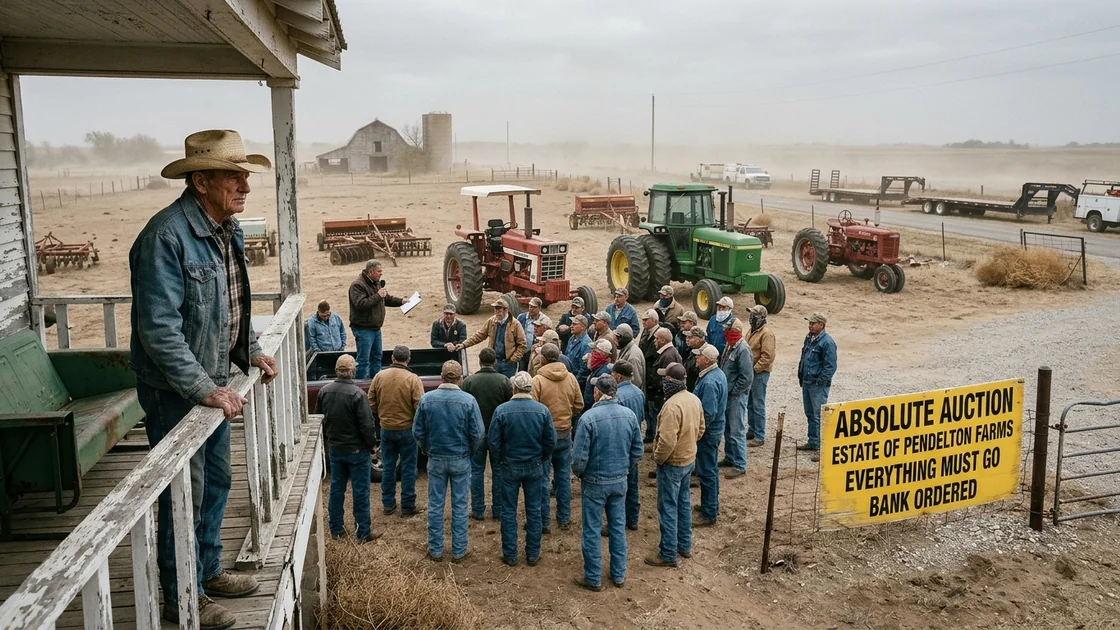
This is the story of Arthur Pendelton, a seventy-four-year-old farmer in the heart of the plains, who endures the final, agonizing day of his family's generational legacy. After five consecutive years of relentless drought have turned his once-fertile acreage into a barren wasteland of blowing silt, the bank has foreclosed on his property. Over the course of a blistering October Saturday, Arthur is forced to stand on his sagging front porch and watch an auctioneer systematically sell off the antique tools, heavy machinery, and personal heirlooms that represent three generations of backbreaking labor, ultimately forcing him to confront who he is when the soil he gave his life to can no longer sustain him.
The wind did not blow across Oakhaven County anymore; it prowled. It came down from the northwest, hot and raspy, carrying the ghosts of three hundred acres of topsoil that used to belong to Arthur Pendelton. Now, that soil belonged to the sky, to the ditches, to the radiators of passing trucks, and to the lungs of anyone foolish enough to stand outside and breathe too deeply.
Arthur stood at the kitchen window, his crooked fingers hooked over the edge of the porcelain sink. The faucet dripped—a slow, rhythmic plink that sounded like a tiny hammer striking an anvil. Every ten seconds, a drop of rust-colored water fell into the basin, tracing a faint orange path down the drain. The well was nearly dry. When he turned the tap full on, it coughed up air and red silt from the bottom of the aquifer, three hundred feet below the limestone shelf.
Outside, the dawn was not breaking so much as smoldering. The eastern horizon was a bruised smear of violet and burnt sienna, choked with the dust kicked up by forty-mile-an-hour gusts two states over. And down by the road, where the mailbox leaned at a drunken forty-five-degree angle in the pulverized gravel, the first of the trucks were already arriving.
They came with empty trailers. That was the detail that stuck in Arthur’s throat like a dry hull of corn. Flatbeds, dual-axle goosenecks, battered utility trailers hitched to three-quarter-ton pickups. They came like carrion birds with wheels, rumbling over the cattle guard with a hollow thump-thump-thump that vibrated through the soles of Arthur’s worn work boots, even from two hundred yards away.
A bright yellow sign, corrugated plastic wired to two rusted T-posts by the gate, flapped violently in the wind. ABSOLUTE AUCTION, it read in heavy black block letters. ESTATE OF PENDELTON FARMS. EVERYTHING MUST GO. BANK ORDERED.
Arthur turned away from the window. The kitchen smelled of stale coffee and old linoleum. It was a room built for a woman who had been dead for six years, and Arthur had changed nothing since Martha passed, save for the accumulation of grit on the windowsills. You couldn't keep the dust out. You could stuff rags around the sashes, you could tape the seams with masking tape until the house looked like a bandaged wound, and still, by noon, you could write your name on the dining room table.
He poured the last of the coffee from the aluminum percolator into a chipped ceramic mug. The liquid was black and bitter, with a fine sediment at the bottom—whether coffee grounds or plains dirt, he couldn't tell and didn't care. His left knee, the one that had been crushed between a wagon tongue and a tractor hitch back in the wet spring of '83, throbbed with a dull, toothache misery. Usually, that ache meant rain. For the last fifty-eight months, the knee had lied to him. It ached for the pressure drops that brought nothing but dry lightning and more wind.
Outside, a truck door slammed. A voice carried up to the house, amplified and distorted by a portable loudspeaker being tested. "Testing, one, two. Check, one, two. Morning, folks, testing."
It was Jim Vance. Arthur knew the voice. Jim had auctioned off the Miller place four miles south in April, and the Sorenson dairy in July. Jim had a good voice for it—deep, folksy, capable of sounding mournful over the microphone while his clerks took seven percent off the top of a man's ruined life.
Arthur set his mug down. He picked up his hat from the peg by the door—a sweat-stained straw Resistol with the brim curled tight from years of his thumb pulling it down against the sun. He settled it onto his head, over the thin wisps of white hair, took a breath that rattled slightly in his chest, and pushed open the screen door.
The yard was a museum of iron and sun-bleached wood, arranged in neat, linear rows that Arthur himself had never bothered to maintain. For three days, Jim Vance’s boys had been out here with chains and a skid-steer, dragging things out of the machine shed, the hay barn, the blacksmith shop, and the tall weeds behind the silo. Stuff Arthur had forgotten he owned was now lined up like soldiers awaiting inspection.
They called it the "bone line." Every farm auction had one.
At the far west end sat the junk: buckets of rusted bolts, coffee cans full of bent nails, rolls of hog wire that had grown into the trunks of volunteer elms and had been sawed out, three-legged milk stools, cracked single-trees from his grandfather's mule teams, and five-gallon pails of hydraulic fluid with skins of dirt floating on top.
As the line moved east toward the gravel drive, the iron got heavier and the heartbreak got sharper. There was the twelve-foot grain drill, its steel press wheels polished to a dull pewter by a thousand miles of dirt, though its hoppers hadn't held a single kernel of wheat since two autumns ago. Next to it sat the twenty-foot Krause disc, three of its front blades notched like broken teeth from the rocks up on the north ridge. Beyond the disc was the New Holland square baler, the red paint faded to a chalky pink, and beside that, the hay rake, looking like a giant, skeletal spider frozen mid-stride.
And then, parked on the highest ground near the diesel tank, stood the tractors.
There were three of them. The smallest was the 1951 Farmall M, narrow-front, sitting on cracked rubber. That had been his father’s pride, bought brand new the year Arthur turned three. It didn't run anymore—the magneto was shot and the manifold was rusted through—but Arthur had kept it under a tarp in the back of the calf barn for thirty years, telling himself he’d restore it when he had a good year.
Next to the Farmall was the workhorse of his middle years: an International 1066, cabless, with a white canopy shaded by a layer of baked-on grease and field dust. Ten thousand hours on the tachometer, and the engine had been rebuilt twice right there in the dirt floor of the shop, with a chain hoist slung over the rafters and Martha bringing him iced tea in Mason jars while his knuckles bled into the oil pan.
And at the head of the line stood the John Deere 4440. That was the newest piece of iron on the place, a 1981 model with a Sound-Gard cab and dual rear wheels. He had bought it used ten years ago, signing the note at Farmers & Merchants Bank with a steady hand, back when corn was pushing seven dollars a bushel and the rains came every Tuesday and Friday like they were scheduled by the county commission. That tractor was the anchor that had finally dragged him under, though not by itself. It was the tractor, plus the seed loans, plus the fertilizer notes for crops that germinated and then cooked in the ninety-degree April winds before they ever made a tassel.
"Morning, Arthur."
Arthur stopped at the bottom of the porch steps. Jim Vance was walking toward him, holding a clipboard thick with yellow legal paper against his belly to keep the pages from whipping away in the wind. Jim was wearing a crisp white western shirt with pearl snaps and a silver belt buckle the size of a saucer. He looked clean. Nobody who still farmed in Oakhaven County looked that clean anymore.
"Jim," Arthur said. His voice was like two pieces of dry pine rubbing together.
"Looks like a good turnout," Jim said, gesturing back toward the road with his chin. There were twenty trucks parked along the shoulder now, and another dozen pulling into the flat pasture west of the barn—a pasture that usually held thirty head of Black Angus cows, until Arthur had been forced to haul them to the sale barn in Dodge two winters ago because hay had hit three hundred dollars a ton and the grass had turned to glass. "Got some boys here from up in Nebraska. Even saw a dealer tag from Iowa. Dry as it is here, they got corn standing up northeast. They're looking for clean iron."
"It's clean," Arthur said, looking toward the 4440. "Changed the oil and the filters in the Deere back in March. Thought we might get a planting window in May."
Jim nodded, looking down at his boots. He kicked at a clod of dirt; it didn't roll, it just disintegrated into a puff of gray talcum that the wind immediately snatched away. "I know you did, Arthur. You always kept your stuff right. That's what I put in the bill. 'Well-maintained owner-operator equipment.' That brings the money."
"Brings the bank's money," Arthur corrected mildly.
Jim sighed, the professional optimism dropping from his face for a second, revealing the tired fifty-year-old man underneath. "Mr. Henderson is over by the clerk's trailer. He said to tell you the bank appreciates your cooperation in having everything pulled out and accessible."
Arthur looked toward the small white trailer parked near the well-house, where two women sat behind sliding plexiglass windows, setting up cash boxes and credit card machines. Leaning against the fender of a shiny black Chevrolet Tahoe next to the trailer was Mark Henderson. He was thirty-two years old, wore khaki pants and deck shoes without socks, and had taken over the agricultural loan desk at Farmers & Merchants when old man Miller retired. Old man Miller had carried Arthur's father through the fifties drought on handshake notes and character. Mark Henderson had a tablet computer that ran risk algorithms from a corporate office in Kansas City.
"I didn't pull it out for him," Arthur said. "Your boys pulled it out."
"Well, you didn't meet us at the gate with a twelve-gauge," Jim said, trying for a faint smile. "Last month over in Kiowa County, sheriff had to sit in the driveway the whole morning while I sold off the Perkins place. Nobody wants that, Arthur. You're a respected man in this county."
"Respect doesn't pay seven percent on an operating note, Jim."
"No," the auctioneer admitted softly. "No, it sure doesn't. We're gonna start on the smalls down by the trees at nine o'clock sharp. Hit the machinery around noon. You gonna stay out here?"
"It's my yard," Arthur said. "Until five o'clock, anyway."
Jim nodded once, touched the brim of his immaculate felt hat, and turned back toward the gathering crowd.
By eight-thirty, there were over a hundred people milling through the yard.
Arthur didn't walk among them. He went back up the three wooden steps to the porch and sat down in the green metal glider that he and Martha had bought at the Western Auto store in 1974. The springs squeaked with a familiar, high-pitched whine as he settled his weight into it. From here, the yard sloped gently down toward the road, giving him a view of the whole operation, like a general watching a battle he had already lost.
He knew half the men down there. They were his neighbors, men between fifty and eighty, wearing seed-corn caps and frayed denim jackets against the gritty morning wind. They walked slowly down the bone line, their hands shoved deep into their pockets. Every now and then, one of them would stop, reach out a booted foot, and kick the tire of the grain drill or rattle the hitch pin on a wagon.
They weren't vultures, not all of them. The dealers from Iowa and Nebraska—the ones with the shiny trucks and the bluetooth earpieces—they were here for blood and bargains. They walked fast, crawling under the tractors with flashlights, checking the drawbars for wear, pulling dipsticks and smelling the oil for coolant.
The neighbors were different. They moved like men at a viewing in a funeral home.
Arthur watched Henry Miller—sixty-eight years old, walking with a cane since his hip replacement—stop in front of the 1066 International. Henry stood there for a long time, just looking up at the exhaust stack, where an old soup can was still slipped over the pipe to keep out the rain that never came. Henry looked up toward the porch, saw Arthur sitting in the glider, and raised two fingers from the head of his cane in a slow, solemn salute. He didn't come up to the porch. None of them did. What was there to say? Sorry your dirt blew away, Arthur? Sorry the sky turned to brass? They were all three missed rainstorms away from having Jim Vance’s yellow sign wired to their own gateposts. Coming up on the porch would be like climbing into the casket to tell the corpse he looked natural.
At nine o'clock, the loudspeaker crackled to life down at the west end of the line, near the windbreak of dying cedar trees.
"Alright, folks, gather round, gather round! Let's get started here this morning on the Pendelton farm," Jim Vance’s voice boomed across the yard, bouncing off the tin siding of the machine shed. "Terms of the sale are cash or good check today, nothing removed until settled with the clerks over in the white trailer. Everything sells as-is, where-is, no warranties expressed or implied. Now, what you see here is seventy years of farming history, folks. Arthur Pendelton and his daddy before him took care of their tools. We got a lot of hay to haul before sundown, so let's go right to work on wagon number one!"
The cadence began.
It wasn't words, not really. It was a rhythmic, rolling chant, a hypnotic percussive hum that rose and fell like a combine cylinder hitting heavy weeds. "I got five, gimme ten, ten, ten, now fifteen, wouldja gimme fifteen, fifteen, twenty..."
From the porch, Arthur couldn't see what Jim was holding up off the first flatbed hayrack, where the small hand tools had been laid out in numbered flats. He didn't need to see. He knew what was on that wagon. He had walked out there at midnight with a flashlight after Jim’s crew left, just to look at it one last time in the quiet.
"Sold! Seven dollars to bidder forty-two!"
That would be the coffee cans of bolts. Seventy years of saving every washer, every cotter pin, every square-headed nut taken off a piece of worn-out horse machinery. His father, Thomas Pendelton, had been a child of the thirties. Growing up in the first Dust Bowl had carved a groove into Thomas’s brain that never smoothed out: you threw nothing away. If a bolt was bent, you laid it on the anvil and beat it straight with a ball-peen hammer. If a shovel handle broke, you shaved down a piece of ash from the creek bottom and riveted it into the collar.
Arthur had inherited that habit, along with the mortgage and the quarter-section by the river that had dried up to a ribbon of cracked mud and salt cedar. Now, a lifetime of thrift—thousands of hours spent bending over to pick a rusty three-eighths bolt out of the dirt so they wouldn't have to drive into town and spend a dime at the hardware store—had just gone for seven dollars.
"Alright, look here now, got a post-hole digger, two fence stretchers, and a bucket of staples. Who'll start me at twenty? Twenty, twenty, gimme ten then, ten, twelve-fifty, fifteen, fifteen, sold for fifteen dollars to number twelve!"
Arthur closed his eyes. The glider creaked as he pushed slightly with his heel.
Fifteen dollars for the fence stretchers.
In the spring of 1966, when Arthur was sixteen, he and his father had fenced the whole north eighty with those stretchers. Three strands of four-point barbwire, stretched so tight you could play a tune on them like a banjo string. His father had been a hard man, a quiet man whose affection was measured solely by whether or not he trusted you to do a job without him standing over your shoulder. That spring, Thomas had handed Arthur the Golden Rod stretcher, walked down the line to the corner post, and let the boy pull the tension himself. Arthur still had a faint white crescent scar on his right forearm where the wire had snapped once, whipping back through his denim sleeve and laying him open to the fat. His father hadn't taken him to the doctor; they had poured turpentine over it from the bottle kept in the tractor toolbox, wrapped it in a clean shop rag with electrical tape, and finished the quarter-mile stretch before supper.
Now the wire on the north eighty was half-buried under drifted blow-dirt, looking like the ribs of a dead cow sticking out of a sand dune. And the stretchers belonged to bidder number twelve for fifteen bucks.
"Mr. Pendelton?"
Arthur opened his eyes. A woman was standing at the bottom of the porch steps. She wasn't from around here; she wore clean blue jeans tucked into tall leather boots that had never seen the inside of a corral, and a quilted vest over a flannel shirt. She held a cardboard box in her arms, filled with Mason jars.
"Yes, ma'am," Arthur said, sitting up straighter. His generation didn't slouch when a woman spoke to them, even if she was carrying off pieces of his house.
"I bought these off the second table," she said, gesturing toward the box. "The auctioneer's helper said the rings were in the shed, maybe? The old zinc lids?"
Arthur looked at the jars. They were Atlas Strong Shoulder quarts, the old blue-green glass ones from before the war. Martha had used them for peaches when the trees behind the chicken coop still bore fruit, before the late freeze of '18 killed the roots and the drought finished the wood. When the peaches died, Martha had just washed the jars, lined them up on the cellar shelves, and left them empty, waiting for a good year that never came back around.
"They're not in the shed," Arthur said. "They're in a lard tin on the bottom shelf in the root cellar. Didn't the boys bring that up?"
"I don't think so," she said, offering a bright, sympathetic smile that made Arthur's stomach turn over. "I do vintage decor in Wichita. People love the blue glass with the real zinc tops for centerpieces. Do you mind if I look?"
"Help yourself," Arthur said, pointing a gnarled thumb toward the storm cellar doors around the side of the house. "Mind the bottom step. The concrete's crumbled on the left side."
"Thank you so much! It's a lovely old place you have here. So much character."
She walked away, her boots crunching on the dry buffalo grass that shattered like cornflakes under her weight.
Centerpieces, Arthur thought. Martha had stood over a boiling water bath in the middle of August in a kitchen with no air conditioning, sweat running down her temples, canning forty quarts of Elberta peaches so they’d have something sweet in January when the snow drifted up to the windowsills. And now those jars were going to sit on a table in Wichita with plastic flowers sticking out of them.
He was glad Martha was up in the cemetery behind the Methodist church. He had thought, the first two years after the cancer took her, that the loneliness would kill him. He used to sit at the kitchen table at night with the radio off, listening to the house settle, wishing she would walk through the swinging door from the pantry and tell him to take his dirty boots off. Now, listening to Jim Vance sell off her enamelware washbasins and the cast-iron corn-stick pans her mother had given them for their wedding, Arthur got down on his knees inside his own mind and thanked God she wasn't sitting on this glider beside him. It would have killed her twice.
By ten-thirty, the wind had picked up another ten miles an hour. The sky had lost all trace of blue, turning a uniform, dirty pewter. The dust was moving at knee-height now across the open driveway, snaking between the legs of the bidders like dry-ice fog. Men pulled red and blue bandanas out of their back pockets and tied them over their noses, or held the brims of their hats down while they squinted at the auction block.
Jim Vance’s crew had moved off the hayracks and onto the shop tools. This was where the crowd thickened. A man might not have money to buy eighty acres of parched ground or a hundred-horsepower tractor, but every man in Oakhaven County could use another bench vise or a set of three-quarter-inch sockets.
Arthur stood up from the glider, his knee popping with an audible crack, and walked to the edge of the porch, leaning his forearms on the blistered white paint of the railing.
Down by the open doors of the machine shed, Jim was standing on the bed of a pickup truck, his microphone cord whipping in the breeze. Two of his helpers—boys in their twenties with strong backs and indifferent faces—were holding up the heavy anvil.
"Look at the ring on this one, boys!" Jim shouted. He took a ball-peen hammer and struck the face of the anvil. A clear, high ping cut through the roar of the wind, pure as a church bell. "That's a hundred-and-fifty-pound Peter Wright! Forged wrought iron with a steel face, straight out of England! Look at the horn on that thing, hardly a nick in it! You can't buy iron like this at the Tractor Supply, fellas, this is the real McCoy. Who'll give me five hundred to start? Five, five, gimme three then! Three hundred, three-fifty, four, four-fifty..."
Arthur’s hands tightened on the porch rail until his knuckles turned white and yellow beneath the age-spotted skin.
That anvil had come across the Mississippi River in the bed of a Studebaker wagon in 1889. His great-grandfather, Jeremiah Pendelton, had brought it from Illinois when he claimed the original homestead quarter under the Timber Culture Act. Every piece of iron on the farm had been shaped on that face. On winter mornings when the mercury dropped below zero, Jeremiah, and then Thomas, and then Arthur, had lit a coal fire in the forge next to it, the smell of bituminous smoke filling the dark shop while they drew out plowshares and welded broken chain links.
When Arthur was eight years old, he had tried to lift it on a dare from his cousin Roy, straining until his nose bled while the anvil didn't budge a fraction of an inch. To a boy, that anvil wasn't a tool; it was a geological feature of the earth, as permanent and immovable as the limestone bluffs down by the Cimarron.
"Seven hundred! Seven-fifty! Eight hundred in the back! Eight-fifty to the man in the red coat! Nine hundred! Nine-fifty! All done at nine-fifty? Sold for nine hundred and fifty dollars to number eighty-eight!"
Number eighty-eight was one of the guys with the Iowa plates. He wasn't a farmer; Arthur had seen him earlier loading antique cream separators and old lightning rods into the back of an enclosed Sprinter van. The anvil that had built the farm was going to an antique mall in Des Moines, probably to sit next to a fireplace that burned gas logs.
Arthur felt a strange, hollow sensation behind his ribs. It wasn't anger—he had burned through all his anger back in July when the last three inches of groundwater in the observation well dried up, and again in August when Mark Henderson had driven out here in his black Tahoe with the certified letter from the bank's board of directors. What he felt now was a profound, terrifying weightlessness.
For seventy-four years, he had been anchored to this dirt by iron. By the weight of the anvil, the drag of the plow, the massive cast-iron blocks of the tractors, the deep well casings driven into the bedrock. Every piece of equipment was a tether keeping him in place against the relentless Kansas wind that wanted to blow everything flat and empty. With every bang of Jim Vance’s gavel, another tether was cut. He felt as though, by five o'clock, when the yard was finally empty, a forty-mile-an-hour gust would simply pick him up off the porch like a dry corn shuck and blow him into the road ditch against the woven wire.
He turned and went back inside the house. He couldn't watch them sell the drill press or the Lincoln welder.
The house felt weirdly loud because of the silence inside it. Out in the yard, the loudspeaker was a muffled, rhythmic rumble through the clapboard walls, like a distant train that never finished crossing a trestle.
Arthur walked through the dining room into the living room. The furniture was still here. The bank didn't want a thirty-year-old floral sofa with worn armrests or a console television that hadn't worked since the state switched to digital signals. The personal property exemption in the foreclosure allowed him to keep his household goods, his clothes, his 1997 Ford F-150 with the rusted cab corners, and one shotgun. The mortgage covered the land, the buildings, and the chattel lien on all farm equipment, livestock, and tools of the trade.
He walked over to the roll-top oak desk in the corner of the living room. This was his office. The pigeonholes were stuffed with decades of paper: pink and yellow carbon copies of grain elevator scale tickets from the Co-op; soil test results from the county extension office; breeding records for bulls that had been ground into hamburger during the Reagan administration; and five small, black leather-bound notebooks with the word RECORD stamped in gold on the covers.
He pulled out the newest notebook and opened it on the blotter.
The pages were ruled in faint blue and red lines. Every day since he was twenty-one years old, Arthur had written down the high and low temperatures from the thermometer nailed to the north side of the washhouse, the wind direction, and the precipitation down to the hundredth of an inch, measured in the brass-tube rain gauge out in the middle of the garden.
He flipped back through the pages of the last five years. It was an obituary written in blue ballpoint pen.
May 14, 2020: High 94, Low 62. Wind SW 30mph. Trace. June 22, 2020: High 104, Low 75. Wind S 25mph. Clouds built west at 4pm, split around us. 0.00. August 3, 2021: High 108, Low 78. Hot wind. Corn firing to the ear leaf. 0.00. October 19, 2022: High 81, Low 40. Drilled wheat in the dust. Praying for November moisture. 0.00. March 11, 2023: High 65, Low 28. Wind NW 50mph. Black roller came through at noon. Lost the north field wheat, roots blown clean out of the ground. Fence drifted over by the road. 0.00.
"Zero point zero zero," Arthur whispered to the empty room.
People in the cities thought a drought was like a fire—something sudden and dramatic that came through and burned everything up at once. They didn't understand that a drought was a liar. A drought was the cruelest confidence man on God's earth. It didn't just stop raining; it teased you. It gave you a quarter-inch in April, just enough to turn the pasture a faint, hopeful green and convince you to go down to the bank, sign your name on a promissory note for sixty thousand dollars' worth of seed and anhydrous ammonia, and put a crop in the ground.
Then, once your money was buried two inches deep in the dirt, the sky would slam shut like a vault door. Every afternoon in July, great, towering thunderheads would build up over the Colorado line, purple and black at the base, flashing with lightning. You would stand in the yard, smelling the rain twenty miles away, feeling the cool outflow wind hit your face, watching the radar on the computer screen with your heart hammering against your ribs. And then, five miles west of the creek, the storm would hit the thermal dome rising off the parched ground and split straight down the middle, half going north to Nebraska, half going south to Oklahoma, leaving you standing in a whirlwind of your own dust while the sun set blood-red in the gap between the clouds.
It did that to you a hundred times a summer. It wore down your mind before it broke your bank account. It made you feel like you had sinned, like there was something specifically wicked about your quarter-section of earth that made the Almighty steer the clouds around your fence lines.
Arthur closed the ledger. His eyes fell on a folded sheet of heavy bond paper tucked under the edge of the desk blotter. It was a printout from the county historical society that his daughter, Sarah, had mailed him two years ago from Denver. She had been trying to convince him to move out there, to buy a little townhouse in Littleton where somebody else mowed the grass and the water came out of a municipal pipe whether it rained or not. She had sent the article to show him that he wasn't the first Pendelton to be beaten by the weather—that there was no shame in walking away when the climate shifted. He remembered reading the digitised archives from the Kansas Historical Society that she had bookmarked for him, detailing the mass exodus of Oakhaven County between 1933 and 1937, when three-quarters of the townships lost half their population to California and Oregon.
"Grandpa Thomas stayed," Arthur had told her over the phone that night. "The others packed their mattresses on top of their Model As and ran. Your granddaddy stayed and ate jackrabbit and Russian thistle until the rains came back in '41. That's why we have the land, Sarah."
"Dad," she had said, her voice tight with that patient, exhausted tone children use when their parents become children again, "Grandpa Thomas was twenty-six years old in 1935. You're seventy-two. And there's nobody left to leave the land to. I'm an accountant. My kids don't even know which end of a cow gets the hay. Who are you dying out there for?"
He hadn't had an answer for her then, and he didn't have one now. He hadn't even told her the auction was today. He had told her the bank was handling the sale privately next month, and that he’d call her when the paperwork was done so she could come help him move his boxes. He couldn't bear the thought of his little girl standing out there in the grit, watching strangers paw through her mother’s things.
A sudden silence outside made him look up.
The rhythmic chant from the loudspeaker had stopped. Instead, there was the deep, coughing roar of a heavy diesel engine firing up, followed by a second one. Black smoke drifted past the living room window, torn into shreds instantly by the wind.
It was noon. They were moving to the heavy iron.
When Arthur stepped back out onto the porch, the atmosphere in the yard had changed. The casual browsers, the women looking for canning jars and cast-iron skillets, were loading their boxes into their trunks and pulling out onto the county road. The crowd that remained was smaller, tighter, and entirely male. About sixty men stood in a thick semicircle around the gravel area by the diesel tanks.
The 1951 Farmall M didn't run, so Jim Vance stood on the drawbar at the back of it, leaning against the faded red fender with the microphone in his hand.
"Alright, boys, we're on the tractors now," Jim said, his voice dropping an octave into his serious-money register. "We're gonna start with the antique here. 1951 Farmall M, serial number says it was built in Rock Island. Now, Arthur tells me it hasn't run in twenty years, motor is stuck from sitting, tires are weathered, sheet metal is straight as an arrow though. Look at that grill, boys, not a dent in it. Great restoration project for a 4-H kid or a parade tractor, or part it out. Who'll give me five hundred dollars to start the old girl?"
Silence. The wind whistled through the power lines overhead.
"Five hundred? Come on, boys, there's five hundred dollars' worth of scrap iron sitting here! Gimme three! Three hundred, three, three, two-fifty! Two hundred! Thank you, sir, I got two hundred, looking for two-fifty..."
Arthur walked slowly down the porch steps. He hadn't meant to. He had told himself he would stay by the house, out of the way, where nobody had to look him in the eye. But his boots carried him down the walk, through the gate in the chain-link yard fence where Martha’s lilac bushes stood like bundles of gray kindling, and out onto the gravel behind the crowd.
The men at the back of the semicircle heard his boots on the stones. Without turning around fully, they shifted aside, parting like water around a bridge piling so Arthur had a clear line of sight to the Farmall.
It was a small tractor by modern standards, narrow and tall, with the steering rod running exposed over the top of the long hood to the front bolster. When Arthur was seven, his legs hadn't been long enough to reach the clutch pedal unless he slid entirely off the steel pan seat and stood up with all his forty-five pounds on the lever. His father used to put it in first gear down in the alfalfa field while they were loading square bales, climb off the tractor, and let Arthur steer it down the windrows alone. Arthur had felt ten feet tall up there, the heat rolling off the four-cylinder engine into his face, the smell of hot gear oil and bruised green alfalfa filling the summer air.
"Three hundred! Three-twenty-five! Three-fifty! All done at three-fifty?"
The man holding the bid at three-fifty was standing near the front. Arthur recognized the back of his neck—thick, red, creased like an old boot, topped by a greasy cap from Salina Salvage & Metal. He was a scrapper. He had a thirty-foot flatbed parked out by the road with a portable cutting torch rig mounted behind the cab and three crushed pickups already chained to the deck. If he bought the Farmall, it wouldn't be in a parade. By Tuesday afternoon, it would be cut into four pieces with an acetylene torch, loaded into a railcar, and shipped to a smelter in China.
Arthur opened his mouth. He had four hundred and ten dollars in his wallet—the remainder of his Social Security check from the third of the month, which he was supposed to use for gas and motel rooms on the drive out to Denver.
Before he could raise his hand, a cane went up on the left side of the crowd.
"Four hundred," Henry Miller called out, his voice cracking against the wind.
The scrapper looked over at Henry, frowned, and shook his head slightly at the auctioneer. At current shredder prices, there wasn't four hundred dollars of profit in two tons of cast iron once you hauled it sixty miles to the railhead.
"Four hundred to Henry! Four-twenty-five, anyone? Sold for four hundred dollars to Henry Miller!"
Jim Vance pointed his clipboard at Henry, the clerk scribbled on her pad, and the crowd immediately shifted six feet to the right, centering around the International 1066.
Henry didn't move with them. He turned around, leaning heavily on his aluminum cane, and limped back through the thinning crowd toward Arthur. His breathing was shallow and wheezy from fifty years of grain dust and Red Man chewing tobacco.
"Henry," Arthur said quietly as the old man reached him. "You don't need that old M. Your boys run green tractors, and it's locked up tighter than a drum."
Henry stopped beside him, turning to look back at the little red tractor sitting alone now that the crowd had moved on. He spat a dark stream of tobacco juice into the gravel and wiped his mouth with the back of his flannel sleeve.
"My grandboy," Henry said, not looking at Arthur. "Tyler. He's fourteen now. Taking ag mechanics at the high school in town. Teacher says they need an old four-cylinder to tear down and rebuild for their winter project."
Arthur looked at Henry. He knew perfectly well that Henry’s grandson Tyler played travel basketball all winter and didn't know which end of a wrench to hold. Henry had lost his own south quarter to the bank in April; he didn't have four hundred dollars to throw away on lawn ornaments.
"He'll learn a lot on that engine, Henry," Arthur said, his throat constricting so tightly he could barely get the words past his teeth. "They're simple. Sleeve and piston kit is easy to drop in from the top."
"Yeah," Henry rasped, squinting against a gust of dirt that blew between them. "That's what I figured. Give me a week or two to get my boy over here with the winch trailer to pull it home. Unless the bank wants the ground cleared sooner."
"Land didn't sell yet, just the equipment," Arthur said. "They're putting the land up at the courthouse steps on the first of the month. Take your time."
Henry nodded once. For a second, his free hand came up, hovering an inch away from Arthur’s shoulder, before he thought better of it and dropped it back into his pocket. Men of their breed didn't touch each other unless they were pulling somebody out of a grain bin or carrying six-handle coffins out of a church.
"Your dad helped my dad pull that well casing in '56 when the pump dropped," Henry said to the ground. "Spent three days down in the mud with chain tongs and a jack, didn't charge him a nickel. Just didn't want to see that tractor get torched."
He turned and limped away toward the clerk's trailer to write a check he probably couldn't afford to clear, leaving Arthur standing alone in the gravel.
The 1066 International was running. One of Jim’s boys was sitting in the seat, goosing the throttle every few seconds so the straight pipe barked against the sky, sending puffs of blue-black diesel smoke rolling over the heads of the bidders.
"Hear that six-cylinder sing, boys!" Jim shouted over the roar. "International 414 turbo! Hundred and twenty-five horsepower on the PTO! Now, this isn't a beauty queen, we all know that, sheet metal's got some character, canopy's got a bend on the left corner where Arthur got too close to the barn door, but the rear rubber is sixty percent and the TA works! Pulls in high and low! Who'll start me at ten thousand? Ten, ten, gimme five then! Five thousand! Five, five-five, six, six-five, seven..."
Arthur watched the tractor vibrate. At idle, the left front fender had a particular shimmy to it, a harmonic shake that stopped the moment you bumped the throttle past twelve hundred RPM. He knew that tractor better than he knew his own body. He knew that on mornings below forty degrees, you had to give it a one-second shot of starting fluid in the air cleaner—no more, or it would knock like a sledgehammer—and hold the clutch down for thirty seconds after it fired so the cold hydraulic oil wouldn't stall it out. He knew that the third-gear shift fork was slightly worn, so if you shifted from second to third too fast while pulling the disc uphill, it would hang between gears and you’d have to climb down with a pry bar and pop the linkage back into place through the floorboards.
Who was going to tell the new owner about the shift fork?
The thought struck him with a sudden, absurd urgency. He took two steps toward the crowd, his hand half-raised. If some stranger bought it and jammed the transmission lever like a regular tractor, he’d lock it in two gears at once and tear the rear end out of it before he finished his first round in the field.
He stopped himself. The bids were at eight thousand five hundred. The only two people bidding now were the dealer from Nebraska and a tall, sunburned man in a clean white cowboy hat who stood near the front axle, bidding with a barely perceptible nod of his chin.
"Eight-seven-fifty! Nine thousand! Nine-two-fifty! Nine-five? All done at nine thousand two hundred and fifty? Sold to number one-oh-four!"
Number one-oh-four was the man in the white hat. As the crowd moved on toward the big John Deere, the man stepped up to the side of the 1066, pulled a yellow grease pencil out of his shirt pocket, and wrote a series of numbers across the dusty red hood: LOT 44 - PORT OF HOUSTON.
An exporter. They bought the old pre-computer American tractors by the dozen, drove them onto lowboys, hauled them down Interstate 35 to Texas, and stuffed them into shipping containers bound for Honduras, Guatemala, or Nigeria—places where a man could fix an engine with a hammer and a pair of pliers without needing a laptop from the dealership to clear a sensor code.
Arthur let his hand drop to his side. In a month, that tractor would be plowing red tropical clay two thousand miles away, driven by a man who didn't speak English and had never heard of Oakhaven County, Kansas. Maybe it would rain where it was going. Maybe the tires would sink into black, greasy mud instead of spinning out in gray talcum powder.
And then they were at the 4440.
This was the finale. Everything else had been an appetizer for the bank; the Deere was the meat. Even in a drought year, a clean 4440 with the quad-range transmission and less than seven thousand hours was gold standard. It was big enough to pull modern tillage, small enough to feed round bales in the winter, and built in Waterloo before plastic replaced cast iron.
Mark Henderson, the young banker, had detached himself from the side of his black Tahoe and walked over to stand behind Jim Vance’s truck, his arms crossed over his chest, watching the crowd with the tight, focused expression of a man watching his fourth-quarter performance bonus being tabulated in real time.
"Here she is, gentlemen," Jim Vance said. He didn't even need to use the auctioneer's shout for the preamble; the crowd had gone dead quiet, save for the low, muscular rumble of the John Deere’s 466-cubic-inch engine idling smoothly in the wind. "1981 John Deere 4440. Six thousand, eight hundred and twelve actual hours. Air conditioning blows cold, interior headliner was redone two years ago, duals go with it, three-point, dual hydraulics, quick hitch. Look under it, boys—dry as a bone on the concrete before we pulled it out. Not a drip of oil on this tractor. You could drive it home to Iowa today and hook it to a planter tomorrow morning. Who'll give me thirty thousand to start?"
"$Twenty," shouted the dealer from Nebraska immediately.
"I got twenty, twenty-two, twenty-five, twenty-seven-five, thirty! Thirty thousand right here in the front, thirty-two-five, thirty-five..."
Arthur didn't watch the bidders. He watched the cab of the tractor.
Through the curved green-tinted glass of the Sound-Gard cab, he could see the padded brown seat. Over the right-hand console, tucked under the edge of the rubber floor mat where the hydraulic levers came up, there was a rusted horseshoe he had plowed up in the creek bottom the first day he brought the tractor home. And wired to the bracket of the AM/FM radio above the windshield was a little plastic clip that held a pair of cheap drugstore reading glasses—plus two-point-zero magnification—that he used to read the seed population charts on the back of the bags.
He had forgotten to take his glasses out of the cab.
In that cab, he had lived a whole second life. Farmers his age spent more waking hours inside the glass box of their primary tractor than they did in their own living rooms. It was where he had listened to Paul Harvey every day at noon while eating bologna sandwiches out of a cooler wedged behind the seat. It was where he had listened to the farm reports as the Chicago Board of Trade crashed in '15, and where he had listened to the KFRM preacher on Sunday mornings when the wheat was ripe and he had to keep the grain cart rolling instead of sitting in a pew.
It was also where he had been sitting on an October afternoon six years ago when his cell phone rang, and the doctor in Dodge City told him that Martha’s scans had come back, and the spots on her liver weren't cysts. He had pulled the throttle back to idle right there in the middle of the west quarter, set the park lock, and put his forehead down against the steering wheel for two hours while the diesel engine ticked and cooled beneath him, unable to find the strength in his legs to climb down the four steel steps to the earth.
"Thirty-eight! Thirty-eight-five! Thirty-nine! Thirty-nine thousand cinco—forty! I got forty thousand dollars from the gentleman on the phone with my ringman! Forty-one? Forty-one anywhere in the yard?"
The dealers in the yard shook their heads. Forty thousand was retail price for a forty-year-old tractor, plus buyer's premium if it was an online bid. The ringman—a kid in a bright orange vest holding an iPhone to his ear—held his hand up straight.
"Forty thousand once! Forty thousand twice! Last call, boys, she's leaving the county! Sold for forty thousand dollars to the internet bidder!"
The gavel came down against the wood of the clipboard with a sharp crack.
Mark Henderson uncrossed his arms over by the clerk's trailer, nodded once in satisfaction, and turned back toward his Tahoe. Between the Deere, the International, the baler, and the line of tillage equipment, the bank had just cleared enough to cover the principal on the equipment note and the accrued interest from the 2023 operating loan. When they auctioned the three hundred acres of dirt on the courthouse steps next month, even at drought-depressed prices of twelve hundred dollars an acre, Farmers & Merchants would walk away whole, with a tidy legal fee tacked on for their trouble.
The ledger was balanced. On a server in Kansas City, a red line next to the name PENDELTON, A.T. would turn black on Monday morning, and then be deleted from the active portfolio.
Arthur turned his back on the tractor and walked back toward the house.
The afternoon took longer to die than the morning had.
Once an auction ends, the violence begins. The selling is orderly, governed by numbers and clerks and rules. The loading is a feeding frenzy.
For three hours, Arthur sat at the kitchen table with his back to the window, staring at the calendar on the wall—a complimentary calendar from the Oakhaven Co-op & Grain, still turned to August, showing a glossy photograph of a lush, emerald-green pasture in Kentucky with fat Hereford cattle standing knee-deep in clover beside a running creek. A cruel joke to hang in a Kansas kitchen.
Outside, the yard sounded like a construction site in hell.
Trucks backed up with shrill, incessant beeping noises. Chains rattled and clanked as binders were ratcheted down over axles.Jim Vance’s boys ran the big yellow skid-steer loader back and forth across the gravel at full throttle, lifting the heavy shop tools—the drill press, the welder, the Peter Wright anvil—with pallet forks and dropping them into the beds of pickups with heavy, metallic booms that made the springs of the trucks groan.
Men shouted over the wind. "Watch your fingers! Back her up, back her up, whoa! Get a block under that tongue before you pull the pin!"
Someone had backed a semi-truck with a hydraulic Beaver-tail trailer up to the ditch by the mailbox to load the 1066 and the Krause disc. To get the twenty-foot disc out of the yard, they had to pull the gateposts on the south side of the driveway because the wings were rusted in the down position and wouldn't fold flat for transport. Arthur heard the skid-steer hook a chain to the corner post he had set in concrete in 1994, heard the diesel engine lug down, and then heard the dry, splintering crunch as the creosote timber snapped off at ground level.
He didn't get up to look. What difference did a broken gatepost make when there was nothing left inside the fence to keep in, and nothing outside that wanted in?
At four-fifteen, there was a sharp, brisk knock on the back screen door.
Arthur didn't say "come in," becauseMark Henderson had already opened the screen door and was tapping his knuckles against the glass of the inner door, holding a manila folder in his left hand.
Arthur stood up slowly, walked across the linoleum, and turned the brass knob, pulling the door open six inches. A swirl of dust immediately eddied around his ankles from the porch.
"Mr. Pendelton," Henderson said. He wasn't wearing a hat, and his gelled hair was stiff with gray silt, giving him the premature look of an old man around the temples. He smelled of expensive cologne and the leather interior of his truck. "We're all wrapped up out here with the clerk's tally. I wanted to leave your preliminary settlement sheet with you before I headed back into town."
He held out the manila folder. Arthur didn't take it. He looked at the young man’s soft, clean hands—hands that had never pulled a calf in a sleet storm or had the skin split open at the knuckles from handling anhydrous hoses.
"Did it cover the chattel note?" Arthur asked.
"Yes, sir," Henderson said, his tone brisk and businesslike, as if he were delivering good news about a mutual investment. "Gross receipts came in at seventy-eight thousand, four hundred and ten dollars. After Vance's ten percent commission and the advertising costs for the sale bills, net proceeds are sixty-nine thousand, one hundred. That clears the equipment note in full and applies eleven thousand toward the deficiency on the operating line. That puts us in a very clean position going into the real estate auction on the first. Frankly, at current land values, once the quarters sell, there may even be a small surplus returned to you after closing costs. Maybe fifteen or twenty thousand dollars."
Arthur stared at him.
Three generations. A hundred and thirty-five years of breaking sod, digging wells by hand, fighting grasshoppers, hail, greenbugs, market crashes, and drought. Over a century of men breaking their backs before they turned fifty and women growing old in kitchens while the wind howled under the eaves. And when you boiled it all down in the crucible of the Farmers & Merchants Bank, the whole enterprise—the blood, the sweat, the dead babies buried in the corner of the pasture from the diphtheria winter of 1902, the callus on Arthur’s palm and the steel plate in his knee—came out to maybe fifteen thousand dollars. Enough to pay for three months in a nursing home or a decent burial plot in Denver.
"Put it on the glider," Arthur said.
Henderson blinked, his professional smile faltering slightly. "Sir?"
"The folder," Arthur said. "Put it on the porch glider. Put a rock on it so it doesn't blow into Oklahoma."
Henderson hesitated, then leaned down and slid the manila folder under a brick that Martha had used as a doorstop. He straightened up, adjusting his glasses. "The bank's agreement gives you until the fifteenth of November to vacate the residence, Mr. Pendelton. Once the land sells on the first, the new buyer will want possession before winter to do whatever tillage they're planning."
"Nobody's doing any tillage this winter, son," Arthur said softly. "If you put a plow in that ground right now, the whole farm will be in the Missouri River by Christmas."
Henderson looked uncomfortable. "Well. Regardless. The fifteenth. Have a good evening, Mr. Pendelton."
Arthur closed the door and turned the deadbolt before the young man had reached the bottom of the steps.
By five-thirty, the silence had returned, but it was a different silence than the one the farm had known that morning.
Before, when the wind blew across the yard, it had played a complex symphony of small, familiar sounds. It had whistled through the tines of the hay rake; it had made the loose sheet metal on the combine header bang rhythmically against the frame; it had rattled the clevis pins in the tractor drawbars and hummed through the stacked irrigation pipes behind the barn.
Now, the wind came out of the northwest and hit nothing.
Arthur stepped out onto the porch as the sun began to drop into the brown haze on the western horizon. The light wasn't gold; it was the color of a copper penny that had been buried in the dirt.
The yard was vast, flat, and mutilated.
Where the machinery had stood for years, there were rectangular scars on the ground—patches of pale, dead white grass and hard-packed dirt bordered by ridges of blown silt, like the foundations of houses that had been torn down. Between those rectangles, the gravel driveway and the buffalo-grass yard were crosshatched with a thousand tire tracks, deep ruts cut by heavy trailers and the spinning wheels of the skid-steer, turning the crust of the earth into loose powder that was already beginning to drift.
Every gate stood wide open or lay broken in the weeds. The doors of the big machine shed, the hay barn, and the blacksmith shop were yanked back on their rusted rollers, gaping black and empty at the evening sky like the mouths of dead fish.
There wasn't a piece of red or green paint left on the place, except for the little 1951 Farmall M sitting all by itself down by the diesel tank, looking tiny and pathetic in the middle of the chewed-up gravel, with a piece of yellow shipping tape stuck to its steering wheel that read H. MILLER.
Arthur walked down the steps and across the yard toward the machine shed.
Without the tractors parked beside it, the building looked smaller, sagging in the middle of its roof ridge like an old swaybacked horse. He stepped through the wide sliding doors into the gloom within.
The smell hit him first. A machine shed has a scent that takes fifty years to build: a dense, rich mixture of spilled 80-weight gear oil, diesel soot, mouse droppings, damp dirt, old baling twine, and the metallic tang of grinding sparks.
The floor was dirt, packed as hard as asphalt over the decades and stained pitch-black in the center where the tractors had been parked and serviced. Along the north wall stood the long wooden workbench his father had built out of two-inch bridge planks salvaged from the county road crew in 1948.
Yesterday, that bench had been buried under four inches of tools, coffee cans, hydraulic fittings, grease guns, and half-finished repair jobs. Today, it was swept clean.Jim Vance’s crew had even unbolted the big Columbian bench vise from the corner; four clean holes showed the raw, pale wood of the plank where the carriage bolts had been pulled through, surrounded by a dark square silhouette of sixty-year-old grease.
They had sold the vise. They had sold the grinders. They had even pulled the extension cords down from the rafters and sold the wooden step-ladder sitting by the fuse box.
Arthur walked to the center of the empty dirt floor and stopped. The wind found the gaps in the corrugated tin siding, making the loose nails screech in the dry oak purlins overhead. Dust sifted down through the cracks in the roof, catching the last red beams of sunlight coming through the west doors, looking like columns of smoke in a burned-out cathedral.
He looked down at his hands.
They were large hands, the fingers permanently curved inward toward the palms so that even when he tried to lay them flat on a table, the middle knuckles stayed half an inch in the air. They were shaped to fit the steering wheel of an International tractor, the handle of a scoop shovel, the grip of a pair of fencing pliers. The fingernails were thick, yellowed, and grooved down the center from old hammer blows.
For sixty years, since he was fourteen years old and tall enough to do a man's day of work, these hands had known what to do every single morning before his eyes were even open.
In the spring, they greased zerks, lifted fifty-pound bags of seed corn into planter boxes, and adjusted depth wheels in the mud. In the summer, they tensioned combine belts, cleared plugged sickles, and wrestled irrigation tubes in a hundred-degree heat. In the fall, they worked throttles and hydraulic levers from dawn until midnight under the halogen glare of work lights. In the winter, they chopped ice out of stock tanks with a double-bit axe, forked hay to bawling cows in twenty-below windchills, and turned wrenches in this dark shed with numb fingers over a kerosene heater.
What did a man's hands do when there were no wrenches left to turn?
What did he do tomorrow morning at five-thirty when his eyes opened in the dark bedroom? There were no cows to check. There was no well pump to prime. There was no tractor to plug in, no grain to haul, no fence to mend. He was seventy-four years old, and the only trade he knew, the only language his body spoke, had just been loaded onto flatbed trailers and driven down the county road toward the state highway.
A sudden, violent tremor started in his bad knee and ran all the way up his spine into his jaw.
He reached out blindly to steady himself, expecting his hand to hit the fender of the John Deere or the cold iron frame of the drill press. There was nothing there. He stumbled a step in the loose dirt of the shop floor before catching himself with a palm flat against the rough wood of the empty workbench.
He stood there, leaning his forehead against the splintered edge of the two-by-twelve plank, his breath coming in short, ragged gasps that kicked up little eddies of dust and metal filings under his nose. He waited for tears to come, thinking maybe if he cried, the terrible, crushing pressure behind his breastbone would ease up.
Nothing came. His eyes felt as dry and parched as the three hundred acres outside the door. He had given all his water to the ground years ago—in sweat, in worry, in prayers that hit the tin roof and bounced back down—and now he was just like the well out by the windmill: three hundred feet of dry pipe going down into the dark, pumping nothing but red silt and air.
After a long time, the light in the shed faded from copper to a bruised, twilight purple. The wind was dropping, as it sometimes did when the sun went down, though it didn't bring any coolness with it, just a heavy, stagnant stillness that smelled of dead ragweed and static electricity.
Arthur pushed himself upright from the workbench. He slapped the dust off the front of his jeans with his hat, set the hat back on his head, and walked out of the shed.
He didn't bother pulling the big sliding door shut. Let the owls have it. Let the tumbleweeds blow in and stack up to the rafters.
Instead of walking back toward the house, he turned north, walking past the empty concrete stave silo and the caved-in chicken coop, heading toward the lane that led out to the fields.
The lane was two ruts worn eighteen inches below the level of the surrounding ground by a century of iron wheels and rubber tires. The banks of the lane were drifted high with blow-dirt—fine, flour-like soil that had detached itself from the fields during the March windstorms and settled into the weeds like gray snowdrifts. When Arthur stepped into it, his boots sank over the ankles with a soft shhh sound, raising a cloud that hung around his knees in the twilight.
He walked a quarter-mile up the gentle rise to the crest of the north eighty. This was the highest point on the farm. From here, on a clear day, you could see the white grain elevators of three different towns sticking up above the horizon like tombstones: Oakhaven seven miles east, Copeland twelve miles west, and Sublette fifteen miles north.
Tonight, you couldn't see any of them. The dust hung in the upper air like a brown wool blanket, blotting out the first stars and turning the twilight into a claustrophobic dome of dirt.
Arthur stopped at the edge of the field and looked out over the land.
There was nothing growing on it. Not a weed, not a volunteer stalk of wheat, not even the stubborn buffalo burs or kochia that usually thrived when everything else died. Two years ago, on the advice of the county extension agent, he had tried to plant a cover crop of forage sorghum just to get some stalks standing to hold the dirt down against the wind. The seed had laid in the dry powder for four months without swelling, until the field mice and the horned larks ate what didn't blow away.
Now, the field looked like the surface of the moon, or an ocean beach when the tide goes out. The wind had scoured the topsoil down to the hardpan clay in places, leaving smooth, shiny patches of bare earth that looked like skin scraped raw on gravel. Around those bare spots, the lighter silt had formed miniature sand dunes, rippled like washboards, marching steadily from northwest to southeast.
He walked twenty paces out into the field and knelt down on his good knee.
He took off his work glove—he hadn't even realized he had put his gloves on before coming outside—and pushed his bare fingers into one of the ripples.
It wasn't soil anymore. Soil had life in it. When Arthur was a boy walking behind his father’s moldboard plow in the spring, the turned earth had come up black and shining like grease, smelling so rich and sweet of decaying roots and earthworms and moisture that you almost wanted to chew a handful of it. Blackbirds and gulls used to follow the tractor by the hundreds, diving into the furrow to feast on the grubs and worms rolled up into the sun. If you took a handful of that dirt and squeezed it in your fist, it held the shape of your fingers like modeling clay.
He scooped up a handful of the north eighty and held it up to his face.
It was dead. Every trace of organic humus, every microbe, every fungus had been baked out of it by five summers of hundred-and-ten-degree soil temperatures and blown away into the atmosphere. What was left in his palm was just pulverized rock—silica and clay particles ground into dead flour. He opened his fingers slightly, and the faint evening breeze didn't let it fall to the ground; it simply dissolved out of his hand sideways, drifting away like wood-ash from a cold stove.
"I tried," Arthur said aloud.
His voice sounded small and strange out here with no walls or machinery to bounce off of. The flat, empty horizon swallowed the sound instantly.
"I did what you taught me, Pa," he said to the dark field. "I terraced the slope in '78. I left the stubble standing when everybody else was burning off. I didn't overgraze the creek until the wells gave out. You can't farm without water. Nobody can."
The ghost of Thomas Pendelton didn't answer him. Why would he? Thomas had died in 1988, a wet year when the wheat made fifty bushels to the acre and the cattle were sleek and fat. Thomas had gone to his grave believing that if a man just worked sixteen hours a day, kept his machinery greased, went to church on Sunday, and didn't buy things he couldn't pay for, the land would take care of him forever. Thomas had never seen the aquifer drop forty feet in a decade because ten thousand center-pivot sprinklers across three states were sucking the ancient ice-age water out of the ground faster than the sky could ever put it back.
Arthur stood up, brushing his palm against his thigh.
He looked back down the hill toward the farmstead. The single mercury-vapor yard light atop the tall pole by the barn flickered on automatically as the darkness deepened, casting a cold, bluish-white circle of light over the empty gravel and the gaping doors of the sheds.
From up here, without the red and green tractors parked around the yard, without the silver grain bins that he had sold off five years ago to pay Martha’s hospital bills, the place didn't look like a farm anymore. It just looked like a handful of gray, weathered boards dropped by accident in the middle of the Great Plains, waiting for the wind to finish grinding them back into sawdust.
A strange thought came to him then, standing there in the dark dirt.
The bank hadn't taken his farm. Mark Henderson with his khaki pants and his tablet computer hadn't taken it, and the bidders from Iowa with their gooseneck trailers hadn't hauled it away.
The farm had already left. It had left inch by inch over the last sixty months, rising up into the hot afternoon skies and drifting east, settling on the porches of townsfolk, washing down the gutters of Kansas City, sifting into the waters of the Mississippi. What the bank was going to auction off on the courthouse steps on November first wasn't Pendelton Farms; it was just the corpse left behind after the spirit had departed. You couldn't own this land any more than you could own the surface of the ocean. You just rode on top of it for a little while when the weather let you, and when the weather turned, it shook you off like a tick on a dog's back.
For the first time all day, the tight, suffocating band around Arthur’s chest loosened by a fraction of an inch.
He couldn't save it. The realization wasn't a defeat anymore; it was an absolution. You couldn't be blamed for failing to hold back the desert with a twenty-foot Krause disc and a handful of bank notes.
He walked back down the lane toward the blue glow of the yard light.
As he passed the diesel tanks, he stopped beside the little 1951 Farmall M. The metal of the hood was cold now, already losing the day's heat to the dry night air. He reached out and ran his rough palm over the raised cast-iron letters on the side of the radiator housing: McCORMICK-DEERING FARMALL.
He walked around to the back of the tractor, stepped up onto the drawbar, and swung his stiff left leg over the battery box, settling himself down into the deep, bowl-shaped steel pan seat.
The spring under the seat gave its familiar, rusty screech as it took his weight. He put both hands on the three-spoked black steering wheel, the hard rubber cracked and chipped down to the inner steel ring, and looked out over the long, narrow hood toward the dark road.
He didn't make engine noises like a child, and he didn't weep like an old man. He just sat there for ten minutes in the quiet dark, letting his hands rest in the grooves worn into the wheel by his father’s palms and his own, feeling the solid, immovable weight of the old iron beneath him one last time before he had to let go for good.
Then he climbed down, carefully so he wouldn't catch his boot heel on the brake pedals, and walked up the path to the house.
On the porch, he bent down, moved the brick doorstop, and picked up the manila folder Mark Henderson had left on the glider. He didn't open it as he walked into the yellow light of the kitchen. He tossed it onto the counter next to the dripping sink, right beside the empty coffee percolator.
He walked through the dining room into the living room, went over to the roll-top oak desk, and picked up the black corded telephone.
He didn't need to look up the number on the pad; he knew the ten digits by heart. He dialed, then stood there looking at the faded wallpaper where a square of darker floral print showed where his parents' wedding portrait had hung before he packed it into a U-Haul box last Tuesday.
The phone rang three times on the other end before it clicked.
"Hello?" Sarah’s voice came through the receiver, surrounded by the faint, lively clatter of dishes and a television playing in the background—the sounds of a house where people were still living, where water ran clear from the tap and the future wasn't measured in hundredths of an inch of rain. "Dad? Are you okay? You never call on Saturday night."
Arthur looked down at the open black ledger on his desk blotter. He reached out with his free hand, picked up the blue ballpoint pen, and wrote one final line at the bottom of the October page, his handwriting steady and square despite the crookedness of his fingers:
October 24, 2024: High 78, Low 45. Wind NW 35mph. 0.00. Sold out.
He clicked the pen shut, laid it in the groove of the blotter, and closed the cover of the book.
"I'm fine, Sarah," Arthur said into the phone. "Everything's done here. If you and your husband still have that spare room made up, I think I'm ready to head west in the morning."