The Distance Between Two Walls
Elena Vance was once an elite marathoner who measured her existence in sub-six-minute miles and the euphoric exhaustion of crossing twenty-six-point-two-mile finish lines, until an aggressive onset of seronegative rheumatoid arthritis and autonomic dysfunction shattered her trajectory. This story chronicles her harrowing descent from athletic greatness into physical confinement, where the twenty-two-foot expanse between her bedroom mattress and the bathroom doorway becomes a landscape more punishing than any mountain pass she ever raced. Through the agonizing monotony of daily survival, the friction of a marriage strained by caregiving, the loss of her primary identity, and the slow, unglamorous work of mourning the body that betrayed her, Elena must redefine endurance not as the speed at which she covers the earth, but as the quiet courage required to inhabit a body at war with itself.
Part I: The Twenty-Two-Foot Marathon
The carpet in the hallway was a low-pile Berber, woven in shades of oatmeal and ash. When Elena had picked it out four years ago with Marcus, she had chosen it because it wouldn’t show the dried mud flaked off her trail shoes after morning runs in the foothills. Now, she knew the topography of that carpet with the intimacy of a prisoner studying the mortar of a cell. She knew where the tack strip near the linen closet poked slightly upward through the backing; she knew the exact rectangle where the afternoon light bleached the grey threads into bone; she knew that from the edge of the oak bedframe to the cool linoleum threshold of the bathroom was precisely nineteen steps on a good day, and thirty-four shuffling, weeping increments on a bad one.
Today was a thirty-four.
It began before her eyes opened. In the old life—the life measured by Garmin watches, lactate thresholds, and the metallic tang of cold dawn air in her lungs—waking up was a clean mechanical transition. Her heart rate would rise from its resting forty-two beats per minute, her legs would swing over the side of the mattress with the heavy, pleasant stiffness of forty miles already logged that week, and her feet would take her weight without negotiation.
Now, waking was an ambush.
The pain did not arrive all at once; it assembled itself. First came the awareness of her hands. Even beneath the lightweight down duvet, her fingers felt as though they had been stuffed with crushed glass and then bound tightly in wet leather that had shrunk overnight in the sun. The metacarpophalangeal joints—a word she could now spell backwards, a twelve-letter monument to her ruin—throbbed with a thick, heated rhythm that matched the pulse in her carotid artery. Then came the ankles. Then the knees, swollen to the size of softballs, their synovial linings thickened and furious, swimming in inflammatory fluid that her own immune system had dispatched like an army mistaking its capital city for foreign soil.
Elena lay flat on her back, staring at the plaster swirl directly above the bed. Beside her, the sheets on Marcus’s side were cool and rumpled. The clock on the nightstand read 7:14 AM. He was already downstairs, likely packing his briefcase, moving through the kitchen with the thoughtless, fluid grace of the healthy. She could hear the faint, rhythmic clink of a spoon against a ceramic mug through the floorboards. That sound—someone stirring coffee while standing upright on two functioning legs without holding onto the counter—filled her with a grief so sharp it tasted like copper.
She needed to use the bathroom. It was a primal, humiliatingly simple requirement.
Prepare the course, she told herself, borrowing the mental cadence of her coach, Arthur, from a lifetime ago. Break it into sectors. Don't run mile twenty while you're still in mile three.
Sector One: The Roll.
She slid her right forearm beneath the small of her back. Because her wrists could no longer bear flexion, she had to use the meat of her ulna as a lever. A white-hot wire of agony shot from her elbow to her shoulder blade as she shifted her hips two inches toward the edge of the mattress. She gasped, a small, dry sound absorbed immediately by the pillowcase. Her body was slick with the sour sweat of low-grade fever, the constant furnace of a biological civil war.
She waited ten seconds for the nausea to subside. With the autoimmune arthritis had come secondary dysautonomia—her nervous system forgetting how to regulate the simple hydraulic physics of gravity. If she sat up too fast, the blood would pool in her lower extremities, her heart would hammer at a hundred and forty beats per minute like a trapped sparrow, and the room would dissolve into gray static.
Slowly, degree by agonizing degree, she wedged her elbows behind her and pushed her torso up to a forty-five-degree angle. Her spine felt fused, each vertebra rusted to the next. She paused again, breathing through her nose—in for four counts, out for six—the same respiratory cadence she had used climbing Heartbreak Hill in Boston three years ago, when the rain was horizontal and she was running a 2:34 personal best.
Back then, pain had been a collaborator. Pain had been a furnace into which you shoveled discipline and out of which came speed. If your quads burned at mile eighteen, it meant you were working; if your lungs screamed at mile twenty-four, it meant you were alive and contesting the clock. That pain had an off-switch. You crossed the timing mat, someone wrapped you in a crinkled Mylar blanket, handed you a banana and a medal, and the pain immediately began to turn into pride.
This pain had no finish line. It produced nothing. It was pure, sterile subtraction.
Sector Two: The Drop.
Using her palms like paddles behind her thighs—her fingers curled into useless, bloated claws to keep them from brushing the rough linen—Elena dragged her legs toward the precipice of the mattress. When her heels cleared the edge, gravity took them. The sudden downward pull on her inflamed knee joints tore a whimper from her throat. It felt as if someone had driven cold iron wedges under her kneecaps and struck them with a mallet.
Her bare feet touched the carpet.
The soles of her feet were so tender that the tiny loops of the Berber wool felt like roofing nails. The plantar fascia were permanently inflamed, and the small bones of the metatarsals shifted against each other without their cushioning cartilage, grinding like stones in a riverbed.
She sat on the edge of the bed for three full minutes, hands resting palms-up on her lap, staring at the bathroom door across the room. Twenty-two feet. In her prime, at race pace, she covered twenty-two feet in roughly one point two seconds. Three strides. A blink. An exhale.
Now, the hallway looked like the Mojave Desert.
Downstairs, the front door clicked shut. Marcus was leaving early for a deposition. He hadn't come up to check on her, and she didn't blame him; they had an agreement that if she was still asleep at seven, he wouldn't wake her, because sleep was the only country where her bones didn't burn. Still, the sound of his Honda backing out of the driveway left the house terrifyingly quiet. If she fell between the bed and the dresser, she would lie there until five o'clock in the evening, or until she crawled back to the nightstand where her phone was charging.
"Up," she whispered to the empty room. Her voice was raspy, dried out by the methotrexate and the mouth-breathing of troubled sleep. "On three."
One. Two. Three.
She pitched her weight forward over her knees, engaging her quadriceps—muscles that had once been braided cables of lean power, now wasted to soft, trembling ribbons beneath pale skin—and drove upward.
The room tilted violently to the left. Black spots bloomed at the periphery of her vision like ink dropped in water. Her heart immediately launched into a frantic, ragged gallop against her ribs. She didn't dare move her feet; she simply locked her hips, leaned her hipbone back against the mattress for stability, and waited for her vascular system to catch up with the radical ambition of standing upright.
One stride at a time, Arthur’s voice echoed in her skull. Keep your cadence high and your stride short. Don't over-reach.
She slid her right foot forward four inches. She couldn't bend her ankle or roll through the toe—that crucial biomechanical rocker motion that propelled a runner across the asphalt was completely dead to her. If she flexed her big toe, the scream in the joint would drop her to her knees. Instead, she walked like a wooden doll, lifting the entire leg slightly from the hip and setting the foot down completely flat, transferring her weight with excruciating slowness before dragging the left foot up to meet it.
Shuffle. Pause. Breathe. Shuffle. Pause. Breathe.
At step six, she reached the corner of the oak tallboy dresser. She leaned her forearm against the cool wood, panting as though she had just sprinted four hundred meters at altitude. Sweat trickled from her temples into her hairline. Her left knee gave a sickening, audible pop, followed by a flood of heat that made her stomach lurch. The joint was unstable, the ligaments stretched by chronic swelling, the meniscus frayed.
She looked down at her legs. Below the hem of her oversized cotton T-shirt, they were unrecognizable. The calves were thin, almost juvenile, while the knees and ankles were bulbous, mottled with a faint purple web of livedo reticularis. On her right shin, there was still a tiny, faded white scar from when she had spiked herself during a collegiate 10,000-meter track race at Stanford. That scar belonged to another woman entirely. A woman who ate four thousand calories a day and still had veins standing out like vines across her abdomen; a woman who thought a tweaked hamstring that kept her out of training for ten days was a Shakespearean tragedy.
God, how arrogant she had been. She used to look at people riding motorized carts in grocery stores or struggling up the three steps of the post office and feel a subconscious, smug pity, secretly believing that her own vitality was a moral achievement rather than a temporary loan from fate. She had believed that if you stretched, hydrated, ate wild salmon, and ran seventy miles a week, your body was an impregnable fortress.
Then came the winter after Chicago. It had started with a stiff left index finger and an inexplicable exhaustion after an easy eight-mile recovery run. She had blamed overtraining. Then both wrists had swollen after a flight to Denver. She had blamed dehydration. Within four months, the fortress hadn't been besieged from the outside; the guards inside the gates had simply turned their weapons on the foundation and pulled the stone walls down from within.
Step eleven. She was in the open water now—the five-foot gap between the dresser and the doorframe where there was nothing to hold onto.
Her right hip caught. A sharp, pinching spasm radiated down her groin. She froze, balanced precariously on two burning pedestals, terrified of shifting her weight either way. Tears finally spilled over her lower lashes, hot and involuntary, tracking through the salt on her cheeks. They weren't tears of sadness; they were purely physiological, the body's automatic overflow valve for an overloaded pain receptor network.
Move, she commanded the ruined machinery of her legs. Just six more feet.
She slid the left foot. The tack strip under the carpet bit into the swollen ball of her foot. She cried out—a sharp, barking sound in the silent house—and pitched forward.
For a terrifying half-second, she was falling toward the drywall corner. Instinctively, she threw her hands out, then remembered in mid-air that catching herself on outstretched wrists would feel like plunging her arms into a woodchipper. She twisted her torso at the last instant, taking the impact on her right shoulder and the side of her face against the wooden jamb of the bathroom door.
The collision knocked the breath out of her. Her cheek scraped against the brass strike plate of the latch. She hung there, slumped against the doorframe, her ribs heaving, her vision swimming in red and gold flares. Every joint in her body was screaming in a discordant choir—a high, whistling agony in the small bones of her hands, a low, grinding bass in her pelvis and knees.
Slowly, she slid her back around the frame until she was inside the bathroom, then lowered herself onto the closed lid of the toilet, dropping the last six inches in an uncontrolled thud because her thighs simply turned off.
She sat hunched over, forehead resting on the cool porcelain edge of the sink basin to her left, shivering violently as the adrenaline drained out of her blood.
She looked back through the doorway at the bed. It looked miles away. And the cruelest truth of all settled over her like ash: in a few minutes, she was going to have to run the entire course back.
Part II: The Ghost in the Gear Closet
By eleven o'clock, the morning medication cocktail had begun to blunt the edges of the knives.
It never took the pain away—nothing short of general anesthesia did that anymore—but the prednisone and the biologics and the gabapentin eventually threw a heavy wool blanket over the sirens. The volume dropped from a shriek to a loud, insistent hum. Her fingers thawed just enough that she could curl them halfway toward her palms, enabling her to grip the stair rail with the crook of her thumb and forearm to make the perilous descent to the first floor.
Going downstairs took twelve minutes. She did it on her bottom, like a toddler, hitching herself from one oak tread to the next with her elbows and heels, her pride long since incinerated in the first year of her diagnosis. At the bottom landing, she kept a pair of thick-soled recovery slides with molded arches; slipping her swollen feet into them was the closest thing to relief her lower half ever experienced.
The kitchen smelled of Marcus’s morning: dark roast coffee and toasted sourdough. On the counter beside the toaster sat a small yellow sticky note in his neat, architecturally precise handwriting:
Left your smoothie in the bottom door shelf (loose lid so you don't have to twist). Back by 6:30. Love you. Call if you need anything.
Elena stared at the parenthetical: (loose lid so you don't have to twist).
It was an act of profound tenderness, and it made her want to throw the glass Mason jar through the bay window.
She remembered the day, eighteen months ago, when she had tried to open a new jar of almond butter while Marcus was on a conference call in the study. She had wedged the jar between her knees, wrapped a rubber grip pad around the lid, and clamped her swollen hands down. When she twisted, a subluxation in her right thumb had given way with a sickening snap. She had dropped the jar, and instead of asking for help, she had sat on the linoleum floor and kicked the cabinet door with her heel until the wood split, furious at the universe, furious at the lid, furious at the fact that she was thirty-two years old and defeated by vacuum-sealed packaging.
Now, her life was curated around her incapacity. Lever doorknobs had replaced all the round brass knobs in the house. The silverware had been swapped for hideous, thick-handled foam utensils that looked like they belonged in a geriatric nursing wing. In the shower sat a white aluminum stool with gray rubber suction feet—an object Elena despised with such burning intensity that she often washed her hair with her eyes tightly shut so she wouldn't have to look at it between her shins.
She retrieved the smoothie, lifting it with both forearms pressed together like pincers, and carried it to the dining table.
Through the glass doors of the patio, the October morning was brilliant. It was sixty-two degrees, low humidity, with a crisp northwest breeze stirring the yellow leaves of the birch trees.
PR weather, her brain automatically registered.
A runner never stops reading the sky like a sailor. Even after two years without taking a single running stride, Elena’s nervous system still evaluated every meteorological shift through the lens of thermal regulation and wind resistance. Sixty-two and sunny with a slight tailwind on the canal path meant five-forty pace would feel effortless for the first ten miles.
As if summoned by the thought, a figure flashed past the front window on the street.
It was a woman in her late twenties, wearing high-cut navy split shorts and a bright coral singlet. Her ponytail swung like a metronome—left, right, left, right—with that compact, economical strike of a seasoned distance runner. Midfoot landing directly beneath the center of mass, high heel recovery, shoulders relaxed, jaw loose. She was cruising at maybe a six-thirty pace, eating up the asphalt of Elmwood Avenue without a second thought.
Elena froze with the Mason jar halfway to her lips. Her chest constricted with a jealousy so violent it felt criminal. She watched the woman until the coral singlet vanished behind the Hendersons' privet hedge at the end of the block.
She didn't envy the woman’s youth, or her clothes, or her destination. She envied the sheer, unconscious liquidity of her joints. She envied the way the woman’s Achilles tendons stretched and snapped back like high-tensile elastic with every stride; she envied the privilege of choosing to suffer, of going out into the cold morning air to inflict muscular fatigue upon oneself because one’s baseline state was painless normalcy.
When the street was empty again, Elena set the smoothie down untouched. Her appetite was gone, replaced by a restless, claustrophobic agitation. The prednisone did this to her—it pumped synthetic cortisol into her veins, giving her a jittery, false wire of mental energy trapped inside a leaden carcass, while simultaneously rounding her once-hollow cheeks into the dreaded "moon face" of long-term steroid users.
She stood up from the table, leaning heavily on the wooden chair back, and looked down the short hallway toward the laundry room. Across from the washer and dryer was a narrow closed door.
The gear closet.
She hadn't opened it in nine months. Around Christmas of last year, when the second biologic drug failed and her rheumatologist, Dr. Aris, had gently used the phrase refractory disease progression for the first time, Elena had walked past that door, heard the phantom rustle of Tyvek race numbers inside, and asked Marcus to put a brass slide bolt near the top of the frame so she wouldn't be tempted to go in and weep among her relics.
Marcus hadn't put a bolt on it—he had refused to lock her out of a room in her own house—but he had pulled the door firmly shut and hung a heavy winter coat over the outside hook, a quiet curtain drawn over a coffin.
Elena shuffled down the hallway. Each step in the recovery slides was a dull thud-drag, thud-drag. Her knees protested, a hot grating sensation behind the patellas, and her breath came in shallow puffs by the time she covered the fifteen feet.
She reached up with her left hand, hooked her stiff wrist under the handle, and pushed it down. The latch clicked. The door swung inward, bringing with it a very specific smell that hit her olfactory bulb like a physical blow: vulcanized EVA foam, dried salt, nylon, and the faint, wintergreen ghost of muscle rub.
She flipped the wall switch with her elbow. A single bare bulb illuminated the narrow space.
It was a shrine to a dead deity.
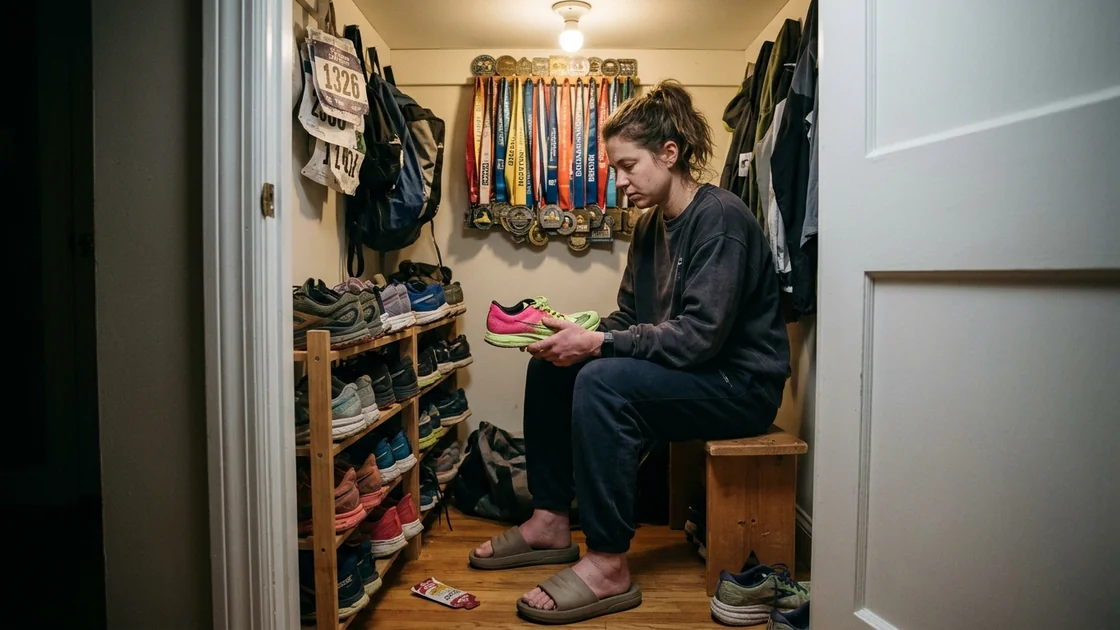
On the cedar shoe racks along the left wall sat fourteen pairs of running shoes, arranged by purpose. On the top shelf were the carbon-plated super-shoes, their neon pink and volt-green midsoles slightly scuffed at the outer heel, still retaining the curved, aggressive rocker geometry designed to propel a human body forward at twelve miles per hour. Below them were the daily trainers, their mesh uppers stained with the reddish dust of the Bridger trails; the lightweight track flats with twenty-millimeter spikes rusted slightly in their plates; the Gore-Tex winter shoes with tiny carbide studs screwed into the lugs for January ice runs.
Above the shoes hung the medal rack Marcus had welded for her thirtieth birthday. Over sixty heavy zinc-alloy medallions hung from red, white, blue, and gold grosgrain ribbons, overlapping like scales on a dragon. Boston. Chicago. New York. Berlin. Big Sur. Grandma’s Marathon. Dozens of regional half-marathons where she had broken the tape outright, her name engraved on the back alongside times that now read like cryptographic codes from an alien civilization: 1:12:44. 2:34:19. 33:50.
Elena stepped across the threshold and sank onto the small wooden bench she used to sit on while lacing up before dawn.
With trembling, clumsy hands, she reached out and lifted a single shoe from the top rack. It was her race-day pair from Berlin—the last marathon she had ever finished before the sickness bloomed.
The shoe weighed almost nothing—six point five ounces of engineered mesh and Pebax foam. She held it cradled between her bloated palms because her fingers couldn't close around the heel counter. Near the toe box, there was a faint dark smudge where she had spilled flat Coca-Cola at the thirty-five-kilometer aid station while moving at full tilt.
She remembered that exact kilometer. The cobblestones near the Kurfürstendamm had been slick with morning mist. Her hamstrings had been screaming, her toenails bruised black inside the mesh, her glycogen stores completely empty. She had looked at her watch, seen she was nineteen seconds ahead of her goal split, and simply decided not to feel her legs for the next twenty minutes. She had severed the wire between her body’s complaints and her brain’s ambition through sheer, tyrannical willpower. And it had worked. She had surged past two Kenyan club runners in the shadow of the Brandenburg Gate, throwing up in a plastic trash bin ten seconds after crossing the line, laughing with blood in her spit because she was invincible.
Why didn't that willpower work now?
People who didn't understand autoimmune illness—well-meaning neighbors, distant cousins on Facebook, colleagues from the sports marketing agency she had been forced to resign from—always said the same thing: If anyone can beat this, Elena, it’s you. You’re a marathoner. You’re the toughest person we know.
They didn't understand that willpower was a currency that only spent in a healthy economy. When you were running a marathon, the harder you pushed, the faster you got to the end. With this disease, the harder you pushed, the more violently your immune system punished you. If she tried to "push through" a bad morning and walk down the driveway to get the mail, she didn't get stronger; she triggered a systemic flare that spiked her C-reactive protein, filled her lungs with pleuritic fluid, and locked her in bed for nine days unable to lift a fork.
The very psychological machinery that had made her great—the refusal to yield, the obsession with metrics, the equation of physical effort with human worth—was now poison.
Elena pressed the dirty nylon mesh of the racing flat against her cheek. She inhaled the dead scent of Berlin asphalt and old sweat.
"Where did you go?" she whispered into the foam tongue of the shoe.
She wasn't talking to her youth, or her health. She was talking to her body as if it were a twin sister who had walked into the woods one afternoon and never come back, leaving Elena trapped inside a clumsy, malicious stranger made of lead and fire.
Suddenly, a sharp spasm locked her lower back—the price of sitting on an unpadded wooden bench for four minutes without lumbar support. She gasped, dropping the shoe. It bounced harmlessly off her shin and rolled onto the floor beside a box of expired Maurten energy gels.
She couldn't bend over to pick it up. If she bent her spine past thirty degrees, she wouldn't be able to straighten it again without help.
She sat there, staring down at the neon shoe lying sideways on the floorboards two feet below her knees. It might as well have been at the bottom of the Mariana Trench.
With a jagged, tearless sob, Elena braced her palms on the doorjamb, hauled her stiff torso upright, and backed out of the closet. She kicked the door shut with the toe of her recovery slide, leaving the light bulb burning inside the dark tomb.
Part III: The Caregiver’s Stride
Marcus came home at 6:42 PM, carrying a paper bag from the Thai restaurant on Fourth Street and the crisp, cold smell of the October evening caught in the wool of his overcoat.
Elena was on the living room sofa, propped up by four strategically wedged memory-foam pillows—one under her knees to keep them at a fifteen-degree bend, two behind her thoracic spine, and a U-shaped cervical pillow cradling her wrists so they didn't touch her lap. A heating pad hummed at the base of her neck.
"Hey," Marcus said, dropping his keys into the ceramic bowl by the door. He walked over and leaned down to kiss her forehead, his cheek cool and smooth against her feverish skin. "How was the course today?"
It was their private vernacular. Early on, she had hated when he asked How are you feeling? because the answer was always Like I’ve been beaten with iron pipes, and saying it three hundred days in a row corroded the soul. So he asked about "the course," treating the house like a variable terrain whose conditions shifted daily without anyone’s fault.
"Hilly," Elena said, offering a weak smile. "Strong headwind in the hallway this morning. Scraped my face on the bathroom turn-around."
Marcus frowned, his eyes dropping immediately to the faint red abrasion on her right cheekbone. A muscle in his jaw tightened—that familiar flicker of helpless rage that crossed his face whenever he found evidence of a fall that had happened while he was at his desk downtown reviewing commercial real estate contracts.
"Did you go down?" he asked quietly, unbuttoning his cuffs.
"No. Caught the frame with my shoulder. Just clumsy."
"You should have called me, El."
"So you could drive forty minutes through traffic to look at a carpet burn?" She tried to keep her voice light, though her throat felt tight. "I made it to the couch by noon. Even drank half the smoothie."
"Only half?"
"The methotrexate nausea kicked in around two."
Marcus nodded once, accepting the data point without pressing her. He had learned not to push food when the low-dose chemotherapy drugs turned her stomach into a churning pit. He went into the kitchen, and she listened to the domestic choreography that had become entirely his burden: opening containers, plating mild jasmine rice for her and spicy drunken noodles for himself, filling her lightweight plastic tumbler with water and a bent silicone straw.
When he came back in, he set a padded lap tray across her thighs with practiced care, making sure the legs of the tray rested on the couch cushions rather than pressing into her inflamed femurs. Then he sat on the coffee table opposite her, eating directly out of the cardboard takeout box with wooden chopsticks.
Elena watched him while she slowly maneuvered spoonfuls of plain rice toward her mouth with her thick-handled foam spoon.
Marcus was thirty-five. They had met eight years ago at a trail running club in Boulder. He hadn't been as fast as she was—very few men outside the semi-pro circuit were—but he was a rugged, steady ultra-runner who loved grinding out fifty-kilometer ridge routes on Saturdays with a hydration pack and a bag of salted boiled potatoes. Their courtship had been entirely kinetic: twenty-mile long runs followed by devouring pancakes at roadside diners, camping trips where they ran up fourteeners before sunrise, biking to breweries in the summer twilight with salt crusted on their eyebrows.
He had married a gazelle. Now he was the sole caretaker of a fragile, broken bird who couldn't pull up her own sweatpants after using the toilet.
She looked at the gray hairs multiplying at his temples and the deep creases bracketing his mouth. He still ran, though he never talked about it in front of her anymore. He went out at 5:30 in the morning while she was still drugged on amitriptyline, showered in the guest bath downstairs so the sound of the pipes wouldn't wake her, and hid his muddy shoes in the trunk of his car rather than bringing them into the house.
"You ran this morning," she said softly, setting the foam spoon down after four bites.
Marcus paused with his chopsticks halfway to his mouth. A look of guilt flashed across his eyes, which hurt her worse than the joint pain.
"Just four miles around the park," he said, looking down at his noodles. "Needed to clear my head before the Henderson deposition."
"What was your pace?"
"El, don't."
"I want to know, Marc. Please. Don't treat my whole life like a banned topic."
He sighed, rubbing the back of his neck. "Seven-fifteen. The air was really crisp. The oaks by the boathouse are totally orange now."
"Did your left calf hold up?"
"Yeah. A little tight on the uphill by the library, but it loosened up after mile two."
Elena closed her eyes for a second, visualizing the uphill by the library—a four-percent grade over cracked asphalt under a canopy of maples, where the roots pushed the sidewalk into little ramps. She could feel the exact change in hip flexion required to attack that grade, the shift onto the balls of the feet, the rhythm of the breath switching to two-in, one-out.
"I'm sorry," she whispered, opening her eyes.
Marcus set his takeout box down on the table with a sharp click. "Stop. We talked about this. You aren't apologizing for being sick."
"I'm not apologizing for the disease," Elena said, her voice cracking as the steroid fragility and the exhaustion of the morning finally breached her dam. "I'm apologizing because you're thirty-five years old and it’s a gorgeous Friday night in October, and instead of being out with friends or packing the Subaru to go camp at Red Rocks, you’re sitting on a coffee table watching your wife struggle to lift a plastic spoon. I ruined our life, Marc. My blood ruined our life."
Marcus didn't offer the hollow platitudes that strangers used. He didn't tell her she would be running again by spring, because they had both looked at the X-rays of her eroded carpal bones and knew that cart was never coming back to the barn.
Instead, he moved from the coffee table to the narrow strip of sofa cushion beside her hip, careful not to jar the mattress springs in a way that would send vibrations into her joints. He laid his warm, dry palm gently over her swollen forearm—one of the few two-inch patches of skin on her body that didn't hurt when touched.
"You didn't ruin anything," he said, his voice low and steady. "The terrain changed, El. That’s all. We signed up for a long course, and the weather turned to shit at mile ten. I’m not dropping out of the race just because we can't run the pace we planned."
"It’s not a race anymore," she wept, turning her face toward his shoulder, though she couldn't twist her stiff neck far enough to bury it in his shirt the way she wanted to. "A race ends. This is just... staying in the ditch until we get old."
"Then I'll sit in the ditch with you," Marcus said simply. He picked up her foam spoon, scooped a tiny mound of warm jasmine rice, and held it out. "Two more bites. You need something in your stomach before the evening pills, or you'll be sick at three AM."
She looked at the spoon, then at his tired, steadfast eyes. Swallowing her pride along with the bile in her throat, she leaned forward half an inch and took the rice.
Part IV: The Waiting Room of the Damned
Tuesday was Infusion Day.
In the calendar of Elena’s old life, Tuesdays were Track Days—400-meter repeats at the high school oval until her vision tunneled, followed by an ice bath and a massive plate of pasta. Now, every fourth Tuesday belonged to the Rheumatology & Immunology Infusion Suite on the fourth floor of St. Jude’s Medical Pavilion.
Getting out of the house was an expedition that required the logistical precision of an Arctic supply drop. Marcus took the morning off work. At 7:30 AM, he carried her down the front steps in his arms—an indignity that still made Elena bite the inside of her lip until it bled, though she now weighed only a hundred and four pounds, her muscle mass cannibalized by chronic systemic inflammation while her face remained artificially puffy from the steroids.
The wheelchair ride from the parking garage to the fourth floor was a gauntlet of sensory assaults. Every expansion joint in the concrete sidewalk sent a percussive shockwave up through the solid rubber tires, straight into her ischial bones and spine. Inside the elevator, healthy people in scrubs or business suits did the terrible hospital shuffle: their eyes would flick down to the woman in the chair—young, wearing a faded Boston Marathon finisher’s jacket that hung off her shrunken shoulders like a tent, her bloated purple hands resting on a pillow in her lap—and then immediately snap upward to the floor indicator numbers with panicked sympathy.
Elena knew what they saw. Before she got sick, she had thought of arthritis as an old person’s nuisance—a grandma rubbing her knuckles when it rained, an excuse to skip gardening. She hadn't known that autoimmune arthritis was an aggressive, systemic organ-threatening monster that could ambush a twenty-nine-year-old athlete in her prime, devouring cartilage, scarring lung tissue, inflaming the pericardium around the heart, and burning out the autonomic nerves until the body couldn't regulate its own blood pressure or temperature.
The infusion suite smelled of isopropyl alcohol, faux-leather vinyl recliners, and the faint, metallic tang of saline.
Twelve recliners were arranged in a wide semicircle around a central nurses' station, separated by half-drawn pastel curtains. It was a quiet room, punctuated only by the rhythmic shhh-click, shhh-click of the Alaris IV pumps and the low murmur of daytime television from muted monitors mounted near the ceiling.
"Morning, Elena," said Maya, the head infusion nurse, as Marcus wheeled her into Bay 4. Maya was a compact Filipino woman with hands so gentle and skilled she could thread a twenty-four-gauge catheter into a rolling, steroid-destroyed vein without leaving a bruise. "How are we transferring today? Pivot or lift?"
"Pivot," Elena said stubbornly, though her knees were screaming from the car ride. "Give me a second to get my feet under me."
Marcus locked the wheelchair brakes and folded the footrests back. Elena leaned forward, planted her flat feet on the linoleum, took Marcus’s forearms—he held them rigid like parallel bars so she didn't have to use her grip—and stood up into the dizzying black rush of orthostatic hypotension. She pivoted ninety degrees on stiff legs and collapsed backward into the deep vinyl recliner.
Her heart hammered at 135 beats per minute for two minutes before settling back below a hundred.
"I've got to run down to the third-floor pharmacy to sort out the prior authorization on the new rescue inhaler," Marcus said, squeezing her shoulder. "I'll be right back up with decaf."
Once he was gone, Maya pulled her rolling stool alongside the chair and wrapped a warm, moist towel around Elena’s left forearm to coax the veins to the surface.
"Dr. Aris looked at your labs from Friday," Maya said softly, tapping the blue skin of Elena’s inner arm with two gloved fingers. "Your ESR is still up around sixty-eight, and the CRP hasn't budged much. So we’re bumping the infusion dose up today and adding an IV Solu-Medrol push beforehand to try and break this flare."
More steroids. Elena closed her eyes. More insomnia, more bone density loss, more muscle wasting in her thighs, more nights lying awake listening to her own pulse rattle in her ears while her skin felt too tight for her skull.
"Little pinch, honey," Maya murmured.
Elena didn't even flinch as the needle slid through her skin. When your baseline existence was a seven out of ten on the pain chart, a needle stick barely registered as a tactile event; it was like striking a match inside a burning house.
The cold saline hit her vein first, traveling up toward her collarbone like an icicle sliding through a pipe. Then came the pre-meds: IV Benadryl and steroids to keep her immune system from going into anaphylactic shock against the mouse-human chimeric antibodies that were about to spend the next four hours dripping into her bloodstream to kill off her B-cells.
Within ten minutes, the IV Benadryl pulled a heavy, syrupy curtain across her brain. She wasn't asleep, just pinned to the vinyl chair in a state of chemically induced detachment.
She turned her head slightly against the paper headrest cover and looked at Bay 5 to her right.
The curtain was pulled back. In the chair sat a man named Julian. He was fifty-two, a former high school shop teacher with ankylosing spondylitis and lupus whom Elena had shared the fourth-Tuesday slot with for over a year. His spine was almost completely fused into a forward curve—bamboo spine, the textbooks called it—so he required three wedges behind his shoulders just to recline without snapping his cervical vertebrae.
Julian was holding a paperback book propped on a gooseneck stand because his shoulders couldn't hold the weight, turning the pages with the rubber eraser end of a pencil held between his teeth.
He caught Elena looking and removed the pencil from his mouth with his left hand, which was slightly less twisted than his right.
"Rough road in today, kid?" Julian asked. His voice was always surprisingly resonant, a rich baritone that hadn't been touched by the calcification of his ribs.
"Thirty-four steps to the bathroom this morning," Elena murmured, her tongue thick from the antihistamine. "And I dropped a shoe in the closet yesterday that I couldn't pick up."
Julian nodded slowly, a tiny one-inch dip of his entire upper torso since his neck couldn't hinge independently. "Dropped my coffee mug on Thursday. Didn't break, just rolled under the radiator. Watched it sit there until my daughter came over on Saturday. Looked at that damn porcelain handle for forty-eight hours."
A dry, wheezing sound escaped Elena’s chest—the closest she had come to a laugh in three weeks.
"Do you ever stop measuring against who you were?" she asked him, staring at the clear plastic tubing carrying the biological poison-cure into her arm. "I keep trying to run the old splits in my head. Every time I stand up, my brain expects my legs to be twenty-eight years old, and then reality hits me with a shovel."
Julian set the pencil down on his lap blanket. The infusion pump beside his head beeped once, paused, and resumed its rhythmic ticking.
"Took me five years to bury the shop teacher," Julian said quietly. "For the first five years, I kept all my woodworking chisels oiled on the pegboard in the garage. Kept thinking if they found the right biologic, I'd be back out there turning oak table legs on the lathe by autumn. Every time I looked at that lathe, I wasn't just in pain—I was being murdered all over again."
"So what did you do?"
"Sold the lathe to a kid down the street for two hundred bucks," Julian said. "Cried for three days until my eyes swelled shut. Then I realized something."
"What?"
"That the guy who used to build cabinets was dead, Elena. And as long as I kept trying to Weekend-at-Bernie’s his corpse around the house, the guy who was actually left in the chair didn't get to have a life at all." He gestured toward the paperback on the gooseneck stand with a crooked knuckle. "Shop teacher Julian never read a book thicker than a Chilton auto manual. Sick Julian has read all of Dostoevsky and half of the Russian realists because he sits in a chair for fourteen hours a day. It’s a shit trade. If God offered me my spine back in exchange for forgetting The Brothers Karamazov, I’d take the spine in a heartbeat. But nobody’s offering that deal. The only deal on the table is whether you spend your four good hours a week mourning the dead runner, or whether you let the woman in the chair have those four hours."
Elena looked away from him, up at the acoustic ceiling tiles.
Bury the runner.
The thought terrified her more than the joint erosion. Who was she if she wasn't the woman who ran? Running wasn't a hobby she had picked up in her twenties to stay fit; it was the architecture of her identity since she was twelve years old, running cross-country through the wet birch woods of Michigan to outrun a loud, chaotic childhood. Every friend she had, her degree in exercise physiology, her career, her marriage, the very way she organized time into training cycles and tapers—it was all built on the bedrock of locomotion.
If she buried the runner, what was left under the duvet except ninety-eight pounds of burning cartilage and medical debt?
"I don't know how to be anyone else," she whispered to the sterile air between their chairs.
"Nobody does at first," Julian said, slipping the pencil back between his teeth to flip a page with the rubber eraser. "You don't learn a new pace in the first mile, kid. You should know that better than anybody."
Part V: The Flare at Mile Twenty
The high-dose steroid push from Tuesday bought her seventy-two hours of deceptive grace, followed by a crash that nearly broke her.
On Saturday afternoon, while Marcus was at the hardware store buying weatherstripping for the basement windows, the biological bill came due. Sometimes an infusion didn't calm the immune system right away; sometimes the dying B-cells dumped cytokines into the blood in a final, spiteful tantrum known as a post-infusion flare.
Elena was sitting at the dining table, trying to sort through a stack of mail while her hands were relatively cooperative. She had actually walked from the living room to the kitchen in twelve steps earlier that morning—almost a glide—and a dangerous, fragile bubble of hope had begun to inflate in her chest. Maybe the higher dose is the magic key, she had thought, watching a cardinal hop across the patio stones. Maybe by spring I can walk around the block with Marcus.
Then, at 2:15 PM, the cold arrived.
It wasn't the cold of an open window; it was the deep, marrow-freezing rigor of a sudden cytokine spike. Within three minutes, her teeth were chattering so violently she bit the side of her tongue. Her fingernails turned the color of slate. Every joint in her body—even ones that normally stayed quiet, like her temporomandibular jaw hinge and the sternoclavicular joints where her collarbones met her breastbone—suddenly seized as if injected with quick-setting cement.
She knew what was coming. If she didn't get back to the bed upstairs or the sofa within ten minutes, she would be completely immobilized at the wooden dining chair when the fever hit.
She dropped the envelopes. Pushing against the table edge with her forearms, she forced herself to her feet.
The living room sofa was only fourteen feet away across the hardwood floor.
She took two shuffling steps. On the third step, her right ankle simply refused to bear weight; the talus bone felt as if it had splintered into shards. She cried out and dropped to her knees on the bare oak floorboards.
The impact of her inflamed patellas hitting the hardwood was a white solar flare of pure agony that erased her vision and hearing for ten seconds. When her senses returned, she was lying curled on her side on the floor between the dining rug and the sofa, gagging on dry heaves, her whole body shaking with rigors as her internal thermostat rocketed past a hundred and two degrees.
Her phone was on the dining table, three feet above her head. Might as well have been on the moon.
The sofa was eleven feet away.
Crawl, the voice in her head hissed.
She couldn't crawl on hands and knees—her knees were swollen to bursting and her wrists couldn't flex. She had to move like a wounded seal, hitching herself across the polished oak on her elbows, hips, and the sides of her calves.
Inch by agonizing inch, dragging her lower body across the cold wood while sweat and tears glued her hair to her cheeks, Elena crossed the floor. Every movement of her ribcage against the wood sent sharp, pleuritic stabs through her chest cavity; the lining of her lungs was inflamed again, rubbing like dry sandpaper with every breath.
It took her twenty minutes to cover the eleven feet.
When her forehead finally bumped against the upholstered base of the sofa, she realized the horrible miscalculation she had made: she was on the floor, and the sofa cushions were eighteen inches above her. With no functioning knees or wrists, she had no mechanical way to climb up onto it.
She tried anyway. She hooked her chin and her right armpit over the edge of the seat cushion and tried to drive with her toes against the floorboard. The effort sent a tearing spasm through her sacroiliac joint while her feet slipped uselessly in their cotton socks. She slid back down to the hardwood in a heap, knocking her lap tray off the coffee table on the way down. The plastic water tumbler hit the floor and spilled cold water across her shins.
She couldn't even pull her legs out of the puddle.
Elena lay on her side on the wet hardwood floor, cheek pressed against the dusty edge of the area rug beneath the coffee table, shivering violently while her skin burned like a stovetop.
In every marathon, there is a moment around mile twenty or twenty-two when the glycogen is gone, the brain stops receiving glucose, and the existential void opens up. Runners call it hitting the wall, or "bonking." It isn't just physical fatigue; it is a sudden, chemical depression where the brain whispers with absolute, seductive certainty: Lie down on the curb. Nobody cares if you finish. Nothing matters. Just stop moving.
Lying in the spilled water on her living room floor, Elena hit the wall.
Not the marathon wall. The human one.
She looked under the coffee table toward the hallway where the bathroom and the medicine cabinet were. Inside that cabinet was a full bottle of Oxycodone that Dr. Aris had prescribed six months ago for acute breakthrough pain—a bottle Elena had refused to touch because she hated how opioids made her feel disconnected from her mind, and because some stubborn remnant of the clean-living athlete still viewed narcotics as a final surrender. Sixty ten-milligram tablets.
For the first time in two years of agony, her brain didn't look at the hallway as a course to be endured. It looked at the medicine cabinet as an exit ramp off the course entirely.
You don't have to do this for another forty years, the quiet voice whispered, and the terrifying thing was that the voice didn't sound crazy. It sounded calm, merciful, and deeply rational. Marcus is only thirty-five. If you drop out of the race, he will grieve for two years, and then he will meet a healthy woman who can run fifty-Ks with him at Red Rocks and have children and open her own jars of almond butter. You are holding both of you hostage in a burning building.
She closed her eyes, letting the logic of it wash over her shivering frame. No more morning ambushes. No more thirty-four steps to the toilet. No more watching runners pass the window while her bones turned to chalk. Just a clean DNF—Did Not Finish—stamped across her chart, and then quiet.
She lay there in the dark behind her eyelids for a long time, listening to the ticking of the grandfather clock in the entry hall and the wet wheeze of her own inflamed lungs.
Then, something strange happened.
Her memory didn't go back to Berlin, or Boston, or any of the races she had won.
It went back to her sophomore year at Stanford. The NCAA West Regional Cross Country Championships.
Four hundred meters into the six-kilometer race, in the chaotic stampede of two hundred spiked runners funneling into a narrow turf turn, someone had clipped her heel from behind. Elena had gone down hard on the frozen mud. Before she could roll clear, two runners behind her had stepped directly on her right calf and her collarbone with quarter-inch steel track spikes.
When she stood up, her singlet was soaked in blood from a gash below her clavicle, her right shoe was torn completely off her foot, and the entire field of two hundred women was already disappearing over the crest of the first hill, two hundred yards away.
Every coach along the rope line had screamed at her to step off the course. You can't run five kilometers in November mud with one shoe and a punctured calf, Vance! Your race is over! Save yourself for indoor track!
She had stood there in the churned mud, dead last by twenty seconds, one bare foot freezing against the frosted grass, blood running down her ribs. She knew with mathematical certainty that she could not win. She could not place. She could not even score points for her team. Everything she had trained for all autumn was utterly destroyed in the first sixty seconds by a random stumble that wasn't her fault.
And yet, she had started running.
Not fast. Not pretty. She had limped and splashed through the freezing mud with one bare purple foot and one shoed foot, passing nobody for the first two miles, running entirely alone in the wake of the race while the officials began taking down the kilometer flags behind her. She had finished 142nd out of 198 runners, four minutes slower than her personal best, her bare foot cut to ribbons by gravel, weeping into her coach’s parka at the finish chute.
Later, when Arthur had asked her why the hell she hadn't stepped off the grass at the four-hundred-meter mark when all hope of a good time was gone, twenty-year-old Elena had looked at him while the trainer stitched her calf and said:
Because I didn't come here to only run the races that go according to plan.
On the wet hardwood floor of her living room, twelve years later, Elena’s eyes fluttered open.
She stared at the grain of the oak inches from her nose.
She had spent two years acting as if her athleticism was stored in her cartilage, her VO2 max, and her six-ounce carbon shoes. She had believed that because the stopwatch was gone and the podium was gone and her legs were broken, she was no longer an athlete.
She had been completely wrong.
Any healthy fool with decent genetics and good cartilage could run fast when the weather was sixty-two degrees and their joints were lubricated with healthy synovial fluid. That wasn't endurance. That was just velocity.
Endurance wasn't what you did when your body obeyed you. Endurance was what you did when your shoe was torn off in the first four hundred meters, your calf was laid open to the bone, the whole pack had left you behind in the freezing mud, and there was no medal waiting for you at the end—only the brutal, unapplauded choice to stay on the course anyway.
She wasn't a dead marathoner rotting on a living room floor.
She was running the hardest, slowest, most invisible ultramarathon on the planet. And she was still on the course.
Elena reached out with her swollen left forearm, hooked it around the wooden leg of the coffee table, and pulled her shins out of the puddle of spilled water, dragging them six inches onto the dry wool of the area rug. Then she pulled the fallen fleece throw blanket off the edge of the sofa cushion with her teeth and chin, draping it awkwardly over her trembling shoulders while she waited for Marcus to come home.
Part VI: The Redistribution of Weight
When Marcus walked through the front door twenty minutes later with two bags of foam pipe insulation under his arm and found her curled on the floor beneath the coffee table, wrapped in a blanket with her hair wet from spilled water and fever sweat, he dropped the bags and fell to his knees beside her so hard the floorboards shook.
"Elena! Jesus Christ, El—"
"I'm okay," she rasped through chattering teeth, before he could panic and reach for his phone to call an ambulance. "Post-infusion flare. Rigors hit fast. Just missed the sofa transfer."
He slipped his hands beneath her back and knees, lifting her as carefully as if she were made of spun sugar, and laid her on the sofa cushions. Within three minutes he had stripped off her wet socks, wrapped her feet in a heated electric throw, packed warm rice bags around her shoulders, and helped her sip twenty milligrams of liquid prednisone and Tylenol through a straw.
For two hours, he sat on the floor beside the sofa with his hand resting on her shoulder while the fever crested at 102.6 and then slowly broke, soaking the cushions in sweat.
Around six o'clock, as the autumn twilight turned the living room windows deep indigo, the rigors stopped. The pleuritic stabbing in her chest subsided to a dull ache. Her joints still felt swollen and hot, like plums left in the sun, but the acute cytokine storm had passed over the ridge.
Elena turned her head on the pillow and looked down at Marcus. His head was resting against the sofa cushion near her elbow, his eyes closed, dark purple hollows beneath his lower lids.
"Marc," she said softly.
He opened his eyes immediately. "Yeah? Water?"
"No. Go downstairs to the laundry room."
"Do you need clean sheets?"
"No," she said. Her voice was hoarse, scraped raw, but steady. "I want you to open the gear closet across from the dryer. And I want you to bring up the two large cardboard moving boxes from the basement storage."
Marcus blinked, sitting up straight. He searched her face in the dim light of the living room lamp. "El... you just had a hundred-and-two fever. You don't need to make any big gestures right now."
"It’s not a gesture," Elena said. "The light bulb in that closet has been burning since Monday because I couldn't reach back in to turn it off after I dropped my Berlin shoe. It’s wasting electricity. And it’s taking up space we need."
"Space for what?"
"If I'm going to be on the first floor during the day when I'm flaring, I can't keep crawling up the stairs on my tailbone at night when my hips lock," she said plainly, saying aloud the pragmatic horror she had refused to acknowledge for fourteen months. "We need to turn the downstairs den into a bedroom for the bad weeks. Which means the bookshelves in the den need to go into that closet. Which means the shrine has to come down."
Marcus stared at her for a long moment. He knew what those shoes and medals meant to her; he had watched her guard that closed door like a dragon guarding gold she could no longer spend.
"Are you sure?" he asked quietly.
"Keep the Berlin shoes and the Boston medal," she said. "Put them in a shadow box in the hallway if you want. They happened. I earned them. I don't have to pretend I never ran a 2:34 just because I can't walk today. Looking at a photograph of a mountain you climbed doesn't mean you have to pitch your tent on the summit forever."
She paused, drawing a careful breath into her bruised ribs.
"Everything else—the unworn trainers, the track spikes, the winter Gore-Tex pairs, the racing singlets—box them up. Coach Arthur works with that high school track program on the south side where the girls run in basketball sneakers. Call him tomorrow and tell him to come get them. Size seven and a half. Somebody should be burning up the roads in that foam before it dries out."
Marcus swallowed hard. His eyes shone wetly in the lamplight, though he didn't let the tears fall. He leaned forward and pressed his forehead gently against the side of her temple.
"Okay," he whispered. "Okay, El."
"And Marc?"
"Yeah?"
"Tomorrow morning, don't put your muddy trail shoes in the trunk of the Honda like you're hiding an affair," she said, a faint, tired curve touching the corner of her mouth. "Put them on the mat by the back door where they belong. And when you come back in, I want to hear the splits."
Part VII: A New Cadence
November arrived with an early snow that dusted the birch trees along Elmwood Avenue and turned the canal path into a quiet white ribbon.
On a Wednesday morning three weeks after the living room fall, Elena woke up at 7:05 AM in the new ground-floor bed they had set up in the converted den.
The room didn't look like a hospital room—she had been fiercely specific about that. There were no steel rails or institutional vinyl. It was painted a deep, warm sage green, with large double windows facing the bird feeders in the backyard, and the floor was covered in a dense, ultra-soft wool rug without a single protruding tack strip. Above the dresser hung a single framed shadow box containing one pair of scuffed neon-pink carbon racing shoes and a single blue-and-yellow unicorn medal from Boston.
The ambush still happened when she opened her eyes. The disease had not been cured by an epiphany; biology did not care about narrative arcs. Her metacarpals still throbbed with that familiar, heated pulse, and her left knee was swollen stiff from a drop in barometric pressure overnight.
Today was maybe a twenty-four-step day. Not a nineteen, not a thirty-four. Somewhere in the middle.
Instead of clenching her jaw and trying to hurl her body out of bed with the angry impatience of a healthy sprinter trapped in tar, Elena reached over to the nightstand before sitting up.
Sitting beside her lamp were two objects she had finally consented to bring into the house the week before: a pair of lightweight, ergonomic forearm crutches with molded soft-silicone troughs that cradled her elbows and forearms so her ruined wrists and hands didn't have to bear a single ounce of downward pressure, and a thermos of warm water she had pre-dosed with her morning anti-inflammatories at midnight.
Before she got sick, she had viewed mobility aids as symbols of defeat—white flags hoisted over a conquered body. Now, after a long Tuesday afternoon talk with Julian in Bay 5 while the biologic dripped into their veins, she saw them for what they actually were: gear.
A runner didn't run across January ice in bare feet out of pride; she put carbide studs in her soles to match the terrain. If the terrain of her hallway was jagged bone and unstable knees, then forearm troughs were simply the carbon plates required for the course.
She drank the warm water through the silicone straw, waited fifteen minutes while watching a downy woodpecker hammer at the suet cage outside the frosted window, and then began the sectors.
Sector One: The Roll. Sector Two: The Drop.
She slid her feet into the recovery slides waiting at the edge of the wool rug. Then she slipped her forearms into the black cuffs of the crutches, letting her swollen hands rest loosely and harmlessly over the padded forward grips without squeezing.
"On three," she told the quiet room.
One. Two. Three.
She drove upward, letting the aluminum shafts and the strong muscles of her lats and triceps take forty percent of the load off her screaming knees.
The room tilted with the morning blood-pressure drop, the familiar black snowflakes dancing across the sage-green wall. She didn't fight it or curse it. She simply stood planted on her four points of contact—two slides, two rubber crutch tips—and breathed. In for four. Out for six.
When her vision cleared, she looked across the hall toward the kitchen doorway.
Marcus was standing at the stove in his running tights and a fleece pullover, his cheeks bright red from the November frost outside, flipping pancakes with a spatula while steam rose from the kettle. On the rubber mat by the back door sat his muddy trail shoes, chunks of slushy snow melting off their lugs onto the tray.
He heard the soft thump-click of her crutches on the threshold and turned around, a grin breaking across his windburned face.
"Morning," he said. "You're up early. How’s the course?"
Elena took a step forward—left crutch, right foot; right crutch, left foot. With the weight redistributed through her shoulders and forearms, her knee didn't buckle or pop. The pain was still there—a loud, hot six out of ten—but she wasn't falling. She was moving under her own power, upright, across the twenty-two feet from the bed to the kitchen table.
It took her ninety seconds. No world records were broken. No crowd roared behind a timing mat.
When she reached the table, she eased herself down into the padded captain’s chair, rested the crutches against the wall, and wrapped her stiff, warm forearms around the ceramic mug of coffee Marcus set in front of her, inhaling the dark, rich steam.
"Slick," Elena said, looking out the window at the snow falling over the backyard. "A little icy on the first turn. But I held my pace."
She looked across the table at her husband as he sat down with two plates.
"Now," she said, lifting her thick foam fork with the crook of her thumb. "Tell me about the hill by the library."