The Decade of Borrowed Hours
Clara Vance spent ten years of her life suspended in the amber of a promise, waiting for Arthur Pendelton to leave his wife and build the life he swore they deserved together. From the vibrant optimism of her mid-twenties to the quiet, encroaching exhaustion of her mid-thirties, she existed in the margins of his schedule, accepting stolen weeknights, belated holiday celebrations, and an endless litany of domestic excuses as the temporary price of true love. It was only on the tenth anniversary of their clandestine affair, when a chance encounter in a rain-slicked city square shattered the careful architecture of his lies, that Clara realized the agonizing truth: she had not been the prelude to his new life, nor a partner in waiting, but a convenient harbor he never intended to make his home, leaving her to mourn a decade of her youth squandered on a phantom future.
The kettle on Clara’s stove had a peculiar whistle, a fractured, dual-toned shriek that always sounded to her like a bird caught in a chimney. When she had first moved into the fourth-floor walk-up on Elm Street, she had intended to replace it. She had intended to replace a great many things: the rattling aluminum blinds, the chipped porcelain sink in the bathroom that bore a rust stain shaped like Corsica, the radiator that hammered like an angry neighbor throughout the long New England winters. In the beginning, the apartment was merely a staging ground, a temporary barracks where she would store her books, her linen, and her youth until the real house—the one with the wrap-around porch, the cedar closets, and the legitimate mailbox bearing two names—became available.
That was in the autumn of her twenty-fifth year, when the air smelled perpetually of woodsmoke and possibility, and when Arthur Pendelton still looked at her as though she were a body of water and he a man dying of thirst.
Now, the kettle shrieked its familiar, broken note, and Clara did not even wince. She lifted it from the gas burner with a faded quilted mitt, poured the boiling water over two porcelain mugs containing loose-leaf Darjeeling, and glanced at the small brass clock on the mantelpiece. It was 6:15 on a Tuesday evening in November. Outside, a cold, greasy rain was smearing the amber streetlights across the windowpanes.
Arthur was fifteen minutes late, which meant he was on time by the metric of their shared existence. Fifteen minutes was the buffer required to tell Margaret that the quarterly audit at the firm was dragging on, or that the commuter rail had stalled outside of Stamford, or that he was having a quick drink with Harrison from accounting to smooth over the Henderson merger. Over three thousand six hundred and fifty days, Clara had learned the taxonomy of Arthur’s excuses so thoroughly that she could have written the playbook herself. She knew which lies required a follow-up text message, which ones allowed him to stay until eleven, and which ones meant he would spend his time in her bed staring at the ceiling, his jaw tight with the phantom pressure of a domestic schedule he refused to sever.
The buzzer rang—two short bursts, never a long one. Even in the empty vestibule of an apartment building four miles from his neighborhood, Arthur operated with the stealth of a cold-war operative.
Clara pressed the talk button, then the release, and unlocked her front door, leaving it ajar by two inches. She returned to the kitchen, took a slow breath to smooth the lines between her eyebrows, and checked her reflection in the dark glass of the microwave door. At thirty-five, she was still striking, though the brightness that had once defined her features had settled into something quieter, more deliberate. Her dark hair, once worn in loose, careless waves down her back, was pinned into a neat French twist. There were faint, papery crescents beneath her gray eyes—the permanent ledger of a thousand nights spent listening for a key in a lock that never turned after midnight.
She heard his footsteps on the stairs. They were heavier than they used to be. Ten years ago, Arthur had taken the stairs two at a time, bursting through her door with the cold air clinging to his wool coat, his hands immediately finding her waist, his mouth urgent against her neck before his briefcase had even hit the floor. Now, there was a slight pause on the third-floor landing. A soft clearing of the throat. The measured tread of a man of forty-eight whose knees bothered him when the barometer dropped.
The door pushed open, and Arthur stepped inside, shaking out a black umbrella before placing it precisely in the porcelain stand by the radiator.
"Sorry, darling," he said, his voice that familiar, rich baritone that had first undone her in a crowded conference room a decade ago. "The cross-town traffic was an absolute nightmare. An overturned delivery truck on Fifth. I sat through four cycles of the light at Mercer."
"It's alright," Clara said, stepping forward to take his damp trench coat. "The tea is just steeped."
He caught her by the wrist as she reached for his lapel, pulling her into his chest. He smelled of rain, the sharp citrus of his cologne, and underneath it, the faint, dry scent of the cedar blocks Margaret kept in their hall closet. Clara closed her eyes and leaned into him for the allotted five seconds. It was a choreography they had perfected. Long enough to signify devotion; brief enough that her face powder wouldn't transfer to the wool of his suit jacket.
"God, let me look at you," Arthur murmured, framing her face with his hands. His palms were warm. His silver-threaded hair was slightly damp at the temples, curling over his ears. He still had the handsome, patrician profile of an old-money lawyer, though his jawline had softened and the creases around his mouth had deepened into permanent parentheses. "You look wonderful. Is that new?"
He gestured to her sweater—a soft, moss-green cashmere V-neck.
"I bought it three years ago, Arthur," she said, offering a small, indulgent smile. "We were in Boston. Remember? When you had that deposition for the shipping company."
A shadow of something—embarrassment, perhaps, or just the fleeting irritation of a man reminded of his own failing memory—crossed his face before he smoothed it away with a kiss to her forehead. "Of course. The little boutique near the Common. It still brings out the green in your eyes."
Her eyes were gray, entirely devoid of green, a fact she had corrected him on in year two and abandoned correcting by year five. She turned back to the kitchen and handed him his mug.
"Happy anniversary," she said softly.
Arthur froze with the mug halfway to his mouth. For a fraction of a second, panic flared in his pupils—the conditioned reflex of a husband who believes he has forgotten a mandated milestone—before he recalibrated which life he was currently standing in.
"Ten years," he said, his voice dropping an octave into the register he used for profound declarations and courtroom summations. He set the mug down on the small butcher-block island and reached into his breast pocket. "You didn't think I'd forgotten, did you?"
He produced a narrow velvet box, dark blue, the edges slightly worn from sitting in his pocket all day. Clara’s heart performed its treacherous, habitual leap. Even now, after a decade of false dawns, some foolish, stubborn organ inside her ribcage still expected the box to contain a key, or a plane ticket, or a folded legal document stamped by the family court of the state.
She opened it. Resting on the white satin was a gold bracelet, a delicate chain set with small, pale aquamarines.
"Because you're my calm water," Arthur said, stepping behind her and taking the bracelet from the box. He fastened it around her left wrist, his fingers lingering over her pulse point. "Ten years, Clara. I don't deserve you. I know I don't. The patience you've shown me... the grace."
Clara looked down at the pale stones. They were beautiful, expensive, and entirely anonymous. It was the kind of jewelry a woman could wear to her job at the university press without drawing questions from her colleagues, the kind of piece that didn't scream of a grand passion, only of modest, tasteful self-purchase. Her jewelry box in the bedroom was full of such things: pearl studs, silver pendants, a thin gold watch. A museum of quiet consolation prizes.
"It's lovely, Arthur," she said, turning in his arms to kiss his cheek. "Thank you."
"Next year," he whispered into her hair, his hands sliding down to the small of her back, pulling her hips against his. "Next year, we won't be celebrating in this apartment. We'll be in Florence. Or the coast of Maine. Out in the open. Just you wait. Once Toby is settled into his spring semester at Dartmouth, the house goes on the market. I've already spoken to Miller about structuring the assets."
There it was. The liturgy.
In the first year, it had been: Margaret is fragile right now; her mother just passed, and if I leave, it will break her.
In the third year, it had been: Toby is only eleven. A boy needs his father in the house during those formative middle-school years. Just until he’s in high school, Clara. Two years, I swear to God.
In the fifth year, it had been the партнерship track at the firm: The senior partners are old-school Presbyterians. A messy divorce right before the vote would ruin everything I’ve worked for—everything I’m building for us.
In the seventh year, Margaret had had a cancer scare—a benign cyst, ultimately, though the diagnostic period had stretched into eighteen months of preventative anxiety during which Arthur could not possibly be seen as the monster who abandoned a potentially sick wife.
And for the last two years, it had been Toby’s college applications, followed by Toby’s transition to freshman year, which apparently required the structural integrity of a nuclear family three hundred miles away in Hanover to prevent the boy from failing introductory economics.
Clara knew the script by heart, yet as Arthur’s mouth found hers, parting her lips with the familiar, practiced urgency that still managed to make her knees weak, she let the words wash over her like warm water. It was easier to believe him than to calculate the cost of disbelieving him. To doubt Arthur now was to admit that the woman who had walked into this apartment at twenty-five had been murdered by inches, and that Clara herself had held the pillow over her face.
To understand how a sensible woman—a woman with a master’s degree in comparative literature, a woman who paid her taxes early and read dense Russian novels for pleasure—could misplace a decade, one had to understand the specific gravity of Arthur Pendelton in the autumn of 2014.
Clara had been twenty-five, freshly arrived in the city from a small, flat town in Ohio where people married their high school sweethearts at twenty-two and spent the rest of their lives discussing lawn maintenance and church potlucks. She had come east looking for texture, for intellect, for a life that felt like the books she edited as a junior assistant at Mercer House Publishing.
Arthur had been thirty-eight, an intellectual property attorney brought in by the publishing house to vet a contentious memoir by a former diplomat. He had walked into the third-floor conference room wearing a charcoal flannel suit that fit him like an accusation against every poorly dressed boy Clara had ever dated. While the senior editors dithered over libel clauses, Arthur had leaned back in his leather chair, uncapped a heavy fountain pen, and dismantled the plaintiff’s theoretical case in four sentences of crisp, devastatingly precise prose.
When he looked across the table and caught Clara staring at him, he hadn't looked away. He had held her gaze for three seconds too long, the corner of his mouth lifting in a faint, conspiratorial smile that seemed to say: You and I are the only two people in this room who are actually awake.
The affair did not begin with a predatory lunge; if it had, Clara would have recognized it from the cautionary tales her mother had fed her since puberty. Instead, it began with books.
He lingered after the meetings to ask what she was reading. When she mentioned a little-known translation of Rilke’s letters, he showed up two days later at the reception desk with a first-edition copy from 1945 he had found in a dusty shop on Fourth Avenue, leaving it in a brown paper bag with her name written in his fountain-pen script. No note. Just the book.
Then came the accidental coffees in the lobby. Then the rainstorm in late October when he offered her a cab ride uptown and ended up sitting with her in a dark, wood-paneled booth at the Algonquin for four hours while the rain lashed the awning outside.
He had told her about Margaret that very first night. He had not hidden his wedding ring; in fact, he had turned the heavy gold band around and around on his fourth finger as he spoke, a study in noble melancholy.
"We married too young," he had said, staring into his scotch. "We were twenty-four. Our families knew each other in Connecticut. It was what was expected. Margaret is a good woman, Clara. She’s an admirable woman. She runs charities, she keeps an immaculate house, she loves our son. Looking at her is like looking at a very fine, very cold piece of marble. We haven't shared a bedroom in three years. We haven't shared a thought in ten."
He had looked up then, his dark eyes fixing on hers with an intensity that made the air in her lungs feel thin. "I thought that part of my life was simply over. I thought a man made his bed, lay down in it, and waited to get old. And then I walked into that conference room three weeks ago, and I saw you."
At twenty-five, Clara had not heard the banality of the speech. She had not heard the ancient, worn-out tropes of the dissatisfied suburban husband. She had heard tragedy. She had seen a man of immense passion and intellect trapped in an Edwardian cage of duty, and she had cast herself—with all the fierce, romantic arrogance of youth—as his liberation.
The first time he came to her apartment—not the Elm Street walk-up, which came later, when he insisted on helping her find a place in a better neighborhood, "closer to the park so we can walk"—he had stopped inside the doorway, trembling. He had kissed her hands, her wrists, the hollow of her throat, whispering her name as if it were a prayer he was only allowed to utter in secret. When they made love on her narrow mattress, he had wept afterward, burying his face in the curve of her shoulder.
"I can't do this to you," he had choked out, his body heavy and hot against hers. "I can't make you a secret, Clara. You're too bright for the shadows. Let me go home tonight and end it. Let me tell her."
And it was Clara—God help her, it was Clara—who had stroked his damp hair and whispered, No, wait. Don't be reckless. Think of your son. Think of the holidays coming up. We have time. What does a few months matter when we have the rest of our lives?
She had laid the first brick of her own prison, and she had handed him the trowel with a smile of saintly self-sacrifice.
In the bedroom of the Elm Street apartment, the radiator clanked its metallic rhythm as Arthur dressed.
It was 9:45 PM. The window between dinner and the last plausible train to Westport was closing. Clara lay propped against the pillows, the white sheet pulled up to her collarbone, watching the familiar ritual of his reconstruction.
When Arthur arrived, he shed his life in layers: the coat, the jacket, the watch, the wedding ring (which he always placed in the small ceramic dish on her dresser—a gesture of respect for her, he said, though she noticed he never forgot to put it back on), the cufflinks, the tie. For three hours, he was simply Arthur: naked, attentive, hungry for the soup she had simmered all afternoon, eager to hear her thoughts on the manuscript she was editing, laughing at her dry observations about the pompous head of her department.
Then, at 9:30, the transformation began in reverse.
He stood before her full-length mirror, knotting his silk tie with practiced, blind efficiency. As each piece of cloth went back onto his body, his posture changed. The slight softness in his shoulders vanished; his chin lifted; his mouth settled into the flat, neutral line he wore into the world.
"I won't be able to call tomorrow until after two," he said, adjusting his cuffs. "We're in arbitration all morning with the pharmaceutical people. And Thursday night is that dinner for the Bar Association. Margaret’s on the committee this year, so I have to be there early for the cocktail hour."
"I remember," Clara said, her fingers tracing the hem of the sheet. "You told me on Sunday."
He picked up his wedding ring from the ceramic dish. There was always a fraction of a second—a microscopic hitch in his movement—before he slid it over his knuckle. He never looked at her when he did it.
"What will you do this weekend?" he asked, turning to sit on the edge of the mattress to put on his shoes.
"Sarah asked me to go up to the Hudson Valley with her and Mark," Clara said. "They rented a cabin near Beacon. Some friends of Mark’s from the architectural firm are going."
Arthur’s hands paused on his shoelaces. He didn't turn around, didn't raise his voice, yet the temperature in the room dropped by five degrees.
"Friends of Mark's?" he repeated, his tone carefully light. "Single friends, I assume. Is Sarah still trying to play matchmaker?"
A tired spark of anger flickered in Clara’s chest. Five years ago, this reaction would have thrilled her; she had taken his jealousy as proof of his claim on her, evidence that he viewed her as his true wife. Now, it just felt like a leash being tugged.
"They're just friends, Arthur. Couple friends, mostly. And even if there is someone single there, what am I supposed to do? Sit in this apartment from Friday at five until Monday at nine waiting for you to send me a text from your garage when you take the dog out?"
Arthur sighed, turning around on the bed to take her hands. His face was a mask of wounded devotion. "That's not fair, Clara. You know it kills me when I can't be with you on the weekends. Do you think I want to spend Saturday afternoon at a country club listening to Margaret's brother talk about his golf handicap? Every minute I'm there, I'm thinking about being here. With you."
He brought her knuckles to his lips. "Go to the cabin, of course. Have fresh air. See Sarah. I just... I hate the thought of some man looking at you across a dinner table, thinking you're available, when you're mine. I'm selfish where you're concerned. I admit it."
"I'm thirty-five, Arthur," she said quietly, pulling her hands back just an inch. The aquamarine bracelet caught the dim light of the bedside lamp. "Sarah had her second child four months ago. When I go to her house, there are highchairs and toys on the rug, and Mark comes home at six o'clock and walks right through the front door. He doesn't have to buzz two short times. He has his name on the lease."
Arthur’s expression darkened with that familiar, heavy sorrow that always made Clara feel as though she were kicking a man who was already down.
"I know," he whispered. "I know what I've asked of you. And I know the biological clock... if it's children you're worried about, Clara, women have babies at thirty-seven, thirty-eight all the time now. Once the divorce is filed in the spring, we won't wait. We'll start trying immediately. Before the ink is even dry, if that's what you want."
He leaned in, pressing his forehead against hers. "Just hold on a little longer for me. We're at the thirty-yard line. Don't give up on us when we're so close to the end."
He kissed her—a deep, lingering kiss that tasted of the mints he kept in his pocket to mask the Darjeeling tea and the garlic from her pasta sauce. Then he stood, picked up his briefcase, and walked out the door.
Clara listened to his footsteps descend the four flights of stairs. One flight. Two flights. The pause on the third landing. Three. Four. The heavy thud of the street door closing.
She got out of bed, walked naked to the living room window, and parted the rattling aluminum blinds with two fingers. Down below, on the rain-slicked pavement of Elm Street, Arthur emerged from the vestibule. He opened his black umbrella, turned up his collar, and hailed a cab at the corner of Mercer. Within thirty seconds, the red taillights had dissolved into the wet neon blur of the avenue.
Clara let the blind snap shut. The apartment was instantly, crushingly silent.
She walked into the kitchen. On the counter sat the two mugs, two dinner plates smeared with the remnants of bolognese, and two wineglasses—one with a faint crescent of her rose lipstick on the rim, the other clean. She washed them slowly in the hot, soapy water, dried them with a linen towel, and put them back in the cabinet.
It was the ritual of erasure. Every Tuesday and every other Thursday, after Arthur left, she scrubbed every trace of his presence from her home, while simultaneously knowing that he was sitting on the Metro-North train, wiping every trace of her from his skin before Margaret picked him up at the station—or before he pulled his Mercedes into the circular driveway of the colonial house in Westport she had looked up on Zillow three hundred times in the dark.
The erosion of a life does not happen all at once, like a cliff collapsing into the sea; it happens like the tide wearing down a jetty, grain by imperceptible grain.
Looking back over the ten years, Clara could see the ghosts of the lives she had declined to live in order to keep the space beside her empty for Arthur.
There had been the fellowship in Edinburgh when she was twenty-seven. Six months at the university there, working with their archival collection of nineteenth-century Scottish periodicals. Her mentor at Mercer House, a sharp-tongued woman named Evelyn who wore heavy turquoise jewelry and smelled of clove cigarettes, had practically handed her the grant on a silver platter.
"Go," Evelyn had told her over a dry martini at PJ Clarke's. "Get out of New York for half a year. Meet a poet with bad teeth and a woolen sweater. Make yourself indispensable to the European distributors."
When Clara had told Arthur about it, sitting on a bench in the Conservatory Garden on a bright Saturday morning he had stolen by claiming he had a CLE seminar in midtown, he hadn't forbidden her to go. He was far too clever for that.
Instead, he had stared at the gravel path between his polished oxfords for a long time, his jaw working.
"It's a tremendous opportunity," he had said, his voice hollow. "You should take it. Of course you should."
"Wait," she had said, reaching for his arm. "Talk to me. What are you thinking?"
"I'm thinking," he said, turning eyes on her that were bright with unshed tears, "that you're the only thing keeping my head above water right now. I'm thinking that six months without seeing your face, without touching you... Clara, I don't know if I'll survive that house without you. And I'm terrified that if you go to Scotland, you'll realize how easy life is when you're not loving a man with baggage. You'll forget me."
She had turned down the fellowship the following Monday. Evelyn had looked at her over the top of her reading glasses for a long, terrible minute before dropping the rejection form into her out-box. "A man?" Evelyn had asked flatly. When Clara didn't answer, the older woman had only sighed. "If he's not standing on the dock with a steamer trunk of his own, Clara, he's an anchor, not a sail."
Then there had been Julian, when she was thirty.
Julian was a book designer who freelanced for the press—tall, slightly stooped, with ink stains on his cuticles and a laugh that made people turn around in restaurants. During one of Arthur’s "dark periods"—a six-week stretch in the summer of 2019 when Arthur had taken Margaret and Toby on a grand tour of the Mediterranean to celebrate Toby’s middle-school graduation, leaving Clara with only sporadic, frantic emails sent from hotel business centers—Clara had agreed to go to an art opening in Chelsea with Julian.
It wasn't a date, she had told herself. It was colleagues looking at paintings.
Afterward, they had walked along the High Line in the warm July dusk, drinking cheap white wine from plastic cups at a pop-up bar. Julian had talked about his sister's wedding in Vermont, about the woodshop he was building in his garage in Brooklyn, about his absurd desire to learn how to bake sourdough bread. He was thirty-two, entirely unencumbered, and he looked at Clara in the golden hour light with an open, uncomplicated admiration that made her chest ache.
Outside her building on Elm Street, he had leaned against the iron railing of the stoop, his hands shoved deep into the pockets of his chinos.
"I'd really like to kiss you, Clara," he had said, his voice slightly rough with nervousness. "And then I'd like to take you to breakfast tomorrow at that diner on Ninth with the terrible coffee, and then maybe we could go to the Brooklyn Museum. In that order."
She had looked at his mouth, at his kind, honest eyes, and for ten seconds she had felt the dizzying vertigo of a prisoner looking through an open cell door. If she stepped forward, she would have mornings. She would have Sundays with the newspaper spread across the floor. She would have Thanksgiving dinners where she didn't eat take-out Thai food alone in her bathrobe while waiting for a three-minute phone call from a snowy driveway in Connecticut.
And then her phone had vibrated inside her purse.
She hadn't even needed to look at it to know who it was. It was 4:00 AM in Amalfi. Arthur had slipped out onto the balcony of his suite while Margaret slept to send her a message: Looking at the sea. It means nothing without you here. Counting the hours until Tuesday. I love you more than my life.
"I can't, Julian," she had said, stepping backward up the first concrete stair. "I'm... I'm seeing someone. It's complicated."
Julian had nodded slowly, the light going out of his face in a quiet, dignified way. "Complicated usually means he belongs to someone else," he had said gently, without malice. "Take care of yourself, Clara."
Two years later, Julian had sent a mass email to the department announcing his marriage to a ceramicist named Nora, complete with a photograph of the two of them laughing under an arbor of wildflowers in Vermont. Clara had stared at the JPEG on her office monitor for twenty minutes before going into the third-floor ladies' room and vomiting dryly into the sink.
And it wasn't just the men or the jobs. It was the friendships that had withered because she could never explain where she went on Tuesday nights, or why she was periodically unavailable on random Saturday afternoons at twenty minutes' notice, or why she refused to bring the "man in her life" to Sarah’s dinner parties.
In the early years, Sarah—her college roommate and dearest friend—had listened to the saga of Arthur with wide-eyed, wine-fueled fascination. At twenty-six, an affair with an older, wealthy lawyer sounded like the plot of a French film. By thirty, when Sarah was engaged to Mark and buying registry china at Bloomingdale's, her sympathy had curdled into skepticism. By thirty-three, after Clara had spent her third consecutive Christmas Eve crying on Sarah’s sofa while Mark awkwardly mixed eggnog in the kitchen, Sarah had drawn a boundary.
"I love you, Clara," Sarah had said the following January, sitting across from her in a bright, noisy cafe in Soho. "You are my sister. Which is why I am telling you that I cannot hear the name Arthur Pendelton again unless it is attached to a docket number in the Connecticut Superior Court. He is eating your life. He is eating your thirties like a man eating grapes off a platter, and when he's full, he's going to wipe his mouth and go back to his wife."
Since then, they had never spoken of him. A vast, silent continent had risen between them. When Clara visited Sarah and Mark’s townhouse in Park Slope, holding their baby daughter, smelling the warm milk and the roast chicken in the oven, she felt like a ghost pressed up against the window of the living world—transparent, weightless, unable to leave a fingerprint on anything real.
The Friday after their tenth anniversary, Clara did not go to the cabin in Beacon.
She told Sarah she was coming down with a sinus infection and needed to stay in bed with a humidifier and a stack of page proofs. In truth, she simply couldn't bear the thought of sitting around a fire pit with three married couples and Mark’s single architect friend, performing the bright, self-contained thirty-five-year-old woman who "just loved her independence too much to settle down."
Instead, on Saturday afternoon, when the November rain finally broke into a sharp, crystalline autumn chill, Clara put on her heavy camel wool coat, wrapped a cashmere scarf around her neck, and walked downtown toward the village.
She needed to buy a birthday gift for her niece in Ohio, and she wanted to walk until her legs were tired enough to guarantee sleep that night without the aid of the little blue pills she had started breaking in half over the last year.
The city was putting on its holiday armor early. In the West Village, the brownstones were already draped in garlands of cedar and white fairy lights, and the air smelled of roasted chestnuts and exhaust. As she turned onto Bleecker Street, passing the small, jewel-box boutiques and bakeries with lines curling out onto the sidewalk, she felt a sudden, sharp craving for the pear tart from a little French patisserie on Perry Street that Arthur had brought her once during the pandemic—the dark winter of 2020 when she had gone four months without touching another human being because Margaret was terrified of the virus and had insisted on locking the family down at their second home in Litchfield County.
She turned the corner onto Perry, her hands tucked into her pockets, her head down against the wind coming off the Hudson.
She was twenty yards from the patisserie when the door of the shop opened, the little brass bell jingling brightly in the cold air, and Arthur stepped out onto the pavement.
Clara stopped dead behind the trunk of a bare London plane tree.
For a disorienting second, her brain refused to process the image because the context was entirely wrong. Arthur was never in the city on a Saturday afternoon unless he was with her. Saturday was Westport. Saturday was leaf-blowing, or hardware stores, or driving up to Hanover to take Toby out to dinner, which was precisely where Arthur had told her he was going this weekend. Toby’s having a rough time with his organic chemistry midterm, he had texted her from the highway at ten o'clock that morning. Driving up to New Hampshire to take him for a steak and talk him off the ledge. Spotty service on I-91. Miss you already.
Yet here he was on Perry Street.
He was not wearing the dark, sober suits she knew, nor the slightly worn tweed jacket he kept in her closet for their rare walks in the park. He was wearing a cream-colored cable-knit sweater under a navy quilted vest, pristine dark jeans, and brown suede Chelsea boots. He was carrying two pink pastry boxes tied with white string.
And he was not alone.
A woman stepped out of the shop behind him, laughing at something he had just said.
Clara had seen photographs of Margaret Pendelton before, of course. In the early, masochistic years, she had scoured the society pages of the Fairfield County Look and the charity gala archives of the local hospital, staring at the pixelated images of a tall, blonde woman in silk evening gowns until her eyes burned.
In Clara’s mind, shaped by ten years of Arthur’s descriptions, Margaret was a gargoyle of domesticity: frigid, brittle, joyless, a woman with a mouth like a steel trap and eyes like chipped ice who held Arthur hostage through guilt and financial entanglement.
The woman standing on the sidewalk in the late afternoon sun was fifty-two, perhaps, though she looked forty-five. Her blonde hair was cut in a chic, effortless bob that grazed the collar of her camel coat—a coat uncomfortably similar to the one Clara was currently wearing, though undoubtedly three times the price. Her face was unlined around the mouth, except for deep, warm crinkles at the corners of her eyes as she laughed.
As Clara watched, paralyzed, her back pressed against the rough bark of the tree, the woman reached up and adjusted Arthur’s scarf, tucking the cashmere neatly into the collar of his vest.
Arthur did not flinch. He did not pull away with the stiff, dutiful tolerance of a man trapped in a loveless marriage.
Instead, he leaned down, caught his wife’s gloved hand in his own, and kissed her knuckles—the exact, fluid gesture he had used on Clara’s hand on Tuesday night—before nuzzling his nose against her cheek.
Margaret said something, nodding toward the small park at the end of the block, and slipped her arm through his. As she did, she lifted her left hand to brush a lock of hair from her face, and the late afternoon sunlight caught her wrist.
Around it gleamed a delicate gold chain set with small, pale aquamarines.
Wait. No.
Clara’s breath left her lungs in a silent, violent rush, as if someone had driven a crowbar into her solar plexus. She squinted through the cold air, stepping half an inch out from behind the tree as the couple walked toward the corner of Greenwich Avenue.
It wasn't the exact same bracelet. The stones on Margaret’s wrist were larger, alternating with small diamonds, set in heavy platinum rather than thin fourteen-karat gold. The original, Clara realized with a sickening, subterranean lurch of her stomach. Hers was the duty-free version. The department store bonus gift that came at a discount when you bought the real piece at Tiffany’s.
And behind them, emerging from the shop while staring down at his iPhone, was a tall, gangly young man of nineteen wearing a Dartmouth sweatshirt. Toby. Not in New Hampshire panicking over organic chemistry, but right here on Perry Street, eating a croissant out of a wax paper bag while his parents strolled ahead of him, their hips bumping together in the easy, unconscious rhythm of two people who had shared a bed for twenty-four years and intended to share it for twenty-four more.
At the corner, while waiting for the crosswalk light to change, Arthur slipped his free arm around Margaret’s waist, his hand resting low on her hip, his thumb stroking the wool of her coat in a slow, absentminded circle. Margaret leaned her head back against his shoulder. Arthur looked down at her and smiled—not the tragic, burdened smile he brought up the four flights of stairs on Elm Street, but the relaxed, proprietary smile of a man who was entirely content with his estate.
The light changed. They crossed Greenwich Avenue and disappeared into the weekend crowd.
Clara stood by the tree for a very long time. The sun dropped behind the brick buildings across the street, plunging the pavement into purple shadow. The wind off the river bit through her coat, chilling the sweat that had broken out beneath her arms and along the base of her spine, yet she couldn't seem to send the signal from her brain to her feet to move.
A dog walker with three terriers brushed past her, tangling a leash around her ankle before muttering an apology. The sharp tug against her shin broke the paralysis.
She looked down at her left wrist. She pulled back the cuff of her camel coat. The pale blue stones of the bracelet looked like drops of dirty ice.
With fingers that had gone entirely numb from the cold, she fumbled with the tiny lobster clasp. It wouldn't open. Her nails slipped against the metal. A sudden, claustrophobic panic seized her throat—the sensation that the gold chain was tightening, fusing with her skin, branding her as property. She hooked her right index finger under the chain and yanked.
The thin gold snapped immediately, biting a red line into her flesh before falling into her palm.
Clara walked three steps to the curb, stood over the black iron municipal trash can on the corner of Perry and Bleecker, and opened her hand. The bracelet fell between a crushed coffee cup and a greasy paper napkin, vanishing into the dark.
She did not go home and tear her apartment apart, as women did in movies. She did not drink a bottle of gin or smash the ceramic dish on her dresser where he kept his ring.
When Clara let herself back into the Elm Street walk-up at six o'clock, she didn't even turn on the lamps. She left her coat on the floor in the hallway, walked into her kitchen, and sat down on one of the wooden stools at the butcher-block island in the gathering dark.
Her mind felt strangely, terrifyingly clear, like a room from which all the furniture had been abruptly removed, revealing the stained floorboards and the cracks in the plaster that had been hidden behind the sofas for years.
She thought about the cancer scare in year seven. She remembered how Arthur had wept in her kitchen, his head in his hands, while she stroked his neck and made him chamomile tea. The biopsy is on Friday, he had said. If it’s malignant, Clara, I have to stay through the chemo. You understand that, don't you? You wouldn't love me if I were the kind of man who walked out on a dying woman.
Had there even been a biopsy? Or had Margaret simply gone to canyon ranch in Arizona with her sister while Arthur spent two weeks taking Clara to bed every night and enjoying the tragic nobility of his position?
She thought about the partnership vote in year five. She had looked up the firm’s website two years ago while proofreading a legal citation for a book; Arthur’s bio stated he had been made equity partner in 2012—two years before they had met in the conference room at Mercer House. When she had asked him about the discrepancy, he had laughed and kissed her nose, explaining some convoluted distinction between "junior equity tier" and "managing committee equity" that she had swallowed whole because the alternative was to call him a liar to his face.
She got off the stool, walked into her small study, and opened her laptop.
In the past, she had maintained a disciplined, almost superstitious avoidance of Arthur’s digital footprint. Don't go looking for pain, she had told herself whenever she was tempted to search Margaret’s name or look at the Connecticut property records. You have his heart; she only has his name. Don't torture yourself with the legalities.
Now, in the cold blue glow of the screen, she typed Margaret Pendelton Westport CT into the search bar.
Within four minutes, she was on the public Facebook page of the Westport Historical Society, of which Margaret was the vice president. Within ten minutes, she had found the Instagram account of Margaret’s younger sister, a woman named Lydia who lived in Darien and had no privacy settings enabled on her profile.
Clara scrolled backward through time. Each swipe of her trackpad was a shovel of dirt thrown onto the grave of her twenties and thirties.
Here was October 2023—thirteen months ago. A photograph of Arthur and Margaret in Napa Valley, standing in front of rows of autumn-gold grapevines, holding glasses of cabernet. The caption read: Happy 25th Anniversary to my favorite couple! Here’s to 25 more! #RelationshipGoals #SilverAnniversary.
Wait. That was the week Arthur had told Clara he was in Chicago taking depositions for a patent infringement case. He had called her every night from his "hotel room" at eleven o'clock, whispering because "the walls at the Drake are paper-thin and my junior associate is in the connecting room." He had been calling her from the bathroom of a luxury resort in Napa while his wife slept twenty feet away after celebrating a quarter-century of marriage.
She scrolled further down.
August 2021. A video of a backyard barbecue at the colonial house in Westport. String lights hung between the old maple trees. A large golden retriever was chasing a ball across a manicured lawn. By the outdoor brick pizza oven stood Arthur, wearing an apron that said The Godfather of Grill, laughing uproariously as he poured prosecco into Margaret’s glass before pulling her in for a long, playful kiss on the mouth while their friends cheered.
That was the summer Arthur had told Clara that the tension in the house had become so unbearable he had moved into the guest room over the garage, that he and Margaret only communicated via text message or through their attorneys’ preliminary mediators.
She scrolled until two in the morning. She watched ten years of her life play out in reverse on a stranger’s phone screen: the ski trips to Vail, the family reunions on Nantucket, the renovation of the master suite in 2018 ("Wait, why would a couple who hasn't shared a bedroom since 2011 spend eighty thousand dollars installing a dual rain-shower and a California King built-in in the master suite, Clara?" a cold, mocking voice inside her head asked).
He hadn't stayed with Margaret out of duty. He loved his wife. Or, at least, he loved his life with his wife—the status, the comfort, the history, the shared son, the seamless architecture of upper-middle-class success.
And what was Clara?
Clara was the annex. Clara was the quiet, rent-controlled sanctuary on Elm Street where Arthur never had to talk about property taxes, or Toby’s tuition, or his mother-in-law’s hip replacement. In this apartment, Arthur was perpetually thirty-eight, perpetually brilliant, perpetually desired by a younger woman who cooked his favorite meals, ironed the creases of his workday away with her hands, asked for nothing that cost more than a few hundred dollars twice a year, and greeted his arrival twice a week as if it were the second coming of Christ.
He hadn't been waiting for the right time to leave his wife. He had been managing Clara’s expectations with the precise, incremental skill of a veteran trial lawyer running out the clock on a statute of limitations. Every time she grew restless, he moved the goalposts by eighteen months—just far enough to keep her stationary, just close enough to keep her from walking off the field.
At 2:15 AM, her phone buzzed on the desk beside the laptop.
A text message from Arthur: Finally back at the hotel in Hanover. Toby is doing much better, thank God. Exhausted. Going straight to sleep. Wish I was holding you tonight. Love you.
Clara looked at the glowing words. For ten years, a message like that had acted like a shot of morphine, dulling the ache of her empty weekend. Now, she looked at the punctuation, the economical phrasing, and wondered where he was actually sending it from. The bathroom of the Westport house? A hotel suite at the Carlyle where he and Margaret were spending a romantic weekend in the city?
She picked up the phone. Her thumb hovered over the keyboard.
For a moment, she considered sending him a photograph of the broken bracelet in the trash can on Bleecker Street. She considered typing a thousand words of blistering, operatic rage, detailing every lie she had uncovered over the last six hours.
She didn't.
If she confronted him via text, he would have forty-eight hours to prepare his defense before Tuesday. And Arthur was magnificent at defense. He would weep; he would claim that the Napa trip was a desperate, failed last-ditch effort demanded by a marriage counselor Before they could file; he would claim that the affection on Perry Street was a performance for Toby’s benefit because the boy was suicidal over his grades. He would spin a web of plausible deniability so dense and sticky that even if she didn't believe him, she would get exhausted trying to cut through it.
Instead, she typed: Glad he’s okay. Sleep well. See you Tuesday.
She hit send, closed the laptop, and walked into the bathroom.
She turned on the fluorescent light over the sink—the harsh, unforgiving bulb she always kept off when Arthur was here, preferring the flattering amber glow of a candle on the tank.
She leaned in close to the mirror and looked at herself. Really looked at herself, without squinting or tilting her chin to catch her best angle.
Ten years.
When she had met him, Barack Obama was in the middle of his second term. Her knees didn't click when she climbed the stairs. Her friends were living four to an apartment in Astoria, eating ramen and talking about the novels they were going to write. Now, those friends had mortgages, 401(k)s, elementary-schoolers, divorces of their own, promotions, lives that had moved forward through time with all the messy, bruise-colored momentum of real existence.
Clara had stayed in a bell jar. She had preserved herself like a specimen in formaldehyde so that whenever Arthur Pendelton unscrewed the lid for three hours on a Tuesday, she would be exactly where he had left her.
She reached up and pulled the pins from her French twist. Her dark hair fell around her shoulders. Right at the crown, catching the harsh white light of the bulb, were three distinct, wiry strands of silver. She had been plucking them out with tweezers for two years so Arthur wouldn't see them when he stood behind her.
She left them there.
On Monday morning, Clara went to work at Mercer House Publishing at 8:30 AM.
She didn't go to her cubicle on the fourth floor. Instead, she took the elevator to the sixth floor, where the executive offices overlooked Bryant Park, and knocked on the heavy oak door of Evelyn Vance—no relation, though Evelyn had once joked they shared the same stubborn chin.
Evelyn was seventy-one now, semi-retired as Editorial Director Emeritus, though she still came in three days a week to terrorize the marketing department and oversee the European acquisitions. She was sitting behind a desk piled high with uncorrected proofs, wearing a charcoal cardigan and a necklace of silver hammer-beaten discs.
"Come in, Clara," Evelyn said without looking up from a manuscript page she was attacking with a red pencil. "If this is about the typography on the Rostova translation, I've already told production that if they use Garamond I'll have them shot."
"It's not about the Rostova translation," Clara said, closing the door behind her and sitting in the leather chair across from the desk.
Something in her voice made the older woman pause. Evelyn lowered the red pencil, peered over the half-moon rims of her glasses, and studied Clara’s face in the bright morning light coming off the park.
For five seconds, neither of them spoke. Evelyn had never asked about Clara’s personal life since that afternoon at PJ Clarke's eight years ago when Clara had turned down the Edinburgh fellowship, yet every year at the Christmas party, when Clara arrived alone and left at nine-thirty, Evelyn’s sharp dark eyes had tracked her across the room with a mixture of pity and impatience.
"Well," Evelyn said softly, taking off her glasses and setting them on the blotter. "You look like someone who has finally survived a very long illness. Did the bastard die, or did you finally buy a pair of glasses?"
A strange, dry sound came out of Clara’s throat—halfway between a sob and a laugh. "I saw him on Perry Street on Saturday with his wife. He told me he was in New Hampshire."
Evelyn nodded once, neither surprised nor triumphant. "How long was it, Clara? All told?"
"Ten years on Tuesday."
Evelyn closed her eyes for a brief moment, her wrinkled hand resting flat on the stack of paper. "God forgive men for what they take because it's offered," she murmured. Then she opened her eyes, and they were entirely businesslike. "What do you need from me? A week off? A bottle of Scotch from my bottom drawer?"
"Is the London office still looking for a senior managing editor to oversee the academic backlist digitization?" Clara asked.
The job had been posted on the internal company board three weeks ago—a two-year transfer to the Bloomsbury office to integrate the newly acquired historical archives from a smaller British press. Clara had scrolled right past it without reading the salary band.
"They're interviewing internal candidates through Friday," Evelyn said, leaning back in her chair. "The pay is lateral once you factor in the exchange rate, the flat they provide in Camden is the size of a postage stamp, and it rains from October to May. They want someone on the ground by December first. That's three weeks from now."
"I don't have any furniture worth shipping," Clara said. "And my lease on Elm Street has been month-to-month since 2019."
Why hadn't she ever signed a standard two-year lease after the first one expired? Because Arthur had told her every October not to lock herself in, because by spring they would be looking for a townhouse in Gramercy together. Even the landlord had profited off her delusion, raising her rent by fifty dollars every autumn for the privilege of her flexibility.
Evelyn looked at her for a long moment. Then she picked up her desk phone and dialed an extension.
"Richard? Evelyn. Take the London posting down from the board. I'm sending Clara Vance's file over to HR this afternoon. Yes, she wants it. And Richard—expedite the visa paperwork through the firm’s immigration counsel. Not Pendelton's firm. Use the people on Broad Street. I want her on a plane before Thanksgiving."
She hung up the phone and looked across the desk. "Go home at noon, Clara. Pack your books. Leave the pots and pans for the super."
On Tuesday evening, it did not rain. The November sky was clear and the color of a bruise, the air sharp with the first real frost of the season.
At 6:00 PM, Clara stood in the center of her living room.
She had not packed boxes yet—those were stacked flat in the hallway, smelling of fresh cardboard—but she had spent the last twenty-four hours conducting a quiet, methodical purge.
In the bedroom, the ceramic dish on the dresser was gone. The drawer she had cleared for Arthur’s things in 2016—containing three pairs of silk socks, two pressed white dress shirts, a bottle of his citrus cologne, a spare toothbrush, and the worn tweed jacket hanging in the corner of her closet—had been emptied into a large, white department-store shopping bag that now sat neatly beside the front door.
Inside the top of the bag, resting on the folded lapel of the tweed jacket, was a smaller velvet box containing every piece of anonymous, sensible jewelry he had given her over the last decade: the pearl studs, the silver pendants, the thin gold watch. She hadn't pawned them; she didn't want the money they would bring. Keeping even a dollar of his value felt like swallowing poison.
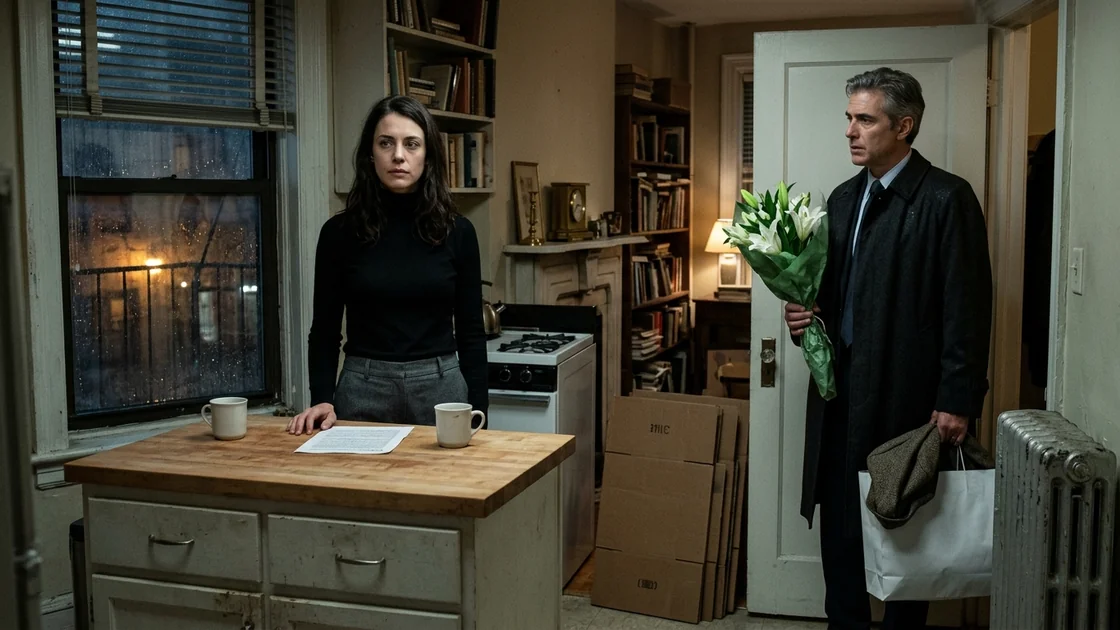
She had also printed out a single piece of paper on her office laser printer that afternoon. It sat face-down on the kitchen island next to two empty porcelain mugs. The kettle on the stove was cold, empty of water.
At 6:18 PM, the buzzer rang. Two short bursts.
Clara walked to the intercom, pressed the release button, and opened the front door by two inches.
She listened to him climb. First floor. Second floor. The slight pause on the third landing to catch his breath. Fourth floor.
When Arthur pushed the door open, he was smiling, carrying a bouquet of white lilies wrapped in green florist paper—an unusual extravagance, likely purchased at the Grand Central market because he felt a residual twinge of guilt for lying about New Hampshire, or perhaps just to keep the tenth-anniversary glow burning through another week.
"Sorry I'm late, darling," he said, stepping into the foyer and shaking off the chill. "The meeting with the compliance—"
He stopped.
Clara was not in the kitchen in her silk blouse and apron, waiting to take his coat. She was standing by the window, still wearing her tailored gray wool trousers and the black turtleneck she had worn to the office, her coat draped over the arm of the sofa. Her hair was down, loose and unstyled around her face.
And his eye caught the large white shopping bag sitting by the radiator, the sleeve of his tweed jacket visible at the top.
Arthur was a trial lawyer; it took him less than three seconds to read the geometry of the room and realize the defense had rested without his knowledge.
He didn't ask what the bag was. He didn't play the buffoon. He slowly lowered the lilies onto the small table by the door, closed the apartment door behind him until the latch clicked, and looked at her with a face that had gone entirely still.
"Clara," he said, his baritone dropping into its gravest, most reasonable register. "What's going on?"
"You dropped your scarf on Perry Street on Saturday," she said. Her voice was remarkably steady. It didn't shake; it didn't rise in pitch. It sounded like the voice of a woman reading a train schedule. "Or rather, it came untucked. Margaret fixed it for you right outside the French bakery. The one with the pear tarts."
Arthur didn't flinch, though a dull, brick-red flush crept up from beneath his white collar, staining the skin along his jaw. For a long moment, he simply stared at her, his mind visibly whirring through the available permutations of a lie—I ran into them unexpectedly; Toby took the train down; Margaret ambushed me at the office—before he looked into Clara’s gray eyes and saw that the courtroom was empty and the judge had already signed the order.
His shoulders dropped by an inch. The noble, tormented mask he had worn for three thousand six hundred and fifty days slipped sideways, revealing the tired, pragmatic face of a middle-aged man whose favorite arrangement had just come to an inconvenient end.
"Toby wanted to come into the city for the weekend," Arthur said quietly. "Margaret wanted to see an exhibition at the Whitney. I couldn't tell you that right after our anniversary, Clara. You were already so fragile on Tuesday night when we talked about Sarah's cabin. I was trying to protect you from unnecessary pain."
Clara almost smiled. It was an extraordinary thing, witnessing the mechanism of the trick after you knew where the trapdoor was hidden. I lied to you because you're too fragile to handle the truth. Even his deceit was framed as an act of chivalry.
"And Napa Valley last October?" she asked, walking slowly toward the kitchen island and picking up the single sheet of paper. "When you were in Chicago taking depositions, and calling me from the hotel bathroom while celebrating your twenty-fifth anniversary?"
She turned the paper over and laid it on the butcher block. It was a color printout of the photograph from Lydia’s Instagram: Arthur and Margaret raising their glasses in the California sun, coupled with a printout of the renovation permit for his master suite in 2018 and his firm bio showing his 2012 equity partnership.
Arthur walked to the island, glanced down at the paper for less than two seconds, and then looked back up at her. He took off his trench coat and laid it over the stool.
"So you went digging," he said, and for the first time in ten years, there was an edge of coldness in his voice—not the theatrical sorrow of the trapped lover, but the genuine irritation of a man whose privacy has been violated. "What did you expect to find, Clara? That I keep her locked in a cellar? We have a life in front of other people. We have families, we have social obligations, we have a son. Do you think I enjoy smiling for photographs with my sister-in-law's camera in my face? It's a facade. You know that."
"You renovated your master bedroom together six years ago, Arthur. Two years after you told me you hadn't touched her since 2011."
"For the resale value of the house!" he snapped, stepping closer to her, his hands coming up in the persuasive, open-palmed gesture he used on juries. "Which I am selling in the spring! Goddammit, Clara, listen to yourself. You let ten years of our history be erased by a couple of curated photographs on the internet? Who have I been with twice a week for a decade? Who knows every thought in my head? Who do I call every single morning on my way to the station?"
He reached across the small space between them and gripped her upper arms. His hands were warm, strong, familiar. A week ago, that touch would have short-circuited her nervous system, flooding her with the desperate need to resolve the conflict before 9:30 PM so their three hours wouldn't be ruined by a fight.
Now, she looked down at his hands on her sleeves and felt nothing at all, except a mild surprise at how ordinary his fingers looked.
"You never intended to leave her," Clara said, looking right into his eyes. "Not in the first year. Not when Toby was eleven. Not when he went to high school. Not next spring. You're going to grow old in that house in Westport, Arthur. You're going to bounce Toby's children on your knee on that lawn, and when you die at eighty-five, Margaret is going to bury you in the family plot in Connecticut."
"That's not true," he whispered, his voice cracking on cue, his thumb stroking her collarbone through the wool of her turtleneck. "I love you. You are the love of my life, Clara. If I've been a coward, it's because breaking up a twenty-five-year marriage is like amputating a limb without anesthetic. I've been slow. I've been weak. I admit it! Tell me what you need me to do right now to prove it to you. Do you want me to call her right now? From this room? I'll do it. I'll stay here tonight. I won't get on the 9:50 train."
It was his trump card—the ultimate bluff.
Clara didn't step back from his grip. She held his gaze, her expression entirely serene.
"Okay," she said.
Arthur blinked. "What?"
Clara reached into her trouser pocket, pulled out her phone, unlocked it, and held it out between them, the keypad glowing.
"Call her," Clara said softly. "You know the number by heart. Put it on speaker. Tell her you're at 412 Elm Street with Clara Vance, the woman you've been sleeping with since 2014, and that you aren't coming home tonight or ever again."
The silence in the apartment was sudden and absolute. Down on Elm Street, a delivery truck rumbled past, rattling the aluminum blinds in their frames. The radiator gave a single, sharp hiss of steam.
Arthur looked at the glowing screen of the phone in her hand. He didn't reach for it. His fingers slowly loosened on her upper arms and dropped to his sides.
"Not like that," he muttered, looking away toward the dark kitchen window. "That's cruel, Clara. After twenty-six years, she doesn't deserve to find out over a speakerphone like a teenager's prank. I have to do it face-to-face. This weekend. When Toby isn't home."
"Of course," Clara said, slipping the phone back into her pocket.
There was no triumph in it. Watching him fold wasn't satisfying; it was just small and sad, like watching a magician drop a coin out of his sleeve onto a linoleum floor. All the grand tragedy she had constructed around them—Anna Karenina and Vronsky, Abelard and Heloise, the star-crossed lovers separated by cruel circumstance—evaporated in the span of ten seconds, leaving behind a forty-eight-year-old lawyer who didn't want to ruin his Thanksgiving plans in Westport.
"Your things are in the white bag by the door," Clara said, walking past him to pick up his trench coat from the stool and holding it out to him. "Your shirts, the jacket, and all the jewelry you gave me. Except the bracelet from Tuesday. I broke that on Bleecker Street and threw it in the trash."
Arthur took the coat slowly, holding it against his chest like a shield. He looked around the room—at the bare surfaces, the flat cardboard boxes stacked in the hall.
"Where are you going?" he asked, and for the first time, a genuine tremor of panic entered his voice. Not the panic of a man losing a wife, but the panic of an addict realizing his supplier is boarding up the shop. "Clara, don't be dramatic. We're having a crisis, yes, and I deserve your anger. Take a week. Go up to Sarah's. Let's not throw away ten years in ten minutes."
"I didn't throw away ten years in ten minutes, Arthur," she said, walking to the front door and opening it wide to the dim hallway landing. "I threw them away one Tuesday at a time. And I'm not going to Sarah's. I'm moving to London on the twenty-fourth."
He stared at her, his mouth slightly open. "London? For how long?"
"Forever, as far as you're concerned." She picked up the white shopping bag and the bouquet of lilies and held them out into the hallway. "Don't call me. Don't email my work address. Don't come back to this building. If I ever see you on my street, or if a single flower or letter shows up at my office, I won't call you, Arthur. I'll pack up ten years of photographs, train receipts, hotel bills, and voicemails, and I will drive them up to Westport myself and hand them to the vice president of the Historical Society on her front porch."
Arthur’s face went gray under the hallway light. The romantic lover vanished completely; the risk-averse corporate attorney calculated the exposure, assessed the witness's credibility, and recognized a fatal liability.
He stepped past her threshold onto the landing. He took the white shopping bag from her hand. He left the lilies on the floor by the radiator.
"You're making a mistake," he said, though there was no conviction in it anymore—only the reflexive closing statement of a man who hated to lose an argument. "Nobody will ever love you the way I loved you, Clara."
"I certainly hope not," she said.
She closed the door, threw the deadbolt, and fastened the brass chain.
She did not walk to the window to part the blinds and watch him leave. She didn't listen to his footsteps descending the stairs. Instead, she walked into the kitchen, filled the kettle with cold tap water, and set it on the burner.
When it began to shriek its fractured, two-toned whistle five minutes later, she turned off the gas, picked up the kettle with a potholder, walked over to the trash bin beneath the sink, and dropped the entire metal pot inside on top of the coffee grounds. Tomorrow, she would buy a French press, or she would walk down to the corner bodega and buy her tea in a paper cup among the morning commuters in the daylight.
She walked into the bathroom, took a bottle of lavender bath oil she had been "saving for a special occasion" since her thirty-second birthday, and poured half of it into the chipped porcelain tub under the roaring hot tap.
As she undressed, she caught sight of her left wrist. There was a faint, thin red scratch where the gold chain had snapped on Saturday afternoon, already fading into a pale pink line that would be gone before her plane touched down at Heathrow.
She stepped into the water, sank down until her ears were submerged and the hammering of the radiator was muffled into a distant, rhythmic pulse, and closed her eyes. For the first time in a decade, it was Tuesday night, it was seven o'clock, and she was waiting for no one at all.