The Cold Clause
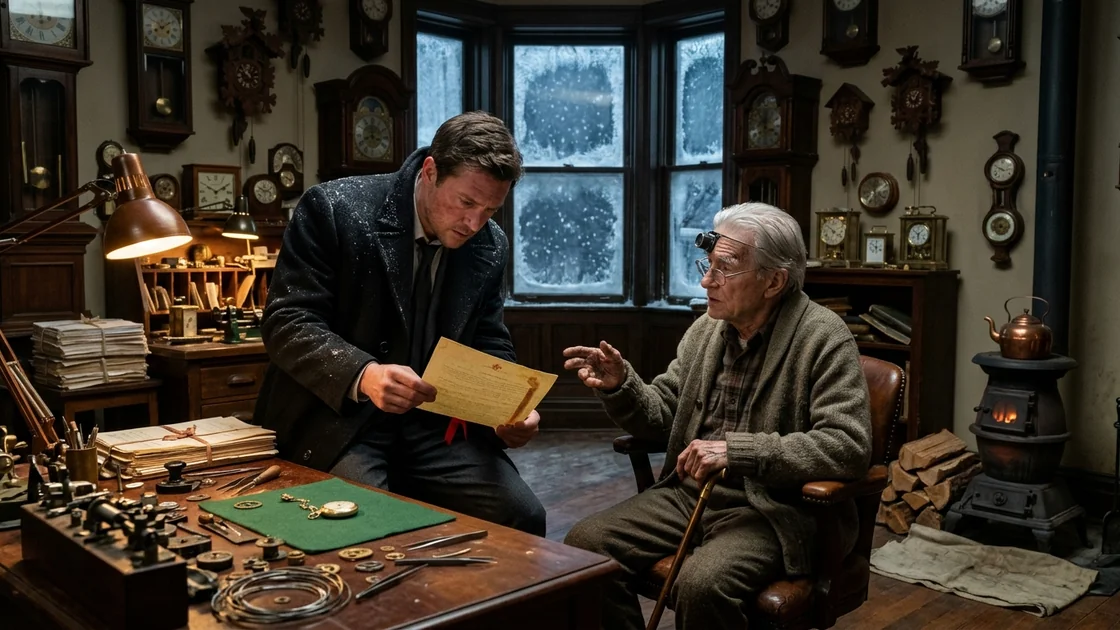
Julian Vance is an ambitious junior associate at a ruthless corporate real estate law firm in Chicago who is assigned the task of executing an emergency mid-winter eviction against Arthur Pendelton, the last remaining tenant in a historic apartment building slated for demolition. As a brutal polar vortex descends on the city, Julian expects a standard paper-pushing battle, only to discover that the firm’s star partner has buried crucial evidence of a binding historical covenant that grants the eighty-two-year-old clockmaker the legal right to remain in his home for life. Forced to choose between a lucrative career trajectory that will pay off his crushing law school debts and the basic survival of a fragile old man during a lethal freeze, Julian faces a profound crisis of conscience that pushes him to dismantle his own professional future to save a stranger's life.
The wind off Lake Michigan did not merely blow through the canyons of downtown Chicago; it hunted. It dropped from the dark, iron-gray expanses of the northern sky, gathered speed across the jagged ice shelves of the shoreline, and sheared through the glass-and-steel corridors of the Loop with the surgical malice of a razor. High up on the forty-fourth floor of the obsidian tower housing Sterling, Cross & Vance—though Julian was no relation to the long-dead Vance on the brass plaque—the wind registered only as a low, baritone hum against triple-paned thermal glass.
Julian Vance stood by the window of his narrow interior office, watching the snow swirl horizontally past the ledges. The radiator beneath the sill clicked with a steady, dry warmth. In his hand, he held a heavy ceramic mug of black coffee, its heat seeping into palms that had grown unaccustomed to hard labor. He was twenty-eight years old, dressed in a charcoal wool suit that had cost him half a week’s paycheck before he had even passed the bar, and he had slept precisely eleven hours over the last four days.
His desk was an archipelago of cream-colored file folders, yellow legal pads covered in cramped shorthand, and glowing monitors displaying the municipal codes of Cook County. At the center of the blotter sat a single, slender red binder labeled Apex Development Group v. Pendelton, Docket No. 24-CH-08819.
A sharp double-rap on his open doorframe made him turn.
Richard Cross stood in the threshold. At fifty-five, Cross possessed the lean, weathered look of a man who spent his weekends sailing on rough water and his weekdays gutting small businesses. His silver hair was swept back with military precision, and his bespoke navy pinstripe suit hung on him without a single errant crease. He did not step into Julian’s small office; he never did. He occupied the doorway as if he had purchased the air rights to it.
"Tell me the Sheriff’s office has the writ in hand, Julian," Cross said. His voice was a smooth baritone, practiced at soothing nervous board members and terrifying junior associates.
"The judge signed the final order for possession at four o'clock yesterday afternoon, Mr. Cross," Julian said, setting his mug down on a coaster. He straightened his spine instinctively. "I walked it down to the seventh floor of the Daley Center myself. Because of the temperature drop, though, the Sheriff’s Eviction Unit is stalling. The county usually suspends enforcement when the wind chill drops below zero."
Cross’s jaw tightened almost imperceptibly. He glanced out Julian’s window at the gray wall of snow swallowing the Sears Tower three blocks away. "The county suspends standard residential evictions during the holiday moratorium and extreme weather advisories, Julian. That is why we did not file a standard residential eviction. We filed an emergency motion for possession predicated on structural condemnation and immediate municipal hazard. Did Judge Halloway sign the emergency rider?"
"He did," Julian admitted, his eyes dropping briefly to the red binder. "Based on the structural engineering affidavit that Apex provided. The one stating the boiler manifold in the basement of the Marquette Building is at imminent risk of catastrophic failure."
"Then the weather advisory is legally irrelevant," Cross said coldly. "If the building is an imminent hazard to life and limb, the Sheriff is statutorily obligated to clear the premises regardless of the thermometer. Apex has demolition crews staging in the West Loop right now. Their bridge loan carries an interest penalty of forty-two thousand dollars a day starting on the first of the month if that site isn't cleared and fenced. Sterling and I promised Marcus Thorne that the Marquette Building would be vacant by five o'clock tomorrow."
"I understand, sir. I called the Watch Commander at the Civil Process division twenty minutes ago. They’re short-staffed because of the blizzard warnings, and they want a representative from the plaintiff’s counsel on-site to sign the chain-of-custody waivers for the tenant’s chattels before they’ll roll a truck."
Cross looked at his Patek Philippe wristwatch. "Then I suggest you put on your heavy coat, Julian. Take a town car over to Pilsen. Serve the final twenty-four-hour notice personally so that when the deputies arrive tomorrow morning at eight, he cannot claim improper notice. Make sure he understands that if he isn't out, the deputies will put him in the back of a squad car and his belongings in a dumpster."
Julian hesitated. It was a micro-expression, a fraction of a second where his fingers brushed the edge of the red binder, but Cross caught it immediately. Predators always noticed a limp.
"Is there a problem with the filing, Vance?"
"No, sir. The paperwork is airtight." Julian swallowed. "It’s just... the tenant, Arthur Pendelton. According to the background check, he’s eighty-two. He has no listed next of kin in Illinois. His wife died six years ago. If the city shuts off the gas today per the condemnation order, and the Sheriff doesn't forcibly remove him until tomorrow morning, he’ll be in an unheated brick building overnight when the temperature is projected to hit twenty below."
Cross stared at him for a long, quiet moment. The hum of the wind against the glass seemed to grow louder in the silence.
"Let me clear up a fundamental misconception you seem to be harboring about your profession, Julian," Cross said, his voice dropping an octave into a register that was almost paternal, which made it infinitely more dangerous. "You are not a social worker. You are not a priest. You are an instrument of the law, retained by a client who pays this firm four million dollars a year in retainers. We offered Mr. Pendelton thirty thousand dollars in ‘cash-for-keys’ in October. He refused. We offered him fifteen thousand in November, along with a six-month lease at a senior facility in Oak Park. He threw the process server down the stairs—metaphorically speaking. He has chosen to barricade himself in a dying building that my client legally purchased. Whatever discomfort Mr. Pendelton experiences tonight is entirely the result of his own obstinacy."
Cross took a half-step into the room, his cold blue eyes locking onto Julian’s. "There are twelve first-year and second-year associates on this floor. Next month, the partnership committee meets to decide which six of you will be invited to stay for your third year, and which six will be updating their resumés while trying to explain why they couldn't hack it at Sterling, Cross. You have a hundred and ninety thousand dollars in student debt from Northwestern, Julian. I know, because I approved your hiring bonus. Do not let a sudden attack of sentimentality ruin a very promising career. Serve the notice. Clear the building."
"Yes, Mr. Cross," Julian said. His voice sounded hollow to his own ears.
"Good. Email me when the notice is posted." Cross turned and vanished down the carpeted hallway, his footsteps making no sound at all.
Julian stood motionless for a full minute after he left. Slowly, he reached down, picked up the red binder, and tucked it into his leather briefcase. He pulled on his black cashmere overcoat—another credit card purchase meant to project an image of success he did not yet possess—wrapped a scarf around his neck, and took the elevator down to the lobby.
Outside, the cold hit him like a physical blow to the chest. It sucked the breath straight out of his lungs and froze the moisture in his nostrils instantly. The sky above LaSalle Street was the color of a fresh bruise, and the snow was coming down in dense, blinding sheets that turned the afternoon traffic into a slow-moving river of red taillights and honking horns.
He eschewed the firm’s town car service—partly out of a subconscious desire to delay his arrival, and partly because he hated the way the drivers looked at him in the rearview mirror when he took calls about foreclosures. Instead, he walked three blocks through the slush to the Blue Line station, his dress shoes immediately soaking through with freezing gray brine, and rode the train south toward Cermak.
The Marquette Building sat on a quiet, cobblestoned side street on the eastern edge of Pilsen, bordered by a defunct rail spur and a sprawling swath of vacant lots that Apex Development had already leveled. Five years ago, this block had been a collection of old manufacturing warehouses, family-owned bakeries, and three-flats. Now, giant plywood signs bearing glossy artist renderings of The Enclave at Marquette—Luxury Micro-Lofts & Artisanal Retail towered over chain-link fences wrapped in tattered green tarps.
Standing alone in the middle of the cleared block was the Marquette Building itself. It was a four-story Romanesque Revival structure built in 1894 out of dark red Chicago common brick and carved Bedford limestone. Gargoyles with weathered, soot-stained faces peered down from the cornice, their stone mouths packed with snow. The windows on the first three floors were boarded up with fresh sheets of OSB plywood sprayed with bright orange municipal stencil paint: CONDEMNED — DO NOT ENTER BY ORDER OF THE DEPARTMENT OF BUILDINGS.
Only on the fourth floor, in the corner turret overlooking the dead rail spur, did a faint, warm amber light glow behind frost-feathered glass.
Julian stood across the street for a moment, his briefcase clutched tightly in his gloved hand, his toes already numb inside his wet leather oxfords. A crew from the gas company was just packing up a heavy yellow utility truck at the curb. Two men in insulated Carhartt coveralls were lifting a massive steel wrench out of a manhole near the building’s foundation.
Julian crossed the street, leaning into the shrieking wind. "Excuse me!" he shouted over the gale.
One of the workers, a thickset man with icicles clinging to a bushy mustache, looked up from latching the truck’s tool compartment. "Yeah?"
"Did you just cap the main line to this building?"
"Orders from the city," the worker grunted, slamming the metal door shut. "Emergency structural ticket came down from downtown an hour ago. Said the basement steam boiler is cracked and leaking carbon monoxide or ready to blow. We locked out the regulator at the street."
"How long until the radiators inside go cold?" Julian asked.
The worker looked up at the four-story brick facade, then back at Julian’s tailored coat and soaking dress shoes. He spat into the snow. "In this wind? With all them lower windows boarded up loose? Two hours, maybe three before the pipes freeze solid and burst. Hope nobody's still up there."
The truck roared to life, its exhaust pluming thick and white in the frigid air, and rumbled away down the unplowed street, leaving Julian alone in the gathering gloom.
He walked up the wide limestone steps of the building’s main entrance. The heavy oak double doors were chained shut from the outside, except for a smaller service door to the right, where the padlock hung open on its hasp. Julian pushed it open and stepped inside.
The interior of the lobby smelled of damp plaster, decades of dust, and the faint, sweet scent of old pipe tobacco. The marble floor was cracked and covered in tracked-in dirty snow that had already frozen into slick gray ridges. The grand staircase spiraled upward into the shadows. As the utility worker had predicted, the massive cast-iron radiator in the vestibule was silent, its metal already merely lukewarm to the touch.
Julian began to climb. His footsteps echoed hollowly through the empty building. Second floor: dark, gutted corridors where Apex’s demolition teams had already illegally stripped the copper plumbing from the vacant units to force the remaining tenants out months ago. Third floor: colder still, the wind whistling through gaps in the plywood over the stairwell windows.
When he reached the fourth-floor landing, the air changed. A draft of warmth seeped from beneath the heavy mahogany door of Apartment 4A, accompanied by a sound that made Julian stop dead in his tracks.
It was the sound of ticking. Not the solitary tick of a wall clock, but a dense, rhythmic, overlapping symphony of hundreds of tiny mechanical hearts beating in asynchronous harmony. Tick-tock-tick-tick-tock-whir-click.
Julian pulled off his right glove, his fingers stiff and aching, and knocked three times on the frosted glass pane of the door.
The ticking continued, unbroken, until heavy, shuffling footsteps approached from within. Two deadbolts slid back with a metallic clack, and the door opened four inches, held by a brass security chain.
An eye peered through the gap, magnified to absurd proportions by a jeweler’s loupe clipped to a pair of wire-rimmed spectacles.
"If you’re the fella from the gas company coming to apologize for cutting off my heat in the middle of a blizzard," a raspy, reedy voice said, "you can save your breath and turn the valve back on."
"Mr. Pendelton?" Julian said, clearing his throat. "My name is Julian Vance. I’m an attorney with Sterling, Cross & Vance, representing Apex Development Group."
The eye behind the loupe blinked. The old man flipped the magnifying lens up with a practiced flick of a gnarled finger. "Ah. They sent a boy in a wet suit this time. The last one they sent looked like an off-duty bouncer from Cicero. What happened to him?"
"We don't employ process servers for emergency motions, Mr. Pendelton," Julian said, reaching into his briefcase and pulling out the blue-backed legal document. "I’m here to serve you with a final Order for Possession signed by Judge Halloway of the Circuit Court of Cook County. The building has been declared an immediate structural hazard due to the boiler. The gas has been disconnected by the city. The Cook County Sheriff’s Department will be here tomorrow morning at eight o'clock to enforce the order and physically remove you from the premises."
Arthur Pendelton looked at the paper in Julian’s hand, then down at Julian’s feet. "Your shoes are ruined, son. And your lips are turning blue. Come inside before you let all my woodstove heat out into the stairwell."
The door closed momentarily, the chain rattled free, and then the door swung wide open.
Julian hesitated on the threshold. Every clinical rule taught in law school, every risk-management memo circulated by the firm’s ethics committee, screamed at him not to enter the domicile of a hostile pro se litigant alone. Hand him the paper, let it drop at his feet if he refuses to touch it, sign the affidavit of service, and walk away.
"I really shouldn't come in, Mr. Pendelton. I just need you to take this document—"
"I’m eighty-two years old and I have sciatica in my left hip, Mr. Vance," Arthur said, already turning his back and shuffling into the apartment with the aid of a brass-headed cane. "If I’m going to assault you, you’ll have plenty of warning. Shut the door. The draft is terrible."
Julian stepped inside and pulled the heavy mahogany door shut behind him.
Apartment 4A was unlike any space Julian had ever seen. It was a sprawling corner unit with fourteen-foot ceilings, wainscoted in dark oak that had been polished until it gleamed like chestnuts. Every vertical surface, every mantelpiece, shelf, and wall, was covered in clocks. There were tall grandfather clocks in walnut cases from the eighteen-hundreds; intricate French carriage clocks under glass domes; German Black Forest cuckoo clocks carved with hunting scenes; brass marine chronometers; and dozens of pocket watches suspended from tiny velvet-lined racks.
In the center of the main parlor, beneath the turret window where a long mahagony workbench was set up with lathes, tiny screwdrivers, and brass gears, stood a small cast-iron potbelly stove vented directly into the brick chimney flue. A stack of split oak logs sat neatly on a canvas tarp beside it, and a copper kettle on top of the iron lid sent a thin ribbon of steam into the air.
Arthur Pendelton lowered himself slowly into a worn leather swivel chair behind the workbench. He was a small, bird-like man, wearing a thick cardigan with suede elbow patches over a flannel shirt and wool trousers. His hands were spotted with age and stained around the cuticles with machine oil, yet when he picked up a pair of tiny brass tweezers to adjust a hairspring on the bench, those hands did not tremble at all.
"Put your paper down on the side table there, by the door," Arthur said without looking up. "Right next to the other forty pounds of wood pulp your bosses have sent me since June."
Julian looked at the small mahogany side table. There, stacked in neat, chronological piles tied with butcher’s twine, were dozens of letters, notices to quit, summonses, and motions, all bearing the letterhead of Sterling, Cross & Vance.
Julian set the final eviction order on top of the pile. "Mr. Pendelton, I need you to understand that this one is different. The previous notices were part of the civil litigation process. Those are over. The court has issued a summary judgment based on the city’s condemnation. Tomorrow morning, men with badges and crowbars are going to walk through that door. They won’t argue the law with you. They will put your clocks into plastic bins, put them on the curb in the snow, and take you to a city warming center or a hospital."
Arthur set the tweezers down on a green felt pad and turned his chair around to face Julian. Behind his spectacles, his eyes were a faded, watery blue, but they were sharp and completely devoid of panic.
"Did you read the boiler report, Mr. Vance?" Arthur asked quietly.
"Yes. It was prepared by a licensed structural engineer."
"A fella named Miller, out of Naperville?"
Julian blinked. "Yes. Donald Miller. How did you know that?"
"Because Mr. Miller has been Apex Development’s pocket engineer for twenty years," Arthur said, gesturing toward a radiator against the wall. "That boiler down in the basement is an Kewanee low-pressure steam unit installed in 1952. Do you know who installed it?"
"No."
"My father and I did. And do you know who bled the valves, flushed the sediment trap, and replaced the pressure relief gauge three weeks ago?" Arthur tapped his own chest with a stained forefinger. "I have a stationary engineer’s license from the City of Chicago, first issued in 1968. There is nothing wrong with that boiler, Mr. Vance. Not a cracked manifold, not a faulty weld. Nobody from the city buildings department ever set foot in that basement. Your engineer signed a perjured affidavit from his desk in Naperville so your firm could bypass the winter eviction moratorium."
Julian felt a cold prickle at the base of his neck that had nothing to do with the weather outside. In the back of his mind, he remembered the affidavit in the red binder. It had been remarkably brief—just two pages of boilerplate language and a notarized signature, delivered to Julian’s desk directly by Richard Cross’s personal paralegal yesterday morning, twenty minutes before Julian had been sent to Judge Halloway’s chambers for the emergency ex-parte hearing. There had been no inspection photos attached. When Julian had asked about the photos, Cross had waved him off, saying the building was too dangerous for the photographer to enter.
"Even if you dispute the engineering report," Julian said, falling back on the rigid defensive posture of his training, "the time to contest that was at the hearing, or through a motion to vacate. As the record stands, Apex Development owns the fee simple title to this property. You don't have a valid lease, Mr. Pendelton. Your last written lease expired four years ago when the previous owner, the Marquette Historical Trust, dissolved and sold the building to the intermediate holding company that sold it to Apex. Under Illinois law, you are a holdover tenant on a month-to-month basis. They have every legal right to terminate your tenancy."
Arthur sighed. It was a long, tired sound that seemed to rattle in his narrow chest. He looked around the room at the hundreds of swinging pendulums.
"A month-to-month tenant," the old man murmured. "Is that what Richard Cross told the judge I was?"
Julian stiffened. "You know Mr. Cross?"
"I met him once, back in August, before he handed my file down the totem pole to you," Arthur said. "He came up here himself. Offered me a check. Looked at my clocks like he was appraising estate jewelry. When I showed him the 1989 Covenant and the life estate rider, he smiled, told me he’d have his title people look into it, and walked out. Then the motions started coming, and mysteriously, none of them ever mentioned the deed."
Julian frowned. "What 1989 Covenant? I did the title review on this file myself when I took over discovery in November. The chain of title goes from the Marquette family estate to the Marquette Historical Trust in 1989, then to West Loop Holdings in 2019, and then to Apex Development eight months ago. There are no recorded life estates on the Torrens register or with the County Recorder of Deeds."
Arthur looked at Julian for a long moment, studying his face as if he were examining the worn teeth of an escapement wheel.
"Take off your coat, Mr. Vance," Arthur said softly. "And come over here to the desk. If you’re going to throw an old man into a twenty-below blizzard to freeze to death, you ought to at least look at the murder weapon your boss hid in the drawer."
Julian did not take off his coat, mostly because he was afraid that if he stopped shivering, he would realize just how badly his feet were hurting. Still, a quiet, insistent compulsion pulled him across the worn Persian rug toward the turret window.
Arthur wheeled himself over to a heavy steel filing cabinet tucked into the alcove behind a seven-foot-tall grandfather clock. He unlocked the top drawer with a small brass key from his watch chain, pulled out a thick, faded manila envelope tied with red ribbon, and laid it on the workbench beside his tools.
"In 1988," Arthur began, his fingers untying the ribbon with methodical precision, "this building was owned by Eleanor Marquette, the granddaughter of the man who built it. The neighborhood was rough back then, and the building was falling apart. Specifically, the great four-faced Seth Thomas clock in the central rooftop tower—which Apex knocked down with a crane four months ago without a permit, by the way—had been dead since the Depression. Eleanor wanted the building preserved as a landmark before she died. I had a clock repair shop on the ground floor."
He slid a document out of the envelope. It was typed on heavy, cotton-rag bond paper, yellowed at the edges, bearing the embossed gold seal of a notary public from November 14, 1989, and the purple ink stamp of the Cook County Recorder of Deeds.
"Eleanor didn't have the money to pay me to restore the tower clock and maintain the mechanical systems of the building," Arthur continued, pushing the document toward Julian. "So when she transferred the building to the Marquette Historical Trust, she executed a Quitclaim Deed with a Covenant Running with the Land. Read paragraph four, Mr. Vance."
Julian leaned over the bench. The light from the jeweler’s lamp illuminated the crisp, carbon-ribbon typewriter font.
...PROVIDED HOWEVER, and this conveyance is made upon the express covenant and condition, which shall run with the land and be binding upon the Grantee, its successors, assigns, and all future holders of title in fee simple or otherwise, that Arthur Thomas Pendelton and his spouse, Clara Mae Pendelton, in consideration of forty years of master horological restoration and stationary engineering services rendered without monetary compensation, shall retain an irrevocable, rent-free Life Estate in and to the fourth-floor corner suite known as Apartment 4A, together with unimpeded ingress, egress, and utility services provided at the sole expense of the fee owner, for the duration of their natural lives, or until such time as both shall voluntarily vacate the premises in writing...
Julian’s breath caught in his throat. He turned the page. At the bottom was the Recorder’s stamp: Document #89-554102, Book 1142, Page 88.
"This... this is recorded," Julian whispered, his eyes scanning the registration numbers. "Why wasn't this in the title abstract in our file?"
"Keep reading inside the folder," Arthur said grimly.
Julian pulled the second sheet from the envelope. It was a carbon copy of a certified mail receipt and a letter dated August 14th of the current year—four months ago. It was addressed to Richard Cross at Sterling, Cross & Vance. In the letter, Arthur had stated that he was enclosing a certified copy of Document #89-554102, proving his life estate, and demanding that Apex cease and desist from cutting off building maintenance. Stapled to the bottom was the green postal return card, signed for by Sterling, Cross & Vance’s mailroom.
And beside it was a letter on Sterling, Cross & Vance letterhead, signed by Richard Cross himself, dated August 18th.
Dear Mr. Pendelton: We are in receipt of your correspondence of August 14. Please take notice that our title underwriters are reviewing the purported 1989 instrument. In the interim, we advise you not to file this document with the court, as doing so will immediately invalidate our client’s pending settlement offer of thirty thousand dollars, which remains your most prudent financial course of action...
Julian stared at the letter until the black print seemed to swim on the page.
He remembered the file in his briefcase. When Cross had handed the Apex v. Pendelton litigation down to Julian in November, the title abstract in the red binder had included copies of the 1989 deed—Pages 86, 87, and 89. Page 88 had been missing. In its place was a title company summary sheet stating No active encumbrances or life estates of record. Cross hadn't just overlooked the life estate; he had actively stripped Page 88 out of the discovery packet before handing the case to a junior associate to litigate, and then he had bullied an eighty-two-year-old man without a lawyer into keeping quiet about it by dangling a settlement offer he had no intention of honoring once the condemnation trap was sprung.
And why hadn't Arthur shown it to the judge?
"Mr. Pendelton," Julian said, his voice shaking slightly. "Why didn't you bring this to court when we filed for possession?"
Arthur looked down at his swollen knuckles, then over at his cane leaning against the workbench. "I tried, back in November, when the first summons came. Took the bus down to the Daley Center in the rain. Wait in line at the security checkpoint for forty minutes. Got up to the courtroom on the fourteenth floor, and the clerk told me your firm had moved the hearing to an electronic Zoom call two hours earlier because of a scheduling change. A Default Judgment was already entered before I even got off the elevator."
Julian remembered that day. Cross’s paralegal had filed an emergency motion to advance the call at eight-thirty in the morning. Julian had appeared on Zoom at ten; no one had appeared for the defense. Julian had simply read the script Cross had given him.
"And yesterday?" Julian asked, though he already knew the answer.
"Yesterday, I didn't even get a notice until a courier taped it to the downstairs door at three-thirty in the afternoon, half an hour before the judge signed your paper," Arthur said quietly. "A man without a computer and without a lawyer doesn't stand much of a chance against a forty-fourth-floor law firm, Mr. Vance. I figured out pretty quick that the law down at City Hall isn't a clock. In a clock, every gear has to obey the same physics, whether it’s made of brass or solid gold. Down where you work, the big gears just grind the little ones into dust and call it timekeeping."
The silence in the room was suddenly suffocating, punctuated only by the relentless tick-tock-tick-tock of a hundred pendulums.
What Richard Cross had done was not aggressive advocacy. It was not zealous representation within the bounds of the law. It was fraud upon the court. It was the deliberate suppression of a dispositive recorded deed, coupled with a fabricated engineering report to bypass a municipal safety ordinance during a lethal weather event. If a life tenant was evicted without compensation, the fee simple value of the land skyrocketed instantly because Apex wouldn't have to buy out the life estate—which, given the forty-two-thousand-dollar-a-day loan penalty Cross had mentioned, would have given Arthur immense leverage to demand millions, or simply refuse to leave until the day he died, bankrupting Apex’s development timeline.
Cross hadn't just saved his client money; he had used Julian as the unwitting mule to carry perjured documents across the bench. Julian’s bar number was on the bottom of the motion for possession. Julian’s signature was on the certificate of service. If this ever came to light, Cross would claim a clerical error in the mailroom and point directly at the junior associate who had certified the title record to Judge Halloway.
And if it never came to light—which was infinitely more likely, once the building was reduced to rubble by Friday afternoon and an eighty-two-year-old man was lost in the labyrinth of the county elder-care system—Julian would make third-year associate, collect his bonus, and pay down his student loans.
All he had to do was walk out the door right now.
"Do you have anywhere to go tonight, Mr. Pendelton?" Julian asked, his voice barely a whisper. "Friends? Church members? A nephew out of state?"
Arthur shook his head slowly, turning back to his workbench and flipping his magnifying loupe back down over his eye. "Clara and I never had children. Outlived all my brothers. And my whole life is in this room, son. Some of these clocks are two hundred years old. If the temperature in here drops below freezing tonight after my firewood runs out, the lubricating oils in the escapements will congeal, the steel mainsprings will go brittle and snap, and the wood cases will split. And tomorrow, your sheriff’s deputies will throw the rest into the back of a garbage truck." He picked up his tweezers again. "I’ve lived in this room for fifty-four years. I carried Clara out of that bedroom when her heart gave out. I’m not walking down those stairs while I still have a pulse. If they want me out, they can carry me out too."
Julian looked at the stack of split oak logs beside the tiny potbelly stove. There were perhaps eight small pieces of wood left. Outside the turret window, the wind shrieked like a dying animal, slamming a fresh wave of sleet against the thin nineteenth-century glass. The frost on the inside of the windowpane was already creeping inward, forming delicate, lethal ferns of ice across the wood frame.
Julian looked down at the 1989 deed on the workbench.
"Mr. Pendelton," Julian said. "May I borrow this envelope?"
Arthur paused. He didn't turn around, keeping his back to Julian, his shoulders hunched under the worn cardigan. "If I let you walk out of here with that original deed, Mr. Vance, what’s to stop you from throwing it into the Chicago River on your way back to your office? Then there really wouldn't be any proof left in the world."
Julian looked at the old man’s reflection in the darkened glass of a grandfather clock. He saw Arthur’s bent frame, and beside it, his own reflection: young, tall, dressed in expensive wool, holding a leather briefcase paid for with borrowed money, standing at the exact intersection of who he thought he was and who he was being paid to become.
Julian reached into his breast pocket, pulled out his wallet, and took out his Illinois State Bar Association card and his gold grandfather’s pocket watch—the only thing of value his family had ever owned, given to him the day he graduated from Northwestern Law. He set both down on the green felt pad beside Arthur’s hand.
"That’s a 1924 Waltham Vanguard, twenty-three jewels," Julian said quietly. "It belonged to my grandfather. He was a brakeman on the Illinois Central Railroad. It’s the only thing I own that doesn't belong to a bank. Keep it until I bring your deed back."
Arthur turned his head slowly. He picked up the Waltham pocket watch with reverent fingers, popped open the gold hunter case, and listened to the steady, rapid chime of the balance wheel. He looked up at Julian, his watery blue eyes widening slightly behind his glasses.
"The mainspring is overwound by half a turn, and the pallet fork needs oiling," Arthur murmured. "And you’re going to get yourself fired, boy."
"Probably," Julian said, picking up the manila envelope and sliding it carefully into his briefcase. "Put another log on that stove, Mr. Pendelton. And lock the chain behind me."
When Julian emerged from the Marquette Building onto the street, the city had vanished into a howling white void. It was five-fifteen in the evening, pitch dark, and the polar vortex had fully arrived. The ambient temperature had plummeted to negative nine degrees; with the forty-mile-per-hour gusts screaming across the vacant lots, the wind chill was thirty-five below zero.
Julian’s wet shoes froze almost instantly into solid blocks of ice around his feet. As he trudged the four blocks back toward the Cermak subway station, the wind knifed through his cashmere coat as if it were made of tissue paper. His face went numb first, then his fingers inside his leather gloves. Every breath felt like inhaling crushed glass.
He pulled out his phone on the train platform, his thumb shaking so violently he could barely unlock the screen. He called the Clerk of the Circuit Court’s emergency after-hours desk. No answer—the courts had closed early at three-thirty due to the blizzard warning.
As the train rattled northward through the dark tunnels beneath the city, Julian pulled out the red binder and the 1989 deed, spreading them across his knees. Think like a lawyer, he told himself. Strip away the emotion, strip away the fear, and look at the mechanics of the law—the gears of the clock.
To stop the Cook County Sheriff from executing an Order for Possession at eight o'clock tomorrow morning, he needed an Emergency Stay of Execution signed by a Circuit Court judge. Normally, during business hours, he would file an emergency motion in the Chancery Division, serve opposing counsel, and appear before the motion judge.
Wait. He was plaintiff’s counsel of record.
Could plaintiff’s counsel move to vacate their own judgment? Yes, under Section 2-1203 of the Illinois Code of Civil Procedure, any party could move to stay or vacate within thirty days. If he logged into the court’s e-filing system tonight using his firm credentials and filed an Emergency Motion to Vacate and Withdraw Order for Possession based on newly discovered title encumbrances, the electronic filing alone wouldn't stop the Sheriff’s trucks from rolling at dawn. The Sheriff’s Civil Process Unit only halted an active emergency hazardous-building writ upon receipt of a judicial order signed by a judge, or a formal withdrawal signed by the Managing Partner of record on the case caption.
And the Managing Partner on the caption was Richard Cross.
Julian arrived back at the Sterling, Cross & Vance building at six-ten. The cavernous marble lobby was nearly deserted, save for two security guards huddled near the main desk drinking coffee from thermoses. Julian rode the elevator up to the forty-fourth floor.
Most of the offices were dark, the support staff having fled to the commuter trains before the storm peaked. Only in the corners—where the partners sat—and in the interior bullpen cubicles—where the first- and second-year associates were grinding through document review—did the fluorescent lights still burn.
Julian did not go to his office. He walked straight down the wide, mahogany-paneled corridor toward the northwest corner of the building, his freezing, waterlogged shoes squelching softly on the thick Oriental runner.
Richard Cross’s office was the size of a small apartment. A warm lamp glowed on his antique partner’s desk, and behind him, through the floor-to-ceiling windows, the snow swirled in hypnotic eddies against the floodlit spire of the Board of Trade building. Cross was standing by his credenza, pouring two fingers of single-malt Scotch into a crystal tumbler. Across from the desk sat Marcus Thorne, the CEO of Apex Development—a bull-necked man in his forties wearing an cashmere turtleneck and a shearling coat draped over the leather armchair.
They were laughing about something when Julian stepped into the open doorway without knocking.
The laughter died instantly. Cross looked at Julian’s snow-crusted hair, his raw, wind-burned face, and the dark wet stains spreading across the carpet beneath his shoes.
"Julian," Cross said, his voice pleasant on the surface but hard as granite underneath. "I didn't expect you back in the office tonight. An email confirming service would have sufficed. You know Marcus Thorne, of course."
Thorne barely glanced at Julian, checking his phone instead. "Is the old man out?" Thorne asked bluntly.
"No," Julian said. He stepped fully into the room, reached into his briefcase, and laid the yellowed 1989 deed and Cross’s August 18th letter directly on the polished mahogany surface of the desk, right between Cross’s blotter and the crystal glass of Scotch. "And we have to call the Sheriff’s Watch Commander right now and withdraw the emergency writ."
Cross did not look down at the papers immediately. He kept his eyes fixed on Julian’s face for three slow seconds, then lowered his gaze. Nothing in his posture changed. He didn't flinch; he didn't pale. He simply picked up his glass of Scotch and took a small, measured sip.
"Marcus," Cross said smoothly, "would you excuse us for five minutes? Step into the conference room next door. I’ll have Sarah bring you a fresh espresso while Julian and I review the municipal service affidavits."
Thorne frowned, looking from Julian’s intense expression to the old papers on the desk. "Is there a snag, Richard? Because my demolition crane is sitting on Cermak Road right now costing me four grand an hour just to keep the diesel idling so the hydraulics don't freeze."
"No snag at all, Marcus. Just a procedural detail with the county clerk. Five minutes."
Thorne grunted, grabbed his shearling coat, and brushed past Julian without a word.
As soon as the heavy oak door of the conference room clicked shut down the hall, Cross walked slowly around his desk, closed his own office door, and turned the brass thumb-lock.
When he turned back to Julian, the genial mentor mask was completely gone. His face was cold, flat, and lethal.
"Where did you get this?" Cross asked quietly.
"From Arthur Pendelton," Julian said, his heart hammering against his ribs like a trapped bird, though he kept his voice steady. "It’s a recorded Quitclaim Deed with a covenant running with the land, Document 89-554102. It grants him an irrevocable life estate in Apartment 4A, along with utility services paid by the owner. You knew about it in August, Mr. Cross. You wrote him a letter telling him not to file it with the court. Then someone removed Page 88 from the title abstract before you gave me the file to argue the summary judgment motion."
"Nobody removed anything from the title abstract, Julian," Cross said, walking back to his desk and picking up the August letter with two fingers. "Pendelton sent me an unverified photocopy of an ancient document back in the summer. Our title company, First Metro Title—which happens to be a subsidiary of Apex—conducted a review and determined that the covenant was extinguished in 2019 under the Doctrine of Merger when the Historical Trust dissolved. Therefore, it was not a relevant encumbrance."
"That’s legally impossible and you know it!" Julian said, his voice rising. "The Doctrine of Merger only applies when the life estate and the remainder interest vest in the same person! Arthur Pendelton never owned the fee simple! That covenant is legally binding on Apex. And even if you wanted to argue merger in good faith, Illinois Rule of Professional Conduct 3.3 required us to disclose this adverse instrument to Judge Halloway during an ex-parte proceeding! We told the judge he was a month-to-month holdover!"
Cross stared at him. "We told the judge that the building was a condemned hazard to human life. Which supersedes any tenancy—month-to-month, leasehold, or life estate. Even a life tenant cannot legally occupy a building that is about to explode."
"The boiler isn't cracked, Mr. Cross," Julian said quietly. "Pendelton is a licensed stationary engineer. He maintains that boiler himself. Nobody from Donald Miller’s engineering firm ever entered that basement. The affidavit we gave Judge Halloway yesterday is perjured. And the gas company shut off his heat an hour ago. It’s thirty-five below zero with the wind chill. If we don't withdraw the condemnation order and get the gas turned back on, or if the Sheriff drags him out into this tomorrow morning, it could kill him."
Cross set his Scotch glass down with a sharp clink. He walked right up to Julian, stopping less than a foot away. Cross was two inches taller, and he smelled of expensive cologne and peat smoke.
"Listen to me very carefully, you arrogant little boy," Cross whispered, each word clipped and venomous. "You think you’ve stumbled onto a morality play? How do you think this city gets built? Do you think those towers out that window were erected because polite lawyers asked stubborn old men if they felt like moving? Apex has eighty million dollars leveraged on that parcel. If that building isn't down by Monday, their syndicate defaults, three hundred construction workers lose their winter contracts, and this firm loses its largest real estate client."
Cross reached out and tapped a finger against Julian’s damp lapel. "Now, let’s talk about your reality, Julian. Whose name is on the motion for summary judgment? Yours. Whose bar number is on the certificate of service for Donald Miller’s engineering affidavit? Yours. Whose signature is on the ex-parte emergency order Judge Halloway signed yesterday? Yours. My name isn't on a single filing in that court record."
Julian felt the blood drain from his face. "You... you signed the August letter."
Cross smiled thinly, picked up the August 18th letter from the desk, folded it in half, and slipped it into the inside breast pocket of his suit jacket. "What letter, Julian? All I see here is a junior associate who was so desperate to impress the partnership committee before the third-year cuts that he cut corners on his title search, suppressed a deed he found during discovery, and pushed through a hasty eviction. And if you go near a judge tonight, that is exactly what myself, Marcus Thorne, and the entire risk-management department of this firm will testify happened. You won't just be fired before breakfast. You will be disbarred by the ARDC before your twenty-ninth birthday, and you will spend the next thirty years working at a car wash trying to pay off two hundred grand in non-dischargeable federal student loans."
The silence in the room was absolute. Julian could hear the faint tick of the grandfather clock in Arthur’s apartment echoing in his memory, and right beside it, the cold, crushing weight of his own ruin.
Everything Cross said was true. The firm was a fortress. They had fifty partners, an army of defense counsel, and deep political ties to the county bench. Julian had no copy of the August letter now in Cross’s pocket—unless he wrestled a fifty-five-year-old partner to the floor to get it back.
Cross watched the realization sink into Julian’s eyes. Slowly, the partner’s posture relaxed. He put a heavy, warm hand on Julian’s shoulder, the paternal mentor returning in an instant.
"Take a breath, Julian," Cross said softly. "You’re exhausted. You’ve been working eighty-hour weeks since Thanksgiving, and it’s freezing out there. Look at the reality: tomorrow at eight, the Sheriff’s deputies will go in with paramedics. They’ll take Mr. Pendelton to Rush University Medical Center for a seventy-two-hour observation hold—where it is warm, safe, and he’ll get three hot meals a day. Once the building is demolished on Friday, the life estate becomes legally moot because the physical structure described in the 1989 deed no longer exists. Under Illinois law, destruction of the premises terminates a life estate in a specific apartment unit. At that point, Apex will quietly cut him a check for fifty thousand dollars as a humanitarian gesture, and he can live out his days in a nice assisted-living facility. Nobody dies. The client wins. The firm wins. And on Monday morning, I walk into the partnership committee and tell them that Julian Vance has the stomach to handle high-stakes litigation."
Cross reached down to pick up the 1989 Quitclaim Deed from the desk.
Julian’s hand moved before his brain even issued the command. He slammed his palm down over the yellowed paper.
He looked at Cross’s manicured hand, then up into the partner’s cold blue eyes. He thought of Arthur Pendelton sitting at his workbench in his cardigan, oiling a two-hundred-year-old clock while the frost crept across his windowpane. He thought of his own grandfather, the railroad brakeman with grease under his fingernails, who had worked forty years in the freezing railyards of Champaign so his family could have a house with a furnace that worked, and who had handed Julian a gold pocket watch with the words, A man’s only worth the time he keeps for people who can't keep it themselves.
"He said his whole life is in that room, Mr. Cross," Julian said.
"People say a lot of things when they’re old, Julian. Take your hand off the file."
"And what about my life?" Julian asked quietly. "If I let you shred this deed, who do I belong to on Monday morning?"
"You belong to the top tier of the Chicago legal market," Cross snapped, his patience finally snapping. "Now let go of the damn paper, Vance, before I call security and have you escorted out of this building for theft of firm property!"
"This isn't firm property," Julian said. "It’s an original deed belonging to Arthur Pendelton. And I gave him collateral for it."
Julian snatched the 1989 deed off the desk, shoved it back into his briefcase, unlocked the office door, and walked out into the hallway.
"Vance!" Cross roared behind him, stepping into the corridor as two associates in the nearby bullpen popped their heads up over their cubicle walls in shock. "If you take one more step toward that elevator, you are terminated for cause! Effective immediately! Security will deactivate your keycard before you hit the ground floor!"
Julian didn't turn around. He didn't run. He walked down the mahogany corridor in his freezing, squelching shoes, pressed the down button for the elevator, and stepped inside as the brass doors slid shut on Richard Cross’s livid face.
By the time the elevator reached the ground floor lobby, the two security guards were already standing by the turnstiles, one of them holding a black telephone receiver to his ear, looking directly at Julian.
"Mr. Vance," the older guard, a retired cop named Miller whom Julian had chatted with about the Bears every morning for two years, said with genuine regret in his voice. "Word just came down from the forty-fourth floor. I gotta take your building pass and your firm laptop if it’s in that bag."
Julian stopped at the turnstile. He opened his briefcase, pulled out his thin silver Lenovo laptop and his plastic ID badge, and handed them over. He kept the red binder and the manila envelope pressed against his chest.
"Sorry about this, kid," Miller muttered, setting the laptop on the security console. "Hell of a night to get walked."
"It’s alright, Frank. Have a good holiday."
Julian pushed through the revolving glass doors and stepped back out onto LaSalle Street.
He stood on the sidewalk as the wind howled down the canyon of buildings. He had no job. He had no firm laptop, no access to the firm’s LexisNexis account, no corporate town car account, and his phone was already buzzing with an automated notification from the firm’s IT department wiping his work email profile remotely. Within an hour, Cross would likely file an emergency notice of substitution of counsel electronically, removing Julian’s name from the case caption—no, wait. Cross wouldn't remove Julian’s name tonight; doing so would put Cross’s own name on the caption right before the illegal eviction went down. Cross would wait until tomorrow afternoon, after the Sheriff cleared the building and the wrecking ball hit the fourth floor, and then terminate Julian’s appearance on the docket.
Which meant that until eight o'clock tomorrow morning, Julian Vance, Bar No. 6348819, was still legally counsel of record before the Circuit Court of Cook County.
Julian looked at his watch—his wrist was bare; his grandfather’s watch was sitting on Arthur’s workbench. He looked at his personal phone: 6:42 PM.
He couldn't file an electronic motion to stay and hope a clerk saw it before 8:00 AM. When the courts were closed for a blizzard, there was only one way to stop an active Sheriff’s writ before dawn: he needed a wet-ink signature on an Emergency Stay of Execution from a sitting Chancery judge, and he had to walk that physical piece of paper into the Cook County Sheriff’s Civil Process headquarters or hand it directly to the supervising deputy at the scene.
And which judge had signed the emergency order yesterday afternoon?
Judge Raymond Halloway.
Julian ducked into the vestibule of an automated 24-hour ATM lobby across the street to get out of the wind. His fingers were stiff as wooden pegs as he pulled out his phone and opened the Chicago Law Bulletin directory he had downloaded as a PDF months ago. Judges’ home addresses were unlisted and fiercely protected under state privacy laws, especially for Chancery judges who handled tens of thousands of home foreclosures and evictions.
Wait. Judge Halloway hadn't always been on the Chancery bench. During the forty-minute wait outside Halloway’s chambers yesterday, Julian had made small talk with Halloway’s longtime courtroom clerk, a woman named Brenda who had been complaining about the incoming snowstorm. What had she said?
“Judge Halloway wants to wrap the call by four today so he doesn't get snowed in down here; his wife is hosting the annual Wilmette Historical Society charity dinner at their place on Sheridan Road tonight, and if he’s late, she’ll have his robe.”
Wilmette. Sheridan Road. Historical Society.
Julian’s numb thumbs flew across his phone screen. He searched Google for Wilmette Historical Society Board of Directors Halloway.
Bingo. Eleanor Halloway, Co-Chair. Annual Winter Gala & Benefit Dinner, December 19th, held at the historic Halloway Residence, 1422 Sheridan Road, Wilmette.
Julian looked at the battery icon on his phone: 18%—the extreme cold was draining the lithium battery at triple the normal rate. He opened the Uber app. Because of the blizzard, surge pricing was astronomical; a ride seventeen miles north to Wilmette along the lakefront was $165. He tried to book it with his corporate Amex—Card Declined. Cross’s accounting team was thorough. He switched to his personal Visa debit card, where he had $412 left to last until the end of the month, and hit confirm.
Twenty minutes later, a battered Subaru Outback with snow chains rattling on its tires slid to a halt at the curb. Julian climbed into the backseat, his teeth chattering so violently he bit the inside of his cheek, tasting copper.
As the car crawled northward up Lake Shore Drive at twenty miles per hour through blinding whiteouts and abandoned, snow-drifted sedans, Julian turned on the dome light. He pulled a blank yellow legal pad and a black rollerball pen from his briefcase.
He didn't have a printer. He didn't have a word processor. Look at the rules of civil procedure: did an emergency motion require typed 12-point Times New Roman font? Local Rule 1.4 preferred it, except in cases of extreme emergency out of court hours, wherein legible handwritten pleadings upon standard paper shall be accepted at the discretion of the presiding magistrate.
Bracing the legal pad against the red binder on his freezing knees as the Subaru bounced over ice ruts, Julian began to write in block capitals, forcing his shaking right hand to form clean, precise letters:
IN THE CIRCUIT COURT OF COOK COUNTY, ILLINOIS COUNTY DEPARTMENT, CHANCERY DIVISION APEX DEVELOPMENT GROUP, LLC, Plaintiff, v. ARTHUR PENDELTON, Defendant. Case No. 24-CH-08819 EMERGENCY MOTION OF COUNSEL TO VACATE ORDER FOR POSSESSION, STAY SHERIFF'S ENFORCEMENT, AND COMPEL RESTORATION OF ESSENTIAL UTILITIES, COMBINED WITH SELF-REPORT OF RULE 3.3 VIOLATION.
He didn't hide behind passive language. He wrote out every single fact in stark, numbered paragraphs. He stated that he, Julian Vance, had presented an ex-parte motion yesterday based on a title record that omitted a recorded 1989 Quitclaim Deed granting a Life Estate. He stated that he had personally inspected the premises tonight and discovered that the defendant possessed a valid stationary engineer’s license and that the plaintiff’s engineering affidavit regarding the boiler had been executed without a physical inspection of the basement. He stated that the gas utility had been severed during a lethal polar vortex, placing an eighty-two-year-old life tenant in imminent danger of death by hypothermia.
And on the second page, he drafted the Order itself for the judge’s signature.
When the Uber finally turned onto Sheridan Road in Wilmette at eight-fifteen, the lake wind was apocalyptic. Giant waves from Lake Michigan were crashing over the seawalls across the street, freezing instantly on the trees along the bluff and turning them into grotesque, glistening sculptures of solid ice.
1422 Sheridan Road was a massive Georgian Revival mansion set back behind wrought-iron gates. Because of the blizzard, it was clear the charity gala had mostly been a washout; only three snow-covered SUVs were parked in the circular driveway, though warm yellow light spilled from the leaded-glass windows on the ground floor.
"Wait here, please!" Julian told the driver, grabbing his briefcase and stumbling out into knee-deep snowdrifts. "I’ll give you fifty dollars cash if you don't leave!"
Julian fought his way up the unshoveled flagstones to the front portico. His feet had stopped hurting an hour ago; now it felt as if he were walking on two wooden stumps. He pressed the brass doorbell.
Inside, chimes rang. A moment later, the heavy front door opened, revealing a tall man in his late sixties wearing a tuxedo jacket over a wool sweater, holding a glass of red wine. It was Judge Raymond Halloway. Up close, without his black robes and elevated bench, he looked smaller, his silver hair slightly rumpled, his thick eyebrows drawn together in astonishment at the sight of a half-frozen young man standing on his porch in the middle of a blizzard.
"Who on earth are you?" Judge Halloway demanded, peering out into the swirling snow.
"Your Honor, my name is Julian Vance," Julian said, his voice cracking through chattering teeth. "I appeared before you yesterday afternoon at three-forty-five in Apex Development v. Pendelton, 24-CH-08819. I represent the plaintiff."
Judge Halloway’s eyes narrowed. "Mr. Vance? Of Sterling, Cross? Do you have any idea how wildly improper it is to appear at a judge’s private residence at night? Ex-parte communication on my front porch will get you sanctioned before noon tomorrow!"
"I’m already reporting myself to the ARDC in this filing, Your Honor!" Julian blurted out, holding up the yellow legal pad and the 1989 deed as the wind whipped snow into the judge’s foyer. "Please, Judge! Give me three minutes in your vestibule! If you don't read this paper tonight, an eighty-two-year-old man in Pilsen is going to freeze to death or have his home demolished over his head at eight o'clock tomorrow morning because my firm lied to you yesterday!"
Halloway stared at him. Slowly, the judge looked down at Julian’s ruined, ice-encrusted dress shoes, his trembling bare hands, and the desperate, terrified honesty in the young lawyer’s eyes. Thirty years on the Cook County bench had taught Raymond Halloway what a lying lawyer looked like, and lying lawyers did not take an Uber into a thirty-below blizzard to hand-deliver their own professional suicide note.
"Get inside before my pipes freeze," Halloway barked, stepping back and pulling the door shut behind Julian.
"Ray? Who is it?" a woman’s voice called from the dining room down the hall, where the clink of silverware could be heard.
"Court business, Eleanor! Keep eating with the Hendersons, I’ll be ten minutes!" Halloway pointed Julian toward a small wood-paneled study off the foyer. "In there. Don't drip on the Persian rug; stand on the hearth tiles."
Julian stood on the slate tiles before a crackling fireplace, his body convulsing with violent shivers as the warm air hit his skin. He opened his briefcase with clumsy, raw fingers and handed Halloway the handwritten motion, the 1989 recorded deed, and the red binder containing the incomplete title abstract and Donald Miller’s two-page boiler affidavit.
Judge Halloway put on a pair of half-moon reading glasses, sat down behind his desk, and began to read.
For five minutes, the only sound in the study was the crackle of the birch logs in the fireplace and the rustle of paper. Halloway read the handwritten motion first. Then he examined the embossed seal and Recorder’s stamp on the 1989 Quitclaim Deed. Then he flipped through the red binder to the title abstract, noting the jump from Page 87 to Page 89. Finally, he read the boiler affidavit.
Slowly, Halloway took off his glasses and set them down on the desk. His face had turned the color of old brick.
"Richard Cross’s firm presented me with a redacted public deed and a sham condemnation report to circumvent the Chief Judge’s winter eviction moratorium," Halloway said, his voice dangerously quiet.
"Yes, Your Honor," Julian said. "I didn't know about the deed until I went to serve Mr. Pendelton at five o'clock tonight. When he showed it to me, and told me he was a licensed engineer who maintained the boiler himself, I took the deed back to Mr. Cross and asked him to withdraw the writ. He refused, took the August correspondence proving the firm had prior notice, and fired me when I walked out with the original deed."
Halloway leaned back in his chair, staring up at Julian. "You realize that by signing this self-report admitting you certified an incomplete record to my court—even unwittingly—you’re giving Cross ammunition to blame the entire fraud on your negligence?"
"He already told me he was going to do that anyway, Your Honor," Julian said simply. "At least this way, Mr. Pendelton doesn't get thrown into the snow tomorrow."
Judge Halloway looked at the young man standing on his hearth for a long time. Something in the old judge’s stern face softened by a fraction of an inch. He picked up a heavy Montblanc fountain pen from its stand, uncapped it, and pulled Julian’s handwritten Order across the blotter.
He didn't just sign it. Below Julian’s text, in bold, slashing black ink, Judge Halloway wrote an additional paragraph of his own:
IT IS FURTHER ORDERED SUA SPONTE that the Cook County Sheriff’s Department is strictly enjoined from executing any writ of possession at 1844 W. 19th Street (The Marquette Building); that Peoples Gas Light and Coke Company is ordered under penalty of emergency judicial contempt to restore gas service to the premises forthwith; that Apex Development Group and all contractors are enjoined from entering within 500 feet of the structure; and that Managing Partner Richard Cross of Sterling, Cross & Vance shall appear personally before this Court on Monday at 9:00 AM to show cause why he and his firm should not be held in criminal contempt of court and referred to the State’s Attorney for subornation of perjury. Entered this 19th day of December at 8:38 PM.
Halloway signed his name with a flourish, pulled his official Circuit Court embosser from his desk drawer—every duty judge kept one at home for emergency night warrants—and crimped the seal into the yellow legal paper with a loud crunch.
He stood up and walked over to his landline desk phone. "I’m calling Tom Brady—he’s the Chief Deputy of the Sheriff’s Civil Process Unit, we went to Loyola together. I’ll have him pull the Marquette Building off tomorrow morning’s dispatch sheet right now and fax this order to the emergency night crew at Peoples Gas."
"Thank you, Your Honor," Julian breathed, a wave of dizziness washing over him so strong he had to brace a hand against the mantelpiece.
Halloway dialed the number, barked orders into the receiver for three minutes while reading off the docket number, and slammed the phone down. Then he walked over to a closet in the study, pulled out a thick pair of wool hunting socks and an old oversized pair of L.L.Bean duck boots, and tossed them onto the floor at Julian’s feet.
"Take off those wet leather shoes before you lose two toes to frostbite, counselor," Halloway gruffly ordered. "Put those on. Keep 'em. Did you drive here?"
"I have an Uber waiting in the driveway, sir."
"How is Mr. Pendelton doing for heat right now? It’ll take the gas company at least four or five hours to get a truck back out there in this storm to uncap the street main and relight the basement pilot."
Julian’s stomach dropped. He thought of the eight small logs left beside the tiny potbelly stove at five o'clock. Four hours had passed since then.
"He has a small woodstove on the fourth floor, Your Honor, but he was almost out of firewood when I left him. And the lower floors are boarded up with thin plywood."
Halloway frowned, looking toward the fireplace where a brass rack held two dozen split, seasoned birch logs, and another canvas carrier sat stacked by the side door. "Help me load two bundles of this birch into the trunk of your Uber. You’re going back down there tonight, aren't you?"
"I have to give him back his deed, Your Honor," Julian said, sitting on the floor and pulling off his frozen shoes with a grimace of agony as blood began to prickle back into his gray feet. "And he’s got my watch."
It took an hour and twenty minutes for the Subaru to fight its way back south through the paralyzed city to Pilsen. The driver, a Moroccan immigrant named Tariq who had listened in stunned silence as a judge in a tuxedo helped a shoeless lawyer load forty pounds of firewood into his trunk in Wilmette, refused to take Julian’s fifty-dollar bill when they finally pulled up in front of the dark, hulking silhouette of the Marquette Building at ten-fifteen.
"You go help the old man, brother," Tariq said, popping the trunk in the howling gale. "I help you carry the wood inside the door."
Together, they hauled the two heavy canvas slings of seasoned birch up the limestone steps and into the vestibule. Julian thanked him, waited until the Subaru’s taillights disappeared into the whiteout, and then shouldered both canvas slings himself, his briefcase strap slung diagonally across his chest.
The interior of the building was now as cold as a meat locker. The ambient freeze had penetrated the brick walls completely; in the second-floor hallway, Julian heard a sharp crack like a pistol shot as an un-drained water pipe behind the plaster split open and froze solid.
He climbed the stairs one agonizing step at a time, Judge Halloway’s oversized boots clumping heavily on the wooden treads, the eighty pounds of birch logs cutting into his shoulders.
When he reached the fourth-floor landing, no warm air seeped from beneath the door of Apartment 4A.
Julian dropped one sling of wood and pounded on the frosted glass. "Mr. Pendelton! It’s Julian Vance! Open the door!"
There was no sound of shuffling footsteps. Only the clocks—and even the symphony of ticking sounded slower, heavier, like a sluggish pulse.
Julian grabbed the brass doorknob and twisted. To his shock, the door wasn't latched; the cold had contracted the old wooden doorframe enough that the bolt had slipped free of the strike plate when the wind rattled the building, and the security chain hung loose.
Julian burst inside, hauling the firewood behind him.
The apartment was frigid. His breath plumed white under the dim amber glow of the single jeweler’s lamp still burning on the workbench. The cast-iron potbelly stove in the center of the room was dark and cold, its last embers reduced to gray ash an hour ago.
And slumped sideways in the leather swivel chair behind the workbench, wrapped in two wool blankets and an old Army greatcoat, was Arthur Pendelton.
"Mr. Pendelton!" Julian dropped his briefcase and ran to the chair.
Arthur’s eyes were half-closed behind his spectacles, his skin waxy and pale, his lips tinged with a faint, terrifying shade of violet. He was shivering, though the shivers were small, sluggish tremors—the dangerous stage of mild-to-moderate hypothermia where the body begins to run out of glucose to fuel its own trembling.
"Mr... Vance?" Arthur’s voice was a barely audible slur. "You came... back. My hands... got too stiff to split the old crate down in the hall... dropped the hatchet..."
"I’ve got wood, Arthur. I’ve got plenty of wood. Stay right there."
Julian didn't waste a second. He dragged the leather swivel chair away from the freezing draft of the turret window and positioned it two feet from the potbelly stove. He opened the iron door, crumpled six pages of Apex Development’s previous eviction notices from the side table into a tight ball over the warm gray ashes, stacked dry splinters of birch bark on top, and struck a wooden match from the box on the stove shelf.
The paper caught instantly. Julian fed smaller split pieces of bone-dry birch onto the flames, followed by two thick logs, opening the bottom flue damper wide. Within three minutes, the dry birch was roaring inside the firebox, and the thin cast-iron walls of the stove began to ping and tick as radiant heat flooded outward into the center of the room.
Julian grabbed the copper kettle, saw that the water inside had a thin crust of ice on top, and set it directly over the main burner eye. Then he went into the small bedroom, stripped the down comforter off Arthur’s bed, warmed it in front of the stove until the fabric was hot to the touch, and wrapped it tightly around the old man’s shoulders and head, tucking it under his chin.
Ten minutes later, when the kettle began to whistle, Julian found a jar of honey and a box of chamomile tea in the tiny galley kitchen. He brewed a mug laced with four tablespoons of sugar and honey, knelt beside the chair in Halloway’s big duck boots, and held the mug to Arthur’s trembling hands.
"Drink this, Arthur. Slow sips. You need the sugar."
Arthur wrapped his oil-stained fingers around the hot ceramic mug and drank. Slowly, as the stove began to glow a dull cherry red at its base and the sweet, hot tea hit his stomach, the violent shivering returned—a good sign, as his core temperature began to climb back up—and the violet tint around his mouth faded back to pink.
After twenty minutes, Arthur let out a long, shuddering breath and looked down at Julian kneeling by the stove in a crumpled, salt-stained suit and gigantic rubber boots.
"Where on earth did you get those boots, son?" Arthur rasped, a ghost of a smile touching his cracked lips.
"From Judge Halloway," Julian said, sitting back on his heels and pulling the embossed yellow legal pad and the 1989 deed from his briefcase. He laid them on Arthur’s lap. "He signed an Emergency Stay of Execution at eight-thirty tonight. The Sheriff isn't coming tomorrow. The demolition crews are barred from coming within five hundred feet of the building. And the judge ordered the gas company to come back out tonight and restore your steam main."
Arthur stared down at the yellow paper, his fingers tracing the raised ridge of the Circuit Court seal. A single tear leaked from the corner of his left eye, tracking down through the deep lines of his cheek before he quickly wiped it away with the edge of the quilt.
"You told him what your boss did," Arthur whispered.
"I did."
"And they fired you."
Julian looked around the warm, glowing perimeter of the stove, listening as the clocks nearest the heat began to tick with their old, crisp vigor again. For the first time in three years—since the day he had first walked into the sterile marble lobby on LaSalle Street and traded his soul for a direct-deposit paycheck—the crushing band of iron around Julian’s chest was gone.
"Yeah," Julian said softly, smiling back at the old man. "They fired me."
Arthur reached beneath the blankets into his cardigan pocket and pulled out the 1924 gold Waltham pocket watch. He held it out to Julian.
"Before my hands got cold tonight," Arthur said quietly, "I oiled the pallet fork and let down the tension on your grandfather’s mainspring. Listen to it."
Julian took the warm gold watch and held it to his ear. The chime was pure, steady, and bright—tick-tick-tick-tick—beating in perfect, unhurried time.
Around two o'clock in the morning, the flashing amber lights of a Peoples Gas emergency utility truck illuminated the frost-covered turret windows from the street below. Julian went downstairs with a flashlight and a copy of Judge Halloway’s order, unlocked the basement access door for the stunned crew chief, and stood beside the massive 1952 Kewanee boiler as the technician inspected the manifold.
"Cracked manifold, my ass," the technician muttered, shining his flashlight over Arthur’s immaculate brass fittings and fresh maintenance tags before lighting the main pilot burner with a whoosh of blue flame. "This unit’s cleaner than the one in City Hall. Give it forty minutes and you’ll have full steam pressure on all four floors."
When Julian climbed back up to the fourth floor, the cast-iron radiators along the oak wainscoting were already beginning to clank and hiss as hot steam surged back through the veins of the old brick building. Arthur was fast asleep in his leather armchair beside the stove, his breathing deep and even, the 1989 deed resting safely on his lap.
Julian threw two more birch logs into the stove, closed the damper halfway, and curled up on the worn horsehair sofa under his cashmere overcoat. As the heat from the radiators filled the room and the blizzard raged harmlessly against the stone gargoyles outside, Julian closed his eyes and fell into the deepest, most dreamless sleep of his adult life, carried away by the gentle, synchronized heartbeat of a hundred pendulums.
Monday morning dawned crisp, blindingly bright, and still. The polar vortex had broken over the weekend, leaving Chicago buried under fourteen inches of glittering white snow beneath a sky of piercing, cloudless cobalt blue.
At 8:50 AM, Courtroom 2402 of the Richard J. Daley Center was standing-room only. Word had traveled through the downtown legal community over the weekend like wildfire along a powder train: Judge Raymond Halloway had issued a midnight emergency rule to show cause against Richard Cross of Sterling, Cross & Vance. Half the Chancery bar had invented excuses to have motions on the morning call just to watch the spectacle.
Julian sat alone at the counsel table nearest the bench. He was wearing his second-best navy suit, freshly pressed, and his own black oxfords, which he had dried out by Arthur’s stove and polished with clock oil. Sitting beside him at the table, dressed in a sharp, three-piece tweed suit from 1975 with a gold watch chain draped across his vest, was Arthur Pendelton.
At 8:58, the heavy double doors at the back of the courtroom swung open.
Richard Cross walked in, flanked by two of the most expensive white-collar ethics defense attorneys in the state of Illinois and the General Counsel of Sterling, Cross & Vance. Cross looked impeccable as always, though there was a tightness around his eyes and a grim, ashen cast to his skin beneath his winter tan. He did not look at Julian as he took his place at the respondent’s table.
"All rise!" the bailiff called out.
Judge Halloway stepped through the door behind the bench, his black robes billowing, his face carved out of Mount Rushmore granite. He sat down, adjusted his half-moon spectacles, and looked out over the silent courtroom.
"The Court calls Case Number 24-CH-08819, Apex Development Group v. Pendelton," Halloway’s baritone boomed through the microphones. "Step up and state your appearances."
Cross’s lead defense attorney, a silver-tongued former federal prosecutor named Patrick Conroy, stepped swiftly to the podium. "Good morning, Your Honor. Patrick Conroy appearing on behalf of respondent Richard Cross and the firm of Sterling, Cross & Vance. Your Honor, before we proceed, the firm wishes to tender an immediate, unconditional withdrawal of the underlying complaint for possession with prejudice, along with a stipulated dismissal of all condemnation notices. Furthermore, following an internal audit conducted over the weekend, the firm has discovered that a former junior associate, Mr. Julian Vance, regrettably failed to upload the complete title abstract and acted outside the scope of partner supervision—"
"Stop talking, Mr. Conroy," Judge Halloway said.
He didn't raise his voice, yet the temperature in the courtroom seemed to drop twenty degrees. Conroy froze with his mouth open.
"Before you embarrass yourself by placing another lie onto this court’s official transcript, Mr. Conroy," Judge Halloway said, picking up a document from his bench, "I should inform you that at eight o'clock this morning, my chambers received a sworn affidavit and production of documents from Mr. Donald Miller of Miller Engineering in Naperville. Faced with a subpoena from the State’s Attorney’s Financial Crimes Unit, Mr. Miller has admitted that he never inspected the boiler at the Marquette Building, and that his fee of ten thousand dollars for executing a pre-drafted hazard affidavit was approved via direct email by Richard Cross—not Mr. Vance—on December 17th."
Beside Conroy, Richard Cross went completely rigid.
"Furthermore," Judge Halloway continued, leaning forward over the bench and fixing Cross with a stare like a guillotine blade, "Mr. Arthur Pendelton has provided the Court with the original certified mail receipt from August 14th, alongside an affidavit from the supervisor of the Sterling, Cross mailroom, whom my clerk subpoenaed yesterday, confirming that Mr. Pendelton’s certified packet containing the 1989 Quitclaim Deed was signed for and delivered directly to Mr. Cross’s personal secretary four months before Mr. Vance was ever assigned to the file."
A collective, audible murmur rippled through the packed gallery of lawyers behind the bar rail. The General Counsel of Sterling, Cross & Vance slowly took a half-step sideways, physically distancing himself from Richard Cross at the podium.
"Therefore," Judge Halloway said, his gavel coming down with a single, final crack, "the Rule to Show Cause is made absolute. The underlying judgment is vacated with prejudice. Mr. Pendelton’s Life Estate is hereby quieted and confirmed upon the public record. Sanctions in the amount of two hundred and fifty thousand dollars are entered jointly and severally against Apex Development Group and Richard Cross personally, payable to the Defendant, Arthur Pendelton, within fourteen days for tortious interference with a life estate and wrongful disconnection of utilities. The matter of Mr. Cross’s license to practice law is referred immediately to the Attorney Registration and Disciplinary Commission and the Cook County State’s Attorney for felony indictment proceedings."
Halloway looked down at Julian.
"As for Mr. Julian Vance," the judge said, his voice softening while still carrying to every corner of the room, "having reviewed his self-report under Rule 3.3 and his extraordinary efforts to rectify a fraud committed by his superiors at great personal and physical cost to himself, this Court finds that Mr. Vance acted in accordance with the highest ethical traditions of the Illinois Bar. No referral or sanction shall be entered against his license. In fact, Mr. Vance, if you are currently in need of employment, Judge Abraham in the Housing Justice Division informed me over coffee ten minutes ago that the Cook County Legal Aid Foundation is looking for a Senior Staff Attorney to head their new Tenant Defense and Anti-Displacement Unit, and the position qualifies for full federal public-service loan forgiveness."
Julian stood up slowly behind the counsel table, his throat so tight he could barely speak. "Thank you, Your Honor. I would be honored to interview for the position."
"Court is in recess," Judge Halloway said, rising from the bench. "And Mr. Vance? You can keep the boots. Looks like we’re getting another four inches of snow on Thursday."
An hour later, Julian and Arthur stood on the wide concrete plaza outside the Daley Center underneath the towering steel arches of the Picasso sculpture. Behind them, through the revolving glass doors, reporters from the Chicago Tribune and the Sun-Times were swarming around a pale, silent Richard Cross as his attorneys hurried him into a waiting black SUV.
The winter sun was bright on the snow, and though the air was brisk, there was no wind off the lake today.
Arthur leaned on his brass-headed cane, looking up at the towering canyons of glass and steel that surrounded them. He reached into his tweed vest, checked his pocket watch, and nodded in satisfaction.
"Quarter past ten," Arthur said. "Just enough time to catch the bus back to Pilsen and put the kettle on before the morning mail comes. Now that I’m a quarter-millionaire, Mr. Vance, I figure I might need a personal lawyer on retainer to help me set up a trust to turn the Marquette Building back into a proper historical landmark—maybe put a legal clinic down on the first floor where my old clock shop used to be. What are your hourly rates these days?"
Julian smiled, pulling his scarf around his neck and checking his grandfather’s gold Waltham watch, which ticked steadily against his chest.
"For you, Arthur?" Julian said, offering his arm to the old man as they stepped off the curb together into the bright winter morning. "We can call it a covenant running with the land."