The Cartography of Sleepless Hours
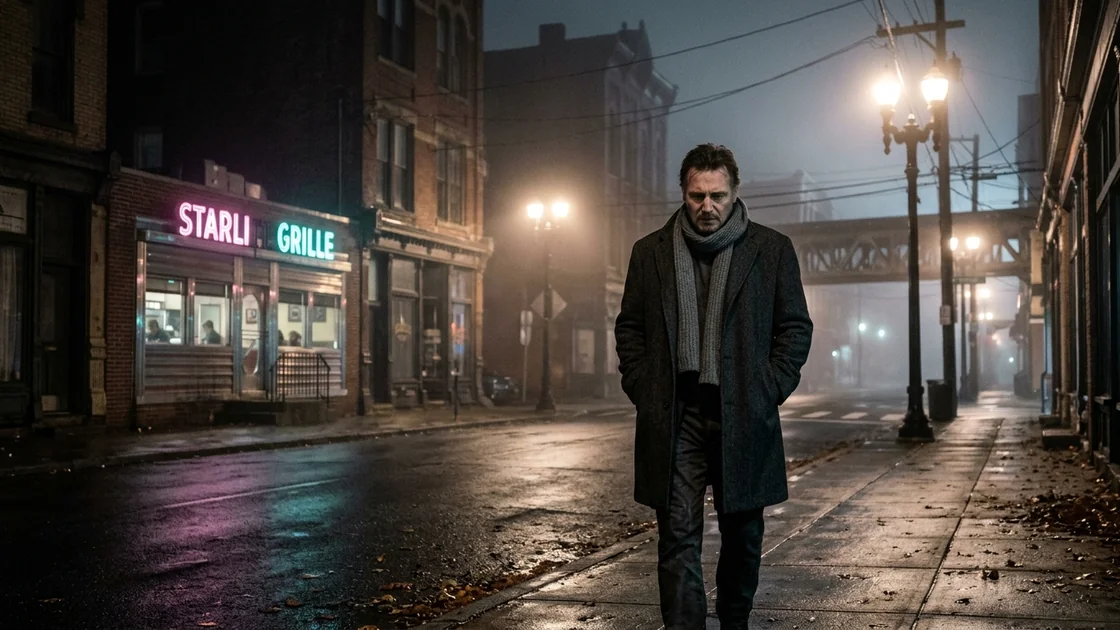
Julian Vance has not slept a full night since his wife Clara died six months ago, leaving him stranded in a silent Victorian house that feels more like a mausoleum than a home. Every evening, when the stillness of the bedrooms becomes too heavy to breathe, Julian puts on his heavy wool overcoat and walks into the sprawling, rain-slicked metropolis of Oakhaven. Through a single, endless night stretching from midnight to dawn, he wanders through deserted financial districts, neon-lit diners, foggy industrial docks, and overgrown public parks. Along the way, he encounters the forgotten denizens of the night shift—a waitress with her own quiet sorrows, a blind accordion player in a subterranean pedestrian tunnel, a security guard watching over an empty museum, and a baker preparing for the morning rush. Through these fleeting connections and the relentless rhythm of his own footsteps, Julian slowly maps the territory of his grief, discovering that while the night cannot bring back what he has lost, the waking world still holds a space for him when the sun finally rises.
The grandfather clock in the downstairs hallway did not merely tick; it excavated the silence, scooping out hollow seconds from the dark air of the foyer and dropping them onto the hardwood floor like lead weights. Up on the second landing, lying flat on his back beneath a quilt that smelled faintly of cedar and lavender that had lost its conviction months ago, Julian stared at the plaster rosette in the center of the bedroom ceiling. A streetlamp beyond the bay window cast the fractured silhouette of an elm branch across the plaster, and whenever the October wind stirred the leaves outside, the shadow twitched like a nervous hand.
It was twelve-fifteen. He knew this without turning his head to look at the brass alarm clock on the nightstand—specifically, on his side of the nightstand, because the other nightstand had been cleared of its water glass, its paperback novels, and its tortoiseshell reading glasses in late April, leaving behind only a pale rectangle in the varnish where the sun had failed to fade the wood.
Sleep was no longer a biological state to Julian; it was a foreign country from which his passport had been revoked. In the first month after the funeral, doctors with soft voices and clean fingernails had written him prescriptions for tiny blue ovals and chalky white cylinders. He had taken them dutifully. They had not brought sleep; they had brought a heavy, chemical paralysis that pinned his limbs to the mattress while his mind continued to pace the corridors of the house, rattling doorknobs and listening for the sound of Clara’s bare feet on the runner rug. Worse, the pills left him with a metallic taste at the back of his tongue that lasted until noon, making the grief taste like old pennies. So he had flushed the plastic amber bottles down the bathroom sink in June and accepted his new citizenship in the dark.
The house was too large for one breathing apparatus. When two people lived within its timber ribs, the ambient noises of their existence had kept the walls at bay—the low murmur of the radio in the kitchen while Clara braided her hair, the clatter of saucers, the sudden groan of the radiator in the study when Julian turned the brass valve with a pair of pliers. Now, the silence had a barometric pressure. By midnight, it grew so dense that Julian felt it pressing against his eardrums, thick and stifling, as if the rooms were slowly filling with invisible silt. Every object in the room was an accusation of permanence. Her mahogany dresser still stood against the eastern wall; the silver-backed hairbrush still held three strands of chestnut hair twisted around its bristles; the velvet armchair in the corner still bore the slight indentation of her weight, a shallow basin of memory that no one had sat in to erase.
If he stayed in the bed until one, he would begin to hear the phantom sounds. The click of the latch on the conservatory door. The rustle of a page turning in the parlor. The soft, sharp intake of breath she used to make when she remembered an errand she had forgotten to run.
Julian swung his legs over the edge of the mattress. The floorboards were cold against the soles of his feet, sending a sharp, clarifying shock up through his shins. He did not turn on the lamp. Over the past one hundred and eighty nights, he had memorized the topography of the dark house with the precision of a cave-dwelling creature. He dressed by touch: heavy corduroy trousers, a flannel shirt with a frayed left cuff, thick wool socks that pulled up to his calves. Downstairs, in the vestibule where the air smelled of damp umbrellas and old mail, he slipped his arms into his charcoal herringbone overcoat. He dropped his brass house keys into his right pocket, a crumpled five-dollar bill and a handful of silver change into his left, and wrapped a knitted grey scarf twice around his throat.
When he pulled open the heavy oak front door, the night air hit his face like a splash of well water.
Outside, Oakhaven was holding its breath. The rain that had fallen steadily through the late afternoon had tapered off into a fine, suspended mist that hung around the cast-iron streetlamps in glowing amber halos. The asphalt of Maple Terrace was black and slick, reflecting the yellow light of the lamps in long, greasy ribbons that stretched down the hill toward the commercial district.
Julian stepped onto the porch, pulled the door shut until the latch clicked—a sound that always felt like the sealing of a vault—and descended the four concrete steps to the pavement. As his leather soles struck the wet sidewalk, the band of iron that seemed to tighten around his ribs every evening at twilight loosened by a fraction of an inch. Here, the silence was different. Inside the house, the silence was an absence, a vacuum created by a missing voice. Out here, under the vast, bruised belly of the low clouds, the silence was merely space. It did not belong to him, and it did not remember her.
He turned left, walking downhill with his hands buried deep in the wool pockets of his coat, his chin tucked into the warmth of his scarf.
Maple Terrace was a neighborhood of three-story Victorian and Edwardian houses, their porches tucked behind overgrown privet hedges and wrought-iron fences whose spear-tips were blunted by decades of black rust-preventative paint. At twelve-thirty on a Tuesday morning, the neighborhood was a necropolis of the content. Behind those dark, curtained windows, people were submerged in the warm, rhythmic tide of ordinary rest. Accountants, schoolteachers, dental hygienists, and retired postal workers were lying side by side, their breathing synchronized, their minds unspooling harmless, chaotic reels of dreams that they would forget before their coffee finished percolating at seven.
Julian felt no envy toward them; he felt only a profound anthropological distance, as if he were a ghost observing a species to which he no longer belonged. Occasionally, as he passed a driveway, the blue, flickering rectangle of a television screen would illuminate a downstairs living room through a gap in the drapes—some other solitary soul watching late-night syndication with the volume turned down low—and Julian would offer a silent nod to the glass before moving on.
His knees Popped softly as he reached the bottom of the hill, where the residential maple trees gave way to the squat brick storefronts of Mercer Avenue.
During the day, Mercer Avenue was a clogged artery of delivery vans, honking sedans, and pedestrians carrying brown paper grocery bags. At night, stripped of its traffic, the street revealed its true geometry. The buildings looked older, their cornices etched sharply against the rust-colored glow of the city’s cloud cover. The traffic lights at the intersections continued their mechanical ballet—green, amber, red, green—for an audience of wet pigeons and blowing newspaper pages. Julian stood at the curb of Mercer and Fourth, waiting for the red hand on the pedestrian signal to turn into the little white walking man, even though there was not a headlight visible for half a mile in either direction. In a life where the fundamental law of cause and effect had been shattered—where a forty-two-year-old woman could go into a hospital with a persistent headache on a Thursday and cease to exist by Sunday—the arbitrary rules of municipal traffic signals provided a strange, rigid comfort.
The white figure flashed on. Julian crossed the street, his shadow stretching out behind him, then swinging underneath his feet, then racing ahead of him as he passed beneath the overhead sodium vapor lamps.
Three blocks down Mercer, a single buzz of pink and turquoise neon cut through the damp gloom. It belonged to the Starlight Grille, an establishment that was neither starry nor particularly skilled at grilling, consisting of a pre-fabricated stainless-steel dining car from 1954 that had been bricked into the gap between a shuttered dry cleaner’s and a bail bondsman’s office. The neon sign was missing the 'g' and the 'h' in Starlight, so that it proclaimed Starli t Grille to the wet pavement with a persistent, sixty-cycle electrical hum that Julian could hear from twenty paces away.
He had not eaten since noon, when he had stood over the kitchen sink and forced down half a tin of cold sardines on saltine crackers, not out of hunger, but because he had promised Clara’s sister on the telephone that he was "taking care of himself." His stomach felt like a folded piece of dry leather.
Julian pushed open the heavy aluminum door. A small brass bell wired to the top frame gave a tired, dull clink.
The air inside the diner was a warm, humid soup of fried onions, industrial bleach, and coffee that had been sitting on a glass burner for three hours, slowly reducing into battery acid. The interior was a long tunnel of yellowing Formica, cracked maroon vinyl booths patched with silver duct tape, and a counter lined with twelve chrome stools that spun on squeaky bearings.
There were only two other people in the room. Behind the counter stood Nadine, a woman in her late fifties whose hair was dyed the exact deep, artificial burgundy of a Bing cherry and pinned up into a fortress of bobby pins that looked capable of deflecting shrapnel. She wore a pale blue polyester uniform with a white apron tied tightly around a waist that had long ago surrendered to the gravity of the graveyard shift. She was wiping down the flattop grill with an oil-soaked rag, sending up little ghosts of grey smoke that vanished into the grease-furred intake of the exhaust hood.
Four stools down from the door sat a man in a beige canvas raincoat that was far too thin for the October chill. He was hunched over a porcelain mug, arranging and rearranging a small regiment of white sugar packets and plastic half-and-half tubs into complex geometric patterns on the Formica.
Nadine didn't look up as Julian took his customary stool near the cash register, two seats down from the glass dome that housed a single, petrified wedge of lemon meringue pie.
"You're early, Professor," Nadine said, her voice possessing the gravelled, musical resonance of thirty years of unfiltered menthol cigarettes. She wasn't actually sure what Julian did for a living—he was, in fact, an archivist for the municipal water department, currently on an extended, unpaid leave of absence—but because he wore a tweed cap on particularly cold nights and never used contractions when he ordered, the title had stuck.
"Twelve-forty-five," Julian said, unwinding the grey scarf from his neck and laying it across his lap. "The house was louder than usual tonight."
Nadine tossed the oily rag into a galvanized bucket under the counter and reached for a heavy ceramic mug from the stack beside the Bunn-O-Matic machine. She didn't ask what he wanted; she pulled the lever for the decaf pot with the orange handle, filling the mug to within a quarter-inch of the rim, and set it down in front of him on a paper napkin that immediately absorbed a ring of brown liquid spilling over the side.
"Plumbing?" she asked, leaning one elbow on the stainless-steel pass-through. Beneath her eyes, the skin was the color of bruised plum, yet her gaze was sharp, unsentimental, and strangely maternal.
"In a manner of speaking," Julian replied. He wrapped his chilled fingers around the thick porcelain. The heat soaked into his palms, thawing the stiffness in his knuckles. "Just the wood settling. Old beams don't like the damp."
"Nothing likes the damp," the man in the beige raincoat muttered without looking up from his sugar packets. He had lined six of them up like miniature dominoes, flanking them with two creamer tubs like watchtowers. "It gets into the mortar. Expands when the frost hits. Next thing you know, the whole facade is sitting on the sidewalk."
Julian looked down the counter. The man was perhaps sixty, with a neat, silver mustache that stood out in stark contrast to his unshaven jaws and a frayed shirt collar. His fingers were stained yellow at the tips and ink-blue around the cuticles.
"That's Arthur," Nadine said, waving a hand toward the man as if swatting at a harmless moth. "Arthur used to work for the Evening Sentinel before they folded the print edition. Proofreader. Now he proofreads the sugar."
"Typographical errors are a symptom of moral decay, Nadine," Arthur said mildly, adjusting a packet by a millimeter so that its serrated edge aligned with the grain of the fake wood counter. "You let a misplaced modifier slip through in the Tuesday obituary column, and by Friday the city council is embezzling from the pension fund. Everything is connected by syntax."
Julian watched Arthur’s hands. There was a tremor in the man’s right index finger, a rhythmic, ticking pulse that reminded Julian of the shadow of the elm branch on his bedroom ceiling.
"You missed the rain, at least," Nadine said to Julian, reaching into her apron pocket for a pack of cigarettes, remembering the health department sticker on the front window, and letting her hand drop back down with a sigh. "Came down like stair-rods around ten. Washed all the leaves out of the gutters on fifth. Clogged the storm drains. The intersection by the bus depot looks like Lake Erie."
"I like the streets after it rains," Julian said, blowing across the surface of his coffee. The steam rose into his face, carrying the bitter, roasted scent of cheap beans. "It washes the chalk off the sidewalks. Everything looks like it’s been varnished."
"Everything looks wet, is what it looks," Nadine countered. "My knees have been singing operettas since sundown. You want some toast? Rye came in fresh this morning. Well, yesterday morning now."
"Just the coffee, thank you, Nadine."
"Suit yourself. You're getting thin enough to slide under a closed door, Professor. One of these nights the wind's gonna come off the river and blow you right into the canal, and I’ll be out a regular."
She drifted down to the far end of the counter to refill the salt shakers from a large cardboard cylinder, leaving Julian in the quiet company of the buzzing neon and the hum of the pie case refrigerator.
He took a slow sip of the coffee. It was scalding and tasted faintly of the vinegar Nadine used to descale the heating elements on Sunday mornings, which was precisely why he liked it. It was an honest, unpleasant taste. Since April, people had been bringing him pleasant things—casseroles baked in disposable aluminum pans, fruit baskets wrapped in yellow cellophane, sympathy cards with watercolor paintings of sailboats slipping over soft horizons. Everything had been designed to cushion the blow, to wrap him in cotton wool so he wouldn't feel the jagged edges of the hole that had been blown through the center of his life. The Starlight Grille offered no cushions. The vinyl was hard, the light was an unforgiving fluorescent green that made everyone look slightly tubercular, and the coffee bit the tongue.
Down the counter, Arthur suddenly swept all the sugar packets into a neat pile and dropped them back into their fluted glass holder. He turned his head toward Julian. His eyes were pale grey, watery at the lower lids, like oysters on a half-shell.
"You're a walker," Arthur said. It was not a question.
"I am," Julian said.
"You have the gait. I watched you cross Fourth through the window. Head down, shoulders up around the ears, long stride, nowhere to be. People going somewhere walk with their chins out. People running away from somewhere look over their shoulders. People who are just trying to use up the concrete walk like they're measuring the blocks with their shoes."
Julian set his mug down. "And which one are you, Arthur?"
Arthur tapped his temple with an ink-stained forefinger. "I walk inside here. The rent is cheaper, and the weather is consistent, though the neighborhood has gone downhill considerably since ninety-eight." He paused, looking at Julian’s left hand, where the plain gold band still sat below the knuckle, slightly loose now that Julian had lost fifteen pounds. "How long?"
Julian’s thumb automatically moved under his palm to touch the underside of the ring, a nervous tic he had developed over the summer. "Six months. Tomorrow will be twenty-seven weeks."
Arthur nodded slowly, as if checking a date against an internal almanac. "The six-month mark is the treacherous one. In the beginning, there’s a sort of terrible glamour to it, isn't there? An emergency. People bring ham. The priest comes by. You have papers to sign—insurance, deeds, plots. You're busy being the bereaved. It’s a full-time occupation." He picked up his cold coffee mug and swirled the dregs at the bottom. "Then, around month five, the living go back to living. They have dentist appointments. Their kids get into trouble at school. The ham runs out. And you realize that it isn't an emergency anymore. It’s just Tuesday. And then it’s Wednesday. And the quiet sets in."
Julian stared at the laminated menu wedged between the napkin dispenser and the ketchup bottle. A grease spot had rendered the price of the Western Omelet translucent. No one in his daytime life—not his brother-in-law, not the well-meaning neighbors on Maple Terrace who waved with sad, tight smiles from behind their lawnmowers, not the grief counselor he had seen twice in May before giving up—had articulated the exact geometry of the trap so clearly.
"My wife," Arthur continued, his voice dropping an octave so it barely carried over the hiss of the coffee urn, "was named Eleanor. She died in the winter of two thousand and four. Embolism. We were arguing about whether to buy a new refrigerator because the ice maker on the old Frigidaire was making a knocking noise. She went into the pantry to get a can of peaches, and she never came out."
"I'm sorry," Julian said, the words feeling small and worn, like smooth river stones.
"Don't be. It was twenty years ago. The Frigidaire outlived her by a decade. I kept it just to spite the universe, knocks and all." Arthur slid off his stool with a stiff, mechanical groan of his joints. He reached into his pocket, pulled out two crumpled one-dollar bills and three quarters, and laid them beside his saucer. "The trick, if you want to call it a trick, is not to go home until your legs are heavier than your head. As long as the brain has more energy than the calves, the brain wins. You walk until the knees give out. Then the bed is just a piece of furniture again, not an operating table."
Arthur gave the brim of an imaginary hat a two-fingered salute toward Nadine, pushed open the aluminum door, and vanished into the mist toward the river.
Julian sat for another twenty minutes, nursing the decaf until it reached the lukewarm temperature of bathwater. Nadine finished her salt shakers and began folding paper napkins into triangles with the rhythmic precision of a factory loom. Neither of them spoke. That was the unspoken covenant of the Starlight Grille between midnight and four: you were permitted to exist in the presence of others without being required to perform the theater of being okay.
At one-twenty, Julian placed two dollars under the edge of his saucer.
"Take the bridge route tonight, Professor?" Nadine asked as he wound the grey scarf back around his neck.
"I think so," Julian said. "Down by the locks."
"Button your collar. The fog's coming up off the flats. And don't go looking over the railings too long. The harbor police get jumpy this time of year, and they don't have a sense of poetry."
"I have no intention of swimming, Nadine. The water is far too dirty."
"Glad to hear it. See you tomorrow."
Back on Mercer Avenue, the temperature had dropped three degrees while he was inside. The mist had thickened into a proper river fog that rolled up the cross streets from the Oakhaven Canal, smelling of wet coal, decaying riverweed, and the faint, sweetish tang of the grain silos on the south bank.
Julian turned east, leaving the low-rise commercial avenue behind and entering the financial district.
By day, the six square blocks around Exchange Plaza were the loudest part of the city—a canyon of granite and smoked glass where five thousand people hurried between investment banks, municipal courts, and law offices. By night, it was the most profoundly deserted place on earth. Nobody lived here. There were no bedrooms, no grocery stores, no dogs needing to be walked at two in the morning. There were only marble lobbies lit by recessed security lights, empty revolving doors gleaming like brass cages, and fifty-story monoliths that disappeared halfway up into the low ceiling of fog, as if the buildings had been sheared off by a giant blade.
Julian’s footsteps echoed sharply off the polished limestone facades. Clack. Clack. Clack. A solitary metronome in a stone amphitheater.
He remembered walking down Congress Street with Clara two Octobers ago. It had been a Saturday afternoon, crisp and bright, the sky that hard, porcelain blue that only happens in mid-autumn. They had come downtown to go to a framing shop on Third because Clara had found a nineteenth-century botanical print of nightshade and foxglove at an estate sale and wanted it mounted in walnut for the hallway.
She had been wearing her camel-hair coat and a rust-colored beret that she kept having to hold onto with one hand whenever they crossed an intersection because the wind was whipping through the canyons between the banks.
“Look at these places,” she had said, stopping to peer through the tinted plate glass of the Mutual Commerce Building at a massive, abstract bronze sculpture in the lobby that looked like a twisted pretzel. “Do you think anyone ever laughs in there? Or do they just whisper numbers to each other until five o'clock and then turn into bats?”
Julian had laughed then—a real laugh, the kind that started in the belly and made vapour clouds in the cold air. He had put his arm around her waist, feeling the warm bulk of the coat and the quick, bird-like solidity of her hip beneath it, and pulled her against his side as they walked. “I whisper numbers all day at the water department,” he had reminded her. “Gallons per minute. Mains pressure. Reservoir depths.”
“That’s different,” she had insisted, leaning her cheek briefly against his shoulder as they waited for a light. “Water is a real thing. You can wash your face in it. You can drown in it. Money is just an agreement people have when they’re awake.”
Now, passing the exact pane of glass at the Mutual Commerce Building, Julian stopped. The bronze pretzel was still there, bathed in a pale, security-halide glow. Beyond it, the marble floor stretched out like a frozen pond. A yellow plastic sign reading CAUTION WET FLOOR stood in the dead center of the lobby, guarding no one from slipping.
In the dark glass of the window, Julian caught his own reflection superimposed over the bronze sculpture. He looked like an etching of a man—all vertical lines, hollow cheeks, the grey scarf cutting a pale slash across the dark wool of his coat. For a second, a trick of the fog drifting behind him made it look as though a smaller figure in a camel-hair coat were standing three paces behind his left shoulder, just at the edge of the peripheral glass.
Julian did not turn around. He had learned in July not to turn around when the glass played tricks. If you didn't turn around, the figure stayed there for a moment longer, a plausible flaw in the optics of the night. If you turned, there was only a fire hydrant or a parking meter, and the sudden rush of emptiness into the space where the illusion had been was enough to bring you to your knees on the wet stone.
Instead, he closed his eyes, pressed his forehead briefly against the cold plate glass—letting the chill ache right through his frontal bone—and then shoved his hands back into his pockets and kept walking.
At the end of Congress Street, the pavement sloped sharply downward toward the pedestrian underpass that led beneath the six lanes of the elevated expressway to the riverfront.
The underpass was a concrete tube tiled in small, hexagonal white ceramics that had yellowed with decades of exhaust fumes and moisture seepage. Most people avoided it after dark, though in truth it was too damp and cold to attract anyone looking for trouble. What it did attract was sound. Above the concrete ceiling, the occasional eighteen-wheeler thundered across the expansion joints of the expressway—thump-thump, thump-thump—sending a low-frequency vibration through the tiles that felt like being inside the chest cavity of a giant beast.
And tonight, mixed with the rumble of a passing freight truck, there was music.
It was a slow, wheezing melody, minor-key and hesitant, played on an accordion that sounded as though one of its reeds were slightly rusted. As Julian descended the concrete stairs into the mouth of the tunnel, the notes bounced off the curved tiled walls, overlapping with their own echoes until it sounded like a whole orchestra of ghosts playing a waltz at the bottom of a well.
Halfway through the tunnel, sitting on an overturned milk crate with his back against the sweating tile wall, was an old man wearing fingerless wool gloves and a navy pea coat with brass buttons that had tarnished to green. A battered red Hohner accordion rested on his thighs. Beside his left boot sat a velvet-lined violin case—why a violin case for an accordion player, Julian had never figured out—holding three pennies, a dime, and a crumpled bus transfer.
The man’s eyes were milky white, turned slightly upward toward the fluorescent tubes that flickered behind wire cages on the tunnel ceiling. He was playing an old Eastern European folk tune that had no business being in Oakhaven at two in the morning.
Julian slowed his pace, his leather heels clicking loudly in the confined space. The accordionist didn't stop playing, though his head tilted slightly to track Julian’s progress by the acoustic reflection of his footsteps.
Julian stopped in front of the violin case. He reached into his left pocket, fished out the five-dollar bill he had brought from the dresser, folded it twice lengthwise so the man would know by touch if he checked the case that it wasn't a one, and leaned down to place it gently beside the dime, making no sound.
The accordion gave a long, dying wheeze as the bellows closed, and the old man rested his chapped hands on the mother-of-pearl keys.
"Paper," the man said. His voice was surprisingly light, almost reedy, carrying a faint trace of an accent that had been worn smooth by forty years in the Midwest. "A gentleman drops paper at two in the morning, either he just robbed a liquor store or he can't bear the weight of his own pockets."
"It's only five dollars," Julian said, standing straight. The tunnel smelled of wet cement and the old man’s pipe tobacco.
"Five dollars is five hundred pennies, friend. That's a lot of copper." The blind man tilted his ear toward Julian. "You're the one with the heavy left heel. You come through here every Tuesday and Thursday around two. Sometimes Friday if the weather isn't freezing."
Julian felt a slight jolt of surprise. He had seen the musician here half a dozen times over the past two months, usually just nodding as he passed while the music played. It had never occurred to him that while he was cataloguing the city, the city was cataloguing him.
"My left shoe needs a new lift," Julian admitted, looking down at his boot. "I haven't gotten around to taking it to the cobbler."
"Don't," the man said, patting the casing of his accordion. "A man needs a signature. Up in the daylight, everybody looks different, so they walk the same. Down here in the dark, everybody looks the same, so you gotta know them by the limp. There’s a nurse from St. Jude’s comes through at three-fifteen—rubber soles, squeaks on the third step because there’s a puddle by the drain. There’s a kid delivers bakery rolls on a bicycle at four—chain needs oil, clicks every fourth revolution. And there’s you. Clack-scrape, clack-scrape. Walking like you're carrying a sack of wet sand on your shoulders."
"My name is Julian."
"Anton," the man said, lifting two fingers from the keys in greeting. "Why aren't you in bed, Julian? You don't sound like a baker, and you don't smell like antiseptic."
"The house is too quiet," Julian said simply. Down here, beneath sixty thousand tons of concrete and asphalt, the truth seemed much easier to speak than it did in living rooms with floral wallpaper. "My wife died in the spring. When I lie down, the quiet gets into my chest."
Anton nodded slowly, his milky eyes fixed on the wire cage above them. A truck rolled over the expressway above, shaking a single drop of condensation loose from the ceiling; it landed with a sharp spat on the concrete three feet away.
"Quiet is a loud thing," Anton agreed. "When I lost my sight—industrial accident at the foundry back in eighty-nine, magnesium flare—everybody thought the dark was the hard part. It wasn't. The dark is just a blanket. The hard part was that I started hearing everything I used to ignore because my eyes were busy. Heard the termites in my porch posts. Heard my blood rushing behind my ears like a river in a pipe. Heard my wife breathing across the room when she was angry at me and pretending to be asleep."
Anton pulled the bellows open an inch, pressing a single bass button so the accordion let out a low, mournful hum—a sustained C-minor chord that vibrated in Julian’s breastbone.
"That's why I come down to the tube," Anton said over the chord. "Up in my apartment, the room is twelve feet by fourteen feet. If I play in there, the sound hits the drywall and dies right in my lap. Down here, the sound goes seventy yards both ways before it hits the stairs. It gives the grief somewhere to run to so it doesn't just sit on your knees like a stray dog."
He released the button. The chord lingered in the tiles for two full seconds after his finger lifted, slowly dissolving into the distant hiss of tires on the wet highway above.
"What was that song you were playing when I came down the stairs?" Julian asked.
"Didn't have a name," Anton said, his fingers beginning to wander lazily over the treble keys without pumping the bellows, making only the dry, wooden clatter of the levers. "Well, it had a name in my grandfather's village, probably something about a girl who married a soldier and the plum trees froze, they're all about that. Out here, it's just something to keep the fingers warm. You want to hear the rest of it?"
"I would," Julian said.
He leaned his back against the opposite wall of the tunnel, ten feet across from Anton, crossing his ankles and resting his shoulder blades against the cold ceramic tiles.
Anton didn't play it the same way he had when Julian first entered. Now that he wasn't playing to an empty corridor, the tempo slowed even further. The accordion breathed in and out like an iron lung, drawing the damp, exhaust-tainted air of the underpass through its brass reeds and turning it into something ancient and dignified. It wasn't a cheerful tune; it made no promises that the soldier would come home or that the plum trees would blossom again in May. Instead, it was a song of endurance. It said: The winter is six months long, the woodpile is low, the wolves are in the timber, and here we sit by the stove anyway.
Julian closed his eyes and listened. For the first time in weeks, when the image of Clara’s face rose behind his eyelids, it was not the hospital face—not the pale, waxy mask surrounded by plastic tubing and the rhythmic, terrifying beep-hiss of the ventilator that had haunted his attempts at sleep. Instead, he saw her in the garden behind the house on Maple Terrace, three summers ago, wearing an old straw hat of his that was too big for her head, her hands black to the wrists with compost as she dug up gladiolus bulbs before the first frost, squinting up at the back porch and laughing because he had accidentally locked himself out with two mugs of tea in his hands.
The memory didn't hurt any less than the hospital ones—in fact, it cut with a sharper, cleaner blade—but it didn't suffocate him. The music in the tunnel held the roof up while he looked at it.
When Anton finally let the bellows collapse with a soft sigh of leather and air, nearly ten minutes had passed.
Julian opened his eyes. His cheeks were cold where the damp air had touched two tracks of moisture he hadn't realized had spilled over his lower lashes. He wiped them away quickly with the back of his wool-gloved hand.
"Thank you, Anton," Julian said, his voice slightly thick.
"Keep walking, Julian," the blind man said, already resetting his fingers for a scale. "The river's got a good smell tonight. Like iron. Go breathe some of it before the garbage trucks start their routes."
Julian pushed himself off the tile wall and walked the remaining thirty yards of the tunnel, climbing the eastern stairs back up into the open air.
He emerged onto the riverwalk.
Here, the city stopped abruptly against a four-foot parapet of granite blocks, beyond which lay the Oakhaven River—or rather, the vast, black void where the river was supposed to be. The fog was so thick over the water that the opposite bank, where the massive concrete cylinders of the municipal grain elevators stood, was completely erased. Only a single red aviation warning light atop the tallest silo was visible, pulsing slowly in the mist like a dying ember suspended in the sky.
The water itself was invisible twenty feet out, though Julian could hear it slapping heavily against the creosote-soaked pilings of the old timber wharves below the parapet. Slap-gurgle. Slap-gurgle. A slow, oily rhythm.
Julian walked along the granite wall, heading north toward the Ironworks Bridge. The cast-iron benches along the promenade were beaded with millions of tiny water droplets that caught the light of the globe lamps like scattered diamonds. Every hundred yards, a life preserver hung inside a rusted metal cabinet, waiting for a crisis that rarely came at three in the morning.
He thought about his job at the water department. For nineteen years, he had spent forty hours a week in a basement room lined with steel flat-files in the Municipal Annex, cataloguing the subterranean veins of Oakhaven. He knew where the wooden water mains from 1874 still lay rotting beneath the cobblestone alleys of the Old Quarter; he knew the exact diameter of the cast-iron trunk lines that carried sixty million gallons a day from the upland reservoirs down to the industrial flats; he knew where the subterranean creeks had been bricked over into culverts in the nineteen-twenties, still running in total darkness beneath parking lots and supermarkets, carrying rainwater to the river without ever seeing the sun.
Clara had always teased him about his affection for the buried rivers.
“You’re a subterranean romantic, Julian Vance,” she had told him once when they were dating, after he had stopped her in the middle of a Sears parking lot to press his ear to a storm grate so he could hear Tanner’s Brook rushing twelve feet beneath the asphalt. “Other men point out constellations. You point out nineteenth-century brick interceptor sewers.”
“The constellations don't care about us,” he had explained earnestly, standing up with gravel stuck to the knee of his trousers. “The sewers are how we survive living together. And besides, the brook was there ten thousand years before the Sears, and when the Sears falls down, the brook will still be going to the river.”
Now, Julian felt very much like one of those bricked-over creeks. On the surface, paved over with grey stone and parking lines, nothing seemed to be moving. His house was static; his career was paused; his bank account slowly bled out through automatic bill payments that he barely checked. Yet underneath the pavement, in the pitch dark where no light reached, a tremendous volume of dark water was roaring through a narrow masonry tunnel under immense pressure, wearing away at the mortar bit by bit.
He reached the base of the Ironworks Bridge.
Built in 1911, the bridge was a towering monstrosity of riveted black steel trusses, counterweights, and thick braided cables coated in black axle grease. Its pedestrian walkway was cantilevered out over the water on steel brackets, floored with heavy oak planks that had been tarred so many times they felt slightly spongy underfoot.
As Julian stepped onto the wooden walkway, the fog swallowed the city behind him. Within fifty paces, the lights of the riverwalk had vanished, and the red light of the grain silo ahead was still invisible. The bridge existed only in fifty-foot increments, illuminated by caged yellow work-lights bolted to the steel girders overhead.
Halfway across the span, the walkway widened into a small semicircular observation platform directly above the central shipping channel. Julian stopped and leaned his forearms on the wet iron railing, looking down into the mist.
Seventy feet below, the river was a swirling soup of black ink and grey vapour.
From somewhere upriver, hidden entirely by the fog, came the deep, mournful bwaaaa-huuuuum of a tugboat’s air horn, warning the bridge tender of a barge tow. A moment later, the bridge’s own horn answered from the control tower hidden in the trusses above Julian’s head—two short, deafening blasts that made the iron railing vibrate under his elbows and sent a flock of sleeping pigeons exploding out from the girders into the mist like a scatter of grey ash.
Julian didn't flinch. He watched the fog part slowly below him as the nose of a gravel barge emerged from the gloom, pushed by a squat, rust-streaked tug named the Martha J. A single deckhand in a fluorescent orange slicker stood on the bow of the barge, holding a long halogen flashlight Whose beam cut a solid white cone through the swirling mist, sweeping the water ahead for driftwood.
As the barge slid directly beneath the bridge, the deckhand happened to tilt his head back and saw Julian standing high above at the railing, framed by the yellow girder lights. For three seconds, across seventy feet of vertical fog and the chugging roar of the tug’s diesel engines, the two men looked directly at one another. Neither waved. There was simply a mutual acknowledgment of presence—I am down here on the water; you are up there in the air; we are both awake while the city sleeps—and then the steel deck of the bridge swallowed the barge, and the tug’s exhaust smoke drifted up through the wooden planks around Julian’s boots, warm and smelling strongly of unburned diesel fuel.
Julian stood in the cloud of diesel heat until the red stern light of the Martha J. dissolved into the eastern fog.
His watch, when he pulled back the wet cuff of his coat to squint at the luminescent hands, read three-ten.
This was the deadest hour. In the taxonomy of the night that Julian had constructed over the past six months, the hours between midnight and two belonged to the stragglers—the bar-closers, the late-shift waiters going home, the teenagers driving too fast down empty boulevards. The hours after four belonged to the early risers—the bakers, the street sweepers, the newspaper distributors.
But three o'clock belonged to no one. At three in the morning, the human body’s core temperature drops to its lowest point; the heart beats slowest; the hospitals record the highest number of quiet expirations in the intensive care wards. Clara had died at three-seventeen. The doctor had written 03:17 on the clipboard with a cheap blue ballpoint pen that had skipped on the seven, so he had had to trace over the downstroke twice. Julian remembered staring at that double-inked seven while the nurse gently pulled the sheet up to Clara’s collarbone, thinking with a strange, detached madness that the pen’s failure was an insult, that if you were going to record the end of the world, you ought to use fountain ink that didn't skip.
Instead of crossing to the industrial south bank, Julian turned back down the bridge ramps and headed north along the edge of the Old Quarter, where the granite warehouse district softened into the iron fencing of the Municipal Conservatory and Botanical Gardens.
Technically, the park closed at ten. Wrought-iron gates ten feet high, topped with gilded spears, barred the main carriage entrances on Conservatory Drive. However, because Julian had spent two decades reading the municipal property surveys, he knew that on the western perimeter, where the park abutted the old streetcar maintenance yard, a delivery culvert built in 1908 to bring coal to the greenhouse boilers had never been properly fenced off when the city switched to natural gas in the fifties.
He walked down the narrow gravel lane behind the streetcar sheds, where weeds grew waist-high through rusted tracks that led straight into bricked-up doors. Stepping over a low chain that hung between two leaning concrete bollards, he ducked beneath the heavy, dripping boughs of a weeping beech tree and emerged onto the crushed-bluestone paths of the park.
Inside the gardens, the city disappeared entirely. The surrounding ring of ancient oaks and Norway spruces muffled the distant hum of the expressway, and there were no sodium-vapor streetlamps here—only low, cast-iron path lights shaped like mushrooms that cast soft pools of white light onto the wet gravel and the rotting autumn leaves.
The smell here was overwhelming after the concrete and diesel of the riverfront. It was the smell of a million leaves returning to dirt—sweet, fungal, sharp with the tannin of oak bark and the bruised, spicy scent of chrysanthemums that had been nipped by the first frost the week before.
Julian walked slowly up the winding incline toward the Ridge Conservatory, a massive Victorian palace of curved iron ribs and thousands of small glass panes that sat on the highest hill in the park like a grounded crystal dirigible. From the outside, the conservatory glowed with a dim, greenish luminescence from the grow-lights and heater coils inside the palm dome, looking like a warm hearth in the middle of the cold drizzle.
At the foot of the conservatory steps, sheltered by a tall hedge of clipped yew, stood a semicircular limestone bench surrounding a dry bronze fountain of a boy holding a leaking dolphin.
Julian was about to sit down on the stone bench to rest his aching calves when he realized it was already occupied.
At the far end of the bench, tucked into the shadow of the yew hedge, sat a young woman in a bulky, olive-drab army surplus parka with a faux-fur hood pulled up over her head. Across her knees lay a large black portfolio case, the kind art students carried across town on buses, wrapped in a clear plastic dry-cleaning bag to keep the damp off. She was holding a small penlight between her teeth, its narrow beam directed down at a spiral-bound sketchbook in her lap, while her right hand moved rapidly with a stick of charcoal.
Julian stopped six feet away, intentionally scuffing his boot on the bluestone gravel so he wouldn't startle her.
The girl stopped drawing and took the penlight out of her mouth, shining the weak beam briefly at Julian’s knees before clicking it off. She didn't look frightened; she looked mildly annoyed, like a badger interrupted while digging a burrow.
"If you're park security," she said, her voice brisk and nasal from the cold, "the gate by the trolley barn was open. I didn't climb anything."
"I'm not security," Julian said, keeping his hands visible outside his pockets and taking a step back toward the path. "I came in through the same culvert. I didn't mean to intrude. I'll walk the lower loop."
The girl squinted at him through the gloom. She couldn't have been more than twenty-two, with a sharp, pale face smudged at the jawline where she had wiped her chin with a charcoal-stained thumb.
"You're too old to be a mugger," she decided after a three-second appraisal. "And you're wearing a herringbone coat. Muggers don't wear herringbone; it’s too heavy to run in. You can sit if you want. It's a twelve-foot bench."
Julian hesitated, then walked to the opposite curve of the limestone semicircle and sat down on the cold stone. The dampness soaked through the seat of his coat almost immediately, a sharp chill that actually felt good against the dull ache at the base of his spine.
For a few minutes, the only sound was the soft scritch-scritch-scritch of her charcoal against the heavy toothed paper and the drip of water from the nose of the bronze dolphin into the leaf-choked basin of the fountain.
"What are you drawing in the dark?" Julian asked eventually, looking up at the dark mass of the conservatory dome rising above them.
"The glass," she said without stopping her hand. "During the day, you can't see the glass because you see all the junk inside it—the ferns and the banana trees and the tourists in yellow windbreakers. At night, with the mist on the panes and the service lights on inside, you only see the ribs and the glow. It looks like the skeleton of a whale."
She held the sketchbook up at arm's length, tilting it toward the glow of the path light to check her proportions. Even from eight feet away, Julian could see that she was good. She had covered the entire white sheet in rich, velvety black charcoal first, and was actually drawing with a kneaded rubber eraser, pulling the pale ghost of the glass dome out of the black soot by removing the dark rather than adding light.
"That's an unusual way to work," Julian observed.
"Reductive tone," she said, going back to work with the corner of the eraser. "My professor says I have a heavy hand with lines. He made me coat ten sheets in vine charcoal and told me not to come back to studio on Wednesday unless I'd found ten buildings by rubbing the black off. Said it teaches you that light isn't a thing you put on top of the world; it's what's left over when you move the dark out of the way."
Light isn't a thing you put on top of the world; it's what's left over when you move the dark out of the way.
Julian looked at the black smudges on her fingers. Clara had been a potter in her twenties, before her wrists developed a slight carpal tunnel from the kick-wheel and she transitioned to teaching elementary school art. He remembered the clay dust that used to live permanently in the creases of her knuckles, how even after she scrubbed with a nail brush before dinner, her skin smelled faintly of wet earth and river silt.
"Why at three in the morning?" Julian asked. "Surely it's dark at eight."
The girl stopped erasing and blew a scatter of grey rubber crumbs off the page. "At eight o'clock, my roommate is watching reality television in our living room and her boyfriend is frying bacon in a pan he never washes. You can't see whales when somebody is burning bacon. Besides, I don't sleep much since I moved to the city."
"Why not?"
She shrugged inside the oversized parka. "Where I grew up, up in the UP near Marquette, when it's night, it's actually night. The pine trees go right up to the window and the sky is black as a boot. Down here, the sky stays orange all night. It's like the city leaves the hallway light on because it's afraid of the dark. Keeps me wired. What's your excuse?"
"The opposite," Julian said, looking down at his laced boots. "My house is too dark. I come out for the orange sky."
She looked over at him properly then, her dark eyes catching the faint green reflection of the greenhouse behind them. Youth usually had a natural armor against the old grief of strangers—a self-absorption that allowed twenty-year-olds to walk past tragedy without catching its scent—but artists were sometimes cursed with porous skin. She looked at the posture of his shoulders, the way he held his hands clasped tightly between his knees as if keeping them from shaking, and the impeccable, slightly dated cut of his coat.
"Did somebody die?" she asked with the blunt, startling directness of someone who hadn't yet learned the polite suburban euphemisms of passing on or losing.
"My wife," Julian said. "In April."
The girl looked back down at her drawing of the whale-bone greenhouse. With the thumb of her left hand, she gently smudged one of the erased white panes so that the mist seemed to drift right across the iron mullions on the paper.
"My brother died when I was sixteen," she said quietly. "Drowned in a quarry up by Ishpeming. Jumped off the limestone ledge in May before the water had warmed up from the snowmelt. Heart just stopped from the cold before he even hit the bottom."
"I'm very sorry," Julian said.
"Yeah. Well." She tapped the charcoal stick against the spiral wire of the pad. "For a whole year after that, my dad used to sit in the cab of his pickup truck in the driveway from two in the morning until five. Didn't turn the engine on. Didn't turn the radio on. Just sat behind the wheel in his bathrobe looking at the garage door. My mom wanted to take him to a doctor in Green Bay, thought he was losing his marbles. I went out there one night in November with two thermoses of chicken broth and asked him what he was doing."
"What did he say?" Julian asked.
"He said that inside the house, there were four bedrooms and three people, and the math didn't work. Out in the truck, there were only two seats, so it didn't feel like anybody was missing."
A sudden gust of wind shook the branches of the weeping beech down the hill, sending a shower of heavy water droplets pattering across the dry-cleaning bag over her portfolio.
With a quick, decisive movement, the girl gripped the top corners of her drawing and tore it cleanly from the wire perforations of the pad. Before the charcoal could smear against her coat, she leaned across the curve of the limestone bench and held the heavy paper out toward Julian.
"Here," she said.
Julian looked at the sheet, then up at her face. "I can't take your assignment. Your professor said ten sheets."
"I work fast when my toes are numb, and I've got nine more in the bag from the warehouse district," she said, shaking the paper slightly until he was forced to lift his gloved hands and take it by the edges. "Take it. Put it on the wall in one of the rooms where the math doesn't work. Don't touch the middle; I haven't sprayed it with fixative yet, so if you rub your thumb on it, the greenhouse disappears."
Julian held the heavy rag paper carefully by its borders. In his hands, the pale grey dome of the conservatory glowed out from the dense, suffocating black of the vine charcoal—fragile, made entirely of absence, yet structurally complete.
"What is your name?" he asked so he could at least know who had given him a piece of the night.
"Clara," she said, pulling the penlight out of her pocket. Then she winced slightly, making a face in the dark. "No, it's not. Why did I say that? It's Chloe. My mom calls me Clara when she's mad at me because that's my aunt's name. It's Chloe."
Julian’s heart gave a single, violent thud against his ribs—a sensation so physical he nearly dropped the paper—before settling back into its slow, cold rhythm. It was just a slip of the tongue, a phonetic collision in the dark between two strangers, yet out here at three-thirty in the morning, where Arthur the proofreader claimed everything was connected by syntax, it felt like a small, gentle tap on the windowpane from the other side of the glass.
"Thank you, Chloe," Julian said. "I have a roll of drafting tissue at home. I'll fix it properly."
"Good. Now go on, I've gotta do this again before the rain starts up, or Old Man Miller will give me a C-minus and tell me to switch to graphic design."
Julian stood up, holding the drawing in his left hand with his arm crooked slightly away from his body to shield it from the mist with the lapel of his overcoat. He walked down the southern slope of the botanical gardens, exiting not through the culvert, but by pressing the brass crash-bar on a pedestrian turnstile near the caretaker’s cottage that rotated only outward. The iron bars ratcheted behind him with a heavy, mechanical clank-clank-clank, locking him back into the city streets.
It was four o'clock.
To protect the charcoal drawing from the thickening drizzle, Julian needed shelter, or at least a wide awning. He was now in the Museum District, where wide boulevards lined with London plane trees flanked the neoclassical limestone temples of the civic institutions: the Public Library, the Historical Society, and the Oakhaven Museum of Fine Arts.
The Art Museum occupied an entire city block, its front steps rising in a grand, forty-foot sweep of pink Tennessee marble toward six Corinthian columns. During the summer, those steps were littered with college students eating lunch and street musicians; now, they were a vast, slick cascade of wet pink stone shining under the floodlights.
However, around the back of the building, on Museum Lane, was the receiving dock and the staff entrance—a recessed glass pavilion tucked beneath the overhang of the second-story wing where the nineteenth-century pastoral landscapes were hung.
Julian turned down Museum Lane, keeping the drawing tucked beneath the overhang of his arm. As he passed the broad plate-glass windows of the security vestibule, a movement inside caught his eye.
Sitting behind a curved wooden console lined with twelve small black-and-white television monitors was an elderly black man in a crisp navy security uniform with a gold badge pinned over his breast pocket. The guard was not looking at the monitors. He had a small cedar cigar box open on the desk in front of him, filled with tiny pots of enamel paint, and was using a magnifying visor strapped to his forehead to paint the brass buttons on a two-inch lead soldier with a brush that appeared to have only three bristles.
Seeing Julian pause outside the glass to adjust his grip on the wet charcoal paper, the guard lifted his chin so he was looking under the rim of the magnifying visor. He looked at Julian, looked at the unmounted drawing in Julian’s bare hand, looked up at the drizzle beginning to slant down through the floodlights, and then reached under his desk.
A loud electric buzzer sounded—bzzzzzt—and the heavy glass door clicked unlocked.
Julian looked at the door, then at the guard, who made a small, impatient beckoning motion with the butt of his paintbrush.
Julian pulled the door open and stepped into the vestibule.
The air inside wasclimate-controlled to an exact sixty-eight degrees with fifty percent relative humidity—the precise atmospheric condition required to prevent Dutch oil paintings from cracking and Egyptian mummy cases from warping. After three hours in the raw October river damp, the dry, warm air felt like stepping into a library in heaven.
"You're gonna ruin that charcoal in the wet, mister," the guard said. His voice was deep, slow, and measured, the voice of a man who had spent twenty years in rooms where shouting was against the bylaws. "Set it down on the radiator grate over there by the umbrella stand. It's warm, not hot. It'll dry the edge of the paper without curling it."
Julian walked over to the bronze grille set into the marble baseboard and carefully laid the drawing flat on the dry brass lattice. The black vine charcoal looked even deeper under the warm halogen lights of the lobby.
"Thank you," Julian said, turning back to the console and unbuttoning the top two buttons of his damp overcoat. "I didn't think you were allowed to let anyone in after hours."
"I'm not," the guard said calmly, dipping his three-bristle brush into a tiny cap of water and wiping it on a folded paper towel. "That's the outer vestibule. The inner security glass is locked from the main box downstairs. You can't get to the Rembrandts from where you're standing unless you brought a tank, and I don't have to watch a man watch his picture turn into soup on the sidewalk."
He pointed with his brush at the brass nameplate pinned above his pocket. H. GILLESPIE.
"Hector," the guard said.
"Julian Vance."
"You the artist, Mr. Vance?"
"No. A girl in the park drew it twenty minutes ago. The conservatory dome. She gave it to me."
Hector tilted his head back down so the magnifying lenses caught the light, returning his attention to the tiny lead infantryman held in a small brass vise on the blotter. With incredible steadiness, he touched a microscopic dot of gold paint to the figure’s collar.
"Good eye on her," Hector murmured. "Most kids today can't draw a straight line without a computer doing the math for them. What is that, fifty-seventh Massachusetts infantry you got there?" Julian asked, stepping closer to the counter to peer at the tiny figure.
Hector stopped his brush and looked up over the visor again, a sudden warmth lighting up the deep creases around his eyes. "Fifty-fourth Massachusetts. Fort Wagner, eighteen sixty-three. How’d you know Union infantry from ten feet away?"
"The forage cap and the light blue trousers," Julian said, a faint ghost of a smile touching the corner of his mouth. "My father used to cast them from lead fishing weights in our basement when I was a boy. I still have a shoebox full of Waterloo hussars in my attic somewhere, though the paint is mostly chipped off."
"You gotta prime 'em with white lacquer first, otherwise the oil in the lead sweats the enamel right off after ten years," Hector said, pleased to have found a fellow specialist in the middle of the night. "I do a regiment a winter. Gives me something to do between the two-o'clock rounds and the four-o'clock rounds. You stare at those twelve television screens for eight hours straight without moving your hands, your eyeballs turn into hard-boiled eggs."
Julian glanced at the bank of twelve small black-and-white monitors set into the console. Each screen showed a different gallery of the vast building above them, switching automatically every ten seconds with a soft vertical roll.
Click. The Renaissance gallery: forty gilded madonnas staring across polished parquet floors at empty velvet benches. Click. The Sculpture Court: white marble Roman emperors standing in dim, shadowy rows like patients in a bathhouse. Click. The Impressionist wing: blurred gardens of water lilies and sunlit haystacks hanging in total silence, waiting for nine o'clock when human eyes would come back to turn the dried pigment back into light.
"Does it ever feel strange?" Julian asked, watching the screens flicker through the empty rooms. "Being in here with all of this when there’s no one looking at it?"
Hector set his paintbrush down in the groove of the cedar box and pushed the magnifying visor up onto his grey, closely cropped hair, rubbing the bridge of his nose where the plastic strap had left a red dent.
"Strange how?"
"As if the building is holding its breath," Julian said, trying to put into words the connection between this vast, silent marble box and his own house on Maple Terrace. "All these things that people made—portraits of their wives, landscapes of farms they loved, statues of their children—and for twelve hours every night, they’re just hanging here in the dark. Like a house after everyone has moved away."
Hector leaned back in his swivel chair, which gave a long, comfortable groan of leather and springs. He looked at the monitors for a long moment. On screen four, the camera in the American Wing showed a massive 1880 Hudson River School landscape of a thunderstorm rolling over the Catskills.
"You got it backwards, Mr. Vance," Hector said softly. "During the day, when the school buses pull up out front and there’s four hundred kids in here chewing gum and looking at their telephones, and the docents are talking loud so the old folks in the back can hear—that’s when the pictures are dead. Nobody’s looking at 'em then; they’re just walking past 'em so they can say they went to the museum."
He tapped the glass of screen four with a dark knuckle.
"Around one in the morning, when I take my flashlight and walk the third floor, that’s when the building wakes up. You walk through the portrait gallery with just your rubber heels on the oak, and all those people from three hundred years ago—the Dutch merchants and the ladies in the lace collars—they aren't posing anymore. They’re resting. And the funny thing is, they don't look sad about being dead. The guy who painted 'em died. The lady in the chair died. The king who bought the picture died. And yet there her hand is, still holding a lemon on a silver plate, looking just as fresh as it did in sixteen-fifty."
Hector looked across the console at Julian, taking in the damp coat, the deep hollows beneath Julian’s cheekbones, and the way Julian kept glancing toward the radiator as if the charcoal drawing were a living infant.
"Things don't stop being what they were just because the room gets empty, Mr. Vance," the guard said. "The paint stays on the canvas in the dark. You don't have to stand in front of it twenty-four hours a day to keep it from fading."
Julian stood very still in the warm air of the vestibule.
For six months, he had been terrified of sleeping—truly terrified, beneath the chemical insomnia and the grief—because some primitive, superstitious part of his mind believed that he was the only witness left. While he was awake and aching, Clara was still in the house; she was present in the sharp contour of her absence. If he fell asleep, if he let the dark roll over his consciousness for eight uninterrupted hours and woke up refreshed, it felt like letting go of the rope that held her boat to the dock. He had been trying to keep the painting on the canvas by staring at it in the dark until his eyes bled.
"My wife used to love the room on the second floor," Julian said, his voice barely above a whisper. "The small octagon gallery by the east stairs. With the Dutch interiors."
"Room two-twelve," Hector said immediately. "The Vermeer study and the two De Hoochs. Good room. Got a radiator under the bench that doesn't clank, so I sit in there on my three-o'clock round when my sciatica acts up. Lots of pictures of women reading letters by open windows."
"She used to say she liked them because nobody in those paintings was trying to be historic," Julian said, remembering how Clara would stand six inches from the varnish, peering at the tiny white dot of lead paint on the pearl earring of a housemaid pouring milk. "They were just sweeping a courtyard or peeling apples in a patch of sunlight. She said it proved that the ordinary days were the only ones worth saving."
Hector checked the round wall clock above the fire alarm panel. It was four-twenty-five.
"Tell you what," Hector said, reaching for his heavy aluminum Kel-Lite flashlight that sat charging in a cradle on the wall. "I'm five minutes late for my four-fifteen walk-through because I was messing with these cartridge boxes. I can't let you past the glass. That's my pension if the chief checks the tape. But screen seven there is the feed for Room two-twelve. The camera’s up in the northeast corner over the doorway."
He flipped a small toggle switch beneath monitor seven, stopping its ten-second rotation so the image stayed fixed on the small octagonal gallery. In the grainy black-and-white phosphor of the small screen, Julian could see the leather bench in the center of the room and the four dark rectangles of the Dutch paintings hanging on the silk-covered walls.
"I'll be up there in about four minutes," Hector said, unlatching the inner security door with a key from his belt. "I'll turn the gallery spots on for five minutes while I check the window latches. Camera sees better with the spots on anyway."
Hector stepped through the inner glass door, locked it behind him, and disappeared down a marble corridor into the dark belly of the museum.
Julian leaned both hands on the wooden edge of the security console, staring intently at the seven-inch screen of monitor seven.
For three minutes, nothing happened. The room on the screen was a grey soup of low-light static.
Then, at the bottom of the frame, the dark silhouette of Hector’s cap appeared. The guard walked over to a panel by the archway and flipped a switch.
Instantly, the small television screen bloomed with light. The recessed halogen track lights in the ceiling of Room 212 snapped on, throwing sharp, brilliant cones of illumination directly onto the walls. Even through the black-and-white security camera, the transformation was miraculous. In the painting on the center wall—Pieter de Hooch’s Courtyard in Delft—the painted sunlight of a June morning in 1658 suddenly blazed across the screen. A woman in a dark bodice stood in a brick archway holding a child’s hand, looking out toward a bright garden that had ceased to exist three centuries ago, yet was entirely present right now at four-thirty in the morning in Oakhaven.
Hector walked slowly to the center of the gallery, stood behind the leather bench facing the painting for a full two minutes with his hands clasped behind his back—standing in for Julian, lending the dead woman’s favorite room a pair of living eyes—before walking back to the switch, touching two fingers to the brim of his cap toward the camera lens in the corner, and plunging the room back into the safe, quiet dark.
When Hector returned to the vestibule three minutes later, Julian had already retrieved his dried charcoal drawing from the radiator grate. He had found a sheet of clean yellow legal paper on the clipboard by the sign-in book and folded it carefully over the front of the drawing like a protective dust jacket.
"Windows were all latched," Hector reported, dropping his flashlight back into its charging cradle with a solid clunk.
"Thank you, Hector," Julian said. He reached across the counter and shook the older man’s hand. Hector’s grip was dry, warm, and surprisingly strong, the calluses on his palm catching slightly against Julian’s skin.
"Come back during the day sometime, Mr. Vance," Hector said, pulling his magnifying visor back down over his forehead. "Ticket's free on Tuesdays for city employees. They look even better in color."
"I think I will," Julian said. "Next Tuesday."
When Julian stepped back out into Museum Lane, the mist had finally stopped falling.
Look up, and you could see why: a brisk wind from the northwest had begun to tear ragged holes in the low orange ceiling of the clouds. Through one of the gaps, high above the dark roof of the Public Library, a single, sharp star—Aldebaran or Capella, Julian wasn't sure which—glinted like a chip of diamond on black velvet.
And in the east, down at the far end of the crosstown avenues toward the river, the blackness of the sky had lost its solidity. It was no longer black; it was the deep, translucent indigo of an old ink bottle held up to a candle.
It was ten minutes to five. The shift was changing.
Julian walked west, back toward the older neighborhoods that bordered the bottom of Maple Terrace, cutting through the heart of the Market District on Sixth Street.
If the Financial District at two in the morning was a tomb, and the Museum District at four was a sanctuary, the Market District at five was a delivery room. Here, the nocturnal world Julian had inhabited for the last five hours began to fray at the edges, giving way to the noisy, pragmatic machinery of the waking city.
On Sixth Street, the metal roll-up gates of the wholesale produce warehouses were rattling upward with ear-splitting metallic shrieks. Forklifts beeped backwards out of loading bays, their yellow strobe lights flashing against the wet brick walls as men in quilted canvas vests stacked wooden crates of waxed rutabagas, cabbages still beaded with field dew, and cardboard flats of late-season apples onto the high concrete docks.
A street-sweeper truck crawled down the gutter at five miles an hour, its great circular steel brushes spinning against the curb with a loud, rhythmic shhhhh-scrape, shhhhh-scrape, spraying jets of water that washed the night’s fallen sycamore leaves and cigarette butts into a neat wet windrow.
Julian had to step off the sidewalk twice to walk around stacks of bundled morning newspapers that had been tossed from the back of a speeding van, bound in tight plastic straps that hummed with tension. The headlines on the top copies—some municipal bond dispute, a fire in a tire warehouse across the state—looked strange and slightly absurd to Julian, like dispatches from a play he hadn't bought a ticket for. Yet for the first time since April, he didn't resent the play for going on without her.
Halfway up the sixth block, a cloud of white steam billowed out of a basement sidewalk grate, carrying with it a scent so rich, primal, and overwhelmingly alive that Julian stopped dead in his tracks right in the middle of the warm vapour.
It was yeast, browned butter, blistered wheat crust, and sugar caramelizing on iron sheets.
Above the grate was the narrow brick storefront of Vogel’s Vienna Bakery. The front retail shop was still dark, the glass display cases empty save for their white paper doilies, and the hand-painted wooden sign on the door was still flipped to CLOSED.
However, down in the basement kitchen visible through the low, barred transom window at the level of Julian’s shins, the world was blazing with golden incandescent light.
Julian knelt down slightly—ignoring the sharp protest of his knees, which had now carried him nearly nine miles through the night—and peered through the dusty glass of the basement window.
Inside the low-ceilinged brick vault, two men in white cotton trousers and sleeveless undershirts dusted to the elbows in white flour were moving with the silent, choreographed grace of dancers around a massive revolving deck oven. One of them, a barrel-chested man with a thick grey mustache, was sliding a ten-foot wooden peel into the glowing maw of the oven and withdrawing three braided loaves of challah and a dozen crusty boules, dumping them onto a galvanized wire cooling rack with a sound like dry autumn leaves rustling.
As the baker turned to reach for the next peel, he caught sight of Julian’s face framed between the iron bars of the sidewalk window.
Julian straightened up quickly, embarrassed to have been caught staring like a child in a Dickens novel. He turned to continue up the hill toward Maple Terrace.
Before he had taken four steps, the narrow wooden side door next to the alley—the one marked DELIVERIES ONLY—swung open with a squeak of flour-gummed hinges.
The barrel-chested baker leaned out into the cool morning air, wiping his sweating forehead with the crook of a flour-white forearm. Steam rose directly off his bare shoulders into the forty-degree street.
"Hey!" the baker called out. "Coat!"
Julian stopped and turned around. "I'm sorry," he said. "The smell came up through the grate. I wasn't trying to pry."
"What's to pry? It's bread, not the Manhattan Project," the baker said. He had a thick, congested laugh and looked down at the yellow-paper-wrapped charcoal drawing tucked under Julian’s arm, then up at Julian’s pale, unshaven face. "You just getting off work or just getting on?"
"Neither, really," Julian said. "Just walking."
"Hell of an hour for a stroll. Wait there a second."
The baker disappeared back down the concrete steps. Thirty seconds later, he reappeared holding a brown paper bag that was already turning translucent at the bottom from the heat of its contents. He held it out across the threshold.
"Sourdough boule," the baker said. "Split on the seam in the oven—too much steam on the first vent. Can't put it in the front window for the housewives at seven because it looks like a baseball mitt, and I hate throwing good starter to the pigeons. Take it."
Julian reached into his left pocket, where the handful of silver change from the night before still jingled against his thigh. "Let me give you something for it. I have two dollars in quarters."
"Register's locked until six-thirty, and if I put cash in my apron pocket my wife thinks I'm playing pinochle with the flour driver," the baker said, shoving the warm bag into Julian’s free hand. "Go on. Eat the crust while it's still singing, otherwise you might as well buy wonder-bread at the pharmacy."
The door slammed shut, and the heavy bolt slid home from the inside.
Julian stood on the sidewalk holding the brown paper bag. If you listened very closely, holding the bag near your chin, the baker was right: the loaf was actually singing. As the scorching crust hit the cold October air, it contracted in thousands of tiny fractures, making a faint, continuous tick-crackle-tick sound inside the paper, like a miniature fireplace.
He tucked the charcoal drawing carefully under his left arm and held the warm loaf against the center of his chest with both hands, letting the heat radiate right through the herringbone wool of his overcoat and into his sternum.
He began the final climb up the hill toward Maple Terrace.
Arthur, the proofreader at the Starlight Grille, had been right about the physics of the human body. After five hours and ten miles of wet asphalt, concrete stairs, iron bridges, and gravel paths, Julian’s legs no longer felt like they belonged to him. They felt like two heavy oak posts bolted to his hips. Every step up the steep incline of the residential hill required a conscious negotiation with his thighs, and the small of his back burned with a deep, radiating fatigue that left no room for the frantic, circular arithmetic of his mind.
His brain was quiet. The relentless projection machine behind his eyes had finally run out of film.
As he turned the corner onto Maple Terrace at five-forty-five, the sky above the eastern gables of the Victorian houses had turned the pale, milky violet of a mourning dove’s wing, striated with long, thin bands of rose and apricot where the sun was preparing to breach the horizon beyond the industrial flats.
In the maple trees lining the curb, the sparrows had begun their tentative, metallic morning arguments—cheep-chink, cheep-chink—testing the air before committing to full song. On the porch of number forty-two, a yellow tabby cat sat on the top step waiting to be let in, licking the dew off its front paw with slow, rhythmic strokes.
Julian stopped at the wrought-iron gate of number thirty-eight.
His house stood behind its overgrown privet hedge, three stories of dark grey clapboard and white trim that needed scraping around the eaves. In the lavender light of early dawn, the windows didn't look like black holes anymore; they reflected the pale pink of the eastern clouds, giving the glass a soft, pearlescent sheen.
He walked up the front path, climbed the four concrete steps—his left heel giving its familiar clack-scrape on the top riser—and unlocked the heavy oak front door with his brass key.
He stepped into the foyer and closed the door gently behind him.
Immediately, his ears sought out the grandfather clock in the hallway. It was still ticking—tock, tock, tock—carving seconds out of the shadows by the stairs.
Julian stood perfectly still on the threshold rug for ten seconds, waiting for the barometric pressure of the silence to crush in against his eardrums the way it had at midnight.
It didn't come.
The house was quiet, yes—profoundly, deeply quiet—but as Julian stood there with the hot loaf of bread pressed against his chest and the girl’s charcoal drawing under his arm, he realized that the quiet had changed its temperature. It was no longer a vacuum trying to suck the air out of his lungs. It was just a room at five-fifty in the morning. Like Room 212 on the second floor of the Art Museum, the house wasn't dead just because the lights were off and only one person was standing in the hallway. The life that had happened inside these walls—the nineteen years of breakfasts, of radiator repairs, of walnut-framed botanical prints hung slightly crooked on the plaster, of laughter in the conservatory—was still painted into the wood grain. It didn't need him to pace the floorboards until three in the morning to prove it had been real.
Julian walked down the central hall into the dark kitchen.
He did not turn on the overhead fluorescent fixture. Instead, he let the pale, blue-grey light of the dawn filtering through the window over the sink guide his hands.
He set the brown paper bag down on the butcher-block table. Then he carried the charcoal drawing back into the parlor, where a narrow strip of empty wallpaper sat between the bookcase and the bay window—a spot that had never held a picture, so it held no ghost rectangle in the paint. He propped the drawing upright on the mantelpiece for now, leaning it against a brass candlestick. Even in the dim twilight of the parlor, the white erased ribs of the greenhouse dome glowed out from the black soot like a lantern.
Back in the kitchen, Julian took the bread knife from the wooden block. He pulled the warm sourdough boule from the paper bag and sawed off the heel. The crust shattered into a dozen golden flakes on the wood, and the interior crumb was still steaming, damp and elastic and smelling of sour wheat and fire.
He didn't bother with a plate. He stood by the kitchen window, looking out at the frost-flattened gladiolus beds in the back garden, and ate the warm bread with his fingers, chewing slowly, tasting the salt and the burnt flour on the bottom crust. When he finished, he drank a full glass of cold tap water straight from the faucet—his own municipal water, carried twelve miles through nineteenth-century cast-iron pipes beneath the sleeping city from the upland hills, tasting faintly of limestone and autumn leaves.
He left the remaining loaf wrapped in a clean linen dishtowel on the counter, took off his herringbone overcoat, and hung it on the newel post at the bottom of the stairs.
As he climbed the steps to the second landing, his boots felt like they weighed forty pounds apiece. He didn't bother undressing completely in the bedroom; he simply sat on the edge of the mattress, unlaced his wet leather boots, and let them drop to the floorboards with two heavy thuds that sounded remarkably final.
He pulled back the quilt—which smelled not of cedar or dead lavender now, but faintly of river fog, diesel smoke, vine charcoal, and fresh yeast from his own shirt—and lay down on his side.
For the first time in six months, he did not lie flat on his back staring at the plaster rosette on the ceiling like an effigy on a tomb. He turned onto his left side, facing the center of the wide bed, and laid his open palm flat on the cool cotton sheet of the empty space beside him—not grasping at it, not trying to hold it down, just resting his hand on the territory as the first real ray of yellow October sunlight cleared the roof of the neighbor's house and struck the brass frame of the bed.
Downstairs, the grandfather clock struck six, its bronze chimes ringing out through the quiet rooms, and before the vibration of the sixth stroke had entirely faded into the oak beams, Julian closed his eyes and went to sleep.