The Borrowed Tongue
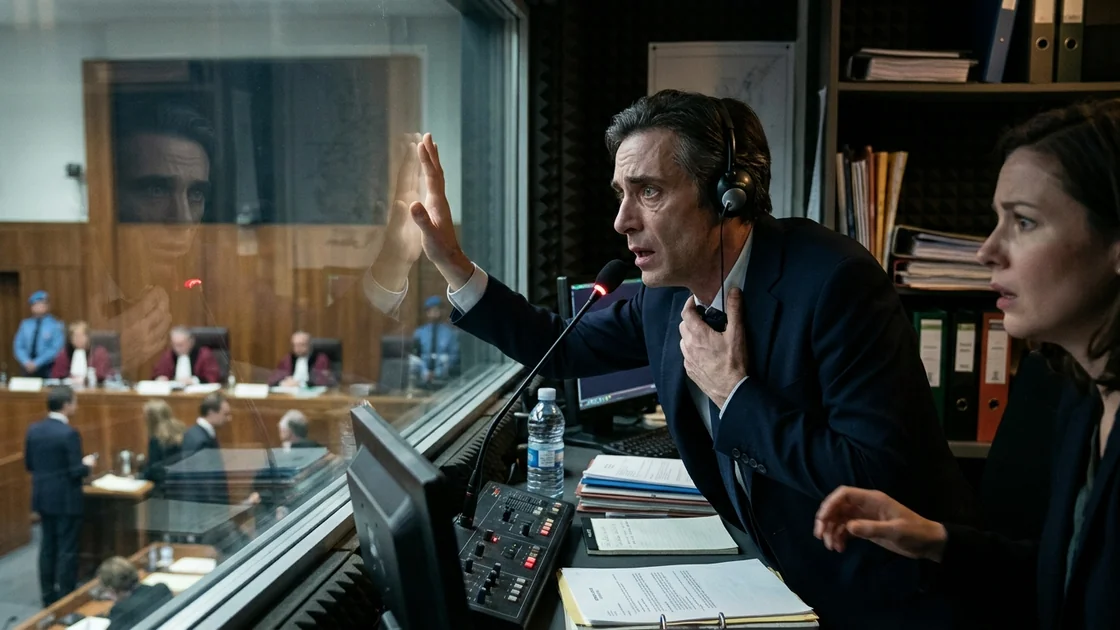
Julian Vance serves as a simultaneous interpreter at an international war crimes tribunal in The Hague, tasked with translating the horrific testimonies of survivors from the war-torn Oakhaven Valley into English. Because judicial protocol requires interpreters to speak in the first person, Julian spends his days repeatedly uttering phrases of unimaginable suffering, loss, and violence as though they happened to him. Over the course of the trial of General Mirko Dragan, the psychological boundary between Julian and the witnesses begins to dissolve. He starts experiencing their phantom pains, their sensory memories of burning orchards and river mud, and their suffocating grief, leading him toward a complete collapse of his own identity as the ghosts of the living claim his voice as their vessel.
The glass of the booth was three-quarters of an inch thick, laminated with an acoustic polyvinyl butyral interlayer designed to keep sound from bleeding in or out. From where Julian Vance sat, the courtroom looked like an aquarium filled with slow, bottom-feeding creatures. The judges in their crimson-trimmed robes perched high on the bench like motionless reef fish; the prosecution and defense teams drifted across the blond-wood floor in muted charcoal suits; the accused sat behind his own pane of ballistic glass, flanked by two United Nations security officers whose blue berets provided the only bright pigment in the windowless chamber.
Julian adjusted the foam pads of his headphones until they sealed around his ears. When the microphone was off, the booth smelled faintly of stale coffee, warm dust from the voltage regulators, and the peppermint lozenges used by his booth-mate, Clara. When the microphone was switched on, the little rectangular LED at the tip of the flexible gooseneck turned a steady, arterial red.
In the profession of simultaneous interpretation, there is a foundational commandment taught during the very first week at the Monterey Institute or the University of Geneva: you do not say he says or she states. You do not report the speech from the safety of the third person. You become the speaker. If the witness says, My brother was taken behind the granary, the interpreter does not say, The witness testifies that her brother was taken behind the granary. The interpreter looks through the double-paned glass, inhales through the nose so the breath does not pop against the condenser capsule, and says, "My brother was taken behind the granary."
For eleven years, Julian had treated the first-person singular as a purely grammatical mechanism—a coat taken from a hook at nine in the morning and hung back up at five in the afternoon. He had translated agricultural subsidies in Brussels, maritime boundary disputes in Hamburg, and intellectual property arbitrations in Zurich. He had been a French dairy farmer complaining about milk quotas, a Russian metallurgist explaining the tensile strength of rolled aluminum, and a Vostran trade minister lying about bauxite tariffs. None of those lives had ever followed him home to his third-floor apartment on the Laan van Meerdervoort.
Then came the Special Tribunal for the Oakhaven Valley, and the Indictment of Case IT-09-44: The Prosecutor versus General Mirko Dragan.
"Court is in session," Julian said into the microphone, rendering the Presiding Judge’s crisp French into the rhythmic, consonant-heavy Vostran dialect for the benefit of the accused and the witnesses waiting in the anterooms. Then he flipped his toggle switch from Channel 4 to Channel 1. For the next three hours, he would go the other way: from Vostran into English.
The usher opened the side door, and Witness 42—a woman named Marta Kovač, though she was known to the public gallery only by her alphanumeric pseudonym and hidden from them by a frosted partition—walked slowly to the stand. She was fifty-three years old, according to the dossier on Julian’s console, though the skin around her eyes had the papery, translucent grayness of a wasp’s nest. She wore a cardigan the color of boiled cabbage, buttoned all the way to her throat despite the climate-controlled warmth of Courtroom II.
She sat. The usher adjusted her headphones. The Presiding Judge asked her to read the solemn declaration on the card before her.
I solemnly declare that I will speak the truth, the whole truth, and nothing but the truth.
"I solemnly declare," Julian said into the darkened booth, his voice a flat, resonant baritone that belonged to a forty-two-year-old Englishman educated at Durham, "that I will speak the truth, the whole truth, and nothing but the truth."
Beside him, Clara uncapped a highlighter and poised it over the glossary of geographic terms. Her role for the next thirty minutes was to monitor Julian, jot down numbers, dates, and proper nouns on a scratchpad if the witness spoke too quickly, and take over the microphone when the thirty-minute cognitive limit expired. No human brain could perform simultaneous translation of high-density trauma for much longer than half an hour without the syntax beginning to fray at the edges. The neurons simply overheated, like an overloaded transformer.
The Senior Trial Attorney for the prosecution, a tall Kenyan woman named Amina Odhiambo, rose to her feet behind her lectern. Her voice came through Julian’s headset with crisp digital clarity.
"Witness 42," Odhiambo said, "I would like to take you back to the morning of the fourteenth of July, nineteen ninety-seven. Where were you when the shelling of Lower Orel began?"
Julian did not translate this; the colleague in the Vostran booth two doors down was handling the English-to-Vostran relay. Julian simply listened, his eyes fixed on the small square monitor on his desk, which showed a close-up of Marta Kovač’s face.
Marta looked down at her hands, which were folded tightly in her lap. For five seconds, the courtroom was filled with the low, mechanical hum of the ventilation shafts and the faint clicking of stenographers’ keys. Then she began to speak. Her Vostran was rural, thick with the diphthongs of the northern river valleys, her voice barely above a whisper.
U podrumu...
Julian’s thumb pressed the mute release. His vocal cords engaged two seconds behind hers—the décalage, the tightrope walker’s lag between hearing a phrase, dismantling its grammar, and reassembling it in another tongue while the speaker is already three words into the next sentence.
"I was in the root cellar beneath the summer kitchen," Julian said. "The floor was damp because the river was high that week. I had my youngest son, Luka, between my knees. I was holding my palms over his ears because the mortar rounds were falling in the plum orchard behind the smithy, and every time one hit, the lime plaster fell from the joists into his hair."
Marta’s voice did not rise. She spoke with the terrifying, level monotony of someone reading an inventory of household goods that had been lost in a flood.
"I could smell the plums," Julian said, his eyes narrowing slightly as he tracked her verbs. "The heat of the blasts was cooking them on the branches. It smelled like jam. Like my mother was making jam in July, which was too early for the blue ones, they aren't ripe until late August. Luka kept asking me why grandmother was cooking when the sky was falling down. I told him to bite on the hem of his wool vest so his teeth wouldn't crack from the pressure waves."
In the courtroom, General Dragan was taking notes with a small, stubby pencil provided by the registry. He looked like a retired postmaster—bald pate, neatly trimmed white mustache, wire-rimmed spectacles perched on a fleshy nose. He did not look up at the witness stand.
"Then the cellar door was pulled back," Julian said. He felt a sudden, sharp constriction in his own diaphragm, as though the air in the booth had been replaced by something heavier, something smelled of turnips and wet limestone. "The light hurt my eyes. Three men from the White Lynx brigade were standing against the sun. I knew the one on the left. He used to buy seed potatoes from my husband every March. His name was Goran. He had a yellow ribbon tied around the stock of his rifle."
Clara scribbled White Lynx and Goran on the pad between them, underlining both twice, though Julian hadn't missed them.
"He looked down at me," Julian continued, his voice dropping half an octave to match the hollow cadence in his headphones. "He said, 'Come out, neighbor, the house is going to burn and we don't want to roast the calf with the cow.' I tried to push Luka behind the potato sacks, into the dark corner where the spiders were, because he was small for nine, he had the rickets when he was a baby and people always thought he was six. If they thought he was six, sometimes they left them with the women."
Marta stopped to swallow. On the monitor, the muscles of her throat worked convulsively against the collar of the green cardigan. In the booth, Julian’s own throat clicked as he swallowed in unconscious synchronization. His mouth was completely dry. He reached blindly for his glass of water, his eyes never leaving the screen.
"They didn't think he was six," Julian said. "Goran reached down and took him by the wrist. Not the arm. The wrist, right where the bone sticks out. I held onto his ankles. My fingernails broke in the wool of his socks. When they pulled him up the stone steps, his knees hit every riser. Tak, tak, tak. Four steps. And then the rifle butt came down on my collarbone, and I heard it snap like a dry walnut branch, and the cellar door came down again, and they piled the firewood against the latch from the outside."
Julian’s left hand crept up to his own right clavicle. Beneath his starched white cotton shirt and silk tie, the bone felt strangely tender, as if bruised from the inside out. He pressed two fingers against the ridge of it.
"I stayed in the dark until the smoke began to come down through the floorboards," Julian said. "It wasn't white smoke. It was black, greasy smoke from the tractor tires they had leaned against the porch to make the oak beams catch. I couldn't lift the door with my right arm hanging loose, so I used my head and my left shoulder, pushing against the oak planks like a pig in a pen..."
The red light on Julian’s console blinked twice—Clara’s finger was on the swap button. His thirty minutes were up.
At the next pause for a breath, Clara pressed her switch, cutting Julian’s mic and activating her own without a millisecond of dead air.
"And when the wood shifted," Clara’s cool, slightly nasal American voice took over, "I rolled out into the nettles behind the rain barrel..."
Julian pulled the headphones from his ears and let them rest around his neck. Even unplugged from the direct feed, he could hear the tiny, tinny insect-chatter of Marta’s voice leaking from the earcups against his collarbones, paired with the murmured cadence of Clara’s English right beside him.
He leaned back in the ergonomic chair and closed his eyes.
Behind his eyelids, the darkness was not the sterile black of an office building in the Netherlands. It was threaded with greasy, soot-laden smoke, and beneath the scent of Clara’s peppermint lozenges, there was a distinct, nauseating sweetness—the smell of green plums blistered by high-explosive cordite.
The interpreters’ lounge on the fourth floor was designed by someone who had read a textbook on corporate wellness in the late nineteen-eighties. There were two beige leatherette sofas, a rubber plant whose leaves were perpetually coated in a fine gray film of radiator dust, a water cooler that gurgled every twelve minutes like a drowning man, and a bulletin board covered in overlapping memos about pension contributions, parking permits, and the schedule for the staff badminton tournament.
Julian stood by the window, holding a porcelain mug of weak Earl Grey tea. Outside, The Hague was dissolving into a typical November twilight. A cold, vertical rain fell from a sky the color of wet slate, dimpling the surface of the canal below and turning the bicycle lanes into ribbons of dull pewter. Commuters in yellow rain ponchos pedaled past the perimeter security bollards, their heads down against the wind from the North Sea.
They were going home to boil potatoes, to argue with their teenage children about algebra, to watch television programs about home renovation. They lived in a world where cellar doors remained on their hinges and neighbors bought seed potatoes without returning four years later with yellow ribbons tied to Kalashnikovs.
"You’re doing the thing with your shoulder again," a voice said behind him.
Julian dropped his left hand from his right collarbone and turned around.
Stefan Lindqvist was leaning against the doorframe, peeling a clementine into a paper napkin. Stefan was sixty-one, a veteran of the Nuremberg archives, the Rwanda tribunal in Arusha, and the early Bosnian trials. He spoke six languages and had the calm, slightly detached demeanor of a country doctor who had delivered ten thousand babies and signed an equal number of death certificates.
"What thing?" Julian asked.
"Holding it like you fell off your bike," Stefan said, popping a segment of fruit into his mouth. "Kovač was tough today. I was listening from the revisers’ office. Her dialect is from the upper Drina basin, isn't it? Lots of archaic pastorals. Hard to render the agricultural idioms without sounding like a nineteenth-century Russian novel."
"It wasn't the idioms," Julian said. He looked down into his tea. A thin rainbow skin of tannin floated on the surface. "It was the sound of the boy’s knees on the stone steps. She used the onomatopoeia. Tak, tak, tak."
"And you kept it," Stefan said. "I heard. Usually, the style guide prefers 'a dull thudding sound' or 'his knees struck the masonry.' Keeping the raw sound is risky. The judges don't like theatre in the booth."
"It wasn't theatre," Julian said quietly. "If I had said 'his knees struck the masonry,' I would have been lying. Masonry is what architects have. She had four limestone risers worn down in the middle from three generations of women carrying pickled cabbage jars up and down. They don't make a thud. They make a click. Bone on stone."
Stefan chewed slowly, watching Julian over the tops of his half-moon reading glasses. "How long have you been on the Dragan docket now, Julian? Eight months?"
"Nine on Tuesday."
"And how many witnesses?"
"Forty-two for the prosecution," Julian said. "Thirty-eight more to go before the winter recess, then the defense begins its case in February."
Stefan folded the clementine peel into the napkin and dropped it into the bin. "You need to ask Registry for a rotation to the Appeals Chamber, or at least the maritime boundary hearings over at the Peace Palace. Spend a month translating arguments about continental shelf sediment between Nicaragua and Colombia. It cleans the palate."
"I can't," Julian said. "There are only four of us certified at Grade A for the northern Vostran sub-dialects. If I rotate out, Clara and Matej have to pull triple shifts, and Matej is already on beta-blockers for his blood pressure."
"The Tribunal will survive if Matej takes a sick day," Stefan said, his voice losing its banter. He stepped closer, lowering his voice so the two French-booth trainees sitting on the sofa wouldn't hear. "Listen to me, Julian. In Arusha, in ninety-six, we had a guy from Kigali. Brilliant linguist. Educated at the Sorbonne. After four months of doing the church massacres—sitting in that box saying I hid under the bodies of my sisters six hours a day—he walked out of the tribunal one evening, went to the market, and tried to pay for a loaf of bread with currency that hadn't been printed since nineteen-seventy. When the vendor told him it wasn't valid, he started screaming that he was an eight-year-old girl from Butare and that his mother was waiting for him by the banana grove. They had to sedate him."
Julian stared at the older man. "That’s different. He was Rwandan. It was his own country."
"The brain doesn't care about passports when you're in the booth," Stefan said, tapping his own temple with a blunt forefinger. "You know how the neural pathways work during simultaneous. To translate at that speed, you have to bypass the analytical cortex. You don't have time to think she is sad. You have to let the limbic system fire the same way hers is firing so you can find the right emotional register in the target language. You’re opening the floodgates and letting their sewage run right through your own pipes. If you don't flush them out at night, the silt settles at the bottom."
"I flush them out," Julian lied. "I run along the beach at Scheveningen. I listen to Bach."
Stefan looked at Julian’s right shoulder, which was still hitched half an inch higher than his left, protecting a collarbone that had never been broken.
"Go home, Julian," Stefan said softly. "Drink a very large gin. Read a detective novel where only one person dies and it happens in an English vicarage. And for God’s sake, stop using the first person when you talk to yourself in the mirror."
Julian’s apartment was tall, narrow, and ruthlessly tidy. When he had moved to The Hague after his divorce from Elena four years earlier, he had furnished the place from a single showroom in Rotterdam, selecting items solely for their lack of history: a gray linen sofa, a glass dining table with chrome legs, white birch bookshelves filled with dictionaries, philological journals, and the complete works of Joseph Conrad. There were no photographs on the walls, no rugs with intricate patterns that might trap dust or memory, no souvenirs from anywhere.
Elena had once told him, during the long, quiet disintegration of their seven-year marriage, that living with him was like living with a very polite hotel concierge. You’re always translating me, Julian, she had said, sitting at their kitchen table in London while the rain beat against the sash windows. When I'm angry, I can see you standing two feet behind your own eyes, parsing my sentences, looking for the precise English equivalent of what I'm feeling so you can file it away without having to actually touch it.
She hadn't been wrong. He had gone into interpretation precisely because he loved the architecture of language more than he loved the messy, ungrammatical reality of human beings. Words were clean. Even the word slaughter had a history; you could trace it back through Middle English slahter to Old Norse slátr, a neat philological specimen pinned to corkboard.
Until Oakhaven.
He hung his wet trench coat on the porcelain hook in the hallway, took off his shoes, and padded into the kitchen in his socks. The apartment was silent except for the hum of the refrigerator. He opened the fridge door. Inside sat a carton of milk, half a lemon on a saucer, a wedge of aged Gouda wrapped in wax paper, and a jar of plum preserves he had bought three days ago at the Polish delicatessen on the corner.
He didn't even like plum preserves. He had always preferred bitter Seville orange marmalade. Yet on Tuesday evening, walking home in the dark, he had seen the jars stacked in the shop window under a bare yellow bulb, their contents dark purple and thick with fruit skins, and he had gone inside and bought two of them without exchanging a word with the shopkeeper.
Now, standing in the cold white light of the open refrigerator, he unscrewed the lid of the jar and held it to his nose.
It didn't smell like cordite. It just smelled like sugar and plums.
He closed the refrigerator door, went into the bathroom, and stripped off his shirt to take a shower. As he reached for the faucet, he caught sight of himself in the medicine cabinet mirror.
He was forty-two, slender to the point of gauntness, with dark hair going silver at the temples and the pale, vitamin-D-starved complexion of northern Europe. His chest was hairless and smooth.
He looked at his right collarbone.
In the harsh fluorescent glare of the vanity light, the skin over the middle third of the clavicle was faintly flushed—because he had been rubbing it through his shirt all afternoon, he told himself. That was the rational explanation. A minor localized erythema caused by repetitive friction.
Yet as he raised his right arm to test the joint, a sharp, lancinating ache shot from the sternum to the acromion, so vivid that he gasped and dropped his elbow back against his ribs.
And the rifle butt came down on my collarbone, and I heard it snap like a dry walnut branch...
"Stop it," Julian said aloud.
His voice bounced off the white ceramic tiles. It didn't sound like his voice. The vowels were slightly flattened, the o in stop pulled back toward the soft palate, the way a native Vostran speaker pronounced English after learning it from books.
He turned on the shower as hot as he could stand it and stepped under the spray, letting the water hammer against the back of his neck until the skin turned scarlet. He washed himself with unscented soap, scrubbing his forearms, his chest, the back of his knees, trying to get rid of the cellar damp that seemed to have settled into his pores.
When he turned off the water and stepped onto the bathmat, the bathroom was thick with steam. He wiped a clear circle in the fogged glass of the mirror with the heel of his hand.
For a fraction of a second, before his eyes adjusted to the condensation, he did not see a forty-two-year-old Englishman looking back. He saw a pair of eyes set deep in papery, gray-ringed sockets, staring out from beneath a damp kerchief, waiting for the wood piled against the cellar door to shift.
That night, Julian did not sleep in his bed.
He lay down on the mattress at midnight, pulled the down duvet up to his chin, and closed his eyes. Within ten minutes, the walls of the bedroom began to press inward. The ceiling lowered until it was only four feet above his chest, smelled of wet lime and spiderwebs, and the darkness grew so dense he could feel it against his eyeballs. He kicked off the covers and sat up, gasping for air, his heart hammering a frantic, arrhythmic tattoo against his ribs.
He ended up on the floor of the living room, wrapped in a thin wool blanket, with every light in the apartment switched on—the overhead halogen spots, the reading lamp, the kitchen fluorescent tube, the hallway sconce. He lay with his cheek pressed against the cold oak parquet because the hardness of the wood was the only thing that convinced his body he was on the third floor of a building in Holland and not buried alive beneath a burning farmhouse in the Oakhaven Valley.
When he finally drifted into a shallow, twitching stupor around four in the morning, the dreams were not visual. They were purely auditory.
A endless queue of voices lined up behind his soft palate, pushing against the back of his teeth, demanding to be let out into the room.
I found his left shoe by the culvert; I knew it was his because I had mended the eyelet with blue carpet thread...
I drank the water from the radiator pipes for four days until the soldiers came back with the dogs...
I dug the hole with a soup ladle because they had taken all the spades to the quarry...
I... I... I...
Every sentence began with the same vertical bar of iron. I. A pronoun like a nail driven through the palm of his hand, pinning him to a hundred different crosses in a country he had only ever seen on topographical maps provided by the Office of the Prosecutor.
By the middle of the following week, the weather in The Hague had turned from rain to a freezing coastal fog that smelled of salt and diesel exhaust. Inside Courtroom II, the air remained precisely twenty-one degrees Celsius with forty-five percent relative humidity.
The prosecution had moved on from the village of Lower Orel to the detention camp at the Novi Brod municipal brickworks.
Witness 47 was a former secondary school mathematics teacher named Emil Hadžić. Unlike Marta Kovač, who had spoken in a flat, hypnotic monotone, Hadžić was a twitchy, fragmented man of sixty whose hands trembled so violently that the courtroom usher had to remove the water glass from the witness stand after he knocked it over twice in the first ten minutes. He had lost all of his fingernails during six weeks of interrogation in the drying kilns at the brickworks, and the tips of his fingers were smooth, bulbous, and shiny pink, like peeled shrimp.
Julian sat in the booth, his headset clamped tight, his eyes glued to the monitor where Hadžić’s shiny fingertips tapped ceaselessly against the blond wood of the lectern.
"They kept sixty-four of us in Kiln Number Three," Julian said into the microphone. His voice was hoarse today; he had gone through an entire tin of pastilles before the morning recess. "Because I taught geometry, the camp commander—the one they called 'The Pharmacist'—made me calculate the volume of the room so he could see how many more men from the eastern villages could be packed in without suffocating the ones at the bottom before Tuesday."
In the courtroom, General Dragan was whispering to his lead defense counsel, a sharp-featured French lawyer named Maître Delacroix. Dragan smiled faintly at something the lawyer said and adjusted his spectacles.
Julian felt a sudden, hot surge of bile at the back of his throat. His fingers—his own long, manicured fingers resting beside the console—began to tap against the Formica desk in the exact three-four rhythm of Emil Hadžić’s ruined hands on the monitor.
"I didn't have paper," Julian said, his voice beginning to take on the high, breathless staccato of the man on the screen. "I had to use a piece of broken brick to scratch the numbers into the dust on the concrete wall. Fourteen meters by six meters, with a vaulted arch of two point four meters at the apex. When my fingers bled from holding the brick shard, the dust turned into red paste, so the equations were easier to read in the dark. The Pharmacist stood behind me with an iron reinforcing rod. Every time I carried a remainder, he tapped the rod against my ankles."
Wait, Clara whispered beside him, pointing to her notepad. Julian had said fourteen meters by six meters, which was right, but he had dropped a clause about the ventilation grates.
Julian didn't look at her pad. He couldn't take his eyes off the monitor. On the screen, Hadžić was holding up his right hand toward the judges’ bench, spreading the five blunt, nail-less digits like a child showing off a drawing.
In the booth, Julian lifted his own right hand six inches off the desk and spread his fingers wide in the air in front of the glass.
"On the nineteenth of August," Julian said, and now the lag—the professional two-second décalage that separated the translator from the speaker—had shrunk to less than half a second. He was practically speaking in unison with the Vostran audio in his ears, riding the crest of the witness’s breath like a surfer on a dark wave. "They brought in the pliers from the tractor maintenance shed. They didn't ask me any questions about the territorial defense units. They already knew I only taught logarithms. They just wanted to hear what a teacher sounded like when he couldn't hold chalk anymore. When they pulled the nail from the index finger, it didn't come off clean. A strip of skin tore all the way down to the first knuckle, like peeling the bark off a green willow switch..."
Julian winced, sucking air through his teeth with a sharp hiss that went straight over the live microphone.
In the courtroom, two of the legal officers at the prosecution table glanced up toward the dark glass of the English booth. Interpreting manuals strictly forbade the transmission of paralinguistic sounds—groans, sighs, weeping, or gasps. The interpreter was supposed to be a pane of clear glass, not a magnifying lens.
Clara reached over and laid her hand firmly on Julian’s wrist, pushing his raised hand back down onto the desk. She hit the mute button on his console and switched her own mic live, even though they were only eighteen minutes into his shift.
"They started with the right hand," Clara’s calm, steady voice resumed seamlessly, "and when I fainted, they threw a bucket of water from the clay troughs over my head..."
Julian sat frozen for three seconds, staring at his own fingertips on the gray Formica.
They were throbbing. Each of the ten nail beds felt as though it had been plunged into boiling oil. Beneath the neatly trimmed crescents of his fingernails, he could see—with total, hallucinated clarity—the dark purple pooling of subungual hematomas.
"Get out of the box, Julian," Clara muttered between sentences, covering her microphone with her palm during a pause while Prosecutor Odhiambo consulted her binder. "Now. Go to the medical unit."
Julian ripped the headset off so violently that the plastic band caught on his left ear, tearing the skin at the top of the helix. He didn't feel it. He stood up, knocking his swivel chair backward against the acoustic foam wall of the booth, fumbled with the heavy latch of the soundproof door, and stumbled out into the narrow service corridor behind the courtroom.
The corridor was windowless, carpeted in industrial blue nylon that absorbed the sound of footsteps, and lit by recessed fluorescent tubes that buzzed at sixty hertz. It ran behind all four translation booths—English, French, Vostran, and German—connecting them to the technicians’ control room and the staff lavatories.
Julian leaned his back against the wall outside the French booth and slid down until his heels hit the baseboard, sitting with his knees drawn up to his chest.
He held his hands in front of his face.
The purple bruises beneath the nails were gone, replaced by the normal pale pink of healthy vascular beds, yet the nerves in his fingertips were still screaming. Every pulse of his heart sent a fresh wave of white-hot agony radiating from his fingers up his ulnar nerves to his elbows. He tucked his hands into his armpits, clamping his biceps down tight to stop the shaking, just as he had seen Emil Hadžić do on the stand five minutes ago when the judge asked him to identify a photograph of the brickworks.
I am Julian Vance, he told himself, squeezing his eyes shut. I was born in Guildford, Surrey, on the twelfth of October, nineteen sixty-six. My father was an actuary for Prudential. My mother grew hybrid tea roses. I have a First in Modern Languages from Durham. I live at Laan van Meerdervoort 412.
The words rattled around in his skull like dried peas in a tin can. They had no weight. They were third-person facts from a dossier about a stranger who had never smelled burning plums or scratched geometry equations in brick dust with bleeding fingers.
What had weight—what possessed the crushing, undeniable gravity of lived truth—were the things he had said into the microphone over the last two hundred and seventy days.
I watched them throw my grandfather into the well. I carried my sister’s jawbone in my apron pocket for three days until we reached the UN checkpoint at Tuzla. I hid in the manure pile behind the pigsty while they shot the boys against the corn crib. I... I... I...
A door clicked open down the hall. Footsteps approached on the carpet and stopped beside him.
Julian opened his eyes. A pair of polished black leather oxfords stood six inches from his loafers. He looked up.
It was Stefan Lindqvist. The older man looked down at Julian for a long moment, taking in the pale, sweat-sheened face, the drop of dark blood drying on the rim of his left ear where the headset had caught, and the hands jammed tightly beneath his armpits.
Stefan didn't ask if he was all right. He simply reached down, hooked a surprisingly strong arm under Julian’s left elbow, and hauled him to his feet.
"Come on," Stefan said. "We're going down the back stairs. If the chief of the interpretation section sees you like this, she’ll put you on administrative leave pending a psychiatric evaluation, and that goes into your permanent UN file in Geneva."
"My fingers," Julian whispered, his teeth chattering so hard he bit the inside of his lip. "Stefan, they pulled them off with the tractor pliers. The green ones from the shed."
"Nobody pulled your nails off, Julian," Stefan said fiercely, steering him toward the heavy fire door marked Nooduitgang. "Look at them. Take them out and look at them."
Julian slowly pulled his right hand from beneath his arm.
"Look at the nails," Stefan commanded as they stepped onto the concrete landing of the emergency stairwell. "You trim them with clippers from the Etos drugstore. You buff them because you’re a vain English bastard who likes to look neat when he turns pages. Say it."
"I..." Julian started.
"Don't say I!" Stefan barked, his voice echoing sharply off the raw concrete walls of the stairwell. He grabbed Julian by the shoulders and pushed him back against the metal handrail. "For the next forty-eight hours, that word is contraband. You do not use the first-person singular. You speak about yourself in the third person like Julius Caesar, or you don't speak at all. Do you understand me?"
Julian stared at him, his chest heaving. "Julian... understands."
"Who had his fingernails pulled out in Kiln Number Three?"
"I—" Julian caught himself as Stefan’s grip tightened painfully on his deltoids, right over the phantom bruise on his clavicle. He swallowed hard, tasting copper from his bitten lip. "Witness Forty-Seven. Emil Hadžić."
"Where was Julian Vance on the nineteenth of August, nineteen ninety-seven?"
Julian closed his eyes, searching the gray, fog-bound archive of his own life. Nineteen ninety-seven. Tony Blair had just been elected. Princess Diana was still alive for another twelve days. Where had he been?
"Julian was... in Geneva," he whispered, the memory surfacing like a waterlogged plank from the bottom of a pond. "He was working at the World Meteorological Organization conference. He was staying at a hotel near the Cornavin station. He ate... he ate perch fillets by the lake with Elena."
"What did the perch taste like?" Stefan pressed, his face inches from Julian’s.
"Lemon," Julian breathed. "Butter and lemon. And white wine. Féchy."
"Good," Stefan said, releasing his shoulders and stepping back. "Hold onto the fish, Julian. Hold onto the butter and the lemon. I’m going back upstairs to get your coat and your briefcase. I’ll tell Clara you had a migraine with aura and had to go home. Wait for me by the staff bicycle shed at the back gate. Do not go back near the courtroom."
Stefan drove Julian home in his battered Volvo station wagon, the heater blasting warm air that smelled of wet dog and old newspapers. Neither of them spoke while they navigated the midday traffic along the Carnegielaan. Only when Stefan pulled up to the curb outside Julian’s apartment building, double-parking with his hazard lights ticking a steady rhythm against the rain-streaked windshield, did the older man turn in his seat.
"I’m taking your name off the roster for Thursday and Friday," Stefan said. "Monday is a court maintenance day anyway. That gives you four days."
"The defense cross-examination of Hadžić is tomorrow morning," Julian said, staring straight ahead at the wet bricks of the building across the street. "Maître Delacroix is going to try to trip him up on the dates of the transfer from the schoolhouse to the brickworks. Hadžić gets confused with dates when he’s shouted at. If Matej does the booth, he’ll translate Hadžić’s hesitation markers as evasive qualifiers. You know how Matej over-corrects for syntax. Delacroix will use the English transcript to impeach his credibility."
"That is the prosecutor’s problem, not yours," Stefan said coldly. "You are a telephone wire, Julian. A copper wire does not care if the person on the other end of the line is being cross-examined by the devil himself. The moment the wire starts trying to save the caller, it shorts out the switchboard."
Julian turned his head slowly to look at Stefan. "How do you do it, Stefan? After Arusha. After Srebrenica. How do you go home to your wife and eat your dinner with the same mouth you used to say those things?"
Stefan looked down at the steering wheel, running his thumb over the worn leather at the ten-o’clock position. For a moment, he looked every one of his sixty-one years—a tired Scandinavian man living in a flat country far from the pine forests where he had grown up.
"I have a ritual," Stefan said quietly. "Before I leave the tribunal building every evening, I go into the lavatory on the ground floor. I lock myself in a stall, and I speak Swedish—my mother’s dialect from Dalarna, a language we never use in the courtroom, a language no war criminal on our docket has ever spoken—and I recite the names of all the trees that grew behind my grandfather’s barn, and the recipe for my grandmother’s cardamom buns, and the names of the girls I kissed before I was twenty. I fill my mouth with words that belong only to me until there’s no room left for theirs. And then I spit into the toilet and flush it."
He reached across the passenger seat and pushed Julian’s door handle open, letting in a gust of damp, freezing air from the street.
"Find your own language, Julian," Stefan said. "Because right now, you’re speaking fluent ghost."
Julian spent Thursday and Friday inside his apartment with the curtains drawn against the gray Dutch sky.
He tried to follow Stefan’s advice. He sat at his glass dining table with a legal pad and a fountain pen, writing out lists of things that belonged solely to Julian Vance.
1. The smell of creosote on the garden fence in Guildford after a summer rain. 2. The scar on the left knee from falling off a Raleigh Chopper bicycle in 1976. 3. Elena’s habit of leaving wet teabags in the sink instead of putting them in the bin. 4. The irregular subjunctive forms of Old Provençal verbs.
He read the list aloud in the empty room, trying to anchor himself to the nouns. Creosote. Raleigh. Teabags. Subjunctive.
Yet the moment he stopped speaking, the silence of the apartment rushed back in to fill the vacuum, and the silence was not in English.
On Friday afternoon, while making himself a piece of toast, he burned the bread. When a thin wisp of gray smoke rose from the slots of the toaster, his knees buckled beneath him. Before he even realized what he was doing, he had crawled under the kitchen sink, wedging his six-foot frame between the PVC drainpipe and the plastic bin of cleaning supplies, pulling the cabinet doors shut from the inside with trembling fingers while he bit down hard on the cuff of his cashmere sweater so the men with the yellow ribbons wouldn't hear his teeth chattering.
He stayed under the sink for two hours in the pitch dark, breathing the chemical fumes of bleach and lemon dish soap, until the cramp in his shins became so excruciating that it broke through the trance.
When he crawled out onto the linoleum floor, his sweater cuff was soaked with saliva and speckled with pink blood from his gums.
He didn't go back to the bedroom that night. Instead, he unlocked the bottom drawer of his desk, where he kept the confidential trial binders he wasn't supposed to remove from the Tribunal premises.
During the weekend, while the rain turned to sleet against the tall windows of the Laan van Meerdervoort, Julian read the pre-trial summary briefs for the remaining thirty-seven prosecution witnesses.
He read them in Vostran, and as he read, he whispered the English translation aloud into the empty room.
He didn't want to. Some surviving, rational fragment of his mind—the Durham scholar, the polite hotel concierge Elena had divorced—stood in the corner of the room and screamed at him to close the binders, to pack a suitcase, to take the train to Schiphol Airport and get on the first flight to London.
Instead, he turned the pages with fingers that still ached at the quick.
"My name is Witness Fifty-One," he whispered to the glass table at two in the morning on Sunday. "Before the war, I was the postmaster in Gornji Vakuf. On the third of May, they tied me to the apple tree in the parish courtyard..."
"My name is Witness Fifty-Four," he whispered to the bathroom mirror at dawn while he shaved around the scab on his ear. "I was fourteen years old when the buses stopped at the sports hall in Kalinovik..."
He was no longer translating them because it was his job. He was translating them because he had realized a terrible, seditious truth that Stefan Lindqvist’s cardamom buns could never erase: if he did not let them speak through him, they were trapped behind the frosted glass partitions of the courtroom, reduced to numbers and redacted transcripts stored on servers in Geneva. The rules of evidence stripped them of their rage; the defense lawyers carved their memories into contradicted dates and disputed distances; the judges weighed their dead children against paragraphs of the Geneva Conventions.
Only in the booth—only in that two-second décalage where Julian Vance ceased to exist and became the vessel for their raw, untranslated agony—were they whole again.
He was the tuning fork. If the tuning fork shattered from the vibration, that was simply the physics of sound.
On Tuesday morning, the first snow of the winter fell on The Hague, dusting the roofs of the trams and turning the lawns around the Tribunal into pristine white squares.
Julian arrived at eight-fifteen, forty-five minutes before the morning session. He had shaved carefully, put on his crispest white shirt and a dark navy suit, and applied a tiny dab of concealer belonging to his ex-wife—found at the very back of the bathroom vanity drawer—to hide the purple half-moons beneath his eyes.
When he walked into the interpreters’ lounge, Stefan was standing by the coffee machine. The older man stopped pouring, the glass carafe poised in mid-air, and stared at him.
"How are you feeling?" Stefan asked, his voice guarded.
"Much better, thank you, Stefan," Julian said. He smiled—a precise, symmetrical movement of the zygomatic muscles that he had practiced in the elevator mirror. "You were quite right. A long weekend of detective novels and gin. And I walked all the way to the pier at Scheveningen yesterday. The wind blew the cobwebs right out."
Stefan’s eyes narrowed behind his glasses. He looked at Julian’s hands, which were hanging loosely, almost languidly, at his sides. There was no tremor. There was no hitch in his right shoulder.
In fact, Julian looked remarkably calm—the deep, eerie calm of a house after all the furniture has been carried out to the moving van.
"Who have you got this morning?" Stefan asked, setting the carafe back on the hotplate.
"Witness Forty-Nine," Julian said lightly, picking up the daily docket sheet from the table. "Milan Kovač. No relation to Marta from last week, apparently, though he’s from the same municipality. A forestry engineer. Only scheduled for a two-hour examination-in-chief."
"I’ll sit in the third chair in the booth," Stefan said. "Just to help with the forestry terminology. There’s always a lot of logging jargon with the mountain witnesses."
"There’s really no need, Stefan," Julian said gently. "Clara and I have the FAO forestry glossary from Rome. And you have the Appeals Chamber briefing at ten."
Stefan hesitated, glancing at the clock on the wall. The President of the Tribunal was notoriously intolerant of delays in the Appeals Chamber, and Stefan was the chief reviser for the panel.
"I’ll check on you at the eleven-thirty recess," Stefan said finally. "If you feel the migraine coming back, you tap Clara immediately. Understood?"
"Of course," Julian said.
At nine o'clock sharp, Julian took his seat in the English booth. Clara arrived two minutes later, unwinding a thick woolen scarf from her neck and blowing on her reddened fingers.
"Morning, Julian," she said, setting a fresh bottle of Evian on the console. "Better?"
"Right as rain," Julian said. He put on his headphones, adjusting the headband so it sat half an inch behind the scab on his left ear. "I’ll take the first thirty."
Through the thick double glass, Courtroom II was already full. General Mirko Dragan sat in his usual chair, wearing a freshly pressed gray suit and a burgundy tie. He looked well-rested; the UN detention unit at Scheveningen had excellent medical facilities, a gymnasium, and art therapy classes where the indictees painted watercolors of sailboats. Just before the judges entered, Dragan turned around and smiled warmly at his daughter, who was sitting in the front row of the public gallery behind the secondary glass wall.
Julian watched the General’s face. For the first time in nine months, he felt no revulsion. He felt only a cold, geometric curiosity—the same feeling Emil Hadžić must have had when calculating the cubic volume of Kiln Number Three.
"All rise," the court usher called out.
The three judges filed in and took their seats. The Presiding Judge bowed slightly to the bar, sat down, and tapped his microphone.
"Good morning to counsel. Ms. Odhiambo, you may call your next witness."
The side door opened, and Milan Kovač walked in.
He did not use the frosted screen; he had waived his right to protective measures, demanding that his face be seen by the public and the accused. He was a tall, broad-shouldered man in his late forties whose suit jacket hung off his frame as if it belonged to a larger brother. The left side of his face was a web of white, puckered scar tissue that pulled the corner of his mouth upward in a permanent, involuntary grimace, exposing his canine tooth. His left eye was milky and fixed.
He stood behind the lectern, placed a large, calloused hand on the solemn declaration card, and read it in a deep, gravelly baritone that vibrated in Julian’s inner ear like the bass pedal of a cathedral organ.
"I solemnly declare," Julian said into his microphone, his own voice dropping down into his chest to match the resonance of the forester’s, "that I will speak the truth, the whole truth, and nothing but the truth."
He did not look at the monitor today. He looked straight through the glass at the back of Milan Kovač’s grizzled neck, and beyond him, directly at General Mirko Dragan.
Ms. Odhiambo began her introductory questions: name, date of birth, occupation prior to the war, ethnic background. Julian translated the exchanges from Vostran to English with effortless, liquid precision. There was no two-second décalage anymore. He wasn't waiting for the end of the Vostran clause to locate the verb; he knew where the verb was going before Milan Kovač’s tongue touched the roof of his mouth.
Why shouldn't he know? He had spent all of Sunday night lying on his parquet floor, reading Kovač’s thirty-page statement given to the investigators in Sarajevo in nineteen ninety-nine. He knew every pine tree on Mount Igman that Kovač was about to describe. He knew the license plate number of the blue TAM logging truck. He knew the name of Kovač’s wife, Jelena, and the exact pattern of the porcelain coffee cups they had been drinking from when the armoured personnel carrier rolled through their front gate.
"Mr. Kovač," Ms. Odhiambo said, "turning now to the afternoon of the twenty-second of September, nineteen ninety-seven. You were taken with thirty-two other men from the forestry station to the karst sinkhole known locally as the 'Crows' Pit' on the eastern slope of Mount Zvijezda. Can you tell the Chamber who was in command of the soldiers at the edge of the pit?"
On the witness stand, Milan Kovač turned his head slowly to the left, bringing his single good eye—dark brown, fiercely bright—to bear directly on the defense table.
He raised his right arm and pointed a thick forefinger at the man in the burgundy tie.
On, Kovač said. General Dragan. Stajao je pored bijelog džipa...
In the booth, Julian’s right arm rose from the console—not six inches this time, but all the way up, his forefinger extended until the nail touched the cold interior surface of the acoustic glass, pointing along the exact vector connecting the witness stand to the dock.
Beside him, Clara stopped writing and stared at him.
"He was," Julian said into the live microphone, and the flat, neutral cadence required by the International Association of Conference Interpreters was gone. In its place was a low, vibrating snarl that carried the unmistakable guttural rasp of a man whose left cheek had been torn open by a nine-millimeter bullet. "General Dragan. He was standing beside a white Mercedes jeep with a bullhorn in his left hand and a pair of Zeiss binoculars around his neck. He was wearing a sheepskin vest over his uniform because the wind was coming off the snowline."
"Julian," Clara whispered sharply, reaching for his raised arm. "Put your hand down. Lower your register."
Julian did not hear her. The booth had vanished. The gray Formica desk, the glowing red LED, the bottle of Evian—all of it had dissolved like mist in the sun.
He was standing on crushed limestone at an altitude of fourteen hundred meters. The wind was freezing against the back of his neck, smelling of wet pine needles and ozone. His wrists were bound behind his back with galvanized baling wire that had cut all the way through the skin to the tendons, and his knees were bruised from being thrown out of the back of the blue logging truck. Below his boots, the sinkhole dropped away into sixty meters of black, vertical emptiness where the water dripped from the stalactites.
"They lined us up in groups of four along the limestone ledge," Julian said, his voice filling the headsets of the three judges, the twelve lawyers, the forty journalists in the press gallery, and the accused himself. "My brother-in-law, Damir, was on my left. He was nineteen. He kept trying to lean his shoulder against mine so he wouldn't slip on the wet moss before they shot us, because he was terrified of falling into the dark while he was still awake. I told him, Look at the tops of the spruce trees across the ravine, Damir, don't look down into the hole."
On the witness stand, Milan Kovač paused to wipe saliva from the scarred corner of his mouth with the back of his hand.
In the booth, Julian wiped the left corner of his own mouth with the back of his wrist, smearing blood from his bitten lip across his cheek.
"General Dragan looked at his wristwatch," Julian continued as Kovač spoke. "He said through the bullhorn, Hurry it up, boys, the fog is coming down from the peak and I want to be back in the valley before the road freezes. Then the machine gun opened up from the hood of the jeep. Damir went backward first. The wire binding our wrists together didn't break, so his weight pulled me over the edge before the second burst finished. The bullet caught me here—under the left cheekbone—and blew out through my mouth, taking four molars with it, and then we were falling through the ferns..."
Julian’s left hand flew to his face, his fingers digging violently into the flesh beneath his cheekbone, pulling the corner of his mouth upward in a grotesque mirror of the man on the stand.
Clara lunged across the console to hit the mute button on Julian’s unit.
Julian saw the movement out of the corner of his eye. With the reflexes of a man fighting for his life in a dark pit, his right hand shot out and caught Clara by the wrist before her finger could touch the switch. He didn't mean to hurt her, yet he gripped her forearm with the iron strength of a forty-eight-year-old forestry engineer who had climbed out of a sixty-meter karst sinkhole using only one good arm and his teeth.
Clara gasped in pain, dropping her pen.
"Julian, let go!" she hissed, trying to wrench her arm free while reaching with her other hand for the emergency technician call button on the wall.
Julian held her fast, leaning forward until his forehead was pressed flat against the soundproof glass of the booth, his breath fogging the pane around the microphone capsule.
On the stand, Milan Kovač had stopped speaking because Ms. Odhiambo had held up her hand to pause him while the Defense Counsel, Maître Delacroix, rose to make a procedural objection regarding hearsay about the bullhorn.
In the courtroom, Kovač was silent.
In the English booth, the red light on Julian’s microphone remained on.
And Julian did not stop speaking.
Because behind Milan Kovač, standing in the gloom at the bottom of the Crows' Pit among the old tires and the sheep bones and the ferns, were all the others. All forty-eight of them who had already testified, and the thirty-seven who were still waiting in the hotel rooms and safe houses across Europe, and the thousands who had never made it out of the root cellars and the drying kilns and the plum orchards. They were crowding into the narrow five-by-seven-foot booth behind him, pressing their cold, wet hands against his back, breathing river mud and cordite down his neck, pouring their voices into the hollow funnel of his skull.
While Maître Delacroix was speaking in French—his words going completely untranslated because the English channel was jammed open by Julian’s live feed—Julian spoke over him into the headphones of the entire court.
"I fell onto the bodies of the first twenty men," Julian’s voice thundered into the microphone, no longer translating anything being said in the room, reciting instead the rest of Kovač’s written statement from memory, fused seamlessly with the forty-eight testimonies that had come before it. "My face was pressed into the wool coat of the schoolmaster from Orel, and while I lay there in the dark with the blood filling my throat, I could still hear my nine-year-old son Luka’s knees hitting the four stone steps of the root cellar—tak, tak, tak, tak—and the plums were cooking on the branches in the heat of the mortar blasts, and I tried to write the volume of the pit on the limestone wall with my bleeding fingers so the Pharmacist wouldn't hit my ankles with the iron rod, fourteen meters by six meters, and my fingernails were gone, they were lying on the floor of the tractor shed, and I bit down on the hem of my wool vest so my teeth wouldn't crack while the black smoke from the tires came down through the floorboards..."
In the courtroom, everything came to a dead halt.
Maître Delacroix stopped mid-sentence, his mouth open, one hand pressed to his headset as if he couldn't believe what was coming through Channel 1. At the prosecution table, Ms. Odhiambo slowly sat down. On the high bench, the Presiding Judge leaned forward, peering through his spectacles toward the darkened rectangle of the English booth at the back of the hall.
Inside the booth, Clara had stopped struggling against Julian’s grip; she was staring at him in sheer, paralyzed horror as tears poured silently down his contorted face.
At the rear door of the booth, the handle rattled violently. Stefan Lindqvist, who had been listening to the floor feed from the corridor outside the Appeals Chamber, threw his weight against the locked soundproof door, shouting Julian’s name through two inches of acoustic insulation.
In the dock, General Mirko Dragan slowly took off his wire-rimmed glasses. For the first time since the trial had begun in February, the old man turned completely around in his chair and looked up at the glass of the interpreter’s booth.
Julian met his gaze through two layers of ballistic glass and fifty feet of conditioned air.
"Look at me, neighbor," Julian whispered into the microphone, his voice dropping to the soft, intimate murmur of a woman in a dark cellar speaking to the man who used to buy seed potatoes from her husband every March. "You piled the firewood against the latch from the outside so the calf would roast with the cow. You tied the yellow ribbon to the stock of your rifle. You asked me why grandmother was making jam in July when the sky was falling down. I am still in the cellar. I am still in the kiln. I am still at the bottom of the Crows' Pit with my brother Damir wired to my wrist. Cut off my tongue, General. Pull out my nails with the green pliers. Pile the oak beams over my head. Ja sam još uvijek ovdje."
He switched back to Vostran for the last four words, his accent indistinguishable from a peasant born on the banks of the Drina, and then translated himself one final time before the sound engineer in the master control room cut the power to the booth’s console:
"I am still here."
When the red light at the tip of the gooseneck microphone finally went dark, the silence inside the booth was absolute.
Behind him, the lock clicked as a UN security officer used a master key to open the door for Stefan. Hands reached into the small space—strong, urgent hands smelling of wool uniforms and peppermint and aftershave—pulling Clara out first, then taking hold of Julian’s arms to draw him back from the glass.
Julian did not resist them. He let his fingers uncurl from Clara’s wrist. He let the headphones slide from his ears and drop onto the gray Formica desk with a dull plastic clatter.
"Julian," Stefan was saying, holding Julian’s face between his two broad palms, speaking to him in crisp, desperate English. "Julian, look at me. It’s Stefan. You’re in The Hague. You’re in the booth. Tell me your name."
Julian looked at the old Swedish man with the half-moon glasses. He recognized the words The Hague, and booth, and name. He understood their etymology; he could have parsed their Germanic roots and rendered them into impeccable French or Italian or Russian.
Yet as he searched the quiet, ravaged landscape behind his eyes for the forty-two-year-old Englishman who had grown up in Surrey, who had eaten perch fillets with lemon by Lake Geneva, who owned a glass table and seven dictionaries of Old Provençal, he found no one at all. The concierge had checked out of the hotel, leaving all the doors propped wide open for the guests.
He felt the phantom ache of a broken right collarbone, the raw sting of ten nail-less fingertips, the cold pull of a bullet scar beneath his left eye, and the heavy, comforting weight of a nine-year-old boy’s head resting between his knees in the dark.
Julian opened his mouth to answer Stefan, and forty-nine voices waited on his tongue to say I.