The Borrowed Elegy
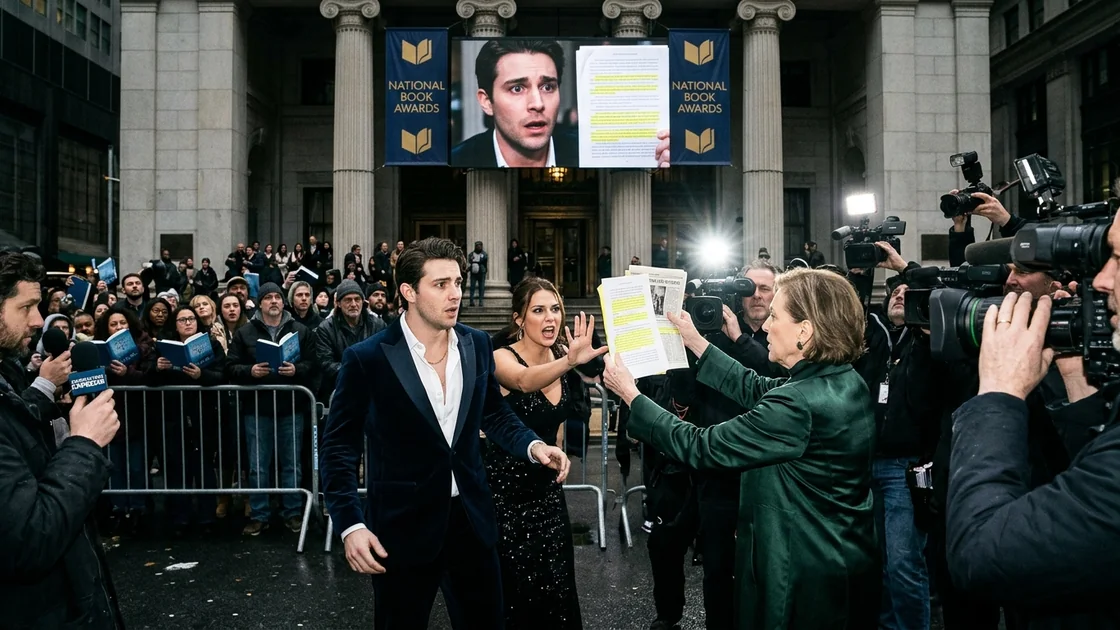
Julian Vance, a struggling ghostwriter consumed by the recent deaths of his wife and daughter, accepts a lucrative contract to write a literary novel for Tristan Sterling, a vacuous reality television star seeking intellectual credibility. Unable to invent a fictional plot through the fog of his devastation, Julian pours his raw, unprocessed grief and the intimate details of his family's tragedy into the manuscript, changing only the names and the geography. When the book is published under Tristan's name, it becomes a global phenomenon, elevating the shallow celebrity to the status of a literary prophet while Julian is forced to watch from the shadows as the world weeps for his stolen pain, leading to a final, shattering confrontation between the man who bled the words and the man who bought the scars.
The radiator in Julian’s apartment did not merely clank; it wept through a series of corroded iron throats, a rhythmic, metallic stuttering that served as the only measure of time in the small rooms above the dry cleaner’s on Seventh Avenue. It was November, the month when the light in Manhattan did not so much fade as curdle, turning the color of old tallow by four in the afternoon. Julian sat before the cherrywood desk—Clara’s desk, bought at an estate sale in Rhinebeck the autumn before the ice—and stared at the cursor on his monitor. It blinked with a steady, indifferent pulse: one, two, one, two. A heart that had no business beating when others had stopped.
Beside the keyboard sat a cerulean ceramic mug. Inside it, a skin of gray mold had formed over half an inch of tea he had brewed six days ago. He did not move it because the mug belonged to the Before, and to wash it felt like an act of vandalism against the last Tuesday when the world still possessed weight and logic.
When the phone rang, it sounded like an intrusion from another century.
"Julian? Tell me you’re dressed. Actually, don't tell me that, just tell me you have electricity."
It was Martha. Her voice was like gravel shaken in a tin can—forty years of literary agency lunches, three divorces, and an unshakeable belief that every human misery could be redeemed by a six-figure advance.
"The power is on, Martha," Julian said. His voice was thick, rusty from disuse. He hadn't spoken aloud since Tuesday, when he had told the Korean grocer down the street that he didn't need a bag for his soup cans.
"Thank Christ. Listen to me. I’m sending a car. Don't argue. You’re going to put on the charcoal blazer that doesn't smell like camphor, you’re going to shave that Whitman-esque disaster off your chin, and you’re going to meet me at the Carlyle at two."
"I’m not taking assignments right now, Martha. You know that."
There was a pause on the line. The background noise of Martha’s office—the muffled trill of junior agents, the distant sirens of Madison Avenue—seemed to recede. When she spoke again, the gravel was gone, replaced by something dangerously close to pity.
"Julian. It’s been fourteen months."
"Thirteen," he corrected automatically. "Thirteen months and eleven days."
"The bank doesn't count the days, darling. They count the defaults. You’re three months behind on the mortgage for the Rhinebeck house, and you won’t sell it, which means you’re bleeding out in two zip codes at once. This isn't a diet book for a holistic cardiologist. This isn't a leadership manual for a disgraced tech CEO. It’s a novel."
Julian closed his eyes. Behind his lids, the gray light of the apartment remained, burned into his retinas. "I don't have a novel in me."
"You don't need one," Martha said briskly, the professional snap returning to her voice. "You just need seventy thousand words of convincing melancholia. The client is Tristan Sterling."
Julian frowned, the name skittering across his memory without finding traction. "The swimmer?"
"The person, Julian. He was on that island show five years ago, then he dated the girl with the eyebrows, then he launched a line of sustainably harvested cashmere hoodies. Twelve million followers. He wants to pivot."
"Pivot to what?"
"To having a soul," Martha said dryly. "Apparently, the market for twenty-eight-year-old men taking their shirts off in Positano is experiencing a downturn. His management wants him to be taken seriously. They want him in the New Yorker festival by next October. They want him on panels discussing the 'crisis of modern masculinity.' And to do that, he needs to have written a devastating literary debut."
"He wants me to ghostwrite a literary novel."
"He wants you to write a masterpiece, and he wants to pay you a hundred and twenty thousand dollars to never, ever tell a living soul that you did it. Half on signing, half on delivery of the first draft. Four months."
Julian looked at the cerulean mug. In the hallway, just beyond his field of vision, stood a small pair of yellow rain boots, size ten, with little green frogs painted on the toes. He hadn't moved those, either. The bank had sent a registered letter on Thursday; he had used it as a coaster for his water glass. If he lost the Rhinebeck house, men in heavy boots would go in there. They would touch Clara’s looms. They would pack Maya’s wooden trains into cardboard boxes with the indifferent efficiency of grave diggers.
"Two o'clock," Julian said.
"Wear a tie," Martha said, and hung up.
The Bemelmans Bar at the Carlyle was dim, smelling of expensive leather, lemon peel, and the faint, sweet rot of old money. At two in the afternoon, it was nearly empty, save for two Japanese tourists photographing the murals and a small, curated entourage occupying the corner banquette.
Martha was already there, looking like an armored beetle in a structured Chanel jacket, nursing a dry martini. Opposite her sat a young man who looked as though he had been assembled by a committee of lighting technicians.
Tristan Sterling was not merely handsome; he was symmetrical in a way that felt vaguely hostile to normal human biology. His hair was the color of toasted wheat, arranged in a state of artful chaos that probably required forty minutes and three distinct waxes to achieve. His skin had the golden, poreless sheen of someone who drank liquefied kale and had never once worried about the price of heating oil. He was wearing a vintage flannel shirt that Julian instinctively knew cost more than the transmission on his old Volvo, left open at the throat to reveal a delicate gold chain.
Beside him sat a woman in her thirties with hair pulled back so tightly it gave her a permanent expression of startled aggression. She was typing furiously on two different iPhones simultaneously.
"Julian," Martha said, rising half an inch off the leather to offer a dry cheek. "Thank God. Sit. This is Tristan. And this is Sloane, his head of brand strategy."
Sloane didn't look up from her screens. "The NDA is on the table. Did he sign the preliminary?"
"He signed it in the car," Martha lied smoothly, kicking Julian’s ankle under the table. "Julian is the best in the business, Sloane. Remember Senator Vane’s memoir? Remember The Quiet Scalpel? Both New York Times bestsellers. Both Julian."
Tristan looked at Julian. His eyes were a startling, vacant blue, like the bottom of a freshly chlorinated swimming pool. He offered a slow, practiced half-smile—Number Four in the repertoire: Humble Empathy.
"Man," Tristan said. His voice was surprisingly resonant, a rich baritone that had clearly been coached to drop an octave at the ends of sentences. "I just want to say, like, I really respect the craft. You know? Words are just... they’re heavy, man. And right now, I’m in a really heavy space."
Julian stared at him. He felt a strange, high-pitched ringing in his ears, the kind that usually preceded a migraine or a panic attack. "Are you."
"Totally," Tristan said, leaning forward, resting his forearms on the white tablecloth. A vintage Rolex Submariner peeked out from his frayed cuff. "Like, for the last six years, my life has been so loud. You know? Milan, Coachella, the brand launches, the breakup with Chloe—which was so toxic, by the way, the press totally spun that—and I just realized last summer when I was doing this silent retreat in Tulum... I was looking at the ocean, and I thought: Who is Tristan when nobody is watching?"
He paused, waiting for the profundity of the question to settle over the table like a fine mist.
"And?" Julian asked. His voice sounded flat, deadened by the heavy velvet drapes of the room.
Tristan blinked. "And what?"
"Who were you?"
"Oh." Tristan’s brow furrowed—just enough to create two photogenic vertical lines between his eyebrows, not enough to wrinkle the forehead. "I think I’m someone who hurts, Julian. Like, deeply. I think my generation is so disconnected from real grief. We filter everything. And I want this book to have no filters. I want it to be about loss. Like, a guy who loses everything and has to find himself in the wreckage."
Sloane stopped typing on her left phone for three seconds. "We’re thinking A Little Life meets The Sun Also Rises, but accessible. Short chapters. Good for reading on a plane or photographing next to an iced matcha. HarperCollins has already pre-bought the North American rights based on the concept. Pub date is September."
"What have you lost?" Julian asked.
The silence at the table went sharp. Martha’s gin glass stopped halfway to her mouth.
Tristan looked confused, as if the waiter had just asked him to solve a quadratic equation in Mandarin. "What do you mean?"
"You said you wanted to write about loss," Julian said, his eyes fixed on the little gold chain resting in the hollow of Tristan’s throat. "To write eighty thousand words about a thing, it helps to have a seed. What is the heaviest thing you’ve ever dropped and couldn't pick back up?"
Tristan shifted in the booth. For a fraction of a second, the boy from the Ohio suburbs—before the veneers, before the jaw fillers, before the twelve million strangers who wanted to see his abs—flickered behind the blue eyes. He looked small and slightly annoyed.
"My grandfather died when I was twelve," Tristan said defensively. "And I had a Golden Retriever named Barnaby that got hit by a FedEx truck in Malibu two years ago. I cried for like three days, man. I couldn't even post."
Martha set her glass down with a sharp clink. "What Julian means, Tristan, is that he likes to work from emotional truth. He’ll interview you, get your cadence, your worldview, and then he builds the architecture around that. Isn't that right, Julian?"
Julian looked at the NDA lying beside the bread basket. He thought of the Rhinebeck house. In the upstairs hallway, where the floorboards slanted toward the west, there was a pencil mark on the doorframe: Maya, 4 yrs, 38 inches. If the bank took the house, whoever bought it would paint over the trim. They would use two coats of Benjamin Moore Simply White, and the graphite would disappear forever.
"Yes," Julian said, reaching for his pen. "That’s right. I build the architecture."
The tape recorder sat between them during three two-hour sessions in Tristan’s Tribeca loft—a cavernous space that smelled of fig-scented candles and new leather, containing four thousand square feet of white oak flooring and precisely six books, all of them about watch collecting or Ibiza.
Julian didn't ask about Barnaby the dog again. Instead, he let Tristan talk.
Tristan talked about the pressure of maintaining four percent body fat. He talked about the betrayal he felt when his former manager took fifteen percent of his kombucha endorsement deal after they had already parted ways. He talked about a girl he had met in Barcelona who had yellow flecks in her eyes and who didn't know who he was, which he described four separate times as "the purest seventy-two hours of my existence, bro, honestly."
Julian took notes in a black Moleskine notebook. He didn't write down what Tristan said; he wrote down how Tristan failed to say it. He noted the way the boy used the word literally as a crutch whenever an emotion threatened to become specific. He noted the small, nervous tic Tristan had of touching his left earlobe whenever he was lying about having read a classic author.
On the fourth night, back in the Seventh Avenue apartment, Julian deleted the transcripts.
He poured three fingers of cheap bourbon into a water glass—leaving the cerulean mug untouched—and opened a blank document.
He had tried, for forty-eight hours, to write the book Sloane wanted. He had sketched an outline about a young architect named Leo who loses his fiancée in a boating accident off Amalfi and wanders through the cafés of Lisbon drinking sour wine and contemplating mortality. He had written twelve pages. They were competent, rhythmic, and entirely dead. They read like what they were: a corpse dressed in a tuxedo.
Julian drank the bourbon. The radiator hissed, a long, whistling sigh that sounded like a tire losing air on a dark road.
The ice on Route 9G doesn't look like ice, Julian typed. It looks like the road has simply decided to remember the rain.
His fingers stopped. His breath caught in his throat, sharp and ragged, as if he had swallowed a piece of glass.
He hadn't thought about the road in months—not in sentences. He had thought of it in flashes: the sudden, weightless spin of the steering wheel under his thumbs; the absurd clarity of the jazz station still playing on the radio as the headlights swept across a stand of white birch trees; the sound of Clara’s intake of breath, not a scream, just a quick oh, as if she had remembered she left the iron on.
Julian reached for the backspace key. His index finger hovered over the plastic for ten seconds, trembling.
Then he dropped his hand back to the home row.
His name was Thomas, Julian wrote. Her name was Elena. The child was called Sarah, and she was four years old, the age at which a human being still believes that if she closes her eyes, the monster in the closet cannot see her.
He didn't stop until the garbage trucks began their grinding ballet on Seventh Avenue at five in the morning.
He changed the geography. The Hudson Valley became the rugged coast of Maine. Clara’s weaving studio became Elena’s ceramic workshop—he swapped the smell of wet wool and lanolin for the grey, dusty scent of red clay and kiln smoke, though the silence of the empty room remained identical. He took the yellow rain boots with the green frogs and turned them into a pair of red mittens with missing thumbs, left drying on a radiator that never quite got warm enough.
It was a perverse kind of alchemy. For thirteen months, the grief had been a formless, crushing mass inside his chest, an internal hemorrhage that had no outlet because there was no one left to tell it to. Now, under the absurd mask of Tristan Sterling’s name, he found he could bleed into the machine. Because it wasn't his book—because it belonged to that golden, empty boy in Tribeca—Julian was free from the shame of exhibitionism. It was like confessing a murder to a priest who didn't speak your language.
He wrote about the hospital in Poughkeepsie—now a clinic in Portland—where the fluorescent lights had a defective ballast that hummed in the key of F-sharp. He wrote about the specific texture of the small, plastic bag the nurse had handed him, containing Clara’s silver wedding band and one of Maya’s plastic barrettes, shaped like a daisy, with three brown hairs still twisted in the clasp.
When he delivered the first fifty pages to Martha three weeks later, she called him at midnight.
"Julian," she said. There was no ice clinking in a glass on her end. The line was dead quiet.
"Did Sloane hate it?" he asked, staring at the ceiling from his sofa.
"Sloane hasn't seen it yet. I just finished reading it." Martha’s voice was strange, stripped of its Manhattan armor. "God almighty, Julian. The scene with the mittens."
"They’re red," Julian said to the dark room.
"I know what they really are, Julian. I was at the funeral, remember?"
Silence stretched between them, heavy and humming with the ghosts of the wires.
"Don't do this," Martha said softly. "Give me the Amalfi Coast garbage. Give them what they paid for. They don't deserve this. He doesn't deserve this. If you put this out there with his face on the jacket, it’s going to break something in you that you won't be able to fix."
"The bank sent the foreclosure notice on Rhinebeck yesterday," Julian said. "I need the second half of the advance, Martha. And I can't write the Amalfi book. I tried. My hands won't do it."
"You’re selling your child’s grave to a boy who sells sweatshirts, Julian."
"No," Julian said, turning his face into the upholstery of the sofa, which still smelled faintly, impossibly, of Clara’s lavender conditioner. "I’m using his money to keep the house where she lived. Nobody reads celebrity novels anyway, Martha. It’ll sell twenty thousand copies to teenage girls who won't get past chapter two, it’ll go to the remainder bins by Christmas, and I’ll have my roof."
Martha sighed, a long, defeated sound that made her sound every one of her sixty-eight years. "You're a fool, Julian. You’ve forgotten how good you are."
The manuscript was finished in late February, during a week of sleet that turned the city into a slush-filled trench. It was titled The Salt in the Loom, though Sloane’s team immediately changed it to The Weight of the Water because "loom" tested poorly with the eighteen-to-thirty-four demographic.
Julian attended one final meeting at the offices of the publisher, a gleaming glass tower near Hudson Yards. He was introduced to the junior editors as "Julian, the developmental consultant brought in to help Tristan structure his drafts."
Tristan sat at the head of the conference table wearing spectacles with non-prescription tortoise-shell frames. Before him lay the bound galley of the manuscript, bristling with pastel Post-it notes that Sloane had clearly placed there twenty minutes prior.
"I just feel like," Tristan said to the room at large, tapping the manuscript with a manicured forefinger, "when we finally got to the end of the process, Thomas really became an extension of my own shadow self. You know? Like, obviously I don't have a daughter—yet, God willing—but that passage on page two-ten, about how a child’s weight stays in your arms even after you put them down? I wrote that after holding my sister’s newborn in Santa Monica. It just poured out of me at three a.m."
Julian sat four chairs down, his hands folded in his lap. That passage had been written on Christmas Eve, while Julian sat on the cold tile floor of the Rhinebeck bathroom, holding a folded bath towel against his collarbone until his arms cramped.
The Editor-in-Chief, a man named Arthur who had edited two Pulitzer winners in the nineties before surrendering to the economics of celebrity imprints, looked at Tristan over the rims of his glasses. Arthur was no idiot; he had been in the room for forty years. Slowly, his eyes shifted from Tristan’s unlined, earnest face down the length of the mahogany table, coming to rest on Julian’s grey, hollowed cheeks and the ink stain on his cuff.
Arthur held Julian’s gaze for three seconds. There was a flicker of profound, professional sorrow in the older man’s eyes, followed by a tiny, imperceptible shrug. This is the world we live in now, the shrug said. Cash the check.
"It’s an extraordinary achievement, Tristan," Arthur said, turning back to the star. "Frankly, none of us expected a work of this... density. The early reads from the sales force are electric. We’re bumping the initial print run from fifty thousand to two hundred and fifty."
Julian’s stomach gave a small, cold lurch.
"Amazing," Sloane said, not looking up from her iPad. "We’ve secured Good Morning America for launch day, and Tristan is doing a long-form podcast tour. Three hours with Rogan, two with Rich Roll. We’re leaning heavily into the 'vulnerability as strength' angle."
After the meeting, in the marble lobby by the elevators, Tristan caught Julian by the elbow.
"Hey, man," Tristan said, dropping his voice to that intimate baritone. He smelled of sandalwood and mint. "I just wanted to say thanks. Like, for helping me organize my thoughts. You’re a wizard with the grammar stuff."
He reached into his pocket and pulled out a small, matte-black box. He pressed it into Julian’s palm.
"A little wrap gift," Tristan winked. "It’s from my personal reserve line. Red light therapy mask. Does wonders for the under-eye bags, bro. You look like you’ve been grinding too hard."
The elevator doors chimed. Tristan stepped inside, gave a two-fingered salute, and vanished upward toward the sky.
Julian stood by the revolving doors for a long time, holding the black box. Outside, the February rain was turning to snow, big wet flakes that died the instant they touched the black asphalt of Tenth Avenue.
The check cleared on the tenth of March. Julian paid the arrears on the Rhinebeck mortgage, paid six months of back rent on Seventh Avenue, and bought a new pair of spectacles. Then he went up to the house in the country and spent the spring sitting on the back porch, watching the forsythia explode in yellow violence along the stone wall Clara had built the summer Maya was born.
He didn't turn on the television. He didn't buy the newspapers. He existed in a quiet, green purgatory, tending to Clara’s perennials with clumsy, ink-stained fingers, waiting for September to pass like a kidney stone.
It was Martha who broke the quarantine. She drove up in her leased Mercedes on the third Saturday of September, her tires crunching loudly on the gravel drive he hadn't weeded.
She didn't say hello when she got out of the car. She walked up the porch steps, dropped a thick stack of newsprint onto the wicker table beside his rocking chair, and sat down heavily on the top step.
On the top of the stack was the New York Times Book Review.
The cover wasn't a photograph of Tristan. It was a woodcut illustration of a pair of small red mittens hanging from a piece of driftwood. Above it, in forty-point serif type, ran the headline: THE UNBEARABLE LIGHTNESS OF GRIEF: TRISTAN STERLING’S ASTONISHING REINCARNATION.
Julian didn't touch the paper. A wasp was crawling along the rim of the wicker table, drunk on late-summer apples from the orchard next door.
"Michiko didn't review it, thank God, she’s retired," Martha said, pulling a pack of Dunhills from her purse—she only smoked when a client died or won the Nobel. "They gave it to Jonathan Vane. Two thousand words, Julian. He called it 'a howling wilderness of a book that strips the skin from the modern soul.' He compared it to Grief Is the Thing with Feathers and early Joan Didion."
"Vane always was pretentious," Julian murmured, watching the wasp.
"It’s number one, Julian. Not just on the celebrity list. Fiction. Overall. It’s outselling the new King. It’s in its sixth printing in eleven days. Every book club from Scarsdale to Seattle has made it their October pick. And yesterday..." Martha took a long drag of her cigarette, her hand trembling slightly. "Yesterday, the publisher submitted it to the National Book Foundation. And the rumors from the judges' panel are that it’s going to make the shortlist."
Julian finally looked down at the paper. Below the fold of the Book Review, someone had tucked a copy of New York magazine. Tristan was on the cover, shot in high-contrast black and white by Annie Leibovitz. He was wearing a coarse fisherman’s sweater, his hair wet and plastered to his forehead, staring into the lens with an expression of such raw, hollowed-out agony that Julian felt a sudden urge to laugh.
"He’s good," Julian said softly. "In front of a camera, he’s actually quite good."
"Turn on your computer, Julian," Martha said grimly. "Or don't. Actually, don't. Keep weeding the hydrangeas. I just thought you should know before you walked into the village pharmacy and saw your dead wife’s kitchen table described on a cardboard display next to the sunscreen."
After she left, Julian lasted four hours.
At nine o'clock that night, sitting at Clara’s cherrywood desk in the upstairs bedroom—he had moved it back from the city in May—he opened his laptop and typed Tristan Sterling Weight of the Water into the search bar.
The deluge was instantaneous.
He watched a clip from The Late Show. The audience didn't cheer when Tristan walked out; they gave him a hushed, reverent applause, the kind reserved for returning hostages or cancer survivors. Tristan wore all black, no jewelry. He sat in the chair with a slight slump, his shoulders rounded, as if the physical labor of carrying such a mind had injured his spine.
"Tristan," the host said, leaning in with earnest, late-night gravity, "everyone is talking about this book. Frankly, I think a lot of people expected a vanity project, and instead you’ve given us something that made my wife cry for two days straight. Where did Thomas come from?"
On the screen, Tristan looked down at his hands. He twisted a non-existent ring on his fourth finger—a gesture Julian had written for the character of Thomas on page forty-two, a habit Julian himself had developed in the months after he took his own wedding band off because his knuckles had swollen from crying.
Tristan had read the book carefully. He had studied the stage directions.
"I think," Tristan said softly into the lapel mic, his voice cracking with a masterfully calibrated huskiness, "for a long time, I used my public life as an anesthetic. You know? If the music is loud enough, you don't hear the house burning down inside you. And when I went away last winter... I just sat in a room with a yellow legal pad, and I asked myself what the worst thing in the world would be. And I realized the worst thing isn't dying. It's surviving when the people who knew your real name are gone."
The studio was dead silent. A woman in the front row wiped her eyes with the back of her hand.
Julian stared at the glowing rectangle of his screen. The sentence—the worst thing isn't dying, it's surviving when the people who knew your real name are gone—was from his own journal. He hadn't even put that in the novel. He had written it in the margin of the second draft, by hand, and must have forgotten to erase it before Sloane’s assistant scanned the pages.
He clicked another video. It was a TikTok compilation with four million views. Young women—hundreds of them, sitting in their cars, lying in their beds under fairy lights—filming themselves weeping openly while holding the hardcover up to the camera.
Over the montage played an audio clip of Tristan reading the audiobook.
"The mittens stayed on the radiator until April," Tristan’s rich, coached baritone purred through Julian’s cheap laptop speakers. "Sometimes, when the furnace kicked on at four in the morning, the wool would smell faintly of pond water and peppermint—the cheap kind they give away in baskets at the diner on Route 9. I didn't move them because if I moved them, it meant spring had come, and she had never seen the spring."
Julian slammed the laptop shut.
He stood up so fast the chair tipped backward, crashing onto the wide pine floorboards. He didn't make it to the bathroom; he leaned over the small wastebasket beside the desk and retched, bringing up nothing but bitter coffee and bile.
His hands were shaking uncontrollably. It wasn't anger—not yet. It was a sensation of profound, biological violation, as if he had woken up on an operating table to find a stranger wearing his skin like an overcoat, strolling down Fifth Avenue to applause.
When the words had been inside the book, they were still, in some quiet way, Maya’s and Clara’s. They were a monument built in an unmarked forest. Now, hearing them come out of that mouth—hearing the peppermint from the Red Hook Diner turned into content for twelve million strangers to consume between videos of skincare routines and golden retrievers—the memories themselves began to rot.
He closed his eyes and tried to see Maya’s face on the morning of the accident, the way the maple syrup had stuck to her chin.
Instead, behind his eyelids, he saw Tristan Sterling in a fisherman’s sweater, squinting tragically for Annie Leibovitz.
The parasite hadn't just taken the book. It was eating the host.
By October, The Weight of the Water had ceased to be a book and had become a cultural weather system.
Julian returned to the city, drawn back by a morbid, self-lacerating magnetism. He couldn't stay in Rhinebeck; the silence of the house now felt like a theater set after the crew had struck the lights.
In Manhattan, there was no escaping it. He saw the pale blue dust jacket on the subway every morning—held by finance bros on the Lexington Avenue line, tucked under the arms of NYU students in Washington Square, resting on the tables of outdoor cafés in SoHo.
Once, sitting on a downtown C train, he watched a woman in her fifties across the aisle reach the final chapter—the chapter where Thomas finally cleans out the kiln and finds the small, unfired clay thumbprint of his daughter on the underside of a shelf.
The woman’s face crumpled. She closed the book over her thumb to keep her place, bowed her head, and wept silently into her scarf while the train rattled through the dark tunnel beneath Central Park.
Julian wanted to cross the aisle. He wanted to drop to his knees on the filthy linoleum floor of the subway car, grab her by the wrists, and scream: It wasn't clay! It was blue yarn! I found a piece of blue yarn tied around the leg of her high chair three weeks after the funeral! Look at me! I’m right here!
Instead, he stared at his reflection in the dark glass of the train door until his stop came, and then he walked out into the cold rain.
He began to follow the tour.
He didn't go to the big events at the 92nd Street Y or the Brooklyn Academy of Music, where tickets were being scalped for three hundred dollars. He went to the smaller, high-brow panels that Sloane had booked to solidify Tristan’s credentials with the literary establishment ahead of the National Book Awards voting in November.
On a Tuesday night in late October, Julian stood at the very back of the McNally Jackson bookstore in Seaport, his collar turned up, a damp wool cap pulled low over his forehead.
The store was packed to fire capacity. At the front, beneath the warm halogen spots, Tristan sat in a leather armchair opposite Eleanor Vance—no relation to Julian, a famously acerbic critic for the London Review of Books who had flown in specifically for the conversation.
Tristan had evolved his look over the past six weeks. The tan was gone, replaced by an interesting, indoor pallor. He had let a ragged, five-day beard grow in, and he wore an oversized olive cardigan with a small tear near the pocket. He looked like a man who lived on black coffee and Kafka.
"What strikes one most about the prose, Tristan," Eleanor said into her microphone, her British vowels cutting cleanly through the humid air of the bookstore, "is its extraordinary technical restraint. In the scene where Elena’s sister comes to collect her clothes—a scene that in lesser hands would devolve into melodrama—you spend four pages describing the sound of the wire hangers sliding across the wooden rod in the closet. That metallic shhh-click. It’s devastatingly specific. How many drafts did it take to pare the emotion down to the object like that?"
Julian leaned against a bookshelf labeled Eastern Philosophy. His heart was hammering a slow, sick rhythm against his ribs.
It hadn't taken any drafts. Clara’s sister, Rachel, had come up from Philadelphia on a Sunday. Julian had been lying on the bed in the guest room with the door cracked an inch, unable to move, listening to Rachel take Clara’s summer dresses off the cedar rod one by one. Shhh-click. Shhh-click. Every hanger had sounded like a guillotine.
Up at the front of the room, Tristan smiled—not Number Four, a new one. Number Seven: The Exhausted Genius.
"You know, Eleanor," Tristan said softly, looking up at the ceiling as if consulting the muses, "I didn't really do drafts for that section. I’m a very visceral writer. When I’m in the chair, I actually put headphones on with white noise turned up to the max so I can hear the rhythm of my own blood. And for that closet scene... I actually went into my own walk-in in Tribeca, turned off all the lights, and just slid my own hangers back and forth for two hours in the dark until I understood the sonic architecture of emptiness."
A murmur of awed appreciation rippled through the crowd. A young man in round spectacles standing next to Julian whispered to his girlfriend, "God, he’s like a Method actor. It’s incredible."
Julian’s vision went white around the edges.
When the Q&A began, Julian didn't plan to move. His feet simply detached themselves from his brain’s authority and carried him six paces to the left, placing him behind the standing microphone in the center aisle.
There were three people ahead of him: a trembling college girl who asked Tristan for his favorite Rilke poem (Tristan skillfully pivoted to saying he didn't like to rank poets because "comparison is the death of grace"), an older man who wanted to know his writing routine, and a woman who just wanted to thank him for helping her process her divorce.
Then Julian was at the mic.
The halogen lights were hot on his face. He took off his wool cap.
At the front of the room, Tristan was taking a sip of bottled water. As Julian stepped up to the stand, Tristan’s eyes flicked over him, registered a middle-aged man in a damp raincoat, and began to form Smile Number Four.
Then the water bottle stopped an inch from Tristan’s lips.
To the boy’s credit, the years of reality television had given him remarkable control over his facial muscles. He didn't gasp. He didn't drop the bottle. Only the knuckles of his right hand, gripping the plastic, turned dead white, and the small muscle beneath his left eye gave a tiny, rhythmic flutter.
In the front row, sitting on the aisle, Sloane turned her head to see why her client had gone quiet. Her eyes met Julian’s. Her mouth opened slightly, her phone freezing in her lap.
"Yes, hi," the bookstore moderator said brightly, gesturing to Julian. "Last question of the evening."
Julian leaned toward the foam windscreen of the microphone. He could smell the mint breath of the woman who had stood there before him.
"My question is about the yellow boots," Julian said. His voice sounded strange amplified through the store’s PA system—booming, hollow, like the voice of God in an old movie.
Tristan swallowed. He set the water bottle down on the small side table with exquisite care. "I think you mean the red mittens, man. In the book, Sarah wears red mittens."
"In the published version, yes," Julian said calmly. "With the missing thumbs. Left on the radiator. Because red is a more cinematic color against the grey Maine coast. It pops better on the cover illustration. Doesn't it?"
The room went very quiet. The kind of quiet that happens in a crowded restaurant when someone drops a tray of glasses, and everyone waits to see if someone is bleeding.
Eleanor Vance frowned, looking between Julian and Tristan with sudden, sharp curiosity. "I’m sorry, are you with the publisher?"
"I’m an admirer of the craft," Julian said, never taking his eyes off Tristan’s blue ones. "I’m just curious about the transmogrification of the object. Suppose, hypothetically, that before they were red mittens in Maine, they were yellow rubber boots in the Hudson Valley. Size ten. With little green frogs painted on the toes. And suppose the reason the narrator couldn't move them from the hallway wasn't because of some poetic theory about the arrival of spring, but because on the morning of October fourteenth, his four-year-old daughter had thrown a tantrum about wearing them because the left one had a pebble stuck in the heel, and he had yelled at her to hurry up because they were late."
Julian’s voice didn't shake. It was cold and flat as the river in January.
"Suppose," Julian continued into the silence of the two hundred people holding their breath, "that the last thing the father ever said to her before the black ice on Route 9G was, 'Maya, if you don't put your shoes on right now, I’m leaving without you.' How many hours would a writer have to sit in a walk-in closet in Tribeca to invent the way that sentence tastes in your mouth every morning when you brush your teeth?"
Nobody moved. In the back of the store, the espresso machine at the café let out a sudden, violent hiss of steam that made several people jump.
Tristan stared at Julian. For five seconds, six seconds, the silence stretched to the point of snapping. The boy was trapped in the amber of his own lie; if he called security, he looked guilty or cruel; if he answered defensively, he broke character.
Then, slowly, Tristan leaned forward, resting his elbows on his knees, clasping his hands together in front of his mouth. When he spoke into his lapel mic, his voice was a masterpiece of bruised, gentle compassion.
"Man," Tristan whispered. "First of all... I just want to say I hear you. And I’m so, so sorry for your loss. Maya is a beautiful name."
Julian felt the floor tilt beneath his shoes.
"That’s the miracle of literature, isn't it, Eleanor?" Tristan said, turning slightly to include the British critic, his eyes glistening under the halogen spots—actual tears, summoned on command from whatever reptilian reservoir actors keep behind their sinus cavities. "When you write something from the deepest, most private well of your own imagination... it stops belonging to you. People see their own lives in it so clearly that they feel like you stole their diary. I’ve had four or five fathers come up to me on this tour and tell me almost the exact same thing—that Thomas’s story is their story. That my red mittens are their yellow boots."
Tristan looked back at Julian, offering his hand across the sea of folding chairs in a gesture of benediction.
"It’s not my book anymore, brother," Tristan said softly. "It’s yours. It’s Maya’s. And if my words gave you a vessel to pour that pain into tonight... then every agonizing hour I spent writing it was worth it."
The applause didn't start at the back; it started in the second row, with a woman in a silk blouse who stood up, clapping fiercely through her tears. Within three seconds, the entire bookstore was on its feet. They weren't just applauding the book anymore; they were applauding the saintly grace of this young man who had just absorbed the unhinged projection of a grieving stranger and turned it into a moment of communal healing.
Sloane was already on her feet, whispering urgently to two large men in dark suits near the stockroom door, pointing a manicured finger at Julian.
Julian looked at Tristan through the forest of standing, clapping silhouettes. Behind the tears, in the very center of those chlorinated blue eyes, there was nothing at all. Not malice, not guilt, not triumph. Just the flat, reflective surface of a mirror.
Julian turned and walked out of the bookstore before the security guards could reach the center aisle.
The phone calls started before he even reached the Fulton Street subway station.
First it was Martha, screaming at him over the roar of an approaching train that Sloane’s lawyers were threatening to sue for breach of the non-disclosure agreement, demanding the return of the hundred and twenty thousand dollars plus five million in liquidated damages for defamation if he came within five hundred yards of another tour stop.
"They can't sue me for asking a hypothetical question at a bookstore, Martha," Julian said, leaning against a tiled pillar on the platform.
"They don't have to win the suit to ruin you, Julian! They just have to file it and put a lien on Rhinebeck until you starve! What the hell were you thinking? Did you think he was going to break down like Perry Mason and confess in front of the woman from the London Review?"
"No," Julian said. "I don't know what I thought."
"Go home. Pack a bag. Go back upstate and unplug the phone. The National Book Awards are in three weeks. Once the prize is announced, the cycle will move on, he’ll go shoot a movie with Zendaya or whatever the hell they have lined up for him, and you can have your life back."
Julian hung up. He didn't go back upstate.
He went back to the apartment on Seventh Avenue. For the next two weeks, the radiator clanked, the November rain fell in greasy sheets against the fire escape, and Julian systematically dismantled his own life in search of a weapon.
He knew the NDA was ironclad. He had signed away the copyright, the moral rights, and the right to ever acknowledge his participation in the creation of The Weight of the Water. Even if he went to the New York Times with his laptop—even if he showed a reporter the early drafts—Sloane’s team had prepared for that. Under the terms of the "developmental consulting" contract Julian had signed at the publisher’s office, any files on his hard drive were legally defined as transcriptions of Tristan’s dictation or editorial suggestions based on Tristan’s original manuscripts. It would be the word of a washed-up, grief-deranged ghostwriter who had already publicly embarrassed himself at a bookstore against a multi-million-dollar corporate apparatus and a beloved cultural icon.
They would paint him as a stalker. They would use Maya’s death as proof of his mental instability.
On the night the National Book Award finalists were announced—with The Weight of the Water leading the pack—Julian sat at his desk and finally washed the cerulean mug.
He scrubbed the grey mold out with hot water and dish soap until the ceramic was bright blue again. Then he dried it with a clean towel, set it on the desk, and opened the bottom drawer of the filing cabinet where he kept his old leather-bound journals.
Wait.
He stopped, his hand hovering over the third journal from the left—the one from the autumn before the accident.
When he had written the novel in that four-month fever dream, he had been so desperate to preserve the small, vanishing details of his life with Clara and Maya that he had smuggled them into the text like contraband. He had assumed no one would ever look closely enough to find them.
He pulled the journal out and flipped to the back pages, where he had sketched the rough structural outline of the book during that first week in November.
Julian was not just a ghostwriter; before he had sold his soul to Martha’s stable of senators and surgeons, he had been a student of Renaissance literature at Columbia. He had written his master’s thesis on John Donne and the tradition of the cryptographic funeral elegy—poems where the grieving author wove acrostics, numerological ciphers, and hidden autobiographical anchors into the verse so that God, and the dead, would know who had truly written the prayer, even if the poem was published anonymously.
During the third week of December, when the bourbon had been running very low and the fever of the writing had been at its peak, Julian had done something to Chapter Seven—the chapter about the hospital waiting room.
He opened his copy of the published hardcover of The Weight of the Water, which he had bought with cash at a kiosk in Penn Station. He turned to page one hundred and fourteen.
Sloane’s editors hadn't touched a word of Chapter Seven. Even Arthur, the Editor-in-Chief, had left it intact during the line edit because the rhythm of the prose was so strange and hypnotic that changing a single comma felt like cutting a wire in a bomb.
The chapter consisted of thirty-six short, fragmented paragraphs describing Thomas’s thoughts as he stared at the acoustic tiles of the waiting room ceiling while the surgeons worked on Elena.
Julian laid a ruler across the page.
He read the first word of the first paragraph: I. The first word of the second paragraph: Julian. (In the text: "Julian calendars, the nurse said, were off by thirteen days, which was why the winter felt so early...") The first word of the third paragraph: Vance. ("Vance County porcelain was what they used for the sinks in the washroom...")
He ran his finger down the thirty-six paragraphs across five pages of the book.
I, Julian Vance, wrote this book for my wife Clara and my daughter Maya, who died on Route 9G on October 14. Tristan Sterling is a thief who never knew their names. Forgive me for selling their bones.
Every single word was the opening word of a consecutive paragraph in the most famous chapter of the most famous book in America.
Julian sat back in his chair. A strange, terrible laugh bubbled up in his throat, dry as dead leaves.
He hadn't even remembered doing it until just now. He had written that section at four in the morning after drinking half a bottle of rye, weeping so hard he could barely see the monitor. His subconscious, terrified of the betrayal he was committing, had carved his name into the floorboards of the house before handing the keys to the buyer.
It wasn't proof that would hold up in a contract court—the NDA still forbade him from claiming authorship.
Wait.
The NDA forbade Julian from claiming authorship or disclosing the relationship to a third party.
It did not forbid someone else from reading the book that HarperCollins had printed two million copies of.
And more importantly: Tristan Sterling had claimed, on twenty different podcasts, in the New York Times, and before the judges of the National Book Foundation, that he had written Chapter Seven himself, by hand, during a forty-eight-hour fast in Joshua Tree.
If a literary critic discovered a thirty-six-word acrostic confession buried in the exact center of the novel, naming a specific ghostwriter and two dead women whose obituary was a matter of public record in the Poughkeepsie Journal—after Julian had already stood up in a crowded bookstore and asked about Maya and Route 9G in front of Eleanor Vance of the London Review of Books—no PR firm on earth could spin it as a coincidence. The mathematical probability of thirty-six consecutive paragraphs accidentally spelling out a coherent, grammatically correct indictment of the author’s fraud, containing the real names of a known ghostwriter’s deceased family, was zero.
Julian looked at the clock on his wall. It was Tuesday, November seventeenth.
Tomorrow night was the National Book Awards dinner at Cipriani Wall Street.
He didn't send the email to the New York Times. They would fact-check it for four days, call HarperCollins for comment, and give Sloane time to invent a narrative—perhaps that Julian had been hired as a copy-editor and had maliciously inserted the cipher into the proofs without Tristan’s knowledge.
To make it fatal, Tristan had to own Chapter Seven one last time, in a room from which there was no exit.
Instead, on Wednesday morning at ten o'clock, Julian walked into a FedEx office on Eighth Avenue and sent a courier envelope to the Algonquin Hotel, addressed to Eleanor Vance.
Inside the envelope, he placed no letter—nothing with his handwriting or signature that could be traced back to him as a breach of contract. He simply placed five photocopied pages of Chapter Seven from the published book, with the first word of each of the thirty-six paragraphs highlighted in bright yellow marker, alongside a printed copy of the Poughkeepsie Journal obituary for Clara and Maya Vance, and a printout of the Publishers Weekly announcement from four years ago noting that Julian Vance was represented by Martha Klein Literary.
On a Post-it note stuck to the top page, typed on an old library computer at the Mid-Manhattan branch using a guest pass, were two sentences:
Ask him at the Cipriani press line tonight why he used the name 'Julian' in paragraph two of page 114. Watch his face before you show him the rest.
Then Julian went home, put on his charcoal blazer, shaved his beard, and took the subway down to Wall Street.
He didn't have a ticket to the dinner—tickets were ten thousand dollars a table—but he didn't need one. Cipriani Wall Street, with its massive Greek Revival columns and cavernous marble interior, was surrounded by barricades along the narrow financial district canyon, where the public and the freelance photographers gathered to watch the literary world play at being Hollywood for one night a year.
By six o'clock, the November air was biting cold. Searchlights swept across the granite facades of the old banks. Inside the velvet ropes, beneath a heated canopy running along the stone steps, the press line was three deep: cameras from Entertainment Tonight (drawn purely by Tristan’s presence), reporters from NPR, Vanity Fair, the Times, and the international press.
Julian stood across the narrow street, pressed against the cold iron fence of the old Morgan building, his hands shoved deep into his coat pockets. Directly above the entrance to the hall, a massive Jumbotron screen had been erected by the sponsors so the crowd on the street—Mostly MFA students and Tristan’s teenage fans holding copies of The Weight of the Water—could watch the red carpet interviews and the livestream of the ceremony inside.
At six-forty-five, a black Maybach pulled up to the curb.
The screaming from the barricades was deafening, wholly out of place for an event where the previous arrival had been a seventy-four-year-old translator of Hungarian poetry.
Tristan stepped out of the car. He was wearing a bespoke midnight-blue velvet tuxedo by Tom Ford, no tie, his throat bare save for that little gold chain. He looked magnificent. He looked like F. Scott Fitzgerald if Fitzgerald had never touched a drop of gin and had a personal trainer named Gunnar.
Sloane trailed three paces behind him in a black sequined gown, her ear glued to an AirPiece.
Tristan worked the line with the effortless majesty of a prince visiting the provinces. He signed books for the crying girls at the barricade; he hugged Arthur, his editor, for the photographers; he paused to give a three-minute interview to the Today show correspondent about how humbled he was just to be in the same room as his fellow nominees.
Then he reached the print journalists near the giant bronze doors.
Julian squinted across the street, then looked up at the Jumbotron, which was carrying the feed from the official National Book Foundation roving camera as it followed the night’s biggest star along the carpet.
Standing beside the Paris Review reporter was Eleanor Vance. She looked formidable in a dark green silk coat, holding a small notebook and a black clutch that was slightly too large for evening wear—large enough to hold five folded sheets of standard copy paper.
"Tristan!" Eleanor called out.
Sloane, spotting the prestigious British critic who had moderated the Seaport event, immediately tapped Tristan’s shoulder and steered him toward her. The roving camera crew swung their boom mic over the velvet rope to capture the exchange between the literary heavy-hitter and the golden boy.
On the massive screen above Wall Street, Tristan’s face appeared in ten-foot-tall high definition.
"Eleanor," Tristan said warmly, taking her hand in both of his. "So good to see you again. Thank you for that piece in the Review last week, it was so generous."
"I hasn't gone to press yet, Tristan," Eleanor said dryly. Her face was pale under the harsh television lights, her mouth set in a thin, dangerous line. "In fact, I’m holding the proofs until tomorrow morning because a rather fascinating textual question came up today regarding Chapter Seven."
Tristan’s smile didn't waver, though Julian saw his thumb rub lightly against his forefinger. "Oh yeah? The waiting room chapter. That’s the heart of the book for me."
"Yes, you’ve mentioned several times that you wrote that chapter in a single forty-eight-hour sitting in Joshua Tree, entirely by hand, without any outside editorial input. Is that right?"
"Literally didn't eat or sleep for two days," Tristan said into the camera mic, nodding solemnly. "Just me, a legal pad, and the desert. When I handed it to Arthur, I told him, 'If you change a single word of this chapter, I’ll pull the book.' It’s the purest thing I’ve ever created."
"Fascinating," Eleanor said. "Because I was looking closely at the prose structure this afternoon, and I noticed something rather unusual about the opening words of the thirty-six paragraphs in that chapter. For instance, paragraph two begins with the phrase 'Julian calendars', and paragraph three begins with 'Vance County porcelain.' Now, given that Julian Vance is the name of the man who stood up at my bookstore event two weeks ago and accused you of stealing his dead daughter’s life... why on earth did you choose those two words in the middle of the desert?"
On the Jumbotron, the world saw the exact moment the floor gave way beneath Tristan Sterling.
The golden tan seemed to turn the color of wet putty in real time. His blue eyes widened, darting left toward Sloane, then right toward the camera lens three feet from his nose, then back to Eleanor. His left hand came up, completely involuntarily, and pinched his left earlobe.
"I... what?" Tristan stammered. The coached baritone vanished, replaced by the reedy, panicked tenor of a twenty-eight-year-old from Ohio who hadn't done the reading. "I don't know what you’re talking about. It’s a calendar. Like, Julius Caesar."
"And the remaining thirty-four paragraphs?" Eleanor asked, her voice rising clearly over the hum of the street as she opened her black clutch and pulled out the five yellow-highlighted pages, holding them up right in front of the National Book Foundation’s high-definition camera lens.
The cameraman, smelling blood with the instinct of a shark, zoomed in tight on the pages in her hand, broadcasting the highlighted words onto the thirty-foot screen above Wall Street and into the livestream watched by fifty thousand publishing insiders around the world.
"Shall I read your acrostic aloud, Tristan?" Eleanor’s voice rang out through the loudspeakers along the street. "'I, Julian Vance, wrote this book for my wife Clara and my daughter Maya, who died on Route 9G on October 14. Tristan Sterling is a thief who never knew their names. Forgive me for selling their bones.'"
The silence that fell over Wall Street was absolute. Even the girls behind the barricades stopped screaming, staring up at the giant screen as their brains tried to process the yellow lines running down the page of the book they were clutching to their chests.
Sloane lunged forward, slamming her hand over the camera lens. "Cut the feed! Cut the fucking feed right now! That’s a fabrication! Someone doctored those pages!"
"It’s page one hundred and fourteen of the first trade edition, darling," Eleanor said coldly, stepping back out of Sloane’s reach as twenty other photographers began firing their strobes like machine guns into Tristan’s frozen, gaping face. "And about five hundred people on this street are holding a copy right now."
All along the barricades, in a wave of synchronized motion, dozens of hands opened blue hardcovers to the middle of the book.
A girl in a NYU sweatshirt standing ten feet from Julian found the page first. Her eyes scanned down the left margin for five seconds. Then she let out a small, disgusted gasp and dropped the book into the slush of the gutter as if it had turned into a dead rat in her hands.
Up on the steps, Tristan was backing away from the microphones, his mouth opening and closing silently while reporters shouted over one another—"Tristan, who is Julian Vance?!" "Did you pay a ghostwriter?!" "Are you withdrawing from the prize tonight?!"
He didn't go inside the hall. Surrounded by Sloane and two bodyguards who were desperately trying to shield his face with their suit jackets, the boy stumbled backward down the red carpet toward the curb where the Maybach was still idling, his velvet tuxedo flashing under a hundred merciless white strobes as the crowd he had bought began to boo.
Julian didn't stay to watch the car pull away.
He turned his back on the lights of Wall Street and walked north toward the subway, his hands warm in his pockets.
By morning, the lawyers would call. They would threaten him with everything they had, though Martha would remind them that a contract to commit fraud against the National Book Foundation was unenforceable in the State of New York, and that the last thing Tristan Sterling’s shattered brand needed was a public trial where Julian Vance took the stand to talk about yellow rain boots. They would settle cleanly, quietly, for mutual silence and the cancellation of his obligations. The book would be pulled from the shelves by Friday; by Monday, it would be a punchline on late-night television, a cautionary tale about the hubris of the influencer age, and then it would be forgotten.
That was fine with Julian. He didn't want the book to be famous under his name any more than he had wanted it under Tristan’s. A tombstone didn't belong in a bookstore window.
As he descended the stairs into the subway station, the cold air of the street gave way to the warm, gritty wind of the tunnel. He stood on the platform and closed his eyes.
For the first time in months, when he looked into the dark behind his eyelids, the golden boy was gone.
In the quiet, he saw the kitchen in Rhinebeck. He saw the morning light coming through the wavy glass of the old windows, hitting the dust motes above the cherrywood table. And there was Maya, sitting on the floorboards by the back door, struggling to pull a yellow rubber boot onto her left foot, looking up at him with Clara’s dark, serious eyes, waiting for him to help her with the heel.
The train roared into the station, its brakes screaming against the steel rails, and Julian stepped aboard to go home.