The Basement of Distant Skies
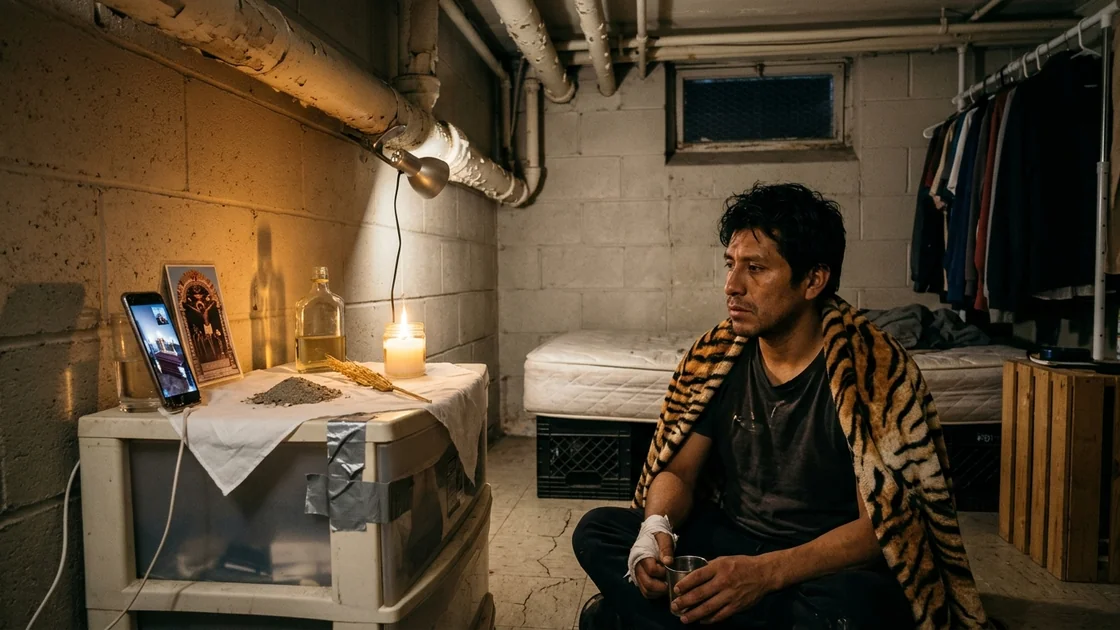
Mateo, an immigrant from a coastal village in Peru, lives in a suffocating basement apartment in a relentless northern city, working grueling shifts as a dishwasher to send money back to his family. When he receives the devastating news that his father has suddenly passed away, his already profound homesickness sharpens into an agonizing grief. Desperate to return home for the funeral, Mateo discovers that the cost of a last-minute flight is far beyond his meager savings, trapping him thousands of miles away from the people and the land he loves. Over the course of the forty-eight hours leading up to his father's burial, Mateo navigates the cold indifference of the city, the physical toll of his labor, and the crushing weight of his isolation, ultimately finding a way to honor his father's memory and conduct a solitary vigil from the concrete depths of his subterranean room.
Part I: The Concrete Hull
The pipes in the ceiling always knew when the building was waking up before Mateo did. At five-thirty in the morning, the cast-iron arteries running directly above his mattress would begin to shudder, knocking against the floorboards of the first-floor lobby with a rhythmic, metallic clatter. Then came the hiss of steam, a pressurized sigh that smelled faintly of rust and damp plaster, followed by the heavy rush of water as the tenants upstairs turned on their showers, flushed their toilets, and began their lives in the world of light.
Mateo lay on his back, staring at the main sewage line that bisected his ceiling. It was painted with six or seven layers of thick, glossy white paint that had yellowed over the decades, flaking in spots where condensation gathered and dripped. He kept an old coffee tin on the floor just beside his knee to catch the occasional drop, though the radiator had been working overtime since November, drying the air into a parched, breathable dust that made his throat ache every morning.
His apartment, if the superintendent could legally call it that on the hand-written receipts Mateo collected each month, was a twenty-by-twelve-foot rectangle carved out of the building’s foundation behind the boiler room. There was one window, a narrow hopper set high in the concrete wall, its glass reinforced with chicken wire and coated on the outside with a thick patina of street grime and salt spray from the snowplows. Through it, Mateo could see no sky—only the lower six inches of passing trousers, the splashed hems of winter coats, the treads of boots, and the occasional frantic paws of a dog being tugged along the icy concrete.
He reached out from beneath the heavy acrylic blanket—printed with the faded image of a roaring tiger he had bought from a thrift store three winters ago—and touched the wall beside his bed. The cinderblocks were always cold, holding the deep, subterranean frost of the northern earth.
In his mind, before the waking world fully claimed him, it was already warm. In his mind, the walls were not grey cinderblock, but adobe washed in faded blue lime, flaking under the salt breeze of the Pacific. He could hear the mar brava—the rough sea—striking the pebbled shelf below the cliffs of Huanchaco, a long, dragging roar that pulled the stones back down into the foam with a sound like a thousand castanets. He could smell the sharp, smoky tang of eucalyptus wood burning in his mother’s mud stove, mixed with the brine of drying kelp and the sweet, heavy rot of fallen figs in the courtyard.
Then a delivery truck hit a pothole on the avenue outside, the iron grate above the sidewalk rattled like a dropped skillet, and the Pacific vanished.
Mateo sat up, swinging his legs over the side of the mattress. The linoleum floor was freezing, its tiles cracked and curling at the edges like dried leaves. He slipped his feet into thick wool socks and then into his work boots, whose leather uppers were permanently stiffened and whitened by kitchen grease and road salt.
He stood five feet six inches tall, which was a mercy in the basement; a taller man would have had to duck beneath the water main every time he walked from the hotplate to the narrow stall that held the toilet and the rust-stained sink. He turned on the tap, letting the water run until it turned from brown to clear, and splashed his face. In the mirror—a square of silvered glass glued directly to the concrete—his face looked back at him under the buzzing hum of a single fluorescent tube. He was thirty-two, though the hollows beneath his eyes and the deep parentheses around his mouth belonged to someone older. His skin, once the color of toasted almonds from hours spent mending nets and hauling wooden caballitos de totora onto the sand, had faded to a sallow, underground olive, starved of ultraviolet light.
He boiled water in a small aluminum pot on the single burner, stirred in two spoonfuls of instant coffee and three of sugar, and stood by the radiator to drink it. He did not own a table. There was the mattress on its milk-crate frame, a plastic chest of drawers with one cracked corner repaired with silver duct tape, a wooden crate that served as a nightstand, and a tension rod wedged into the alcove beside the boiler wall where his two pairs of jeans, three black t-shirts, and one heavy winter parka hung.
His phone sat on the wooden crate, plugged into a frayed white cord. He picked it up, his thumb automatically swiping the screen.
There were three missed calls from his sister, Elena, and four messages on WhatsApp. They had come in at three-fifteen in the morning.
Mateo’s stomach dropped. A coldness, sharper and more ancient than the frost in the cinderblocks, bloomed behind his ribs. Nobody called from Peru at three in the morning unless the earth had shaken or someone had stopped breathing.
The tin cup of coffee trembled in his hand. He set it down on the top of the radiator, where it rattled faintly against the iron ribs, and tapped the green icon on his screen.
Mateo, wake up. Mateo please call me. It’s Papá. Mateo please.
His thumb was so dry and calloused from the industrial bleach at the restaurant that the screen didn't register his touch thefirst two times he tried to press the call button. He licked his thumb, wiped it on his jeans, and pressed again.
He held the phone to his ear. The international connection took a long time to bridge the four thousand miles between the basement and the coast. First came a hollow, digital silence, then a series of clicks, like small stones dropping into a well, and finally the long, low ringtone used in the south.
It rang once. Twice.
"Mateo?"
Elena’s voice was unrecognizable. It was stripped raw, scraped down to the bone by hours of weeping. Behind her, he could hear the distinct, cavernous echo of his parents' house—the high corrugated tin roof, the open courtyard—and beneath that, the low, rhythmic murmur of women praying the rosary. Santa María, Madre de Dios, ruega por nosotros, pecadores...
"Elena," Mateo said. His voice sounded small, swallowed immediately by the low ceiling and the hum of the boiler behind the wall. "Elena, what happened? Tell me."
"He’s gone, Mateo," she said, and the words dissolved into a jagged intake of breath. "He’s gone. Last night. Just before midnight."
Mateo’s knees lost their lock. He didn't fall, he simply slid down the face of the concrete wall until the base of his spine hit the cold linoleum, his boots splayed out in front of him on the cracked tiles. He pressed his free hand against his eyes, pushing hard until geometric bursts of yellow and violet bloomed in the dark behind his lids.
"How?" The word came out as a wheeze. "He was fine on Sunday. We talked on Sunday. He told me about the lemon tree. He said the blossoms were coming early."
"It was his heart," Elena sobbed. "The doctor at the clinic in Trujillo said it was massive. He didn't even make it to the hospital, Mateo. He was sitting in the courtyard, fixing the latch on the chicken coop, and he said he felt dizzy. He asked Mamá for a glass of warm water with anise. When she came back out from the kitchen, he had fallen sideways off the stool. His eyes were already open. He wasn't breathing."
Mateo looked at the coffee tin beside his boot. A single drop of water fell from the sewage pipe above, striking the tin with a loud, hollow plink.
He saw his father’s hands. That was the first thing that came to him—not his father’s face, with its deep sun-creases and the small mole beside his left nostril, but his hands. Thick, square hands with fingernails permanently split and darkened by tar and fish scales. Hands that smelled of kerosene and tobacco and the lime they used to cure adobe bricks. When Mateo had left three years ago, standing at the station in Trujillo while the bus to Lima idled in a cloud of black diesel smoke, his father had held him by the shoulders. Those hands had gripped him through his thin jacket with a terrifying strength, as if Don Julián were trying to press his own marrow through the cloth and into his son’s bones to keep him safe in the north.
"Don't stay too long in the cold, hijo," his father had said, his voice gruff to hide the wetness in his eyes. "The cold makes men forget where they came from. Make your money, build your roof, and come back to the sea."
"Mateo? Are you there?"
"I’m here," Mateo whispered. His chest felt as though the twenty stories of brick and mortar above him had finally given way, settling directly onto his sternum. He couldn't draw a full breath. The dusty, radiator-baked air refused to go past his throat. "How is Mamá?"
"She won't speak," Elena said, her voice dropping to a frantic whisper. "Tía Carmen is with her. They gave her some valerian root, and she’s just sitting on the edge of the bed, holding his good shirt. The white one you sent him for his birthday. We have to dress him soon, Mateo. The men from the parish are bringing the casket at noon. Because of the heat... the doctor said we cannot wait past tomorrow afternoon for the burial. The cemetery in Huanchaco is already digging the niche."
"Tomorrow?" Mateo repeated. The word felt foreign, like the English words he struggled to untangle when the restaurant manager shouted orders through the steam of the dish pit. "Tomorrow afternoon?"
"Can you come?" Elena asked. In her voice, beneath the ruin of her grief, there was a sudden, fragile flare of hope—the automatic trust of a younger sister who believed that the brother in America, the brother who sent the Western Union transfers every second Friday without fail, lived in a land where miracles were purchased at the corner store. "Is there a flight today? If you leave tonight, you can get to Lima by morning and take the first bus north. Or fly to Trujillo. Mamá keeps looking at the door, Mateo. She hasn't said your name, but I know she’s waiting for you to walk in."
Mateo looked at the plastic chest of drawers across the narrow room. In the top drawer, tucked inside an old wool sock behind his passport and his expired tourist visa—the piece of paper that had turned him into a ghost the day its ink ran out—was a roll of twenty-dollar bills.
He didn't need to count it. He counted it every Sunday night after he paid his rent and bought his rice, beans, and eggs for the week. There were nineteen twenties and one ten. Three hundred and ninety dollars. He had sent four hundred home just four days ago to pay for the new corrugated sheets for his mother’s kitchen roof before the coastal damp set in, and to cover the balance of his father’s blood pressure medication from the pharmacy.
"Mateo?"
"I’m going to look right now, Elena," he said, forcing a steadiness into his voice that made his jaw ache. "I’m going to look at the flights right now. I'll call you back in an hour. Put the phone by Mamá’s ear."
There was the sound of shuffling feet on packed earth, the creak of a wooden door, and the louder hum of the women praying in the main room.
"Mamá," Elena said softly. "It’s Mateo."
Silence filled the receiver. Not the digital silence of the satellite link, but the heavy, breathing silence of his mother. He could hear the faint wheeze in her lungs—the asthma she had carried since she was a girl—and the rustle of stiff cotton as she clutched his father's shirt.
"Mamá," Mateo said. The Spanish words felt thick on his tongue, salted with the tears that were finally spilling over his lower lashes and running down into the stubble on his cheeks. "Mamá, estoy aquí. Te quiero mucho, Mamá. Papá ya está descansando." I am here. I love you so much. Papa is resting now.
His mother didn't use words. She let out a single, low sound—a keening moan that seemed to rise not from her throat, but from the earth beneath the house, the sound of an animal that had lost half of its body in a trap.
Then the line went dead, or Elena took the phone away; Mateo couldn't tell through the roaring in his own ears.
He sat on the cold linoleum for a long time. Above him, the seven o'clock rush began. Footsteps drummed across the lobby floor—sharp heels, heavy boots, the roll of a suitcase. The world was going to work.
Mateo wiped his face with the sleeve of his sweatshirt, crawled on his hands and knees to his mattress, and opened the web browser on his phone.
Part II: The Arithmetic of Exile
The screen of the phone was cracked across the bottom left corner, a spiderweb of glass held together by a piece of clear packing tape. Through this fractured lens, Mateo typed the three-letter codes that had haunted his daydreams for thirty-six months: JFK to TRU. New York to Trujillo.
The little wheel on the screen spun. The basement had terrible reception; the thick foundation walls blocked the cell towers, so he had to stand up and hold the phone near the hopper window, his arm raised like a man holding a lantern in a cave, while the blue light of the screen illuminated the cobwebs in the corners of the concrete recess.
The numbers loaded.
Mateo stared at them. He blinked, wiped the screen on his chest, and looked again.
For a flight leaving that evening—connecting through Bogotá and Lima, arriving in Trujillo at 11:40 the next morning, just four hours before they would slide his father’s pine box into the whitewashed concrete wall of the cemetery by the sea—the price was $1,840.
One thousand, eight hundred and forty dollars.
He tried another airline. $2,110.
He tried flying only to Lima, thinking he could take the nine-hour bus ride north along the Pan-American Highway, though that would mean he would miss the burial and arrive only in time to see the fresh plaster drying over his father’s name. Even to Lima, leaving today, the cheapest seat on a budget carrier with two layovers in Central America was $1,350.
Mateo lowered his arm. The math was simple, brutal, and absolute. He had $390 in the sock. He had $42.18 on his prepaid debit card. It was Wednesday; the restaurant paid in cash on Sunday nights for the previous week’s work. He had worked Monday and Tuesday—twenty-two hours at twelve dollars an hour, off the books, paid in a small brown envelope by Mr. Costa at the back door by the grease traps. That was another two hundred and sixty-four dollars that he hadn't even touched yet.
All together, if he emptied his life down to the last copper penny, he had just under seven hundred dollars.
And there was the other math—the math that wasn't measured in dollars, but in years and borders.
Even if a bag of money fell through the iron grate on the sidewalk above him right now, even if he walked into Kennedy Airport with two thousand dollars cash in his fist and bought the ticket, the moment the plane lifted off the tarmac and crossed the Atlantic coast heading south, the door behind him would slam shut forever. Without papers, a departure was a ten-year ban. If he went home to bury his father, he would never get back into the north. And if he didn't come back, who would pay for the loan his family had taken out to fix his uncle’s fishing boat two years ago? Who would pay for his mother’s inhalers, the electricity bill in Trujillo, the tuition for Elena’s nursing classes at the technical institute?
His father had been the one who managed the small plot of land behind the house and sold the occasional basket of sea bass at the market when his legs allowed it. Without Don Julián, Mateo was no longer just the son who sent help from abroad; he was the sole pillar holding up the tin roof in Huanchaco. If he went home to carry his father’s coffin for three hundred yards down the dusty road to the cemetery, they would all starve together in the sun afterward.
He looked at his reflection in the glued mirror.
You are a prisoner, he thought. The realization didn't come with anger, only with a vast, hollow nausea. He had paid a coyote six thousand dollars three years ago to help him walk across a desert and ride in the back of a refrigerated produce truck so that he could live in a concrete hole beneath a radiator pipe, scrub burnt marinara sauce off stainless steel pans for seventy hours a week, and not even have the right to kiss his father’s cold forehead before they sealed him in the dark.
The clock on his phone read 6:45 AM.
His shift at La Trattoria di Marco started at eight. If he was late, Mr. Costa would dock him half an hour’s pay and give the Sunday overtime shift to Rodrigo, the kid from Honduras who lived in Queens and was always looking for extra hours.
Mateo went to the plastic dresser. He opened the top drawer, took out the wool sock, and held the roll of twenties in his hand. The paper felt soft, greasy with the residue of a thousand strangers' hands. He put it back.
He pulled on his heavy parka, wrapped a scratchy acrylic scarf around his neck, and stepped out of his room into the boiler corridor. The heat here was oppressive, smelling of scorched dust and fuel oil. The giant furnace rumbled like a sleeping beast, its gauges trembling in the dim light of a caged bulb. Mateo climbed the narrow iron stairs at the back of the building, pushed open the heavy metal fire door, and stepped out into the alley.
The winter hit him like a slap in the face.
It wasn't snowing, which was worse; when it snowed, the city had a certain quiet softness to it. Today, the sky was the color of an old zinc bucket, low and flat and hard, and the wind coming off the river carried microscopic needles of ice that found every gap in his clothing. The alley was lined with black plastic bags of garbage frozen solid overnight, stacked like barricades beside the dented aluminum cans.
Mateo turned his collar up, shoved his hands deep into his pockets, and walked toward the subway station six blocks away.
As he walked along the avenue, the city rose around him—five-story walk-ups of soot-darkened brick, dry cleaners venting clouds of chemical steam into the freezing air, bodegas with their neon signs buzzing COFFEE - LOTTO - ATM against the grey morning. People hurried past him, their faces tucked into their scarves, puffs of white breath trailing behind them like small, vanishing ghosts.
Nobody looked at him. That was the first thing you learned when you came here without the language and without the height or the clothes of the people who owned the streets: you became part of the infrastructure. You were like the fire hydrants, the scaffolding poles, the steam grates. People stepped around you without their eyes ever registering your face.
Normally, Mateo preferred it that way. Invisibility was safety. If nobody saw you, nobody asked you for a card you didn't have; nobody asked you why you were here.
Today, the invisibility felt like an erasure. He wanted to stop the woman in the long camel-hair coat who was waiting for the light at the crosswalk, holding a plastic cup of iced coffee despite the freezing wind, and say to her in his broken, kitchen-learned English: My father died six hours ago. He knew how to read the tides by looking at the color of the foam on the rocks. When I was seven, he carried me four miles on his back when a stingray barbed my ankle in the shallows, and he sang old vals songs the whole way so I wouldn't cry.
The light turned white. The woman stepped off the curb without glancing sideways, her heels clicking sharply against the asphalt.
Mateo followed her across the street and descended the concrete steps into the subway.
Down on the platform, the air smelled of brake dust, stale urine, and roasted nuts from the vendor’s cart near the turnstiles. He stood near the yellow line at the edge of the tracks, looking down into the black trough where the rats scurried between the wooden ties. The third rail gleamed dimly in the gloom—dirty steel carrying six hundred volts of current.
A train roared out of the tunnel, pushing a wall of warm, metallic wind ahead of it. The silver cars screeched to a halt. The doors slid open.
Mateo stepped inside, grabbed the cold stainless-steel pole with a bare hand, and closed his eyes as the train lurched forward into the dark. In the rhythmic clack-clack, clack-clack of the wheels over the joints in the track, he heard the rosary again: Ruega por nosotros, pecadores, ahora y en la hora de nuestra muerte. Amén.
Part III: The Steam Pit
The kitchen of La Trattoria di Marco was also in a basement, though it was larger and brighter than Mateo’s apartment. It was a long, narrow galley tiled in white squares that had cracked and been grouted over with grey cement a hundred times. Along one side ran the line—sixteen gas burners roaring blue and orange under heavy aluminum sauté pans, two deep fryers bubbling with golden oil, and a massive steel salamander broiler that radiated a fierce, desert heat. Along the other side, tucked into an L-shaped alcove next to the walk-in refrigerators and the service stairs, was Mateo’s domain: the pit.
It consisted of a three-compartment stainless steel sink, a high-pressure pre-rinse sprayer dangling from a coiled spring like a metallic cobra, and a Hobart commercial conveyor dishwasher that hissed, clanked, and belched clouds of chemical-scented steam at ninety-second intervals for fourteen hours a day.
When Mateo came down the back stairs at 7:52 AM, Mr. Costa was sitting on an overturned five-gallon pickle bucket near the dry storage shelves, checking off an invoice on a clipboard while the delivery guy from the restaurant depot wheeled in stacks of canned San Marzano tomatoes and fifty-pound sacks of flour.
Mr. Costa wasn't Italian; he was from somewhere in the Balkans, a thick-necked man in his fifties with a shaved head, gold-rimmed glasses, and a permanent scowl etched into his forehead by twenty years of managing thin margins and temperamental line cooks.
"Morning, Mateo," Mr. Costa grunted without looking up from his clipboard. "Prep didn't wash the stockpots from the midnight reduction last night. They're soaking by the grease trap. Get those knocked out before the lunch prep starts at nine, or Hector’s gonna have an aneurysm."
Mateo stopped two steps from the bottom of the stairs. His hands were still in the pockets of his parka. His throat felt as if it were lined with crushed glass.
"Boss," Mateo said.
The word came out so strange and hollow that Mr. Costa actually paused his pen and looked up over the rims of his glasses.
"What's the matter with you? You got the flu? Don't tell me you got the flu, Mateo, it’s Wednesday, we got two private parties booked in the mezzanine tonight."
"My father," Mateo said. He had to search for the English words, pulling them up like heavy nets from a dark sea. "In Peru. Last night... he die."
The delivery guy paused with his handtruck tilted back, looking sideways at Mateo before dropping his eyes to his boots and wheeling the flour into the back room. The kitchen was relatively quiet at this hour—only the hum of the walk-in compressors and the low roar of the pilot lights—so the words hung in the grease-thick air between them.
Mr. Costa lowered the clipboard to his knee. The scowl didn't leave his face—it was too deeply carved into his skin for that—but something behind his small, grey eyes shifted slightly, softening for the span of two heartbeats. He sighed through his nose and rubbed the back of his thick neck with his free hand.
"Ah, Christ," Mr. Costa said quietly. "Your old man? How old was he?"
"Sixty-four," Mateo said.
"Sixty-four. Jesus, that’s nothing. That’s ten years older than me." Mr. Costa looked down at the concrete floor, where flattened cardboard boxes were laid out to catch the grease tracks. "I’m sorry, Mateo. Really. When’s the funeral?"
"Tomorrow," Mateo said. "Four o'clock."
Mr. Costa’s eyes narrowed slightly, the manager’s brain automatically calculating schedules, coverage, and replacements even in the presence of death. "You going back? Because if you leave the country, kid..." He didn't finish the sentence; everyone in the restaurant industry knew the status of the guys in the back of the house.
"No ticket," Mateo said, shaking his head once. The movement made his temples throb. "Too much money. One thousand eight hundred."
"Yeah, the airlines rob you blind if you don't book a month out," Mr. Costa muttered. He looked at Mateo’s pale face, the dark bruises under his eyes. "You want to go home today? I can call Rodrigo to come in by noon. Hector and Luis can rinse their own pans through the morning prep."
Mateo thought of his basement room. He thought of the six-by-twelve patch of cracked linoleum, the buzzing fluorescent tube, the sewage pipe dripping plink, plink, plink into the Maxwell House tin. If he went back to that room now, while the sun was climbing over the coastal desert in Peru, while his mother sat on the edge of the bed holding a white shirt and the men from the parish carried a wooden box across the courtyard where the lemon tree was blooming... if he sat in that room alone for twelve hours with nothing to do but stare at the cinderblocks, he knew with a cold certainty that he would lose his mind. And he would lose a day’s pay—one hundred and twenty dollars that his mother was going to need to pay the parish priest and the men who dug the niche.
"No, boss," Mateo said, his voice barely above a whisper. "I work. Better I work."
"You could borrow it, maybe?" Mr. Costa said, though his voice lacked conviction. "Wait... how much can I advance you?"
"Boss?" Mateo’s heart gave a violent, painful thud against his ribs.
Mr. Costa stood up from the pickle bucket, his knees popping. He reached into the back pocket of his slacks and pulled out a thick leather wallet held together by a rubber band. "I can't give you eighteen hundred bucks, Mateo. The owner would skin me alive, and frankly, if you get on that plane, I never see you or the money again. That's just business, nothing personal. You're the best guy I ever had on the Hobart, and I don't want to lose you anyway."
He opened the wallet and thumbed through a wad of bills. He pulled out three hundreds—the crisp, blue-tinted ones—and held them out.
"That's Monday and Tuesday's pay, rounded up by forty bucks from my own pocket," Mr. Costa said, pressing the bills into Mateo’s cold hand. "Send it to your mother for the flowers or whatever they do down there. Do the morning prep, get me through the lunch rush until three, and then get the hell out of here for the night. I'll pay you for the full twelve hours today. Okay?"
Mateo looked down at the three hundred-dollar bills in his palm. Benjamins, the line cooks called them. Three pictures of an old man with long hair and a tight, knowing mouth. Three hundred dollars wasn't a plane ticket. It wasn't the smell of the Pacific or the weight of his father's coffin on his shoulder. It was just paper.
Still, in a city where every breath of air seemed to have a meter attached to it, forty dollars and four paid hours off was the closest thing to mercy the basement had to offer.
"Thank you, boss," Mateo said. He folded the bills carefully and slid them into the front pocket of his jeans, pinning them there with a safety pin he kept attached to the denim lining—an old habit from the crowded buses in Lima.
"Go put your apron on," Mr. Costa said, already turning back to his clipboard, the two-minute window of human tragedy officially closed as the kitchen clock clicked to 8:00 AM. "And watch the drain in the middle sink, Hector dumped a whole hotel pan of risotto down there last night and it’s backing up."
Mateo hung his parka on a nail behind the ice machine, tied a heavy black rubber apron around his waist and neck, and pulled on a pair of elbow-length green nitrile gloves.
He stepped into the pit.
The three stockpots waiting by the grease trap were forty-quart aluminum cylinders, each one encrusted with a two-inch ring of blackened beef bones, scorched mirepoix, and gelatinous fat from the veal stock that had simmered all night. Mateo hoisted the first one—it weighed thirty pounds empty—and wrestled it into the left-hand sink. He turned on the hot tap.
The water in the restaurant was kept at one hundred and forty degrees to melt grease. Within minutes, the alcove was filled with a thick, grey fog that smelled of boiled marrow and wet iron. Mateo picked up a ball of coarse stainless-steel wool—the kind that tore through rubber gloves in three days and left tiny, festering splinters of metal in the calluses of your palms—and leaned his torso over the rim of the pot.
Scritch-scratch. Scritch-scratch. Scritch-scratch.
He put all his weight into his right shoulder, driving the steel wool in tight, violent circles against the scorched aluminum.
When Mateo was ten years old, his father had decided to teach him how to make a caballito de totora—the traditional reed boats that the fishermen of Huanchaco had ridden through the surf for three thousand years, long before the Spanish came with their iron and their crosses.
They had walked together down to the wachaques, the sunken freshwater marshes dug into the sand behind the beach where the giant totora reeds grew taller than a man’s head. His father had carried a short, curved machete with a handle wrapped in braided leather.
"Watch the base, Mateo," Don Julián had said, crouching in the warm, black mud at the edge of the water. The sun had been blinding that day, reflecting off the brackish water and turning the green reeds into blades of emerald light. "You don't chop at it like you're angry at the earth. You slide the blade under the water, right where the white root meets the green stalk, and you pull toward your heart. One clean cut. If you bruise the reed, the water gets inside when you're a mile off the beach, and the boat grows heavy and drags you down."
Mateo had tried it, his small hands slipping on the wet leather handle, hacking clumsily at the tough fibers until his father knelt behind him, wrapping his big, tar-stained hand around Mateo’s fist. Together they had drawn the blade back. Shhhk. The reed had parted with a sound like tearing silk, rising buoyantly from the mud.
For two weeks afterward, the reeds had lain in the courtyard of their house to dry in the sun, turning from bright green to the color of pale gold, filling the whole neighborhood with a sweet, grassy scent like dry hay and river water. And then, sitting in the shade of the overhang during the hot afternoons, his father had shown him how to bind them with nylon cord, pulling the knots tight with a wooden peg, shaping the high, curved prow that looked like the neck of a swan or the horn of a bull.
"A man who can build his own boat is never poor, Mateo," his father had told him, spitting a shred of tobacco leaf onto the dirt and squinting down the hill toward the blue line of the ocean. "The land belongs to the politicians and the rich men in Trujillo. They put fences on it. They ask for papers. Only God owns the sea, and God doesn't ask to see your identity card when you drop a line in the water."
"Behind! Hot behind!"
Hector, the morning prep cook, slammed a stack of six half-sheet pans onto the stainless-steel landing table beside Mateo’s elbow. The pans clattered like a gunshot, making Mateo flinch and bang his knuckles against the rim of the stockpot.
"Wake up, peruano!" Hector shouted in Spanish over the roar of the exhaust hoods. Hector was from Puebla, a short, barrel-chested man who listened to cumbia music on a grease-splattered Bluetooth speaker turned up to maximum volume and treated every morning prep shift like a knife fight. "I need those sheet pans back in five minutes for the bacon! Move your ass!"
Mateo didn't answer. He couldn't. If he opened his mouth, the sound that his mother had made on the phone—that low, animal keening from the floor of the earth—would come pouring out of him right here between the ice machine and the Hobart.
He grabbed the sheet pans, slid them into the plastic pegs of the dishwasher rack, pulled down the heavy steel hood of the machine, and hit the green start button.
The Hobart roared to life, its internal pumps thrashing water at a hundred and eighty degrees against the steel walls. Steam billowed out from the rubber curtains at either end of the machine, wrapping Mateo’s head in a wet, suffocating cloud that smelled of chlorine sanitizer and burnt pork fat.
He looked at his watch through the condensation on the plastic crystal. It was 9:15 AM in New York.
Because Peru didn't change its clocks for the winter, it was 9:15 AM in Huanchaco too.
Right now, the sun would be high enough to clear the dusty brown hills of the Andes foothills to the east, pouring a flat, white heat across the desert and the corrugated roofs of the town. In his mother’s house, Tía Carmen and the neighbor women would be in the kitchen, boiling huge pots of water with cinnamon and cloves, or making caldo de gallina in the big aluminum kettle for the people who would come to sit with the body through the day.
And in the main room—the room where the floor was poured cement painted red and polished with kerosene until it shone—they would have moved the small wooden dining table against the wall to make space in the center.
His father would be lying on the bed now while his uncle Andrés and his cousin Beto washed him.
That was Mateo’s job. He was the eldest son. It was supposed to be his hands that took the warm cloth and wiped the sweat of death from his father’s chest—the narrow, barrel chest with the old white scar across the ribs where a wooden oar had snapped in the surf back in eighty-nine. It was supposed to be Mateo who shaved his father’s chin with the little plastic razor, being careful around the mole by his nostril. It was supposed to be Mateo who buttoned the stiff collar of the white shirt—the shirt from the Marshall’s on 14th Street that Mateo had bought on clearance for twelve dollars and ninety-nine cents and mailed in a padded envelope six months ago—and pulled the good black trousers up over those thin, knotted calves that had spent fifty years bracing against the pitch and roll of the Pacific.
Instead, Mateo was scraping congealed Alfredo sauce out of a porcelain pasta bowl with a rubber spatula, his boots standing in half an inch of grey, sudsy water that refused to go down the clogged floor drain.
The lunch rush began at eleven-thirty and didn't let up until two-fifteen.
In the financial district or midtown, Wednesday was the busiest day of the week. The dining room upstairs filled with people in wool suits and silk blouses eating thirty-two-dollar plates of linguine alle vongole and forty-five-dollar veal piccata.
Down in the basement, the dumbwaiter bell rang every forty seconds. Ding. Ding. Ding.
The busboys—two kids from Ecuador who had only been in the country for four months and spoke even less English than Mateo—pulled the plastic bus tubs out of the dumbwaiter and dumped them onto the landing table. It was an avalanche of dirty porcelain, silverware crusted with egg yolk and parmesan, wine glasses smudged with lipstick and fingerprints, and copper-bottomed sauté pans coming off the line so hot that when Mateo hit them with the pre-rinse sprayer, they shrieked like dying birds and sent geysers of boiling steam straight into his face.
Mateo moved like an automaton.
Scrape. Rack. Spray. Slide. Pull the lever. Wait ninety seconds while scrubbing two sauté pans by hand in the middle sink. Lift the lever. Pull the steaming rack out the clean side. Let it flash-dry for thirty seconds while loading the next rack. Sort the burning-hot plates into stacks of ten—dinner plates, salad plates, pasta bowls, bread saucers—and carry them twenty feet down the narrow, greasy floor behind the cooks' backs, shouting "Platos! Caliente atrás!" so nobody spun around with a ten-inch chef’s knife and opened his ribs.
By one o'clock, the front of his black t-shirt beneath the rubber apron was soaked through with sweat, while his back felt clammy and chilled whenever the back door opened to let the garbage man out. His lower back—the L4 and L5 vertebrae that had been aching since his second year in the pit—throbbed with a dull, toothache rhythm that radiated down the back of his left thigh.
At 1:40 PM, a busboy dropped a rack of twenty burgundy wine glasses on the corner of the stainless-steel table. Three of them shattered.
"Leave it, I got it," Mateo told the kid in Spanish, waving him back toward the dumbwaiter. The kid looked terrified; Mr. Costa charged the busboys five dollars a glass out of their tips if he saw them break stemware.
Mateo pulled off one of his thick rubber gloves to pick the smaller shards of crystal out of the drain trap where the sprayer couldn't reach. His fingers were pruned white, the skin wrinkled and soft as boiled dough from five hours inside the wet nitrile. As he reached into the murky, lukewarm water at the bottom of the sink screen, a triangular shard of glass he hadn't seen slid neatly into the meat of his right thumb, just below the knuckle.
He didn't feel the pain at first, only a sharp, sudden tug, as if his skin had caught on a fishhook.
He pulled his hand out. For two seconds, the cut was a clean white line in the pale, water-logged skin. Then the blood welled up—dark, bright crimson—and spilled over the side of his palm, dripping into the grey water of the sink and swirling away like ribbons of red silk.
Mateo stood perfectly still, holding his right wrist with his left hand, watching himself bleed into the dirty dishwater of a stranger’s country.
"Shit, Mateo, you cut yourself?" Luis, the grill cook, glanced over his shoulder while flipping a strip steak on the charbroiler. "There’s Superglue and duct tape in the yellow box by the office. Wrap it up before Costa sees you bleeding in the sink."
Mateo walked over to the hand-washing station, turned on the cold water, and held his thumb under the stream. It stung fiercely now, a bright, clean pain that cut through the fog in his head.
He remembered the stingray in the shallows of Huanchaco when he was seven. How the water around his small brown ankle had turned pink in the white foam. How his father had come running down the beach, dropping his net on the wet sand, scooping Mateo up against his chest—his chest that smelled of sun-baked skin and salt and strong black tobacco—and how his father had pressed his own thumb hard against the wound to stop the bleeding while he carried him up the cliff path toward the clinic.
"Look at the pelicans, Mateo," his father had said, pointing with his chin toward a line of six giant birds gliding inches above the crest of an incoming wave. "Don't look at the blood, look at the birds. See how they fly without moving their wings? They let the wind do the work. Hold on to my neck, hijo. I’ve got you."
Mateo leaned his forehead against the cold stainless steel of the paper towel dispenser beside the sink. His shoulders began to shake.
The roar of the Hobart, the sizzle of the deep fryers, and the bass line of Hector’s cumbia music drowned out the sound he made, so none of the cooks looked over. He cried for two minutes with his forehead pressed against the metal, his blood washing down the drain with the soap scum, until the shaking stopped and there was nothing left behind his eyes but a dry, burning heat.
He dried his hand on a brown paper towel, wrapped the thumb tightly in three layers of blue waterproof band-aids and a strip of electrical tape from the maintenance drawer, pulled the green rubber glove back over his hand, and went back to the pit.
He didn't leave at three o'clock until every pan was stacked, every floor mat was hosed down in the alley, and the stainless-steel tables were wiped clean with bleach water. It was the only way he knew how to be his father’s son: you did not leave the boat until the nets were mended and stowed.
Part IV: The Western Union on 149th
When Mateo stepped out of the alley at three-fifteen, the afternoon light was already beginning to fail. In December, the sun in this city never really climbed the sky; it just dragged itself along the southern horizon behind a curtain of grey slush-clouds and then dropped behind the rivers before four o'clock, leaving the streets in a long, purple twilight.
His hair was damp with sweat beneath his wool knit cap, and the wind froze it against his temples within half a block. His cut thumb throbbed in time with his pulse inside his pocket, where his hand was clutched around the roll of cash—the three hundred from Mr. Costa and the three hundred and ninety he had gone back to his basement to retrieve before walking up to the avenue.
He walked north for twelve blocks until the brick facades grew more battered, the fire escapes rusted to the color of dried blood, and the signs in the shop windows changed from English to Spanish. Envíos de Dinero. Paquetería a Centro y Sudamérica. Recargas Claro y Movistar.
He pushed open the glass door of a small check-cashing and wire-transfer storefront wedged between a Botanica selling statues of Saint Lazarus and a laundromat.
Inside, the air was stiflingly hot and smelled of wet wool coats, floor wax, and the fried plantains the woman behind the bulletproof plexiglass was eating out of a styrofoam container. A radiator hissed violently in the corner. There were six men and two women standing in line on the black rubber runner that led to the window.
Mateo took his place at the back of the line.
He looked at the backs of the men ahead of him. They were all versions of himself, or versions of what he would become in ten years if the basement didn't kill him first. Men with paint-splattered Timberland boots and Carhartt jackets stiff with drywall dust; men with the rounded shoulders of garment pressers or the chemical-burned knuckles of car wash attendants. They stood in silence, their eyes fixed on the faded posters taped to the yellow walls—posters showing smiling families in Guatemala, Ecuador, the Dominican Republic, and Peru, sitting around tables piled high with food that had been bought with the small, rectangular yellow slips of paper dispensed from behind the thick glass.
Every man in this line was a ghost in two places at once. Here, they were bodies without names—muscle and bone rented by the hour to build scaffolding, wash dishes, and shovel snow. There, four thousand miles south, they were names without bodies—voices on WhatsApp, signatures on money orders, photographs propped up next to candles on their mothers' dressers.
The line shuffled forward.
Mateo’s phone vibrated in his pocket. He pulled it out with his left hand.
Elena had sent a photo.
Mateo stared at the four-inch screen, his breath catching in his throat.
It was a picture taken inside the main room of their house in Huanchaco. The wooden casket was there, set on two iron sawhorses lent by the parish. It wasn't the cheap pine box Mateo had feared; it was dark, polished mahogany—or wood stained to look like mahogany—with silver-painted handles along the sides and a small glass window built into the upper half of the lid. Around the casket stood four tall silver candlesticks holding thick yellow wax tapers, their flames appearing as blurry white halos in the dim light of the room. Wreaths of white gladiolus and purple carnations leaned against the walls, their paper ribbons printed with gold letters: Recuerdo de tus hermanos, La Hermandad de Pescadores de Huanchaco.
And through the small square of glass in the lid of the casket, Mateo could see the side of his father’s face.
Don Julián looked smaller than Mateo remembered. The skin over his cheekbones was pulled tight, the color of old ivory under the yellowish glow of the candles. His eyes were closed, his thick black-and-silver mustache neatly trimmed above a mouth that looked strangely stern, as if he were concentrating hard on a horizon no one else could see. He was wearing the white shirt from 14th Street. Mateo could see the little blue stitched logo on the edge of the pocket just below the glass frame.
Sitting on a plastic chair beside the head of the coffin, her forehead resting directly against the dark wood, was his mother. She was wrapped in her black wool shawl, her small back curved like a crescent moon.
Beneath the photo, Elena had written: Estamos rezando el rosario de las cuatro. Todos preguntan por ti. Te mandamos un abrazo fuerte, hermano. (We are praying the four o'clock rosary. Everyone asks for you. We send you a strong hug, brother.)
"Next! ¡Siguiente!"
The woman behind the bulletproof glass rapped her acrylic fingernails against the metal tray beneath the window.
Mateo blinked hard, shoved the phone back into his coat pocket, and stepped up to the glass.
"Buenas tardes," Mateo said, his voice cracking.
"Buenas," the woman said without looking at him, chewing a piece of sweet plantain and wiping her fingers on a napkin. "Sending or paying a bill?"
"Sending. To Peru. Trujillo."
"ID and phone number."
Mateo slid his Peruvian consular card through the curved steel trough under the glass and recited his number. The woman’s fingers flew across her keyboard with a loud clacking sound.
"Receiver is Elena Quispe Rojas?"
"Sí."
"How much?"
Mateo unpinned his pocket with his left hand, his bandaged right thumb sticking out stiffly, and pulled out the roll of bills. He kept fifty dollars back—thirty for groceries to get him through until Sunday night, twenty on his MetroCard so he could get to the restaurant and back—and pushed the rest through the trough. Six hundred and forty dollars.
The woman counted the bills with practiced, snapping movements of her wrists: shuck, shuck, shuck, shuck.
"With the fee, it comes to six hundred and twenty-two dollars even going down there," she said, her eyes flicking up for the first time to register Mateo’s face—the gray pallor of his skin, the red-rimmed eyes, the fresh blood that had soaked through the blue band-aid and the edge of the electrical tape on his thumb.
Her hands paused on the keyboard for a fraction of a second. In this neighborhood, everyone knew what an emergency mid-week transfer of six hundred dollars in crumpled twenties and crisp hundreds meant. It meant a hospital bed, a coyote’s ransom, or a hole in the ground.
"Sign on the screen with the pen," she said, her voice dropping half an octave, losing its sharp edge.
Mateo picked up the plastic stylus attached to a coiled wire with his left hand and scrawled a shaky, backwards M on the electronic pad.
The printer beside the woman’s elbow whirred and spat out a long yellow receipt. She folded it neatly, slid it under the glass with his consular card, and looked him in the eye.
"Que Dios te bendiga, primo," she said softly. May God bless you, cousin.
Mateo nodded, unable to speak, took the yellow paper, and walked back out into the freezing purple dusk.
He stood on the sidewalk outside the Botanica, took a picture of the receipt showing the ten-digit control number with his phone, and sent it to Elena.
For the casket and the cemetery and whatever Mamá needs, he typed with one thumb. Tell the priest to say a Mass for him on Sunday too. Tell Mamá I am with her.
He stood there under the buzzing neon sign of the laundromat until the two little grey checkmarks beside the message turned blue, indicating that four thousand miles away, in a warm room smelling of candle wax and white gladiolus, his sister had seen it.
Then he turned south and began the long walk back toward his basement, because he didn't want to spend two dollars and ninety cents on the subway when his feet still worked.
Part V: The Vigil in the Hold
By the time Mateo unlocked the iron gate beneath the front stoop of his building and descended into the boiler corridor, it was past seven o'clock at night.
The walk down from 149th Street had taken him nearly two hours. The cold had soaked all the way through his jeans and his parka, settling into the marrow of his shinbones and his hips until his legs felt like two columns of cast iron swinging from a rusted hinge.
Inside his room, the heat from the radiator and the sewage pipe had turned the air thick and stagnant. He didn't turn on the overhead fluorescent tube; he couldn't bear the harsh, surgical buzz of it tonight. Instead, he plugged in a small clip-on lamp with a forty-watt yellow bulb that was attached to the milk crate beside his mattress. It cast long, distorted shadows across the cinderblock walls, making the narrow room look like the timbered hull of an old ship riding deep beneath the waterline.
He took off his boots. When he peeled off his wool socks, his feet were white and cold, the heels cracked from standing in wet boots all day. He took off his parka and his sweatshirt, sitting on the edge of the mattress in his faded undershirt.
His thumb was throbbing fiercely now. He unwrapped the electrical tape and the wet, blood-soaked band-aid. The cut was about half an inch long and fairly deep, the edges gaping slightly and white from the moisture, though the bleeding had slowed to a dark ooze. He went to the rust-stained sink, washed it again with a bar of cheap hand soap that made him hiss through his teeth, dried it on a clean t-shirt from his rod, and bound it tightly with strips torn from a clean white handkerchief his mother had packed in his backpack three years ago.
He was hungry—he hadn't eaten anything since a piece of cold focaccia bread Hector had thrown him at ten in the morning—but the thought of boiling rice or frying an egg on the hotplate made his stomach turn over.
Instead, he reached under his mattress, behind the milk crates where the floor met the foundation wall, and pulled out a brown paper bag.
Inside the bag were the only things in this country that belonged to Mateo Quispe Rojas and not to the dishwasher who lived in the basement.
There was a small plastic zip-lock bag containing about two ounces of dry, gray-brown sand from the beach at Huanchaco, mixed with tiny, broken fragments of purple mussel shells. There was a three-inch piece of dried totora reed, golden and brittle as old parchment, that had broken off his father’s boat the morning Mateo left. There was a small laminated card of El Señor de los Milagros—the Lord of Miracles, painted by an enslaved Angolan man on an adobe wall in Lima centuries ago, which had survived every earthquake that leveled the city—with a prayer printed on the back that was nearly worn away by his thumb. And there was a flat, half-pint glass bottle of Pisco Acholado that his cousin had sent up with a friend from Queens a year ago, which Mateo had been saving for the day he finally got his papers or the day he went home.
Mateo cleared the top of the plastic chest of drawers. He wiped the dust off the plastic with the palm of his hand and spread his second clean white handkerchief over it like an altar cloth.
In the center of the handkerchief, he propped up the laminated card of the dark Christ on the cross against the wall. Beside it, he placed the piece of totora reed and poured a small mound of the Peruvian sand onto the white cotton. Then he reached into the bottom drawer, where he kept matches and emergency candles for when the city’s power grid failed in the summer storms, and took out a stubby white tallow candle in a small glass jar.
He struck a match. The sulfur flared bright orange and sharp in the heavy air of the room. He touched the flame to the blackened wick.
The candle caught, sputtered for a second, and then rose into a steady, golden teardrop of light that reflected in the glued mirror on the wall and gleamed off the glass bottle of pisco.
Mateo pulled his phone over to the makeshift altar, plugged it into the charger so it wouldn't die during the night, and leaned it against the water glass beside the candle. He opened the photo Elena had sent him—the photo of the mahogany casket and his father’s profile behind the little square of glass—and adjusted the phone’s settings so the screen would never go dark.
In Peru, this was the night of the velorio—the wake.
Right now, at eight o'clock in the evening, the courtyard and the main room of the house in Huanchaco would be full. The old fishermen who had grown up with Don Julián—Don Segundo with his missing index finger, Don Pancho who could still haul a hundred-pound net at seventy—would be sitting on wooden benches along the adobe wall outside, wearing their Sunday shirts with the collars unbuttoned in the warm night air. They would be passing around a bottle of pisco or cañazo and a single small glass, pouring a few drops onto the packed earth for the dead man before drinking the rest in one swallow, their faces twisting at the burn before they wiped their mouths on the backs of their hands and went back to talking in low, gravelly voices about the great El Niño of eighty-three or the time Julián caught a seventy-pound corvina off the point at Cerro Campana.
Inside, the women would be drinking hot coffee and anise tea, eating small bread rolls stuffed with cheese, their voices rising and falling like the tide as they started another decade of the rosary every hour on the hour. And the children of the neighborhood would be chasing each other around the lemon tree in the dark until someone hushed them, too young to understand that when a man goes into the wooden box, the sea never gives him back.
Mateo sat down on the floor in front of the plastic dresser, crossing his legs on the cold linoleum so his eyes were level with the candle flame and the glowing screen of his phone.
He unscrewed the metal cap of the pisco bottle. The smell rose immediately into the small room—sharp, clear, fragrant with sun-ripened Quebranta grapes distilled in copper pots in the valleys of Ica. It was the smell of every baptism, every wedding, every fiesta of San Pedro, and every funeral Mateo had ever known.
He poured an inch of the clear liquor into his tin coffee cup, which he had rinsed out in the sink.
Before he lifted it to his lips, he dipped his left index finger into the cup and flicked three drops of the pisco onto the little mound of gray sand on the handkerchief. The dry sand drank the liquor instantly, turning the dark color of wet slate, releasing a faint, phantom scent of salt and dry earth that existed more in Mateo’s memory than in the air.
"Salud, Papá," Mateo whispered to the silent room.
He threw the pisco back. It hit the back of his throat like liquid fire and spread a sudden, fierce warmth through his empty stomach, radiating outward into his chest and up into his sinuses.
Above his head, someone on the first floor walked across the lobby—thump, thump, thump, thump—and the front door of the building clicked shut. Behind the cinderblock wall at his back, the giant boiler cycled on with a dull whoompf of igniting oil and began its low, vibrating roar.
Mateo looked at the small image of his father’s face behind the casket glass on his phone screen.
"I didn't come back, Papá," Mateo said out loud.
Speaking in the empty basement felt strange at first; he had lived alone in this hole for so long that his own voice sounded like an intruder’s. Yet once the first sentence was out, the silence of the room seemed to lean in and listen, the way his father used to lean over the gunwale of the boat when they were waiting for the fish to bite in the gray dawn before the wind came up.
"I tried to look at the planes this morning," Mateo said, looking at the candle flame. "They wanted nearly two thousand dollars, Papá. And even if I had it... if I get on that plane, I can't come back here. If I come home to carry you to the cemetery tomorrow, what happens on Monday? What happens next month when the man from the bank in Trujillo comes for the payment on the boat motor? What happens when Mamá needs the little blue inhaler that costs eighty soles at the Inkafarma?"
He picked up the piece of dried totora reed between his fingers, turning it gently in the yellow light of the forty-watt bulb. The cellular structure of the pith inside was like a honeycomb—tiny chambers built to hold air so the reed could float on five hundred fathoms of dark water.
"You told me not to let the cold make me forget where I came from," Mateo said, a tear slipping down the side of his nose and hanging on his upper lip, tasting of salt and pisco. "I haven't forgotten, Papá. I swear to God I haven't forgotten a single stone on that beach. When I’m standing in front of that machine at the restaurant, with the steam in my face and the grease on my hands, I’m not even here. I’m walking with you down the hill past the church on the cliff. I’m watching you mend the green gillnet with the wooden shuttle under the awning. I remember everything."
He poured another splash of pisco into the tin cup.
"Do you remember when I was twelve, and we went out too far past the second break because the bonito were running?" Mateo asked the small face on the screen. A faint, trembling smile touched the corners of his mouth. "The fog came down so fast we couldn't see the bell tower on the cliff anymore. The water turned black like oil, and the swell was lifting us ten feet up and dropping us into the troughs. I was so scared in the back of the caballito that my teeth were chattering so loud you could hear them over the water. I thought we were going to drift all the way to China or drown in the dark."
Mateo touched his own chest with his bandaged right hand.
"And you didn't even turn around. You just sat there astride the reeds in front of me, your legs hanging down in the cold water, paddling steady with the split bamboo. And you said to me: 'Put your hand in the water, Mateo. Feel which way the current is pulling your fingers. And listen. Even when you can't see the shore because of the fog, the sea always tells you where the land is. You just listen for where the waves break against the rocks. As long as you can hear the break, you know the way home.'"
Mateo closed his eyes.
In the dark behind his eyelids, the rumble of the building’s boiler was no longer a furnace burning heating oil in a northern winter. It was the deep, bass undertone of the Humboldt Current moving north along the continental shelf. And the hiss of the steam pipe above his bed was the long, white sigh of the surf rushing up the pebbles of Huanchaco beach, spending its strength against the stones, and drawing back down into the deep to gather itself again.
He sat on the cold floor for hours.
At midnight, his sister called him on a video link.
Mateo answered immediately, holding the phone with both hands like a chalice.
The image was pixelated and jerky from the weak signal in his basement and the cheap data plan on Elena’s phone in Peru, yet suddenly the tiny subterranean room was filled with light and sound and faces.
"Mateo," Elena said, her face appearing close to the camera, her eyes swollen nearly shut, a black sweater pulled over her shoulders. "We’re having coffee now. Tío Andrés is here. Don Segundo is here. Look."
She turned the camera around.
Through the cracked glass of his phone, Mateo looked into his home.
He saw the red cement floor he had helped his father pour when he was sixteen. He saw the peeling blue paint on the adobe wall where his first communion certificate still hung in its cheap gold frame. He saw Don Segundo stand up from a wooden chair near the door, taking his straw hat off and holding it against his chest as he squinted at the little screen in Elena’s hand.
"¡Mateo, muchacho!" the old man’s voice crackled through the tiny speaker of the phone, thick with gravel and pisco and genuine sorrow. "Tu viejo se fue tranquilo, hijo. Un hombre bueno. Un pescador de los de antes. Aquí lo estamos acompañando, no te preocupes. No está solo." (Your old man went peacefully, son. A good man. A fisherman of the old school. We are keeping him company here, don't worry. He is not alone.)
"Gracias, Don Segundo," Mateo choked out, nodding at the screen as if the old man could see him clearly in the dim yellow light of the basement. "Gracias por estar ahí."
Then Elena walked over to the casket.
"Mamá," Elena said gently. "Look, Mamá. Mateo is here on the video."
His mother lifted her head from the dark wood of the coffin.
Mateo felt his heart break all over again at the sight of her. In three years, she seemed to have shrunk by half. Her hair, which had been salt-and-pepper when he kissed her goodbye at the bus station, was now entirely white, pulled back into a loose braid that was coming undone around her ears. Her face was wet, the skin around her mouth collapsed inward with grief.
When she saw Mateo’s face on the screen—his pale skin, the dark shadows under his eyes, the little candle burning on the handkerchief behind his shoulder—her hand came up to touch the glass of Elena’s phone, her thumb smudging the camera lens for a second before dropping back to the rim of the casket.
"Mi hijito," she whispered. Her voice was like dry leaves blowing across a courtyard. "Mi Mateo. ¿Has comido, hijo? Estás muy flaco. Hace mucho frío allá donde estás." (My little son. My Mateo. Have you eaten, son? You are very thin. It is very cold there where you are.)
Even today—even with her husband of forty years lying cold six inches from her hand—the first thing she asked him was whether he had eaten and whether he was warm.
"Yes, Mamá," Mateo lied, his tears falling freely onto his wrists now. "I ate at the restaurant. Everything is very warm here, Mamá. Don't worry about me. Did the money arrive?"
"Yes, hijo," Elena’s voice came from behind the camera. "We paid the parish and the men at the cemetery. Everything is paid for. Look, Mateo... we’re going to close the glass soon for the night. Say goodbye to him."
Elena leaned over the casket and held the phone directly above the small square window in the mahogany lid.
For ten seconds, there was no distance. The four thousand miles of ocean, jungle, desert, concrete, and border fences vanished into the blue light of the pixels. Mateo looked straight down into his father’s face. He saw a tiny speck of gray lint on the lapel of the white shirt from 14th Street. He saw the silver stubble in the crease of his father’s chin that cousin Beto had missed with the razor. He saw the deep, permanent furrow between his father’s eyebrows from sixty-four years of staring into the blinding glare of the Pacific sun.
Mateo brought the phone up to his mouth and pressed his lips against the cracked glass of his screen, right over his father’s forehead. The glass was warm from the battery.
"Adiós, Papá," Mateo whispered. "Gracias por todo. Descansa en paz, viejito. Yo cuido a mi mamá. Te lo juro que yo la cuido." (Goodbye, Papa. Thank you for everything. Rest in peace, old man. I will take care of my mama. I swear to you I will take care of her.)
Elena pulled the phone back. She was crying so hard the image blurred into streaks of yellow candle-light and dark wood. "I’ll call you tomorrow from the cemetery, Mateo. At four."
"Okay, hermanita," Mateo said. "Stay with Mamá."
The call ended. The screen returned to his lock screen—a picture he had taken three years ago from the cliff above Huanchaco at sunset, the water turning the color of hammered copper while three reed boats stood propped up against the adobe walls like sleeping horses.
Mateo set the phone down beside the mound of sand.
The candle in the glass jar had burned halfway down, its wax pooling liquid and clear around the base of the wick. Outside, the city had finally grown quiet. Even on the avenue above his window, the traffic had thinned to the occasional whisper of a taxi’s tires over the salted asphalt.
Exhaustion, heavy as wet canvas, pulled at Mateo’s eyelids. He had been awake since five-thirty that morning; he had scrubbed three hundred pans, walked seventy blocks in the freezing wind, bled into a sink, and carried his father’s ghost across an entire city.
He didn't climb onto the mattress. At a velorio in Huanchaco, the family didn't sleep in their beds while the body was in the house; you stayed on the chairs or on woven reed mats on the floor beside the coffin until the sun came up.
Mateo pulled the heavy tiger-print blanket off his bed, wrapped it around his shoulders, and lay down on his side on the cracked linoleum directly in front of the plastic dresser, curling his knees up toward his chest for warmth, his head resting on his folded parka.
He watched the small yellow flame of the candle through half-closed eyes until the light blurred into the memory of sun on water, and finally, to the rhythmic plink... plink... plink of the pipe dripping into the coffee tin, he slept.
Part VI: Four O'Clock
Thursday was gray and raw, with a wet, dirty snow beginning to fall around noon—the kind of snow that didn't stick to the streets but turned instantly into three inches of brown slush at every curb, soaking through the seams of old boots in seconds.
Mateo worked the morning shift in a state of suspended animation.
Mr. Costa didn't yell at him once. Even Hector, who normally treated the dish pit like his personal punching bag, quietly stacked his own sauté pans by size on the landing table instead of throwing them, and at eleven o'clock, before the lunch tickets started printing on the line, Hector set a small white porcelain bowl on the stainless-steel ledge above the three-compartment sink.
Mateo looked at it through the steam. It wasn't the leftover staff pasta they usually fed the dishwashers. It was caldo de res—a rich, clear beef broth with chunks of short rib, corn on the cob, cabbage, cilantro, and a wedge of lime on the side, which Hector had made in a six-quart pot on the back burner using meat from the walk-in.
"Eat, peruano," Hector said gruffly in Spanish without looking at him, busy chopping parsley on his green cutting board with rapid, machine-gun strokes of his chef's knife. "You look like a dead man yourself. If you pass out in the Hobart, I gotta wash my own dishes, and I don't do that shit."
Mateo picked up the warm bowl with his left hand and drank the broth straight from the rim, eating the tender meat and the sweet corn with a soup spoon between racks of wine glasses. The hot liquid and the salt and the sharp bite of the lime seemed to stitch his body back together, giving him just enough strength to lift the forty-quart pots when the noon rush hit.
At three-thirty, when the dining room upstairs emptied out and the kitchen crew began breaking down their stations to hand off to the night shift, Mateo took off his rubber apron.
"Boss," Mateo said to Mr. Costa, who was sitting at his tiny desk by the dry storage, counting the lunch register receipts. "I go outside for thirty minutes. At four o'clock. Then I come back and finish the shift until ten."
Mr. Costa looked up at the wall clock, then at Mateo. "The burial?"
Mateo nodded.
"Take an hour," Mr. Costa said, waving a hand toward the back stairs. "Luis can run the glasses through. Go on."
Mateo didn't want to be in the restaurant at four o'clock, surrounded by the smell of garlic and chlorine and the clatter of steel. And he didn't want to be in his basement room, with twenty stories of brick and four feet of concrete between his head and the sky. When they put his father into the earth by the sea, Mateo wanted to be somewhere where he could see the water and the open air, even if it was the wrong water and the wrong air.
He pulled on his parka, his hat, and his scarf, took the small zip-lock bag of Huanchaco sand and the dried piece of totora reed from his coat pocket where he had placed them that morning, and walked out of the alley.
The restaurant was on the west side of the avenue, six blocks from the river.
Mateo walked west, heading straight into the wet, driving snow that blew off the water. Cross-town streets were wind tunnels; the gale coming off the Hudson funneled between the high-rise luxury apartment buildings and the old brick warehouses, driving wet flakes horizontally into his eyes. He kept his head down, stepping through the deep, freezing puddles of slush at the crosswalks, feeling the icy water finally breach the cracked leather welt of his left boot, soaking his wool sock.
He crossed the wide, six-lane highway when the pedestrian light turned white and walked out onto the concrete esplanade of the Hudson River Park, following an old wooden pier that jutted two hundred yards out into the gray channel.
Because of the weather, the pier was completely deserted. The runners in their neon lycra and the people walking their expensive dogs had all stayed inside today. There were only the wet wooden planks darkening under the melting snow, the black iron railings glistening with moisture, and three white gulls hunched miserably on a rotting timber piling twenty feet off the end of the dock.
Mateo walked all the way to the very tip of the pier, where the wooden timbers met the churning, slate-colored water of the Hudson.
He looked out across the river. The opposite shore in New Jersey was barely visible through the swirling veil of wet snow and low fog—just a smudge of gray cliffs and the dim, yellow grid of office buildings fading into the murk. The water below him was deep, choppy, and dark as cold iron, moving south toward the harbor and the Atlantic beyond with a heavy, muscular current that slapped against the wooden pilings beneath his feet with a hollow thud-slap, thud-slap.
It wasn't the Pacific. It didn't have the long, rolling, three-thousand-mile fetch of the southern ocean, nor the warm, fishy smell of the Humboldt Current, nor the white foam that hissed over black volcanic pebbles.
Yet as Mateo gripped the freezing iron railing with his bare left hand and his bandaged right, looking down into the swirling gray chop, he remembered what his father had told him when he was twelve: Only God owns the water. And all the waters of the world are connected at the bottom of the earth.
If you followed this dark river south past the tip of the island, past the giant green statue with the torch that Mateo had only ever seen on postcards, it poured into the Atlantic. And if you followed the Atlantic south past the tropics, past the bulge of Brazil and through the furious, freezing straits at the bottom of the world where the oceans met, it became the Pacific, rising northward along the desert coast of Chile and Peru until it broke in white lines of surf against the sand of Huanchaco, five hundred yards from the whitewashed wall of the cemetery on the hill.
His phone vibrated in his hand. It was 3:55 PM.
Mateo pulled his knit cap down over his ears to block the wind, tucked himself slightly into the lee of a wooden shelter frame at the end of the pier, and answered the video call.
The contrast between the world around him and the world in his palm was so violent it made him dizzy.
Around him: gray slush, iron railings, freezing sleet, and the gray Hudson. In his hand: a sky of blinding, merciless Peruvian blue, bleached white at the horizon by the desert sun; brown sand hills shimmering in the heat; and the whitewashed concrete wall of the Huanchaco cemetery, stacked four tiers high with rectangular burial niches, each one decorated with plastic flowers, small wooden crosses, and iron grilles.
The wind was blowing in Peru too—he could hear it roaring rhythmically across the microphone of Elena’s phone, mixed with the distant, unmistakable boom of the Pacific surf breaking on the beach just down the slope behind the cemetery wall.
There were fifty or sixty people crowded into the narrow dirt aisle between the walls of niches. All the men from the Hermandad de Pescadores were there, wearing white shirts and black armbands, their straw hats held in their hands. Six of them—including cousin Beto and Tío Andrés—were lifting the mahogany casket off their shoulders, sliding it feet-first into an open concrete rectangle on the second tier from the ground.
The wood of the coffin made a loud, hollow scraping sound against the raw cement as they pushed it home. Shhhhhk-thud.
Beside the niche stood the cemetery mason in a dusty blue work shirt, a bucket of wet gray mortar at his feet and a steel trowel in his hand, ready to brick up the opening and plaster it smooth.
At the sound of the coffin hitting the back of the concrete vault, his mother broke.
Tía Carmen and Elena had to hold her up under both arms as her knees gave way in the dirt, her black shawl slipping off her white hair into the dust as she reached both hands toward the dark square opening where Don Julián was disappearing from the sun forever.
"¡Julián! ¡No me dejes sola, Julián! ¡Llévanos contigo!" she cried out, her voice tearing through the tiny speaker in Mateo’s freezing hand, rising above the wind off the Hudson and the gulls on the pilings.
"Mateo," Elena sobbed, turning the camera briefly toward her own wet, sun-burned face before pointing it back at the mason, who was already setting the first red clay bricks across the mouth of the niche, slapping gray mortar onto the joints with rapid, practiced flicks of his wrist. Clink, scrape. Clink, scrape. "Say your prayer now, Mateo. He’s closing it."
Mateo fell to his knees on the wet, snow-covered planks of the pier. The slush soaked instantly through the knees of his jeans, burning his skin with frost, though he didn't feel it.
He propped the phone against the bottom rail of the iron fence so it pointed at his face, letting his father’s spirit—if spirits could travel across satellite beams and fiber-optic cables buried at the bottom of the sea—see his eldest son kneeling by the water.
With his shaking left hand and his bandaged right thumb, Mateo pulled the small plastic bag from his pocket. He tore it open with his teeth.
On the screen beside his knee, the mason placed the last brick at the top of the niche, sealing out the blue sky of Trujillo, leaving only a dark wall of wet gray cement where his father’s face had been. The parish priest stepped forward in his white alb and purple stole, lifting a silver sprinkler of holy water toward the fresh mortar.
"Requiem aeternam dona eis, Domine," the priest chanted into the coastal wind. "Et lux perpetua luceat eis."
Mateo reached through the black iron bars at the edge of the pier, holding his open palm over the dark, churning water of the Hudson River twenty feet below.
In his palm lay the two ounces of gray-brown sand from Huanchaco, the tiny fragments of purple mussel shell, and the three-inch piece of golden totora reed from his father’s last boat.
"En el nombre del Padre, y del Hijo, y del Espíritu Santo," Mateo cried out into the snow, his voice breaking across the empty water.
He tilted his hand.
The wind caught the dry Peruvian sand first, spinning it into a small, golden-brown cloud that hung in the gray northern air for a heartbeat alongside the white snowflakes before scattering across the surface of the river. The little piece of totora reed fell straight down, striking the dark water quietly.
Mateo leaned his forehead against the freezing iron bars, watching through the tears freezing on his eyelashes as the golden reed bobbed once in the chop, caught the main current of the river, and began to float steadily south—light, unbruised, and buoyant—riding the dark water out toward the harbor, toward the open sea, toward home.
He stayed on his knees on the pier until Elena’s phone battery died and the screen went black. He stayed until the wet snow covered the shoulders of his parka in a thin white mantle and the four o'clock twilight turned the river and the sky into a single, seamless bowl of dark iron.
Then Mateo Quispe Rojas stood up. He brushed the freezing slush from the knees of his jeans, put his dead phone back into his pocket alongside the fifty dollars he had left in the world, turned his back on the water, and walked back through the snow toward the basement to finish his shift.