The Architecture of Whiteout
Clara Vance retreats to a high-altitude cabin in the Absaroka Range after discovering a devastating betrayal by her fiancé and her closest confidante on the eve of their wedding. As a historic three-day blizzard buries the valley in twelve feet of snow, cutting off all power and communication, Clara is forced to navigate the physical perils of extreme isolation alongside the psychological wreckage of her former life. Through the relentless labor required to keep the fire burning and the encroaching cold at bay, she slowly dismantles the illusions of her past and reconstructs a solitary, resilient identity beneath the weight of the winter storm.
The road up to the ridgeline had not been plowed since Tuesday, and by Friday afternoon, the ruts left by the timber trucks had frozen into iron ridges that caught the undercarriage of Clara’s hatchback with a rhythmic, scraping violence. She did not slow down. If she lost momentum on the twelve-percent grade above the switchbacks, the tires would spin out on the packed shale and grease-ice, and she would spend the night wedged against a stand of lodgepole pines with nothing but a box of ginger snaps and two gallons of windshield washer fluid.
The cabin sat at eight thousand four hundred feet, tucked into a wind-scoured pocket of granite where the spruce trees grew stunted and flagged, their branches growing only on the leeward side like hair blown permanently back by a gale. It belonged to an uncle who had died in nineteen-ninety-eight and left the property to a family trust that no one in the family bothered to maintain because the well water tasted of sulfur and the roof leaked above the pantry whenever the chinook winds melted the eaves too fast.
Clara killed the engine six yards from the porch. The silence that rushed in to fill the absence of the rattling four-cylinder motor was immense, heavy as wet wool, broken only by the ticking of the cooling exhaust manifold and the dry, salt-like hiss of the first snow pellets striking the windshield.
She sat with her hands locked at ten and two on the steering wheel until her knuckles turned the color of lard. In the passenger seat lay a cream-colored envelope of heavy cotton rag paper—the kind that cost four dollars a sheet at the stationery shop on Newbury Street—and her leather valise, which she had packed in eleven minutes while Julian was in the shower at her sister’s apartment.
Not his apartment. Her sister’s. That was the detail that kept catching on the ribs of her mind like a jagged wire. It wasn't the hotel in Providence she had half-imagined when his texts grew clipped in October, nor was it some nameless colleague from the architectural firm with a penchant for minimalist jewelry. It was Margot’s apartment on Beacon Hill, with the radiator that clanked like a dropped wrench every twenty minutes and the blue velvet sofa Clara had helped her carry up three flights of narrow Georgian stairs in the August heat.
She had gone over at seven in the morning to drop off the antique pearl hairpin their grandmother had worn in nineteen-forty-six—the "something borrowed" Margot had insisted on holding for safekeeping as maid of honor. Clara had used her spare key because she didn't want to wake her sister; she had planned to leave the small velvet box on the kitchen island beside the French press and slip out before the kettle was even warm.
Instead, she had found Julian’s cordovan loafers—the ones with the slight scuff on the left toe from when they had walked the cobblestones in Lisbon—tucked neatly beneath Margot’s sideboard, right beside Margot’s shearling slippers. And on the dining table, amidst the scatter of seating charts and linen swatches for Saturday’s reception, lay Julian’s wristwatch, face down on a stack of ivory place cards, its gold links still warm from his skin.
She hadn't screamed. She hadn't even walked down the hallway toward the closed bedroom door where the low, familiar murmur of Julian’s morning voice was rising and falling in a cadence she knew better than her own pulse. She had simply placed the velvet box containing the pearl hairpin directly on top of his Patek Philippe, turned the deadbolt quietly behind her, driven to the bank to empty her half of the joint savings account into a cashier's check, and pointed her car west on Route 2 before the commuters had finished their first cups of coffee.
Twenty-six hundred miles later, the air smelled of nothing. No exhaust, no wet asphalt, no lilies from the rehearsal dinner arrangements. Only old pine needles, frozen granite, and the ozone bite of a giant low-pressure system dropping down from the Yukon.
Clara opened the car door. The wind took it from her hand and slammed it against the stops with a sound like a rifle shot.
The cabin smelled of mouse droppings, cedar shingles, and kerosene.
It was a single-room structure with a sleeping loft pitched low under the rafters and a lean-to kitchen at the back where the linoleum had curled at the corners like dried leaves. The windows were small, six-pane casements set deep into squared fir logs that had silvered and checked over seventy winters.
She worked with the mechanical efficiency of someone operating under local anesthesia. If she stopped moving, she knew she would look at her left hand, where the pale indentation of the platinum band still circled the base of her ring finger like a scar that hadn't finished healing. She had left the ring in the tollbooth basket at the Massachusetts border, handing it to a bewildered attendant along with three single-dollar bills and driving away before the barrier arm had fully risen.
First, the water. She went down into the crawlspace beneath the kitchen trapdoor with a flashlight held between her teeth, her knees bruising against the frozen dirt as she found the brass gate valve wrapped in fiberglass insulation. She turned it until the pipes groaned and rattled, sending a rusty, sulfurous trickle into the iron sink above.
Second, the heat. The cabin’s heart was a Fisher Mama Bear woodstove, a squat, black cast-iron box with two heavy doors shaped like cathedral arches and nickel-plated spring handles. The woodbox on the porch was half-full of split tamarack and Douglas fir left over from her cousin’s hunting trip two autumns ago, the bark loose and powdery from wood-boring beetles.
She crumpled four pages of a nineteen-eighty-seven Field & Stream she found under the woodbox, laid a lattice of dry cedar kindling over the paper, and struck a wooden match. The sulfur flare stung her nostrils. When the kindling caught, snapping with resinous sparks, she laid two heavy splits of tamarack across the flames and screwed the draft caps open three turns.
Within twenty minutes, a circle of heat three feet wide had established itself around the stove, though the corners of the room remained well below freezing. Her breath hung in the air like torn gauze as she carried her valise and three cardboard boxes of canned goods from the car.
By four o’clock, the light hadn't faded so much as thickened. The sky over the Absarokas had turned the color of a grease fire—a low, bruised yellowish-gray that swallowed the peaks of the surrounding ridge first, then the timberline, and finally the fence posts fifty yards from the cabin door.
The wind changed its note. All afternoon it had been a dry, rushing sound through the spruce needles, like a river heard from a mile away. Now, as the barometric pressure plunged, it dropped an octave into a steady, bassoon-like moan that vibrated through the sole-plates of the cabin walls. The first true squall hit the west wall at four-fifteen. The snow didn't fall; it traveled horizontally at forty miles an hour, a dense, pulverized flour that found every hairline gap in the window putty and formed tiny, razor-sharp drifts along the interior sills.
Clara stood by the south window, watching her hatchback disappear. Within half an hour, the blue steel of the roof was gone, replaced by a smooth, aerodynamic hump of white that merged seamlessly into the drift building against the woodshed.
She was four miles from the county highway, which itself was twenty-two miles from Dubois. No one knew she was here. Her phone was in the bottom of a trash barrel at a rest stop outside of Bozeman, smashed between two chunks of concrete until the lithium battery had hissed and smelled of bitter almonds.
By now, it was six-fifteen in Boston. The rehearsal at Trinity Church would have ended an hour ago. No—there wouldn't have been a rehearsal. At some point between seven-thirty and eight that morning, three days ago, Julian would have come out of Margot’s bedroom in his grey flannel trousers, bare-chested, looking for his watch and a glass of tap water. He would have seen the velvet box sitting on the crystal face of the Patek.
Clara wondered which one of them had spoken first. She knew Julian’s face when he was cornered; she had seen it once when an audit at the firm had uncovered a miscalculation in the load-bearing specs for a municipal library in Worcester. He didn't flush or stammer. He went very still, his jaw settling into a hard, scholarly line, his eyes narrowing slightly as if he were trying to read fine print at a distance. He was a man who believed that any catastrophe could be managed if one simply adjusted the narrative quickly enough and spoke in a sufficiently low, reasonable tone.
Clara, let’s not allow the optics of a single morning to dismantle six years of architecture.
She could hear the exact cadence of the words he would have practiced into her voicemail before realizing the line was dead. He loved the word architecture used metaphorically. He spoke of the architecture of their finances, the architecture of their social obligations, the architecture of trust.
"The architecture of a rat," Clara said aloud.
Her voice sounded small and thin against the roar of the wind in the stovepipe. She hadn't spoken since she asked for forty dollars in regular unleaded in Billings. Her throat felt dry, lined with woodsmoke and dust.
She pulled a wooden chair up to the Fisher stove, resting her boots on the iron lip of the hearth plate, and opened a can of beef broth. She didn't bother heating it; she drank it cold from the tin, the salt and congealed fat coating her tongue as the cabin creaked like the hull of a wooden ship caught in pack ice.
She woke at three in the morning to a cold so intense it felt like an iron bar pressed against her cheekbones.
The fire had died down to a handful of grey ash and two walnut-sized embers that pulsed a dull cherry red when the wind sucked at the chimney flue. In the corner of the kitchen, a gallon jug of spring water she had left on the counter had frozen solid, the plastic bulging outward into a tight, milky dome.
Clara slid out from beneath the pile of moth-eaten Hudson’s Bay blankets. Her wool socks felt like cardboard against the pine floorboards. When she touched the iron handle of the stove door without her leather gloves, the metal bit into her palm with a dry, searing stickiness that nearly took the skin off.
She knelt on the hearth, shivering so violently that her teeth clicked together like castanets, and blew on the two remaining embers until a curl of blue smoke rose from a fresh sliver of pine pitch. If the fire went out entirely, and her fingers grew too stiff to strike a match, the cabin would equalize with the outside temperature in less than four hours. The thermometer nailed to the porch post outside the kitchen window was buried in rime, its red spirit column retreated all the way down into the bulb below minus twenty.
As the kindling caught, throwing erratic orange shadows across the peeled logs of the walls, the memory hit her with the physical force of a falling beam.
It was last November. Thanksgiving at her parents' house in Concord. They had all been in the pantry after dinner, washing the good crystal by hand because the dishwasher strips the gold leaf off the rims. Clara had been drying a burgundy glass with a linen towel, standing between Julian and Margot. She had dropped a silver dessert fork, and as she bent down below the level of the butcher-block counter to retrieve it from the baseboard, she had glanced up—just for half a second—and seen Julian’s left hand resting against the small of Margot’s back, his thumb moving in a slow, absentminded circle over the silk of her emerald blouse, right above the curve of her hip.
When Clara had stood up, Julian’s hand was on the faucet, testing the water temperature, and Margot was laughing about a cousin’s terrible Labrador.
Clara had stood there with the fork in her hand, looking at the back of her sister’s neck—at the small brown mole just below her hairline that Clara had known since they shared a twin bed during thunderstorms when they were six and eight—and she had actively, consciously deleted what she had seen. She had told herself it was a trick of the pantry light, an accidental brush in a cramped five-by-eight room, a brotherly steadying as Margot reached for the high shelf.
She had participated in her own ambush. That was the poison that burned hotter than the betrayal itself. For four months, and perhaps longer, she had been the curator of her own blindness, smoothing over the small anomalies: the Tuesday evenings when Julian’s phone went straight to voicemail while he was supposedly at the structural engineering lab in Cambridge; the sudden change in Margot’s perfume from the heavy fig scent she had worn since college to a dry, cedar-and-bergamot cologne that smelled suspiciously like the soap in Julian’s gym bag; the way the two of them never quite looked at each other when Clara was in the room, maintaining a careful, polite buffer of six feet, like two magnets turned with their like poles facing so no one would see them snap together.
"You idiot," she whispered to the stove.
The tamarack split popped, throwing a shower of sparks against the cast-iron door.
She didn't go back to bed. She sat on the floor with her back against the warm bricks of the chimney breast, her knees pulled up to her chin, and watched the grey light of Saturday morning leak through the upper panes of the casement windows.
The lower four panes were entirely blacked out. A drift had built up against the south wall of the cabin, rising five feet high and pressing directly against the single-pane glass. Through the top two squares of glass, there was nothing to see—no trees, no fence, no sky. Just a churning, milky void that looked like the inside of a cataract.
Today was her wedding day.
In seven hours, three hundred and forty people—though surely they had been called by now, surely her mother had spent Friday on the telephone with a damp handkerchief pressed to her mouth, inventing a sudden hemorrhage or a mental collapse or a tragic incompatibility—would have been filing into the nave of Trinity Church. The boys' choir would have been warming up in the vestry. The white peonies, flown in from a greenhouse in Holland at twelve dollars a stem, would be sitting in plastic buckets in the basement of the Copley Plaza, rotting in their own cold water.
Clara reached into the pocket of her flannel shirt and pulled out the cream-colored envelope she had taken from the passenger seat of her car.
It was not a letter from Julian. It was the final invoice from the caterer, which had arrived in Thursday’s mail, stamped PAID IN FULL in bright red ink across the bottom. Twenty-eight thousand four hundred dollars for poached halibut with saffron beurre blanc, miniature beef Wellingtons, and four cases of vintage Pol Roger.
She opened the right-hand door of the Fisher stove. The firebox was a roaring cave of orange and white heat now, the tamarack reduced to glowing blocks of geometric charcoal that shifted and settled with a soft, metallic tinkle.
She didn't throw the invoice in whole. She tore it into strips half an inch wide, feeding them into the draft intake one by one, watching the heavy cotton paper curl, blacken along the deckled edges, and vanish upward into the flue before it could even leave an ash.
By noon on Saturday, the cabin had begun to groan in a way that suggested the roof trusses were taking on serious weight.
The snow on the lee side of the ridge was accumulating at a rate of four inches an hour, driven by sixty-mile-an-hour gusts that came over the granite saddle above the property and dumped their load into the pocket where the cabin sat. Every ten minutes, a miniature avalanche would slide halfway down the steep metal roof, only to be arrested by the five-foot drift rising from the porch, locking the structure into a solid shell of compressed ice.
Clara put on her Carhartt bibs, two wool sweaters, her uncle’s old sheepskin coat that smelled of pipe tobacco and deer tallow, and tied a wool scarf over her nose and mouth.
When she pulled the front door latch, the door didn't move.
It opened outward—a stupid design for high country, built by her grandfather who had grown up in Missouri and didn't understand snow loads. A solid wall of wind-packed snow was wedged against the storm door from the outside.
She went to the kitchen window on the east side, which faced the narrow gap between the cabin and the woodshed where the wind funneled through and scoured the ground relatively clear. The casement was frozen shut with ice from her own breath condensing on the glass during the night. She took a flathead screwdriver and a claw hammer from the kitchen drawer, chipped the ice away from the brass latch, and struck the wooden frame with the heel of her hand until the seal broke with a sharp crack.
The wind that came through the eighteen-inch opening wasn't air; it was a solid column of pulverized ice that knocked her backward against the sink and filled the kitchen with a swirling fog before she could even get one leg over the sill.
She dropped four feet into a trough of snow that came up to her mid-thigh, pulling the window nearly shut behind her so the cabin wouldn't fill with drift while she was out.
The world outside had lost all geometry. There was no horizon, no distinction between the earth and the atmosphere. The sky and the snowfield had merged into a single, blinding luminance without shadow or depth—a true whiteout where looking down at her own boots produced a wave of vertigo, as if she were suspended in a bowl of milk.
The noise was terrifying. Up on the granite ridge three hundred feet above the cabin, the wind was tearing through the couloirs with a sound like a freight train crossing a steel trestle—a continuous, mechanical roar that made it impossible to hear her own footsteps or the rasp of her breathing inside the wool scarf.
She had to keep her left hand on the rough fir logs of the cabin wall to find her way ten yards to the porch. If she let go of the wall and took five steps in the wrong direction, the storm would erase her tracks in thirty seconds, and she would walk right off the bench into the timber, where the tree wells around the base of the spruces were already eight feet deep and waiting like bear traps.
Her fingers were numb inside her leather mittens by the time she reached the corner of the porch. The woodbox was there, tucked under the overhang, its lid buried under a sculpted fin of snow that looked like the dorsal fin of a shark.
She dug the lid free with her forearms, loaded five heavy splits of fir into the canvas cradle on her left arm, and paused, her forehead resting against the frozen upright post of the porch.
For a split second, the temptation was remarkably simple.
She didn't even have to walk into the timber. She could just sit down right here on the top step of the porch, lean her back against the woodbox, and let the wind do the work. In this windchill—somewhere near fifty below zero—the shivering would stop in forty minutes. Then would come the warm, syrupy confusion, the feeling that the sheepskin coat was actually too heavy, the quiet sliding away of the pantry in Concord and the Patek Philippe on the place cards and the sound of Margot’s laugh. It would be an accident. A woman goes out for firewood during the worst March blizzard in forty years, gets disoriented six feet from her door, and is found in May when the game warden comes up to check the salt licks.
Julian would wear a dark charcoal suit to the memorial service. He would stand beside her mother, his head bowed at an angle of fifteen degrees, his face a study in dignified, incomprehensible grief. And six months later—no, eight, Julian had an exquisite sense of the calendar—he and Margot would find tremendous comfort in their shared trauma. They would tell people at dinner parties in Brookline how their grief had brought them together, how Clara would have wanted the two people she loved most to salvage something whole from the wreckage.
Clara straightened up so fast her helmet of a wool hat scraped against the porch beam.
"Not on your life," she spat into the wool scarf, the moisture instantly freezing her wool mask to her upper lip. "Not in a million goddamn years."
She turned back along the cabin wall, clawing her way against the gale with forty pounds of Douglas fir cradled against her ribs like a baby, kicked the kitchen window open with the toe of her boot, and tumbled headfirst onto the curled linoleum floor alongside a cascade of snow and bark.
The afternoon became a study in calories and B.T.U.s.
Once she had jammed the kitchen window shut with a wooden wedge and swept the snow off the linoleum into a bucket to melt for wash water, Clara took stock of her siege.
The wood inside the cabin would last until tomorrow morning if she burned it sparingly. That meant she had to make at least four more trips through the kitchen window before dark—when the whiteout would turn into an ink-well and going outside would be suicide—to fill the entire corner of the room behind the stove.
She did it between one and three o'clock, working like a mule. Out the window, along the logs, five splits of wood, back to the window, heave the wood onto the floor, repeat. By the fourth trip, her thighs were trembling from post-holing through the waist-deep trough, and her eyelashes were clumped together with tiny beads of ice that melted into stinging tears whenever she stuck her head near the stove.
She stacked the wood four feet high against the interior log wall, brushed the snow off the splits with a whisk broom so the meltwater wouldn't rot the floorboards, and then collapsed onto the braided rug in front of the Fisher stove.
As her body thawed, the pain in her fingers and toes came back—a fierce, throbbing ache as the capillaries dilated. She pulled off her boots and wet socks, holding her bare, dead-white feet six inches from the cast-iron sides of the stove until the skin turned a mottled, angry pink.
While she waited for a pot of lentils and canned tomatoes to simmer on the top plate of the stove, her eyes wandered over the cabin’s shelves.
Her Uncle Arthur had been a retired surveyor for the Forest Service who spent his summers up here alone after his wife died of ovarian cancer in nineteen-eighty-two. The shelves were a geological record of a solitary life: rusted coffee tins filled with dry flies tied from elk hair and tarnished brass hooks; a row of paperback Westerns with the covers torn off; three kerosene lamps with blackened chimneys; and a leather-bound logbook with marbled endpapers.
Clara reached up, took down the logbook, and blew a quarter-inch of grey mouse-turd dust off the top edge.
The entries ran from May nineteen-eighty-three to September nineteen-ninety-seven. They were written in a tiny, upright draftsman’s hand with a fountain pen that occasionally blotted when the altitude affected the ink reservoir.
June 14, 1984. Cleared windfall off the lower switchback. Three lodgepoles down across the culvert. Saw a sow grizzly with two yearlings in the basin below Dead Indian Peak. Ate corned beef hash. Roof still leaks over the flour bin.
August 2, 1984. Helen’s birthday. Would have been fifty-eight. Caught four cutthroat in the North Fork using a Royal Wulff. Kept one, threw three back. Replaced the leather washer in the kitchen pump.
October 19, 1989. Early snow. Fourteen inches on the flat. Barometer 29.10 and falling. Split half a cord of tamarack. Quiet tonight. Just the coyotes down by the creek.
There was no grand philosophy in the book. No poetic musings on grief or loneliness. Just a man recording the small, stubborn transactions between his body and the mountain: wood cut, trout caught, washers replaced, snow measured. Helen appeared once or twice a year—a single line noting a birthday or an anniversary—sandwiched between observations about roof tar and the price of kerosene in Dubois.
Clara turned the pages slowly, the lentils bubbling with a soft plop-plop on the iron stove top behind her.
There was something profoundly stabilizing about Arthur’s handwriting. He had lost the person he loved to an indifferent cellular mutation after thirty-two years of marriage, and he had come up to this eight-thousand-foot rock pile not to die, and not to "heal" in the glossy, therapeutic sense that Margot’s magazines talked about, but simply to keep the roof from leaking over the flour bin.
Clara thought of her life in Boston. Everything in that world was weightless, mediated by screens and contracts and social choreography. Julian didn't build buildings with his hands; he manipulated three-dimensional wire-frame models on a dual-monitor setup while drinking espresso from a porcelain cup that had no handle. Margot didn't make anything at all; she was a "brand consultant" for luxury hospitality groups, which meant she flew to Miami twice a month to tell hoteliers whether their lobby smelled sufficiently of sandalwood and leather.
And Clara herself—she restored nineteenth-century botanical prints and maps for a private gallery on Charles Street. She loved the work, the delicate chemistry of de-acidifying paper and lifting foxing stains with a camel-hair brush, the slow emergence of a hand-colored fern or an eighteenth-century coastline from beneath a century of coal smoke and glue.
Julian had always treated her work as a charming, slightly eccentric hobby, like needlepoint or keeping bees. Clara’s little paper shop, he called it when introducing her to the senior partners at his firm. And Margot had always chimed in with that bright, protective older-sister laugh: She’s practically a monk in that back room with her tweezers; if I didn't drag her out to dinner on Thursdays, she’d turn into parchment herself.
They had been diminishing her for years, whittling her down into a quiet, domestic backdrop against which their own vibrant, ambitious lives could shine in higher relief. And she had let them because she had mistaken Julian’s condescension for steadiness, and Margot’s interference for devotion.
The wind hit the cabin with a sudden, violent gust that made the stovepipe damper clang shut and open again, puffing a cloud of grey woodsmoke out through the draft caps. Outside, a branch—or the top of a whole spruce tree—snapped with a sound like a pistol shot and went cartwheeling across the metal roof, its frozen boughs screeching against the galvanized tin before vanishing into the roar to the east.
Clara ladled the lentils into a chipped enamel bowl. They were slightly crunchy—at eight thousand four hundred feet, water boils at less than two hundred degrees, and dry legumes take forever to soften—and they tasted vaguely of the sulfur water from the crawlspace.
She ate every spoonful, wiped the bowl clean with a crust of three-day-old sourdough, and felt, for the first time since Thursday morning, the faint, stubborn return of an appetite.
That night, the storm dropped its full weight on the Absarokas.
Around eleven o’clock, the wind stopped gusting and settled into a steady, eighty-mile-an-hour shriek that seemed to come from inside the logs themselves. The cabin didn't just creak; it shuddered, a continuous low-frequency vibration that Clara could feel in the fillings of her teeth as she lay on the braided rug beside the stove.
She had abandoned the sleeping loft entirely; heat rises, yes, but the wind was finding its way under the eaves where the chinking had fallen out fifty years ago, and the loft was full of swirling eddies of ice crystals that settled on the blankets like dandruff.
Instead, she dragged the horsehair mattress down the ladder and wedged it into the corner between the Fisher stove and the woodpile.
Sleep came in thirty-minute fragments, punctuated by the necessity of feeding the iron box. The tamarack burned hot and fast in the high draft caused by the gale; every hour and a half, the cabin temperature would drop ten degrees in twenty minutes, waking her with a nose like an icicle.
In the intervals between stoking the fire, her dreams were claustrophobic and hyper-literal. She was back in the apartment on Beacon Hill, trying to pack her leather valise, except the valise had no bottom and everything she put into it—her sweaters, her grandmother’s pearl hairpin, her botanical brushes—fell straight through onto the floor where Julian and Margot were sitting on the blue velvet sofa, reviewing the catering invoice with red pens and marking her items as non-deductible.
At two-fifteen, she woke not to the cold, but to a loud, rifle-crack sound directly overhead.
She sat bolt upright, snatching the flashlight from beside her boot. She shone the beam up at the ridgepole of the cabin roof.
The main ridge beam was a sixteen-inch peeled Douglas fir log spanning the twenty-four-foot length of the cabin. Halfway along its length, just where the stovepipe collar passed through the roof jack, one of the secondary purlins had split horizontally along an old check crack. A gap the width of two fingers had opened in the wood, showing pale, raw timber inside the dark, smoke-stained exterior.
Above that purlin lay at least six feet of wind-slab snow, dense as wet concrete, weighing hundreds of pounds per cubic foot.
Clara stood up, her heart hammering against her ribs. If the purlin gave way entirely, it wouldn't necessarily bring the whole roof down—the main ridge log was massive—but it would drop the corrugated tin panels on the south side by six inches, shearing the stovepipe right off at the roof jack.
If the stovepipe sheared, the cabin would fill with smoke and carbon monoxide in seconds, and she would have to douse the fire with snow. Without the stove, she would be dead before Sunday noon.
She looked around the cabin, her flashlight beam darting across the corners.
In the kitchen lean-to, propped behind the pantry door, was a four-foot iron jack-screw and two six-by-six fir posts that her uncle had used ten years ago to level the porch piers when the frost heave tilted the steps.
The posts were only six feet long—four feet short of the ten-foot height of the split purlin.
Clara didn't hesitate. She dragged the heavy oak kitchen table across the floor until it sat directly beneath the split beam. The table legs were three-inch turned maple, bolted through the apron with iron lag screws. Not ideal, and it might punch right through the pine floorboards into the crawlspace if the load shifted suddenly, so she dragged four eighteen-inch rounds of unsplit firewood from the bottom of the woodpile and wedged them tightly underneath the center of the table to transfer the weight directly to the floor joists below.
Then she wrestled the sixty-pound iron house-jack and one of the six-by-six posts onto the tabletop.
Climbing onto the table in the swaying light of the kerosene lamp, the heat near the ceiling suddenly stifling and thick with the smell of old soot, she stood the six-by-six post on end atop the jack-screw plate, centering the top of the post directly under the belly of the cracked purlin.
Using a piece of iron rebar as a turning rod, she began to crank the jack.
The iron threads groaned, dry and rusted. With each quarter-turn, the post rose an eighth of an inch, biting into the underside of the purlin. When the post took the weight of the roof, the oak table beneath her boots let out a terrifying, high-pitched squeal as the wood compressed against the firewood rounds below.
She cranked it three more turns. The two-finger gap in the split purlin narrowed slightly, pinching down on a splinter of pale wood like a jaw closing.
Clara stopped, her chest heaving, sweat running down the channel of her spine inside her wool union suit despite the frost crystals glittering on the cabin nails three feet from her head. She tied the turning bar to the leg of the six-by-six with a length of baling wire so the vibration of the wind couldn't back the screw off, and climbed down from the table.
She looked at the contraption in the middle of the room: an oak dining table resting on tree trunks, supporting a rusted iron screw and a timber column that held up the sky.
It was ugly, makeshift, and violated every principle of load distribution Julian had ever lectured her about over white wine in Cambridge.
And it held.
She sat down on the edge of the mattress, picked up the cold tin of beef broth from the floor, and laughed—a harsh, barking sound that startled a mouse living behind the flour bin.
Sunday morning did not arrive with light; it arrived with a sudden, eerie cessation of noise.
At eight o’clock, the eighty-mile-an-hour gale simply stopped, as if someone had thrown a main breaker switch up on the Continental Divide.
The silence that followed was so absolute that Clara’s ears rang with a high, tinny phantom roar, the way they used to after she had spent four hours near the speakers at a concert in college.
She climbed onto the kitchen counter and scraped the frost off the top two inches of the east window with the edge of an old credit card.
The sky was an impossible, violent cobalt blue—the kind of high-altitude sky that looks almost black at the zenith. And everything below it was gone.
The fence line was gone. The hatchback was not even a recognizable hump anymore; it was merely part of a smooth, forty-foot whaleback drift that ran from the woodshed all the way down into the timber. The spruce trees were no longer green; they were white obelisks, their branches bent all the way to the ground and welded into the surface pack like frozen waterfalls.
The thermometer outside the kitchen window was visible again where the wind had scoured the porch post clean at the end of the blow. The red line sat squarely on minus twenty-eight.
In the still, diamond-hard air, a plume of pale blue woodsmoke rose straight up from the cabin’s stovepipe without a single waver.
Clara brewed a pot of coffee using the last of the stale Folgers she had found in a Mason jar in the pantry, boiling the grounds twice in a saucepan and settling them with a splash of cold sulfur water.
She sat on the floor with her back against the warm stove, holding the hot enamel mug between her palms, and looked at the makeshift timber shore standing on the kitchen table.
In Boston, it was ten in the morning. The brunch at the Harvard Club—which her father had paid a non-refundable deposit on six months ago—would have been starting right now. Smoked salmon platters, silver chafing dishes of scrambled eggs with chives, Bloody Marys served in heavy cut-glass tumblers.
For the first time since she had walked out of Margot’s apartment on Thursday morning, Clara allowed herself to picture the two of them without immediately flinching away into physical labor.
She pictured Margot first.
Margot was two years older, two inches taller, and had always possessed that effortless, slightly predatory charisma that made waitresses bring her table free appetizers and made men in airports offer to carry her luggage. When they were girls in Concord, whenever Clara had found something small and private to love—a particular climbing tree in the orchard, a neighborhood stray cat, a watercolor set—Margot had eventually wandered over, admired it with extravagant praise, and within a week, somehow owned it. Not through malice, Clara had always thought, but through a sheer, expansive gravitational pull. Margot simply couldn't bear for there to be a room in anyone’s house where she wasn't the primary source of light.
And Julian.
Clara took a sip of the bitter, sulfurous coffee and looked at Julian with the cold, high-altitude clarity of minus twenty-eight degrees.
Why had he done it? Not because he was swept away by some ungovernable passion for Margot; Julian didn't have ungovernable passions. He was a man who measured the coffee grounds with a leveled tablespoon and kept a spreadsheet of the tread wear on his snow tires.
He had done it because Clara had begun to bore him, or worse, because Clara saw him too clearly. When you live with someone for four years, the grand architectural facade eventually shows its hairline settling cracks. Clara knew that Julian practiced his spontaneous toasts in the bathroom mirror before dinner parties. She knew he got slight indigestion when senior partners didn't laugh at his dry jokes, and she knew that he hadn't actually read two-thirds of the heavy German architecture monographs stacked on his walnut coffee table.
To Clara, he was just a man—flawed, slightly vain, occasionally anxious, someone to be loved with a quiet, forgiving domesticity.
To Margot, who only saw him across candlelit tables in the South End or in stolen, adrenaline-soaked hours on Tuesday afternoons while Clara was hunched over nineteenth-century engravings with a magnifying glass, Julian was still a monument. Margot gave him back the reflection of himself that he craved: dangerous, brilliant, irresistible enough to make a woman betray her own sister three days before the altar.
They deserved each other.
The thought didn't come with a surge of dramatic rage. It arrived with the dry, flat finality of an entry in Uncle Arthur’s logbook: March 14. Purlin cracked over the table. Shored it up with a 6x6. Julian is a small man.
The pain was still there, of course—a deep, bruised hollow behind her sternum that made it hurt to take a full breath, like she had been kicked in the solar plexus by a shod horse. When she thought of the six years she had poured into that foundation—the holidays spent with his humorless parents in Rye, the compromises on where they lived and who they saw, the small, daily tendernesses she had offered up like kindling to a cold stove—her throat tightened with a hot, salty grief that spilled over her eyelashes and ran down into the corners of her mouth.
She let herself cry then. Not the frantic, hyperventilating sobs she had stifled in the car across Ohio and South Dakota, where she was afraid that if she started she would drive off a bridge into the Missouri River. This was a slow, heavy weeping that lasted for twenty minutes while the coffee went cold in her mug and the cabin logs popped in the rising morning sun.
She cried for the sister she thought she had, who had actually died years ago in the Concord orchard—or perhaps had never existed at all. And she cried for the woman who had walked up the stairs of that Beacon Hill apartment on Thursday morning carrying a velvet box with a nineteen-forty-six pearl hairpin, full of a sweet, foolish excitement about poached halibut and white peonies.
When she was finished, she wiped her face with the sleeve of her flannel shirt, poured the cold dregs of the coffee into the sink, and went to look for the snow shovel.
If she wanted to get off this mountain before May, she could not let the twelve-foot drift on the south side of the cabin sinter and freeze into glacial ice. Once wind-packed snow sits in the sun and refreezes through two night cycles, a steel shovel bounces off it like concrete; you have to cut it out with a chainsaw.
She found an aluminum grain scoop and an iron coal shovel in the lean-to, pushed the kitchen window open—it took twenty minutes just to dig a ramp out of the window well so she could climb up to the surface of the drift—and crawled out into the sun.
The light was blinding. Without sunglasses, she would have snow-blindness by two o’clock, her corneas burned like welder’s flash.
She went back inside, took a piece of cardboard from one of her food boxes, cut two horizontal slits in it the width of a dime with her pocketknife, rubbed charcoal from the cold edge of the stove hearth around the slits to absorb the glare, and tied the mask around her head with twine.
Looking through the narrow cardboard slits, the world was reduced to horizontal slices of brilliant white and deep indigo shadow.
She started at the roof edge on the south side, right above the spot where the purlin had cracked inside. The snow had drifted all the way from the ground up to the eaves, forming a seamless ramp straight onto the metal roof.
Walking directly onto the roof of the cabin would have been insanity yesterday, adds her own one hundred and thirty pounds to the load, so she stayed on the ground-side of the drift and used the long-handled grain scoop to undercut the snow where it met the tin eaves, slicing blocks of dense, squeaking styrofoam-snow away so the roof load could slide free.
It was brutal, rhythmic work. Push the scoop in, lever the handle down until the snow block sheared with a dry whump, lift twenty pounds of white brick, throw it clear into the gulley toward the woodshed.
After forty minutes, she had stripped off the sheepskin coat and the outer wool sweater, working only in her bibs and flannel shirt despite the twenty-below air. A cloud of steam rose from her shoulders and hair whenever she paused to lean on the shovel handle.
At one o’clock, as she drove the iron coal shovel into the key-block near the stovepipe overhang, the entire upper slab on the south pitch of the roof let go at once.
She heard the low, bass whoomp of the snow settling against the warm tin, scrambled backward six feet on her hands and knees, and watched a forty-foot sheet of snow three feet thick slide off the galvanized roof like a tectonic plate. It hit the ground drift with a muffled thunder that shook the granite beneath her knees and sent a geyser of powder thirty feet into the cobalt air.
Inside the cabin, she heard the distinct clank of the iron rebar on the house-jack falling loose and hitting the tabletop as the purlin sprang back up an inch, relieved of four tons of dead weight.
Clara sat back in the snow, breathing hard through her nose, the cardboard snow-goggles damp against her cheekbones.
She looked out over the Absaroka basin. Below her, twenty miles away and three thousand feet down, the Wind River valley lay under a flat, unbroken blanket of white, cut only by the black, twisting thread of the river where the current was too fast to freeze. Not a single plume of smoke rose from the ranch houses down on the flats; the county plows wouldn't even start working the secondary roads until Monday afternoon, and the forest service road up to her switchbacks wouldn't see a blade until the June thaw—unless she paid a local rancher in Dubois two hundred dollars to come up with a D-6 Caterpillar and a logging chain.
She still had the cashier’s check for forty-one thousand dollars buttoned into the breast pocket of her flannel shirt, right over her ribs.
She began to calculate what it would take to get out, and then—more strangely—whether she was in any hurry to do so.
She had forty pounds of flour in the mouse-proof galvanized bin, twenty pounds of pinto beans and lentils, two cases of canned vegetables she had bought in Bozeman, a gallon of cooking oil, and three cords of dry tamarack in the woodshed now that she could dig a trench to its door.
If she stayed until the snowpack settled in late April, the gallery in Boston would certainly fire her—though old Mr. Henderson on Charles Street was seventy-eight and half-blind himself, and most of the prints she worked on had already been waiting three hundred years to be cleaned; another six weeks wouldn't ruin the paper.
And what was waiting in Boston anyway? An apartment in Cambridge full of furniture she and Julian had chosen together, where every sofa cushion and salad bowl would require a forensic negotiation or a lawyers' letter? Her parents’ house in Concord, where her mother would look at her with wet, terrified eyes and ask if there wasn't some way the family could heal this rift before Aunt Sarah’s eightieth birthday in July?
Up here, there was nothing that belonged to Julian. He had never seen the Absarokas. He didn't know how to bleed an air lock out of a sulfur well pipe, or how to shore up a cracked fir purlin with a house-jack, or what tamarack smelled like when the resin caught fire. If Julian had been in this cabin on Saturday night when the roof beam split, he would have tried to call a structural contractor on a dead satellite phone while his toes turned black.
Clara stood up, knocked the ice cakes off her Carhartt knees with the flat of the grain scoop, and began digging the trench toward the front porch door.
By Tuesday afternoon, the world had shrunk and expanded at the same time.
She had carved a neat, four-foot-wide canyon with vertical walls six feet high connecting the front porch, the woodshed, and the buried hulk of her hatchback. Walking through the trench was like walking through the ruins of a marble city; the walls of wind-packed snow were so dense they took the imprint of her flat shovel like carved limestone, glowing a deep, translucent glacial blue in the late afternoon shadows.
She had dug out the driver’s side door of the hatchback just enough to retrieve her emergency kit, two wool blankets, and the crate of books she had thrown into the trunk at the last minute when she cleared out her workspace in Cambridge—three volumes of nineteenth-century botanical illustrations by Pierre-Joseph Redouté that she had been re-binding for an estate in Vermont, along with her bone folders, linen thread, curved needles, and a jar of wheat starch paste that had frozen into a solid grey puck.
Inside the cabin, she had dismantled the jack-screw setup on the oak table after nailing two heavy two-by-six fir sister-splints across the cracked purlin from the top of the ladder, using six-inch spikes that she drove home with a four-pound sledgehammer until her right shoulder felt like it had been pulled from its socket.
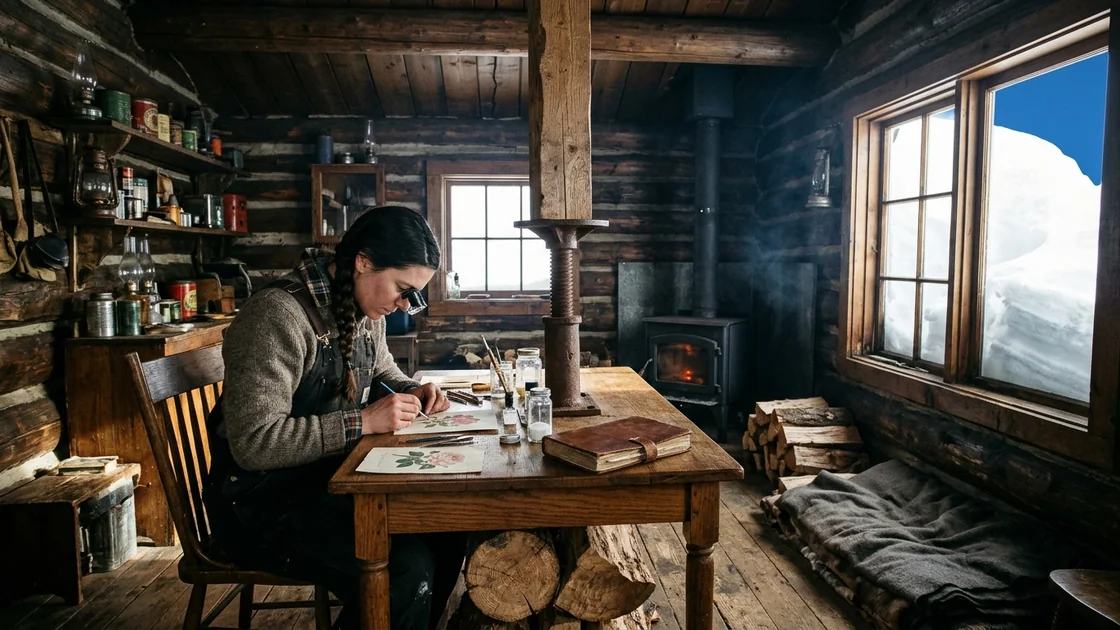
Now, the oak table was cleared, scrubbed down with hot water and baking soda, and pushed right up against the south window where the snow trench allowed a flood of clear, reflected sunlight to pour through all six panes of glass.
Clara sat at the table in two sweaters, her hair braided tightly down her back, a magnifying loupe resting on her cheekbone.
Before her lay an eighteen-twenty-four copperplate engraving of Rosa gallica officinalis—the Apothecary’s Rose.
Someone in the nineteenth century had carelessly repaired a three-inch tear across the lower stem using animal hide glue and a strip of acidic newsprint on the verso. Over a hundred and fifty years, the animal glue had oxidized into a dark, brittle amber crust that was puckering the delicate cotton rag paper and eating away the fibers along the seam, threatening to snap the stem of the rose in two.
Clara had a small saucer of warm distilled water—melted from clean surface snow—sitting on the corner of the Fisher stove to stay tepid.
With a tiny sable brush, no thicker than three eyelashes, she applied a microscopic bead of moisture along the edge of the old glue line on the back of the print.
She waited three minutes, listening to the clock-like ticking of the metal roof expanding in the afternoon sun and the soft, occasional shhh-plop of snow falling from the spruce boughs down by the creek.
Then, taking a surgical scalpel with a fresh number-fifteen curved blade, she held the steel nearly flat against the paper—at an angle of less than five degrees—and began to pare away the swollen, gelatinous animal glue and the rotting nineteenth-century newsprint, working one millimeter at a time under the magnifying glass.
Her hand did not shake. Despite four days of swinging a four-pound sledge and heaving fifty-pound blocks of snow, her fingers were steadier than they had been in Cambridge all winter.
In Cambridge, her hands had developed a slight, fine tremor around Christmas—she had blamed it on too much espresso and the stress of the wedding seating charts, though her body had clearly known what her mind refused to read in the pantry mirror on Thanksgiving.
Now, the blade moved with a dry, whispery precision, lifting the brown, toxic crust of the old repair without disturbing a single white fiber of the original rag paper beneath.
When the old backing was entirely gone and the two ragged edges of the torn eighteen-twenty-four paper lay clean and relaxed against the blotter, she mixed a fresh thimbleful of wheat starch paste, teased out the long, silky fibers of a strip of Japanese kozo paper with a needle until its edges were as feathery as spiderweb, and laid it across the scar.
She pressed it down with the smooth curve of her bone folder through a sheet of silicone release paper.
When she turned the print over and held it up to the south window, the tear had vanished. The stem of the Apothecary’s Rose was continuous again—not because the tear hadn't happened, and not because it had been hidden under a thick, ugly patch of glue, but because the foreign poison had been scraped away and the original fibers had been realigned, grain to grain, held together by something nearly invisible and stronger than the paper itself.
Clara set the print down on the drying rack, pulled the magnifying loupe from her eye, and looked out through the window down the length of her blue snow-trench.
Sitting on the top of the six-foot snow wall, ten feet from the glass, was a Clark’s nutcracker.
It was a tough, crow-sized mountain bird, pale grey with sharp black-and-white wings, built to survive winter above timberline on cached whitebark pine seeds. It cocked its head, fixing Clara with a bright, bead-black eye through the glass, entirely unimpressed by her presence in its basin, before launching itself off the drift andplaning down into the sunlit timber below.
Clara reached across the oak table and pulled Uncle Arthur’s leather-bound logbook toward her.
In the back of the kitchen drawer, beneath the flathead screwdriver and the box of sixteen-penny nails, she had found a stub of a carpenter’s pencil—flat, octagonal, painted red, with a thick rectangular lead meant for marking rough-sawn lumber. She had sharpened it to a chisel point with her scalpel.
She opened the logbook to the first blank page after Arthur’s final entry in September nineteen-ninety-seven. The paper was yellowed around the edges and smelled faintly of woodsmoke and thirty-year-old kerosene, but the rag content was high and the binding thread was still sound.
She looked at the date at the top of her mind, counted backward through the whiteout, and pressed the flat lead to the paper.
March 16. Eighty inches on the flat, twelve-foot drift on the south wall. Cleared the roof pitch and dug out the woodshed. Sistered the center purlin with two 2x6s. Repaired the Rosa gallica. Water still tastes of sulfur, but the stove draws well.
She closed the book, laid the carpenter’s pencil in the groove along its spine, and stood up to put another split of tamarack on the fire before the sun dropped behind the ridge.