The Architecture of Grief
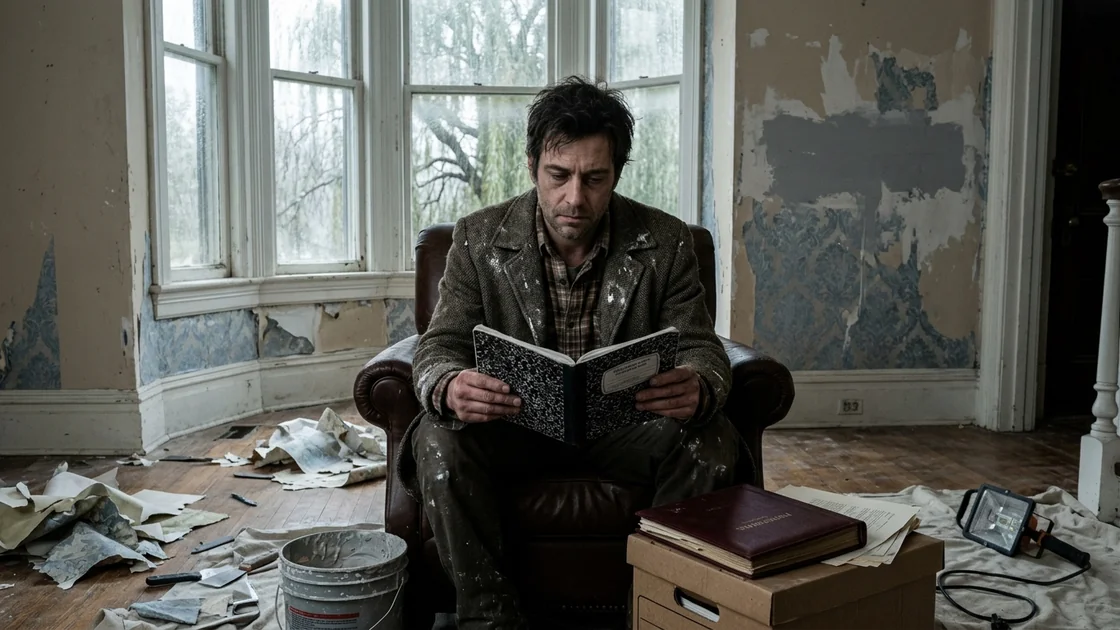
Arthur Pendelton, a forty-two-year-old archivist suffocating under the weight of clinical depression, liquidates his life savings to purchase the decaying Victorian house where he grew up, convinced that returning to the sanctuary of his youth will mend his fractured psyche. Instead of the golden nostalgia he desperately seeks, the neglected rooms and peeling wallpaper force him to confront the suppressed traumas of his childhood—the suffocating silence of his mother’s undiagnosed mental illness, his father’s simmering resentment, and the systematic erasure of his own emotional life—ultimately teaching him that healing cannot be found by retreating into the past, but only by surviving the truth of it.
The brass key felt heavier than it had any right to be, a cold, jagged piece of metal pressing into the center of Arthur’s palm. He stood on the porch of 412 Sycamore Lane, listening to the October wind rattle the loose panes of the front bay window. It was a sound he had not heard in twenty-four years, yet his body recognized it instantly, his shoulders drawing up toward his ears in a phantom flinch against a draft that hadn’t touched him since he was eighteen.
The real estate agent, a woman named Brenda whose teeth were too white and whose perfume smelled aggressively of synthetic vanilla, had left ten minutes ago. She had pressed the key into his hand with a practised, sympathetic tilt of her head, likely wondering why a single man in a frayed tweed coat was paying twenty percent over asking price—in cash, drained from every retirement account and pension fund he possessed—for a rotting Victorian that needed a new roof, updated wiring, and a complete structural overhaul.
"It has good bones, Mr. Pendelton," she had said, her heels clicking nervously on the warped floorboards of the foyer during the final walkthrough. "A lot of history in a place like this."
"Yes," Arthur had replied, his voice barely a rasp. "I know."
He hadn't told her that his height was still notched into the doorframe of the pantry in the back of the house, or that if you pulled up the corner of the linoleum under the kitchen sink, you would find a rusted tin soldier he had hidden there during the summer of 1989. He hadn't told her anything. For the last three years, Arthur had found it increasingly difficult to tell anyone anything at all.
His depression was not a sudden storm; it was a slow, glacial encroaching of fog. It had begun after his divorce from Claire, thickening when his mother died in a state-run facility two years later, and finally solidifying into an impenetrable gray wall that separated him from the rest of the living world. He went to his job in the basement of the university library, where he cataloged estate donations and breathed in the sweet, vanilla-like rot of decaying paper. He came home to a sterile, white-walled apartment where the refrigerator hummed like an angry hornet. He slept for twelve hours a day and woke up exhausted. The medications his psychiatrist prescribed only seemed to pad the sharp edges of his despair with cotton wool, leaving him numb, untethered, and drifting.
Then, three months ago, while aimlessly scrolling through property listings at three in the morning, he had seen it. 412 Sycamore Lane. 4 Bed, 2.5 Bath. Sold As-Is.
Looking at the pixelated photographs of the wraparound porch and the steeply pitched gables, a sudden, violent clarity had pierced through the chemical fog in his brain. He remembered lying on the braided rug in the parlor, the afternoon sun pouring through the stained-glass transom, warming the back of his neck while he read The Wind in the Willows. He remembered the smell of his mother’s lemon verbena soap and the sound of his father’s heavy wingtips on the gravel driveway. In the sterile isolation of his apartment, his childhood home had bloomed in his mind as an Eden—the last place on earth where he had been whole, before time and disappointment had whittled him down to a ghost. If he could just get back inside, he reasoned, if he could sleep under that roof and breathe that specific air, the circuit would be completed. The boy who had been happy and the man who was broken would merge, and he would remember how to live.
Now, he slid the brass key into the deadbolt. It turned with a gritty, reluctant shriek of metal on metal.
Arthur pushed the heavy oak door open and stepped inside.
The smell hit him first. It was not lemon verbena, nor was it the beeswax polish he had conjured in his daydreams. It was the suffocating, damp odor of old plaster, mouse droppings, and stagnant air—the smell of a house that had been closed up to digest its own decay.
He let the door swing shut behind him. The latch clicked, and the silence of the house dropped over him like a heavy wool blanket.
He stood in the foyer. To his left, the grand staircase curved upward into the gloom of the second floor, its mahogany banister dull with a thick film of gray dust. To his right, the double pocket doors leading to the parlor stood half-open, like a mouth caught mid-sentence. Straight ahead, the narrow hallway led back into the bowels of the house—the dining room, the kitchen, the pantry.
Arthur set his single suitcase down by the coat rack. He hadn't hired movers. His furniture from the apartment—an IKEA sofa, a particle-board desk, a mattress on a metal frame—had been left on the curb or given away to the building superintendent. He had brought only his clothes, a box of kitchen essentials, a sleeping bag, and an old, battered leather armchair that had belonged to his grandfather. It was arriving via a freight service tomorrow. Tonight, he would camp in his own past.
He walked into the parlor. The braided rug was long gone, of course, as were the velvet curtains and the glass-fronted bookcases. The family who had bought the house from his parents in 1998 had painted the walls a garish, builder-grade beige, covering up the intricate, faded damask wallpaper Arthur remembered. Yet, near the baseboards, where the damp had crept up from the cellar, the beige paint was peeling back in long, brittle curls, revealing the pale blue and silver damask underneath.
Arthur knelt on the bare oak floor. His knees popped loudly in the quiet room. He reached out with a trembling finger and touched the exposed patch of blue wallpaper. The texture was raised, slightly velvety even after forty years.
Be happy, he commanded himself, waiting for the rush of warmth, the golden light of the memory he had chased across three decades and sixty thousand dollars of early-withdrawal penalties. You’re home. You’re safe.
Nothing happened. The wood beneath his knees was cold. A draft whispered through the floorboards, smelling of wet dirt.
He looked over at the bay window, the exact spot where he had pictured himself reading in the sun. Now that he was actually here, looking at the angle of the window and the overhanging eaves of the porch outside, a strange realization unsettled him. The porch roof was too deep, and the house faced north-northwest. The sun never came through this window in the afternoon. It couldn't. It was physically impossible.
Where had that memory of the golden sun come from?
Arthur frowned, a dull ache beginning to throb behind his right eye. He stood up, brushing the dust from his trousers, and walked back into the hallway. He flipped the light switch by the doorframe. Nothing happened. The power wasn't scheduled to be turned on until Monday. The gray October twilight was fading fast outside, turning the rooms into deep wells of shadow.
He went to his suitcase, retrieved a heavy metal flashlight, and clicked it on. The beam cut a sharp, yellow tunnel through the floating dust motes.
He walked down the hall toward the kitchen. With every step, the floorboards groaned—a specific, melodic sequence of creaks that unlocked a sudden, visceral tension in his calves. Step over the third board by the radiator, a voice in the back of his mind whispered. It pops. If it pops, you’ll wake him.
Arthur froze, his right foot suspended in the air over the third floorboard. His heart was suddenly hammering against his ribs, a frantic, trapped bird. He looked down. The board was slightly warped, its nails rusted and sunken.
He hadn't thought about that board since he was twelve years old. Why had his body remembered to step over it? Why was his mouth suddenly dry with the metallic taste of adrenaline?
"Just an old habit," he said aloud. His voice sounded thin, swallowed instantly by the high ceilings. "Old houses make noises."
He forced himself to step directly onto the board. It let out a sharp, rifle-crack POP that echoed down the hallway. Arthur flinched, his eyes darting involuntarily toward the top of the stairs, half-expecting to see a tall, shadowy figure standing on the landing, belt in hand, or worse, carrying that heavy, suffocating wall of silence that meant the entire weekend would be spent walking on eggshells.
There was nothing there, of course. Just dust and darkness.
Arthur let out a shaky breath and continued into the kitchen. The room had been remodeled in the early two-thousands, and badly. The cabinets were cheap oak veneer, the countertops a hideous speckled laminate that looked like pressed gravel. The old cast-iron sink where his mother used to stand for hours, staring out at the weeping willow in the backyard while the water ran and ran over the same single plate, had been replaced by a shallow stainless-steel basin.
He walked over to the pantry door. It was the original wood, painted over in a thick, glossy white that had yellowed with age. He shone the flashlight along the doorframe, about four feet up from the floor.
The paint was too thick. The pencil marks were gone, buried beneath layers of latex and primer. He ran his thumb over the wood, feeling for the tiny indentations of the knife his father had used to mark the dates. Arthur, 7. Arthur, 8. Arthur, 9.
Why had they stopped at nine?
He stood in the dark kitchen, the flashlight beam trembling against the yellowed wood. He tried to remember his tenth birthday. There had been a cake—store-bought, white frosting with blue plastic balloons stuck into it. He remembered the balloons because he had kept them in his desk drawer for years. He remembered sitting at the dining room table. His father wasn't there; he was working late at the accounting firm, as he always did in the spring. It had just been Arthur and his mother.
And what else?
The memory was like a photograph that had been dropped in water; the edges were blurred, the colors bleeding into a dark, unrecognizable smudge at the center. He remembered the blue plastic balloons. He remembered the ticking of the grandfather clock in the hall. And he remembered a profound, crushing sense of embarrassment, though he couldn't recall why a ten-year-old boy would feel ashamed of his own birthday cake.
Arthur shook his head, turning away from the pantry. He was tired. The emotional toll of the closing, the drive out from the city, the sheer weight of the silence in this massive house—it was all conspiring to drag him down into one of his spirals. He needed to eat something, roll out his sleeping bag, and go to sleep. Tomorrow, in the daylight, the house would look different. He would buy some paint strippers, some sandpaper, and some drop cloths. He would work with his hands. That was part of the plan, wasn't it? Physical labor to quiet the mind.
He ate a cold roast beef sandwich he had bought at a highway rest stop, sitting on the bottom step of the grand staircase with his flashlight resting beside him. The bread was soggy, the meat gray and tasteless, but he chewed mechanically and swallowed.
When he finished, he crumpled the wax paper and stood up. He didn't want to sleep downstairs; the parlor windows were too large, looking out onto the empty street like dark, unblinking eyes. He wanted the smaller, enclosed space of his old bedroom on the second floor.
He climbed the stairs. The banister felt slick under his hand, coated in the greasy residue of years of neglect. At the top of the landing, the hallway branched in two directions. To the left, at the front of the house, was the master bedroom—his parents' room. The door was shut. Arthur didn't even look at it as he turned right, walking down the narrower back hall toward the room above the kitchen.
His old bedroom door was ajar. He pushed it open.
It was smaller than he remembered, the ceiling sloping down sharply on the eastern side to follow the line of the roof. A single window looked out over the backyard, where the silhouette of the giant weeping willow swayed against the bruised purple sky. The walls here had been painted a pale, sickly green by the previous owners, a failed attempt at a nursery or a guest room. In the corner, the small closet door hung slightly askew on a broken hinge.
Arthur swept the flashlight beam across the floor, looking for the cleanest spot to unroll his sleeping bag. He settled on the space directly beneath the window. He fetched his bag and suitcase from downstairs, brushed away a few dead boxelder bugs with the side of his shoe, and laid out the nylon pad and the quilted bag.
He didn't undress, save for kicking off his shoes. The October chill was seeping through the uninsulated walls, turning his breath into faint plumes of white vapor when it crossed the beam of the flashlight. He zipped himself into the sleeping bag, pulled his tweed coat over his shoulders like a blanket, and clicked off the light.
The darkness was absolute.
In the city, it was never truly dark; there was always the sodium-vapor glow of the streetlights filtering through the blinds, the distant red blink of a radio tower, the headlights of passing cars sweeping across the ceiling. Here, at the edge of a dying commuter town thirty miles from the metropolis, the night was thick and rural.
Arthur closed his eyes and waited for sleep.
Instead, the house began to speak.
It started with the wind under the eaves—a low, mournful whistle that sounded remarkably like someone sighing through their teeth. Then came the settling of the timbers, a slow, rhythmic tick-tick-tick inside the plaster walls as the warmth of the day bled out into the freezing night air. Down in the backyard, the long, whip-like branches of the willow tree scraped against the wooden clapboards of the kitchen below. Shhh-scrape. Shhh-scrape.
Arthur pulled the collar of his coat up over his ears. His mind, deprived of visual stimuli, began to project its own images onto the backs of his eyelids. He thought of the blue damask wallpaper downstairs. He thought of the third floorboard.
Why did they stop measuring me at nine?
He rolled onto his side, the nylon of the sleeping bag rustling loudly. His hip bone pressed through the thin foam pad into the hard oak floor.
Suddenly, he smelled smoke.
His eyes snapped open. He sat up, his heart leaping into his throat, and sniffed the freezing air. It wasn't woodsmoke, nor the acrid smell of an electrical fire. It was the sweet, heavy, unmistakable scent of Benson & Hedges menthol cigarettes, mixed with the sharp tang of burning paper.
Arthur fumbled wildly in the dark until his fingers closed around the cold cylinder of the flashlight. He clicked it on, shining it frantically around the empty green room.
The air was completely clear. There was no smoke. As he took another deep breath, the scent vanished entirely, replaced once more by the dry, sour smell of dust and old plaster.
An olfactory hallucination. His psychiatrist, Dr. Aris, had told him once that severe stress and sleep deprivation could trigger phantom sensory memories, especially when the brain was exposed to strong environmental cues.
Environmental cues. He was sleeping on the floor of the room where he had spent the first eighteen years of his life. The entire house was a massive, three-story environmental cue.
Arthur lay back down, leaving the flashlight on. It lay on the floorboards beside his head, casting a long, distorted shadow of the closet door across the sloped ceiling.
Benson & Hedges menthols. His mother had smoked them, two packs a day, sitting at the kitchen table with a ceramic ashtray shaped like a maple leaf. And the burning paper...
The memory didn'tblur this time. It arrived with the sudden, sickening clarity of a blade sliding between ribs.
His tenth birthday.
His father hadn't come home. His mother had sat across from him at the dining room table for two hours while the candles on the store-bought cake burned all the way down to the frosting, melting the blue plastic balloons at their bases. She hadn't sung. She hadn't told him to make a wish. She had just stared at the center of the table, her face slack, her eyes wide and glassy, a menthol cigarette burning down to the filter between her yellowed fingers until the ash dropped onto the tablecloth, burning a tiny, black-rimmed hole in the linen.
Ten-year-old Arthur had sat there, terrified to move, terrified to blow out the candles without permission, watching the wax pool into the white sugar. When the phone finally rang at eight o'clock—his father calling to say he was staying in the city for the night—his mother hadn't answered it. She had stood up, picked up the stack of birthday cards Arthur’s aunts and grandmothers had mailed him, walked over to the kitchen stove, turned on the gas burner, and fed the unopened envelopes into the blue flame one by one.
Then she had gone upstairs and locked her bedroom door, leaving Arthur alone in the smoky kitchen to scrape the melted wax off the cake with a butter knife and eat it in the dark.
Arthur stared at the ceiling, his breath coming in shallow, ragged gasps. A cold sweat had broken out under his arms, chilling him to the bone inside the sleeping bag.
How had he forgotten that? For thirty-two years, whenever anyone asked about his childhood, he had said, It was quiet. Normal, really. My parents were reserved people. He had believed it. He had constructed an entire mythology around those few scattered moments of peace—the books in the parlor, the willow tree in the summer—and bricked over the rest with a wall of protective amnesia.
And now, he had paid three hundred and forty thousand dollars to take a sledgehammer to the bricks.
When morning finally came, it brought no warmth, only a flat, pewter light that filtered through the grimy windowpane. Arthur had slept for perhaps two hours, slipping into a shallow, twitching doze just before dawn. He woke with a stiff neck, a throbbing headache, and a mouth that tasted like copper.
He unzipped the sleeping bag and stood up, his joints aching in the damp cold. He walked to the window and looked down into the backyard.
In his memories, the yard was an expansive, green kingdom dominated by the majestic canopy of the weeping willow, bordered by his mother’s thriving hydrangea bushes. Looking at it now, from the objective height of the second floor, he saw a narrow, rectangular patch of dead crabgrass choked with plantain weeds and dandelions. The chain-link fence at the back property line was rusted and sagging under the weight of invasive bittersweet vines. The willow tree was still enormous, but half of its crown was dead—great, skeletal limbs of gray wood poking out through the yellowing fronds, littering the yard with a thick mat of rotting branches. There were no hydrangeas; only a line of thorny, overgrown barberry bushes hugging the foundation.
A truck horn blared from the street out front.
Arthur limped down the stairs, his body protesting every step, and opened the front door. Two burly men in gray coveralls were lowering his grandfather’s leather armchair from the liftgate of a box truck.
"Where you want it, buddy?" the older of the two asked, spitting a stream of brown tobacco juice into the dead weeds lining the front walk.
"The parlor," Arthur said, stepping back to hold the door open. "First room on the right."
They maneuvered the heavy chair through the doorway, their boots tracking damp mud and crushed leaves across the dusty oak floor, and set it down in the center of the empty room. Arthur signed the electronic clipboard, tipped them twenty dollars, and watched the truck rumble away down the quiet street.
He looked at the chair. In his apartment, it had been the one piece of warmth, a relic of a grandfather who had smelled of pipe tobacco and peppermint and who had died when Arthur was seven. Here, sitting in the middle of the decaying parlor with the beige paint curling off the walls, the chair looked pathetic—a worn, cracked piece of salvage marooned in a wreck.
Arthur sat down in it anyway. The springs groaned familiarly beneath him.
He pulled his phone from his pocket. The battery was at fourteen percent. He had no charger that would work without electricity, save for the twelve-volt adapter in his sedan parked in the driveway. He opened his email, scrolling past a dozen automated notices from his bank confirming the wire transfers that had zeroed out his accounts, until he found an old thread from Dr. Aris.
Arthur, I haven't seen you on the schedule for three weeks. Please call the office so we can discuss your dosage before you run out of refills.
The email was a month old. He had four pills left in the amber bottle in his suitcase. He hadn't planned on refilling them. The whole point of 412 Sycamore Lane was that he wouldn't need the chemical crutch anymore. The house was supposed to be the cure.
He locked the phone and dropped it into his lap.
"I need to get to work," he told the empty room. "If I’m working, I’m not thinking."
He drove his ten-year-old Honda into the town center, charging his phone on the way. The town of Oakhaven had not aged well. In the eighties, it had been a prosperous bedroom community for white-collar commuters like his father. Now, half the storefronts on Main Street were boarded up or converted into vape shops, check-cashing joints, and thrift stores. The old hardware store where his father used to buy lawnmower parts was gone; Arthur had to drive out to the highway strip to find a massive, fluorescent-lit home improvement warehouse.
He spent two hundred dollars he couldn't really spare on wallpaper steamers, metal scrapers, heavy-duty trash bags, work gloves, a respirator mask, and a long yellow extension cord—remembering belatedly that he had no power to run a steamer until Monday. He bought the scrapers anyway, along with three gallons of primer and a five-gallon bucket of joint compound.
When he returned to the house at noon, the sun had finally broken through the clouds, casting a weak, watery light over the peeling white clapboards of the exterior. Arthur carried his supplies into the parlor, took off his tweed coat, rolled up the sleeves of his flannel shirt, and knelt by the wall where the beige paint was peeling over the blue damask.
He slid the edge of the three-inch putty knife under a loose flap of latex paint and pushed.
It came away with a dry, satisfying rip, exposing a foot-long strip of the original wallpaper beneath. Arthur worked methodically, moving from left to right along the baseboard, scraping and peeling. The physical effort felt good at first. His forearm muscles burned pleasantly, and the rhythmic scritch-scrape of the metal blade against the wall gave his mind a narrow, safe track to run on.
By three o'clock, he had cleared a four-foot-by-six-foot section of the wall near the bay window. The beige paint had been applied directly over the old wallpaper without proper sizing, so it came off in large, leathery sheets, though it often tore the delicate top layer of the blue damask with it.
Arthur sat back on his heels, wiping the sweat and plaster dust from his forehead with the back of his wrist. He looked at the exposed patch of the past.
Near the bottom, about two feet off the floor, the blue damask was stained with a large, brownish-yellow ring, as if something wet had been thrown against the wall and left to dry. And right in the center of the stain, the plaster beneath the paper was caved in—a spiderweb indentation the size of a man’s fist, or a heavy glass tumbler.
The previous owners had simply skimmed a thin layer of spackle over the dent and painted right over it. When Arthur’s scraper had hit the spot, the dry, brittle spackle had crumbled away onto the floor like chalk, revealing the wound in the wall that had been waiting there since 1991.
Arthur’s hand went slack. The putty knife clattered onto the floorboards.
A heavy glass tumbler. Cut crystal. Scotch on the rocks.
It was a Tuesday night in November. Arthur was thirteen. He had come home from school with a D in pre-algebra—the first bad grade of his life. He had been so terrified of showing the report card to his father that he had forged the signature at the bottom with a blue ballpoint pen, a clumsy, looping scrawl that didn't look anything like his father’s razor-sharp script.
The school had called his father’s office to verify it.
Arthur remembered standing right here, his back pressed against the bay window, watching his father’s face turn the color of raw beef. His father hadn't yelled at first. His father rarely yelled; he was an accountant, a man of ledgers and quiet, crushing ledger-balances. He had sat in his armchair—not the grandfather’s chair, a different one, upholstered in stiff green tweed—holding the crystal tumbler of Glenlivet in his right hand, swirling the ice cubes. Clink, clink, clink.
"Do you know what I do all day, Arthur?" his father had asked, his voice terribly soft. "I sit in a windowless room on the fourteenth floor, and I look at numbers until my eyes bleed. And then I get on a train for an hour and forty minutes to come back to this morgue, where your mother hasn't spoken a coherent sentence since Easter, and the roof leaks, and the furnace burns money like kindling. Do you know why I don't just walk in front of the five-fifteen express?"
Thirteen-year-old Arthur had shaken his head, tears blurring the room into watery shapes.
"Because I told myself I was raising a son who wasn't a liar and a parasite," his father whispered. "I told myself there was one thing in this house that wasn't completely rotten."
Then, without changing his expression, his father had drawn back his arm and hurled the heavy crystal glass directly at Arthur’s head.
Arthur had ducked. The glass had hit the blue damask wallpaper two feet above the baseboard, shattering in an explosion of amber liquid, ice, and glittering shards. The plaster had caved in with a dull thud.
His father had stood up, stepped over the broken glass without looking at it, and walked out the front door. He didn't come back for four days. Arthur had cleaned up the glass with a dustpan and a wet rag, picking the tiny splinters out of the braided rug with his fingernails while his mother sat upstairs in the dark, listening to the static between radio stations.
Arthur stared at the dent in the plaster. He reached out and pressed his knuckles into the indentation. It fit the curve of his hand almost perfectly.
"Why did I come back here?" he whispered to the empty room.
A wave of nausea rolled through his stomach, sharp and sour. The depression that he had been trying to outrun—that heavy, gray blanket he had carried around the city—suddenly felt different. In his apartment, it had been a formless, existential dread, an inexplicable sadness without a name. Here, in this room, the fog was burning off, and what stood beneath it was infinitely worse: a landscape of jagged, rusted iron. He hadn't been depressed in the city because his life was empty; he had been depressed because he had spent thirty years using every ounce of his psychic energy to keep the doors of this house bolted shut inside his head.
He picked up the five-gallon bucket of joint compound, pried off the plastic lid with the screwdriver end of his scraper, and scooped up a massive glob of wet, gray mud. With frantic, sloppy strokes, he slapped the compound into the dent, smoothing it over again and again until the spiderweb cracks and the yellow scotch stain were buried beneath a thick, glistening smear of wet plaster.
He left the tools on the floor, walked out to the porch, and sat on the top step until the sun went down, shivering in his flannel shirt, terrified to go back inside.
Monday brought the electricity, and with it, a different kind of haunting.
At ten in the morning, the lights throughout the house flickered and hummed to life as the utility company threw the switch remotely. Down in the cellar, the ancient oil furnace—a rusted green behemoth the size of a compact car—let out a series of terrifying metallic clanks, a roar of igniting diesel, and began to pump warm, dusty air up through the cast-iron floor registers.
The heat woke the house's dormant smells. As the floorboards and horsehair plaster warmed, they released decades of trapped odors: the stale grease of a thousand forgotten dinners, the camphor and mothballs from the closets, the sour tang of wet wool, and beneath it all, that faint, lingering ghost of menthol tobacco.
Arthur spent Monday and Tuesday in a manic, desperate frenzy of work. He plugged in the wallpaper steamer and attacked the parlor and the dining room, filling the downstairs with thick, choking clouds of hot vapor. The steam loosened the old glue, turning the walls into a dripping, sodden mess of beige latex and blue damask. He scraped until blisters formed on his palms, burst, and bled into the leather of his work gloves.
He refused to look closely at what the peeling paper revealed. When he uncovered a row of faint, frantic pencil tally marks hidden behind the dining room curtain rod—hundreds of tiny vertical slashes his mother had made during the winter of 1993 when she refused to leave the first floor—he immediately rolled thick white primer over them before the wall had even dried. When he pulled up the tack strips in the hallway and found a crushed, dried-up prescription bottle of Haloperidol that had rolled under the radiator thirty years ago, he swept it into a heavy-duty contractor bag without reading the date on the label and threw it into the bed of the pickup truck he had rented for a dump run.
He wasn't restoring the house anymore; he was trying to erase it. He was locked in a silent, exhausting war with the architecture itself. If he could just get down to bare plaster, if he could cover everything in clean, sterile white primer, he could turn 412 Sycamore Lane into his city apartment. He could make it blank again.
On Wednesday afternoon, his phone rang.
The sound startled him so badly that he dropped his paint roller into the tray, splattering white Kilz primer across his jeans and boots. He wiped his hands on a rag and pulled the phone from his pocket. It was an unknown number with a local area code.
"Hello?" Arthur croaked, his throat raw from breathing paint fumes and plaster dust.
"Mr. Pendelton? Arthur Pendelton?" It was a woman’s voice, crisp and professional.
"Yes."
"Hi, this is Sarah Jenkins down at the Oakhaven Historical Society and Public Library. I hope I’m not catching you at a bad time. Brenda Miller over at Century 21 mentioned that you had bought the old Pendelton place on Sycamore—that you’d actually moved back into your family home!"
Arthur’s grip tightened on the phone. "Brenda shouldn't be giving out my number."
"Oh, I’m so sorry, it’s a small town, you know how it is," Sarah said quickly, her tone shifting from breezy to cautious. "It’s just... well, we heard you work in the archives at the university in the city. And when your father sold the house back in ninety-eight, before he moved to Florida, he donated several boxes of family papers and local municipal records to our branch. Since they weren't strictly related to town history, they’ve just been sitting in our basement storage uncatalogued. The board is doing a clean-out to make room for a new HVAC system, and we were going to pulp them, unless you wanted them back."
Arthur stared at the half-primed wall of the dining room. Where the wet paint met the bare plaster, the old water stains were already bleeding through, turning the bright white surface a sickly, bruised yellow.
"My father donated family papers?" Arthur asked slowly. His father had been an intensely private man, terrified of the neighbors knowing what went on behind their drawn curtains. Why would he give anything to the town library?
"Four banker's boxes," Sarah said. "Mostly ledgers from when your grandfather was on the town council in the fifties, it looks like, and some old household files. Like I said, we’re happy to recycle them if you don't want the clutter, especially if you’re renovating, which I hear is a huge undertaking—"
"I'll take them," Arthur heard himself say.
"Oh! Wonderful. We're open until five today. Just come to the back loading dock on Elm Street and ring the bell."
She hung up. Arthur stood in the center of the dining room for a long time, listening to the furnace rattle in the cellar. He didn't want the boxes. Every instinct of self-preservation he had left was screaming at him to stay away from the library, to let them feed those four boxes into a commercial shredder until nothing remained but confetti.
Yet, twenty minutes later, he was backing his Honda up to the concrete loading dock of the Oakhaven Library.
Sarah Jenkins was a woman in her late twenties wearing a cardigan covered in cat hair. She looked slightly alarmed when she saw Arthur in person; he hadn't showered since Monday, his hair was matted with white paint flecks, and dark, bruised hollows had formed beneath his eyes from living on cold canned soup and four hours of fractured sleep a night.
She helped him load the four dusty, yellowing cardboard boxes into his trunk without trying to make any more small talk.
"Thank you," Arthur mumbled, slamming the trunk lid down.
Before he drove back to Sycamore Lane, he stopped at the local pharmacy to refill his antidepressants. He stood at the counter under the buzzing fluorescent lights, tapping his paint-stained boots on the linoleum while the pharmacist stared at his computer screen.
"Says here the prescribing physician canceled the remaining refills on this file last week, Mr. Pendelton," the pharmacist said, peering over his half-moon glasses. "Requires an in-person consultation before re-authorization. I can fax his office, but with it being late Wednesday, you probably won't hear back until Friday."
"Fine," Arthur said hollowly. "Fax it."
He drove back to the house as a cold, steady rain began to fall, drumming against the windshield and turning the dead leaves in the gutters into a slick brown mash.
He carried the four banker's boxes into the parlor, setting them down next to his grandfather’s leather armchair. The room was a disaster zone: heaps of wet, scraped wallpaper lay rotting on drop cloths, the air smelled sharply of ammonia and damp plaster, and a single halogen work light sat on the floor, casting harsh, theatrical shadows up the mutilated walls.
Arthur sat in the armchair and pulled the first box toward him.
The top layer was exactly what the librarian had described: his grandfather’s town council minutes from 1954 to 1961, typed on brittle onion-skin paper. Beneath that were stacks of canceled checks, utility bills from the seventies, and warranty booklets for appliances that had been hauled to the dump decades ago. His father hadn't curated this donation; in his haste to liquidate the house after committing Arthur's mother to the state hospital in 1998, he had simply swept the contents of the basement filing cabinets into boxes and dumped them on the library to avoid paying a junk removal fee.
Arthur pushed the first box aside and opened the second. More tax returns. Property tax assessments.
He opened the third box.
Sitting right on top, resting on a stack of old National Geographic magazines, was a thick, burgundy leather binder with brass corners. The word PHOTOGRAPHS was embossed in faded gold leaf across the front cover.
Arthur’s breath caught.
They hadn't owned photo albums when he was growing up. He remembered asking his mother once, when he was in third grade and had to bring a baby picture to school for a class project, where their pictures were. She had told him, in a flat, final voice, that they had all been ruined when the hot water heater burst in 1983. Arthur had brought a school portrait from first grade instead and had been docked five points by Mrs. Gable for not following instructions.
With trembling, paint-crusted fingers, Arthur lifted the burgundy album out of the box and laid it across his knees. He opened the cover.
The pages were the old-fashioned magnetic kind from the late seventies, where you peeled back a sheet of clear plastic and pressed the photographs onto sticky, glue-striped cardboard. Over the decades, the acid in the glue had yellowed the cardboard and eaten into the edges of the prints, but the images themselves were still sharp.
The first ten pages were from before Arthur was born, or from his infancy. There was his father, looking startlingly young and handsome in a wide-collared shirt, standing in front of 412 Sycamore Lane with a "SOLD" sign on the lawn. The house was gleaming white, the shutters freshly painted a deep hunter green.
And there was his mother.
Arthur leaned forward, bringing the album closer to the harsh glare of the halogen work light. He had never seen this woman in his life.
In his memories, his mother, Eleanor, was a gray wraith in a pilled terrycloth bathrobe, her hair limp and streaked with silver, her face permanently slack with the heavy, dead-eyed exhaustion of someone walking underwater.
The woman in the photographs on page three was radiant. She was standing in the backyard beneath the weeping willow, which was half its current size, holding a garden hose and laughing directly into the camera, her head thrown back, her dark hair catching the summer sunlight. In another shot, she was sitting on the front porch steps holding a toddler—Arthur, fat-cheeked and squinting in a yellow sunsuit—kissing the top of his head with such fierce, obvious adoration that it made Arthur’s chest constrict with a sudden, violent spasm of grief.
He turned the page. 1984. Arthur was four. He was sitting on the braided rug in the parlor—the exact rug from his daydream—and the afternoon sun was shining on him. Not through the north-facing bay window, as he had misremembered, but through the side window that used to exist on the western wall before his father had it bricked up and plastered over to build an exterior chimney for a woodstove they never installed.
It was real, Arthur thought, a single hot tear spilling over his lower lashes and dropping onto the plastic sheet. The golden light was real. I didn't make it up.
He turned the page. 1985. 1986. 1987.
And then, on page twelve, dated August 1988, the album changed.
There was a photograph of Arthur, eight years old, standing next to a baby crib in the small bedroom at the back of the second floor—the room Arthur had been sleeping in all week. Inside the crib was a bundle of blue blankets.
Arthur frowned, leaning closer. A crib? Why would there be a crib in his bedroom when he was eight? He had moved into that room when he was six; before that, he had slept in the tiny nursery next to his parents' room at the front of the hall.
He looked at the next photograph. His mother was sitting in the grandfather’s leather armchair—the very chair Arthur was sitting in right now—holding an infant. A tiny, dark-haired baby boy. Eight-year-old Arthur was perched on the arm of the chair, looking down at the baby with a wide, gap-toothed grin, one hand resting protectively on his mother’s shoulder.
The room around Arthur seemed to tilt on its axis. The buzzing of the halogen light grew deafeningly loud, filling his skull with a high-pitched, metallic whine.
Who is that baby?
He had no brother. He was an only child. He had written "N/A" under the siblings section of every medical form and university application he had ever filled out.
Frantically, he turned the page.
The remaining twenty pages of the album were completely blank. The sticky yellow cardboard was covered in darker, rectangular ghosts where photographs had once been pressed, and then violently ripped out, tearing strips of the paper backing away with them.
Arthur dropped the album onto the floor. He plunged his hands back into the third banker's box, throwing the National Geographics across the room, digging down to the bottom. Beneath the magazines was a stack of manila folders labeled in his father’s neat, accountant’s handwriting: INSURANCE - AUTO, MORTGAGE - FIRST FIDELITY, MEDICAL - ELEANOR, and at the very bottom, a thin folder with no label at all, sealed shut with three strips of brittle, yellowed masking tape.
Arthur tore the tape open with his thumbnail.
Inside were three documents.
The first was a birth certificate from Oakhaven General Hospital. Thomas James Pendelton. Born June 14, 1988.
The second was a death certificate. Thomas James Pendelton. Date of Death: January 22, 1989. Age: 7 months. Cause of Death: Acute Hypothermia / Exposure.
The third document was a folded clipping from the Oakhaven Gazette, dated January 25, 1989.
LOCAL INFANT DIES IN TRAGIC ACCIDENT Police have ruled the death of seven-month-old Thomas Pendelton of 412 Sycamore Lane a tragic accident following an investigation this week. According to Oakhaven Police Chief Robert Vance, the infant was found unresponsive in an upstairs bedroom early Sunday morning after a window in the room was inadvertently left open during Saturday night’s sub-zero blizzard. No charges will be filed against the parents, Richard and Eleanor Pendelton. Funeral services will be private.
The paper slipped from Arthur’s fingers, fluttering down to rest on the paint-splattered drop cloth.
A window in the room was inadvertently left open.
The back bedroom. The room above the kitchen.
In 1989, Arthur was nine years old. That wasn't his bedroom yet. His bedroom was still the small one at the front of the hall. The back bedroom—the larger one—had been converted into the nursery for Thomas because it was warmer, directly above the kitchen stove.
Arthur clapped both hands over his mouth, his eyes wide and staring at the peeling wall in front of him, as the thirty-three-year-old dam inside his mind didn't just crack—it disintegrated completely, releasing a black, freezing flood of memory that drowned him where he sat.
January 21, 1989.
Nine-year-old Arthur couldn't sleep. The baby had been crying for three hours—a thin, colicky, endless wail from the back of the house. His mother was exhausted; she had been up for days, her nerves frayed to nothing, weeping quietly in the kitchen while his father shouted at her to "just keep the damn kid quiet" so he could finish his tax-season prep work in the dining room.
Finally, around midnight, the house had gone quiet. His parents had gone to bed, collapsing into a heavy, exhausted sleep behind their closed door at the front of the hall.
But Arthur was still awake, lying in the dark, listening to the blizzard howl against the eaves. He had gotten a new plastic telescope for Christmas, and his teacher had told the class that even when it snowed, sometimes the wind blew the clouds apart for a few minutes and you could see Mars right above the horizon in the east.
His window faced west, toward the street. The only window on the second floor with a clear view of the eastern sky above the weeping willow was the window in Thomas’s nursery.
Nine-year-old Arthur had crept out of bed in his flannel pajamas, carrying the cheap plastic telescope. He had walked down the hall, stepping carefully over the third floorboard so it wouldn't pop and wake his father.
He had pushed open the nursery door. The room was stiflingly hot; his father had turned the radiator valve all the way open to combat the drafty walls. Thomas was asleep in his crib in the corner, bundled in a blue blanket, his tiny chest rising and falling rapidly.
Arthur had walked to the window. The glass was frosted over on the inside from the humidity of the radiator meeting the sub-zero air outside. He couldn't see through the frost with his telescope.
So, he had unlocked the brass sash latch. With all the strength in his nine-year-old arms, he had shoved the heavy wooden window up about six inches—just enough to poke the barrel of the plastic telescope out into the roaring, freezing night.
The wind had blasted into the room, smelling of ice and pine needles, swirling dry snow across the floorboards. Arthur had shivered, squinting through the eyepiece for five minutes. There was no Mars; only a blinding wall of white flakes spinning in the dark.
His fingers had gone numb from the cold. Frustrated and suddenly sleepy, he had pulled the telescope back inside. He had grabbed the top of the window sash and pulled down to close it.
It had stopped halfway, jamming on a buildup of ice that had blown into the wooden track. To his sleepy nine-year-old eyes, in the pitch dark of the room, the dark line of the sash looked like it was touching the sill. It was still open by four inches.
Arthur had tiptoed back out of the room. And because he had been taught to always keep the nursery door shut so the hallway drafts wouldn't wake the baby, he had pulled the heavy wooden door firmly closed behind him until the latch clicked, sealing the room off from the rest of the house's heat, and sealing the freezing gale inside with the crib.
When he woke up the next morning to the sound of his mother’s inhuman, animal screaming—a sound that seemed to tear the plaster right off the laths—his father was already in the nursery.
Arthur had stood in the doorway in his pajamas, holding the plastic telescope behind his back. He had seen the four-inch gap at the bottom of the window. He had seen the drift of white snow piled on the floorboards right where he was sleeping thirty-three years later. He had seen the blue blanket in the crib, stiff with frost.
His father had turned around from the crib. He had looked at the open window. And then his eyes had dropped to the plastic telescope sticking out from behind nine-year-old Arthur’s pajama leg, its black plastic barrel still wet with melted snow.
His father hadn't called the police right away. He had walked across the room, taken the telescope out of Arthur’s freezing hands, walked down to the cellar, and thrown it into the firebox of the oil furnace, where it melted into a toxic black puddle.
Then he had come back upstairs, grabbed Arthur by the shoulders, shaking him so hard his teeth clicked together, and hissed into his face while his mother shrieked on the floor behind him:
"You were never in this room. Do you hear me? Your mother put him to bed and she didn't check the latch. If you ever say a word—if you ever tell a single living soul what you did—it will kill her, and I will put you in a home where nobody will ever find you. Nod your head."
Arthur had nodded.
His mother had believed until the day she died in the state hospital that she had left the window open in her postpartum exhaustion. She had burned Arthur's tenth birthday cards on the stove because every time she looked at him growing older, she saw the baby she thought she had frozen to death. His father had stopped measuring Arthur's height on the pantry door that winter because you don't measure the growth of the boy who killed your other son; you just feed him, house him, pay his tuition from a distance, and wait for him to leave so you can finally burn the whole rotten life down.
And Arthur? Nine-year-old Arthur couldn't carry the weight of a dead baby on his conscience. So his mind had done the only thing a child's mind could do to survive: it had taken Thomas, and the crib, and the plastic telescope, and the snow on the floorboards, and it had buried them under thirty feet of concrete in the darkest sub-basement of his brain.
He had forgotten his brother existed. And the rot of that buried corpse had poisoned every single day of his adult life, leaking up through the concrete as a nameless, incurable depression that ruined his marriage, isolated him from the world, and finally dragged him back to the scene of the crime like a sleepwalker returning to a cliff's edge.
Arthur didn't know how long he sat on the floor of the parlor.
At some point, he had fallen out of the leather armchair. He was curled on his side on the plastic drop cloth among the wet strips of blue damask wallpaper, his knees pulled up to his chest, sobbing with such violent, dry heaves that his ribs felt as if they were cracking. He cried like a nine-year-old boy—ugly, gasping, suffocating cries that echoed through the empty downstairs rooms and up the grand staircase.
The halogen work light burned on, hot and indifferent, baking the smell of wet plaster into the air. Outside, the October rain turned to sleet, ticking against the north bay window like thousands of tiny fingernails.
When the tears finally stopped, sometime after midnight, Arthur was completely empty. The gray fog of his depression was gone, burned away entirely by the searing, catastrophic heat of the truth. In its place was a vast, freezing vacuum.
He pushed himself up onto his hands and knees. His palms were raw and bleeding where the dried plaster had cut into his blisters, and his face was stiff with dried salt.
Slowly, moving like an old man of ninety, he stood up. He didn't look at the birth certificate or the photo album on the floor. He walked out of the parlor, down the hall—stepping directly onto the third floorboard, which popped loudly in the dark—and into the kitchen.
He opened the basement door and walked down the narrow wooden steps toward the roaring furnace.
Sitting on the concrete floor next to the 275-gallon oil tank were two red plastic five-gallon cans of gasoline the previous owners had left behind for an old riding mower, along with a stack of turpentine tins and paint thinner Arthur had bought on Saturday.
Arthur looked at the rusted iron door of the furnace's firebox. Through the tiny mica viewing window, he could see the orange roar of the oil burner.
It would be so easy. His father had burned the telescope in there. If Arthur unscrewed the caps on those two red cans, poured ten gallons of unleaded gasoline across the dry, ancient pine joists of the basement ceiling, and kicked over a tin of turpentine near the burner, 412 Sycamore Lane would go up like a tinderbox. The dry horsehair plaster and lath walls, opened up by his scraping, would act like chimneys, sucking the fire straight up to the second floor in less than two minutes.
He could just walk back upstairs, lie down on the sleeping bag beneath the nursery window, and let the house finish what had started in 1989. No more archives. No more empty apartments. No more waking up with the crushing weight of a ghost he now knew the name of. The architecture of his grief would finally collapse in on itself, reducing the blue wallpaper, the dent in the parlor wall, the tally marks, and Arthur himself into a neat, sterile pile of gray ash in the cellar hole.
Arthur reached out and wrapped his blistered fingers around the handle of the first red gas can. He lifted it. It was heavy, sloshing with a deep, hollow glug-glug against the plastic walls.
He carried it to the bottom of the basement stairs. He unscrewed the yellow vent cap at the back, then twisted off the main pouring spout. The sharp, dizzying fumes of high-octane gasoline bloomed instantly in the warm air of the cellar, cutting right through the smell of damp earth and menthol.
He tilted the can, letting the first splash of clear, shimmering liquid arc out onto the dry wooden risers of the basement steps. It soaked into the unpainted pine instantly, turning the wood a dark, wet amber.
Do it, the house seemed to whisper in the creaking of the floorboards above his head. You came back here to die, Arthur. We both know it.
He tilted the can again, splashing the second and third steps.
As he stepped back to douse the landing, his boot heel struck one of the cardboard banker's boxes he had left near the top of the cellar stairs—the fourth box from the library, the one he hadn't opened yet. The box tipped over, spilling its contents down the gas-soaked wooden steps right between Arthur’s feet.
It wasn't tax returns or town council minutes. It was a cascade of spiral-bound notebooks—dozens of cheap Mead composition books with marbled black-and-white covers, their pages swollen with dampness.
One of them landed open on the concrete floor at the base of the stairs, soaking up a puddle of spilled gasoline.
Arthur froze, the gas can still tilted in his hand. He looked down at the open page. The handwriting wasn't his father’s neat script. It was a sprawling, erratic, desperate cursive written in blue ballpoint pen—his mother’s handwriting.
He set the gas can down on the concrete. He knelt and picked up the wet composition book, the smell of gasoline stinging his eyes and nostrils. The date at the top of the page was October 12, 1996—two years before she was committed, the year Arthur had left for college.
He read the page in the dim yellow light of the single bare bulb hanging over the furnace.
Richard thinks I don't know. He thinks because the Haldol makes my tongue thick that I don't have eyes or a memory. I knew the night it happened. Thomas's crib was in the corner away from the radiator, and I checked that window latch three times at ten o'clock because the wind was rattling the glass so hard. When I went in at seven in the morning, the plastic lens cap from Arthur's Christmas telescope was lying right under the radiator valve where it had rolled in the dark. I picked it up and put it in my bathrobe pocket before Richard even came upstairs.
Richard told the police it was me. He did it to save Arthur from the juvenile courts, I know that, and I let him do it because what would they do to a nine-year-old boy who just wanted to look at the stars? It was an accident. A terrible, freezing accident.
My sin wasn't leaving the window open. My sin was that after the funeral, every time Arthur walked into a room, my heart turned to stone. I couldn't touch him. I tried—God knows I tried on his birthday to just look at him and tell him I knew it was an accident, that I forgave him—but the words turned to ash in my mouth, and I burned his cards instead because I hated the world for going on when my baby was in the frozen ground. Richard hates him too, though he won't admit it. We are destroying the boy left behind to punish him for the one we lost, and I don't know how to stop. The doctors change my pills, and the walls get closer, and my poor Arthur walks through this house like a shadow trying not to make the floorboards creak. If I ever get well enough to speak clearly again, I have to tell him I found the lens cap. I have to tell him he was just a little boy.
She had never gotten well enough. Two years later, a stroke in the state facility had taken the rest of her speech, and she had lingered for twenty years in a wheelchair before dying during the pandemic.
Arthur knelt on the cold concrete of the cellar floor, holding the gasoline-soaked notebook against his chest.
She knew.
She hadn't believed she killed the baby. She had carried the blame in front of the town, the police, and her own husband to shield a nine-year-old boy, and the weight of that unspoken secret—combined with her own shattered grief—had driven her into madness.
And she had forgiven him. Six feet below the floorboards where he had spent his adolescence tiptoeing in terror, hidden inside a metal filing cabinet, the words It was an accident and He was just a little boy had been written down in blue ink twenty-six years ago.
The urge to strike a match didn't vanish in a burst of Hollywood triumph; it simply drained away into the concrete floor, leaving him shivering and nauseous from the gasoline fumes. If he burned this house down with himself inside it, then both of Eleanor Pendelton’s sons would have died in that back bedroom, and everything she had endured in the silent hell of those final years would have been for nothing.
Arthur dropped the notebook. He stood up, grabbed the red gas can, screwed the cap back on tightly, and carried both cans out through the bulkhead doors at the back of the cellar into the freezing October sleet. He left them sitting out in the dead crabgrass by the weeping willow.
Then he went back inside, left the bulkhead wide open to air out the basement, walked up to the kitchen, and opened every single window on the first floor, letting the icy wind scream through the house to blow the fumes away.
He didn't sleep in the back bedroom that night. He dragged his grandfather’s leather armchair onto the front porch, wrapped himself in his sleeping bag and his tweed coat, and sat in the freezing damp air watching the sleet turn to rain as Thursday morning broke gray and bleak over Sycamore Lane.
At nine o'clock, his phone buzzed in his pocket. It was Dr. Aris’s office, confirming an emergency fifteen-minute telehealth appointment at noon so his prescription could be re-authorized.
Arthur looked at the screen, then looked back over his shoulder through the front bay window into the parlor. In the gray morning light, the room looked exactly like what it was: a ruined, water-damaged box of wood and plaster. There were no ghosts in it anymore. Ghosts required secrets to feed on, and the house had none left to keep.
He stood up, his muscles stiff and aching, and walked back inside.
He didn't pick up the putty knife or the paint roller. Instead, he went upstairs to the back bedroom.
In the daylight, the room looked tiny, sad, and ordinary. He walked over to the eastern window—the one with the view of the dead willow tree. The brass sash lock had been replaced at some point in the two-thousands with a cheap white vinyl latch, and the old wooden tracks had been lined with aluminum weatherstripping. It slid up and down smoothly now, closing with a tight, solid thud that no winter wind could ever force open.
Arthur knelt on the bare oak floorboards beneath the window, right where the snowdrift had piled up thirty-three years ago. He laid his raw, blistered palm flat against the cold wood.
"I'm sorry, Thomas," he whispered aloud. His voice didn't sound thin anymore; it sounded heavy, gravelly, and entirely his own. "I just wanted to see Mars."
The house didn't answer. Down in the cellar, the furnace clicked off, its cycle finished, leaving only the sound of the rain dripping from the eaves into the overgrown barberry bushes below.
Arthur stood up, rolled up his sleeping bag, and carried it downstairs along with his suitcase. He picked up the burgundy photo album and the four wet composition books from the basement stairs, placing them carefully on the passenger seat of his Honda. He left the wallpaper steamer, the buckets of joint compound, the cans of white primer, and his grandfather's armchair right where they were.
At ten-thirty, he walked without an appointment into the offices of Century 21 on Main Street.
Brenda Miller looked up from her desk, her overly white smile faltering when she saw him standing in her doorway. He smelled faintly of gasoline and wet wool, his hands were wrapped in a dirty rag, and his face was gaunt, yet there was a strange, terrifying stillness in his eyes that hadn't been there at the closing a week ago.
"Mr. Pendelton!" she said, standing up nervously. "Is everything alright with the property? Did you find an issue with the foundation?"
"The foundation is fine, Brenda," Arthur said. He reached into his coat pocket, pulled out the heavy brass key to 412 Sycamore Lane, and set it down in the center of her blotter. "I want you to put it back on the market today."
Brenda blinked at the key, then up at him. "Today? Mr. Pendelton, you just closed last Friday. In this market, if we relist immediately without any completed renovations, and with closing costs and transfer taxes, you're going to take a bath on the price. You could lose forty, fifty thousand dollars."
"Drop the price by sixty so it sells before Thanksgiving," Arthur said evenly. "Sell it to a developer who wants to tear it down for townhomes, or sell it to a flipper who wants to gut it to the studs. I don't care. Just mail the closing documents to my lawyer in the city. I won't be coming back to Oakhaven."
"Where will you stay?" she asked, bewildered, watching him turn toward the glass doors of the lobby.
Arthur paused with his hand on the push-bar, looking out at the wet pavement of Main Street and the gray sky beyond, where the highway led back toward the city, toward his tiny office in the university basement, toward Dr. Aris, and toward whatever small, quiet life could be salvaged by a man who finally knew his own name.
"Anywhere else," Arthur said, and pushed the door open into the rain.