The Architecture of Frost
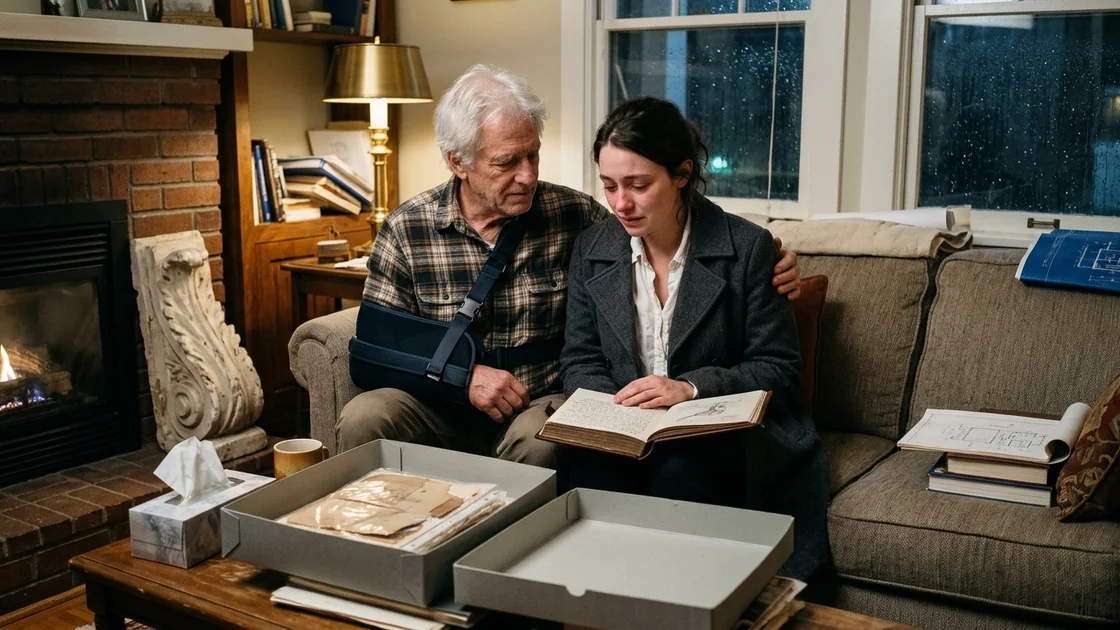
This is the story of Arthur Pendelton, an architectural restorer who shatters his twelve-year-old daughter Clara’s absolute trust on a rainy Tuesday in November by breaking a sacred promise to rescue her deceased mother’s journals from a house scheduled for demolition, choosing instead to salvage a lucrative commercial contract with a demanding developer. The narrative spans fifteen years of the resulting emotional winter, chronicling Arthur’s quiet, desperate attempts to endure Clara’s polite, impenetrable coldness as she grows from a betrayed child into a fiercely independent woman who refuses to rely on him for anything, culminating in a confrontation over the remnants of their shared past that forces them both to reckon with the permanent architecture of grief and the fragile possibility of thaw.
The rain in Oakhaven did not fall so much as it settled, a gray, persistent mist that clung to the wool of Arthur Pendelton’s coat and turned the red clay of the demolition site into a slick, treacherous mire. It was four-fifteen in the afternoon on the twelfth of November. That time, and that date, would become the central load-bearing wall of Arthur’s remaining life, the point around which all subsequent years would be forced to bend.
Inside the warm cab of his pickup truck, his cell phone sat on the passenger seat. It had stopped ringing twenty minutes ago. Now, the screen merely glowed every few minutes with a silent, damning notification: 14 Missed Calls from Clara (Home).
Arthur did not look at the phone. He looked through the rain-streaked windshield at the ribs of the Vance Building, anineteenth-century textile mill he was being paid a great deal of money to disembowel. Beside him stood Julian Vance, the thirty-two-year-old heir to the Vance development fortune, a man who wore Italian loafers in the mud and held an umbrella over his own head without offering to share its canopy.
"If we don't sign off on the limestone lintels before five, Arthur, the crane crew walks," Julian said, his voice tight with the artificial urgency of men who had never built anything with their hands. "They have another job in the city tomorrow. If they walk, my schedule slips by three weeks. If my schedule slips, I find another preservationist. Are we clear?"
Arthur’s boots felt impossibly heavy, caked with ten pounds of wet clay. Five miles away, on the other side of town, a smaller, much less grand crane was idling in front of a modest Victorian house with peeling yellow paint and a sagging front porch. It was the house where Arthur had lived for fourteen years. It was the house where his wife, Sarah, had died three winters ago, leaving behind a sun-drenched attic studio filled with sketches, letters, and six leather-bound journals.
Because of a bank foreclosure that had moved with terrifying, bureaucratic suddenness after Sarah’s medical bills finally broke Arthur’s solo practice, they had been forced out at the end of October. In the frantic, humiliating chaos of packing their lives into rented vans while a county sheriff watched from the driveway, a single, unmarked wardrobe box had been left behind in the attic crawlspace.
Clara had realized it that morning at breakfast.
She was twelve years old, all sharp elbows, bruised shins, and a terrifyingly solemn pair of gray eyes that she had inherited directly from her mother. She had dropped her spoon into her oatmeal, the metal clattering against the ceramic bowl with a sound like a pistol shot.
"The blue box," she had whispered, the blood draining from her face until her freckles stood out like specks of rust. "Dad. Mom’s books. The ones she wrote for me."
Before she died, when the sickness had begun to eat away at her lungs and she knew she wouldn't see Clara turn thirteen, or sixteen, or twenty-one, Sarah had spent her afternoons writing. She had filled six thick, unlined leather notebooks with letters to her daughter’s future self—advice on heartbreak, recipes for lemon pound cake, memories of Clara’s infancy, and small watercolour sketches of birds. They were not merely keepsakes; to Clara, they were the remaining, unlived years of her mother’s life, stored in paper and ink.
And they were sitting in the eaves of a house that the municipal transit authority had purchased through eminent domain to clear the way for a highway bypass. The wrecking crew was scheduled to bring the roof down at four-thirty that afternoon.
"I'll get them," Arthur had said that morning, dropping to his knees beside her chair and taking her small, cold hands in his large, calloused ones. He remembered the fierce, absolute certainty in his own voice. He was a father; fixing things was his trade. "Listen to me, Bean. Look at me. I have a walkthrough with Vance at noon, it'll take an hour. The house isn't coming down until four-thirty. I know the foreman on the municipal crew—Big Mike. He’ll let me run up the stairs before they pull the cables. I’ll pick you up from school at three-fifteen, we’ll drive over there together, and we’ll get the box."
Clara had stared at him, her lower lip trembling with a terror so vast it made Arthur’s chest ache. "What if you're late? What if Mr. Vance keeps you?"
"He won't," Arthur had said. And then he had spoken the words that would echo in the empty hallways of his mind for the next decade and a half. "I promise you, Clara. On my life. I won't let them touch that house until we have her books. Trust me."
She had nodded, just once, the tension leaving her small shoulders as she transferred the entirety of her unbearable weight onto his back. "Okay," she had breathed. "I trust you."
Now, it was four-twenty.
The Vance walkthrough had not taken an hour. An unexpected structural fault in the mill’s east wing had brought the city inspectors down on them at one o'clock. Julian Vance had panicked, threatening lawsuits, wavingArthur’s unsigned retainer agreement in the air like a weapon. The retainer was worth eighty thousand dollars—enough to pull them out of the suffocating debt of Sarah’s illness, enough to rent a decent apartment in Clara’s school district, enough to ensure that they would never again have a sheriff standing in their driveway.
At two-thirty, Arthur had tried to leave. Julian had blocked the door of the site trailer. You walk out of here, Pendelton, and you don't get the first draw. You don't get the job. In fact, I’ll make sure every developer in the tri-county area knows you abandoned a site during a structural hold.
Arthur had looked at his watch. He had thought: I can settle this in thirty minutes. I can still make it by four.
He had called Big Mike, the demolition foreman at the old Victorian. Mike hadn't answered; his phone went straight to voicemail. Arthur left a frantic message, begging him to hold the crew until five. Mike, it’s Artie. My wife’s things are in the attic. Please, just give me until five.
At three-fifteen, the inspection had dragged into the sub-basement, where there was no cell service. When Arthur finally climbed back up into the gray light of the November afternoon, his boots sucking at the mud, it was four-fifteen.
"Sign the indemnity variance, Arthur, and we can all go home," Julian said, holding out a clipboard shielded beneath his umbrella. "The crane operator is literally in the cab waiting for the green light."
Arthur’s hand was shaking as he took the pen. He was thinking of the eighty thousand dollars. He was thinking of the dentist bill for Clara’s braces, the rent due on the first, the shame of his emptied bank accounts. He was making a father’s calculation, a cold, adult arithmetic where survival outweighed sentiment. He told himself that Big Mike had gotten the voicemail. He told himself that demolition crews always ran late in the rain.
He signed his name. The ink bled slightly on the damp paper.
He didn't walk to his truck; he ran, slipping once in the red clay and tearing the knee of his trousers, drawing blood that he didn't feel. He threw the truck into reverse, tires spinning wildly before catching the asphalt of the main road.
He didn't stop at the school. It was four-thirty-five. She wouldn't be at the school anymore; the old house was only six blocks from her middle school. He knew, with a sickening drop in his stomach, where she would be.
When he turned the corner onto Maple Street at four-forty-two, the rain had turned into a freezing downpour. The street was blocked by orange sawhorses and the flashing amber lights of two municipal dump trucks.
The yellow Victorian was gone.
It had not been dismantled piece by piece, as Arthur had hoped. Because of the rain and the tight schedule, they had used a high-reach excavator with a hydraulic shear to simply crush the roof inward and pull the load-bearing walls down into the cellar hole. What remained was a steaming, jagged mountain of splintered lath, wet horsehair plaster, and shattered yellow siding, already being scooped into the waiting beds of the dump trucks by a front-end loader.
Big Mike stood near the sawhorses in a neon yellow slicker, holding a megaphone he wasn't using. He was looking down at someone standing beside him.
Clara stood in the rain without a coat, wearing only her navy-blue school sweater, which was soaked black and plastered to her thin arms. Her backpack lay in the gutter at her feet, half-submerged in the brown runoff.
Arthur slammed on the brakes, leaving the truck idling in the middle of the street with the driver’s side door hanging open.
"Clara!" he shouted, his voice cracking over the roar of the diesel engines.
Big Mike looked up, his broad, weathered face twisting with sudden, terrible comprehension. "Jesus, Artie," Mike said as Arthur stumbled toward them. "My phone was in my lunchbox in the cab. I didn't hear your message until five minutes ago. The kid showed up right as the roof came down. We tried to stop her from going near the—"
Arthur didn't hear the rest. He was looking at his daughter.
When Clara turned her head to look at him, she wasn't crying. The tears had evidently happened earlier—perhaps while she stood under the dripping awning of the school for an hour, waiting for the truck that didn't come, or perhaps as she ran the six blocks with her heavy backpack slamming against her spine, arriving just in time to see the hydraulic jaws bite through the attic eaves where her mother’s desk had once sat.
Now, her face was entirely blank. The rain ran down her cheeks, dripping from her chin, plastering her dark hair to her forehead. Her eyes, those wide gray eyes that had looked at him that morning with absolute, desperate faith, were fixed on a jagged piece of yellow wood being lifted into the air by the loader’s bucket. Slowly, she shifted her gaze to his face.
She looked at his wet wool coat. She looked at the mud on his boots—red clay from the Vance site across town, not the dark topsoil of Maple Street. She was twelve years old, and she was smart enough to read the geography of his betrayal on his shoes.
"Clara," Arthur breathed, reaching out to pull her into his coat, to shield her from the freezing rain. "Bean, I'm so sorry. The inspector—there was a hold on the site, I couldn't—"
She took one step back.
It was a small movement, barely six inches, her wet sneakers splashing in a puddle on the asphalt. Yet the distance it created felt as wide and unbridgeable as an ocean. She didn't scream at him. She didn't pummel his chest with her fists, as he would have preferred, as he would have begged her to do.
She simply looked through him, as if the man who had promised her the world that morning had died in the collapse of the house, and this man standing before her was a stranger who happened to share his coat.
"They poured diesel on the rubble," she said. Her voice was flat, stripped of all childhood inflection, small and terrifyingly clear beneath the rumble of the trucks. "To keep the dust down. Even if they dug it out now, the ink would be gone."
"I'll talk to Mike," Arthur said wildly, his hands hovering uselessly in the air between them. "We'll follow the trucks to the transfer station. I'll go through every ton of it by hand, Clara, I swear to you—"
"Don't swear to me," she said.
She bent down, picked up her dripping backpack by one strap, turned around, and walked past his idling truck toward the bus stop at the end of the street.
Arthur spent three days at the county landfill. He paid the site manager five hundred dollars out of his own pocket to dump the four loads from Maple Street in a segregated corner of the yard. For seventy-two hours, in the freezing November wind, Arthur climbed through the jagged ruins of his former life with a crowbar and a pair of torn leather work gloves. He found a shattered porcelain doll’s head. He found a crushed spice rack still smelling faintly of cinnamon and damp rot. On the afternoon of the third day, beneath three feet of pulverized plaster and wet fiberglass insulation, he found a corner of the blue wardrobe box.
The heavy bucket of the front-end loader had sheared directly through it. The leather bindings of three of the journals were torn in half; the pages, soaked in rainwater, hydraulic fluid, and the muddy runoff of the street, had fused into a solid, gray, pulpy mass that smelled of petroleum. When he tried to peel two pages apart with his trembling, bloodied fingers, the wet paper simply disintegrated like wet tissue, taking Sarah’s violet ink with it.
He brought what remained home in a plastic grocery bag.
Clara was sitting at the kitchen table of their new, cramped rental apartment, doing her pre-algebra homework. She had a slight cough from standing in the rain, and she was wearing a thick sweater that had belonged to her mother, the sleeves rolled up four times around her thin wrists.
Arthur set the plastic bag on the linoleum floor beside the radiator. He was filthy, smelling of landfill gas and old sweat, his fingernails blackened and split.
"I found three of them," he said, his voice hoarse. "A woman at the university—a paper conservator—she thinks maybe with freeze-drying, we might be able to read a few of the inner pages. If the oil didn't soak all the way through."
Clara didn't look down at the bag. Her pencil continued to move across the graph paper, drawing a neat, precise parabola.
"Thank you for trying," she said. Her tone was the one she used with the grocery store clerk or the school nurse—impeccably polite, entirely hollow. "Do you want me to heat up the soup in the fridge for your dinner?"
"Clara," he pleaded, sinking onto his knees beside her chair, just as he had done three mornings ago, though it felt like a different century. "Please. Yell at me. Throw something at me. Tell me you hate me."
She stopped writing. She rested the point of her number-two pencil on the vertex of the parabola and looked at him. There was no anger in her gray eyes. Anger required heat; it required an ongoing investment in the person who had wronged you. What Arthur saw in his daughter’s eyes was the quiet, permanent settling of frost.
"I don't hate you, Dad," she said softly. "You had to work. We need the money. I understand."
"No, you don't understand, it was a mistake, I thought I had time—"
"It's okay," she said, turning back to her math homework. "Really. You don't have to explain."
That was the day Arthur learned that forgiveness is not the opposite of resentment. Sometimes, forgiveness is simply an eviction notice—the quiet, final decision that a person is no longer worth the expectation of anything better.
The years that followed did not pass with the dramatic storms that Arthur had braced himself to weather. As Clara moved through her teens, there were no slammed doors, no screaming matches at two in the morning, no episodes of drunken rebellion or skipped classes.
Instead, there was an exquisite, agonizing competence.
Before that November afternoon, Clara had been a messy, affectionate, slightly disorganized child who lost her mittens every winter, cried over scraped knees, and needed Arthur to check her closet for ghosts until she was nine. She had leaned on him with the careless, heavy weight of a child who believed her father was made of iron and oak.
After the yellow house came down, Clara never lost anything again.
By fourteen, she was doing her own laundry, separating whites and darks with silent precision on Sunday mornings before Arthur was even awake. If she had a fever, she didn't knock on his bedroom door in the middle of the night; he would only discover she had been sick two days later when he found an empty blister pack of generic cold medicine neatly discarded in the bathroom trash and her school absence form already filled out on the kitchen counter, awaiting only his signature on the bottom line.
When she was fifteen, her high school orchestra held their winter concert. Clara played second violin. A week before the performance, Arthur saw the green flyer magneted to the refrigerator.
"Seven o'clock next Thursday?" he asked, pouring himself a cup of coffee while she packed her lunch at the counter. "I'll tell the crew on the post office restoration that I'm leaving at four. I won't miss it."
Clara zipped her canvas lunch bag. "You really don't need to leave early, Dad. It's mostly just the freshman wind ensemble for the first hour. We only play two pieces at the end."
"I want to be there, Bean," he said, wincing inwardly at the old nickname, which now sounded like a foreign word he was mispronouncing. "I'll be in the front row."
He was there at six-thirty. He sat in the third row, center aisle, holding a small bouquet of yellow roses wrapped in cellophane until the plastic crinkled damply in his sweating palms. When Clara walked out onto the stage in her black skirt and white blouse, her hair pinned back neatly from her pale, serious face, she didn't scan the audience the way the other girls did, smiling and waving nervously at their parents. She walked directly to her chair, sat down, rosined her bow, and stared at her sheet music.
After the concert, in the noisy, crowded cafeteria smelling of floor wax and damp wool coats, he gave her the roses.
"You played beautifully," he said, his throat tight. "That Vivaldi piece was wonderful."
"Thank you," she said, taking the flowers carefully so her fingers didn't brush his. "Jessica's mom is driving four of us to get ice cream, and then she's dropping me at home. So you don't have to wait around for me to pack up my instrument."
"Oh," Arthur said, the fluorescent lights humming loudly above them. "I thought maybe we could go to the diner on Fourth. Get some pie."
"I already told Mrs. Gable I'd go with them," Clara said, offering him a small, neat smile that didn't reach her eyes. "Because I didn't know for sure if you'd be able to make it off the site in time. It's easier this way. I'll see you at home around nine-thirty."
She walked away toward her friends, carrying the yellow roses downward at her side like an umbrella she didn't need.
Because I didn't know for sure if you'd be able to make it.
That was the architecture of their life together. She had redesigned her entire existence so that it had no load-bearing walls resting on him. If he showed up, it was a pleasant, non-essential addition, like a coat of paint on a house that was already weather-tight. If he failed to show up, nothing would collapse, because nothing had been trusted to his keeping.
Arthur’s business, ironically, flourished during these years. The Vance contract had indeed made his reputation. He became the premier historical preservationist in the state, the man called in when a crumbling nineteenth-century courthouse or a decaying guildhall needed its rotting joists sistered with steel and its delicate plaster cornices recast by hand. He spent his days saving the past for strangers. He worked with lime mortar, heart pine, and hand-blown glass, painstakingly reconstructing what time and neglect had ruined.
And every evening, he came home to a house where nothing was ever broken, and nothing could ever be repaired.
In his workshop in the basement of the small house he had bought when Clara was sixteen, Arthur kept a locked mahogany cabinet. Inside, resting on a bed of acid-free tissue paper, were the three petrified blocks of leather and paper he had dug out of the landfill. The university conservator had done what she could. Freeze-drying had separated perhaps twenty pages out of six hundred, though most of the ink had washed away into faint, violet-gray ghosts. Only a few fragments of sentences remained legible across the ruined sheets: ...when you choose a coat, always look at the seams... and ...your father’s hands are so large, when you were born he was afraid to... and ...never let a winter make you think the trees are dead...
He had tried to give the conserved fragments to Clara on her sixteenth birthday.
She had looked down at the grey, brittle sheets in their Mylar sleeves on the dining room table, her hands clasped behind her back as if she were in a museum. She had looked at them for a full minute without breathing. A muscle in her jaw had twitched—the only crack in her armor he had seen in four years.
Then she had looked up at him. "You should keep them in your shop, Dad. Where it's dry. They're too fragile to be in my room."
She had never asked to look at them again.
The true test of a structure, Arthur knew from forty years of reading blueprints, was not how it stood in fair weather, but where the stress fractures appeared under an unexpected load.
The load came in the spring of Clara’s senior year of high school.
She was seventeen, nearly eighteen, and had grown into a tall, striking young woman who looked so much like Sarah that sometimes, when Arthur caught sight of her reading by the living room window in the late afternoon light, his heart would stutter with a brief, cruel illusion that the last eight years had been a nightmare.
He knew she was applying to colleges. He had set up a dedicated account with the money from the Vance project and fifty others like it; there was nearly two hundred thousand dollars sitting in a conservative money-market fund, enough to pay for four years at almost any private university in the country without her taking on a dime of debt. He had mentioned it to her in September, leaving the bank statement on her desk so she would know her options were limitless.
In April, the thick envelopes began arriving in the mail. She was always home before him to collect them from the box by the front door, and she never left them on the kitchen counter.
One Tuesday evening, while he was taking out the recycling, a cream-colored envelope slipped from between two grocery circulars in the blue bin. It bore the crest of the University of Chicago, five hundred miles away. Inside was a letter not from the admissions office, but from the financial aid department, detailing a full-tuition merit scholarship, augmented by a federal work-study grant and a small student loan package in Clara’s name alone, co-signed by her maternal aunt, Sarah’s sister, who lived in Seattle.
Arthur stood in the garage under the bare bulb, the paper trembling in his hands. The acceptance date on the bottom of the form was already signed. The deposit had been paid three weeks ago, presumably from the wages Clara had earned working twenty hours a week at the public library since she turned sixteen.
He walked back into the kitchen. Clara was standing at the stove, stirring a pot of tomato soup, her textbook propped open against the toaster.
He laid the letter on the butcher-block island between them.
"What is this, Clara?" His voice was quiet, roughened by sawdust and a sudden, suffocating dread.
She glanced at the letter, then turned the burner down to low. "It's my financial aid package for Chicago. It must have fallen out of my folder when I was cleaning out my desk."
"You got into Chicago," he said. "You didn't even tell me you applied there."
"I applied to six schools," she said calmly, picking up a dish towel and wiping a small drop of soup from the stovetop. "Chicago offered the best combination of merit aid and work-study. I was going to tell you this weekend, once the housing assignment came through."
"Why did you apply for loans?" Arthur’s voice rose, cracking against the low ceiling of the kitchen. "Why did you have your Aunt Helen co-sign a promissory note when there is two hundred thousand dollars sitting in an account at First National with your name on it? I worked sixty hours a week for five years to put that money there for you!"
Clara folded the dish towel into a neat square and laid it beside the sink. When she turned to face him, her face had that familiar, porcelain stillness that had driven him half-mad with grief for six years.
"That's your money, Dad," she said evenly. "You need it for your retirement. Your knees are getting bad—I hear you on the stairs in the morning. You can't climb scaffolding forever."
"I don't care about my knees! It's for your school!" He stepped around the island, stopping three feet from her because he knew that if he came any closer, she would take that six-inch step backward, and he didn't think he could survive seeing her do it tonight. "Why won't you let me pay for it? It's the one thing I can actually do for you."
"Because I don't want to owe you anything," she said.
The silence in the kitchen was absolute, save for the soft, rhythmic plop-plop of the simmering soup.
"Owe me?" Arthur whispered, the words tasting like ashes. "I'm your father, Clara. It's not a loan. There are no strings attached."
"There are always strings, Dad," she said, and for the first time since she was twelve years old, there was a faint, sharp edge in her voice, like a piece of glass buried in snow. "Not from you to me. From me to you. If I take your money, then next semester, when tuition is due, I have to wait for you to transfer it. I have to wonder if a big job fell through, or if you got busy, or if something else became more important that week. If I do it myself, with the scholarship and the library job in the campus basement, then I know it's done. I don't have to wait by the window."
Arthur felt as though a heavy timber had swung out of the dark and struck him square in the chest. He gripped the edge of the butcher block until his knuckles turned white.
"You think I would let them kick you out of college?" he choked out. "After six years—when have I been late since that day, Clara? Name one time! One doctor's appointment, one parent-teacher conference, one dinner! I have been here every single night at six o'clock for six years!"
"I know you have," she said softly, and the terrible pity in her eyes was infinitely worse than her coldness. "You've tried really hard, Dad. I see that. Moving your shop to the basement so you wouldn't be far away. Coming to all the concerts. Leaving the bank statements on my desk."
"Then why—"
"Because you didn't break a cup, Dad," she said, her voice dropping to a near-whisper, her hands gripping the edge of the sink behind her. "If you break a cup, you can glue it back together, and maybe it holds water again if you're careful. You didn't break a cup. You showed me how the world works. Before that day, I thought that if something was the most important thing in the world to me—if it was the only part of Mom I had left—then it would be the most important thing in the world to you, too. And then I stood in the rain for an hour and a half and watched a man in a bulldozer crush her handwriting into the mud, and when you finally showed up, you had another man's dirt on your shoes."
A single tear slipped over her lower lashes, tracing a fast, straight line down her pale cheek. She wiped it away instantly with the back of her wrist, looking annoyed with herself for the breach in discipline.
"I'm not punishing you," she said, her voice steadying again as she pulled the frost back around herself like a cloak. "I really, truly am not trying to hurt you. I just learned how to carry my own boxes. And once you learn how to do that, you can't unlearn it. You can't put them back down and hope somebody else picks them up before the roof falls in. It's too scary."
She turned back to the stove, switched off the burner altogether, and picked up her textbook.
"I'm going to study in my room," she said gently. "There's bread in the pantry if you want some with your soup."
She walked out of the kitchen, her footsteps light and even on the oak stairs—stairs Arthur had sanded and refinished himself two summers ago so they wouldn't creak outside her door when he came home late from a job.
Arthur stood alone in the warm kitchen while the soup grew cold in the pot, listening to the latch of her bedroom door click shut with a quiet, final precision.
When Clara went to Chicago that August, she took the train.
She told him it made no sense for him to drive ten hours round-trip with a pickup truck when everything she needed fit into two large rolling suitcases and a trunk she had shipped ahead via freight the week before. He drove her to the commuter rail station in Oakhaven at seven in the morning.
On the platform, surrounded by commuters reading newspapers and drinking coffee from paper cups, he stood beside her with his hands shoved deep into the pockets of his canvas work jacket to keep from reaching for her.
"If you need anything—" he began.
"I have my debit card, and the campus security number is programmed into my phone," she said, adjusting the strap of her messenger bag over her shoulder. It was a new bag, dark green canvas. He wondered how long it had taken her to save for it at the library.
The train’s horn sounded down the track, a low, mournful brass note that vibrated through the concrete platform beneath their soles.
She turned to him and stepped forward, wrapping her arms briefly around his shoulders. It was a polite, four-second hug, the kind of embrace one gave a distant uncle at a wedding. Her cheek brushed the rough collar of his jacket; she smelled of peppermint toothpaste and the lavender soap she always bought at the pharmacy.
"Take care of yourself, Dad," she said, stepping back onto her own two feet as the silver cars of the train hissed to a halt behind her. "Don't eat canned soup every night. And wear your knee braces when you're on the ladders."
"Call me when you get to the dorm?" he asked.
"I'll text you when I'm unpacked," she promised. And because Clara never broke a promise—not even a small, logistical one—she did. At four-fifteen that afternoon, his phone chimed once in his silent workshop: Made it. Room is good. Roommate seems nice. - C.
That became the rhythm of the next nine years.
It was a correspondence conducted entirely in blueprints and status reports. She called every second Sunday at five o'clock in the afternoon. The conversations lasted between twelve and eighteen minutes. She told him about her classes—she was studying urban planning, a field that sat with painful irony right next door to his own, though where Arthur looked backward at what had been built, Clara looked strictly forward at traffic patterns, zoning laws, and municipal water systems. She told him about her internships, first in Chicago, then in Boston after she graduated magna cum laude (he attended the ceremony, sitting in the vast stadium bleachers among ten thousand other parents, taking blurry photographs with a zoom lens before taking her and two of her classmates out for a brief, polite lunch where she insisted on splitting the check with her friends).
She came home for Christmas for three days every December, arriving on the twenty-fourth and leaving on the morning of the twenty-seventh. She slept in her old room, which he kept spotless and unchanged, though it required very little effort; she had left almost nothing personal behind on the walls or shelves. During those three days, she would help him chop vegetables for Christmas dinner, watch whatever old movie was on television while sitting on the opposite end of the sofa with a knitted throw over her knees, and give him a thoughtful, practical gift—a set of Japanese chisels, a high-end thermos for his truck, a merino wool sweater.
In return, he gave her things that couldn't be construed as rescuing her: books on Olmsted’s park designs, a vintage brass compass, a framed antique map of Boston.
The two hundred thousand dollars remained in the account at First National, gathering interest in the dark like an unwanted heirloom.
When she was twenty-four, working for the municipal planning board in Boston, she mentioned during a Sunday phone call that she was moving into a new apartment in Somerville.
"Just a one-bedroom?" Arthur asked, sitting on his back porch, watching a cardinal pick at the empty bird feeder he kept forgetting to fill.
"A two-bedroom, actually," she said. There was a slight pause on the line. "I'm moving in with David. We've been seeing each other for about a year."
Arthur’s hand tightened on the phone. A year. She had been sharing her life with someone for three hundred and sixty-five days, and the man’s name had never once crossed the threshold of their biweekly, fifteen-minute conversations.
"David," Arthur repeated carefully, trying to keep the hurt from bleeding through the receiver. "Tell me about him. What does he do?"
"He's an environmental engineer with the state," she said, her voice pleasant and measured, as if describing a colleague on a committee. "He's very quiet. Very organized. You'd like him, I think."
He doesn't forget things, Arthur heard beneath the words. He shows up when he says he will.
"I'd love to meet him," Arthur said. "Maybe I could drive up one weekend next month? Take you both out to dinner? I haven't seen Boston since your graduation."
"Next month is pretty crazy with the new fiscal year budgets," she said smoothly. "And David is going to be up in Maine doing watershed surveys most weekends until November. Let's aim for Christmas. We're talking about driving down together on the twenty-fourth."
David did not come at Christmas. By November, during another Sunday call, Clara mentioned casually—between an update on her car’s transmission and a remark about an early snowstorm in New England—that she had moved into a studio apartment in Cambridge by herself.
"What happened with David?" Arthur asked, his heart aching with a fierce, helpless urge to get in his truck, drive four hundred miles up I-95, and wrap his coat around the twelve-year-old girl who didn't exist anymore.
"It just didn't work out," she said lightly. "We wanted different things long-term. The studio is great, though. Right on the Red Line. My commute is fifteen minutes shorter."
"Clara," he said softly. "Are you alright?"
"I'm fine, Dad. Really. It was a very mutual, sensible decision. How's the roof on the Methodist church coming along? Did the slate come in from Vermont?"
She never cried on the phone. She never called him at midnight from the floor of a bathroom after a heartbreak, or asked him how to get a security deposit back from a difficult landlord, or confessed that she was lonely in a city of six hundred thousand strangers. She handled her heartbreaks the way she had handled her fevers at fourteen and her college tuition at十八—quietly, privately, disposing of the evidence neatly in the trash before anyone could see she had been wounded.
Arthur grew older in the quiet house in Oakhaven.
His hair went from salt-and-pepper to the dull, uniform white of lime putty. The arthritis in his knees, which Clara had noticed when she was seventeen, worsened until he finally had to hire two younger carpenters to handle the high scaffolding and heavy timber work, relegating himself to the benchwork—the fine, tedious joinery and carving that could be done sitting on a tall stool in his basement shop.
He spent hours down there after the crew went home, the single brass lamp over his workbench casting a warm yellow pool of light in the dusty gloom. Sometimes, late at night, when the winter wind rattled the basement casement windows, he would unlock the mahogany cabinet and take out the Mylar sleeves containing Sarah’s ruined pages.
He knew every surviving word by heart, yet he still read them with a magnifying glass, trying to decipher the pale violet stains where the ink had bled into the paper fibers when the diesel fuel and rainwater had hit them. He spent years trying to reconstruct the missing sentences around the fragments, the way he reconstructed the missing gingerbread trim on a Victorian gable from a single surviving splinter.
...your father’s hands are so large, when you were born he was afraid to...
He knew the rest of that sentence. He had been there. Sarah was writing about the night in the hospital when the nurse had handed him the seven-pound bundle wrapped in a striped hospital blanket, and Arthur—who spent his days swinging sixteen-ounce framing hammers and prying up iron grates—had stood frozen in the middle of the room, terrified that the sheer calloused weight of his palms would bruise the translucent skin of his daughter’s cheek. Sarah had laughed from the hospital bed, weak and pale, and said, Hold her, Artie. You won't drop her.
And he hadn't. For twelve years, he hadn't dropped her once. Until the day he set her down in the rain to sign a piece of paper for a man in Italian loafers, and when he turned back around, she was already grown up and walking away toward the bus stop.
The thaw—if something so painful, slow, and jagged could be called a thaw—did not begin with a grand gesture of reconciliation. Like the collapse of a building, it began with a small, unseen failure in the foundation.
Arthur was sixty-two. Clara was twenty-seven.
It was a Tuesday in late October, almost fifteen years to the day since the yellow house on Maple Street had been crushed into the cellar hole.
Arthur was working alone on the second floor of the old Oakhaven Opera House, a massive brick structure built in 1884 that the town was finally converting into a community arts center. His two young carpenters had gone down to the lumberyard to pick up a load of quarter-sawn white oak molding. Arthur was supposed to be measuring the window casings on the mezzanine level—safe, flat work that didn't require climbing.
Instead, he noticed that one of the plaster corbels high up near the proscenium arch—a carved acanthus leaf that supported the curve of the ceiling molding twenty feet above the stage—had pulled away from the brick backing. A fine trickle of white dust was sifting down onto the stage floorboards. If it fell, fourty pounds of nineteenth-century plaster and horsehair would shatter into a thousand pieces, and he would spend three weeks casting a replica that would never quite match the hand-tooled patina of the original.
He looked at the aluminum rolling scaffold standing ten feet away. He knew he should wait forty minutes for the boys to get back from the lumberyard.
Then he thought of the schedule. He thought of the preservation committee meeting on Friday. And beneath that, in the deep, habitual rut of his mind, he felt the restless urge that always drove him when a piece of the past was in danger of falling—the compulsion to catch it before it hit the ground.
His left knee popped loudly as he pulled himself up the rungs of the scaffolding, a bright, hot needle of pain lancing through the joint. He ignored it, hauling a canvas bucket of stabilization resin and two long steel clamps up onto the plywood platform twenty feet in the air.
He had just leaned out over the guardrail to slip the jaw of the first clamp behind the loose corbel when the plaster gave way entirely.
It didn't fall straight down; it hinged outward on a rusted iron wire embedded in the brickwork, swinging forty pounds of dead weight directly against Arthur’s outstretched forearms.
Instinctively—stupidly, with the reflex of a craftsman rather than a sixty-two-year-old man on a high platform—Arthur didn't let go. He caught the heavy plaster leaf against his chest to save it from shattering on the stage below.
The sudden shift in weight threw him sideways against the aluminum guardrail. His arthritic left knee buckled completely under the torque. The guardrail pin, which one of the younger men had failed to lock with a cotter key that morning, popped out of its socket.
Arthur remembered the absurd, fleeting satisfaction of realizing that as he twisted in the air during the twenty-foot drop, he had managed to keep his body beneath the plaster corbel so that when they hit the oak stage together, it was his ribs and his right shoulder that absorbed the impact, while the nineteenth-century acanthus leaf landed relatively intact on his stomach.
Then the breath went out of him in a red-hot burst of white light, and the dusty ceiling of the opera house spun into dark.
When he woke up, the ceiling was white acoustic tile, perforated with thousands of tiny gray dots. He counted forty-two of them in a single row before he realized his right arm was immobilized in a heavy sling strapped across his chest, and every breath he took felt as though someone were driving a framing chisel between his third and fourth ribs.
"Don't try to sit up," a voice said from the corner of the room.
Arthur turned his head slightly on the flat hospital pillow.
Clara was sitting in the vinyl armchair beside the window. It was dark outside; the glass reflected her pale profile and the harsh fluorescent strip above his bed. She was wearing a charcoal-gray wool coat over a rumpled white blouse, and her dark hair was pulling loose from its tidy knot at the nape of her neck. Sitting on the floor beside her chair was a small overnight bag—she hadn't even taken the time to pack a suitcase.
"Bean?" he croaked. His mouth felt as though it were packed with sawdust. He looked at the plastic clock on the wall. It was two-thirty in the morning. "How did you... aren't you in Boston?"
"Your foreman, Lucas, found you at three o'clock yesterday afternoon," she said. Her voice was very quiet, tight around the edges, like a wire tuned too high. "They had my number on the emergency contact sheet clip-boarded to the wall in your trailer. I got the five o'clock train out of South Station."
Arthur closed his eyes for a moment against a wave of nausea and dull, throbbing pain. "You didn't have to come all this way. You have work. I'm fine. Just... banged up."
"You broke three ribs, shattered your collarbone, and tore the meniscus in your left knee, Dad," she said. There was a strange, brittle tremor in her voice that made him open his eyes and look at her more closely. "And you had a concussion. You were unconscious for twenty minutes on the floor of an empty theater before those kids came back with the truck. The doctor said if your head had hit six inches to the left on the edge of the orchestra pit, you'd be dead."
She was gripping the padded arms of the hospital chair so hard that her knuckles were white and bloodless. Her gray eyes were wide, dark-ringed, and fixed on the cardiac monitor blinking steadily beside his bed.
For fifteen years, Arthur had watched his daughter master the art of indifference. Now, in the sterile light of a county hospital room at two in the morning, he saw something he hadn't seen since the morning of November twelfth in their old kitchen: she was terrified.
"I caught the corbel, though," he said weakly, trying for a joke to ease the frightening tension in her shoulders. "Didn't even crack the leaf tip."
Clara didn't smile. She stood up abruptly, the vinyl chair scraping loudly against the linoleum floor. Her chest rose and fell in a sharp, ragged breath.
"You caught a piece of plaster," she whispered, staring down at him. "You're sixty-two years old, you're alone on a twenty-foot scaffold with a bad knee, and you broke your own bones to keep a piece of dirty plaster from hitting the floor."
"Clara—"
"Do you have any idea what it was like getting that phone call?" Her voice broke, climbing an octave, losing its cool, Bostonian municipal-planner composure entirely. Her hands flew up to cover her face for a second before dropping back down to her sides, clenched into fists. "A stranger calling me from your phone while I'm in the middle of a zoning hearing, telling me my father fell twenty feet and isn't waking up in the ambulance! Five hours on that train, Dad! Five hours sitting there while the train stopped at every little station in Connecticut, thinking—"
She stopped, biting down hard on her lower lip, her chin trembling violently as she turned her face toward the dark window so he wouldn't see the tears spilling over her eyelashes.
"Thinking what?" Arthur asked softly, ignoring the stabbing pain in his chest as he shifted slightly toward her.
"Thinking that the last thing I said to you on Sunday was that I had to go because my laundry buzzer was going off!" she cried out, the sound raw and jagged and twelve years old in the quiet hospital room. She pressed her forehead against the cold glass of the window, her shoulders shaking beneath the gray wool coat. "Thinking that for fifteen years I've been waiting to not care anymore, and then the phone rang and I couldn't breathe all the way from Providence to New Haven!"
Arthur stared at the back of her dark head against the glass. His heart was hammering against his cracked ribs, a painful, glorious thudding that made the green line on the monitor beside him jump.
Waiting to not care anymore.
All these years, he had believed that her coldness was a completed building—a solid, impenetrable fortress of stone where she lived comfortably without him. He had never realized that frost was something she had to actively maintain every single day, a wall she had to constantly shore up because, underneath it, she was still terrified of what would happen to her if she let him matter and he disappeared again.
"Come here," he whispered.
She didn't move from the window, wiping furiously at her cheeks with the sleeve of her coat. "I'm fine. I'm just tired. The train was late."
"Clara. Please. I can't get up."
Slowly, as if walking against a heavy wind, she turned away from the window and walked to the side of the bed. She didn't look at his face; she looked at the white hospital blanket covering his chest, and at his large, scarred left hand—the uninjured one—resting palm-up on the sheet.
He didn't reach out to grab her wrist. He left his hand open on the mattress, offering it without demanding.
After a long, trembling moment, she laid her cold fingers in his palm.
His fingers closed gently around hers. Her hand was no longer the small, ink-stained hand of the twelve-year-old girl at the breakfast table; it was the slender, capable hand of a woman, cool and slightly calloused on the middle finger from years of drafting and writing. Yet as he held it, he felt the fine, continuous tremor running through her bones.
"I'm not going anywhere, Bean," he said quietly into the dim room.
She let out a long, shuddering breath, sinking down onto the edge of the mattress beside his hip, bowing her head until her forehead rested against the knuckles of his hand where it held hers.
She didn't say I trust you. He didn't expect her to. Words like that were not timber you could simply nail back into place after a rot had taken them; they had to grow back from the ground up, season by slow season.
They released him four days later on a crisp, bright Saturday morning.
The orthopedist had been blunt: with the shattered collarbone in a figure-eight harness, three fractured ribs, and a knee that required surgery once the swelling went down, Arthur could not climb stairs, could not drive his manual-transmission pickup, and certainly could not live alone for the next three weeks.
"We can arrange for a visiting home-health aide," the discharge nurse said, holding a clipboard that reminded Arthur painfully of Julian Vance. "Or a short-term stay at the rehabilitation facility out on Route 9."
"He's coming home," Clara said from the corner of the room, where she was stuffing his work clothes into a plastic hospital bag. "I already spoke to my director in Boston. I have four weeks of unused vacation time built up over the last three years, and I can do my GIS mapping remotely from a laptop. I'm staying at the house until the knee surgery is over."
Arthur opened his mouth to protest—to tell her that she had a life in Cambridge, that she shouldn't put her world on hold to play nursemaid to an old carpenter who hadn't known better than to stay off a scaffold—and then he stopped himself.
He looked at the set of her jaw as she tied the handles of the plastic bag into a firm knot.
For fifteen years, he had tried to pay for her life to prove he was still her father, and she had rejected every dime because she couldn't bear the vulnerability of needing him. Now, the tables had turned. He was the one who was broken, helpless, unable to carry his own boxes up the stairs. And by letting her carry him—by accepting the weight of his own dependence on her without pride or argument—he was allowing her back into the house on the only terms she currently knew how to trust: her own strength.
"Okay," Arthur said softly. "Thank you, Clara. I'd rather be at home."
She paused, glancing over her shoulder at him with a flicker of surprise—she had clearly braced herself for an argument—before nodding once. "Okay. Let's get you down to the car. I rented a sedan; you won't be able to climb up into your truck with that knee."
The first week back in the house in Oakhaven was strange and quiet, like living inside a clock that was slowly learning to tick again after years of standing still.
Clara set up the downstairs den as a bedroom for him, hauling a twin mattress down from the guest room herself before he was even discharged, refusing to let his young carpenters help when they stopped by with a fruit basket and the rescued acanthus leaf (which now sat propped against the fireplace hearth like a stray dog that had caused a multi-car pileup).
She worked at the dining room table from eight until four, her laptop surrounded by spread-out zoning maps of Somerville and a mug of black tea that she constantly reheated. Every few hours, she would get up, bring him two ibuprofen and a glass of water, check the ice pack on his knee, and make him lunch.
In the evenings, because Arthur couldn't go down the steep basement stairs to his workshop and couldn't hold a chisel with his right arm strapped securely against his ribs, they sat together in the living room.
At first, the silence between them had the old, polite stiffness of their three-day Christmases. They talked about the weather, about the Boston transit system, about the opera house restoration.
Then, on the fifth night, while a cold November rain drummed steadily against the front windows—a sound that always made Arthur’s chest tighten when November rolled around—Clara closed her laptop at seven o'clock, rubbed her eyes, and looked across the room at him.
"Whatever happened to Julian Vance?" she asked out of nowhere.
Arthur, who had been dozing upright in his armchair with an old architectural digest open on his lap, blinked at her. In fifteen years, the name Vance had never been spoken aloud under his roof. It had been a cursed word, the name of the thirty pieces of silver for which he had sold her childhood.
"He went bankrupt about six years ago," Arthur said slowly, watching her face in the warm light of the table lamp. "Overextended himself on a luxury condo development by the river right before the market corrected. Last I heard, he was living in Florida, selling commercial insurance."
Clara pulled her knees up onto the sofa, wrapping her arms around her shins and resting her chin on her sweater. She stared into the small gas fire flickering in the hearth, right beside the plaster acanthus leaf.
"When I was in college," she said, her voice quiet and steady against the patter of the rain on the glass, "I looked up that building you were working on that day. The Vance Mill. I found articles about it in the architectural library at Chicago. You won a state preservation award for the limestone work on the east wing."
Arthur looked down at his scarred left hand resting on the arm of the chair. "I didn't go to the dinner. They mailed the plaque to the shop. I threw it in the dumpster behind the hardware store."
Clara turned her head on her knees to look at him. "Why?"
"Because every time I drove past that building on the way to the lumberyard, I wanted to take a sledgehammer to the foundation," he said, the honesty coming out of him easily now, stripped of defensiveness by age and painkiller fatigue. "You told me when you were seventeen that I showed you how the world worked that day. Do you know what I learned that day, Bean?"
She didn't answer, her gray eyes wide and still in the firelight.
"I learned that a man can spend his whole life thinking he's a good father because he pays the bills and keeps a roof over his kid's head, and then in one afternoon, out of fear—just plain, cowardly fear of being poor again after your mother's sickness broke us—he can trade away the one thing that couldn't be bought back. For eighty thousand dollars. Money you wouldn't even let me spend on you when the time came."
He gave a dry, humorless laugh that made his ribs ache, leaning his head back against the upholstery of the chair.
"You know the funniest part?" he said to the ceiling. "I kept that money in that account at First National for ten years after you went to Chicago. I never touched a cent of it. Even when the transmission went out on the work truck in '18, I took out a line of credit rather than touch that account. I used to think I was saving it for your wedding, or for when you bought a house. The truth is, I was terrified to spend it. Because as long as it was sitting there untouched, waiting for you, I could pretend that what I did that Tuesday had some kind of point. And if you never took it, then I broke my word to you for nothing at all."
The rain beat harder against the windowpanes, wind-driven now, rattling the old wooden sashes that Arthur had weather-stripped himself.
Clara didn't speak for a long time. She sat curled on the sofa, looking smaller than her twenty-seven years, her eyes fixed on his white hair and the heavy canvas straps holding his broken shoulder together.
"When I stood on Maple Street that day," she said finally, her voice so low he had to strain to hear it over the wind, "watching the loader scoop up the attic... I didn't actually think the books were the most important thing."
Arthur turned his head to look at her.
"I was twelve," she whispered. "Mom had been dead for three years. I couldn't remember the sound of her voice anymore unless I really, really concentrated before I went to sleep, and even then, sometimes it sounded like Aunt Helen's voice instead, and it made me panic. The journals were... they were proof that she was still going to talk to me when I grew up. When they tore the roof down, it felt like she died a second time. Right in front of me. And I was all by myself in the street."
A tear slipped down her cheek, catching the orange light of the gas fire, and this time she didn't wipe it away with the back of her wrist. She let it fall onto the wool of her sweater.
"And when you didn't come," she continued, her voice trembling but holding fast, like a bridge swaying in a gale, "I thought: If I let myself need him the way I needed her, and something happens to him, or he forgets me too, there won't be anything left of me at all. So I just... stopped needing anything. From anybody. I thought I was being so smart, Dad. I thought I had figured out how to never get hurt like that again."
She looked across the small space of the living room rug at him, her eyes shining with fifteen years of unshed water.
"And then David left last year," she whispered. "Do you know why he left?"
Arthur shook his head slowly.
"Because one night we were having a fight about nothing—about who was supposed to call the plumber for the kitchen sink—and he looked at me and said, Clara, I've lived with you for a year, and if I walked out that door tonight and never came back, I think you'd just change the locks, pay my half of the rent yourself, and never mention my name again. He said living with me was like living in a museum where you weren't allowed to touch the furniture."
She buried her face against her knees for a moment, her shoulders curving inward.
"And he was right," she said into the wool of her sweater. "I didn't let him carry anything. I didn't let you carry anything. I built this whole life where nobody could ever drop me, and it's freezing cold inside it, Dad. And when Lucas called me from the ambulance on Tuesday, I realized you could die—you could just fall off a ladder on an ordinary Tuesday afternoon—and we would have spent half my life talking about the weather on the second Sunday of every month."
Arthur didn't care about the orthopedist's orders. He didn't care about the three cracked ribs or the torn meniscus.
He pushed himself up out of the armchair with his left hand, biting back a groan as his knee protested, and limped the four steps across the braided rug to the sofa. He sat down heavily beside her, awkwardly maneuvering his strapped right arm out of the way, and put his left arm around her shoulders, pulling her against his good side.
For a split second, he felt the old, habitual stiffness in her spine—fifteen years of muscle memory telling her to pull back, to apologize for making a scene, to go to her room and close the door.
And then, with a long, broken sigh that seemed to come from the very bottom of her lungs, the twelve-year-old girl who had been standing in the rain on Maple Street since 2011 finally came inside.
She turned into his chest, careful of his sling, and wept. She cried the way she hadn't cried at the demolition site, the way she hadn't cried at sixteen or eighteen or twenty-four—hard, gasping sobs that soaked the front of his flannel shirt and shook them both on the old sofa while the November rain washed against the glass outside.
Arthur held her with his one good arm, resting his chin on the crown of her dark head, his own tears running silently down into the stubble of his jaw. He didn't try to hush her. He didn't tell her it was okay. He just held the weight of her grief until his good arm ached, grateful beyond measure for every ounce of the load.
Around ten o'clock, after the storm outside and the storm inside had both quieted into a steady, exhausted drip, Arthur reached into the pocket of his flannel trousers and pulled out a small brass key on a piece of twine.
He held it out to her on his open palm.
Clara, her eyes swollen and red, her breathing still hitching occasionally like a child's after a fever breaks, looked down at it. "What's this?"
"It goes to the mahogany cabinet over my router table in the basement," he said quietly. "I can't get down those stairs for another month. Will you go down and bring up what's on the middle shelf?"
She looked at him for a moment, puzzled, then took the key, wiped her nose with a tissue from the coffee table, and walked out to the hallway. He heard the basement door open, the click of the light switch, and her light, steady footsteps descending the wooden treads into the smell of white oak sawdust and linseed oil.
Five minutes later, she came back up.
She was carrying the flat, archival gray box he had built out of cedar and lined with acid-free paper a decade ago. She walked into the living room slowly, holding it with both hands as if it weighed fifty pounds, and set it down on the coffee table in front of the sofa.
"I thought I told you to keep these down there," she whispered, looking down at the closed lid. "When I was sixteen."
"You did," Arthur said. "Open it, Bean."
With trembling fingers, she lifted the cedar lid.
Inside, resting on top of the Mylar sleeves that held the twenty conserved, water-stained fragments of Sarah’s original pages, was a thick, newly bound leather notebook. It wasn't old; the dark brown calfskin was supple and unstained, though the brass corners showed the faint patina of having been handled nearly every night for the past ten years.
Clara frowned slightly, picking up the new leather book. She opened the cover.
The pages inside were heavy, cream-colored rag paper. They were filled from margin to margin not with Sarah’s looping violet ink, but with Arthur’s own handwriting—the neat, block-lettered architectural script he used on blueprints, interspersed with careful, measured pencil drawings of birds, of the floor plan of the old yellow house on Maple Street, of the way the morning light used to hit the attic studio windows.
"What is this?" she breathed, turning the first page, then the second, seeing hundreds of densely written pages stretching through the volume.
"After the university conservator gave me back what was left of your mother's books," Arthur said, looking at the fire rather than at her, suddenly shy in the face of his own decade-long penance, "I realized that nine-tenths of the ink was gone forever. You couldn't read them. Nobody could. Except... I was there when she wrote them, Clara."
Clara’s hands went completely still on the open book.
"That last year, when her lungs were bad and she couldn't come downstairs much," Arthur said softly, "I used to bring my drawing board up to the attic in the afternoons so she wouldn't be alone. And while she wrote in those six books, she used to read parts of them out loud to me. To ask if a recipe sounded right, or if I remembered what color dress you wore on your third birthday, or just to talk about what she hoped you'd be like when you were twenty, or thirty. And on the pages that survived in the Mylar sleeves—even where only three or four words are left on a page—when I looked at them under the glass in the shop at night, I could remember what those three words were attached to."
She looked down at the third page of his notebook.
At the top of the page, Arthur had carefully copied a surviving fragment from one of the ruined Mylar sheets in violet pencil: ...never let a winter make you think the trees are dead...
Beneath it, in his precise, square carpenter’s graphite, he had written:
November 14, 2007. Your mother wrote this the day we had the early ice storm that took down the big sugar maple in the back yard. You were eight, and you cried all afternoon because you thought the cold had killed all the trees in the neighborhood and they would never get their leaves back in May. Sarah wrapped you in a quilt at the bedroom window and told you that trees don't die in the winter; they pull all their sap down into their roots under the frost where the ice can't reach it, just waiting until it's safe to grow again. She wanted you to remember that when you were older, if you ever went through a season where everything felt gray and frozen—that you were just keeping the best parts of yourself safe underground until spring.
Clara’s breath caught in her throat. She turned the page. And the next.
There were hundreds of them. For ten years, sitting alone on his wooden stool under the brass lamp in the basement while she was in Chicago and Boston, Arthur had taken every ghost of a word from the landfill, every water-stained syllable, every half-washed sketch, and reconstructed the missing structure around it from his own memory of the woman they had both loved. Where he couldn't remember Sarah’s exact words, he had written down everything he could remember about Sarah herself—the way she burned toast because she was always reading at the counter, how she hummed Vivaldi slightly off-key while gardening, how proud she had been of Clara’s solemn gray eyes, and how fiercely she had loved the little girl who used to lose her mittens every winter.
At the very back of the book, on the last twenty pages, the entries changed. They were no longer reconstructions of the past. They were dated over the last nine years, matching the dates of their fifteen-minute Sunday phone calls:
October 12, 2019. Clara called from Chicago today. She got an A on her urban housing paper. Her voice sounded tired, like she's working too many hours at the library, though she won't tell me. Sarah, if you could see her, you wouldn't believe how strong she is. I wish she didn't have to be so strong all the time, and I know it's my fault that she does. I'm just writing this down so that someday, when I'm gone, she knows I was listening to every word.
Clara closed the heavy leather cover over her hands. Her head was bowed so low that her dark hair fell forward like a curtain, hiding her face entirely. A single drop of water fell onto the calfskin cover, darkening the leather in a small, round spot.
"You remembered all of it," she whispered, her voice muffled and thick. "For ten years. You sat down there and put it back together."
"I'm a restorer, Bean," Arthur said quietly, resting his left hand gently on the back of her neck, feeling the warmth of her skin beneath his calloused palm. "It wasn't the same as the original. I know that. I couldn't bring back her handwriting. All I could give you was what I remembered."
She lifted her head and looked at him. The frost that had lived behind her gray eyes since she was twelve years old was gone, melted away entirely into the warm, lamplit air of the small living room, leaving behind only the clear, deep water of a woman looking at her father.
"It's better than the original," she said, her voice breaking on a small, watery laugh as she wiped her cheek against her shoulder. "Because you're in it, too."
She leaned sideways against his good shoulder, pulling the knitted throw up over both of their laps, keeping the heavy leather book cradled tightly against her chest with both arms, as if she were never going to set it down again.
"Dad?" she murmured after a long while, her eyes growing heavy as the gas fire hummed softly beside them and the November rain slackened into a quiet mist against the dark glass.
"Yeah, Bean?"
"After your knee heals up in the spring... I was looking at a little triple-decker house in Somerville last month. The third floor is a wreck—water damage in the eaves, and the porch railings are rotting off. I didn't put an offer in because I didn't know how to fix it by myself."
Arthur felt a slow, deep warmth spread through his chest, easing the ache of his broken ribs better than any medicine in the hospital. He looked down at the top of her head resting against his collarbone.
"Well," he said, his voice rough and steady in the quiet room. "Why don't we take some measurements when the weather clears? You can use that money at First National for the down payment, and I'll bring my tools up on the train. We'll rebuild the porch together."
She didn't stiffen. She didn't calculate the cost or look for the exit. She simply closed her eyes, let out a long, even breath against his flannel shirt, and let him hold the weight.
"Okay," Clara whispered. "I'd like that. Promise?"
Arthur tightened his good arm around his daughter, looking out past the lamplight toward the dark window where the rain was finally stopping, knowing that whatever years he had left on his scaffolding, he would never be late for her again.
"I promise," he said. And this time, the walls held.