The Architecture of Fading Hours
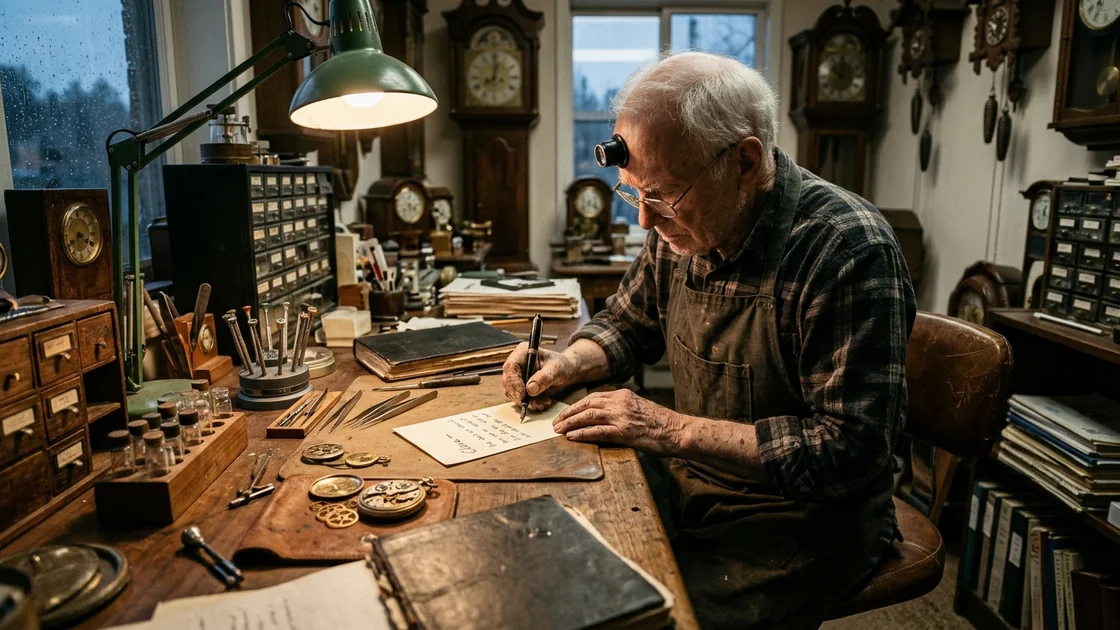
Arthur Pendelton is a master horologist who has spent his life repairing the intricate gears of antique timepieces, only to find the delicate mechanisms of his own mind slipping out of alignment due to early-onset dementia. As his daily reality fragments and familiar faces begin to blur, he retreats to his dusty workshop to embark on one final, desperate project before the fog consumes him entirely. Throughout the seasons of a single vanishing year, Arthur hides dozens of handwritten notes inside the casings of clocks, beneath floorboards, and within the pages of books for his devoted wife, Clara, to find after he is no longer himself. Though the disease ultimately claims his ability to recognize the woman he has loved for forty years, his hidden trails of paper and ink ensure that his devotion remains wound tight, ticking steadily onward long after his memory stops.
I. The Slipping Escapement
The mainspring of a late-nineteenth-century Patek Philippe pocket watch is a coiled ribbon of high-carbon steel, tempered to a precise blue hardness and housed within a brass barrel no wider than a wedding band. When wound, it holds potential energy—a quiet, stubborn tension waiting to be released by the steady, rhythmic interrogation of the escapement. If a single tooth on the escape wheel is worn down by even a fraction of a millimeter, the impulse fails. The pallet fork slips. Time does not stop, precisely, but it stutters. It loses its anchor.
Arthur Pendelton held the brass barrel between the tips of his Dumont tweezers, his right eye pressed against the black plastic rim of a ten-power loupe. Outside the tall, rain-streaked windows of his shop on Elm Street, an October twilight was settling over the cobblestones, turning the wet slate roofs of the town the color of tarnished pewter. Inside, the only light came from the green-shaded gooseneck lamp bolted to his scarred walnut workbench, throwing a harsh, circular pool of illumination over a landscape of micro-screws, jewel bearings, and disassembled balance bridges.
He breathed shallowly through his nose, a habit cultivated over forty-two years at the bench so that a stray exhale wouldn't send a hairspring skittering into the sawdust on the floor.
He reached with his left hand for the vial of synthetic ruby oil. His fingers met empty wood.
Arthur frowned, the skin around his loupe crinkling, and pulled his head back. The sudden shift in focal length made the room swim for a second—a brief, nauseating heave of shadows before the bookshelves and the rows of wall clocks snapped back into their proper places. The vial wasn't in the notched wooden block where it had lived since the Carter administration. Neither was his oiling needle, the one with the red anodized handle.
"Clara?" he called out, his voice raspy from hours of silence.
There was no answer, only the polyphonic, unsynchronized chorus of forty-seven mechanical clocks ticking against the plaster walls. Regulators, cartel clocks, Black Forest cuckoos with their weights hanging like pine cones, marine chronometers suspended in brass gimbals—they all chewed away at the evening with a dry, insectile persistence. Tick-tack, tick-tack, tock-tick. Usually, the sound was a comfort, the audible proof of an ordered universe where friction could be mitigated by oil and gravity could be compensated for by a tourbillon cage. Tonight, the noise felt crowded. Irritating.
Arthur stood up, his knees popping like dry twigs under his canvas apron. He walked out from behind the counter, passing the glass display cases filled with trench watches and silver chatelaines, and pushed through the heavy velvet curtain that separated the shop from the back parlor.
The room smelled of rosemary and roasted parsnips. The small radio on the sideboard was playing a cello suite, the volume turned down so low it was mostly just the hum of the vacuum tubes and the occasional deep scrape of a bow.
Clara was standing at the kitchen sink, her silver-streaked braid resting over one shoulder as she peeled apples into a colander. A long ribbon of red skin spiraled down from her paring knife.
"Did you come into the shop this afternoon?" Arthur asked, leaning against the doorframe.
Clara turned, her face brightening with that immediate, unguarded warmth that had first undone him in the spring of 1978, when she had walked into his father’s shop with a broken sovereign-case pendant watch and rain dripping from the brim of her yellow hat. Then, she saw the tightness around his mouth, and the brightness softened into something more careful.
"No, love. Not since I brought you your tea at two. Why?"
"My oil," he said, gesturing vaguely back toward the curtain. "The red-handled needle and the Moebius 9010. Someone’s moved the block."
Clara set the knife down on the porcelain drainboard and wiped her hands on her apron. "Are you sure you didn't put it in the ultrasonic cleaner? Or the top drawer with the mainspring winders?"
"Why would I put oil in the winder drawer?" The sharpness in his own voice surprised him. He swallowed, rubbing the bridge of his nose where the loupe had left a red indentation. "It stays on the right-hand corner of the bench. Right next to the pith wood. Forty years, Clara. I don't just move my bench layout."
"I'll help you look," she said gently, stepping past him. As she brushed against his arm, she laid a cool, damp hand against his cheek. "You've been at that Patek since eight this morning, Arthur. Your eyes are bloodshot."
"It's for Judge Miller's grandson. He wants it for the rehearsal dinner on Friday."
They walked back into the shop. The smell of old brass, whale oil, and cedar dust was thicker here. Clara went straight to the workbench, her eyes scanning the organized chaos. She didn't touch anything—that had been the first rule of their marriage, established long before they bought the building from his father's estate—but after a moment, she pointed toward the small cast-iron radiators under the front window.
Sitting on the marble sill above the radiator, next to a dead geranium in a clay pot, was the wooden block. The little glass vials were lined up neatly inside it, alongside a half-eaten butter biscuit on a saucer.
Arthur stared at it. The glass of the window behind the sill was black now, reflecting the two of them: an tall, stoop-shouldered man with a fringe of white hair, and a smaller woman in a blue cardigan watching him with an expression she was trying very hard to keep blank.
"You were looking out at the street when the school buses went by," Clara said softly. "When I came for the teacup, you were standing right there. You must have had it in your hand."
Arthur walked over and picked up the block. The wood was warm from the radiator. Heat ruined viscosity; any apprentice knew that. You never put synthetic lubricants near a heat source. He looked at the biscuit on the saucer. He didn't remember eating half a biscuit. He didn't remember the school buses, which were bright yellow and loud and always rattled the loose pane in the transom window when they shifted gears at the corner of Elm and Third.
How did a man lose a forty-foot yellow bus?
"I must have been checking the light," Arthur muttered, though the lie tasted like tin in his mouth. You didn't check the color of synthetic oil against a gray October sky. He carried the block back to the bench and sat down heavily on his leather stool. "Thank you. Go on back to your apples. I'll be thirty minutes."
Clara lingered by the velvet curtain. "Arthur..."
"Thirty minutes, Clara. I just need to oil the pallets and set the beat."
When the curtain fell shut behind her, Arthur didn't pick up the red-handled needle. Instead, he pulled open the deep bottom drawer on the left side of his knees—the one where he kept old supplier catalogs from Geneva and scrap brass stock. Tucked beneath a 1994 Boley catalog was a small, black leather-bound ledger with grid-lined pages. He had bought it three months ago at the stationer’s two streets over, paying in cash so it wouldn't show up on their joint bank statement, though why he had felt the need to hide the purchase of a seven-dollar notebook, he couldn't quite articulate.
He flipped past the first three pages. They contained a sparse, clinical inventory of his own misfires:
July 14 — Forgot the combination to the floor safe. Had to look it up in Dad's old Bible. (It is Clara's birthday, 04-19-56). August 2 — Called the hardware man 'Miller' instead of 'Henderson.' Known him twenty years. August 19 — Left the soldering iron plugged in all night. Scorched the bench mat. September 8 — Couldn't remember the word for 'collet.' Called it the 'little brass collar thing' to a customer. September 29 — Drove to the post office on Pine. Sat in the car for ten minutes because I didn't know if I was arriving or leaving.
Arthur uncapped his fountain pen—a heavy black Pelikan that had belonged to his grandfather—and wrote in his neat, upright draftsman’s hand:
October 12 — Put the Moebius block on the radiator. No memory of standing by the window.
He stared at the wet ink. In horology, there was a phenomenon known as magnetism. If a watch came too close to a dynamo or a heavy electrical field, the steel coils of the hairspring would stick together. The watch wouldn't stop dead; instead, it would run wildly, erratically fast, skipping whole hours, until the mechanism simply choked on its own haste. To fix it, you had to pass the movement through an alternating current demagnetizer to scramble the poles back into neutrality.
There was no demagnetizer for whatever was happening behind his forehead.
He turned to the back of the ledger, to the very last page, and wrote something different. It wasn't a log entry.
Clara, he wrote, the nib scratching softly against the paper. If you find this book, it means the gear train is stripping further down than I hoped. I am going to start leaving things for you. Not because you don't know how to wind the house, or because you don't know what you mean to me. I am leaving them for me, too, so that the man who sits in this chair today can still speak to you when the man who sits in it tomorrow doesn't know his own tongue.
He blotted the page, closed the ledger, and slid it back under the Boley catalog. Then he picked up his loupe, screwed it into his eye socket, and went back to the Patek Philippe.
II. The Diagnosis of Friction
Dr. Aris Thorne had a Rolex Submariner on his left wrist—a modern one with a ceramic bezel that Arthur found vulgarly oversized—and a framed print of a sailboat on the wall behind his head. The office smelled of rubbing alcohol and the lemon polish they used on the laminated cabinetry.
"The MRI shows some mild, generalized cortical atrophy, predominantly in the temporal and parietal lobes," Dr. Thorne said, turning his computer monitor slightly so Arthur and Clara could see the grayscale cross-sections of Arthur’s skull. It looked to Arthur like a walnut that had dried out in the shell, the dark spaces between the convoluted ridges wider than they ought to be. "Combined with the cognitive battery we ran last Tuesday, and the history you've both provided, we are looking at early-onset Alzheimer's disease."
Beside him, Clara’s hand tightened around his fingers. Her skin was freezing. She hadn't worn gloves on the drive into the city, despite the November frost on the windshield.
"Early-onset," Arthur repeated. He was sixty-two. His father had worked the bench until seventy-eight, dropping dead of a massive coronary while eating a ham sandwich, his mind as sharp as a gravers-point until his heart simply unhooked itself. "Isn't that for people in their forties?"
"Anything under sixty-five falls under that classification," Dr. Thorne said. He had a practiced, measured baritone, the voice of a man who spent his days dropping anvils into small rowboats and watching people try to keep them afloat. "And in many ways, Arthur, the fact that you've come in so early is an advantage. Your baseline vocabulary and visuospatial skills—likely from your profession—have masked the deficit for a year or two. We call that cognitive reserve. We can start you on a cholinesterase inhibitor today. Donepezil. It doesn't stop the underlying progression, I want to be transparent about that, but it can help the neurotransmitters bridge the gap for a while."
"How long is a while?" Clara asked. Her voice didn't tremble. She had always been like that; when their daughter, Sarah, had broken her collarbone falling out of the neighbors' crabapple tree at age eight, Clara had driven to the emergency room with the steadiness of an ambulance driver, only sitting down on the linoleum to weep after the plaster cast was set.
Dr. Thorne looked at his hands, the heavy steel links of the Rolex catching the fluorescent light. "Every clock runs at its own speed, Mrs. Pendelton. Some patients plateau for two or three years with minimal decline. Others move through the stages more rapidly. Given that Arthur is already experiencing short-term episodic blackouts and occasional aphasia..." He trailed off, letting the silence do the heavy lifting. "You should make sure your legal and financial affairs are in order this winter. And you should talk to your daughter."
The drive back from the hospital took forty minutes along the river road. The trees were bare now, gray ribs against a sky the color of dirty wool. The river itself was high and brown, carrying mats of dead leaves toward the dam at Miller’s Falls.
Neither of them spoke until they passed the old brick textile mill outside of town.
"We won't tell Sarah until after Christmas," Arthur said, watching the empty brick windows of the mill flash by. "She’s got the twins' first birthday in December, and David is up for that partnership at the firm in Chicago. There's no sense spoiling their holidays."
"Arthur, she's your daughter," Clara said, her hands at ten and two on the steering wheel. He had let her drive home. He had walked out to the passenger side in the hospital parking lot without even thinking about it, a small, quiet surrender that had made his stomach turn once he buckled the belt. "She’ll want to know."
"She’ll want to fix it," Arthur corrected gently. "She’s like you. She’ll start reading medical journals at three in the morning and calling clinics in Boston. Let her have November and December. It won't change the MRI."
Clara didn't argue, which told him how frightened she was. When they pulled into the gravel driveway behind the shop, she turned off the ignition, and the sudden quiet inside the Subaru was immense.
"I don't know how to run the shop without you," she whispered, staring straight ahead at the peeling white paint of the garage doors. "I know the books. I know how to order watch bands and replace batteries in the quartz junk. Look at me, Arthur—I don't know a balance staff from a winding stem."
Arthur unbuckled his seatbelt and leaned across the center console, taking her chin in his hand and turning her face toward him. Her eyes were gray, the color of slate after a summer rain, with small flecks of gold near the pupils. He studied them with the fierce, memorizing intensity he usually reserved for sixteenth-century fusee chains.
"You won't run the shop," he said. "After the New Year, I’ll finish what’s in the safe, and I’ll call young Lucas over in Hendricks. He’s been wanting to expand his repair trade. He’ll buy the parts cabinets, the lathe, and the staking set for a fair price. We have the building, Clara. We can rent the storefront to that woman who sells the artisanal soaps, or the fellow with the rare books. The pension funds and the house are paid."
"That's not what I mean," she said, and then her face crumpled, the careful masonry of the afternoon giving way all at once. She pressed her forehead against his collarbone, her shoulders hitching under her wool coat. "That's not what I mean at all, you foolish old man. What am I supposed to do when you look at me like I'm a customer?"
Arthur wrapped his arms around her, smelling the lavender soap she used and the sterile, hospital-corridor scent that had clung to their coats. He looked over her shoulder through the car window at the back door of their house—the brass doorknob he had polished every spring, the storm door with the slightly warped aluminum frame that you had to lift by the handle to get it to latch properly.
Lift the handle to latch the back door, he thought. Write that down. No—she knows that. She’s lived here forty years. I’m the one who’s going to forget to lift the handle.
That night, after Clara had finally fallen into an exhausted, twitching sleep beside him, Arthur slipped out from under the down quilt. The floorboards in the upstairs hallway had a specific geography of sound; he knew by muscle memory to step near the baseboards to avoid the loud groan outside the linen closet.
Down in the shop, he didn't turn on the overhead lights. He used only the green bench lamp.
He didn't open the black ledger this time. Instead, he pulled a pad of heavy, acid-free archival paper from the bottom of the bookcase—the kind he used for drawing diagrams of obsolete French striking mechanisms before taking them apart, because standard wood-pulp paper yellowed and turned brittle within a decade, its own acid eating it from the inside out.
He cut a strip of the archival paper, three inches by five inches, using his brass straight-edge and an X-Acto knife.
Where would she look when things got bad? Not now, not next month, when he was just losing his keys or forgetting the name of the postman. Where would she go when the house felt empty even while he was sitting in the armchair in the corner?
He stood up and walked into the kitchen, carrying the slip of paper and his fountain pen. The moonlight coming through the window over the sink turned the porcelain blue.
In the pantry, on the highest shelf behind the Mason jars of dried bay leaves and the extra bags of flour, sat the heavy silver tea service that had belonged to Clara’s mother. They only took it down twice a year: Christmas Eve and their wedding anniversary in June. It was wrapped in dark blue Pacific Silvercloth to keep the sulfur in the air from tarnishing it.
Arthur leaned against the butcher-block counter and wrote on the heavy paper:
June 14, 1981. It rained so hard the tent at my cousin’s farm collapsed into the potato salad, and we spent our wedding night in that terrible motel outside of Rutland where the radiator banged like a blacksmith’s anvil until dawn. You wore a daisy chain in your hair because we couldn't afford veil lace, and when the petals wilted from the humidity, you laughed and said you were shedding like a dandelion. I loved you then with the terrifying, greedy love of a young man who thought he had eighty years in his pocket. I love you now with the quiet certainty of an old man who knows the value of a single minute. Polish the teapot with the Wright’s cream under the sink, not the liquid dip—the dip eats the soldering around the spout. — A.
He folded the square of paper once, stood on the little wooden step-stool, and slipped the note inside the belly of the silver teapot.
It was the first of the anchors.
III. The Winter Inventory
By January, the snow had piled high against the lower panes of the shop windows, filtering the morning light into a strange, subaqueous glow. The sign on the front door now read BY APPOINTMENT ONLY, and the velvet trays in the display cases were mostly bare, save for a few stray pocket watches whose owners hadn't yet come to claim them.
The Donepezil gave Arthur vivid, mechanical dreams and a persistent, low-grade nausea in the mornings, like he had swallowed a copper penny. Whether it was holding back the tide, he couldn't say. The tide was a sly thing. It didn't come in like a wall of water; it seeped up through the floorboards while you were looking the other way.
He found that his hands still knew their business long after his tongue had abandoned him.
On a Tuesday in mid-January, a man named Peterson came in to pick up an eighteenth-century verge fusee pocket watch—a thick, turnip-shaped thing in a silver pair-case. Arthur had spent three weeks fabricating a new chain for it, linking microscopic bits of steel together under the microscope because nobody made fusee chains anymore.
"Runs like a railway engine now, Mr. Peterson," Arthur said, placing the watch on the leather pad on the counter. He opened the back case so the man could see the pierced, hand-engraved balance cock, where a tiny gilt bird sat among brass foliage, spinning five times a second underneath.
"Incredible work, Arthur. Truly," Peterson said, taking out his checkbook. "My father always said if Pendelton can't fix it, you might as well throw it in the well. How much do I owe you?"
Arthur looked down at the repair ticket tied to the watch bow with red string. He had written the figures himself the night before. There was a 4, a 5, and a 0.
He opened his mouth to say Four hundred and fifty dollars.
What came out was, "The weight on the cord."
Peterson paused, his pen hovering over the check. "Pardon?"
Arthur stared at the numbers. 4-5-0. He knew what they meant. They represented eighteen hours of labor at the lathe, a strip of Swedish spring steel, and a new bull's-eye crystal imported from London. He could see the quantity in his mind—four stacks of a hundred, half a stack more—but the words for the digits had vanished behind a thick, gray curtain.
"The..." Arthur tapped the ticket with a fingernail that had a crescent of brass filings permanently embedded under the quick. He felt a sudden, hot prickle of sweat break out under his arms. The forty-seven clocks on the walls seemed to double their volume. Tick-tack-tick-tack. "You have the number there. On the tag."
Peterson looked up, his brow furrowing. He was a retired school principal; he knew the look of a man stalling at the blackboard. Slowly, he reached over and turned the little cardboard tag toward himself. "Four-fifty. Right. Of course."
He wrote the check quickly, tore it out with a sharp zip of paper, and laid it on the counter. "Take care of yourself in this cold, Arthur. My best to Clara."
When the brass bell above the door jangled shut, Arthur stood frozen behind the counter for five minutes. Then he walked over to the front door, flipped the cardboard sign from BY APPOINTMENT to CLOSED, and threw the deadbolt.
He didn't tell Clara about Peterson. Instead, that afternoon, while she was at the grocery store with Sarah—who had come up from Chicago for a long week after they finally broke the news to her in early January, her eyes puffy and red behind her tortoiseshell glasses—Arthur went to work on the house.
He had realized something crucial during the incident with the check: the disease attacked nouns first, and then sequences. A watch movement is nothing but nouns and sequences. If you remove the barrel bridge before letting down the power on the ratchet wheel, the stored tension will explode through the gear train, shearing off the pivots of the third and fourth wheels in a millisecond.
Life in the old house on Elm Street had its own ratchet wheels.
He took twenty sheets of the archival paper and cut them into uniform rectangles. For the first batch, he didn't write love letters. He wrote a manual for the machine of their life, hiding them in the places where seasonal maintenance occurred—places Clara would only visit when the weather turned and she realized Arthur was no longer reminding her.
He went down into the cellar, his flashlight beam cutting through the damp, earthen smell of the fieldstone foundation. Attached to the main copper water pipe leading out to the garden hose bib was a brass lever valve, stiff with green verdigris.
He tied a piece of waxed horological twine through a hole punched in the corner of a card and looped it around the pipe:
Clara — This is the shut-off for the outside spigot behind the lilacs. Turn it clockwise until it stops before the first hard freeze in November, then go outside and open the tap so the trapped water drains out. Remember the winter of '96 when I forgot and the pipe burst behind the drywall in the laundry room? You stood in two inches of freezing slush in your nightgown holding a bucket while I looked for the wrench. Don't let the house do that to you again. Also: the box on the shelf behind the furnace isn't junk; it’s your grandmother's crystal punch glasses. I put them there when we painted the dining room five years ago and never brought them back up. — A.
He climbed the cellar stairs, his breath coming a little short, and went up to the second floor. In their bedroom, stood the tall walnut tall-case clock—a grandfather clock made by Eli Terry in Connecticut around 1810. It was the heart of the house. Its pendulum was forty inches long, beating once per second with a deep, resonant thrum... thrum... thrum that you could feel through the floorboards in your bare feet.
Arthur opened the narrow waist door of the clock case. The two heavy cast-iron weights hung on brass pulleys, one for the time train, one for the hourly strike.
On the inside of the wooden door, pasted there in 1924 by his grandfather, was a yellowed paper label showing the lineage of the clock’s repairs. Below it, using wheat-starch paste that wouldn't damage the antique mahogany veneer, Arthur glued a large sheet of his archival paper.
How to Keep the Terry Running, he titled it.
1. Every Sunday morning before church, put the brass crank key into the right-hand arbor first. Wind counter-clockwise until you feel the leather stop touch the seat. Do not force it. 2. If you don't want to hear it chime in the night when you can't sleep, do NOT just let the left weight run down—it throws the rack and snail out of phase. Instead, reach up beside the dial at the three o'clock position; there is a tiny brass wire lever hidden against the wood. Push it up half an inch. That is the strike-silent. 3. If the clock stops altogether when I am gone, let it stop. Do not feel guilty. It has ticked through the War of 1812, the Civil War, and the forty-odd years you and I have slept in this room. It has done its work. It is only brass and pine, Clara. You are the one that matters.
He was smoothing down the edges of the paper with a clean rag when he heard a floorboard creak behind him.
He turned. Sarah was standing in the bedroom doorway, holding a basket of folded towels against her hip. She looked remarkably like Clara had at thirty-four, though she had Arthur’s long, narrow hands and his habit of tilting her head slightly to the left when she was trying to figure out how something was put together.
She looked from his paste pot on the dresser to the open door of the grandfather clock.
"Dad?" she said softly. "What are you doing?"
Arthur wiped his sticky fingers on his apron—he still wore the apron all day now, even though the shop was closed; the front pockets were where he kept his pen, his glasses, and a laminated card Clara had made with his name, address, and her cell phone number on it.
"Just updating the service log," he said, nodding toward the clock.
Sarah set the laundry basket down on the bed and walked over. She leaned in and read the third paragraph before he could swing the mahogany door shut.
She stood very still for a long time. The Terry clock went thrum... thrum... thrum between them, the brass pendulum bob catching the gray winter light from the window at the end of each arc.
When she turned back to him, her eyes were bright with unshed tears, her lower lip caught between her teeth. "How many of these have you written?"
Arthur looked at his daughter. He remembered, with sudden, blinding clarity, the night she was born—how small her heel had felt in the palm of his hand, no bigger than a silver pocket-watch case, and how terrified he had been of dropping her because human beings didn't come with spare parts. He was glad he still had that memory. He held onto it with both hands, squeezing it in his mind like a warm stone.
"A few," he admitted in a low voice, glancing toward the hallway. "Your mother is downstairs?"
"She’s putting the groceries away." Sarah reached out and touched the wet edge of the paper inside the clock door. "Dad... this is..."
"It’s a failsafe," Arthur said. "In a marine chronometer, Sarah, as the mainspring unwinds over fifty-six hours, it loses force. If you don't compensate for that loss of torque, the watch runs slower at the end of the day than at the beginning. So the old makers invented the fusee—a cone-shaped pulley with a spiral groove that changes the leverage as the spring weakens, keeping the power constant until the very last turn." He tapped his own temple lightly with one knuckle. "My spring is unwinding. I'm just cutting grooves in the cone while I still have the tools."
Sarah let out a sound that was half-sob, half-laugh, and threw her arms around his neck. She was warm and smelled of the winter air outside and some sweet, floral shampoo. "You're so stubborn," she whispered fiercely into the wool of his shoulder. "You're the most stubborn man in the state."
"Don't tell your mother about the notes," Arthur murmured into her hair. "Not yet. If she finds them now, it'll just break her heart twice. Let her find them when she needs them."
"Where are they?"
"In the places she goes," he said simply. "Wait here a second."
He walked over to his dresser, opened the small cherrywood box where he kept his cufflinks and tie pins, and lifted out the false velvet bottom. Underneath lay a sealed cream-colored envelope with Sarah written across the front in his draftsman's script.
He handed it to her. "Put that in your suitcase. Don't open it on the train back to Chicago. Wait until... well. You'll know when."
Sarah looked down at her name on the envelope, her thumb tracing the black ink. "I'm going to come up every second weekend, Dad. David says he can handle the boys from Friday to Sunday."
"You'll do no such thing," Arthur said firmly. "You have two one-year-olds and a husband. I don't want my grandsons growing up remembering their mother on a train every weekend going to watch an old man forget how to tie his shoes. Come in the spring when the garden is up. Bring the boys so I can see them walk on the grass."
IV. The Spring Great Wheel
By April, the world had shrunk to the perimeter of the backyard iron fence and the three rooms on the ground floor of the house.
Lucas, the young watchmaker from Hendricks, had come in late February with a rented box truck and two burly cousins. Arthur had sat in the parlor with the velvet curtain drawn shut while they dismantled his bench and carried out the heavy cast-iron Boley lathe, the oak cabinets with their hundreds of tiny drawers labeled Staffs, Stems, Mainsprings, and Hands, and the thirty-odd clocks from the walls that belonged to the shop's inventory rather than the family.
Clara had wanted him to go for a drive while they loaded the truck, thinking the sound of his life's work being wheeled out on dollies would be too much to bear.
"No," Arthur had said, sitting in his wingback chair with a cup of tea going cold on his knee. "A captain stays on the bridge when they scuttle the ship, Clara."
In truth, he had been partly relieved. For the last three weeks before Lucas came, the shop had become a room of accusations. Every tool he looked at was a word he couldn't quite reach. Broach. Reamer. Poising tool. Sometimes he would go in there at twilight and stand in the middle of the floor, surrounded by the ticking, and feel a cold, crawling terror that he had left a customer’s watch open on the bench, though the bench had been cleared since Christmas.
Now, the front room was empty and smelled of Murphy's Oil Soap. They hadn't rented it out yet; Clara said she didn't want strangers walking through the front yard while the lilacs were coming in.
The disease was no longer a thief that came in the night; it was a roommate who never left.
Arthur began to experience what Dr. Thorne had called sundowning. While the morning sun was streaming through the kitchen windows, Arthur was mostly Arthur—slower, quieter, preferring to listen to Clara read the newspaper aloud rather than wrestling with the print himself, which had begun to wriggle on the page like black ants. He could still peel potatoes, provided she handed him the peeler, and he could still walk the brick path in the garden and point out where the hostas were poking their tight green spears through the mulch.
"We need to split those this year," he told her on a Tuesday morning in late April, pointing with his cane at a dense clump of variegated leaves under the birdbath. He used the cane not because his legs were weak, but because his depth perception had grown treacherous; a shadow across the bricks looked to his brain like a trench two feet deep. "If you don't dig them up with a spade and cut the crown in half every four years, they choke themselves out."
"We'll do it Saturday," Clara said, walking beside him with her hand tucked into the crook of his elbow.
But when four o'clock came, and the light began to slant long and yellow across the parlor rug, the compass needle inside Arthur’s head started to spin.
Shadows became people standing in the hallway. The reflection of the reading lamp in the glass front of the china cabinet looked like a small fire burning in the yard next door. And a terrible, nameless urgency would settle into his chest—the conviction that he was late for an appointment, or that someone was waiting for him at a train station he couldn't name.
He still wrote, though he had to do it before noon.
By ten o'clock each morning, while Clara was upstairs making the beds or in the basement doing the wash, Arthur would take out his dwindling supply of archival paper. His handwriting had changed. The neat, architectural block letters of October had loosened, the loops of the ls and hs leaning forward like trees in a high wind, and occasionally he would write a word twice—the the—without realizing it until he read the sentence back.
He hid them closer to the surface now. He didn't trust himself to climb the cellar stairs alone or stand on the kitchen stool to reach the top of the pantry.
He slid one beneath the soil rim of the jade plant on the dining room windowsill—a massive, woody specimen they had grown from a single leaf clipping a neighbor had given them when they moved in:
Clara — You always overwater this in the winter because you feel sorry for it when the radiator is on. Let the leaves get a little thin and wrinkly before you give it a drink. Do you remember when Sarah was three and she buried my gold Omega seamaster in this pot because she wanted to 'grow more watches' for me? I found it three days later when I heard the automatic rotor clinking as you carried the pot to the sink. It kept perfect time under the dirt. We were so tired back then, Clara, with the mortgage and the shop repairs keeping me up till midnight, and I don't think I told you enough how beautiful you were with potting soil on your nose and that little girl on your hip. — A.
He slipped another inside the zippered lining of his own heavy winter wool coat hanging in the front hall closet, knowing that one day—next autumn, or the autumn after—she would finally pack his clothes into cardboard boxes to give to the veterans' charity:
Don't give this coat to the charity shop without checking the left inside pocket first. No, there’s nothing in it right now—I just know you’ll smell the cedar and the pipe tobacco I stopped smoking in 1998 and you’ll stand here in the hallway and cry. Go make yourself a cup of Earl Grey with the honey from the farm stand. Put on that recording of Glenn Gould playing the Goldberg Variations—the 1981 one where he plays it slow, not the 1955 one where he’s in a rush. Sit in the sun by the bay window. I am not in the coat, my darling. I am in the light on the floorboards.
One morning in early May, he was sitting at the dining room table, trying to write a note to put inside her sewing basket.
He wanted to write about her blue silk dress—the one she had worn to Sarah’s college graduation, and how a button had popped off at the restaurant, and how he had fixed it temporarily using a tiny brass cotter pin from his pocket repair kit.
He got as far as: Clara, the blue dress with the
Then the pen stopped.
He stared at the paper. What was the word for the round things that held a shirt closed? He could see it. It was pearl-colored, with four little holes in the middle for the thread. He looked down at his own flannel shirt. He touched the plastic disk on his chest.
"Flange," he whispered aloud. No. That was brass. "Collet. Jewel. Click-spring."
A tear of pure, scalding rage dropped from the end of his nose and hit the archival paper, making the black ink of with the feather out into a gray spiderweb.
His hand shook so badly the Pelikan pen rolled across the mahogany table and dropped onto the Oriental rug. He bent down to pick it up, lost his balance on the edge of the chair, and went down hard onto one knee, his shoulder striking the sideboard. The silver sugar bowl rattled on its tray.
"Arthur!"
Clara’s footsteps pounded down the stairs. In seconds she was on her knees beside him on the rug, her hands frantic on his shoulders, checking his head, his glasses. "Arthur, are you hurt? Did you get dizzy?"
"I don't know the word," he gasped, his face pressed against the wool of her cardigan. He was holding the scrap of paper in a fist, crumpling it so she wouldn't see. "I have it in my fingers, Clara, I can see the four holes in it, and the name is gone! The whole goddamn drawer is empty!"
"Shh, shh, it's alright," she murmured, rocking him right there on the dining room floor while the morning sun poured mercilessly over the table. "We don't need words right now. Just sit with me a minute. Just breathe."
When she finally helped him back into his chair and went to the kitchen to get a wet cloth for his face, Arthur smoothed out the crumpled, tear-stained paper with the heel of his palm. He couldn't finish the sentence. The thought had shattered like a dropped glass crystal, the shards too small to glue back together.
Beneath Clara, the blue dress with the, he simply drew a small, neat circle with four dots inside it, and below that, he wrote: I love you. — A.
He leaned over and dropped the mangled note into the bottom of her wicker sewing basket beside the chair, covering it with a skein of red darning wool just before she came back into the room.
It was the last note he ever wrote.
V. The Unwound Summer
By July, the house was full of blue painter's tape.
Clara had read somewhere—in one of the thick, terrifying paperbacks Sarah had brought from Chicago with titles like The 36-Hour Day—that labels helped preserve autonomy. So there were neat strips of blue tape stuck to the birch cabinets in the kitchen: PLATES. MUGS. SPOONS AND FORKS. TEA. There was a strip on the bathroom door, and a strip over the light switch that said DOWN FOR OFF.
Arthur didn't read them very often. Print had become an ornate decoration, like the scrollwork on an old silver case—pretty to look at, signifyng effort, but carrying no message.
He spent most of his days in the small fenced garden at the back of the house, sitting in an Adirondack chair under the shade of the old apple tree. He liked the apple tree because its leaves moved in a way he could still understand. When the wind blew from the river, they turned their pale bellies up; when the wind died, they went dark green again. There was no sequence to forget.
He always kept an old movement in his hands. Clara had saved a half-dozen junk pocket-watch movements from Lucas's purge—big, chunky American Waltham and Elgin 16-size mechanisms from the 1920s, with the mainsprings already removed so he couldn't hurt himself if a tool slipped.
He didn't have tools anymore, anyway, just a brass magnifying glass on a ribbon around his neck and his own thumbs. He would sit for hours, turning the brass plates over and over in the sunlight, watching the little red synthetic rubies catch the glare like drops of pomegranate juice, spinning the balance wheel with the tip of his forefinger just to watch it oscillate back and forth for three seconds before dying.
Sometimes, a woman would come out of the house with two glasses of lemonade on a tin tray.
She was an older woman, with a silver braid pinned up in a crown around her head and kind, tired gray eyes. Arthur always stood up when she approached, because his father had taught him that a gentleman does not remain seated when a lady enters the parlor, though his knees made a terrible fuss about it.
"Good afternoon," he would say politely, nodding toward the empty chair beside him. "Won't you sit down? It's very pleasant out here out of the glare."
The woman’s smile always did a strange, fluttering thing at the corners when he said that, like a bird trying to land on a wire in a gale.
"Thank you, Arthur," she would say, setting the tray on the little cedar table between them. "I'm Clara. I brought you something cold."
Clara. He knew the name. It was a heavy, golden word in his head, like Sunday or Home. When he heard it, he felt a warm expansion behind his breastbone, a sense of absolute safety, as if someone had just locked the front door against a blizzard. He wasn't always entirely sure if this nice woman in the blue apron was the Clara—the Clara in his head had dark hair that smelled of rainwater and wore a yellow hat, and sometimes he worried that girl was still waiting for him down by the pharmacy on Main Street—but this woman had the same hands. He knew the small white scar across the knuckle of her left thumb where a paring knife had slipped forty years ago.
One stifling afternoon in late August, when the cicadas in the elm trees were buzzing like a thousand dry mainsprings uncoiling at once, the woman was kneeling in the dirt near the birdbath, wrestling with a garden spade.
She was trying to dig up a massive clump of green-and-white striped leaves, grunting with the effort as the steel blade bounced off the tangled roots in the baked summer clay.
Arthur watched her from his chair, his thumb rubbing the brass plate of the old Elgin in his lap.
"Too dry," he said clearly.
Clara stopped, wiping her forehead with the back of her gardening glove. She looked over at him, her chest heaving. "What's that, love?"
"Wait for the rain," Arthur said, pointing at the green spears. For a second, a tiny shutter clicked open in the dark room of his brain, letting in a shaft of clean, sharp light. "Or soak the crown with the hose for an hour first. And you need the sharp nursery spade with the flat toe, not the round dirt shovel. You'll bruise the tubers."
Clara stared at him. The cicadas buzzed on. Slowly, she let go of the shovel handle, her eyes widening. "Arthur?"
He blinked. The shutter clicked shut again. The light vanished. He looked down at the brass circle in his hand, wondering why he had pointed at the weeds. "It's a seventeen-jewel," he told her mildly, holding up the Elgin. "Adjusted to three positions. Very reliable for a railroad man."
Clara stayed on her knees in the grass for a moment longer. Then she stood up, walked over to his chair, and knelt beside the wooden armrest, laying her cheek against his thin, blue-veined hand where it rested on the wood.
"Yes, it is," she whispered, her breath warm against his knuckles. "You always kept them running so well."
He patted her silver hair with his free hand, because she seemed a little sad, and he didn't like it when the lady with the lemonade was sad. "Don't fret," he told her kindly. "My wife will be home from the shop soon. She knows how to make tea for a headache."
VI. The Perpetual Calendar
October came back around, bringing the smell of woodsmoke from the chimneys along Elm Street and the loud, rattling yellow buses that shook the loose pane in the transom window every afternoon at three-fifteen.
Arthur no longer went upstairs to sleep under the tall Eli Terry clock. The stairs had become a mountain range he could not navigate; they had moved a hospital bed with wooden side-rails into the back parlor, right where his wingback chair used to be, so he could look out through the glass doors at the apple tree.
A woman named Brenda came for four hours every afternoon now—a broad-shouldered, cheerful Jamaican woman in lavender scrubs who called Arthur Mr. P and sang hymns under her breath while she helped him bathe and changed the sheets.
It was on a Thursday, while Brenda was sitting beside Arthur in the parlor reading him the Psalms—he liked the cadence of the King James, even if he couldn't follow the plot—that the temperature dropped sharply. The sky over the slate roofs turned the bruised purple of a tempered steel spring, and the first freezing rain of the season began to lash against the windows.
Clara stood in the kitchen, looking out at the garden. The hostas were yellowing mush now. The birdbath was overflowing with gray water.
"The pipes," she murmured aloud.
Every October, Arthur went down into the cellar with a flashlight and a wrench to do something to the water pipes so they wouldn't freeze behind the laundry room wall. She had lived in this house since she was twenty-four years old, and she had never once done it herself.
She felt a sudden, rising panic—the specific, sharp loneliness of the survivor who realizes the division of labor in a long marriage is also a division of memory. Half of how to keep their world standing had been stored in a vault to which nobody else had the combination.
She opened the cellar door, flipped the switch, and walked down the narrow wooden stairs into the cool, earthen smell of the foundation.
She followed the copper pipes along the low ceiling joists until she reached the wall below the lilac bushes. There was the brass lever valve.
And hanging from it, tied with a loop of waxed watchmaker’s twine, was a stiff rectangle of cream-colored paper.
Clara stopped. Her heart gave a hard, slow thud against her ribs.
She reached up with trembling fingers and untied the twine. Standing under the single bare forty-watt bulb of the cellar, with the rain drumming against the high casement window above her head, she read the neat, upright handwriting:
Clara — This is the shut-off for the outside spigot behind the lilacs. Turn it clockwise until it stops before the first hard freeze in November...
She read the whole thing twice. When she got to the part about the winter of '96—You stood in two inches of freezing slush in your nightgown holding a bucket while I looked for the wrench—she pressed the back of her hand against her mouth to keep the sound in, so Brenda wouldn't hear her from upstairs and come running.
He had been down here in the dark last winter. While he was losing his nouns, while he was terrified of what was coming, he had come down into the cold cellar to make sure she wouldn't have to stand in the slush again.
She turned the brass lever clockwise until it stopped. Then she walked over to the shelves behind the furnace and pulled down the dusty cardboard box he had mentioned. Inside, wrapped in newspaper from 2018, were her grandmother’s cut-crystal punch glasses, sparkling faintly in the dim light.
Wait.
If there was one here...
Clara carried the note upstairs like a relic. She didn't go into the parlor; she couldn't look at him just yet—couldn't bear the gap between the man who had written Don't let the house do that to you again and the quiet, hollow-cheeked stranger in the parlor bed who smiled politely when she brought him his soup.
Instead, she went upstairs to their bedroom.
The Eli Terry clock stood silent in the corner. It had stopped three weeks ago, after a particularly bad night when Arthur had woken up screaming that there were people in the shop, and Clara had simply forgotten that Sunday had come and gone. She had avoided looking at its dead white face; the silence of the room had felt like a rehearsal for a funeral.
She walked over to the mahogany case, took the small brass key from the finial on top, and unlocked the waist door.
When it swung open, the large white sheet of archival paper greeted her from the inside of the wood.
How to Keep the Terry Running.
Clara sank down onto the edge of the bed, her knees giving way, and read his instructions through a blur of tears.
It is only brass and pine, Clara. You are the one that matters.
She sat there for ten minutes until her breathing steadied. Then she stood up, took the heavy brass crank key from the floor of the case, fitted it onto the right-hand arbor, and began to wind. Clack-clack-clack-clack. The heavy iron weight rose slowly behind the glass, climbing back toward the top of its seven-day journey. She wound the left side. Then she gave the tarnished brass pendulum bob a gentle push with her palm.
Thrum... thrum... thrum.
The heartbeat of the house started up again, vibrating through the soles of her shoes.
Over the next six months, as winter locked the town in ice and then slowly loosened its grip toward March, the house spoke to her in Arthur's voice.
She didn't go hunting for them. She realized early on that tearing the house apart to find them all at once would be like eating the last of the provisions on the first day of a siege. Instead, she let Arthur’s knowledge of her habits deliver them at the exact moment he had calculated.
On Christmas Eve, when Sarah and David and the twins were asleep in the guest rooms, Clara stood on the wooden stool in the pantry and took down her mother’s silver tea service. When she lifted the lid of the teapot and found the note about the collapsed wedding tent in 1981 and the daisy chain in her hair, she sat on the kitchen linoleum for an hour with the silver pot in her lap, weeping not from grief, but from the overwhelming, impossible luxury of being known so completely by another human soul.
In January, when she went to the hall closet to get his heavy coat to lay over his legs for a trip to Dr. Thorne’s office, she found the note tucked inside the zippered lining. That afternoon, while Arthur slept in his bed in the parlor, she bought a jar of clover honey, brewed a pot of Earl Grey, and asked Sarah to find the 1981 Glenn Gould recording on her phone. She sat in the bay window in the pale winter sunlight while the piano notes fell like cold water into the room, holding Arthur’s hand through the bars of the bedrail.
In February, she found the note under the jade plant when she went to turn the pot toward the sun.
In March, when the elbow of Arthur’s favorite blue cardigan finally wore through and she opened the bottom of her wicker sewing basket to look for darning wool, she found the crumpled, water-stained square of paper with the unfinished sentence:
Clara, the blue dress with the
And the little drawing of a button.
That was the one she framed. She put it in a small silver frame on her bedside table, right next to their wedding photograph. To anyone else, it looked like a scrap of waste paper with a child's doodle of a four-hole button. To Clara, it was the bravest thing she had ever seen—the proof that when the language had been stripped from his gears, when the escapement had finally broken entirely, he had still fought through the dark with a broken nib just to leave his mark at her feet.
When the crocuses came up along the brick path in early April, Arthur didn't speak anymore. He lay propped on pillows in the parlor, his eyes—still that clear, pale blue—watching the light move across the ceiling plaster from east to west as the day wore on.
He still held the 16-size Elgin movement in his palm. His thumb no longer spun the balance wheel, just rested against the cool brass plate, feeling the bevels of the gear teeth he had spent fifty years keeping clean.
On a mild Saturday afternoon, Clara opened the glass doors to the garden so the smell of the damp earth and the blooming forsythia could drift into the room. She pulled her chair up close to the bed, took the small silver frame from her pocket, and set it on the bedside table where the afternoon sun hit the glass.
Then she took his other hand—the one without the watch movement—and laced her fingers through his, resting her thumb against the callus on his index finger where the loupe had sat for forty-two years.
Upstairs, through the ceiling joists, the old Eli Terry clock measured out the afternoon with its slow, forty-inch swing. Thrum... thrum... thrum. It didn't rush, and it didn't lag. It simply held the tension of the weight it had been given, releasing it one second at a time into the quiet house, keeping the beat for both of them.