The Architecture of Empty Space
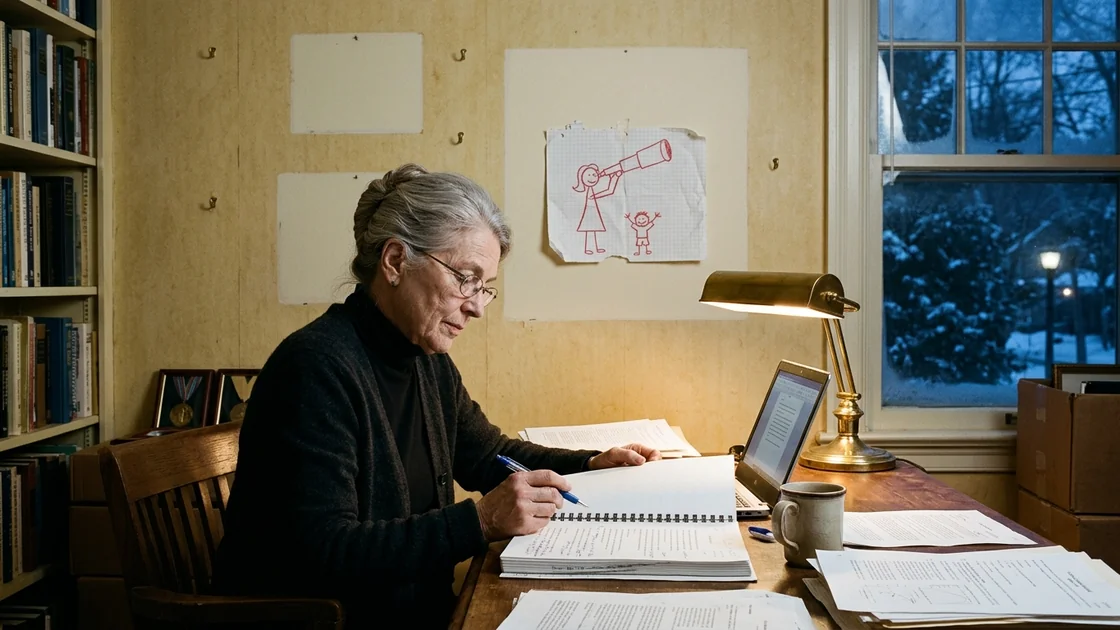
Dr. Evelyn Vance spent forty-two years building the foundational theory of modern cosmology, sacrificing her marriage, her motherhood, and her youth to map the invisible scaffolding of the universe. On the Friday of her retirement from the Institute for Advanced Astrophysical Studies, a newly commissioned deep-space interferometer proves that the Vance-Kovacs Lattice does not exist, revealing her life's work to be nothing more than a complex mathematical mirage caused by uncalibrated cosmic dust and a generational sensor flaw. As the scientific community scrambles to dismantle four decades of textbooks and redirect billions of dollars in grant funding, Evelyn is thrust into a profound existential crisis where she must confront the ghosts of her personal sacrifices, the rage of the mentees she unintentionally misled, and the terrifying emptiness of a universe that no longer holds her name. Through a grueling winter of isolation, obsessive recalculation, and painful reconciliations with her estranged daughter and the young physicist who destroyed her legacy, Evelyn is forced to strip away her ego and discover what remains of a human life when its sole purpose is erased.
I. The Weight of Brass and Paper
The cardboard boxes smelled of dry wood pulp and impending irrelevance. There were fourteen of them, stacked in a neat, brown barricade against the oak paneling of office 402, waiting to swallow forty-two years of inquiry.
Dr. Evelyn Vance stood by the tall leaded window, holding a brass gyroscope that no longer spun true. Outside, the October wind was stripping the ginkgo trees along the quad, sending fan-shaped leaves skittering across the wet slate paths like bright yellow data points scattering from a broken trend line. At sixty-eight, Evelyn’s posture still retained the rigid, military verticality she had developed in the late seventies, back when she was the only woman in the subterranean laboratories of Pasadena and had to stand straighter than the men just to be seen over the oscilloscopes.
Tomorrow night, the University would host a black-tie gala in the Great Hall beneath the Foucault pendulum. The Provost would read a citation. Former doctoral students—now department chairs at MIT, Heidelberg, and Tokyo—would raise flutes of moderately priced champagne. They would toast the Vance-Kovacs Lattice, the theoretical framework that had explained the anomalous gravitational lensing of galactic clusters without resorting to arbitrary dark matter halos. For four decades, her equations had been the mortar holding the standard model’s brickwork together.
She set the gyroscope down inside Box 4, nestled between her 1989 Kyoto notebooks and a laminated pass from the Atacama Large Millimeter Array.
A knock at the half-open door broke the quiet. It was not the brisk, rhythmic rap of her department chair, Arthur Pendelton, nor the hesitant tap of an undergraduate seeking a signature. It was a single, heavy thud, as if someone had leaned their forehead against the wood.
"Come in," Evelyn said, her voice carrying the dry, chalky resonance of a lecture hall.
Arthur stood on the threshold. He was fifty-five, a man whose tweed jackets always looked slightly too large, though today he seemed to have shrunk inside his clothes to an alarming degree. His face was the color of skimmed milk. In his left hand, he held a tablet; his right hand was buried in his gray hair, fingers twisted into the locks above his ear.
"Arthur?" Evelyn reached for a roll of packing tape. "If this is about the seating chart for the head table, I’ve already told the Dean’s secretary that you cannot put Julian next to the contingent from Zurich. They haven't spoken since the 2014 preprint fiasco."
"It’s not the seating chart, Evie," Arthur said.
She paused. Nobody had called her Evie since Viktor Kovacs died of a stroke in the winter of ninety-six.
Arthur stepped into the room and kicked the door shut behind him. The latch clicked with the finality of a bolt sliding home in a cryostat. He walked to her desk—a massive slab of walnut that had once belonged to a man who helped calculate the yield of the Trinity test—and laid the tablet flat upon the blotter.
"The Lagrange-Four Array finished its first six-month calibration sweep at four o'clock this morning," Arthur said. He wasn't looking at her. He was staring at the brass gyroscope in the box. "The team in Geneva ran the raw interferometry through the new quantum-denoising algorithms. The ones developed by that kid at Caltech. Thorne. Lucas Thorne."
Evelyn felt a faint, familiar prickle of professional irritation. Lucas Thorne was twenty-nine, a brilliant, chaotic theorist who treated legacy mathematics the way a wrecking ball treats load-bearing plaster. "I read his preliminary methodology in Nature last spring. It’s flashy, Arthur, and computationally arrogant. He over-corrects for baryon acoustic oscillations. What about it?"
"He didn't over-correct," Arthur whispered.
Evelyn frowned. She stepped around the barricade of boxes, her low-heeled oxford shoes clicking on the parquet before muffled by the worn Persian rug. She looked down at the tablet.
It was an unformatted preprint, uploaded to the arXiv server less than two hours ago. There were forty-four co-authors listed under Thorne’s name, representing the entire signal-processing division of the European Space Agency’s newest deep-space observatory. The title was clinical, stripped of all rhetorical flourish: On the Nullification of Non-Baryonic Lattice Anomalies via Sub-Millimeter Dust Polarization Corrections.
"They found a ghost in the machine, Evelyn," Arthur said, his voice cracking on her name. "Not in their machine. In ours. Going all the way back to the old Kitt Peak charge-coupled devices in eighty-two. The silicate grains in the local filament... they don't scatter infrared light isotropically when subjected to weak magnetic fields. They polarize it at a four-degree offset."
Evelyn picked up the tablet. Her reading glasses were hanging from a gold chain around her neck; she slipped them onto the bridge of her nose. Her hands were steady. They were always steady.
"A four-degree offset is negligible at cosmic scales," she said automatically, reciting the defense she had used at her dissertation defense, and again in Stockholm, and a hundred times in between. "The Vance-Kovacs constant accounts for local dust variance through the secondary tensor—"
"The secondary tensor is derived from the baseline calibration of the 1983 Cerro Tololo survey," Arthur interrupted. He finally looked at her, and the sheer, naked pity in his eyes made the breath catch in her throat. "Evie, the baseline was contaminated. Every subsequent survey—Hubble, Spitzer, Planck, James Webb—used your 1984 normalization curve to zero out their background noise before looking for the Lattice. You built the filter that everyone else bolted onto their telescopes."
She scrolled down. Past the abstract. Past the methodology. She went straight to Figure 4.
In cosmology, a career can be summarized by a single curve. Hers was a sine-like wave with a sharp, unmistakable peak at the third harmonic—the mathematical signature of space-time warping around an invisible, crystalline web of topological defects left over from the universe's first picosecond. It was the peak she had found at three in the morning on a freezing mountain in Chile, drinking lukewarm coffee from a rusted thermos while Viktor snored on a cot in the corner. That peak was on the cover of her textbook. It was etched into the gold medal sitting in her safe deposit box.
On the tablet’s screen, Figure 4 showed two lines.
The first, rendered in a pale, ghostly gray, was the Vance-Kovacs curve.
The second, rendered in stark, merciless crimson, was the new Lagrange-Four data, stripped of the 1984 normalization filter and corrected for magnetic silicate torque.
It was flat.
It was as flat as a dead man’s electrocardiogram. There was no third harmonic. There was no secondary resonance. The error bars were microscopic, smaller than the width of the red pixels themselves.
"They ran it against seven thousand galactic clusters," Arthur said softly. The radiators under the window hissed, a sudden, violent sound in the quiet room. "When you take out the silicate polarization artifact, the lensing anomalies disappear. All of them. They reduce entirely to standard Newtonian baryonic distribution plus a mundane cosmological constant. There is no Lattice. Space is just... empty."
Evelyn did not move. She stared at the red line.
Her mind, trained over half a century to process multi-dimensional differential equations in real-time, began to execute a rapid, silent cascade of implications. If the third harmonic was zero, then the coupling constant \(\Lambda_{vk}\) was zero. If \(\Lambda_{vk}\) was zero, then the seventeen papers she had published between 1985 and 1994 were division-by-zero exercises in creative writing. If those papers were void, then the Dark Sector Mapping Project—a two-billion-dollar multinational consortium she had chaired from 2001 to 2015—had spent fourteen years charting the intricate geography of a smudge on the lens.
"Viktor checked the Cerro Tololo calibration," she heard herself say. Her voice sounded as if it were coming from the bottom of a dry well. "He spent six months in Pasadena with the raw magnetic tapes. He verified the zero-point."
"Viktor used the standard silicate cross-sections from the 1979 Naval Research Laboratory tables," Arthur said. He reached out, as if to touch her shoulder, then let his hand drop back to his side. "Nobody knew about magnetic radiative torque alignment in sub-micron grains back then. You couldn't have known, Evie. The physics didn't exist yet."
"Show me the covariance matrix," she said.
"Evie—"
"The covariance matrix, Arthur. Where is the supplemental data?" Her fingers flew across the glass, opening the appendices. Seventy pages of dense, machine-generated proofs scrolled past. She recognized the architecture of the math. It was cleaner than hers had ever been. It had the brutal, unarguable symmetry of a guillotine.
She stood there for eleven minutes. Arthur did not speak. He simply watched her read, the way one watches a homeowner walk through the charred timber of a house after the fire trucks have rolled away.
By page forty-two, she stopped scrolling.
There was a footnote on the forty-second page. Thorne had not even bothered to put it in the main text. Note 14: Consequently, the formalisms collectively termed 'Vance-Kovacs Lattice Dynamics' (see Vance et al., 1984–2021) must be regarded as historic parameterization artifacts rather than descriptions of physical reality.
Historic parameterization artifacts.
Four decades. Sixteen doctoral students. Three hundred and twelve peer-reviewed publications. One dead marriage. One daughter who lived in Seattle and called only on Christmas and her birthday, speaking with the polite, guarded tone one uses with a distant aunt. All of it compressed into three words in an eight-point font at the bottom of a digital page.
"The Provost knows," Arthur said, reading the slump of her shoulders. "Geneva sent a courtesy copy to the National Academy at noon, and it leaked to the science desk at the Times twenty minutes ago. My phone hasn't stopped vibrating since I walked across the quad."
Evelyn slowly took off her glasses. They felt impossibly heavy, as if the frames had transmuted from gold into depleted uranium.
"What are they saying?" she asked.
"The Times is calling it the 'Michelson-Morley moment of the twenty-first century,'" Arthur said, wincing at his own words. "They’re comparing the Lattice to the luminiferous aether. A beautiful, necessary fiction that took forty years to clear out of the attic."
The luminiferous aether. The joke of undergraduate physics surveys. The thing professors brought up in week two of freshman year to make nineteen-year-olds chuckle at the quaint delusions of Victorian gentlemen before moving on to Einstein.
And now, she thought, I am week three.
"And tomorrow night?" Evelyn asked. She looked toward the closet where her garment bag hung, containing a dark navy silk dress she had bought in Boston for eight hundred dollars—an uncharacteristic extravagance her sister had bullied her into.
Arthur looked down at his shoes. "The Provost thinks... well, given the media requests, and the fact that half the speakers would have to rewrite their remarks between now and seven o'clock tomorrow... he wonders if you might prefer to postpone. Until the dust settles."
Until the dust settles. The irony was so sharp it tasted like copper on the back of her tongue. Interstellar dust, settling at a four-degree angle, blotting out the stars.
"Tell him not to cancel the caterers," Evelyn said, setting the tablet back on the walnut desk with precise, geometric alignment, parallel to the edge of the blotter. "Let the graduate students eat the crab cakes. They don't pay them enough anyway. Tell him I have a sudden viral infection. Nobody questions a fever in October."
"Evie, I can stay. We can go through the raw data from the 2009 Chile run. Maybe there’s a secondary damping effect Thorne missed—"
"He didn't miss anything, Arthur," she said. Her voice was terrifyingly calm. "Look at the residuals on page nineteen. The variance is less than ten to the minus nine. It’s over. Please leave the tablet, and close the door on your way out."
When he was gone, the silence of office 402 returned, but its quality had changed. Five minutes ago, it had been the quiet of a museum at closing time, full of curated treasures being packed for transport. Now, it was the silence of an abandoned mine shaft after the vein had been revealed as fool's gold.
Evelyn walked over to Box 4. She reached in, picked up the 1989 Kyoto notebooks, and opened the top one.
Page after page of her own neat, cramped handwriting stared back at her in blue fountain pen ink. Integrals curled like seahorses down the margins. Tensors marched in disciplined matrices across the grid lines. At the bottom of page twelve, there was a ring stain from a coffee mug, and next to it, a tiny, doodled stick figure that six-year-old Claire had drawn with a red crayon while sitting under Evelyn’s desk during a snow day. Claire had drawn a woman with wild hair looking through a giant tube at a smiling sun, while a smaller stick figure stood at the bottom of the page with its arms raised, waiting to be picked up.
Evelyn remembered that afternoon. She had been trying to reconcile the anisotropic boundary conditions for the third Lattice paper. Claire had asked her three times to play dominoes. On the fourth time, Evelyn had snapped at her—not yelling, she never yelled, which was somehow worse—and told her that Mommy was doing something very important, something that helped people understand how the sky stayed up, and that Claire needed to be a big girl and read her picture books quietly.
The sky hadn't needed her help to stay up. The sky had been doing nothing at all. She had traded her daughter’s afternoon—and a thousand afternoons just like it—for a four-degree calibration error in a forty-year-old camera.
Evelyn walked to the wastepaper basket beside her desk, a tall aluminum cylinder provided by university maintenance. She held the 1989 notebook over it. Her fingers twitched to drop it.
She couldn't. Not because the math was precious, but because the red crayon drawing was on page twelve, and she suddenly realized it might be the only true thing in the entire room.
Instead, she tore page twelve out along the perforation, folded it neatly into quarters, and slipped it into her coat pocket. Then she dropped the rest of the notebook into the aluminum bin. It hit the bottom with a hollow, metallic thud.
One by one, she unpacked the fourteen boxes and threw forty-two years into the trash.
II. The Phantom Limb of Time
By Monday morning, the world had reorganized itself around her absence.
Evelyn lived in a narrow, two-story clapboard house three miles from campus, on a street lined with sugar maples and the quiet, well-maintained homes of retired professors and local attorneys. She had bought the house with Viktor in 1986, shortly after the first Lattice papers had secured them dual tenured chairs. Viktor had loved the wrap-around porch and the overgrown lilac bushes in the back; Evelyn had loved that it was a twelve-minute walk from the theoretical physics building, allowing her to come home for dinner and return to the mainframe terminals by eight.
After Viktor died, she had stopped using the second floor almost entirely, migrating her life down to the converted parlor off the kitchen, as if contracting her physical footprint to match her emotional one.
Now, sitting at the kitchen table in her wool bathrobe at eleven in the morning, she watched the sun move across the linoleum.
She had unplugged the landline on Friday night after the sixth call from a producer at Science Friday. Her cell phone sat in the fruit bowl beside two shriveled clementines, powered off. Yet the silence of the house was not peaceful; it was pressurized, like the cabin of an aircraft losing altitude.
For forty years, Evelyn’s consciousness had possessed a background hum. Even when she was brushing her teeth, or waiting in line at the post office, or half-listening to Viktor talk about his tomato plants, a part of her pre-frontal cortex was running simulations. She had lived inside the Lattice. When she looked up at the night sky in August, she didn't see the swan of Cygnus or the belt of Orion; she saw the invisible, high-tension nodes of her own equations, pulling the visible matter into place like pearls strung along a silk spiderweb. The universe had been a cathedral, and she had been the one to trace the blueprint of its flying buttresses.
Now, when she closed her eyes, the cathedral was gone. There was only black, cold, unstructured volume.
It felt like an amputation. She kept reaching out with her mind to touch a piece of math that wasn't there anymore. At 9:15 AM, while pouring boiling water over a tea bag, she had instinctively thought: If the baryonic infill rate in the Perseus cluster is lower than the radial velocity suggests, then the local Lattice tension must be— and then she had stopped, the kettle trembling in her hand, spilling scalding water across the counter as her brain hit the void.
There is no tension. There is no Lattice.
She sat down and stared at the wet spot on the counter until it evaporated.
Around noon, she walked into her home study. The walls were lined from floor to ceiling with Billy bookcases from IKEA that had bowed over the decades under the weight of The Astrophysical Journal and Physical Review D. On the wall above her desk hung her degrees, the 1998 Eddington Medal, the 2007 Gruber Prize, and a framed photograph of herself shaking hands with a smiling, silver-haired President in the East Room of the White House.
She looked at the photograph. The President was looking at her with that specific expression politicians reserved for scientists: a mixture of deferential awe and complete incomprehension. He was giving her the National Medal of Science because his advisors had told him that this stern, thin woman in the charcoal suit had figured out what seventy percent of the universe was made of.
She stepped onto the leather seat of her desk chair, her knees popping loudly in the quiet room, and lifted the photograph off its brass hook. The wallpaper behind it was a pristine, unfaded cream, a sharp rectangle amidst the yellowed ivory of the surrounding wall. She set the frame face-down on the carpet. Then she took down the Gruber Prize. Then the Eddington Medal.
By one o'clock, the wall was bare, dotted only with thirty-two small brass hooks and thirty-two pale rectangles of preserved wallpaper, looking like a minimalist chart of missing data.
She sat down at her computer and turned it on. She told herself she wouldn't check her email, and she didn't. Instead, she opened her Fortran compiler and downloaded the raw, uncalibrated public dataset from the Lagrange-Four Array.
"Just to see," she whispered to the empty room. Her voice was hoarse from three days of disuse. "Just to check his boundary conditions."
She worked for nineteen hours straight.
It was a terrifying regression. She became twenty-eight years old again, fueled by black tea and a desperate, clawing need to force the numbers to confess. Her arthritis made her fingers stiff on the mechanical keyboard, her lower back throbbed like an infected tooth, and her eyes burned from the blue light of the monitors, yet she wrote code with the ferocious precision that had once terrified generations of graduate students.
She stripped away Thorne’s quantum-denoising algorithm, convinced that the boy had introduced a smoothing bias that artificially flattened the third harmonic. She wrote her own filter from scratch, using raw Bayesian probabilities to isolate the sub-millimeter dust signatures in the Coma Cluster. She incorporated the magnetic torque equations from the 2018 radiative transfer papers—papers she had skimmed and dismissed six years ago because she had been busy writing a keynote address for the International Astronomical Union.
At four-thirty on Tuesday morning, the compiler finished its run. The terminal chimed softly.
Evelyn leaned forward, her nose six inches from the glass, her breath fogging the bottom corner of the bezel. The plotting software rendered the output in green phosphor lines against a black grid.
The curve appeared. It rose through the first harmonic, dipped through the baryonic trough, and approached the critical threshold of \(k = 0.042\)—the exact spatial frequency where the Vance-Kovacs Lattice had lived for forty-two years.
The green line did not rise. It didn't even twitch. It sailed straight through \(0.042\) on a dead, horizontal trajectory, indifferent to her forty years of labor, indifferent to her national medals, indifferent to the fact that Viktor had died with her equations engraved on the brass plaque of his columbarium niche.
Her own code, written by her own hands, agreed with Lucas Thorne to the seventh decimal place.
Evelyn sat back in her chair. The leather creaked. Outside, a garbage truck rumbled down the street, its hydraulic brakes squealing in the pre-dawn frost, followed by the heavy, metallic clang of bins being emptied.
She had been wrong.
Not partially wrong, the way Newton was wrong before Einstein refined him at relativistic speeds. Newton’s apples still fell at nine point eight meters per second squared; bridges built on Newtonian mechanics didn't collapse when Mercury’s perihelion precessed.
No, she was wrong the way the alchemists were wrong about phlogiston. She was wrong the way Giovanni Schiaparelli was wrong when he looked through his telescope in 1877, saw optical illusions caused by the diffraction limit of his lens, and drew an intricate network of Martian canals that convinced the world for thirty years that a dying civilization was irrigating the red planet.
She had spent her life drawing canals on Mars.
A strange, cold nausea rose from her stomach into her throat. She stood up too fast, the blood draining from her head, and stumbled into the downstairs half-bath, dropping to her knees on the cold hexagonal tiles just in time to retch nothing but bitter, yellow tea into the porcelain bowl.
She stayed there on the floor for a long time, her cheek pressed against the cool ceramic of the pedestal sink.
Who am I?
The question wasn't dramatic; it was purely taxonomical. For half a century, whenever she had introduced herself at a dinner party, or filled out a customs declaration form, or comforted herself in the dark at three in the morning when the loneliness of her widowhood felt like a physical weight on her chest, the answer had been an ironclad coordinate: I am Evelyn Vance. I discovered the Lattice.
It was the excuse that absolved every sin of omission in her life.
When her mother was dying of pancreatic cancer in a hospice in Ohio in 1991, and Evelyn had stayed for only four days before flying back to Geneva because the LEP collider was running a critical verification test—the Lattice had forgiven her. Science requires sacrifice, she had told herself on the Swissair flight, watching the clouds over the Atlantic. Personal grief is transient; the structure of the cosmos is eternal.
When Viktor had begged her to take a sabbatical with him in ninety-five, to rent a cottage in the Dordogne and just walk through the markets and eat cheese and be two middle-aged people who loved each other before they got too old—she had said Next year, Vik, after the Sloan Digital Sky Survey comes online. And then there hadn't been a next year, because an aneurysm in his middle cerebral artery had burst while he was grading freshman blue books in his office, alone, while she was in Chicago arguing with the Department of Energy for another twelve million dollars to fund a survey of nothing.
And Claire.
Evelyn closed her eyes on the bathroom floor. A single tear leaked from the corner of her left eye, tracking slowly across the bridge of her nose before dropping onto the grout.
If the work was nothing, then the sacrifices were not noble tragic trade-offs made at the altar of human knowledge. They were just cruelty. She had been a woman who abandoned her dying mother, her exhausted husband, and her lonely child so she could sit in a dark room and play with an imaginary friend made of calculus.
III. The Architecture of Collateral Damage
On Thursday, the rain stopped, replaced by a hard, bright November chill that turned the puddles in Evelyn’s driveway into panes of clouded glass.
At two in the afternoon, someone pounded on her front door.
Evelyn was in the kitchen, slicing an apple into precise, uniform eighths that she had no intention of eating. She froze, the paring knife suspended above the wooden cutting board. She had ignored the doorbell twice on Tuesday—once for a courier carrying a floral arrangement from the Dean (which was still sitting on the porch, its white lilies browned by the frost) and once for a young woman with a press badge hanging from her lanyard.
Whoever was on the porch now wasn't using the bell. They were hitting the solid oak panel with the side of their fist. Three heavy blows, a pause, and then three more.
"Evelyn!" a voice shouted through the glass sidelight. "I see the light on in the kitchen. Open the damn door."
It was Marcus Chen.
Evelyn set the knife down carefully. Marcus had been her prized doctoral student from 2004 to 2009, and her lead postdoctoral fellow for five years after that. He was forty-two now, an associate professor at Cornell, coming up for his full tenure review this winter. He was a brilliant observationalist who had spent the last decade designing the specialized bolometer arrays for the South Pole Telescope—arrays specifically tuned to measure the shear stress of the Vance-Kovacs Lattice.
She walked down the front hall, her cardigan pulled tight around her ribs, and unlocked the deadbolt.
Marcus stood on the porch, his breath pluming white in the cold air. He looked as though he had driven the four hours from Ithaca without blinking. His dark hair was uncombed, his wool coat was unbuttoned over a rumpled dress shirt, and there was a manic, glassy sheen to his eyes. Beside his left foot sat the frost-blackened lilies from the Dean.
"You turned your phone off," Marcus said, not as a greeting, but as an accusation. He stepped past her into the foyer without waiting to be invited, bringing the smell of cold exhaust and stale coffee into the warm house.
"I didn't have anything to say to the reporters, Marcus," Evelyn said quietly, closing the door.
"I’m not a reporter!" He spun around in the narrow hallway. He was a small, compact man, usually soft-spoken and meticulous to a fault, the kind of researcher who color-coded his LaTeX files. Now, his hands were shaking so badly he had to shove them into his coat pockets. "I’ve called you nineteen times since Saturday. Do you know what happened at ten o'clock this morning in Ithaca?"
Evelyn looked at him steadily. "The tenure committee met."
Marcus laughed, a jagged, ugly sound that bounced off the bare walls of the hall. "They didn't even meet, Evelyn. The Dean of Faculty called me into his office with the department chair. The National Science Foundation froze our grant at nine-thirty. All four point two million of it. Indefinite administrative suspension pending a programmatic review of all Lattice-dependent instrumentation."
"They can repurpose the bolometers," Evelyn said, falling back on institutional logic out of sheer muscle memory. "The sensitivity thresholds are entirely applicable to standard CMB polarization studies—"
"Nobody wants my bolometers!" Marcus roared. The sheer volume of it made Evelyn flinch, stepping back until her shoulder blades hit the coat rack. "Standard CMB teams already have their own pipelines! My entire lab—six grad students, two postdocs, twelve years of my life—was built around isolating the third harmonic! Every paper I’ve published since I was twenty-six has your name on it as senior theorist or cites your 1992 metric in the first paragraph!"
He pulled a folded sheaf of paper from his inside breast pocket and slapped it against his own chest.
"My tenure dossier," he said, his voice dropping to a ragged whisper that was infinitely worse than the shouting. "Twelve external letters went out in September. Seven of them came back this week asking the university to allow them to retract their endorsements in light of the Lagrange-Four data. Do you know what the guy from Chicago wrote? Our old friend Dr. Miller? He wrote that my career demonstrates 'a tragic lack of critical independence and a slavish devotion to a defunct paradigm.'"
Evelyn felt the coldness in her chest expand outward, numbing her fingertips. "Miller is a coward. When you came to me in 2011 with the preliminary South Pole discrepancies, you wanted to look at local dust anomalies. You wrote a three-page memo about silicate scattering."
Marcus stared at her, his mouth slightly open. The color drained from his cheeks, leaving two bright spots of feverish red high on his cheekbones.
"I did," he whispered. "November 2011. After the second winter run."
"And I told you it was instrumental noise in the cryogenic pre-amplifiers," Evelyn said. She remembered the meeting with horrifying clarity. It had taken place in office 402, right by the window. She had been preparing for the Solvay Conference in Brussels. She hadn't even read the third page of his memo. She had tossed it back across the walnut desk and told him not to waste six months chasing dirt in the foreground when the cosmological background was waiting. "I told you that if you chased foreground calibration, I’d give the lead authorship on the 2012 survey paper to Henderson."
"You told me," Marcus said, his voice trembling, "that a real physicist looks through the window, not at the glass."
"I was wrong, Marcus."
The three words hung in the hallway between them. They were ridiculously small. They weighed nothing at all compared to twelve years of a man's youth, his mortgage in Ithaca, his two young children, the six graduate students whose dissertations were now dead weight on a university server.
"You were wrong," Marcus repeated numbly. He looked past her, into the study where the thirty-two pale rectangles stood out against the yellowed wallpaper. His eyes tracked to the stack of framed medals sitting on the floor beside the radiator. The sight seemed to drain the remaining fury out of him, leaving only a vast, hollow exhaustion. "I defended you on Friday, you know. When the preprint dropped. I stood up in our department colloquium and told forty people that Lucas Thorne was a clout-chasing data-manipulator who didn't understand sub-millimeter interferometry. I made a complete fool of myself for two hours because I believed you were infallible."
"You shouldn't have believed that," Evelyn said softly. "No one is."
"You let us believe it!" Marcus’s voice cracked, and for a terrifying second, Evelyn thought he was going to weep. "You sat on every review panel, Evelyn. You edited the journals. When that group in Madrid questioned the Cerro Tololo baseline in ninety-nine, you eviscerated them at the Texas Symposium. You made it professionally fatal to question the Lattice. You didn't just make a mistake in eighty-four. You spent forty years building a fortress around it, and you locked all of us inside with you."
He wasn't wrong.
Evelyn looked back across the decades and saw the moments not as she had lived them—as heroic defenses of rigorous science against sloppy contrarians—but as they actually were. The Madrid group had been sloppy; their math had been riddled with basic algebraic errors, which had made it so easy, so deliciously satisfying, to tear them apart at the microphone in front of five hundred peers. Because their critique was flawed, she had assumed the thing they were critiquing was invulnerable. She had fallen in love with the elegance of her own architecture, and anyone who brought a hammer near the walls was treated as a barbarian.
"I will write to your Dean," Evelyn said, though she knew how pathetic it sounded. "I will write a formal letter stating that you identified the silicate scattering anomaly in 2011 and that I suppressed the inquiry as your principal investigator. I’ll send a copy to the NSF program director and to the editors of ApJ."
Marcus looked at her for a long time. The anger was gone from his eyes, replaced by the cold, clinical distance of a stranger on a subway platform.
"A letter from Evelyn Vance," Marcus said quietly, "is worth slightly less than Confederate money right now. If you put your name near my tenure file, it’ll only make them bury it deeper."
He turned around, his hand on the brass doorknob. He paused, looking down at the dead lilies on the welcome mat when he pulled the door open.
"My wife asked me this morning what I’m going to do if Cornell doesn't renew my contract in May," Marcus said to the cold air outside. "I’m forty-two. All I know how to do is calculate non-baryonic shear tensors that don't exist. Wall Street doesn't even hire quantitative analysts over thirty-five anymore. I think I’m going to have to teach high school AP Physics in New Jersey." He glanced back over his shoulder. "Enjoy your retirement, Dr. Vance."
The door clicked shut.
Evelyn stood in the hallway until the sound of his Honda backing out of the gravel driveway faded into the hum of traffic on the main road. Then she walked back into the kitchen, looked at the eight symmetrical slices of apple turning brown on the cutting board, and swept them into the sink with the back of her hand.
IV. The Observatory in the Clouds
In December, the snow came early and stayed, burying the town under two feet of heavy, wet powder that turned gray along the edges of the plows' paths.
Evelyn stopped opening her mail. The envelopes piled up on the foyer floor underneath the brass mail slot like fallen leaves—bills, university notices, alumni magazines that had gone to press in October featuring glowing six-page retrospectives on her career that now read like cruel satire, and the occasional thick cream envelope from an old colleague offering awkward, stilted condolences, as if she had been diagnosed with a terminal illness rather than an intellectual failure.
She existed in a state of suspended animation. She slept from four in the morning until noon, woke with a heart rate that felt like a trapped bird beating against her sternum, and spent the afternoons sitting in the parlor watching the chickadees fight over the empty birdfeeder in the lilac bushes.
One afternoon in the second week of December, while looking for an extra wool blanket in the cedar chest at the foot of her bed, she found Viktor’s old gray cashmere scarf and a leather-bound photo album from 1983.
She sat on the edge of the mattress and opened the album.
There were no pictures of the wedding—they had been married by a justice of the peace in Pasadena on a Tuesday lunch break—and only two pictures of Claire as an infant, blurry Polaroids where Evelyn looked exhausted and slightly bewildered by the pink bundle in her arms.
The rest of the album was Cerro Tololo.
Page after page showed the white domes of the observatory perched on the barren, rust-colored peaks of the Chilean Andes, four thousand feet above the desert floor, where the air was so thin and dry that your lips cracked and bled during the first week. There was Viktor at thirty-four, with his thick dark beard and his awful maroon corduroy jacket, grinning beside the four-meter Blanco telescope receiver cage. And there was Evelyn.
She stared at the photograph of her younger self. She was thirty-one, wearing an oversized Air Force parka over a flannel shirt, her dark hair pulled back in a severe braid. She was leaning against the metal railing of the catwalk outside the dome, looking out over a sea of evening clouds that lay two thousand feet below the summit, stained violent violet and gold by the Pacific sunset.
Look at her face, Evelyn thought, running her thumb over the glossy paper. Look at the sheer, insufferable certainty in her jaw.
She remembered when Viktor had taken that picture. It was November 14, 1983. Inside the control room, the nine-track magnetic tapes were spinning, recording the infrared sweep of the Fornax Cluster. They were young, they were poor, they had left their ten-month-old daughter with Evelyn’s sister in Ohio for six weeks, and they believed—with a religious fervor that made monks look casual—that they were the first human beings in history to see the true skeleton of creation.
That night, after the sunset in the photograph had faded into the terrifyingly bright blaze of the southern hemisphere's stars, they had made love on the narrow vinyl sofa in the observer’s lounge while the liquid nitrogen pumps throbbed through the floorboards. Afterward, lying under two scratchy wool army blankets, Viktor had traced the line of her collarbone with his cold fingers and said, Even if the math breaks tomorrow, Evie, we had tonight on the mountain.
And what had she said?
She remembered. She had pulled the blanket up to her chin, already thinking about the signal-to-noise ratio in the third quadrant, and said, The math won't break, Vik. I checked the integrations twice.
She hadn't even looked at him when she said it.
Sitting on her bed forty-one years later, in a quiet house where no one had spoken her first name with affection in twenty-eight years, Evelyn closed the album and began to cry.
It was not the quiet, single tear of the bathroom floor. It was a violent, shuddering collapse that folded her in half over Viktor’s cashmere scarf. She wept for the boy in the maroon jacket who had loved her enough to follow her up a mountain and spend his life polishing the brass of her delusion. She wept for the ten-month-old baby in Ohio who had learned to walk on her aunt’s living room rug while her mother was four thousand miles away measuring silicate dust.
Most of all, she wept because the universe was so unbearably indifferent. She had given it everything—her youth, her family, her ethics when she crushed Marcus Chen’s memo—and the universe hadn't even noticed. The stars in the Fornax Cluster were sixty million light-years away, burning hydrogen into helium in total silence, caring nothing for whether a biped on a wet rock drew a curvy line or a flat line to describe the space between them.
When the sobbing finally subsided around dusk, leaving her throat raw and her temples pounding, the house felt colder than before. Not temperature-cold, though the furnace was struggling against the December wind, but existentially sub-zero.
She walked downstairs to the kitchen, opened the drawer where she kept her spare keys and expired batteries, and took out her cell phone. She plugged the charger into the wall outlet by the toaster and waited three minutes for the battery icon to turn from red to green.
When she powered it on, the phone vibrated continuously for forty-five seconds as six weeks of voicemails and text messages flooded the inbox. She didn't open the log. She went straight to her contacts, scrolled past Arthur Pendelton, past Marcus Chen, and tapped Claire.
The phone rang four times. Evelyn stared at the frost crystals forming in the corner of the kitchen windowpane, preparing herself for the voicemail greeting.
"Hello?"
Claire’s voice was deeper than Evelyn’s, inherited from Viktor’s side of the family, with the brisk, slightly distracted cadence of a woman who ran an urban planning firm and had two teenagers of her own. In the background, Evelyn could hear the clatter of ceramic plates and the low murmur of a television. It was only three in the afternoon in Seattle.
"Claire," Evelyn said. "It’s Mom."
The clattering in the background stopped. Footsteps moved from a hard floor onto carpet, and a door clicked shut.
"Mom?" Claire sounded startled, then immediately guarded. "Are you okay? Did something happen? It’s not Christmas for another ten days."
The casual brutality of that sentence—delivered without malice, simply stating the empirical law of their relationship—made Evelyn close her eyes.
"I’m fine," Evelyn lied, her hand gripping the edge of the laminate counter. "Physically, I’m fine. I just... I wanted to know if you had plans for the holidays. No, that’s a stupid question, of course you have plans. I wondered if I might come out to Seattle. For a few days. In January, perhaps, when things are quiet. I could stay at a hotel near the water."
There was a long silence on the line. Only the faint digital hiss of the cellular network crossed the two thousand miles between them.
"You want to come to Seattle," Claire said slowly, as if translating an unfamiliar dialect. "You haven't been out here since Noah’s eighth-grade graduation. You said the flights in winter ruined your circadian rhythm."
"I’m retired now, Claire. I don't have a schedule to keep."
Another pause. When Claire spoke again, the guardedness had softened into something much more painful: awkward sympathy.
"I saw the article in the New Yorker last week, Mom," Claire said quietly. "David showed it to me. The one about the telescope in Europe."
Evelyn’s stomach dropped through the floorboards. The New Yorker. Of course. A long-form piece, no doubt, written by some lyrical science journalist who had interviewed Lucas Thorne and three of Evelyn’s old rivals from Princeton, weaving a tragic narrative about hubris and the fall of the Queen of Cosmology for educated laypeople to read on the subway.
"I didn't know you read science journalism," Evelyn murmured.
"I don't. I read pieces about my mother when her name is in the sub-headline," Claire said. She sighed, a long, tired sound. "Look, I’m sorry. I don't understand the math—you made sure I knew very early on that I didn't have the head for it—but David explained what it meant. I tried to call your landline the day the article came out, and the operator said the number was temporarily disconnected."
"I unplugged it. The press was being intrusive."
"Right." Claire hesitated. "Mom, January is actually terrible for us. We’re redoing the kitchen starting on the third, and I have the city council zoning hearings for the waterfront project all month, and Maya has travel volleyball every weekend in Oregon. If you came out, you’d just be sitting in a Marriott watching it rain while I’m at the office until seven every night."
It was the exact speech Evelyn had given Claire in the summer of 2006, when Claire had gone through a brutal divorce from her first husband and had asked if she could come stay in the clapboard house for two weeks in July. I have the CERN workshop prep all month, sweetheart, and the postdocs are here until eight every night; you’d just be bored to tears sitting on the porch by yourself.
The symmetry of the universe was intact after all. It wasn't in the galaxies; it was right here, in the conservation of emotional distance. Every action had an equal and opposite reaction, delayed by eighteen years.
"Of course," Evelyn said, keeping her voice level through forty years of academic discipline. "Zoning hearings are monstrous. I wouldn't want to be underfoot during a renovation."
"Maybe in the spring," Claire said, and they both knew she didn't mean it. "Around Easter, after the playoffs are over. Are you sure you’re okay there by yourself? Do you need me to call Arthur Pendelton to check in on you?"
"No, please don't call Arthur. I’m enjoying the quiet. Catching up on my reading."
"Okay. Well... I’ll call you on the twenty-fifth, Mom. Take care of yourself."
"Goodbye, Claire. Give my love to David and the kids."
Evelyn ended the call and set the phone back down next to the toaster.
She looked around her kitchen. The refrigerator hummed. The clock over the stove clicked as the minute hand jumped to 6:14.
She had eighty-four thousand dollars in her checking account, two point one million in her TIAA-CREF retirement annuity, a paid-off four-bedroom house, and approximately fifteen to twenty years of biological life remaining, assuming her mother’s cancer didn't come for her. Seven thousand mornings of waking up, making tea, and waiting for it to be late enough to go back to sleep.
She was entirely superfluous. If she stopped breathing tonight in her bed, the automatic bill-pay would keep the utilities running until the spring thaw, and no one would notice she was gone until the lawn grew tall enough in May to violate a municipal ordinance.
V. The Boy with the Wrecking Ball
In late January, a letter arrived that was not in a cream envelope or a university mailer. It was a plain white number-ten business envelope, addressed by hand in cramped, messy black ballpoint, with a Pasadena postmark.
Evelyn only picked it up because she had slipped on the pile of mail while walking to the front door to check the thermostat, scattering three months of paper across the foyer rug. While shoving the bills into a plastic grocery bag to take to the recycling bin, the return address caught her eye: L. Thorne, Cahill Center for Astronomy and Astrophysics, Caltech.
She stood in the hallway for five minutes holding the envelope by its corner, as if it were coated in ricin.
Then she took it into the parlor, sat in Viktor’s old wingback chair, and slit the top open with her thumbnail.
Inside was a single sheet of yellow legal pad paper, torn roughly from the binding at the top.
Dr. Vance, it read. I am going to be on the East Coast next week giving a talk at Harvard on Wednesday and Princeton on Friday. On Thursday the 28th I am taking the train down to your campus whether you want to see me or not, because Arthur Pendelton told me you haven't left your house since October and frankly that is insane. I will be at the Blue Star Diner on Main Street (Google says this is the only diner in your town) at 1:00 PM on Thursday. I will sit in a booth and eat pancakes until 2:30. If you want to yell at me, or throw coffee in my face, or argue about the Bayesian priors on the Lagrange-Four calibration, you know where I'll be. Sincerely, Lucas Thorne.
Evelyn read the note three times.
The audacity of it was breathtaking. It was so completely devoid of the tiptoeing, funereal politesse that everyone else had used around her since October that it felt like a bucket of ice water thrown through an open window.
Frankly that is insane.
For the first time in twelve weeks, Evelyn felt an emotion other than despair or shame. She felt a sharp, hot spike of pure indignation. Who the hell was this twenty-nine-year-old child from Pasadena to tell her how to conduct her retirement? Who was he to sit in the Blue Star Diner—where she and Viktor had eaten huevos rancheros every Sunday morning throughout the eighties—and summon her like an errant undergraduate?
"I won't go," she said aloud to the empty parlor.
On Thursday morning at eleven, she took a shower for the first time in five days. She washed her silver hair, dried it, and pinned it up into its customary French twist, though her fingers fumbled with the bobby pins three times before the knot held. She put on gray wool trousers, a black turtleneck sweater, and her heavy camel-hair coat. She looked at herself in the hall mirror. She had lost twelve pounds since October; her cheekbones stood out like smooth river stones beneath pale, papery skin, and her eyes looked huge and dark in their sockets. She looked like a hawk that had been trapped in a chimney.
She walked the mile and a half into town rather than digging her Subaru out of the snowbank in the driveway.
The January air was brutally cold, smelling of woodsmoke and road salt, and the walk nearly killed her. By the time she reached the brick storefronts of Main Street, her calves were cramping and her lungs burned with every inhalation, a stark reminder of how quickly the human body begins to dismantle itself when you stop using it.
At 1:08 PM, she pushed open the glass door of the Blue Star Diner.
The bell above the door jangled. Warm air, heavy with the grease of bacon and fried potatoes, washed over her face, instantly fogging her glasses. She took them off and wiped them with her scarf, blinking at the brightly lit room.
It was mostly empty after the lunch rush. Two town snowplow drivers sat at the counter drinking coffee, a pair of undergraduate girls shared a plate of fries by the jukebox, and in the third booth by the window sat Lucas Thorne.
Evelyn had seen his faculty headshot online, of course, and she had watched twenty minutes of his presentation at the American Physical Society meeting two years ago before turning it off in annoyance. In person, he looked even younger than twenty-nine. He was tall and gangly, folded awkwardly into the red vinyl booth, wearing a faded olive-green puffer jacket over a gray hoodie with the strings chewed at the ends. He had a mop of curly brown hair that needed cutting, dark circles under his eyes, and a plate in front of him buried under three enormous buttermilk pancakes.
He was reading a paper with a red pen between his teeth while cutting a piece of pancake with the side of his fork.
Evelyn walked down the linoleum aisle, her wet boots squeaking softly, and stopped beside his table.
Thorne looked up. He took the red pen out of his mouth, stared at her for two seconds, and then scrambled out of the booth so fast his knee banged against the underside of the laminate table, rattling his water glass and sending the syrup dispenser wobbling.
"Dr. Vance," he said. His voice was a sorprendingly deep baritone that didn't match his boyish face at all. "You came. Holy shit—sorry—I mean, thank you for coming. Please, sit."
Evelyn did not sit. She kept her hands buried in the pockets of her camel-hair coat. "You gave me three options in your letter, Dr. Thorne. Yelling, throwing coffee, or arguing about your Bayesian priors. I have already verified your priors using my own code, and I neither yell nor waste coffee. So you have five minutes to tell me why you dragged me out into twenty-degree weather before I walk home."
Thorne stood there awkwardly, one hand rubbing the knee he had just whacked against the table. The arrogance she had expected—the triumphant smirk of the giant-killer—was completely absent. Up close, he looked terrified of her.
"Please sit down, Dr. Vance," he said quietly. "The plow guys at the counter are staring at me like I’m shaking down my grandmother."
Reluctantly, Evelyn unbuttoned her coat and slid into the red vinyl seat across from him. A waitress came over with a glass pot of decaf and a porcelain mug; Evelyn waved the decaf away and asked for the regular pot. When the waitress left, leaving the steaming black coffee between them, Evelyn wrapped her cold hands around the mug and stared straight into Thorne’s eyes.
"Well?" she asked.
Thorne sat back down, pushing his plate of half-eaten pancakes to the side, suddenly looking as though he had lost his appetite.
"I went by the physics building before I came here," Thorne said, tracing a scratch in the tabletop with the tip of his capped pen. "I wanted to see your office. I didn't know you were already retired when the paper dropped on the arXiv. Nobody in Geneva told me your retirement dinner was the next day. If I’d known, I would have held the upload until November."
"And let me stand in front of three hundred people accepting a lifetime achievement award for a phantom?" Evelyn asked coldly. "That would have been infinitely crueler, Dr. Thorne. Though I doubt cruelty or kindness factored into your publication schedule. Priority is everything."
Thorne flinched, because that was true. "Okay. Yeah. We were worried the Japanese group on the Subaru telescope was going to spot the silicate polarization in their December run. We wanted the priority. I’m not going to lie to you about that."
"Good. Don't."
"Anyway," he continued, looking up at her, "I walked up to the fourth floor today. The nameplate is off your door. And I ran into Arthur Pendelton in the hallway by the vending machines. I asked him how you were doing, and he looked at me like I’d personally run over his dog. He told me you threw all your notebooks in the dumpster on Friday night, unplugged your phone, and haven't been seen since. And then I heard about Marcus Chen at Cornell."
At the mention of Marcus, Evelyn’s jaw tightened. "You destroyed his lab."
"The NSF destroyed his lab because program directors are spineless bureaucrats who panic whenever the New York Times writes an article!" Thorne snapped, a flash of genuine heat breaking through his deference. "I spent two hours on the phone on Tuesday with the head of the AST division at the NSF. I told them that shutting down Chen’s bolometer pipeline is scientific vandalism. Do you know how good Chen’s noise-floor calibration is on those South Pole receivers? We need his hardware to map the magnetic grain alignment in the local bubble! By Friday, his grant suspension is going to be lifted, and my group at Caltech is co-signing a three-year bridge proposal with him."
Evelyn blinked. Her hands tightened around the warm porcelain of her mug. "You called the NSF for Marcus?"
"Of course I called them for Marcus! Who else knows how to run sub-kelvin transition-edge sensors at ninety gigahertz without thermal drift?" Thorne looked at her as if she were the one being obtuse. "He’s the best hardware guy on the planet. Why did he know how to build sensors that sensitive, Dr. Vance?"
Evelyn didn't answer.
"Because for fifteen years," Thorne said, leaning forward over his elbows, "you kept moving the theoretical threshold for the third harmonic down by another order of magnitude every time a survey came up dry! You forced the experimentalists to build instruments ten times more precise than anything standard cosmology required, just to look for the Lattice. Do you have any idea why the Lagrange-Four Array was even funded by the ESA in 2016?"
"To map the dark sector shear," she said automatically.
"To map the Vance-Kovacs Lattice!" Thorne tapped the table with his index finger. "The entire optical bench on Lagrange-Four—the cryogenic interferometers that let me see the four-degree silicate torque—was designed to your 2012 specifications! If you hadn't spent forty years convincing the US Congress and the European Space Agency to spend three billion dollars chasing the third harmonic, we would still be using 1990s-grade bolometers! We wouldn't have found the dust polarization flaw until 2060!"
Evelyn stared at him. The grease-scented warmth of the diner seemed to recede, leaving just the two of them and the hum of the refrigerator case behind the pie counter.
"You're trying to console me by telling me my delusion was expensive enough to buy you a nice telescope," she said, her voice flat.
"No!" Thorne ran both hands through his curly hair, making it stand up in wild tufts. For a moment, he looked exactly like Viktor in 1981 when an undergraduate couldn't grasp the concept of gauge invariance. "God, you really are as stubborn as Pendelton said. Listen to me. Why did I go into astrophysics?"
"I have no idea, Dr. Thorne, and very little interest."
"In 2013, I was a sophomore at Michigan," Thorne said, completely ignoring her hostility. "I was an applied math major. I was going to go work for Renaissance Technologies on Long Island and write high-frequency trading algorithms to shave microseconds off fiber-optic arbitrage so hedge fund billionaires could buy bigger yachts. And then I took an elective in the physics department, and the professor assigned your 1994 review paper in Reviews of Modern Physics. The one with the appendix on topological tensor networks."
Evelyn remembered writing that appendix. She had written it in a hotel room in Zurich while recovering from the flu, doing the derivations on hotel stationery because she had run out of legal pads.
"I read that appendix four times in one weekend," Thorne said softly. The manic energy left his voice, replaced by something quiet and fiercely earnest. "It was the most beautiful piece of mathematical engineering I had ever seen in my life. The way you coupled the non-linear Ricci flow to the baryon distribution without breaking Lorentz invariance at the boundaries... it was like listening to Bach. I walked into the registrar's office on Monday morning and changed my major. And when I got to Caltech for grad school, the first thing I did was try to expand your 1994 tensor network to include magnetic dust interactions, because I wanted to work on the Lattice. I wanted to be one of your postdocs."
Evelyn felt a strange, tight ache behind her breastbone. "You never applied to my group."
"I didn't apply because when I ran the magnetic dust interaction through your 1994 tensor network in my third year, the third harmonic started cancelling itself out," Thorne said. He looked down at his cold pancakes. "I thought I’d made a mistake. I spent two years trying to save your curve, Dr. Vance. Ask my advisor at Caltech. I threw away three different dissertation topics because I kept trying to find a secondary mechanism that would keep the Lattice standing once you corrected for the silicate torque. I didn't want the Lattice to be wrong. Nobody wanted it to be wrong. The universe was a hell of a lot prettier with your math in it than without it."
He pulled a thick, bound document out of his canvas messenger bag on the seat beside him and slid it across the laminate table, stopping it just short of her coffee mug.
It was a spiral-bound manuscript, about two hundred pages long. The cover page read: Quantum-Denoising Algorithms for Sub-Millimeter Interferometry: A Modified Vance-Kovacs Tensor Approach. By L. Thorne.
"What is this?" she asked, not touching it.
"It’s the textbook I’m under contract to write for Cambridge University Press," Thorne said. "And before you say I put your name in the title out of pity, turn to chapter four."
Evelyn hesitated, then reached out with one thin, blue-veined hand and flipped the spiral pages to chapter four.
The header read: The Vance-Kovacs Formalism in Anisotropic Foreground Removal.
Page after page was filled with her 1994 tensor equations. Every single one of them was intact. The seahorse integrals, the boundary condition matrices she had scribbled on Zurich hotel stationery with a hundred-and-one-degree fever—they were all there.
"The Lattice isn't out there in the cosmic web," Thorne said quietly. "Space is empty on the intergalactic scale. You were wrong about where the structure was. Your math wasn't describing a primordial dark-matter crystal from the Big Bang. It was describing the magnetohydrodynamic turbulence of the interstellar medium inside our own galaxy. The math wasn't wrong, Dr. Vance. You just had the focal length of the lens set to infinity when you were actually looking at the screen door."
Evelyn’s fingers traced the printed equations on page eighty-six.
\(R_{\mu\nu} - \frac{1}{2}R g_{\mu\nu} + \Lambda_{vk} \Xi_{\mu\nu} = \frac{8\pi G}{c^4} T_{\mu\nu}\)
"You used my coupling tensor to model the silicate torque," she whispered.
"I couldn't have solved the Lagrange-Four data without it!" Thorne said, a grin finally breaking across his tired, twenty-nine-year-old face. "Standard radiative transfer equations choke on seven thousand simultaneous variables! The only reason my quantum-denoising algorithm works in polynomial time is because it runs on the Vance-Kovacs metric! You didn't discover what holds the galaxies together, Dr. Vance. You invented the mathematical language that finally lets us see through the dust of our own galaxy to look at the rest of the universe clearly. Every deep-space telescope for the next hundred years is going to have your 1994 tensor hard-coded into its optical firmware."
Evelyn stared at the page until the black symbols blurred into gray smudges.
She thought of Johannes Kepler, spending years trying to fit the orbits of the planets into nested Platonic solids—cubes, tetrahedrons, dodecahedrons—convinced that God was a geometer who built the solar system out of perfect polyhedra. Kepler had been completely, laughably wrong about the Platonic solids. Yet the math he had forged in the fires of that obsession had given humanity the three laws of planetary motion that eventually put Voyager outside the heliosphere.
She thought of William Rowan Hamilton, spending the last twenty years of his life in Ireland obsessing over quaternions, convinced they were the fundamental master key to all physical reality, while his peers whispered that he had wasted his genius on an algebraic dead end—only for twentieth-century quantum mechanics and twenty-first-century spacecraft attitude control to realize they couldn't turn a satellite without Hamilton's ghosts.
She wasn't Giovanni Schiaparelli drawing imaginary canals on Mars.
She was a mason who had thought she was building a cathedral spire to touch the face of God, only to discover on her last day of work that she had actually built a bridge across a river so that younger people with better eyes could walk to the other side.
"It's not what I wanted it to be," Evelyn said, and to her horror, her voice trembled. "I wanted it to be the cosmos."
Thorne’s smile faded into something remarkably gentle for a man so young. He reached out, tapped the cover of the spiral-bound manuscript once, and pulled his hand back.
"Nobody gets to choose what their work turns into once they let go of it, Dr. Vance," he said. "Dirac thought he was just fixing a minus sign in an electron wave equation, and he accidentally predicted antimatter. You wanted to map the background, and instead you cleaned the lens for the entire human race. Take the win. And please, for the love of God, answer Marcus Chen’s emails when the NSF reinstates his grant tomorrow. He still needs someone to check his covariance matrices, and frankly, his LaTeX formatting drives me crazy."
Thorne stood up, pulled a twenty-dollar bill from his jeans pocket, and dropped it onto the table beside the syrup dispenser. He slung his canvas bag over his shoulder and zipped his green puffer jacket up to his chin.
"I have to catch the 2:40 train down to Princeton," he said. "Keep the draft. If you find any typos in chapter four—and I know you will, because my graduate students are terrible proofreaders—my email is on the title page."
He paused beside the booth, looking down at her.
"It was an honor to meet you, Dr. Vance. Really."
Evelyn looked up at him through her glasses. She cleared her throat, reassembling the stern, dry cadence that had terrified thirty years of first-year graduate students.
"On page eighty-eight, Dr. Thorne," she said, pointing a finger at the open manuscript before her, "you dropped a negative sign in the third term of the Kronecker delta expansion. It cancels out in the integration on page ninety, so your final result is unaffected, which means you were merely lucky rather than rigorous."
Thorne froze, then let out a loud, delighted bark of laughter that made both snowplow drivers at the counter turn their heads.
"I knew it," he said, shaking his head. "I owed my postdoc fifty bucks if you found an error in under ten minutes. Goodbye, Evelyn."
The bell above the diner door jangled, and a blast of cold January air swept down the aisle as he stepped out onto Main Street, disappearing past the frosted glass of the front window.
VI. The Calibration of Remainder
Evelyn stayed in the booth for another forty minutes.
She drank the entire pot of regular coffee, which she hadn't done since her fifties because the caffeine gave her heart palpitations, and she took a cheap blue ballpoint pen from her purse and corrected seven minor notation inconsistencies in Thorne’s fourth chapter.
When she finally walked back up the hill toward her neighborhood, the afternoon sun was already sinking toward the treeline, casting long, indigo shadows across the snowbanks. Her legs still ached, and the cold wind still bit through her camel-hair coat, making her eyes water, yet the crushing atmospheric pressure that had lived inside her skull since October had equalized.
The universe was still empty of the Vance-Kovacs Lattice. Nothing Thorne had said in the diner gave her back the cathedral she had lived inside for forty-two years. When she looked up at the pale winter sky between the bare branches of the sugar maples, she knew with absolute, mathematical certainty that the space between the galactic clusters was just vast, dark, unpatterned vacuum.
And nothing Thorne had said gave her back November 1995 in the Dordogne with Viktor, or the snow day under her desk in 1989 with Claire.
Those ledger entries were written in permanent ink. The universe did not offer refunds on time spent, even if you discovered at the end of the transaction that you had bought something entirely different from what was advertised on the box. The tragedy of her personal life remained a tragedy; she had been an obsessive, arrogant, emotionally unavailable woman who had confused her own ambition with a divine mandate. Being useful to twenty-first-century signal processing did not absolve her of being a cold mother or an absent wife.
And yet, she thought, stopping at the foot of her unshoveled driveway, her breath rising in steady white clouds into the twilight. And yet.
She was not nothing. The forty-two years had not evaporated into the void. They had simply changed phase, like ice sublimating into vapor—invisible, stripped of its crystalline rigidity, yet still obeying the law of conservation of mass, still pressing outward against the walls of the world.
She walked up the porch steps, stepping over the frozen, desiccated remains of the Dean’s October lilies, and unlocked her front door.
The house smelled of dust and old wool.
Evelyn took off her coat, hung it on the rack in the hallway—where she had backed away from Marcus Chen in November—and carried Thorne’s spiral-bound manuscript into her study.
She looked at the thirty-two pale rectangles on the yellowed wallpaper, and then down at the stack of framed medals and certificates leaning against the cold radiator.
She did not hang them back up. The Eddington Medal, the Gruber Prize, the photograph with the President—they belonged to the cathedral that wasn't there. Hanging them back on the wall would be an act of nostalgia, and Evelyn had never been a nostalgic woman. She picked up the stack of frames, carried them to the hall closet, and set them neatly on the top shelf behind the spare blankets. They were artifacts for an archive now, not icons for a shrine.
Except for one small item.
She reached into the pocket of her camel-hair coat and pulled out the folded square of grid paper she had torn from her 1989 Kyoto notebook on the afternoon the world ended.
She unfolded it carefully on her desk blotter, smoothing the creases with the heel of her hand.
In the bottom margin, below a dead integral describing a non-existent cosmic shear, six-year-old Claire’s red crayon stick-figure still stood with its arms raised toward the woman with the wild hair and the giant telescope.
Evelyn opened her desk drawer, found a roll of Scotch tape, and taped the single sheet of notebook paper right in the center of the largest pale rectangle on the wall above her monitors.
Then she sat down, turned on her computer, and opened her email client for the first time in ninety-six days.
There were 1,412 unread messages.
She bypassed the press inquiries from October, the awkward notes from the National Academy in November, and the automated human resources notifications about her pension disbursements in December. She hit Compose.
She typed m.chen@astro.cornell.edu into the recipient line.
Marcus, she wrote. Lucas Thorne informs me that the AST division is lifting the administrative suspension on your South Pole array tomorrow morning to repurpose the bolometers for local bubble silicate mapping. If you intend to recalibrate the 90-GHz transition-edge sensors to isolate four-degree magnetic torque, you are going to run into a severe degeneracy problem in the covariance matrices around the galactic plane. You will need the 1994 Vance-Kovacs boundary formalism to strip the foreground, and as we both know, your postdocs are hopeless at non-linear tensor expansions. Send me the raw calibration tables from your 2011 memo—the one I was too arrogant and blind to read thirteen years ago. I have nothing on my calendar this winter, and my Fortran compiler still works. —Evelyn.
She hit send.
She leaned back in her leather chair, listening to the furnace kick on in the basement, sending a slow, steady wave of heat up through the floor registers.
After a moment, she picked up her cell phone from the corner of the desk. She didn't call Seattle; it was only three-thirty there, and Claire would be in a meeting with city councilmen arguing over waterfront setbacks. Instead, she opened the messaging app, using her right index finger to tap the letters on the glass screen with slow, deliberate precision.
I know January and February are impossible with the kitchen and the hearings, she typed to her daughter. When the contractor is finished in March, I would like to fly out for one weekend. I will stay at the hotel downtown, and you do not need to entertain me. I would just like to take you and the kids to dinner on Saturday night, and perhaps watch Maya play volleyball on Sunday if the gym isn't too far from the highway. You don't have to answer now. Just let me know in the spring.
She sent the text and set the phone face-up on the blotter.
It was dark outside now. Through the study window, past the reflection of her own lined, silver-haired face and the small square of red crayon taped to the wall behind her, the January sky had cleared completely after the afternoon wind.
High above the sugar maples of the quiet street, Orion was rising over the eastern horizon, its great winter stars burning cold and sharp through the thin atmosphere. Between Betelgeuse and Rigel lay trillions of miles of dark, drifting silicate dust, twisting slightly in the weak magnetic fields of the galaxy, scattering the ancient light by four degrees before it ever reached the glass of human eyes.
Evelyn put on her reading glasses, opened Lucas Thorne’s manuscript to page ninety-one, and picked up her pen.