The Architecture of Descending Things
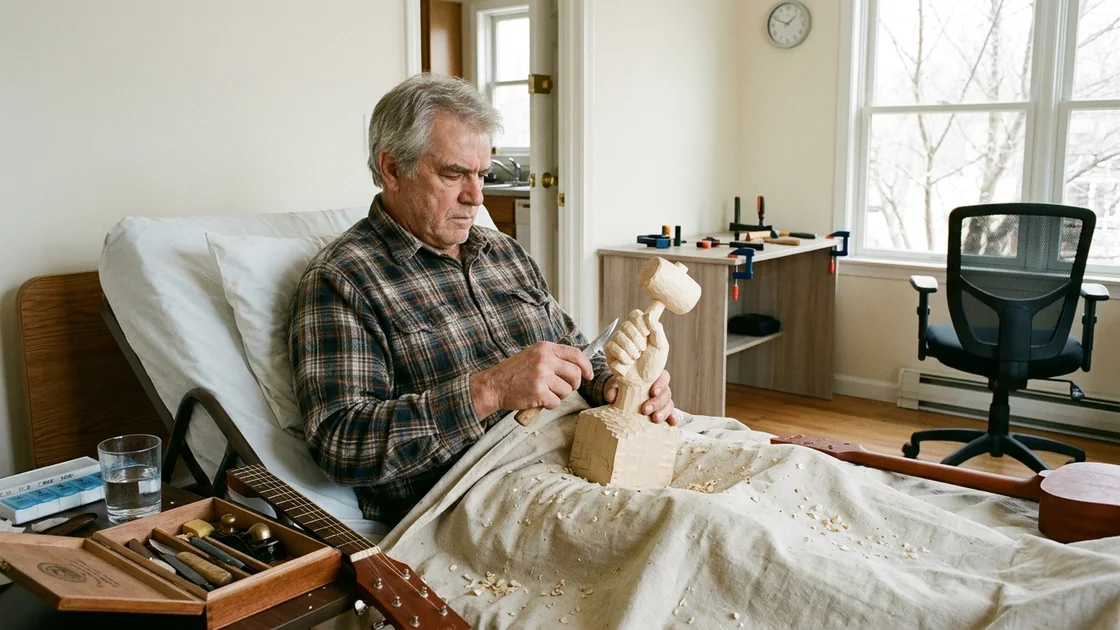
Arthur Pendelton, a sixty-two-year-old master luthier and architectural woodworker, faces the irreversible deterioration of his spine due to severe degenerative disc disease and spinal stenosis. Forced by his failing body and his daughter's pragmatism, he must abandon his cavernous, sawdust-perfumed basement workshop and relocate to a sterile, sunlit ground-floor bedroom converted from a formal dining room. As the tools of his life are packed away and sold, Arthur grapples with the erosion of his identity, the tyranny of flat surfaces, and the persistent memory of wood grain, ultimately discovering a quiet, smaller way to keep his hands in motion before the stiffness claims him entirely.
The stairs had always been twelve in number, cut from two-inch-thick treads of heart-pine that Arthur had milled himself back when Jimmy Carter was in the White House and his own lumbar vertebrae still possessed the wet, forgiving resilience of fresh rubber. For forty years, those twelve steps were merely a throat he cleared before beginning his day. He would take them two at a time in his thirties, a mug of black coffee balanced in his left hand, his right hand barely grazing the hemlock handrail he had planed to the smoothness of river stone. In his fifties, he took them one by one, feeling the familiar, rhythmic thud of his boots against the risers, listening to the specific creak of the fifth tread—a dry, resinous complaint he never fixed because it served as a burglar alarm for when his wife, Clara, was still alive and coming down to bring him soup.
Now, at sixty-two, the twelve stairs were an alpine face.
Arthur stood at the bottom, his back pressed against the cool concrete block of the foundation wall, waiting for the lightning in his left hip to subside into a dull, manageable drizzle of ash. The air down here smelled of forty years of ruptured cells: cedar, walnut, bone glue, boiled linseed oil, and the sharp, metallic tang of high-carbon steel ground against aluminum oxide. It was an atmosphere thick enough to chew, a subterranean climate entirely of his own making. Above him, through the floor joists that served as his ceiling, he could hear the muffled, rubber-soled footsteps of his daughter, Claire, and the heavier, uncoordinated thudding of her husband, Mark. They were preparing the dining room.
They called it "the transition," a word Arthur associated with hospice care or regime change.
"Dad?" Claire’s voice drifted down the stairwell, thin and anxious, cutting through the smell of the pine shavings. "The guys from the estate outfit are going to be here at ten for the jointer and the lathe. Dr. Aris said you shouldn't even be down there today. The dampness."
"It isn't damp," Arthur said, though his voice didn't carry past the fourth riser. He had three dehumidifiers running in a perpetual, humming chorus that kept the basement at a strict forty-two percent relative humidity. Wood moved when it was damp. Wood warped, cupped, and checked. Arthur had spent his adult life fighting moisture; it was an insult to suggest his shop was anything less than an arid vault. Only his own body had failed to hold its shape against the seasons.
He looked down at his boots. The left foot was turned slightly inward, a permanent, lazy drift caused by the L4 and L5 vertebrae collapsing into one another like old bricks in a wet chimney, pinching the nerve root until the signals from his brain arrived at his toes garbled and late. Stenosis, the doctor had called it, tracing a plastic model of a spine with a manicured fingernail. A narrowing of the canal. And the discs above it—here at T11 and T12—they’re essentially gone, Arthur. Bone on bone. Every time you bend over that workbench, you’re grinding mortar in a pestle.
Arthur shifted his weight, testing the left leg. The nerve held. He reached out and laid his palm flat against the cast-iron bed of his 1954 Delta Unisaw. The metal was cold, rubbed with paste wax until it shone with a dull, pewter luster. He knew every scratch on this surface. That crescent gouge near the miter slot was from a kickback in eighty-eight when he was rushing a batch of cherry cabinet doors; the faint ring of rust in the back right corner was where Clara had set a sweating glass of iced tea while telling him her sister was getting divorced.
To leave this room was not simply to stop working; it was to be evicted from his own memory.
Upstairs, the front door chimes rang—two brass tubes striking a chord he had tuned himself thirty years ago. Heavy boots crossed the oak floorboards of the foyer. The movers had arrived, not to move him, because he was only going twelve feet vertically and twenty feet horizontally, but to disembowel the space beneath his feet so he wouldn't be tempted to crawl back down into it.
"I'm coming up," Arthur called out, louder this time.
He turned to the stairs. The ascent required a specific geometry, a choreography of compensation he had developed over the last eighteen months. Left hand on the hemlock rail. Right hand braced against the unfinished drywall of the stud wall. Right foot up to the first pine tread. Lock the knee. Lean forward at a fifteen-degree angle—any further and the facet joints screamed; any less and the spinal canal closed tight on the sciatic nerve, dropping him like a poleaxed steer. Pull the dead weight of the left leg up to meet the right. Breathe through the teeth. Repeat eleven times.
By the fifth step, the familiar heat was blooming at the base of his skull, radiating down between his shoulder blades like boiling water poured under his skin. The fifth tread gave its dry, faithful scritch.
Goodbye, old girl, he thought, his knuckles white on the rail.
When he reached the landing and pushed through the door into the kitchen, the light hit him with the force of a physical blow. The upper floor had always belonged to Clara, and since her death five years ago, it had become a museum he merely passed through on his way from the bed to the basement. Now, Claire had opened all the curtains. The morning sun of late October, thin and merciless, poured through the double-hung windows, illuminating dust motes that had no business being air-borne—household dust, made of dead skin and lint, utterly lacking the clean, fibrous nobility of sawdust.
Claire was standing by the kitchen island, holding a clipboard. She was thirty-six, with Clara’s narrow chin and Arthur’s own stubborn, heavy brow. She looked at him with that terrible, bright pity that children reserve for parents who have begun to shrink.
"You're sweating, Dad," she said, setting the clipboard down and stepping toward him, hands half-raised as if he were a stack of plates about to tip.
"The stairs are warm," he lied, waving her off with a short, chopping motion of his right hand. He shuffled past her, using the edge of the laminate countertop to guide himself toward the front of the house. "Don't fuss, Claire. Where are the men? If they lift that jointer by the outfeed table, they’ll knock it out of coplanar alignment. It takes half a day with feeler gauges to true it up again."
"They know what they're doing," Mark said, emerging from the dining room. He was wiping his forehead with the back of his sleeve. Mark was an actuary, a man whose hands had never known a callus that wasn't put there by a nine-iron. He meant well, which Arthur found infinitely harder to forgive than malice. "The lead guy says they move machine shops all the time. Here, Arthur, take a look. We just got the rug up."
Arthur stopped at the threshold of what had been the dining room.
For thirty-eight years, this room had contained a walnut trestle table he had built for Clara on their fifth anniversary, eight Windsor chairs that had nearly cost him his sanity during the steam-bending of the bows, and a low sideboard with hand-cut dovetails so fine you couldn't slip a fingernail between the pins and the tails. All of it was gone, pushed into the living room or loaded into Claire’s SUV to be kept "in the family."
In their place was a hospital bed, though Claire had insisted on buying one with "home-style" oak veneer headboards that wouldn't fool a blind man. The floor was bare red oak strip flooring, commercially milled, factory-finished with aluminum oxide polyurethane that looked like liquid plastic. The walls had been painted a color Claire called Warm Alabaster, which to Arthur’s eye was the exact shade of dried primer. In the corner, where the sideboard used to sit, was a small, flat-pack desk made of particleboard covered in a photographic paper printed to look like ash. Next to it was a reclining leather armchair with a heavy wooden lever on the side.
There were no shadows in the room. The two large south-facing windows flooded every corner with a flat, shadowless glare. It was a room designed for nothing to happen in. It was a waiting room.
"See?" Claire said from behind him, her voice brittle with forced cheer. "No thresholds. We took the transition strip off between the hall and here so your toe won't catch. The bathroom is twelve steps that way—flat steps, Dad—and we had the grab bars put into the studs yesterday. And look at the view. You can see the maples by the road."
Arthur looked at the windows. The maples were dropping their leaves, wet yellow rags plastering themselves to the asphalt. In the basement, the only windows were two hopper vents near the ceiling, set into steel wells filled with gravel and dead oak leaves. Through them, he had only ever seen the ankles of the mailman and the changing quality of the gray light that told him whether it was raining or snowing. He had preferred the hopper windows. They didn't demand that he look at a world he wasn't participating in.
"It's very bright," Arthur said.
"Light is good for the mood," Claire said firmly. "Dr. Aris said people with chronic pain get seasonal affective disorder twice as fast if they're cooped up in the dark."
Below their feet, a dull, metallic clang echoed through the heating ducts, followed by the grunting of heavy men and the harsh scrape of cast iron dragging across concrete.
Arthur flinched as if the iron had been dragged across his own shins. "They're sliding the lathe," he muttered, his hand tightening on the doorframe. "There’s a leveling bolt on the tailstock leg with a stripped locknut. If they drag it, they'll shear the bolt right off in the casting."
He turned to go back toward the kitchen, toward the basement door, forgetting for a fraction of a second the choreography required of his hips. He pivoted too fast on the left leg.
The space between his fourth and fifth lumbar vertebrae, devoid of cartilage, slid sideways by two millimeters. A white-hot wire was driven instantly from his beltline down through his buttock, behind his knee, and out the heel of his boot. His left knee buckled completely, the muscles simply switching off as the nerve pinched shut.
"Dad!"
Mark caught him under the armpit before he hit the floor, the younger man’s breath hot and smelling of peppermint near Arthur’s ear. Claire was there a second later, taking his other arm. Together they hauled him upright and steered him—his left boot dragging uselessly across the slick polyurethane floor with a humiliating rubbery squeak—into the room and dropped him into the leather recliner.
Arthur sat rigid, his hands gripping the overstuffed armrests, his eyes shut tight against the nausea that always followed the lightning. His heart hammered against his ribs like a trapped bird. Beneath him, through the floor, the scraping continued—scritch, thud, scrape—as the machines that had defined the boundaries of his competence were hauled up the outside bulkhead stairs into the blinding October sun.
"That's it," Claire said, her voice trembling, all the bright cheer gone, replaced by the hard, maternal steel she had inherited from Clara. She walked out of the room and returned ten seconds later with a cordless drill and a brass deadbolt still in its blister pack. "Mark, lock the basement door from this side. Put the latch at the top of the frame where he can't reach it without a stool."
"Claire, don't be ridiculous," Arthur gasped through clenched teeth, the sweat now rolling cold down his temples. "My hand planes are still down there. My chisels. The Japanese water stones."
"We'll bring up what you can use at the little desk," she said, ripping the plastic packaging open with her teeth. "You're done with the stairs, Dad. You're done."
The first week in the white room was defined by the acoustics of absence.
In the basement, sound had been absorbed by forty years of wood storage—racks of rough-sawn mahogany, birdseye maple, and quarter-sawn white oak stacked near the ceiling, along with pegboards bristling with tools and corners drifted high with curls of planed pine. Sound down there was short, dry, and dead. When you struck a chisel with a beechwood mallet, the thwack stayed right there at the bench, intimate and contained.
Up here, the room was an echo chamber. The bare oak floors, the bare plaster walls, the wide panes of glass—every small noise bounced back and forth until it frayed Arthur’s nerves. The ticking of the quartz clock Claire had hung on the wall sounded like someone tapping a drywall screw with a tack hammer. The hum of the refrigerator in the next room vibrated through the floorboards at sixty hertz, a frequency that seemed to settle directly into the inflamed tissue around his thoracic spine. When a delivery truck went by on the road out front, the whole room buzzed like a cheap guitar with a high fret.
Claire had stayed for four days to get him settled, organizing his medications into a seven-day plastic trough with compartments for Morning, Noon, Evening, and Bedtime.
Gabapentin for the nerve fire. Meloxicam for the joint swelling. Tizanidine to stop the paraspinal muscles from locking into iron cables while he slept. And the small white pills in the orange bottle with the warning label about operating heavy machinery—Oxycodone—which Arthur refused to take during the day because they turned his brain into wet balsa wood, incapable of holding an edge or a thought.
On the fifth day, Claire and Mark went back to their lives in the city, forty minutes south, after arranging for a visiting nurse named Brenda to stop by on Tuesdays and Fridays, and setting up grocery deliveries.
Left alone, Arthur sat in the leather recliner and studied the enemy: the flat-pack desk.
It stood three feet wide and two feet deep against the Warm Alabaster wall. On its surface, Mark had lined up the surviving remnants of Arthur’s kingdom, selected during a hasty ten-minute expedition to the basement while Arthur shouted instructions from the top of the locked stairs.
There was his Stanley No. 4 smoothing plane, its rosewood knob and tote darkened by decades of the oils from his palms. There was a roll of canvas containing his eight Marples chisels, honed to a mirror bevel at twenty-five degrees. There was a small brass marking gauge, a six-inch Starrett combination square, a fret saw, three carving knives he used for shaping violin necks, and a wooden cigar box full of sandpaper scraps and brass hinges. Underneath the desk sat two blocks of basswood and an unfinished neck for a parlor guitar made of Honduras mahogany, which he had started in August before the T11 disc had given up the ghost.
Around noon, when the Meloxicam had blunted the worst of the morning stiffness, Arthur pushed himself out of the recliner. It took him forty seconds to achieve verticality. He had to rock forward three times, get his feet squarely under his center of mass, and then use his triceps to press upward until his hips could lock into place. He stood still for a full minute, waiting for the blood pressure in his head to equalize and for his spine to settle into its crooked, calcified stack.
Using a heavy blackthorn cane—he had refused the aluminum quad-cane the physical therapist recommended, choosing instead a stick he had turned himself ten years ago for a neighbor who had died before using it—he crossed the six feet of floor to the desk.
He pulled out the chair. It was an ergonomic office chair on five plastic casters, covered in black mesh. When he sat down on it, the chair rolled backward an inch on the slick floor, nearly dumping him onto his tailbone. Heart pounding, he grabbed the edge of the desk to steady himself.
The desk shifted.
Arthur stared at it. He grabbed the front edge with both hands and gave it a gentle sideways tug. The entire structure racked half an inch to the left with a pathetic, dry squeak of cam-locks turning in chewed-up particleboard.
A real workbench—the one currently sitting in the dark directly beneath his feet, eight feet long, constructed of laminated four-by-four hard maple bolted together with half-inch threaded rod, weighing four hundred and eighty pounds before the vises were even attached—was an extension of the earth’s crust. When you leaned against a real bench, it pushed back with the authority of a mountain. You could clamp a piece of white oak into the tail vise and throw your entire body weight behind a jack plane, and the bench wouldn't move a thousandth of an inch. All the energy went into the blade, into the wood, into the curling, translucent ribbon of shaving that rose from the throat of the plane like smoke.
This desk was a lie. It had no mass. It had no joinery. It was sawdust and urea-formaldehyde glue pressed between rollers and held together by zinc-plated pot metal.
Disgusted, Arthur reached for the unfinished mahogany guitar neck. The wood was warm, reddish-brown, with tight, straight grain running the length of the shaft and a scarf joint at the headstock so clean it was nearly invisible. He had bandsawn the rough profile in late summer; now it needed to be spokeshaved and rasped into the gentle, C-shaped curve that would fit a player's left hand.
How was he supposed to hold it? There was no vise.
He looked around the room. He hobbled back to the closet where Claire had shoved a few miscellaneous boxes, found two four-inch C-clamps, and brought them back to the desk. He laid the mahogany neck near the edge of the fake-ash top, placed a scrap of leather under the clamp jaws so he wouldn't mar the wood, and tightened the screw down against the underside of the desk lip.
He picked up a cabinetmaker’s rasp—a Nicholson #49, hand-stitched teeth that cut smoothly without tearing the grain. Sitting in the rolling mesh chair, he braced his feet wide to keep from drifting backward, leaned forward five degrees, and pushed the rasp across the heel of the guitar neck.
Screeee-ch.
The desk skidded three inches across the polyurethane floor, its plastic feet chattering against the oak strips. At the same time, the rotational force of his push caused the rolling chair to swivel thirty degrees to the right.
The sudden twist went straight to his mid-back. A hot needle slid between his ribs on the left side. Arthur dropped the rasp—it clattered loudly against the floor, leaving a tiny white dent in the plastic finish—and grabbed his knees, breathing in shallow, ragged sips until the spasm unlocked its jaws.
He sat there for ten minutes, staring down between his boots at the fallen rasp. The afternoon sun had moved around to the southwest window, throwing a blinding rectangle of light directly across the desk, making the fake wood grain shine like grease.
He couldn't stand at a bench because his lumbar spine couldn't support his torso for more than five minutes without the nerves dying in his legs. He couldn't sit and work because pushing a tool from a seated position required bending at the waist and engaging the core muscles that were currently locked in a permanent, defensive war around his degenerated thoracic discs. Woodworking was a kinetic chain that began at the soles of the feet, traveled through the hips, coiled through the spine, and exited through the shoulders and hands. His chain was broken in three places.
He was a tradesman with fifty thousand hours of muscle memory locked inside a frame that could no longer transmit force.
Arthur reached down—very slowly, sliding his right hand down his shin until his fingertips brushed the floor—picked up the rasp, and laid it back in the cigar box. He didn't touch the mahogany neck again for a week.
November arrived with a cold, sleeting rain that stripped the last of the leaves from the maples out front, leaving their black, wet branches skeletal against the gray sky.
The routines of the ground floor closed around Arthur like water freezing in a bucket.
On Tuesdays and Fridays at nine in the morning, Brenda arrived. She was fifty, built like a coal stove, with scrub tops covered in cartoon dogs and a voice that had been cured by thirty years of menthol cigarettes. She didn't use the Warm Alabaster voice Claire used. She treated Arthur’s body the way Arthur used to treat a warped board of cheap Home Depot pine—with pragmatic, unsentimental assessment.
"Let's see the walk, Artie," she said on the second Tuesday, standing by the doorway with a blood pressure cuff dangling from her thick fingers.
Arthur got up from the recliner and walked to the dining room window and back. His left foot slapped the floor—clop, shuffle, clop, shuffle. Drop-foot, they called it. The peroneal nerve was losing the argument with the bone spurs at L5.
"You're dragging more than Friday," Brenda noted, scribbling on her tablet. "You wearing that plastic brace the PT gave you?"
"It rubs my ankle bone raw," Arthur said, sitting back down on the edge of the oak-veneer hospital bed so she could take his vitals. "And it doesn't fit inside my boots."
"You don't need boots in the house, Artie. Buy some wide New Balances with the Velcro straps. You catch that toe on the bathroom tiles, you're gonna break your hip, and then you'll be in a place with green Jell-O and a roommate who yells at the television. Put your arm out."
While the cuff inflated with its rhythmic, mechanical wheeze, Arthur looked over her shoulder toward the kitchen. The brass deadbolt at the top of the basement door gleamed in the fluorescent light of the range hood.
"Brenda," he said quietly. "Do you know how to use a cordless drill?"
She didn't even look up from the gauge. "Your daughter pays my agency, Artie. Even if she didn't, I took a look at those stairs when I went down to check the fuse box last week. They're fifty-degree pitch with no risers at the back. You go down there, the fire department's bringing you up in a basket." She ripped the Velcro cuff off his arm. "One-thirty-eight over eighty-four. Little high. You hurting today?"
"It's raining," he said.
"Barometer drops, the tissues swell in the joint space," she recited, clicking her stylus. "Take the muscle relaxer before noon. And do your pelvic tilts on the mattress. I can tell you haven't been doing them because the sheets aren't even wrinkled."
After she left, the silence returned, heavier than before.
Arthur spent his afternoons reading old issues of Fine Woodworking from the nineteen-eighties and nineties, back when the magazine was printed in black and white on heavy paper and featured articles by men with missing fingertips and gray beards who explained how to build eighteen-drawer apothecary chests using only hand tools. He read the articles the way an exiled man reads the newspapers of his homeland. He didn't just read the text; he read the diagrams, checking the proportions of the mortises, mentally calculating the wood movement across a twenty-inch cherry tabletop, arguing silently with the authors when they suggested using polyurethane glue instead of hide glue.
Sometimes, when the Tizanidine made him drowsy, he would close his eyes in the recliner and drop instantly into the basement.
In these half-dreams, his spine was nineteen years old again. He was standing at the lathe, turning a tall spindle of green ash for a Windsor chair. He could feel the specific, chattering vibration of the roughing gouge through the beechwood handle as it knocked the square corners off the spinning blank—thump-thump-thump-thump-shhhhhhhh—until the wood became a cylinder and the sound smoothed out into a high, singing hiss. Cool, wet shavings of green ash sprayed across his knuckles and down the front of his denim apron, smelling slightly of sour grass and vinegar. He would lean in close, bending easily from the waist, squinting behind his safety glasses to sight along the curve of the cove he was cutting with a spindle gouge...
And then his left leg would jerk involuntarily—a myoclonic spasm from the compressed nerve root—and his heel would strike the metal footrest of the recliner with a loud clank, waking him into the white glare of the dining room.
One afternoon in mid-November, a stranger came to the house.
Claire had warned him on the phone the night before. "A young guy named Miller," she had said. "He bought the Unisaw and the jointer from the estate company, and when he found out they came from your shop, he asked if you had any hand planes or wood stock left to sell. Mark’s going to meet him there at two to unlock the bulkhead."
Arthur had protested—he wasn't dead yet, why were they selling his wood stack?—but Claire had been gentle and immovable. Dad, there’s twelve hundred board feet of lumber down there. If the dehumidifiers break and nobody can get down the stairs to empty them, it’ll all mildew and warp anyway. Let someone use it.
That argument had broken him. The thought of his quarter-sawn white oak—wood that had air-dried for a decade under tin roofs in Pennsylvania before spending another fifteen years acclimating in his racks—cupping and growing black mold in the dark was worse than the thought of a stranger cutting into it.
At two-fifteen, Mark led the buyer into the dining room.
Miller was about thirty, wearing Carhartt double-front pants with real sawdust ground into the knees and a flannel shirt frayed at the cuffs. He had thick, square hands with a fresh blood blister under the thumbnail of his left hand. When he stepped into the white room, he took off his wool cap and held it against his chest as if he had walked into a church.
"Mr. Pendelton," Miller said. His voice was quiet, respectful. "I'm really sorry to bother you. I just—when I saw the makers' mark stamped under the outfeed table he built for that Unisaw, I realized who you were. You built the choir stalls at St. Jude’s over in Mercer County, didn't you? Back in ninety-four?"
Arthur, who had been sitting with his jaw set in a hard, defensive knot, blinked. Slowly, he straightened his shoulders against the leather backrest, ignoring the sharp complaint between his shoulder blades.
"Ninety-five," Arthur corrected, his voice raspy from disuse. "The architect wanted red oak stained dark. I talked the parish council into fumed white oak. Built a tent out of six-mil plastic in the church parking lot and fumed the whole lot with twenty-six percent aqueous ammonia for three days."
Miller smiled, a wide, genuine grin that transformed his plain face. "I knew it. No stain gets that gray-brown depth inside the medullary rays. I went and looked at those stalls three times last year when I was bidding on a library job. The linenfold panels on the ends—did you do those with a shaper or by hand?"
"Hollows and rounds," Arthur said, gesturing toward the locked basement door with his chin. "Eighteen pairs of nineteenth-century beech molding planes I bought off an old German cabinetmaker in Bethlehem. You hog out the waste with a rabbet plane, then work the curves with a number six hollow and a number six round. Takes forty minutes a panel once you get your rhythm."
"Your rhythm is faster than mine," Miller said softly. He looked over at the pathetic particleboard desk, his eyes passing quickly and mercifully over the C-clamps and the untouched mahogany guitar neck before returning to Arthur. "Your son-in-law says you're letting the lumber go, and some of the bench tools. I don't want to lowball you, Mr. Pendelton. I brought cash, and I'm paying full retail on the board footage."
For the next forty minutes, while Mark stood awkwardly in the hallway checking his email on his phone, Arthur and Miller talked wood.
Arthur didn't have to go down into the basement; he had an inventory of every board etched into his cerebral cortex.
"Top rack on the north wall," Arthur told him, leaning forward slightly on his blackthorn cane, his eyes fixed on the middle distance as he walked the shop in his mind. "Under the tarps. There’s four flitches of curly cherry, eight-quarter thick, ten inches wide, twelve feet long. They came off the same log from a windfall in Bucks County in two thousand andtwo. Don't use a standard twenty-five-degree frog on those; the grain reverses every two inches. It'll tear out like wet newspaper unless you use a high-angle frog or a scraper plane."
"I've got a Lie-Nielsen number four-and-a-half with a fifty-degree York pitch frog," Miller said, nodding seriously, taking notes in a small spiral pad he pulled from his shirt pocket. "What about the boxwood logs in the corner by the furnace? The ends are waxed."
"Turkish boxwood," Arthur said, a pang of genuine grief tightening his throat. "Bought it from an importer in Brooklyn who went out of business thirty years ago. I used it for lute pegs and violin tailpieces. Hard as bone. You can thread it with a metal tap and die. Don't sell that by the board foot—take the whole crate for two hundred dollars, just promise me you won't turn it into novelty pens for craft fairs."
"I make baroque flutes on the side," Miller said. "I'll use it for the ferrules and the tenon caps."
Arthur looked at the young man’s hands again—at the blood blister, the dry skin around the knuckles split by winter air and fine walnut dust, the slight asymmetry of the right shoulder from years of planing. It was like looking at an old photograph of himself, except the photograph could walk down stairs.
"Mark," Arthur called out.
Mark stepped back into the doorway. "Yeah, Arthur?"
"Give him the molding planes," Arthur said. "The beechwood ones in the pine chest under the main workbench. Don't charge him for them."
Miller held up a hand. "Mr. Pendelton, I can't take a full set of matched hollows and rounds for nothing. Those are worth fifteen hundred bucks easy."
"They're worth nothing if the wedges dry out and drop into the shavings because nobody's tapping them tight," Arthur said fiercely. The pain in his back was flaring now from the tension of sitting upright for so long, a hot band of iron tightening around his ribs, making him short of breath. He wanted the boy gone before his face betrayed what the spine was doing to him. "Take them. Keep linseed oil on the soles so they don't check in your shop if you use forced-air heat. Now go on. It takes two men to get those cherry flitches around the turn in the bulkhead."
After Miller and Mark went back down—Arthur listening for an hour as his life’s savings of seasoned timber were slid out through the cellar doors into the bed of a diesel pickup truck—he didn't feel the relief Claire had promised him when she talked about "downsizing."
He felt light. Not the good lightness of a bird, but the terrible, hollow lightness of a piece of oak that has been eaten from the inside by powderpost beetles until only a paper-thin veneer of grain remains over a core of dry dust.
By December, the world had shrunk to the dimensions of the room, twelve feet by fourteen feet, plus the short, desperate peninsula of the hallway that led to the bathroom.
The winter was hard and gray. Snow piled against the lower panes of the dining room windows, filtering the light into a cold, bluish glare that reminded Arthur of the fluorescent tubes in the MRI machine at the hospital.
His condition was not static; the word degenerative was an active verb. Around Thanksgiving, he had noticed a new symptom. It wasn't the sharp, electric sciatica of the lower back, nor the deep, toothache grind of the collapsed middle discs. It was a quiet numbness in the fourth and fifth fingers of his left hand, accompanied by a strange heaviness when he tried to button his flannel shirts in the morning.
When Dr. Aris saw him in early December—an expedition that required two hours of preparation, a folding wheelchair Mark had to lift into the trunk, and two Oxycodone tablets just to survive the potholes on Route 202—the doctor didn't look surprised.
"Cervical spine, Arthur," Aris said, pulling up the digital X-rays on the wall monitor. The bones of Arthur’s neck looked like melted candle wax that had hardened into jagged drips along the edges of the vertebrae. "Osteophytes—bone spurs—at C6 and C7. Your body knows the discs are failing, so it tries to stabilize the spine by growing more bone to fuse the joints together. Unfortunately, those spurs grow right into the foramen where the nerves exit to your arms."
"Can you grind them off?" Arthur asked. He was thinking of a die grinder with a carbide burr, cleaning up a bad weld on a cast-iron bracket.
Dr. Aris sighed, turning his stool around. "We could do a multi-level laminectomy and fusion in the neck, and another four-level fusion in the lumbar. You'd have titanium rods from your shoulder blades to your pelvis, and plates in your neck. At your age, with the bone density loss we're seeing and the number of levels involved, you're looking at a year of brutal recovery for maybe a thirty percent reduction in pain, and you'd lose whatever flexibility you have left. If it were one disc, I’d operate tomorrow. But your whole column is cascading, Arthur. It’s systemic wear."
"I've got forty years of heavy lifting on that frame," Arthur said, looking at the glowing gray ghost of his skeleton on the screen.
"And it served you well," the doctor said gently. "Now you have to stop asking it to be a crane. We can adjust the Gabapentin, maybe try an epidural steroid injection in the neck after New Year's to buy your left hand some time. In the meantime, Claire tells me you have a hospital bed at home now. Use the incline. Keep your neck supported."
On the drive back, looking out the passenger window at the frozen cornfields of the county, Arthur rubbed the ring finger and pinky of his left hand against his thumb. It felt as though he were wearing a thick leather work glove on just those two fingers.
For a right-handed woodworker, the left hand is not the lesser hand. The right hand provides the engine—it drives the saw, pushes the plane, strikes with the mallet. The left hand provides the intelligence. The left hand presses the toe of the plane down into the board at the start of the stroke; the left hand guides the blade of the chisel within a hair's breadth of the knife line; the left hand feels the microscopic ripples left by a dull iron that the eye cannot see.
If his left hand went blind, the tools on the flat-pack desk weren't even museum pieces anymore. They were just metal and wood.
That night, after Mark and Claire had helped him inside, microwaved a dish of lasagna he barely touched, and driven back to the city before the snow started again, Arthur sat on the edge of the hospital bed.
It was nine o'clock. The house was utterly still except for the ticking of the quartz clock and the occasional pop of the baseboard radiators expanding as the boiler kicked on in the basement—his basement, now nothing more than a utility room housing a cast-iron furnace and four hundred square feet of swept concrete.
He looked over at the desk. The mahogany guitar neck was still clamped to the edge where he had left it in October. A thin film of household dust had settled on its upward-facing surface, dulling the rich reddish-brown of the wood.
Arthur stood up, took his cane, and walked over to the desk. He didn't sit in the treacherous rolling chair. Instead, he leaned his hip against the edge of the radiator under the window, taking some of the weight off his left leg, and unscrewed the two C-clamps with his right hand.
He carried the guitar neck back to the bed, kicked off his Velcro New Balance sneakers—he had finally surrendered to Brenda’s bullying two weeks ago—and climbed onto the mattress. With the wired remote, he raised the head of the bed to a forty-five-degree angle and brought the knees up slightly until his lumbar spine flattened comfortably against the foam.
He laid the piece of mahogany across his thighs.
It weighed less than two pounds. He ran his right thumb along the scarf joint where the angled headstock met the shaft, then switched hands and ran his left thumb over the same spot. His thumb and index finger were still clear; they received the message of the wood perfectly—the tiny, porous open grain of the mahogany, the glassy, hard line of the cured Titebond glue, the slight ridges left by the sixteen-tooth-per-inch bandsaw blade back in August.
He couldn't push a rasp. He couldn't swing a mallet. He couldn't lean over a bench.
Then don't, a voice in his head said. It sounded remarkably like old Mr. Henderson, the high school shop teacher who had first put a spokeshave in Arthur’s hands in nineteen-seventy-six. When the wood fights the tool, Pendelton, you don't hit it harder. You change the angle of attack.
Arthur reached out with his cane, hooked the leg of the rolling office chair, and dragged it across the slick floor until it bumped against the side of the bed. Reaching over, he pulled the wooden cigar box off the desk and set it on his nightstand.
Inside the cigar box, beneath the sandpaper and the rasp, was a tool he hadn't used in five years: a small, curved cabinet scraper made from an old saw plate, and a tiny bronze finger plane—an Ibex luthiers' plane, no bigger than a walnut, with a convex sole and a blade only half an inch wide, designed for carving the arched tops of violins.
Beside it was one of his carving knives, forged from laminated Swedish steel with a handle of curly birch that filled the palm like an egg.
He didn't need a four-hundred-pound maple workbench to use a carving knife. The force of a paring cut doesn't come from the spine or the shoulders; it comes from the opposition of the two hands, working inches apart, a closed loop of leverage between the thumb of the holding hand and the knuckles of the cutting hand.
Arthur pulled the bedsheet up over his knees. On the next Tuesday, Brenda was going to raise absolute hell about wood shavings in the linen, and he found that he didn't care in the slightest.
He cradled the heel of the mahogany guitar neck against his chest, bracing it with the meat of his left palm and his still-working thumb and forefinger. With his right hand, he took the birch-handled knife, placed the razor bevel flat against the rough bandsawn curve of the neck heel, and locked his right thumb against the back of his left thumb as a pivot.
He squeezed his hands together.
Snik.
A small, crescent-shaped curl of Honduras mahogany, no larger than a fingernail paring, peeled away from the parent block and dropped onto the white cotton sheet, looking like a drop of dried blood against snow. Underneath the cut, the wood gleamed with an iridescent, chatoyant luster that no sandpaper could ever produce—the clean, severed cellular structure of a tree that had grown in the rain forests of Central America a hundred years before Arthur was born.
His spine didn't move. The L4 nerve stayed quiet. The T11 vertebrae rested against the foam pillow.
He repositioned his thumbs and made another cut. Snik. And another. Snik.
It was glacially slow. With a Nicholson rasp and a pattern-maker’s vise in the basement, he could have rough-shaped this heel in twelve minutes, sending a blizzard of coarse red dust onto his boots before moving on to the spokeshave and the scraper. Doing it this way—paring away a sixteenth of an inch at a time with a two-inch blade held against his breastbone—would take twenty hours.
Arthur looked up at the quartz clock on the Warm Alabaster wall. It was nine-twenty at night. He had nothing to do until nine o'clock tomorrow morning, and nothing to do after that until Friday. He had more hours than he knew what to do with. Time was the one material he wasn't running out of in the immediate short term; it was stacked to the ceiling like rough lumber.
For an hour, the only sound in the room was the dry, whispery shhh-tik of the Swedish steel slicing across the diagonal grain of the mahogany, and the quiet tink of the bronze finger plane when he switched tools to level the transition between the shaft and the peghead. Tiny curls of reddish wood accumulated in the valleys of the white blanket over his lap, releasing a faint, spicy aroma of humus and tropical sun that rose into his nostrils and pushed back the sterile smell of laundry detergent and drywall paint.
At ten-thirty, his left forearm began to cramp from holding the static grip, and a dull ache started to build at the base of his neck from looking down at his chest.
In the old days, he would have worked through it. He would have set his jaw, ignored the burn between his shoulder blades, and stayed at the bench until midnight to finish the component because the shop schedule demanded it, paying for his stubbornness the next morning with three ibuprofen and twenty minutes under a hot shower.
Now, he stopped immediately. He laid the knife and the bronze plane back into the cigar box, set the mahogany neck carefully on the nightstand beside his water glass, and used his right hand to gather the majority of the shavings off the sheet into an empty prescription bottle so he wouldn't roll over on them in the night. A few fine flecks of red dust remained ground into the weave of the cotton. He left them there.
He lowered the head of the bed twenty degrees, took his nighttime Gabapentin and the Tizanidine, and turned off the bedside lamp.
In the dark, with the snow ticking faintly against the double-hung windows and the radiator breathing softly in the corner, Arthur rubbed his right thumb over the callus at the base of his index finger. The skin there had grown soft over the last two months, peeling away in dead, pale flakes from lack of friction. Tonight, the spot was tender and warm. Tomorrow it would be slightly harder.
The Friday before Christmas, Brenda arrived with snow on her boots and a brown paper bag from the hardware store in town.
She stood at the foot of the bed, hands on her hips, looking down at the white sheet. Despite Arthur’s best efforts with a hand whisk broom he had found in the kitchen closet, the bottom third of his bed and the oak floorboards immediately to the right of the mattress were dusted with a fine, cinnamon-colored powder. On the nightstand sat the mahogany guitar neck, now fully shaped from heel to volute, its curves flowing into one another with the liquid, organic precision of a greyhound's flank.
"I thought you had mice," Brenda said, squinting at the floor. "Then I smelled the wood. You whittling in my clean sheets, Artie?"
"Carving," Arthur corrected from the recliner, where he was sitting with a heating pad wedged behind his neck. "Whittling is making sticks into smaller sticks on a porch. Carving is working to a line."
She snorted, walked over to the nightstand, and picked up the guitar neck. For a woman who moved like a bulldozer, she handled the piece with surprising delicacy, turning it over in her thick hands to look at the diamond-shaped volute carved into the back of the headstock. Her thumb traced the razor-sharp ridge where the two concave facets met at the centerline.
"My brother plays," she said, setting it back down carefully. "Bought a Martin when he got his settlement from the railroad. He don't let nobody touch it unless they wash their hands first. This is real smooth, Artie."
"It needs scraping and four grits of paper yet," he said. "What's in the bag?"
She tossed the brown paper sack onto his lap. "Your daughter called the agency yesterday. Wanted to know if you were 'adjusting to a sedentary lifestyle.' I told her you were a model prisoner. Then I stopped at Miller’s Hardware on my way in."
Arthur opened the bag. Inside was a heavy cotton canvas painter’s drop cloth, six feet by nine feet, and a roll of two-inch blue painter’s tape.
"You tape that canvas over the top sheet before you start messing with that wood," Brenda said, pulling her blood pressure cuff out of her bag. "When you're done, you fold the corners into the middle and shake it out into the trash can by the desk. If Claire comes up here for Christmas and finds mahogany splinters in your mattress pad, she's gonna take your knives away like you're on suicide watch. Put your arm out."
"How much do I owe you for the canvas?"
"Shut up while I'm listening for your pulse, old man. Call it a Christmas present."
That afternoon, after she left, Arthur spread the canvas drop cloth over his legs. It was stiff, unbleached duck cloth that smelled of sizing and cottonseed oil—a workshop smell.
With the neck finished, he had reached an impasse. A guitar neck without a body is just an expensive club, and building an acoustic guitar body—bending the rosewood ribs over a hot pipe, joining the two-piece spruce soundboard with a five-foot jointer plane, routing the binding channels—was completely out of the question in a bedroom. Even if he had the tools, the airborne dust from sanding Indian rosewood would coat the entire ground floor in an oily purple film that would give him bronchitis within a week.
He sat in the bed, looking at the finished neck, and then looked down at the two blocks of basswood sitting under the useless desk.
Claire had grabbed those blocks from a bin near the band saw only because they were small and light. Basswood—Tilia americana, the American linden—was a wood Arthur had always looked down on slightly. It had no figure, no dramatic grain, no structural strength for furniture, and zero acoustic resonance for instruments. It was pale, creamy white, soft enough to dent with a fingernail, with a grain so fine and homogeneous that it cut like cold cheddar cheese. He had kept a few blocks around only for making mock-ups of complex cabriole leg joints before committing to expensive walnut or mahogany.
He hooked one of the blocks out from under the desk with the crook of his cane and pulled it across the floor to the bed.
It was four inches square and ten inches long. On one end, in his own carpenter’s pencil handwriting from ten years ago, was written: Mock-up stock - dry.
He turned the block over in his hands. Because it had no strong grain direction, it wouldn't fight the knife when his left hand got tired. Because it was soft, it wouldn't require the leverage of his thoracic spine to push the blade through the fibers.
What did you make when you couldn't make things that bore weight, or things that made music, or things that held clothes?
He looked out the south window. On the bare branch of the sugar maple nearest the glass, a single dry leaf had refused to fall, its stem frozen into the bud scar, spinning furiously back and forth in the December wind like a weathervane. Below it, perched on the wooden fence post Arthur had sunk into the frost line twenty years ago, sat a mourning dove, puffed up into a gray ball against the cold, its head pulled down into its shoulders.
Arthur reached into the cigar box and found a stub of a 2B pencil.
He didn't draw the bird. He wasn't a parlor artist. Instead, he looked at the fence post the bird was sitting on, and the way the wet snow had drifted against the galvanized wire staples, and then he looked back at his own left hand resting on the canvas sheet—the swollen knuckles of the index and middle fingers, the slight, claw-like curl of the numb fourth and fifth fingers, the prominent tendons running down the back of the wrist like the roots of a beech tree over a riverbank.
He set the basswood block upright on his lap. With the pencil, he sketched the rough block-planes of a human hand, life-sized, rising out of a square plinth of raw wood, the fingers curled gently around the handle of a small wooden mallet.
He didn't have a band saw to hog out the waste between the wrist and the mallet handle. He had the fret saw—a thin, U-shaped steel frame holding a blade no thicker than a sewing needle—and he had his three knives and four of the narrower Marples chisels.
He began at the top of the block, using a half-inch firmer chisel pushed solely with the heel of his right palm to split away the corners along the straight grain.
Chuk. Chuk. Chuk.
Basswood didn't crack cleanly like oak or peel in hard ribbons like mahogany; it parted with a soft, fibrous sigh, leaving a surface that felt almost warm to the touch, like suede. He didn't use a mallet. He used the weight of his right arm, keeping his elbow tucked tight against his ribs so the leverage stayed away from his neck, guiding the bevel of the chisel with his left thumb.
When Claire and Mark arrived on Christmas Eve with bags of groceries and a pre-cooked ham, Arthur had hidden the basswood block inside his nightstand drawer and shaken the canvas cloth out into the kitchen trash can. He didn't want to explain what he was doing, and he didn't want Claire’s bright, anxious encouragement—Oh, look, Mark, Dad’s got a hobby!—to curdle the quiet concentration he had built in the room.
Christmas Day was an exercise in endurance.
Claire had set up a folding card table in the living room so they could eat together outside of his "bedroom." Sitting in a straight-backed dining chair for ninety minutes while they ate ham and scalloped potatoes was a medieval torture that Arthur survived only by taking a whole Oxycodone tablet forty minutes before dinner and gripping his knees under the tablecloth whenever the conversation turned to his health.
"Miller came back last week for the rest of the walnut," Mark said, carving the ham. "The shop is completely clear now, Arthur. Broom-clean. We had a guy come in and service the dehumidifiers and hook them up to a condensate pump that drains right into the sump pit, so nobody ever has to go down there to empty the buckets."
"That's good," Arthur said, his brain floating slightly behind his eyes from the narcotic. "The sump pump has a float switch that sticks if silt gets in the pit. Tell the guy to flush it with a hose in the spring."
"We will, Dad," Claire said, reaching across the table to pat his right hand. Her palm was warm and soft. She looked at his fingers, frowning slightly as she noticed a tiny nick near the knuckle of his left thumb, sealed with a drop of yellow wood glue because he hadn't wanted to walk to the bathroom for a Band-Aid. "How did you scratch your hand?"
"Zipper on my jacket," Arthur said smoothly, pulling his hand back to reach for his water glass. "Sharp teeth on the brass ones."
Before they left that evening, Claire gave him his present. It was an iPad in a ruggedized rubber case, pre-loaded with audiobooks, a subscription to a digital magazine service, and a folder of family photographs scanning back to the nineteen-seventies.
"So you don't have to hold heavy books while you're reclined," she said, kissing the top of his head. "And you can FaceTime us if you need anything."
When the taillights of their SUV disappeared down the driveway, turning onto the salted asphalt of the main road, Arthur walked slowly back into the white room, leaned his cane against the radiator, and sat on the bed. He plugged the iPad into the charger on the useless flat-pack desk and left it there, face down.
Then he opened the nightstand drawer, took out the block of basswood, and spread the canvas across his knees.
January and February were the long tunnel of the year.
The steroid injection Dr. Aris gave him in his neck on the tenth of January worked a small, temporary miracle: three days after the needle went in between his sixth and seventh cervical vertebrae, the thick leather glove vanished from his left ring finger and pinky, replaced by a tolerable, pins-and-needles tingling that allowed him to feel the wood again.
"It's a window, Arthur," Aris had warned him while peeling off his surgical gloves. "Could last six weeks, could last six months. The bone spurs are still there; we just shrank the inflamed tissue around the nerve root so it has room to breathe."
Arthur used the window the way a farmer uses four days of dry weather in haying season.
He abandoned the recliner almost entirely during the day, finding that the semi-Fowler’s position in the hospital bed—back at forty degrees, knees at thirty, a rolled-up bath towel tucked under his right elbow—allowed him to work for ninety minutes at a stretch before the deep paraspinal muscles along his thoracic spine began to burn. When the burn started, he would lower the bed flat, turn on the heating pad, and lie staring at the white plaster ceiling for forty-five minutes while listening to the house creak in the sub-zero wind, mentally planning the next series of cuts.
The sculpture emerging from the ten-inch block of basswood was changing as he worked down through the layers of waste.
Initially, he had intended to carve a clean, anatomical representation of a woodworker’s hand holding a mallet. But as he got deeper into the wood—using the tiny curved gouges from his violin-making kit to excavate the negative space between the fingers and the palm—he realized that basswood, with its pale, matte surface, looked dead when sanded smooth. Without the rich figure of walnut or the glowing pores of mahogany to give the eye something to hold onto, a smooth basswood carving looked like a piece of soap or a plastic medical model.
To give the wood life, the tool marks had to stay.
He stopped using sandpaper altogether. Instead, he honed his three Swedish carving knives and his four narrow gouges every morning on a double-sided diamond paddle he kept in the nightstand drawer, stropping the edges on a strip of horsebutt leather charged with green chromium oxide compound until they could split a freestanding hair.
With edges that keen, the basswood didn't compress under the iron; it sheared cleanly, leaving tiny, slightly concave facets that caught the hard winter light coming through the dining room windows. He carved the tendons on the back of the wooden hand with a three-millimeter V-parting tool, leaving the ridges slightly sharp, almost architectural, like the fluting on a Doric column. Where the wooden fingers wrapped around the shaft of the wooden mallet, he didn't undercut them completely into the round; he left them emerging from the rough, bandsawn matrix of the original block, as if the hand and the tool were growing out of the same piece of timber, inseparable from the material they were meant to shape.
On the lower wrist, just above where the carving met the rough square base of the block, he left a series of subtle, staggered steps—five of them, like tiny overlapping shingles or the treads of a steep stair, slightly tilted out of alignment, pressing down into the wood beneath them.
It was a portrait of his own lumbar spine, translated into joinery.
One Tuesday in late February, while he was doing his slow shuffle-walk down the hallway for Brenda’s chart, his left toe caught—not on the floor, which was flat as a pond, but on the cuff of his own sweatpants, which had sagged down over the heel of his sneaker because he had lost twelve pounds of muscle mass from his legs over the winter.
He didn't fall all the way down. He was close enough to the drywall to throw his right shoulder against the studs, taking the impact on his deltoid while his left knee twisted inward before he caught the grab bar outside the bathroom door.
"Jesus Christ, Artie!" Brenda was there in two bounds, grabbing him by the belt of his pants and hauling him upright before he could slide down the wall. She marched him back to the bed, sat him down, and immediately began checking his pupils and prodding his ribs through his flannel shirt.
"I'm fine," he breathed, though the shockwave of the twist was already traveling up his spine like a train wreck in a tunnel, each vertebra slamming into the next from L5 up to his neck. "Just caught my pant leg. Didn't hit my head."
"You're gray as putty," she snapped, reaching for the orange bottle of Oxycodone on the nightstand without asking him. She shook one out and shoved his water glass into his hand. "Swallow that. Now. Before the spasm locks your chest up and I have to call an ambulance."
He swallowed the pill. Within three minutes, the muscles along his left flank seized anyway, a massive, protective cramp that pulled his torso ten degrees to the left and made every breath past the top third of his lungs feel like inhaling broken glass.
Brenda helped him lie back, adjusted the bed controls, and packed pillows under his knees and left arm. She stayed an extra hour off the clock, sitting in the leather recliner reading a magazine on her phone while the narcotic and the muscle relaxer slowly wrestled the iron cables in his back into a dull, throbbing truce.
Before she left, she went into the closet, found a pair of kitchen shears, and cut two inches off the bottom of all four pairs of his sweatpants, leaving raw, frayed hems that hung well above his ankles.
"You're getting narrower, Artie," she said from the doorway, her coat on. "The road's getting narrower. You gotta watch the ditches."
For four days after the stumble, he couldn't hold the basswood block. The flare-up in his neck had returned, bringing the thick leather glove back over the outside of his left hand, and the lumbar spasm made sitting up at forty degrees impossible.
He lay flat on his back, the bed raised just enough so he could see the tops of the sugar maples against the gray February sky.
The white room, which he had fought to turn into a microscopic corner of his workshop, became a hospital room again. The ticking of the quartz clock grew loud once more. Down below, the furnace clicked on and off, heating a house of empty rooms for a man who occupied thirty square feet of mattress.
On the third day of the flare-up, when the pain was a steady, nauseating hum that the pills only pushed into the next room without silencing, Arthur looked at the locked basement door visible through the kitchen archway.
He thought about the twelve heart-pine steps behind it. He knew with absolute, mathematical certainty that if he ever got that door open and threw himself down those stairs, the twelfth tread at the bottom would finish the job the L4 disc had started, and he would die right there on the concrete floor beside the ghost of his Unisaw, smelling the forty-year-old linseed oil soaked into the foundation walls.
His eyes moved from the basement door to the nightstand.
Sitting next to the plastic pill trough was the basswood block, half-covered by a blue corner of the painter's tape. The afternoon sun hit the faceted wood of the carved thumb, making the tiny, scalloped marks of the three-millimeter gouge cast sharp, overlapping shadows like fish scales.
He hadn't finished cutting the separation between the index finger and the face of the mallet head. There was still a web of rough waste wood there, three-eighths of an inch thick, waiting for the skew chisel. If he left it like that, anyone who picked it up after he was gone—Claire, or Mark, or Miller the young cabinetmaker—would look at it and see a mistake. They would see an abandoned project, a piece of scrap wood from a shop that had closed before the work was done.
Arthur was a master tradesman. In forty-five years of building things out of dead trees, he had never left an unpared glue line, an unscraped tear-out, or an unfinished joint where a client could see it, or even where only God and the mice could see it behind a cabinet back.
Slowly, moving only his right arm so he wouldn't wake the dragon sleeping between his shoulder blades, he reached out to the nightstand and touched the basswood. It was dry and room-temperature, holding none of the cold hostility of the metal bed rails or the glass windowpanes.
He didn't pick it up. He couldn't. Instead, he reached into the drawer, pulled out the six-inch Starrett combination square, and laid the cold steel rule across his chest. Using only his right hand and the working thumb and index finger of his left, he loosened the knurled brass nut, slid the square head back and forth along the precision-ground groove of the blade, and tightened it again, feeling the microscopic click as the locking pin engaged the slot.
He did it fifty times before he fell asleep, keeping the machine oiled while the shop was dark.
Spring didn't arrive all at once; it leaked into the county through the seams of March.
First, the snow piles beneath the south windows shrank into gray, pitted crusts of ice covered in birdseed husks and maple twigs, and then they vanished altogether, leaving flattened mats of yellow grass that turned green at the edges after a week of warm rain. The furnace in the basement stopped running twenty times a day, cycling on only in the pre-dawn hours, leaving the house quieter and the air in the dining room less parched.
By early April, Arthur was back at forty degrees.
The neck hadn't fully recovered from the February stumble—the fourth and fifth fingers of his left hand were permanently numb now, reduced to passive hooks he used to trap the basswood block against his chest while his thumb and index finger did the fine positioning—and Brenda had insisted on bringing in a walker with two wheels on the front legs for his trips to the bathroom.
Arthur hated the walker. It was anodized aluminum the color of a beer can, with two yellow tennis balls split and shoved over the rear glide feet so they wouldn't scratch the polyurethane floor. The first afternoon he had it, after Brenda left, he pulled the tennis balls off, threw them into the back of the closet, and glued two circles of thick cowhide leather—cut from an old shop apron with his Swedish knife—onto the bottom of the aluminum legs using contact cement. Now the walker slid across the oak strips with a whispery, dignified hush instead of dragging like a dog toy.
He finished the basswood hand on the fourteenth of April.
He spent the final three days working with a two-millimeter micro-chisel he had ground himself from an old dental pick years ago for inlaying mother-of-pearl into guitar headstocks. With it, he undercut the shadow line beneath the fingernails of the carved hand and defined the end-grain checks on the face of the carved mallet head, giving the soft white wood the illusion of battered, fifty-year-old beech that had struck ten thousand chisels.
When the last tiny fleck of wood popped free from the space between the thumb and the handle, Arthur blew the dust away, folded his canvas drop cloth carefully at the corners, and set the carving upright on the nightstand in the full morning sun.
It stood ten inches high. From three feet away, the pale basswood looked almost like unglazed porcelain or weathered bone, except for the warmth of the thousands of tiny, deliberate tool facets covering every square millimeter of its surface. It wasn't smooth anywhere, yet there wasn't a single splinter or torn fiber on it. It looked as though it had been grown by a wasp or eroded by a very patient river that knew geometry.
That Saturday, Claire came up alone to bring him fresh fruit and swap out his heavy winter flannels for lighter cotton shirts.
She paused beside the bed, a stack of folded laundry in her arms, looking at the nightstand. Over the winter, she had grown used to seeing the finished mahogany guitar neck lying there like a piece of driftwood, and she knew better now than to ask about the cigar box or the canvas sheet folded over the footboard.
"Dad," she said softly, setting the laundry down on the useless desk. She stepped closer to the nightstand and looked down at the basswood hand. "When did you make this?"
"Since Christmas," Arthur said. He was sitting in the leather recliner—he could manage an hour in it during the mornings now if he kept a lumbar pillow behind his belt—drinking a cup of black coffee. "Out of that block of mock-up stock Mark brought up."
Claire reached out, hesitated, and looked at him for permission.
"Pick it up," he said. "It won't break. I kept the short-grain sections thick behind the wrist."
She lifted it with both hands, surprised by how light the basswood was compared to its visual mass. She turned it toward the window, watching how the April sunlight caught the tiny, chiseled planes along the knuckles and the subtle, collapsing stair-step ridges carved into the wrist above the rough square base.
Her thumb brushed the carved thumb of the wooden hand—the exact same broad, flat-nailed Pendelton thumb she had on her own hand, and that Arthur had on his.
When she looked back at him, her eyes were bright and wet, though she blinked hard to keep them from spilling over. For the first time since October, when she looked at him in this bright, white room, the terrible, clinical pity was gone from her face. She wasn't looking at a patient in a converted dining room; she was looking at the man who had built the house.
"It's..." She swallowed, tracing the tiny bevel of the mallet head with her fingertip. "I didn't know you did sculpture, Dad."
"It's not sculpture," Arthur said, taking a sip of his coffee. "It's just paring to a line. Same as cutting a mortise, except the line bends more."
She set the piece back down on the nightstand, centering it carefully beside the lamp. "There's another block of that white wood under the desk."
"I know," Arthur said. "And Miller’s coming by on Tuesday afternoon. He called me on the house phone yesterday. Said he’s got a box of offcuts from that Turkish boxwood he’s been turning for his flutes—pieces too short for a lathe chuck, two or three inches long. Asked if I wanted them back before he burns them in his woodstove."
Claire looked toward the window, where the yellow-green buds of the sugar maples were swelling against the glass, softening the hard glare of the sky into a dappled, moving light that threw real shadows across the bare oak floor.
"Boxwood is very hard, isn't it?" she asked quietly, remembering the word from forty years of dinner-table conversations. "For your hands?"
"You don't pare boxwood with a knife," Arthur said, resting his left hand—three fingers asleep, two fingers awake—on the leather armrest while his right hand reached into his shirt pocket to touch the small, triangular needle file he had found in the bottom of the cigar box that morning. "You work it with scrapers and fine files. Very small strokes. You take off dust instead of shavings. A two-inch piece of boxwood can keep a man busy until July if the detail is fine enough."
He leaned his head back against the pillow, letting his crooked spine settle into the foam, and looked across the room at the second block of basswood waiting in the shade beneath the desk, already measuring its corners with his eyes, deciding where to make the first cut.