The Architecture of Ash
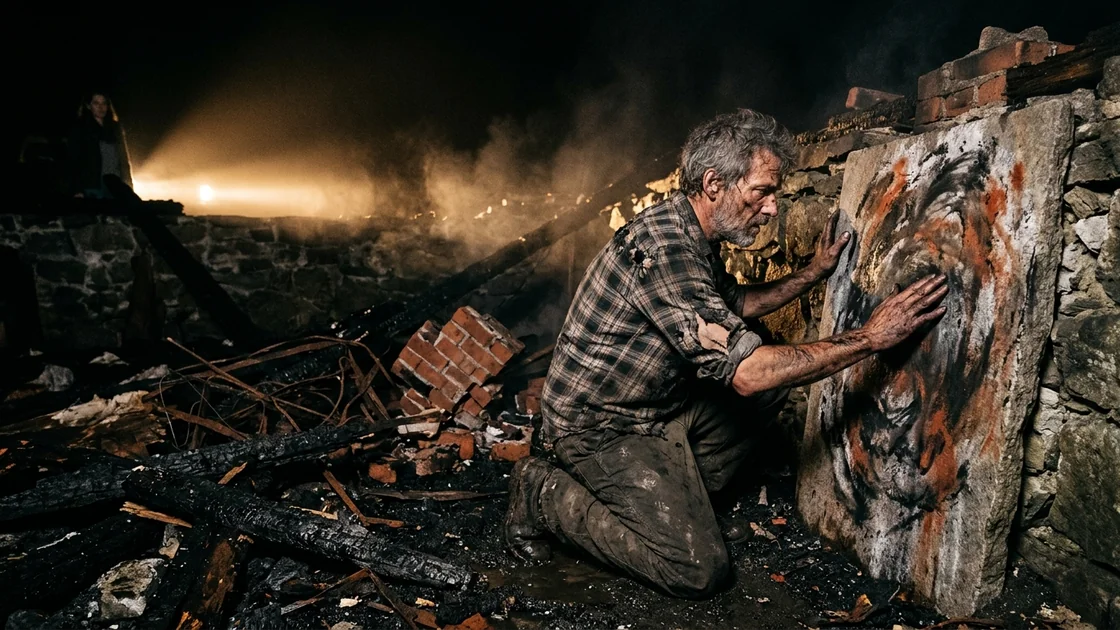
Julian Vance, a reclusive painter, loses three decades of unseen, meticulously crafted masterpieces when a midnight electrical fire consumes his remote barn studio. The catastrophic loss plunges him into a profound, catatonic grief, rendering him mute and immobile as his sister, Clara, brings him into her home to care for him. Through the slow passage of seasons, Julian remains trapped in the internal gallery of his mind, haunted by the phantom colors of his destroyed life's work, until an accidental encounter with the raw, burnt remnants of his studio forces him to confront the void and rediscover the primal urge to create.
The fire did not roar; it inhaled. To Julian, standing barefoot in the wet October grass, the sound was not the violent crackling of dry pine and aged cedar, but a vast, continuous drawing of breath. The converted nineteenth-century timber barn, which had stood against the coastal winds of Maine for a hundred and forty years, was being unmade from the inside out. The windows did not shatter all at once. They bowed outward, glowing with a terrible, furnace-heart incandescence, before yielding to the pressure and spilling rivers of liquid amber down the shingled siding.
Inside that amber were thirty years.
There were the early canvases from the nineties, thick with impasto, where he had used a mason’s trowel to layer lead white and raw umber until the surfaces looked like plowed winter fields. There were the middle-period portraits of nobody—faces constructed entirely from the memory of strangers passed on rain-slicked streets in Boston, rendered in glazes so thin they took six months to cure between coats. And in the loft, racked in custom-built birch slots like files in an archive, were the nocturnes. Two hundred and fourteen variations of the salt marsh at twilight, painted with lapis lazuli he had ground himself on a granite slab, mixed with cold-pressed linseed oil and a touch of beeswax.
Turpentine barrels in the north corner went up with a deep, percussive whump that Julian felt in the sternum rather than heard. The roof sagged, a dark spine breaking against the violent orange sky, and a geyser of sparks—millions of microscopic fragments of linen, rabbit-skin glue, and carbonized pigment—shot upward toward the indifferent stars. Cadmium red burned with a toxic, greenish-yellow edge; cobalt blue surrendered without a fight, turning to black dust before it even cleared the rafters.
Julian did not move toward the wellhouse. He did not go back into the cottage for his phone. The heat at fifty yards was enough to singe the fine hairs on his forearms and dry the moisture on his corneas until he had to blink away thick, involuntary tears that had nothing to do with sorrow yet, only biology. He watched the heavy oak doors, which he had bolted from the inside every night through the connecting breezeway, hold their shape as skeletons of glowing charcoal before folding inward like hands in prayer.
By the time a lobster boat two miles out in the bay spotted the glow over the spruce headland and radioed the harbor master, the structure was down to its granite foundation stones. When the volunteer fire department from town arrived, their sirens wailing uselessly along the empty gravel road, there was nothing to save but the perimeter. They hosed down the wet meadow and the scorched flank of Julian’s living quarters.
Chief Miller found Julian sitting on an overturned galvanized bucket near the vegetable garden. His knees were drawn up to his chest, his canvas trousers soaked to the thighs with dew, his eyes fixed on the steaming, hissing pit of black soup where four hundred and twelve paintings had ceased to exist.
"Julian?" Miller asked, his heavy yellow turnout coat smelling of old smoke and damp wool. He shone a flashlight near Julian’s boots, careful not to blind him. "Julian, you hurt? Did you breath any of that in?"
Julian did not look at the light. He did not look at Miller. In his mind, he was looking at Marsh Light No. 84, a four-by-six-foot panel where he had finally gotten the exact temperature of the fog rolling over the cordgrass—a mix of bone black, titanium buff, and a whisper of viridian. He was trying to remember if the horizon line sat at the lower third or slightly below it. As the steam rose from the ruin under the firemen’s hoses, the horizon line in his head began to blur.
He opened his mouth to tell Miller that the viridian was too warm, that he needed to scrape it back with a razor blade once it dried, but no sound came out. His vocal cords felt as though they had been coated in the same grey ash that was now settling like snow over his bare shoulders.
Clara arrived forty-eight hours later. She had driven straight through from Vermont, her car smelling of stale coffee and panic. She found her brother in the small kitchen of the keeper’s cottage, sitting in a Windsor chair facing the drywall between the stove and the refrigerator.
A neighbor, Mrs. Gable, had been sitting with him. She stood up from the kitchen table, wringing a dishcloth in her knotted hands. "He hasn't slept, Clara. Not that I've seen. Dr. Peterson came by yesterday evening, checked his lungs and his eyes, gave him a shot of something to make him rest, and he just sat right through it. Like you poured water on a stone."
Clara dropped her duffel bag. She was four years younger than Julian, a botanist who spent her life measuring things that grew in millimeters and died on schedule. She had always found her brother’s monomaniacal devotion to his work slightly frightening, like watching a man dig a tunnel with a spoon, refusing to say where he was going. No gallery had ever represented him since he walked out of his MFA program in 1993. No collector had ever written him a check. He lived on a small inheritance from their grandfather, supplemented by ten weeks of rigorous summer carpentry work on the islands, and spent the remaining forty-two weeks of the year behind the bolted doors of the barn.
"Jules?" she said, kneeling beside the Windsor chair.
His skin had a waxy, tallow-like sheen. There was a crescent of dried soot beneath his left cheekbone that Mrs. Gable had missed with the washcloth. His hands—the large, square-knuckled hands that were permanently stained with Prussian blue in the creases of the nails—lay palm-up on his thighs. They were entirely still. Not the relaxed stillness of sleep, but the rigid, high-tension stillness of a bridge cable.
"Julian, look at me." She put her hand over his. His skin was cold, the temperature of a root cellar. "The insurance adjuster called me on the drive up. The structure was covered under the farm policy, Jules. Not the contents, you never itemized the contents, you stubborn ass, why didn't you ever..." Her voice broke. She pressed her forehead against his knee. "Oh, God, Julian. Everything?"
Julian’s eyes remained fixed on a microscopic imperfection in the white latex paint of the kitchen wall—a tiny ridge left by a roller twenty years ago.
Inside his head, the fire was still burning, but it had changed its nature. It was no longer consuming wood and linen; it was consuming the archive. He was standing in the center of a vast, white-walled room, and the paintings were hanging all around him, just as he had always imagined they might hang after he was dead, when someone finally broke the padlock on the barn and saw what he had done with his life.
He was trying to walk down the row of the winter seascapes from 2004, the ones where he had used cold wax medium to mimic the slush at the tide line. He needed to inventory them. If he could hold them in his visual memory, pixel by brushstroke, then the fire had only taken the substrate. The art was the arrangement of light and matter in the mind; the canvas was merely the receipt.
Look at the lower left quadrant of the third panel, he told himself. The grey is built from burnt sienna and ultramarine. There is a diagonal scratch made with the wooden end of a number four filbert brush, revealing the ochre ground beneath.
He had it. It was clear. He moved his internal gaze three inches to the right, toward the crest of a breaking wave.
There was nothing there. Just a patch of static, like an untuned television, or the grey, featureless mud at the bottom of the foundation pit outside. In panic, he looked back to the lower left quadrant, to the diagonal scratch. It was gone too. The ochre ground had vanished. The memory was eating itself from the edges inward, like film caught in the gate of a projector, bubbling, turning brown, and snapping into white light.
He could not move his head, because if he moved his head, the momentum might slosh the remaining images out of his skull. He had to remain perfectly level. Perfectly silent.
The diagnosis at the hospital in Portland was dissociative stupor, secondary to acute traumatic grief. There was no structural damage to his brain. The MRI showed a healthy, fifty-four-year-old cortex, its sulci and gyri entirely unremarkable, giving no indication that it had spent thirty years obsessed with the refractive index of walnut oil.
"He isn't catatonic in the classic schizophrenic sense," the psychiatrist, a young woman named Dr. Patel, explained to Clara in the hallway outside Julian’s room. "There's no waxy flexibility—if I lift his arm, he doesn't hold it in the air; he lets it drop. His autonomic functions are depressed, his speech centers are effectively offline, and his motor initiative is near zero. His mind has essentially pulled the main breaker to prevent an overload."
"For two weeks?" Clara asked. Her eyes were ringed with violet shadows. "He won't eat unless I put the spoon against his lower lip. He doesn't ask for water."
"For someone like your brother, from what you've described, those paintings weren't possessions," Dr. Patel said softly. "They weren't even just his work. Because he never showed them to anyone, they functioned as an externalized self. His memories, his daily existence for three decades, were stored in those objects. Losing them all in forty minutes is neurologically akin to a massive stroke, or waking up to find that your entire family has been erased from history. We can keep him hydrated here, put him on a low-dose atypical antipsychotic and an SSRI to see if it creates a floor for him, or you can take him home with outpatient support. Honestly, familiar sensory environments sometimes do more than a psych ward."
Clara took him to Vermont. She couldn't bear to stay in the Maine cottage, where every window on the east side looked out over the charred rectangle in the meadow, which now stank of wet charcoal and melted lead flashing.
Her house in Montpelier was a Victorian clapboard with a wraparound porch, cluttered with dried seed pods, botanical presses, and stacks of academic journals. She set Julian up in the downstairs parlor, converting her study into a bedroom so he wouldn't have to navigate the steep walnut staircase.
She placed an upholstered armchair near the bay window that looked out onto her side yard—a wild, overgrown tangle of sumac, milkweed, and an ancient, half-dead Cortland apple tree. Every morning at seven, she guided him out of the twin bed, dressed him in soft flannel shirts and wool socks, and led him by the elbow to the chair. He walked like a deep-sea diver on the ocean floor, his feet shuffling in two-inch increments, his gaze fixed four feet ahead on the floorboards.
Once seated, he stayed.
Clara would bring him oatmeal with maple syrup. She would sit on an ottoman facing him, take a small spoonful, and touch it to his bottom lip. After a delay of three or four seconds—the time it took for the signal to travel through miles of cold, dark wire—his jaw would hinge open. He would chew mechanically, swallow, and wait. If she stopped feeding him halfway through the bowl, he would simply sit with the remaining half cooling on the side table until noon.
"It's November twelfth, Jules," she told him one morning, wiping a drop of milk from his greying beard. "The frost finally killed the nasturtiums. I'm going into the university for three hours to check on the greenhouse trials. Sarah—the visiting nurse—will be here at ten."
Julian looked through the wavy nineteenth-century glass of the bay window.
The Cortland apple tree had lost all its leaves, save for three curled, brown scraps clinging to a high twig. A blue jay landed on the branch.
Prussian blue, the voice in the back of his mind whispered. No, cobalt with a touch of dioxazine purple near the scapulars. The breast is dirty titanium white, knocked back with raw umber.
As soon as the pigments named themselves, a wave of nausea so violent it made his throat constrict washed through him. The blue jay was a thief. The tree was a mockery. The world outside the window was continuing to generate color, form, and shadow with obscene, wasteful indifference. The late morning sun hit the frost on the cedar fence, creating a sharp, brilliant line of cadmium lemon, and Julian wanted to tear his eyes out with his fingernails so he wouldn't have to see how easily the universe made what he had bled to capture.
He closed his eyes.
In the dark behind his eyelids, the inventory was nearly gone. Over the past month, the fire had finished its work on the portraits and the early landscapes. Now, all that remained were fragments—the texture of a single corner of Belgian linen where a knot in the weave had caught the edge of his palette knife; the smell of lavender spike oil; the exact weight of a badger-hair blender brush between his thumb and index finger.
He was shrinking. He could feel his consciousness retreating from his extremities, pulling back from his fingers and toes, abandoning his skin, gathering into a tiny, dense, freezing point directly behind the bridge of his nose. Soon, even that point would go out, and he would just be another piece of furniture in Clara’s parlor, requiring slightly more maintenance than the mahogany bookcase.
Winter came early to the Green Mountains. By December, the snow was banked three feet high against the parlor windows, filtering the light into a flat, shadowless grey that lasted from eight in the morning until four in the afternoon.
Julian lost twenty-two pounds. His cheekbones pushed out sharply against his pale skin, and his wrists looked like bundles of dry twigs inside the cuffs of his sweaters. Clara took a leave of absence from the college for the spring semester. Her life narrowed to the dimensions of the parlor and the kitchen: the blender purring with high-calorie protein shakes, the quiet click of the furnace thermostat, the rustle of her turning pages as she read aloud to him in the evenings.
She read him everything she could think of, except books about art. She read The Peloponnesian War, she read books on the mycorrhizal networks of old-growth forests, she read nineteenth-century maritime logs. She just needed a human voice in the room to keep the silence from solidifying into concrete.
In January, an old friend of hers from graduate school, a man named Marcus who now taught sculpture at Bennington, came by for dinner. He stood in the doorway of the parlor, holding a glass of red wine, looking at Julian’s silhouette against the dark window.
"Has he touched a pencil?" Marcus asked quietly in the kitchen afterward, leaning against the counter while Clara washed the plates.
"Dr. Patel said not to force it," Clara said, her hands submerged in the hot, sudsy water. "Wait until he shows some sign of wanting to engage with his environment. Two weeks ago, I left a sketchbook and a box of charcoal sticks on the table right next to his arm. I left them there for four days, Marcus. He didn't even look down at them. In fact, on the third day, Sarah noticed his heart rate was up to a hundred and ten just sitting there. When I took the sketchbook out of the room, it dropped back to sixty-five."
Marcus took a slow sip of his wine. "I remember when you took me up to his place in Maine, what, twelve years ago? He wouldn't let us within fifty feet of the barn. We had to sit on the porch of the cottage drinking warm beer while he watched the door like a hawk."
"He wasn't hiding them because he was ashamed of them," Clara said, staring out the kitchen window into the dark yard. "And it wasn't some precious, pretentious game. I asked him once, after Mom died, why he didn't at least photograph them. Just for a record. You know what he said to me?"
Marcus shook his head.
"He said a photograph flattens the time. He said when you look at a painting in a room, you aren't looking at an image, you're looking at an accumulation of hours held in suspension by oil. If you put it under gallery lights and let strangers walk past it spending four seconds looking at it between glasses of chardonnay, it drains the hours out of it. He was building a cathedral for an audience of none, Marcus. Or maybe he was the cathedral, and the paintings were the stones. And now he's just... rubble."
That night, after Marcus left, Clara went into the parlor to get Julian ready for bed. The room was dark except for the orange glow of the streetlamp filtering through the icicles on the porch roof.
She knelt to pull off his wool socks. As she lifted his left foot, she noticed his right hand had slipped off the arm of the chair and was hanging down near the floor. His index finger was moving.
Clara froze, holding his cold ankle in both hands, scarcely daring to breathe.
Julian’s index finger was moving back and forth, very slowly, about an inch above the braided wool rug. A tiny, rhythmic arc from the second knuckle. Left, right, left, right, feathering the edge.
He was scumbling. He was blending a transition in the dark with a phantom brush, working a passage of air above a floor he couldn't see. His eyes were wide open, staring into the black corner of the room near the radiator, and a single line of saliva had run down into his beard, but his finger moved with exquisite, microscopic precision, adjusting the pressure on the invisible bristles at the end of each stroke so as not to leave a hard line.
Clara sat back on her heels on the floor and wept without making a sound, her hand pressed hard against her mouth so she wouldn't startle him out of the only place he was still alive.
February was the cruelest month because the light began to change, and Julian’s nervous system registered the shift before his mind wanted to. The sun climbed a fraction higher in the southern sky, and by two o’clock in the afternoon, a sharp trapezoid of direct sunlight would cut across the parlor rug, climbing slowly up the mahogany legs of the coffee table and creeping over Julian’s knees.
With the light came the return of sensation, and the sensation was agony.
For three months, the stupor had been a thick lead blanket. It had kept him under the surface of the water, where the muffled shapes of Clara, the nurse, the spoon, and the bedsheets were distant and harmless. Now, the blanket was wearing thin.
He began to smell things again. Not the smells of Clara’s house—the toasted oats, the cedar blocks in the closet, the damp earth of her potted ferns—but the smells of the studio. They were olfactory hallucinations so sharp they made him flinch.
He would be sitting in the grey morning light, and suddenly the air would be thick with the rich, nutty, slightly rancid scent of boiled linseed oil rags piled in a metal bucket. Ten minutes later, it would be the sharp, piney bite of Damar varnish, cutting through the back of his nasal passages. Then the earthy, metallic tang of raw sienna dust rising from the mortar as he ground it with the pestle.
And beneath all of them, waiting like a predator under the floorboards, was the smell of the fire. Not woodsmoke. Woodsmoke was clean; he had burned cordwood in his stove for thirty years. This was the foul, chemical stench of burning vinyl siding from the cottage’s eaves, melted electrical insulation, vaporized mineral spirits, and the scorching of forty-year-old animal glue size.
When that smell hit him, his body reacted before his broken will could stop it. His fingers would claw into the upholstery of the armchair, ripping at the linen threads, and a low, raspy groan—the first sounds he had made since October—would tear out of his dry throat.
"Jules? Julian, I'm here, I'm right here," Clara would say, dropping whatever she was doing to grab his shoulders, pressing her weight against him as he trembled violently, his jaw clenched so hard his molars creaked. "There's no smoke, Jules. Smell my sleeve. Smell the wool. It's laundry detergent. You're in Vermont. There is no fire."
He knew there was no fire in the room. That was the horror of it. The fire was over. The fire was four months ago, two hundred miles away, buried under two feet of coastal snow and ice. He was reacting to a ghost, which meant he was waking up in the world where the ghost was all that was left.
In early March, he spoke his first word.
Sarah, the nurse, had just left. Clara was in the kitchen making tea when she heard a heavy, dull thud from the parlor, followed by the crash of breaking ceramic.
She ran in to find Julian on his hands and knees on the braided rug. He had tried to stand up on his own—his atrophied legs, unused to bearing his weight without support, had buckled immediately, taking the small side table and a porcelain lamp down with him. A jagged shard of the blue-and-white lamp base had sliced a three-inch gash across the back of his left forearm.
Blood, dark and venous, was welling up from the cut and dripping onto the rug, soaking into the cream-colored wool thread.
"Oh, God—Julian, don't move, there's glass everywhere!" Clara went to grab him under the arms, expecting the dead, passive weight she had been lifting all winter.
Instead, he shoved her back with his right shoulder. It wasn't a violent shove, just the stubborn, immovable leverage of a man protecting something on the ground.
He wasn't looking at his cut arm. He was staring at the three drops of blood on the cream rug, beside the broken piece of blue-and-white porcelain.
"Alizarin," he whispered. His voice sounded like two flat stones grinding together in a dry creek bed.
Clara froze, her hands hovering inches from his shoulders. "What?"
Julian reached out with his right index finger and touched the largest drop of blood on the wool, smearing it half an inch toward the blue glaze of the broken lamp shard. He stared at the resulting purple-brown smudge as if it were a message written in a language he had forgotten how to read.
"Too fugitive," he croaked, his chest heaving with the effort of pushing air through his rusted larynx. "Fades in the light. You have to... you have to use quinacridone."
Then he collapsed sideways onto his shoulder among the shards of porcelain, curling his knees up to his stomach, and began to sob.
It was not the quiet weeping of a sad man. It was a terrifying, convulsive howling that came from the bottom of his lungs, the sound of an animal caught in a steel jaw trap in the dark. He wept until his nose bled, until he retched dryly onto the rug, his face pressed against the dusty wool while Clara lay on the floor beside him, wrapping her arms around his bony back, letting the broken porcelain cut into her own knees as she held him together.
The crying broke the stupor, though what replaced it was not recovery. It was a bleak, jagged consciousness.
Julian could walk to the bathroom on his own now, holding onto the walls and the backs of chairs like an eighty-year-old man. He could hold a spoon, though his hand shook so badly that half the soup ended up on his shirt front. He could speak in short, flat sentences when asked a direct question, though he never initiated conversation.
The shield of catatonia was gone, leaving him skinless in the raw air of his loss.
He spent his days pacing the downstairs of Clara’s house—twelve steps from the bay window in the parlor, through the archway into the dining room, past the sideboard, to the swinging door of the kitchen, and twelve steps back. Over and over, wearing a faint track in the runner, his hands clasped tightly behind his back like a prisoner in an exercise yard.
He was fifty-four years old. If he lived as long as their father had, he had thirty years left.
Thirty years was the exact unit of measurement of what had burned. He did the math constantly while he walked. Twelve steps to the kitchen: 1994 to 2004, the structural studies, the studies of timber frames and granite quarries. Turn around. Twelve steps to the bay window: 2005 to 2015, the portraits, the anatomical dissections of light on aging skin, the discovery of lead-tin yellow. Turn around. Twelve steps back: 2016 to 2024, the marshes, the dissolving of form into pure atmosphere, the work where he had finally stopped painting things and started painting the space between himself and the things.
Even if he picked up a brush tomorrow—and the mere thought of holding a brush made his stomach clench with revulsion—he could never get back to where he was on the afternoon of October nineteenth. The paintings had been a ladder. Each canvas had solved a problem that allowed him to climb to the next canvas. You could not paint Marsh Light No. 214 without having painted the two hundred and thirteen before it, because your eye and your wrist only knew what to do based on the physical presence of those previous solutions hanging in the racks behind you.
Without the ladder, he was back on the ground. Worse than on the ground—he was fifty-four, tired, with stiff joints and failing near-vision, standing at the bottom of a cliff he had started climbing when he was twenty-four and full of arrogant, inexhaustible fire.
"You don't have to replace them, Jules," Clara said one afternoon in late April. The windows were open an inch for the first time since autumn, letting in the wet, wormy smell of thawing mud and rotting leaves. She was sitting at the dining table, repotting a root-bound fern on a sheet of newspaper.
Julian stopped his pacing by the sideboard. He looked at the black potting soil clinging to her knuckles.
"I don't know how to be alive without doing it," he said. His voice was still thin, stripped of inflection. "And I can't do it."
"People lose their legs and learn to live in a chair," Clara said, pressing the dark earth firmly around the base of the fern's crown. "People lose their children, Julian. And they wake up and make coffee and go to the grocery store."
"I know," Julian said. He looked down at his own hands. The Prussian blue stains that had lived in the crescents of his fingernails since the Clinton administration were gone. Over the winter, his nails had grown out, and Sarah had clipped them away, millimeter by millimeter, dropping thirty years of pigment into the bathroom wastebasket. His hands were clean, pink, and soft. They looked like the hands of a banker, or a corpse. "I'm sorry, Clara. I know it wasn't a child."
Clara stopped working. She wiped her dirty hands on her jeans and looked up at him, her eyes fierce. "Don't apologize to me for grieving, you idiot. I didn't mean it like that. Those paintings were the only children you were ever going to have. You gave them your twenties, your thirties, your forties, your marriage to Elena before it even started, your money, your teeth, your back. I'm not telling you it's small. I'm telling you that you aren't dead, even if you wish you were."
Julian turned back toward the parlor window. Outside, the Cortland apple tree had tiny, tight green buds swelling along its gnarled gray branches. It was going to bloom again, just because the soil temperature had reached forty-five degrees. It didn't have a choice.
He envied the tree its lack of memory.
In the second week of May, a letter arrived from the town of Harpswell, Maine, forwarded to Clara’s address.
It was a formal notice from the town selectmen’s office regarding the property on the point. A winter storm in February had undermined the remaining stone chimney of the burned barn, causing it to collapse outwardtoward the town right-of-way, and the pit of debris—full of rusted metal roofing, burnt timbers, and hazardous materials—had been declared an attractive nuisance and an environmental hazard due to the runoff into the salt marsh. The owner had thirty days to contract a licensed salvage and demolition company to excavate the foundation, haul the debris to a hazardous waste landfill, and grade the site, or the town would perform the work and place a lien on the cottage.
Clara left the letter on the kitchen table, intending to handle it herself by phone from her office at the college. She had enough savings left to pay the excavation crew five thousand dollars to make the pit disappear so Julian would never have to see it again.
Julian found the letter at ten o’clock that morning while Clara was at a faculty meeting.
He stood by the kitchen table for twenty minutes, reading the two paragraphs of municipal boilerplate over and over. ...excavate the foundation, haul the debris to a hazardous waste landfill, and grade the site...
They were going to bring a backhoe in. A yellow diesel machine with steel teeth on a hydraulic bucket was going to drive over the chamomile and the wild strawberries in the meadow, drop its shovel into the basement of the barn, and scoop up the ash. It was going to dump the ash into the back of a ten-wheel dump truck, tarp it, and drive it to a lined pit outside of Augusta, where it would be buried under used tires, asbestos siding, and municipal garbage.
His lungs began to ache with the old, panicked tightness, but underneath the panic, for the first time in seven months, something else stirred. It was hot, sharp, and jagged. It felt like anger, or the protective territorial fury of a dog watching a stranger walk toward its bone.
He walked into the hallway and opened the coat closet. His old canvas barn coat—the one he had been wearing in the kitchen when Clara found him—was hanging at the back, cleaned and aired out. He put it on. It hung off his shrunken shoulders like a tent.
He went to the mudroom and stepped into a pair of Clara’s husband’s old rubber muck boots, which had been sitting by the door since her divorce five years ago. Then he walked back into the kitchen, opened the little ceramic jar by the toaster where Clara kept her spare house keys and the keys to her old Subaru Outback—she had taken her newer Honda to the campus—and dropped them into his pocket.
He didn't leave a note. If he picked up a pen to write a note, he wasn't sure what his hand would do, and he didn't have time to find out.
Driving was terrifying. The world moved at sixty miles an hour, a blur of green birch leaves, grey granite outcrops, and flashing chrome that his brain, accustomed to the static dimensions of Clara’s parlor, could barely process. His hands cramped on the steering wheel by the time he hit the New Hampshire border on Route 2.
He stopped once for gas in Gorham, fumbling with his wallet, his fingers trembling so badly he dropped his debit card onto the oil-stained concrete by the pump. The teenager in the booth watched him curiously through the glass—a gaunt, hollow-eyed man in an oversized canvas coat in the middle of a warm May afternoon—but Julian didn't look up.
He crossed into Maine at three o'clock, cutting south toward the coast through the back roads around Sebago, avoiding the turnpike. As the pines gave way to coastal spruce and the air began to smell faintly of low tide and mudflats, the ghostly olfactory hallucinations that had haunted him in Vermont vanished, replaced by the real thing.
He turned down the gravel track onto the peninsula at five-thirty. The sun was still high, slanting from the west through the dense needles of the spruce woods, casting long, barred shadows across the crushed clam shells of the driveway.
The cottage stood untouched on the left, its white clapboards looking dingy and grey after a winter without maintenance, the eastern eaves blistered and blackened where the heat had radiated across the breezeway before the fire department cut it down with axes.
Julian turned off the ignition of the Subaru. The engine ticked softly as it cooled. Outside, a song sparrow was singing from the top of the lilac bush by the wellhouse—three clear notes and a trill, exactly as it had every May for thirty years.
He opened the car door, stepped out onto the gravel, and walked around the corner of the lilac bush toward the meadow.
He stopped twenty feet from the edge.
The winter snows and the spring rains had beaten the ruin down into the earth. What had been a chaotic, steaming mountain of jagged beams in October was now a sunken, silent rectangle bound by the massive, smoke-stained blocks of the nineteenth-century granite foundation. The chimney had indeed fallen; a long spill of red brick and white lime mortar lay across the flattened brown grass toward the lane, already being colonized by bright green shoots of witchgrass and dandelion.
Inside the granite walls, there was no recognizable structure left. The floor joists had collapsed into the shallow crawlspace underneath. It was a low bog of black charcoal, twisted rusted metal from the roofing nails and pipe clamps, melted blobs of milky green window glass, and a uniform, crusted layer of dark grey ash that had been rained on, frozen, thawed, and baked by the spring sun into something resembling volcanic tuff.
Julian stood at the northwest corner, where the double doors had been.
For ten minutes, he didn't move. He waited for the stupor to come back. He waited for his brain to pull the breaker, for his legs to lock up, for his vision to tunnel down to a pinhole.
Instead, his eyes began to map the grid.
Here, two yards in from the corner stone, was where the cast-iron woodstove had sat; its cracked cylinder was still visible, sticking out of the muck like a buried cannon. There, ten feet past it toward the center, was where his big H-frame easel—built from four-inch rock maple timbers—had stood bolted to the floor. Beyond that, along the south wall where the high north-facing skylight had thrown its cold, even illumination down for eight hours a day, was where the racks had been.
Without conscious thought, Julian stepped over the low granite sill and dropped down into the pit.
His rubber boots sank two inches into the wet, spongy charcoal. It made a dull, crunching shhhk sound that sent a jolt straight up his spine into his teeth. He walked past the rusted stove, stepping over a charred four-by-four beam that crumbled into black cake under his heel, and made his way to the south wall, where the racks had stood.
He knelt down in the ash. The damp cold of the ruin soaked through the knees of his trousers instantly.
He took his hands out of the pockets of his barn coat and laid his palms flat on the crusted grey surface. It was rough, full of tiny splinters of carbonized wood, fused silica, and oxidized brass tacks from the edges of his stretchers.
He dug his fingers into the crust and lifted a handful.
Underneath the sun-baked top layer, the ash was damp, black, and greasy with the carbonized remains of gallons of linseed oil, stand oil, and wax. He rubbed a pinch of it between his thumb and forefinger.
It was gritty at first, then broke down into a slick, velvet paste. Bone black. No, not bone black—vine black, from the willow charcoal and the birch racks, mixed with the heavy, dead weight of lead carbonate that had been reduced back down to metallic lead dross by the heat.
He dropped the handful and dug deeper, using both hands like a dog digging for a mole, his clean, pink fingernails packing instantly with black grease, tearing at the wet layers of compressed linen.
Six inches down, his right middle finger hit something hard and sharp that wasn't glass or nail. He scraped the wet charcoal away from it and pulled it out.
It was the ferrule of a brush—a wide, flat piece of seamless nickel-plated brass, crushed slightly on one side, the wooden handle burned completely out of the socket, the hog bristles vanished to the last millimeter. He turned it over in his dirty palm. It was a number twelve bright, from the set of German brushes he had bought in 2002.
He set it on the granite foundation stone beside him and kept digging.
A foot to the left, where his heavy wooden taboret had stood beside the easel, he hit a solid, fused mass of metal and stone. He worked his fingers underneath it and pried it up out of the mud with a wet sucking sound.
It was the remains of his storage tin of dry pigments and his palette knives. The tin had melted and rusted into a jagged casing, and inside it, the glass jars had shattered and fused with their contents in the twelve-hundred-degree heat.
He broke a chunk of the mass off with his thumb. The glass fell away, revealing a walnut-sized lump of pure, unharmed bright red powder that had been shielded from the oxygen at the bottom of the pile.
Cadmium red medium. Cadmium was an element; it was forged in stars and mined from zinc ore. A wood fire in a Maine barn couldn't destroy an element. Beside it, fused to the curved bottom of a melted Mason jar, was a thick cake of yellow ochre—iron oxide clay that had already been roasted by the earth millions of years ago—only now, the heat of the burning barn had driven the water molecule out of the iron oxide, roasting the yellow ochre and turning it into a rich, deep, permanent burnt sienna.
The fire hadn't destroyed the yellow ochre. The fire had calcinated it. The fire had painted with it.
Julian sat back on his heels in the black mud. His chest was heaving. The sun had dropped below the spruce line on the western ridge, and the salt marsh beyond the meadow was turning that deep, luminous, impossible violet-grey that lasted for twenty minutes before dark—the exact color he had spent the last eight years of his life trying to trap in the loft above his head.
He looked down at his hands. They were black to the wrists. The grease of the burnt oil and the carbon of the three hundred canvases had worked its way deep into the pores of his knuckles, into the creases of his palms, under the quick of his nails.
He lifted his right hand and looked at the smear of roasted ochre—burnt sienna now—streaked across the meat of his thumb alongside the black carbon.
He turned toward the south foundation wall. In the middle of the granite blocks, there was a large, flat slab of pale grey stone that had served as the hearthstone for an old forge before he had bought the place. The rain had washed the soot off its vertical face, leaving a four-foot-by-three-foot rectangle of clean, pale, toothy granite facing the twilight.
Julian did not think about the ladder. He did not think about the two hundred and fourteen nocturnes, or the portraits of strangers in Boston, or the thirty years of hours held in suspension. The hours were gone. They were in the clouds over the Atlantic by now, rained down into the sea.
He reached into the black muck between his knees, scooped up a handful of the greasy, oil-soaked carbon of his life's work, and pressed his palm flat against the rough grey granite of the foundation stone.
He pulled his hand down in a long, heavy, vertical stroke.
The wet ash caught on the quartz crystals in the granite, leaving a dense, velvety black mark that tapered to a broken grey whisper at the bottom as the material ran out on his skin. It was a good mark. It had weight.
He reached down to the melted glass cluster from his taboret, dug his thumb into the pocket of calcinated yellow ochre that the fire had turned to burnt sienna, and dragged it across the top of the black vertical, cutting a horizon line across the stone just below the upper third.
When Clara’s headlights swung around the lilac bush two hours later, slicing through the pitch dark of the May night and illuminating the ruin, she slammed on the brakes and left the car door open as she ran across the wet grass.
"Julian!" she screamed, terrified of what she would find in the pit.
She stopped at the edge of the granite blocks.
In the twin beams of the headlights, Julian was kneeling in the black mire. His coat was off, his flannel shirt was torn at the elbow and smeared with soot, and his face was streaked with black grease where he had wiped the sweat from his forehead.
The entire four-foot expanse of the granite hearthstone in front of him was covered in a dense, violent, swirling storm of black carbon, white wood-ash, blood-red iron oxide, and roasted sienna, worked into the tooth of the rock with the heels of his hands, his fingernails, and the edge of a crushed brass ferrule. It wasn't the marsh, and it wasn't the sea. It was the shape of the heat itself, held fast against the stone.
Julian didn't turn around when she called his name, because the transition on the lower right quadrant was drying too fast in the night wind, and he needed to work a pinch of the white lime mortar from the fallen chimney into the black before it set. He spat into the palm of his left hand, rubbed a lump of white lime into a paste with his thumb, and leaned back toward the rock.