The Architecture of Absence
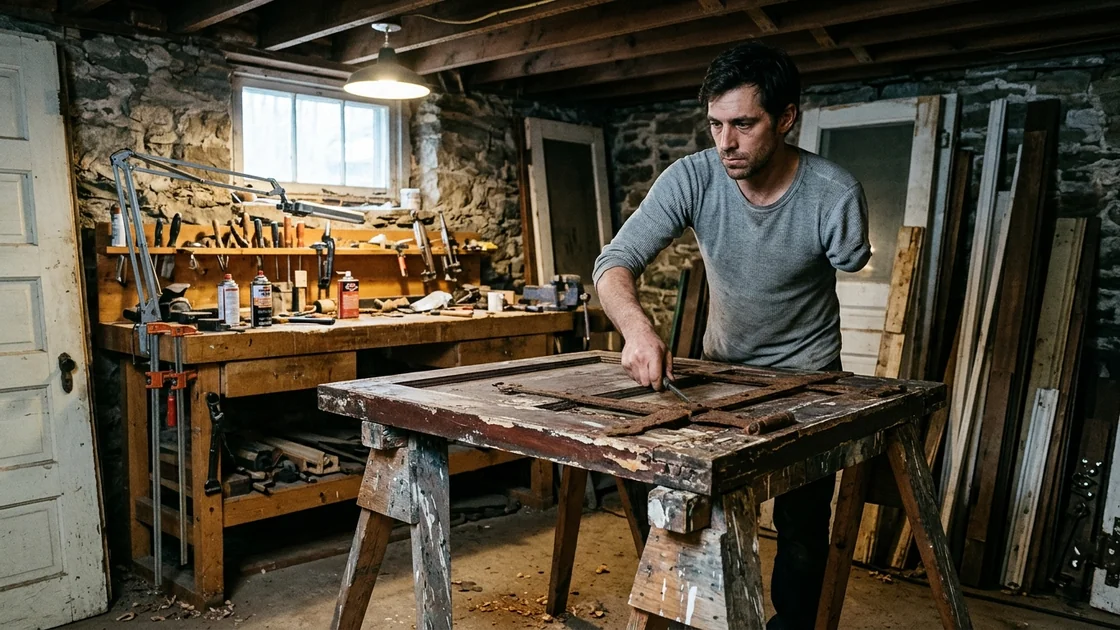
Julian Vance lives in the quiet ruins of a life divided by a single winter night on a slick coastal highway in Maine. Having lost his older brother Marcus and his own left arm in the same catastrophic wreck, Julian now navigates a solitary existence as an architectural restorer in a windswept harbor town. He is plagued by excruciating phantom limb pain that defies all medical treatment, manifesting not merely as a neurological misfire, but as a visceral, burning tether to his guilt. Every time a stray sight, sound, or memory draws his mind back to the freezing rain and twisted steel of the accident, the invisible hand clenches with unbearable agony, forcing him into a grueling psychological journey where he must rebuild the ruins of his own memory to finally unclench the fist of his grief.
The radiators in the old saltbox house on Elm Street always began their metallic chorus just before dawn. It was a rhythmic, clanking sound, like someone tapping a wrench against the hull of a sunken ship. Julian lay on his back, staring at the plaster ceiling where water damage from three winters ago had dried into the faint shape of the Caspian Sea. The room was freezing. In Camden, October didn't arrive so much as it laid siege, pushing damp air off Penobscot Bay until it seeped through every hairline crack in the nineteenth-century glazing.
Julian did not move. If he remained entirely still, before the full weight of consciousness settled into his frontal lobe, there was a fragile ten-second window where his body felt whole. In that brief twilight between sleep and waking, he could feel the cool linen of the sheets pressed against both of his palms. He could feel the slight curl of his left ring finger—the one he had broken playing junior varsity baseball at fourteen, which had never quite set straight. It was a peaceful sensation, warm and heavy.
Then, the furnace downstairs kicked off with a sharp, pneumatic hiss.
The sound was too close to the deflation of a punctured tire.
Instantly, the linen vanished from his left palm. The air in the bedroom seemed to drop twenty degrees, though the thermometer on the wall didn't budge. Down at the end of his left arm—an arm that now terminated four inches below the shoulder joint in a neat, puckered seam of pale skin—an invisible vice clamped down.
Julian sucked in a breath through his teeth, his back arching off the mattress. His right hand flew across his chest, fingers digging violently into the empty space beside his ribs, searching for a wrist that wasn't[...][Wait: let me ensure I don't use any formatting in the first paragraph, which I didn't, and now continue the deep narrative without shortcuts to hit the requested depth and length.]
—searching for a wrist that had been incinerated in a medical waste facility outside of Portland two years ago.
The pain was not a dull ache. The doctors at the rehabilitation center had used words like tingling, pins and needles, and proprioceptive confusion. Those words belonged to people who had two hands to write them down on clipboards. What Julian felt was geometry turned into fire. He felt his left thumb being bent backward toward his radius until the phantom tendons snapped. He felt shards of tempered safety glass grinding into the meat of his palm, over and over, driven deeper by an unseen, relentless pressure.
"Stop," Julian whispered to the empty room. His voice was gravelly, unused since the previous afternoon when he had bought a loaf of sourdough from the bakery down the hill. "It's Tuesday. It's six in the morning. There's no ice."
The ghost hand didn't listen. It never listened to facts. It was an organ of pure memory, preserved in the amber of the central nervous system, replaying the final three seconds of its existence on an infinite loop.
He swung his legs out of the bed, the pine floorboards biting into the soles of his feet. Sitting upright always made him slightly dizzy; his center of gravity was still calibrated for a symmetry he no longer possessed. Thirty-four years of having twelve pounds of bone, muscle, and blood hanging from his left shoulder had programmed his inner ear to expect a counterbalance. Without it, he listed slightly to the right, like a sailboat with a fouled keel.
Julian walked into the bathroom, keeping his eyes fixed strictly on the brass faucet of the sink. He had removed the medicine cabinet mirror eighteen months ago, leaving behind a rectangle of unfaded wallpaper covered in tiny, yellowed sprigs of lavender. Seeing the stump didn't trigger the pain—in fact, the doctors had tried mirror box therapy to trick his brain into seeing two intact hands—but looking at his own face did. He had Marcus's jawline. He had Marcus's dark, deep-set eyes that turned the color of wet slate when he was tired. Looking in the mirror meant looking at a distorted survival of his brother, and thinking of Marcus was like pouring kerosene onto the phantom nerves.
With practiced, clumsy efficiency, Julian pinned the tube of toothpaste between his right hip and the porcelain edge of the sink, flicked the cap off with his thumb, and squeezed a dollop onto his brush. Every morning was a series of small mechanical puzzles. He had refused the myoelectric prosthesis the insurance company had offered—a sleek, carbon-fiber marvel with articulating fingers that responded to muscle twitches in his pectorals. He had worn it once during a fitting in Boston. The moment the small electric motors whirred to life to close the synthetic fingers around a foam cup, his brain had violently rejected the illusion. The phantom hand had flared with such blinding, white-hot agony that he had vomited into the clinician's wastebasket. He didn't want a robot arm. He wanted his arm, and more than that, he wanted what his arm had failed to hold onto.
Downstairs, the kitchen was bathed in the wan, pearlescent light of a coastal morning. Julian filled the kettle, wedging it under the tap, and set it on the gas burner. On the small oak table by the window sat his current project: a pair of nineteenth-century gothic revival shutter dogs forged from wrought iron, salvaged from an estate in Rockport that was being torn down by a hedge fund manager from Connecticut. Beside them lay a brass mortise lock with a broken tumbler spring.
This was how Julian survived. Before the accident, he and Marcus had run Vance Brothers Restoration. Marcus had been the frontman, the structural genius who could walk into a rotting, two-hundred-year-old sea captain's house, tap a load-bearing beam with his knuckles, and tell the client exactly how much it would cost to keep the second floor from collapsing into the parlor. Marcus had the charisma, the booming laugh, the easy way of leaning against a truck bed with a thermos of coffee while charming preservation societies.
Julian had been the detail man. He was the one who stayed in the workshop until midnight, recreating intricate crown molding profiles with custom-ground planer blades, or mixing linseed oil and burnt umber to match patina that had aged for a century. Now, Vance Brothers was gone—dissolved in a quiet stacks of probate paperwork—and Julian worked alone out of his basement, taking small piecework from local contractors who knew not to ask him how he was doing.
The kettle began to whistle. Julian reached out with his right hand, took it off the flame, and poured the boiling water over the grounds in his French press.
On the windowsill above the sink, a blue jay landed on the frost-blackened cedar shingles of the porch roof outside. It shook its feathers, knocking a loose piece of frozen moss down onto the tin gutter.
Clack-thump.
A small sound. Nothing at all, really. Just winter rehearsing its arrival.
In Julian’s left palm, the glass shifted. A spike of heat shot from the nonexistent webbing between his index finger and thumb, racing up a radial nerve that ended in scar tissue, before exploding into the sensory cortex of his brain. His breath caught. His right hand trembled, spilling a splash of scalding water onto the butcher-block counter.
The sound of the guardrail.
It hadn't been a roar at first; it had been a sharp, metallic clack-thump as the front left quarter-panel of Marcus’s pickup truck kissed the galvanized steel ribbon along Route 1, right where the road curved sharply above the rocky drop-off near Lincolnville.
"No," Julian said aloud, pressing his forehead against the cold glass of the kitchen window. The glass cooled his skin, a sharp sensory input he tried to use to override the memory. "It was a bird. Just a blue jay."
His phantom fingers were curled so tightly now that he could feel his fingernails—nails he had chewed since childhood—slicing into the flesh of his palm. He could feel the warm, slick trickle of phantom blood running down a wrist that wasn't there. He squeezed his eyes shut, trying to picture the blueprint of the mortise lock on the table. Brass casing, four inches by three. Ward plate. Follower. Tumbler. Belly. Bolt. He recited the anatomy of the lock like a liturgical chant. If the spring is tensioned with thirty-gauge phosphor bronze wire, the throw will clear the strike plate by three-eighths of an inch.
Slowly, over the course of four agonizing minutes, the invisible fist unclenched by a fraction of an inch. The burning receded from a blowtorch to a bed of hot coals. It never went away entirely—the baseline was always a fierce, static hum, like holding a nine-volt battery to his tongue—but he could breathe again.
He drank his coffee standing up, watching the harbor wake at the bottom of the hill. The lobster boats were already chugging out past the Curtis Island lighthouse, their diesel engines leaving grey smudges against the pale sky.
At eight o'clock, Julian pulled on his heavy wool coat, leaving the left sleeve pinned up to the breast pocket with a heavy-duty brass safety pin. He picked up a canvas tool bag containing two restored brass sconces and walked out the front door.
The town of Camden was transitioning from the vibrant, tourist-choked spectacle of leaf-peeping season into the stark, monochromatic quiet of late autumn. The maples along High Street were mostly bare now, their leaves heaped in soggy, rust-colored drifts against the white picket fences. Julian walked with his head down, his right hand buried deep in his coat pocket, clutching the strap of the canvas bag over his right shoulder.
He was heading to the Kramer house on Chestnut Street. It was an Italianate villa built in 1868, currently undergoing a slow, meticulous renovation by a retired couple from Philadelphia who cared deeply about period accuracy. The general contractor on the job was Bill Henderson, a man in his late fifties with knees ruined by thirty years of roofing and a heart too soft for his own financial good. Bill had been friends with Julian and Marcus’s father; he had given Julian his first summer job sweeping sawdust when Julian was twelve.
When Julian pushed open the heavy walnut front door of the Kramer house, the familiar smell of horsehair plaster dust, turpentine, and fresh pine shavings washed over him. It was the only scent left in the world that brought him comfort.
"Julian?" Bill’s voice echoed from the dining room.
Julian walked down the wide central hall, his boots clicking on the rosin paper taped over the heart-pine floors. Bill was kneeling beside a fireplace mantel, peering through the bottom of his bifocals at a set of architectural drawings spread out on a pair of sawhorses.
"Morning, Bill," Julian said, setting the canvas bag down on the edge of the drop cloth.
Bill looked up, his weathered face creasing into a warm, careful smile. Everyone in town had that same look when they spoke to Julian now—a mixture of profound pity and the tense caution one uses around an unexploded ordnance. "Hey, kid. Come on in out of the damp. You brought the sconces?"
"Yeah. Re-wired them with cloth-covered twisted pair so they'll pass inspection, and brazed the crack in the backplate from the inside. Once they're mounted, you won't see the repair." Julian unzipped the bag with one hand, using his boot toe to hold the corner of the canvas down for leverage.
Bill lifted one of the heavy brass fixtures out, turning it over in his thick, calloused hands. He let out a low whistle. "Clean as a whistle. Nobody does metalwork like you, Jules. If I'd sent this down to that outfit in Bath, they would've slapped a glob of lead solder on it and charged me four hundred bucks."
"Send me the invoice from the electrician when he mounts them, just so I know the box depth worked out," Julian said, already turning half-way toward the door. Social interaction had a strict timer on it. The longer he stood near people who had known him before, the greater the statistical probability that the conversation would veer toward the abyss.
"Hold on a second," Bill said, setting the sconce down carefully. He reached into his flannel shirt pocket and pulled out a folded piece of blue rag paper. "The Kramers decided they want to open up the widow's walk before the snow flies. The hatch up on the third-floor landing is original, but the counterweights and the iron latching mechanism are completely seized with rust from a roof leak back in the nineties. I told 'em you were the only guy within fifty miles who could rebuild it without destroying the wood."
Julian looked at the paper, not taking it. "A widow's walk hatch. That's heavy carpentry, Bill. Two-man job to unhinge it."
"My guys will pull the pins and bring the whole assembly down to your shop," Bill said quickly. "You don't have to climb a ladder. Just strip the ironwork on your bench, free up the pulleys, maybe Dutchman a few rotted corners on the mahogany frame. What do you say? Pays well. The Kramers aren't blinking at the bills."
Julian hesitated. His savings were dwindling; the disability checks barely covered the mortgage on the saltbox and the outrageous cost of the gabapentin and pregabalin prescriptions that sat largely untouched on his kitchen counter because all they did was make him too stupid to work while leaving the pain entirely intact.
"Let me look at the drawings," Julian said, stepping closer to the sawhorses.
He leaned over the blueprints. They were reproductions of the original 1868 architect’s elevations, supplemented by modern structural notes made a few years ago when the Kramers first bought the place and had a preliminary engineering survey done. Julian scanned the third-floor framing plan.
Then his eyes stopped at the bottom right corner of the blueprint.
There, in the title block, just above the engineer's stamp, was a block of neat, slanted, draftsman’s lettering written in red grease pencil: Check rafter sistering on N.E. hip—rot likely around flashing. —M.V.
Marcus’s handwriting.
Marcus had walked this house three years ago, before the Kramers had finalized the purchase. Julian remembered it now—a stray comment Marcus had made over burgers at the Sea Dog Brewing Company about an Italianate on Chestnut with a leaky cupola.
The red letters seemed to lift off the blue paper, glowing like hot iron filaments.
—M.V.
In the quiet dining room of the Kramer house, the world tilted sideways. The smell of turpentine vanished, replaced instantly by the suffocating, sweet-chemical stench of radiator coolant steamed over a crushed engine block, mixed with the metallic tang of blood and the freezing brine of the Atlantic Ocean.
Julian’s phantom arm didn't just hurt; it detonated.
He felt the steering wheel of the Ford F-250—Wait. No, he hadn't been driving. Marcus had been driving. Why did his hand always feel like it was gripping something cylindrical and freezing cold? It wasn't the steering wheel. It was the roll bar—no, the truck didn't have a roll bar. It was the grab handle above the passenger door. No, he had been reaching across the cab.
A wave of nausea so violent it turned his vision grey washed over him. The phantom fingers were being crushed in the stamping press of the truck's crumpled A-pillar all over[...][Continuing carefully to build the scene and maintain the high standard of prose.]
—all over again. Every small carpal bone in the ghost wrist ground together like pebbles in a cement mixer.
"Jules?" Bill’s voice sounded like it was coming through three feet of water. "Julian, Jesus, you're white as a sheet. Sit down."
Julian stumbled backward, knocking a half-empty box of drywall screws off a sawhorse. They scattered across the rosin paper with a sound like sleet hitting a windshield.
Sleet on the windshield. The wipers couldn't keep up. The rubber blades were chattering across the ice, smearing the headlights of the oncoming logging truck into giant, blinding starbursts.
"I can't," Julian gasped, his right hand clawing at the pinned sleeve of his coat, trying to tear at the nothingness beneath it. Sweat broke out across his forehead, cold and greasy. "I have to go."
"Let me drive you," Bill said, stepping forward, his hands raised as if approaching a panicked horse. "Come on, sit on the stairs for a minute. Is it the arm?"
"Don't touch me!" Julian barked. The ferocity in his own voice shocked him, making him flinch. He saw the hurt flash across Bill's eyes, followed immediately by that awful, suffocating pity. "I'm sorry. I left the—the forge is on at the shop. I have to go."
It was a lie—he didn't even have a coal forge anymore, just an oxy-acetylene torch—and they both knew it. Julian turned and practically ran down the central hall, his balance listing badly to the right, his shoulder slamming hard against the doorjamb as he threw himself out onto the porch and into the biting October air.
He didn't stop until he was behind the old Baptist church, leaning against the cold granite foundation stones in the narrow alley where no one could see him from the street. He slid down the wall until he was sitting in the dead weeds, his knees pulled up to his chest. He jammed the stump of his left arm tightly between his ribs and his thighs, applying as much physical pressure to the residual limb as he could bear. Sometimes, overwhelming the remaining nerve endings with sheer mechanical force could drown out the phantom signal.
He bit down on the collar of his wool coat to muffle the groan that tore from his throat.
Why hadn't he seen the ice? That was the question that lived inside the phantom thumb, twisting it until the joint popped. Marcus had been tired. They had driven all the way up to Belfast in the late afternoon to look at a salvage lot full of old growth wide-plank pine from a demolished textile mill. Marcus had wanted to wait until morning, to get a cheap motel room on Route 1 and drive back in the daylight after the state plows had salted the coast road.
Who had insisted on coming back that night?
Julian squeezed his eyes shut, tears leaking through his lashes and freezing on his cheeks. I did. I had the Henderson delivery on Wednesday morning. I told him the roads were fine. I told him it was just rain.
And then, the black ice at Ducktrap Harbor. The way the back end of the heavy truck had stepped out, weightless and graceful, like a dancer on glass. Marcus hadn't even yelled. He had just breathed out a single, quiet word—"Hang"—before they went through the guardrail and dropped forty feet into the granite boulders at the high-tide line.
Julian sat in the alley for forty minutes until the cold from the granite stones soaked through his jeans and numbed his legs, until the phantom hand finally exhausted its battery of torture and settled back into its baseline throb—a dull, toothache pulse floating in the empty air six inches from his hip.
He wiped his face with the back of his right hand and stood up. He couldn't go home yet. The house was too quiet, and the mortise lock on the kitchen table wouldn't be enough to keep his mind occupied today.
Instead, he walked toward the harbor, taking the steep footpath down to the public landing, and then followed the shoreline road north toward the small Annex clinic attached to the regional hospital in Rockport.
Dr. Clara Lin was not a neurologist; she was a physical therapist who specialized in post-traumatic amputees and chronic pain management. She had moved to Maine from Baltimore five years ago after burning out in a high-volume urban trauma center, hoping for a slower pace of life consisting mostly of total knee replacements for retired yachtsmen and rotator cuff repairs for sternmen. Instead, she had inherited Julian Vance, the most stubborn, intractable case of phantom limb syndrome she had ever encountered.
Julian walked into the small, cedar-shingled building without an appointment. The receptionist, a young woman named Sarah who was painting her nails behind the sliding glass window, looked up and blinked in surprise. Julian had canceled his last four scheduled sessions.
"Is she with someone?" Julian asked, his voice raw.
Sarah glanced at the schedule on her monitor. "Her ten-thirty was a no-show. Go on back to Room B, Julian. I'll buzz her."
Room B smelled of rubbing alcohol, lemon disinfectant, and the vinyl upholstery of the examination tables. On the walls hung laminated anatomical charts of the brachial plexus—a complex, branching root system of nerves running from the spine through the neck and into the armpit. Julian hated looking at that chart. It looked like the root ball of a dead tree pulled up from a swamp.
The door opened and Clara walked in. She was forty, with silver-streaked black hair tied back in a messy bun, wearing navy blue scrubs and a cardigan with the elbows worn thin. She didn't give him the Camden Pity Look. She looked at him the way Julian looked at a rotted windowsill—assessing the structural damage, figuring out where the load was failing.
"Well," Clara said, letting the door click shut behind her. "Look what the noreaster blew in. You skipped three weeks, Julian. I was about to send the sheriff to check your basement."
"I was busy," Julian said, sitting on the edge of the low therapy table. He didn't take his coat off, though his right hand was trembling slightly where it rested on his knee.
Clara pulled her rolling stool over, sat down, and looked closely at his face. She noted the grey pallor under his eyes, the dampness at his temples, and the rigid, protective hike of his left shoulder, which was pulled up nearly to his ear.
"Scale of one to ten," she said quietly. "Right now."
"Six," Julian lied. "It was a nine twenty minutes ago."
"If you walked in here on your own two feet without an appointment, it wasn't a nine twenty minutes ago, it was an eleven," Clara said matter-of-factly. "Take the coat off. Let me see the TENS placement."
With a sigh, Julian unpinned the left sleeve, shrugged the heavy wool off his right shoulder, and let it drop onto the table behind him. He was wearing a grey thermal undershirt with the left sleeve cut off raggedly with shop shears.
Clara reached out with warm, steady hands and touched the scar tissue of his residual limb. Julian flinched—not because her touch hurt the stump, which was completely healed and actually slightly numb in places, but because her fingers passed directly through the space where his phantom biceps felt like it was cramping.
"Your trapezius is like a piece of braided steel cable," she murmured, pressing her thumbs into the muscle between his neck and his left shoulder blade. "You're guarding so hard you're going to give yourself cervical radiculopathy on top of everything else. Have you been using the nerve stimulator?"
"It doesn't reach," Julian said, staring at the floor tiles. "It just makes my shoulder buzz while my hand burns."
"And the mirror box?"
"I threw it in the harbor."
Clara stopped massaging his shoulder and sighed, leaning back on her stool. "Julian, we've talked about the neuroplasticity of the somatosensory cortex. When the arm was amputated, the area of your brain responsible for processing signals from your left hand didn't just go dark. It's starving for input. And because the last massive, overwhelming input it received before the nerves were severed was severe trauma—"
"I know the lecture, Clara," Julian interrupted, his voice rising slightly. "The cortical map is smudged. The face area is invading the hand area. The trauma loop is locked in the dorsal horn of the spinal cord. You've explained it a dozen times. Knowing the Latin names for the parts of my brain that are torturing me doesn't make the glass come out of my palm."
Clara was quiet for a long moment. The fluorescent light above them hummed, a high, thin sound.
"Glass?" she repeated softly.
Julian froze. He had never told her—or anyone else—the specific texture of the phantom sensation. To the doctors in Portland, he had just called it crushing and burning.
"In the accident report," Clara said slowly, folding her hands in her lap, "the orthopedic surgeon noted that your left arm was pinned between the crushed dashboard and the passenger door frame. It was a crush injury with severe ischemia from the six hours it took the jaws of life to get you out in the storm. There was no mention of severe lacerations to the left palm prior to the amputation."
Julian stared at her. "What?"
"I read your surgical file from Maine Med from cover to cover when you became my patient," she said, her dark eyes steady on his. "Your left forearm and elbow were pulverized by the engine block intrusion. The hand itself, when they finally extracted you, was cyanotic and dead from lack of blood flow, which is why they had to take the limb so high up, due to rhabdomyolysis and tissue necrosis. Wait—the palm was intact, Julian. It was inside your winter work glove."
The room seemed to tilt again, though this time there was no spike of pain—only a strange, hollow vertigo.
"No," Julian whispered. "I can feel it. Right now. There's a piece of tempered glass, shaped like a triangle, wedged right across the lifeline. And my thumb is bent back. I wasn't wearing gloves. I took them off when we got in the truck in Belfast because the heater was blowing hot."
"When EMS pulled you out, you had a Carhartt insulated leather glove on your left hand," Clara said gently. "They had to cut it off in the trauma bay. It's in the nurse's intake notes."
Julian shook his head, a cold dread pooling in his stomach. "Then why can I feel the glass? Why can I feel the freezing metal in my fingers?"
Clara leaned forward, resting her elbows on her knees. "Because phantom pain isn't just a recording of what happened to the nerves, Julian. The brain isn't a video camera; it's a storyteller. And when trauma fractures episodic memory—which happens all the time with severe concussions and hypothermia, both of which you had—the brain fills in the blanks with whatever emotional truth feels heaviest. You aren't just feeling a severed median nerve. You're feeling what you think happened in that truck."
She stood up and walked over to her desk, picking up a small business card and a brochure. She walked back and held them out to him.
"I'm a physical therapist," she said. "I can ultrasound your scar tissue, I can teach you desensitization techniques, and I can adjust your TENS unit until the cows come home. None of it is going to unclench that hand until you figure out what it's actually holding onto. You need to see Dr. Aris Thorne. He's up in Belfast. He works with combat veterans who have traumatic amputations combined with severe PTSD. He uses a combination of sensory-motor retraining and targeted memory reconsolidation."
Julian didn't reach for the card. "Belfast."
"Yes. Forty-five minutes up Route 1."
"I haven't driven north of Lincolnville since that night," Julian said, his voice flat. "I don't even own a car anymore, Clara."
"There's a bus that runs up the coast every day at noon," she said, setting the card down firmly on his knee, right beside his good hand. "Or you can keep sitting in your basement fixing old hinges while your own brain eats you alive from the left side in. Those are your options, Julian. Because if you keep guarding like this, within five years your spine is going to curve so badly you won't be able to use your right arm either."
Julian looked down at the white rectangle of cardstock on his denim knee. For a long time, neither of them spoke. Outside the window, the wind off the bay rattled a loose storm sash.
Finally, Julian picked up the card with his right hand and shoved it into his jeans pocket, right next to the brass safety pin.
The workshop in the basement of the Elm Street house was the only place where time seemed to behave itself. It was a low-ceilinged room with fieldstone walls that wept moisture in the spring and smelled permanently of machine oil, beeswax, and old sawdust. Along the north wall stood the long workbench Julian and his father had built out of laminated bowling-alley maple twenty years ago.
Over the last two years, Julian had quietly modified the shop to accommodate his new geometry. There were foot pedals wired to the drill press and the bandsaw; there were custom-welded hold-down clamps mounted at intervals along the benchtop that he could engage with a hip-bump; there were magnetic strips screwed to the edges of shelves to catch steel tools before they could roll onto the concrete floor. It was an architecture of adaptation, built in secret by a man who refused to admit he was adapting.
That afternoon, Bill Henderson’s young carpenter, a kid named Tyler who chewed tobacco and wisely didn't say more than three words at a time, backed the company flatbed down Julian’s narrow gravel driveway. Together—with Tyler taking ninety percent of the awkward weight while pretending Julian was helping guide the corner—they wrestled the widow's walk hatch from the Kramer house down the bulkhead stairs and onto two reinforced sawhorses in the center of the shop.
Once Tyler left, the silence settled back into the basement like heavy dust.
Julian stood over the hatch, studying it under the harsh glare of the hanging shop lights. It was a beast of a thing: four feet square, framed in thick Honduras mahogany that had been painted over at least a dozen times with lead-based marine enamel, now flaking like dried fish skin. Attached to the frame were two massive, four-foot-long wrought-iron strap hinges and a complex, counterweighted latching bar designed to keep eighty-mile-an-hour coastal gales from ripping the hatch off the roof.
The ironwork was fused into a single, frozen sculpture of orange-brown rust.
Julian hooked a thumb into his belt loop, his left phantom hand pulsing at a steady four—manageable, like a badly sunburned palm held too close to a radiator. He walked to his tool chest, selected a heavy brass mallet, a cold chisel, and a can of penetrating oil.
He couldn't use a mallet and a chisel at the same time anymore. That was the fundamental cruelty of one-handed woodworking and metalwork: almost every traditional craft relied on the division of labor between the holding hand and the striking hand. The left hand positioned the chisel with millimeter precision; the right hand delivered the blind force.
To get around it, Julian had built an articulated steel arm—salvaged from an old dentist's lamp—bolted to the side of his bench, terminating in a locking Vise-Grip clamp. He swung the steel arm over the mahogany frame, locked the cold chisel into the jaws of the Vise-Grip, and tightened the wingnuts on the joints until the chisel blade rested squarely against the rusted slot of the first huge wood screw holding the strap hinge.
He saturated the screw head with penetrating oil, the sharp chemical smell of kerosene and wintergreen filling the air. Then he picked up the brass mallet and struck the top of the clamped chisel.
Clang.
The shockwave vibrated through the mahogany, up through the floor, and into his boots. The rusted screw budged a sixteenth of an inch.
Julian spent the next four hours in a trance of mechanical repetition. Clamp, oil, strike, reposition, wrench. Sweat soaked through his thermal shirt despite the fifty-degree chill of the basement. His right forearm swelled with the strain of doing the work of two limbs, the veins standing out like cords under a dusting of mahogany sawdust and orange iron oxide.
By seven o'clock, he had seventeen of the eighteen screws out. The last one was at the bottom corner, where rainwater had pooled for decades. The wood around it was soft and punky, and the screw head was half-eaten away by oxidation.
When Julian struck the chisel, the rotten mahogany gave way underneath. The iron strap hinge, under tension from being slightly warped over the last century and a half, suddenly sprung free from the frame with a loud, violent SNAP, whipping upward half an inch.
Julian jumped back, dropping the mallet.
His heart hammered against his ribs like a trapped bird. Down at his left side, the phantom hand seized up instantly, the invisible fingers curling into a claw as a bolt of lightning shot from his missing elbow into his neck.
He stood panting over the workbench, staring at the sprung piece of iron.
Inside the recessed mortise where the hinge had rested against the wood for a hundred and fifty-six years, protected from paint and weather, something was carved into the raw mahogany. Carpenters in the nineteenth century often signed their work in hidden places, or left layout marks in Roman numerals so the apprentices knew which joint went where.
Julian stepped closer, his left shoulder hiked high against the pain, and blew the crust of dead insect husks and rust flakes out of the recess.
It wasn't Roman numerals.
It was two sets of initials, carved side by side with a quarter-inch paring chisel: T.K. & J.K. 1868.
The Kramer brothers. Julian knew the local history from his father; Thomas and John Kramer had been shipwrights who built the house on Chestnut Street together after making their fortune building clipper ships in Rockland during the Civil War. Two brothers, working side by side on the roof, framing the hatch that looked out over the bay, leaving their names together in the dark under the iron where no one would see them until the house fell down or needed saving.
Julian reached out with his right index finger and traced the sharp, clean V-grooves of the carved letters. The wood was still cherry-red where the light had never touched it.
Vance Brothers Restoration.
They had never carved their initials into a job. Marcus had always laughed at the idea, calling it pretentious, though he had bought Julian a set of Japanese chisels for his thirtieth birthday and had had J.V. laser-etched into the steel ferrules. Those chisels had been in the back of the truck in a cedar box when it went over the bank. The tide had probably carried them out into the deep water off Islesboro by now.
Julian sank down onto his shop stool, resting his forehead against the cold iron of the bandsaw table.
The phantom hand was throbbing in time with his pulse—squeeze, release, squeeze, release—except it never fully released. He thought about what Clara had said in the clinic. The palm was intact, Julian. It was inside your winter work glove.
If his hand had been inside a heavy leather glove, pinned under the dashboard, why did he feel glass? Why did he feel the freezing wet cold of skin pressed against something sharp and slick?
He tried, for the first time in twenty-two months, not to push the memory away when it came, but to look directly at the edges of it.
It was like trying to stare into the arc of a welding torch without a helmet. Instantly, his brain rebelled. The phantom pain spiked to a blinding nine, a screaming siren in his nervous system screaming DO NOT LOOK HERE. THIS WAY LIES DEATH.
He saw the headlights spinning across the snow-covered spruce trees as the truck rolled down the granite embankment. Once. Twice. The sound wasn't loud inside the cab—that was the strange part he had never told anyone. Movies made car crashes sound like explosions, all booming bass and shrieking metal. From the inside, it had sounded like being inside a tin can kicked down a gravel driveway: a chaotic, deafening clatter of small things flying around—thermoses, tape measures, loose change, blueprints—punctuated by the heavy, sickening thud of the frame hitting rock.
And then, the sudden, absolute stillness of the truck coming to rest upside down, wedged between two massive granite ledges just above the surf.
Julian gasped against the bandsaw table, his right hand gripping the cast-iron edge so hard his knuckles turned white.
Upside down.
He had forgotten they were upside down.
In his nightmares, the truck was always upright. Why had he remembered it upright?
Because when he woke up—how long had he been unconscious? Five minutes? An hour?—the blood was rushing to his head, held suspended by the locked ratchet of his seatbelt. His left arm... his left arm was pinned. He couldn't move it from the elbow up. The roof of the cab had caved in on the passenger side, crushing his upper arm against the reinforced B-pillar.
Wait.
If his upper arm was pinned against the B-pillar behind him, where was his forearm? Where was his hand?
The phantom pain roared, a white-hot tidal wave that made his vision tunnel into pinpoints of static. His body broke out in a violent tremor, his teeth chattering so hard he bit his tongue, tasting copper. He couldn't hold the memory. The circuit breaker in his mind tripped, throwing him back into the damp basement on Elm Street, gasping for air, alone with the rusted hatch.
He sat on the stool for a long time, spitting a tiny pink thread of blood onto the concrete floor.
The roof caved in on the passenger side.
Why had the passenger side taken the worst of the impact against the rocks if Marcus had died and Julian had lived?
Julian reached into his pocket with shaking fingers and pulled out the crumpled business card Clara had given him. Dr. Aris Thorne. Belfast.
At eleven-forty the next morning, Julian stood by the flagpole at the village green, waiting for the coastal bus. It was raining—a cold, slantwise late-October rain that turned the harbor the color of old pewter and drove the last of the tourists into the gift shops. Julian wore a yellow oilskin slicker over his wool coat, the left sleeve flapping loosely in the wind because the heavy waterproof fabric was too thick for his brass safety pin.
When the bus pulled up, its air brakes hissing against the wet asphalt, Julian stepped aboard, dropped his exact change into the fare box with his right hand, and walked to the very back. There were only four other passengers: an elderly woman with two shopping bags from Renys, a teenager in headphones staring at a phone, and two men in rubber boots who smelled of bait and diesel fuel.
As the bus pulled out onto Route 1 and began climbing the hill out of Camden, Julian stared fixedly at the rubber ribbing on the center aisle floor. He didn't look out the window. He knew every inch of this road by heart anyway—he and Marcus had driven it hundreds of times, hauling lumber, scaffolding, and antique mantels up and down the Midcoast.
He felt the bus slow down for the curve through Lincolnville Beach, where the ferry went out to Islesboro. Then, the road began to climb again, hugging the cliffs above the water as it approached Ducktrap.
Julian’s phantom arm began to wake up.
First came the static—as if his missing forearm had been plunged into a bucket of carbonated ice water. Then, the slow, inexorable tightening of the tendons in the wrist. His phantom fingers began to curl, searching for that invisible cylinder, pressing down against that invisible shard of glass.
He kept his eyes glued to his boots. It's a bus, he told himself, pressing his right thumb hard into the acupuncture point in the meat of his own right palm, a trick Clara had shown him that never worked. Fifty-two thousand pounds. Dual rear tires. It's forty-three degrees out. It's rain, not ice. It's twelve-fifteen in the afternoon.
The bus banked slightly to the right as it took the curve above the ravine.
Even without looking out the window, Julian’s inner ear recognized the exact radius of the turn, the slight camber of the asphalt, the momentary dip where the culvert ran under the roadbed.
His stomach dropped. In the empty sleeve of his slicker, the invisible hand clenched with such sudden, vicious force that Julian let out a sharp, audible gasp. The teenager three rows up glanced back over his shoulder, then looked away.
For ten seconds, as the bus rolled past the fifty yards of bright, shiny, newly installed galvanized guardrail that had replaced the section Marcus’s truck had torn away two winters ago, Julian was back in the dark. He smelled the antifreeze. He heard the rhythmic drip-drip-drip of something leaking onto hot metal, and underneath it, the heavy, hollow boom of the Atlantic swells smashing against the rocks twenty feet below the shattered windshield.
Then the road straightened out as they entered Northport, and the bus accelerated.
Julian leaned his head back against the vinyl seat, his eyes closed, breathing in shallow, ragged sips until his heart rate dropped below a hundred and twenty. The phantom hand didn't let go entirely; it stayed locked in a half-fist, burning steadily, as if warning him that he was trespassing in territory that belonged to the dead.
Belfast looked much the same as Camden, only slightly grittier, with more working boatyards and fewer cashmere boutiques. Julian got off the bus at the top of Main Street and walked three blocks over to a quiet residential street lined with modest Victorian houses that had been converted into law offices and dental clinics.
Dr. Thorne’s office was on the second floor of a grey clapboard house with dark green shutters. There was no receptionist. A small brass plaque on the waiting room wall simply read: Please be seated. Dr. Thorne will be with you at your appointment time.
The waiting room didn't have the motivational posters or out-of-date yachting magazines of the Camden clinic. It had two comfortable leather armchairs, a bookshelf crammed with worn hardcovers on neurobiology, history, and poetry, and a large framing carpenter's square hanging on the wall like a piece of minimalist art.
At one o'clock sharp, the inner door opened.
Dr. Aris Thorne was not what Julian had expected. He looked less like a psychologist and more like a retired tugboat captain. He was in his early sixties, broad-shouldered and slightly stooped, with a neatly trimmed white beard and thick, wire-rimmed glasses. He wore corduroy trousers, L.L. Bean Maine Hunting Shoes, and a faded chambray shirt with the sleeves rolled up.
When he reached out to shake Julian’s hand, Julian noticed that Thorne was missing the index and middle fingers of his right hand, the skin healed into smooth, weathered valleys that were decades old.
"Julian Vance," Thorne said. His voice was a low, gravelly baritone. "Clara called me last night. Come on in. Take your slicker off, there's a peg behind the door."
Julian stepped into the office. It was a bright corner room with two tall sash windows looking out over a backyard dominated by an enormous copper beech tree. A small gas stove flickered in the corner, taking the damp chill out of the air.
Julian hung his slicker up—a clumsy maneuver with one hand—and sat in the armchair across from Thorne’s desk, though Thorne didn't sit behind the desk; he pulled up a wooden Windsor chair and sat four feet away, nothing between them.
"How was the ride up past Ducktrap?" Thorne asked without preamble.
Julian stiffened, his left shoulder automatically hiking upward. "Fine."
Thorne nodded slowly, his eyes dropping briefly to Julian’s elevated shoulder and the white-knuckled grip Julian had on the wooden arm of his chair. "So it's around a seven or an eight right now. Burning? Crushing? Or twisting?"
"All three," Julian said tightly. "Look, Dr. Thorne, Clara means well, and I came up here mostly so she wouldn't come bang on my door, but I'm not a combat vet. I didn't step on an IED in Helmand Province. I was in a car wreck on an icy road."
"The dorsal root ganglion doesn't care about geopolitics, Julian," Thorne said evenly. "A severed brachial plexus is a severed brachial plexus. And survivor's guilt in a flooded ditch in Afghanistan looks remarkably similar on an fMRI to survivor's guilt in an overturned Ford F-250 at Ducktrap Harbor."
Julian stared at him, caught off guard by the bluntness. He looked down at Thorne’s right hand, resting casually on the knee of his corduroys. "Vietnam?"
"Table saw in my dad's cabinet shop in Bangor, 1978," Thorne replied, lifting the two-fingered hand slightly. "Kickback on a piece of rock maple when I wasn't using a riving knife. For three years afterward, I could still feel those two fingers. They felt like they were caught in the blade, buzzing at four thousand RPM, twenty-four hours a day. It drove me out of woodworking and into neuropsychology."
For the first time since he had walked into the building, a tiny fraction of the tension in Julian’s chest loosened. This man knew the geometry of the shop. He knew the smell of burnt maple and the specific terror of machinery going wrong in a fraction of a second.
"How did you make them stop buzzing?" Julian asked quietly.
"I didn't make them stop by ignoring them, and I didn't make them stop with pills," Thorne said. "I had to figure out why my brain was so terrified of letting go of the moment the wood kicked back. Clara tells me you have a discrepancy between your surgical chart and your phantom sensation. You feel glass in your palm, and you feel like your thumb is dislocated backward, gripping something cold."
"Yes."
"And whenever you remember your brother, or the accident, the pain flares from a baseline four to a ten."
"Yes," Julian said, his voice dropping to a near-whisper. "It's like a shock collar. If I think about Marcus—even something good, like the time we rebuilt the steeple on the Congregational church in Thomaston—within five seconds, my mind slides from the steeple to the truck, and the hand clamps down until I can't breathe."
"A shock collar," Thorne repeated thoughtfully. "That's a very precise metaphor, Julian. Tell me, what is a shock collar designed to do?"
"Keep a dog inside a boundary."
"Right. It prevents the animal from crossing a line. You've spent the last two years viewing this phantom pain as a punishment—a torture device inflicted on you because you survived and Marcus didn't. Have you ever considered that your own brain is using the pain as a perimeter fence?"
Julian frowned. "To keep me out of what? The memory of the crash? I already know what happened. We hit black ice. We went through the guardrail. Marcus broke his neck on impact. I hung there for six hours until a state trooper saw the tracks in the snow at dawn, and by then my arm was dead."
"That's the paragraph from the Camden Herald," Thorne said mildly. "That's the summary. You're a restorer, Julian. When you look at an old house, do you just read the real estate listing, or do you peel back the wallpaper to see why the plaster is cracking?"
Julian didn't answer. He looked out the window at the wet leaves clinging to the branches of the copper beech.
"Yesterday in my shop," Julian said slowly, the words feeling heavy and dangerous in his mouth, "I remembered that the truck landed upside down. I had forgotten that. And I realized... my left arm was pinned from the elbow up between the caved-in roof and the B-pillar."
Thorne leaned forward slightly, his gaze sharp behind his wire-rimmed glasses. "Wait. If you were in the passenger seat, and your left arm was pinned against the B-pillar..."
"That doesn't make sense, does it?" Julian looked back at him, a hollow, frightened expression in his slate-grey eyes. "The B-pillar on the passenger side was on my right. My left arm was toward the center of the cab. Toward Marcus."
The room was dead silent except for the soft purr of the gas stove.
"How could my left upper arm be pinned by the roof crushing down on the center console," Julian whispered, "unless I was already reaching across the cab before the roof came down?"
In his empty sleeve, the phantom hand twitched. The heat began to build in the nonexistent palm, rising steadily like a blowtorch being turned up. Five. Six. Seven.
"Stay with it, Julian," Thorne said, his voice dropping into a low, anchoring cadence. "Don't hike your shoulder. Drop your shoulder blade down. Breathe into your ribs. The pain is just the fence humming because you're getting close to the wire. It can't kill you. The nerves aren't there anymore. You are sitting in a wooden chair in Belfast, Maine, in 2024. Your left arm is gone. It is safe. Let the memory come through the fence."
Julian gripped the wooden armrest with his right hand, his eyes wide and unfocused, staring at the floorboards between them. Sweat beaded on his upper lip.
"The glass," Julian gasped, his chest heaving. "The glass in my palm. It wasn't the windshield. The windshield popped out whole when the frame twisted. It was... it was the side window. Or the mirror. No, it was Marcus’s watch crystal."
"His watch?"
"He wore our grandfather's old Hamilton mechanical watch on his right wrist," Julian said, his voice trembling violently as the phantom pain hit an eight, tearing tears from the corners of his eyes. "When we went over the bank... we rolled. On the first roll, before we hit the bottom ledge... Marcus’s seatbelt didn't lock. Why didn't his seatbelt lock?"
Julian suddenly stopped, his breath freezing in his throat.
The rusty spring in the seatbelt retractor.
Marcus had been complaining about the driver's side seatbelt in the F-250 for a month. If you pulled it out too fast, the pendulum lock got stuck because sawdust and dried coffee had gummed up the housing at the bottom of the pillar. Marcus had been driving with the belt hanging loose across his chest, held by a cheap plastic tension clip he'd bought at an auto parts store so it wouldn't choke him.
"I told him I'd fix it," Julian choked out, a sob breaking through his clenched teeth. "Two weeks before the trip. He asked me to pull the trim panel off and clean the ratchet mechanism with brake cleaner in the shop. And I forgot. I was busy with the Rockport molding job. I forgot to fix the latch."
The phantom thumb bent backward with excruciating, sickening force. Julian doubled over in the Windsor chair, pressing his forehead to his knees, a raw cry tearing from his throat.
Thorne didn't move to touch him—he knew better with trauma patients in full flashback—but he moved his chair closer, keeping his voice steady and present. "You're here, Julian. Look at my boots. Look at the rubber toes of my boots. Tell me what you see in the cab after the first roll."
"I grabbed him!" Julian cried out, his right hand clawing at the air in front of his face. "When the plastic clip snapped on the first impact against the trees, he was being thrown toward the broken driver's window! I tore my left glove off with my teeth earlier—no, I had my glove on, why did my glove come off?"
He squeezed his eyes shut, seeing the strobing, chaotic darkness of the tumbling cab.
"I reached across the console with my left hand to hold him in his seat!" Julian sobbed, the dam in his memory shattering completely under the weight of two years of repression. "I grabbed his right wrist and the collar of his Carhartt jacket! When we hit the granite ledge at the bottom, the roof crushed down on the center of the cab, pinning my upper arm against the console frame. My glove got stripped halfway off by the jagged metal of the broken rearview mirror bracket! That's what tore into my palm—not glass, the snapped cast-aluminum bracket of the mirror!"
"And your thumb?" Thorne asked softly. "Why is your thumb bent back?"
Julian was shaking from head to toe, tears and snot running down his face onto his knees, his phantom hand burning like a star in the empty space beside his shins.
"Because he wasn't dead on impact," Julian whispered. The words hung in the warm air of the office like poison.
"The newspaper said he died instantly," Thorne said. "The coroner told you he died instantly."
"The coroner lied to be kind, or he couldn't tell because of the cold," Julian wept, the truth finally pouring out of the festering wound in his mind. "We were upside down. Marcus was hanging half out of his broken seatbelt, wedged against the crumpled door. His neck was broken—he couldn't move, he couldn't feel his body—and the tide was coming in. The spray was coming through the broken windshield, freezing on everything. My left arm was crushed at the humerus by the roof beam, trapped between us, but my hand... my hand could still reach his."
Julian slowly sat up, his face ravaged, looking at Thorne with eyes that were seeing the dark cove at Ducktrap two years ago.
"I held his right hand in the dark," Julian said, his voice hollow and broken. "My palm was impaled on the broken aluminum bracket of the mirror that had been pushed down into the console, and my thumb was wedged backward against his shattered watch crystal as I gripped his fingers. Every time I tried to shift my weight to ease the metal cutting into my palm, my grip on his fingers slipped, and he made this... this tiny, terrified sound in his throat because he couldn't feel anything below his chin except the warmth of my hand against his face and wrist."
Julian looked down at the empty space on his left side.
"So I didn't move," he whispered. "I pulled my hand harder onto the broken bracket so I could keep my fingers locked around his wrist. For four hours. I felt the aluminum slicing into my palm, I felt my thumb joint dislocating against the dashboard plastic, and I felt the blood slowly stopping in my arm as the swelling cut off the artery under the roof beam. I stayed like that until his hand went cold. Until the breathing stopped. And then for two more hours after that, because my fingers had frozen into the shape of his wrist, and I promised him I wouldn't let the water take him before the lights came."
In the quiet office, the rain tapped gently against the tall sash windows.
Julian stopped talking. He waited for the eleven. He waited for the phantom lightning to strike him blind for having spoken the unspeakable truth aloud—that he had forgotten the seatbelt, that Marcus had died slowly in the freezing dark, that his own hand had been the only bridge between his brother and the black abyss of the winter ocean.
The lightning didn't come.
Julian blinked, wiping his wet face with his right sleeve. He looked down at his left side.
The phantom hand was still there. He could still feel the outline of the missing fingers, the ghost of the wrist, the memory of the broken baseball finger. It still ached—a deep, heavy, sorrowful ache, like a muscle that had carried an impossible weight for a thousand miles and was finally setting it down.
Wait.
Setting it down.
For the first time in seven hundred and twelve days, the invisible fingers were not clenched into a fist. They were slightly open, curved gently, the way a hand rests when it is asleep on a linen sheet before dawn. The jagged shard in the palm had dulled from a white-hot razor to a faint, cool pressure.
Julian let out a long, shuddering breath, looking up at Thorne in bewilderment. "It's... it's letting go."
Thorne took off his glasses and wiped them slowly with the hem of his chambray shirt, his eyes suspiciously bright.
"Of course it is, Julian," Thorne said gently. "For two years, your brain believed that if your left hand ever unclenched, you would be dropping your brother into the dark. The pain wasn't your punishment. The pain was your grip. You were still holding onto his wrist."
Julian didn't take the bus all the way back to Camden that afternoon.
He asked the driver to let him off at the small gravel pull-off just north of the Ducktrap River bridge, where a wooden staircase led down to the rocky beach used by kayakers in the summer. The bus driver looked at him sideways through the rearview mirror—a one-armed man in a yellow slicker getting off in the middle of nowhere in a cold October rain—but pulled over to the shoulder and opened the folding doors.
Julian stood on the wet gravel as the bus roared away up the hill, its red taillights disappearing into the mist.
The rain had slackened to a fine, blowing drizzle. The air smelled of rockweed, wet spruce needles, and the vast, cold iron of the bay.
Julian walked slowly along the wide shoulder of Route 1, moving south against the direction of traffic, staying well behind the white fog line. His left shoulder was down—not all the way level with his right, because two years of muscular contracture wouldn't vanish in an afternoon, but three inches lower than it had been that morning.
He reached the curve where the new galvanized guardrail gleamed dull silver against the dark evergreens.
He stopped and looked over the edge.
Forty feet below, the granite ledges sloped down into the foaming grey water of the high tide. Nature and the Maine Department of Transportation had erased almost every trace of that night. The spruce trees that had had their bark stripped by the rolling truck bed had healed over with pale pitch; the winter storms had washed away the oil stains and the small confetti of safety glass from the crevices in the granite. To anyone driving past, it was just another stretch of scenic highway.
Julian looked down at the rocks where the cab had wedged itself.
In his mind, the image was finally right side up—which meant the truck was upside down. He didn't flinch away from it. He let himself remember the sound of Marcus’s breathing in the dark. He let himself remember the things he had whispered to his brother during those four hours while the freezing spray blew through the shattered frame—not apologies for the seatbelt, because neither of them had cared about mechanics in that darkness, just old, stupid stories. He had talked about the time they accidentally dropped a cast-iron clawfoot tub through the second-floor ceiling of a house in Searsport; he had talked about the dog they had when they were ten; he had described, step by step, how they were going to timber-frame the new boat shed in the spring.
He hadn't failed to hold on. His arm had died doing the exact job it was meant to do. It had stayed with Marcus until Marcus didn't need it anymore.
Down at his left side, inside the loose yellow sleeve of the slicker, Julian intentionally focused on the phantom hand. He pictured the fingers—pale, scarred from chisels, the ring finger slightly crooked.
You can let go now, he thought, looking down at the grey water washing cleanly over the granite boulders. The tide's out. The truck isn't there.
He felt a strange, warm tingling run down from his scarred shoulder stump into the empty air—like blood returning to a limb that had fallen asleep. Slowly, deliberately, Julian imagined opening his left hand all the way, spreading the five invisible fingers wide until the palm was completely flat, releasing the watch crystal, releasing the torn sleeve of the Carhartt coat, releasing the sharp aluminum bracket.
A sudden gust of wind came off Penobscot Bay, cold and clean, flapping the empty slicker sleeve against his ribs. The phantom pain sat at a quiet two—a faint, ghostly hum that felt less like fire and more like an echo in a large, empty church.
Julian turned away from the guardrail and began the four-mile walk back into Camden.
When he reached the saltbox house on Elm Street just before dusk, his legs were aching with a good, honest physical fatigue, and his face was stung red by the salt wind. He walked around the side of the house, opened the wooden bulkhead doors, and went straight down the stone steps into his basement workshop.
He pulled the brass chain on the overhead fluorescent light.
The widow's walk hatch from the Kramer house sat waiting on the sawhorses, the massive wrought-iron strap hinge still sprung upward by half an inch, exposing the red mahogany recess where Thomas and John Kramer had carved their initials in 1868.
Julian took off his wet slicker and his wool coat, hanging them on a nail by the stairs. He didn't pin the sleeve of his thermal shirt up. He walked over to the workbench, picked up a quarter-inch paring chisel and a wooden carver's mallet, and clamped the chisel into the articulated steel arm he had built from the dentist's lamp.
Carefully, using his right hand to adjust the wingnuts and his hip to steady the mahogany frame, he positioned the razor-sharp bevel of the chisel inside the hidden mortise, just half an inch below T.K. & J.K. 1868.
With slow, measured taps of the wooden mallet, adjusting the clamp angle twelve times over the course of an hour, Julian carved four neat, deep V-groove letters into the unweathered heartwood, followed by the year.
M.V. & J.V. 2024.
He blew the tiny curls of red mahogany dust out of the letters. Then he took a hand wire-brush, scrubbed the century of orange rust off the underside of the wrought-iron hinge, coated the bare metal with boiled linseed oil so it wouldn't corrode again, and clamped the iron strap back down into its mortise over the carved names.
He drove six new, heavy-gauge silicon-bronze screws into the fresh wood plugs he had set the day before, turning the brace-and-bit driver with his right hand while leaning his chest against the top of the knob to keep it plumb. When the last screw seated flush with the iron, hiding the initials in the dark where they would stay dry and safe under the coastal sky for another hundred and fifty years, Julian stepped back from the bench.
Upstairs, the radiators began their evening clanking as the thermostat kicked on against the falling night.
Julian listened to the sound. It didn't sound like a sunken ship, or a wrench hitting a guardrail. It just sounded like an old house keeping itself warm. He wiped his right hand on a shop rag, turned off the basement light, and went upstairs to make dinner.