The Applause in the Dark
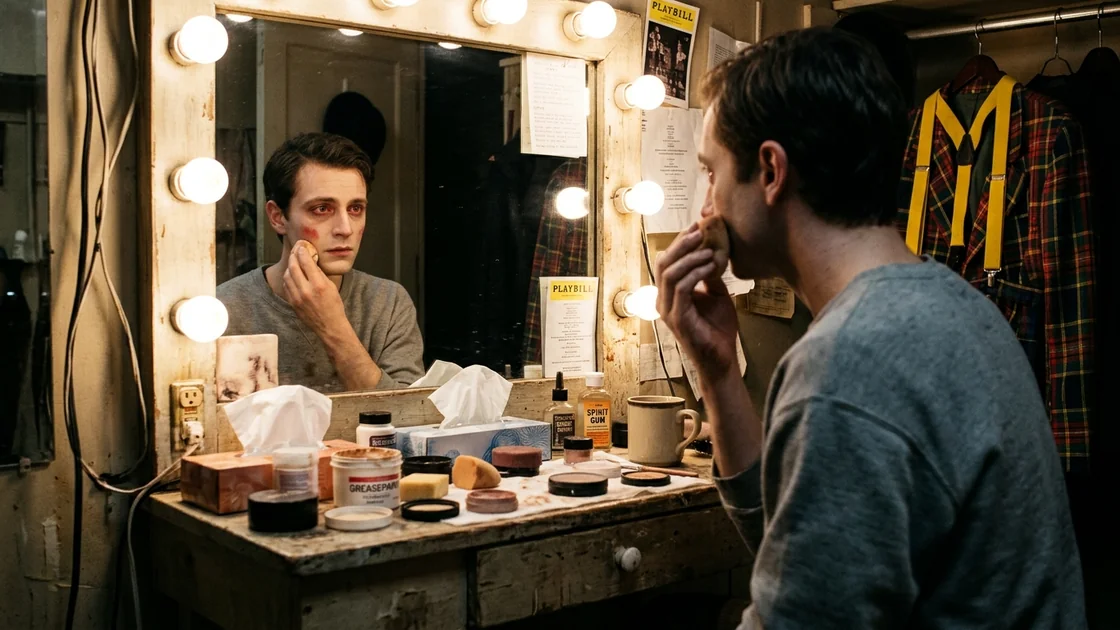
Julian Vance spends every night on a Broadway stage embodying Barnaby Blythe, the relentlessly joyful protagonist of the season's biggest comedic hit, all while hiding the devastating secret that his twin brother, Leo, died suddenly just days before opening night. Terrified that speaking the truth aloud will shatter the fragile illusion keeping him upright, Julian compartmentalizes his grief behind bright greasepaint and slapstick routines, alienating his observant co-star, Clara, and his pragmatic stage manager, Arthur. Over the course of a grueling week of performances and lonely mornings sorting through Leo’s silent apartment, the boundary between Barnaby’s manic euphoria and Julian’s crushing sorrow begins to dissolve. Ultimately, a mid-performance breakdown forces Julian to drop the comedic mask, leading him to discover that true survival requires sharing the weight of his loss with the people waiting for him in the wings.
The dressing room smelled of stale coffee, adhesive spirit gum, and the faint, metallic tang of panic. Julian sat before the vanity mirror, ringed by twenty-four incandescent bulbs that hummed with a low, persistent vibration. They threw a ruthless, shadowless light across his face, illuminating the hollows beneath his eyes and the gray undertone of his skin.
In thirty minutes, he would cease to be Julian Vance. He would become Barnaby Blythe, the irrepressible, clumsy, endlessly optimistic haberdasher at the center of The Petticoat Folly. For two hours and forty minutes, excluding a fifteen-minute intermission, he would trip over ottomans, sing patter songs at breakneck speed, catch falling hats on the tip of his cane, and beam with a radiance so infectious that theatre critics had called him "a human sunbeam in a world gone gray."
Julian picked up a sponge wedged with thick, theatrical foundation—a shade called Warm Ivory—and began to dab it over the dark circles under his eyes. He was painting over his own face. More specifically, he was painting over Leo’s face.
That was the cruelest geometry of being an identical twin. You could not look into a mirror without seeing the ghost. Every time Julian raised his eyebrows to apply the greasepaint, it was Leo’s forehead that creased. When he parted his lips to check that his teeth were clean of lipstick, it was Leo’s crooked lower canine that glinted back at him.
Leo had been dead for nine days. An undiagnosed cerebral aneurysm had taken him on a rainy Tuesday afternoon in his Astoria apartment while he was waiting for a kettle to boil. The kettle had whistled itself dry, scorching the bottom of the copper pot until a neighbor smelled the burning metal and called the superintendent. By the time Julian got the call from the hospital, he was in the middle of the final dress rehearsal at the Belasco Theatre, wearing checkered trousers and a bowler hat, dangling from a chandelier while the director yelled notes about comedic timing from the twelfth row.
Julian had told no one at the theatre.
It sounded insane, even inside the echo chamber of his own skull, where thoughts bounced around like loose marbles. Why hadn't he told Arthur? Why hadn't he called his agent, taken bereavement leave, let the understudy go on for opening week?
Because Julian knew, with a bone-deep, terrifying certainty, that if he spoke the words My brother is dead out loud in the building where he worked, the floor would open up and swallow him whole. The theatre was the only place on earth where Leo had never existed. Leo was a botanist; he lived in a world of humid greenhouses, Latin binomials, and quiet soil. The Belasco Theatre belonged entirely to Julian—or rather, to Barnaby. As long as the cast and crew treated Julian like the lucky, triumphant leading man riding the wave of his big break, Julian could pretend that when he turned his phone back on after the curtain call, there would be a text from Leo complaining about the aphids on his ferns.
"Half hour, Julian. Thirty minutes to curtain."
The voice crackled through the intercom speaker above the mirror, accompanied by a sharp rap on the hollow wooden door. That was Arthur, the stage manager, whose life was measured in five-minute increments and the crisp turning of script pages.
"Thank you, thirty!" Julian called back. His voice was already pitched a fraction higher than his natural baritone, sliding into Barnaby’s bright, nasal resonance. It was a vocal muscle memory that bypassed his brain entirely.
He reached for the pot of rouge. Barnaby needed rosy cheeks. Barnaby had never known a day of genuine despair in his fictional nineteenth-century life; his greatest crisis was accidentally swapping a duchess’s bonnet with a dead pheasant, a mix-up that took the entirety of Act Two to resolve. Julian blended the crimson cream into the apples of his cheeks, smiling wide to find the muscle.
The face in the mirror smiled back. A grotesque parody of Leo, wearing clown paint.
Julian’s hand trembled. A smudge of red streaked toward his temple. He grabbed a tissue, spitting on it to wipe the errant line away, his breathing shallow and fast. Don't think about the kettle, he told himself. Don't think about the kitchen linoleum. Think about the blocking in Scene Three. Enter upstage left, trip on the rug, catch the ledger before it hits the floorboards.
He stood up, stripping off his gray sweatshirt and jeans. He stepped into the heavy wool trousers with the exaggerated tartan pattern, pulling the bright yellow suspenders over his shoulders. He buttoned the stiff white collar that pinched his throat, tied the silk cravat into a deliberately lopsided bow, and slipped his arms into the cutaway coat. Every layer of fabric was armor. The heavier the wool, the harder it was for his chest to heave.
When he stepped out of Dressing Room A into the narrow, cinderblock hallway of the backstage area, the transformation was complete. He adjusted his posture, letting his shoulders roll forward slightly and his knees go loose, adopting the elastic, spring-loaded gait of a man perpetually on the verge of a pratfall.
"There he is! The man of the hour!"
Billy, the twenty-two-year-old ensemble member who also served as Julian’s understudy, was leaning against the callboard, stretching his hamstrings. Billy looked at Julian with the undisguised hunger of a kid waiting for a twisted ankle or a bout of laryngitis to hand him a career.
"Evening, Billy," Julian chirped, offering a mock salute with two fingers. "Keep those calves loose. The raked stage is feeling treacherous tonight."
"I'm always ready, Jules. You know me. One bad oyster at Sardi's and I'm in those tartan pants before you hit the porcelain." Billy grinned to show it was a joke, though his eyes darted to Julian’s face, lingering for a microsecond on the heavy concealer. "You look tired, though, man. Burning the candle at both ends? The Times review got you celebrating every night?"
"Something like that," Julian said, keeping his smile fixed until his zygomatic muscles ached. "Champagne is a cruel mistress, Billy-boy. Cruel indeed."
He kept walking, heading toward the wings of stage left. The backstage was a cavern of organized chaos. Stagehands in black T-shirts moved silently in the gloom, shifting massive painted flats of Victorian London storefronts. The air was thick with dust motes dancing in the amber spillover of the work lights, smelling of sizing paint, sawdust, and hot electrical cables.
Near the prop table, where the infamous fake pheasant sat beside a row of identical black umbrellas, stood Clara.
Clara played Lady Arabella, the object of Barnaby’s bumbling affections. She was thirty-four, possessed a soprano voice that could cut glass, and had eyes that saw entirely too much. She was already in her massive crinoline skirt, which required a three-foot radius of clear space around her at all times. She wasn't looking at her phone or warming up her scales; she was watching Julian walk toward her.
"Evening, my lady," Julian said, sweeping into a low, exaggerated bow that belonged in rehearsal, not five minutes before places.
Clara didn't curtsy back. She reached out, her fingers cool against his jaw, and tilted his face toward the blue gelled light of the wing.
"You missed a spot of spirit gum by your sideburn," she said quietly. Her thumb brushed the skin just in front of his left ear, rolling the tacky residue away. "And your hands are freezing, Julian."
"Cold heart, warm feet," Julian quipped, pulling back gently, just enough to break the contact without seeming rude. "Or is it the other way around? I never was good at biology."
Leo was the biologist. The thought knifed through him, sharp and sudden, stealing his breath. For a fraction of a second, the Barnaby posture faltered. His spine went rigid, his eyes widening as he stared past Clara’s shoulder into the dark rigging above the stage.
Clara frowned, the delicate feathers in her wig trembling. "Julian. Are you alright? And don't give me a line from the show. You've been vibrating like a tuning fork since previews ended."
"Opening week jitters," Julian lied smoothly, snatching his prop cane from the velvet-lined table and spinning it once in his palm. "You know how it is. Once the critics have their say, you suddenly realize you actually have to do the thing eight times a week until your knees give out."
"We've done four shows together, Julian. You don't get jitters. You get bored." She stepped closer, her crinoline cage bumping softly against his shins. Her voice dropped to a whisper that barely carried over the distant murmur of the audience settling into their seats on the other side of the heavy velvet curtain. "Did something happen? With your family?"
Julian froze. His fingers tightened around the brass handle of the cane until the knuckles turned white. "Why do you ask that?"
"Because on Tuesday, during the tech run, you got a phone call. You went into the alley for twenty minutes, and when you came back, you looked like you’d been hit by a crosstown bus. You haven't eaten anything in the greenroom since. You disappear the second the curtain comes down."
She knew. Or she was close enough to knowing that a single crack in his veneer would spill the whole wretched truth onto the dusty floorboards. If Clara knew, she would pity him. She would look at him with soft, mournful eyes during their duet in Act One. She would hold his hand a beat too long during the finale. And if she did that, he would start crying on stage, and once he started, he would never stop. He would drown in front of twelve hundred people paying two hundred dollars a ticket to laugh.
"My landlord is selling my building," Julian said. The lie came out with terrifying ease, smooth and rehearsed, though he had just invented it. "I'm dealing with lawyers and lease agreements during the day. It's a nightmare. New York real estate, right? The true tragedy of the modern age."
Clara studied him. The blue wing light made her look like a figure carved from ice, beautiful and unyielding. She didn't believe him—he could see the skepticism in the slight narrowing of her eyes—but before she could press the point, Arthur’s voice came over the headsets and the low-volume speakers in the wings.
"Places, please. Places for Act One. Overture in two."
"Duty calls," Julian said, giving her a wink that felt like a facial tic. "See you in the haberdashery, my lady."
He retreated to his starting position: inside a three-sided wooden box painted to look like a cramped Victorian closet. When the curtain rose, the stage would be populated by the ensemble, singing about the dreary London rain. Two minutes into the number, the closet door would fly open, and Barnaby would tumble out, entangled in thirty yards of magenta silk ribbon, landing flat on his face downstage center.
Julian stepped into the dark box. A stagehand closed the door from the outside, latching it loosely so Julian could kick it open on cue.
In the pitch dark of the narrow space, smelling of raw plywood and his own sweat, Julian dropped the smile.
He leaned his forehead against the rough wood of the door and closed his eyes. The overture began. The pit orchestra swelled below him, the brass bright and brash, the violins racing through the jaunty, syncopated theme that usually got the audience clapping along before a single word was spoken. The vibrations traveled up through the soles of his thin leather stage shoes, rattling his shinbones, his ribs, his teeth.
I'm sorry, Leo, he whispered into the wood. The music was loud enough that no one outside the box could hear him. I'm sorry I didn't answer when you called that morning. I was sleeping in. I thought you just wanted to ask about Mom’s birthday gift.
There had been a missed call at 10:14 AM that Tuesday. No voicemail. Leo never left voicemails; he thought they were an archaic imposition. At 2:30 PM, Leo was dead.
In the dark, Julian pressed the heel of his hand against his mouth, biting down on the meat of his thumb to stifle a sob that tore up from his diaphragm. His chest convulsed once, twice. He couldn't breathe. The closet was too small. It was a vertical coffin. They had put Leo in a box just like this—no, not like this, a polished mahogany one that Julian had picked out at a funeral home in Queens at nine o'clock in the morning on Thursday, wearing sunglasses indoors while the funeral director asked him about satin linings. There hadn't even been a real service yet; their parents lived in Seattle, and their mother was recovering from hip surgery, unable to fly for another two weeks. So Leo had been cremated, alone, while Julian was doing a Wednesday matinee.
The music shifted. The trumpets blared the four-bar intro to the ensemble’s final verse.
Five seconds.
Julian lowered his hand. He wiped his wet eyelashes on the sleeve of his cutaway coat, praying he hadn't ruined the eyeliner. He wrapped the magenta ribbon around his forearms, looped it once around his neck for comedic effect, and drew in a massive, shuddering breath.
Three. Two. One.
He kicked the door.
The latch gave way. The blinding white heat of the follow-spots hit him like a physical blow, erasing the audience, erasing the theatre, leaving only a blazing halo of light. Julian threw himself forward, tucking his shoulder just as he had practiced a hundred times, hitting the wooden stage with a loud, hollow thwack that made the front row gasp, before immediately popping his head up like a meerkat, cross-eyed, with a bolt of pink ribbon dangling from his teeth.
The roar of laughter that rolled out from the auditorium was deafening. It hit him in the chest, warm and heavy and demanding.
Julian spat out the ribbon, scrambled to his feet, tripped over his own cane, and caught himself on the proscenium arch, grinning out into the black void with manic, terrifying joy.
"Good morning, London!" Barnaby shouted, his voice ringing clear to the back of the balcony. "What a glorious day to be alive!"
Act One was a marathon of kinetic distraction. That was its saving grace. As long as Julian was moving—vaulting over the haberdashery counter, hiding inside a hollow dressmaker’s dummy, executing a complex five-minute tap routine with three chorus boys dressed as chimneysweeps—there was no room in his central nervous system for grief. The human brain could not simultaneously calculate the physics of catching a teacup behind one's back and process the permanence of death.
The trouble came in the quiet beats.
Toward the end of Act One, Barnaby believes Lady Arabella is leaving for Paris forever. The ensemble clears the stage. The bright amber lights dim to a soft, melancholic lavender. Barnaby sits alone on a green park bench downstage right and sings a short, wistful ballad called "A Hat Without a Head." It is meant to be charmingly sad—a clown's moment of pathos before the chaotic farce of the Act One finale kicks in.
Julian sat on the bench. His chest was heaving from the preceding chase scene; sweat was trickling down his spine, soaking through the heavy wool waistcoat, cooling rapidly in the air-conditioned draft from the wings. The spotlight narrowed until it was just a circle of white on the floorboards around his boots.
In the pit, the conductor, Maestro Davis, raised his baton. A solo clarinet began the melody—slow, reedy, and lonely.
Julian looked out into the darkness beyond the footlights. Usually, he focused on the red exit sign at the back of the mezzanine. It was a neutral anchor. Tonight, his eyes drifted lower, to the fifth row of the orchestra.
The light spilling from the stage caught the face of a man sitting on the aisle. He was in his late twenties, wearing a dark turtleneck, with a shock of wavy brown hair that fell across his forehead and a sharp, narrow jawline. He was leaning forward, his chin resting in his hand, watching Julian with quiet intensity.
Julian’s heart stopped.
It was Leo.
It was the exact posture Leo took when he was listening to someone explain something complicated at a dinner party—head tilted slightly to the left, eyes dark and focused, mouth set in a line that looked stern until you realized he was just concentrating.
The clarinet finished its four-bar intro. It was Julian’s cue.
A cobbler needs a heel to mend, the lyric went. A clock requires a chime.
Julian opened his mouth. Nothing came out. His throat had closed completely, constricted by a band of iron. In the fifth row, the man in the turtleneck shifted slightly, the shadow falling across his eyes.
In the pit, Maestro Davis glanced up, his white eyebrows shooting toward his hairline. Down in the darkness, the clarinetist improvised, repeating the last two bars, vamping to give the actor time to recover a dropped line.
It’s not him, Julian’s rational mind screamed. Leo is in a brass urn on the bookshelf next to his ferns. That is a stranger in a sweater.
A tailor needs a frayed old friend, the music begged.
Julian tore his eyes away from the fifth row, staring down at his own hands resting on his knees. They were shaking violently. If he didn't sing on the next downbeat, Arthur would think he was having a stroke. The illusion would break. The show would stop. People would rush out from the wings, and they would ask him what was wrong, and the answer was sitting in his throat like broken glass.
"A... a cobbler needs a heel to mend," Julian sang.
His voice cracked on the word mend, breaking into a fragile, breathy falsetto that wasn't in the score. He swallowed hard, digging his fingernails into his palms through the tartan wool of his trousers until he felt the skin give.
"A clock requires a chime. A tailor needs a frayed old friend, to help him pass the time..."
He sang it at half the usual volume. Usually, he projected the ballad with a warm, theatrical croon that reassured the audience it was all still a game. Tonight, the sound that came out of him was raw, stripped of vibrato, thin and reedy like the clarinet. It sounded like a man singing to himself in an empty house.
In the wings, Clara stopped fanning herself with her script and stepped closer to the curtain line, her head tilted.
Julian didn't look back at the fifth row. He kept his gaze fixed on the scuffed toe of his right boot. When he reached the bridge—For what is one without the two? A glove upon the floor—a single tear cut a hot track through the caked Warm Ivory foundation on his cheek, dropping off his chin to leave a dark spot on his yellow silk cravat.
He finished the song on a whispered note that barely carried past the orchestra pit.
For three full seconds, the theatre was dead silent. Usually, there was polite applause here, maybe a few chuckles at the final self-deprecating shrug written into the blocking. Tonight, Julian had forgotten to shrug. He just sat on the bench, hunched over, staring at the floor.
Then, the applause started. It wasn't the bright, snappy applause of a comedy crowd; it was a low, rolling wave, hesitant at first, then building into a thunderous ovation as the audience reacted to what they assumed was a brilliant, devastating piece of acting.
Then the brass section exploded into the chaotic fanfare of the finale. Three stagehands dressed as policemen burst through the upstage doors blowing whistles.
Julian’s head snapped up. The tear track on his cheek dried instantly under the hot lamps. Barnaby Blythe gasped in comedic terror, leaped over the back of the park bench, and sprinted upstage, his coattails flying behind him.
Fifteen minutes later, the red velvet curtain dropped to the roar of the intermission crowd.
The second the heavy fabric hit the stage floor, cutting off the audience, the frantic energy on stage evaporated into professional efficiency. Ensemble members dropped their panicked expressions and walked calmly toward the stairs; stagehands rushed out to strike the park bench and roll in the Duchesse's drawing room set for Act Two.
Julian didn't walk. He stumbled toward the wings, his vision tunneling at the edges, small black spots dancing in front of his eyes. He made it past the prop table and leaned heavily against the brick wall of the theatre’s exterior shell, behind the massive counterbalance weights of the fly system. He slid down the rough brick until he was sitting on his heels in the dust, dropping his head between his knees.
"Julian."
Heavy footsteps approached, stopping just inches from his polished boots. Julian didn't need to look up to know it was Arthur. He could smell the peppermint altoids and dry-erase markers that always clung to the stage manager.
"I'm fine," Julian wheezed into his knees. "Just got winded on the chase. Took a breath at the wrong time before the ballad."
Arthur didn't say anything for a long moment. Above them, ropes creaked as the haberdashery backdrop was hauled sixty feet into the grid. To his surprise, Arthur knelt down—a concession to gravity the fifty-eight-year-old veteran rarely made, given his two bad knees—and held out a small paper cup of water.
Julian raised his head and took it. His hand shook so badly that half the water sloshed over his wrist, darkening his white cuff.
"You dropped four bars," Arthur said. His voice wasn't angry; it was completely flat, the tone he used when reporting a blown lighting circuit. "Davis covered you, and whatever you did with that song worked like gangbusters out front, so the producers won't care. Wait until the Post writes an essay about your 'chekhovian turn.'"
"Sorry," Julian muttered, draining the rest of the water and crushing the paper cup in his fist. "Won't happen tomorrow."
Arthur looked at him through his thick-rimmed glasses. In the dim amber work light, Arthur’s face was a roadmap of forty years in dark theatres. He had seen actors go through divorces, bankruptcies, substance relapses, and terminal diagnoses, all while wearing greasepaint.
"You're grey under the number four pancake, kid," Arthur said softly. "You're losing weight. Mrs. Higgins in wardrobe says she had to take your waistcoat in an inch on Thursday. Now, I don't care if you're sleeping with a married woman, or if you owe money to guys in tracksuits in Bensonhurst, or if you're just terrified of being a star. That's your business."
Arthur placed a heavy, calloused hand on Julian’s shoulder, squeezing hard enough to hurt.
"My business is the next sixty-five minutes of this play. If you pass out during the chandelier bit in Act Two, you're going to break your neck, and the paperwork will ruin my weekend. Do I need to put Billy in the tartan pants right now?"
The mention of Billy—of someone else stepping into the light, leaving Julian alone in the dark with nothing to do for the next hour—sent a jolt of pure adrenaline straight into Julian’s heart.
"No," Julian said, his voice sharp. He grabbed the iron pipe of the fly rail and hauled himself to his feet, standing straight, forcing his lungs to expand fully. "No. Look at me. I'm solid. My blood sugar just dipped. I skipped lunch."
He reached into his pocket, pulled out a crumpled handkerchief, and dabbed carefully at the tear track on his cheek, smoothing the makeup back into place with his ring finger. Then he turned the smile on Arthur. It was a hundred-watt beam, practiced and blinding.
"Can't let Billy have the laughs in the pheasant scene, Artie. He plays it too broad. No subtlety in the youth of today."
Arthur rose slowly, his knees popping like dry twigs. He stared at Julian for three beats, his eyes narrowing behind his lenses.
"Eat a banana in your dressing room," Arthur said finally, turning back toward his podium. "You have eight minutes."
At 11:15 PM, the stage door alley on 44th Street was a gauntlet of smartphones and Playbills.
Normally, Julian loved the stage door. After years of regional theatre in Ohio and off-off-Broadway black boxes where the audience consisted of three tourists hiding from the rain and a homeless man sleeping in the back row, having fifty people screaming his name behind a metal police barricade was supposed to be the pinnacle of his life.
Tonight, their faces were a blur of carnivorous expectation. They didn't want Julian Vance; they wanted Barnaby Blythe to come out in a leather jacket and make a witty remark while signing their glossy booklets with a silver Sharpie.
He did it. He kept the routine going for ten agonizing minutes, moving down the line like an automaton.
"Thank you so much, glad you liked it! No, the pheasant isn't union, we pay him in birdseed! Where are you visiting from? Toledo! Wonderful town, spent a month there in '18, best chili I ever had!"
Every lie, every recycled joke felt like scraping a spoon against the bottom of an empty pot. When a teenage girl asked for a selfie, he leaned in, throwing his arm around the barricade, and gave the camera the exact wide-eyed, lopsided grin from the poster outside the theatre. The flash went off, searing green spots into his retinas.
Finally, he broke away with a wave, ducking his head and walking briskly toward Sixth Avenue, ignoring the last few calls of his name. As soon as he turned the corner onto the avenue, leaving the warm glow of the Belasco’s marquee behind, he pulled the hood of his sweatshirt up over his head and shoved his hands deep into the pockets of his coat.
He didn't take the train back to his own studio in Hell’s Kitchen. He hadn't slept there since Wednesday. Instead, he walked to the N train at Times Square and rode it out into Queens, watching the dark tiled walls of the tunnel flash by until the train emerged onto the elevated tracks in Long Island City, rattling above the wet pavement and neon bodega signs.
He got off at Broadway in Astoria and walked four blocks east to a pre-war brick building with a wrought-iron fire escape.
Upstairs, on the third floor, the windows were dark.
Julian used the spare key he had taken from Leo’s keychain at the hospital. The lock turned with a heavy clunk that echoed in the tiled hallway. When he pushed the door open, the smell hit him first.
It didn't smell like death. It smelled like life—specifically, the damp, rich, chlorophyll-heavy scent of fifty-two houseplants breathing in the dark, mixed with cedarwood, old paperbacks, and the faint, lingering ghosts of garlic and olive oil.
Julian stepped inside, locked the deadbolt behind him, and didn't turn on the overhead light. He couldn't bear the overhead light; it made the apartment look like a stage set waiting for an actor who had missed his cue. Instead, he walked into the living room, navigating the furniture by memory—his own apartment was laid out in the exact mirror image of this one, a twin quirk they had laughed about when Leo signed the lease three years ago—and switched on the purple-pink LED grow light clamped to the bookshelf in the corner.
The eerie magenta glow washed over the room, turning the jungle of monstera leaves, fiddle-leaf figs, and cascading pothos vines into black silhouettes edged in neon violet.
On the middle shelf, nestled between a fat volume on North American ferns and a terracotta pot holding a thriving jade plant, sat a heavy rectangular box made of brushed bronze.
Julian took off his coat, dropping it onto the floor, and sat down on the rug in front of the bookshelf. His knees ached from the eight pratfalls he had taken that night; there was a fresh purple bruise blooming on his right hip where he had hit the corner of the haberdashery counter during the matinee yesterday.
"The guy in the fifth row looked just like you," Julian said aloud.
His voice was entirely different now. The bright, nasal resonance of Barnaby was gone, stripped away by the three hours of shouting and singing, leaving a low, gravelly baritone that sounded rusted from disuse. It was Leo’s voice. When they were kids, they used to switch places on the phone with their grandmother and see how long it took her to notice. She never did.
"He had that terrible posture you get when you're reading lab reports," Julian continued, leaning his back against the front of the sofa, stretching his legs out on the braided rug. "Made me drop four bars in Act One. Arthur wanted to put Billy in. Can you imagine Billy doing the pheasant scene? He'd milk the double-take for ten seconds. The kid has no sense of rhythm."
The apartment was silent save for the distant hum of traffic on the Grand Central Parkway and the sudden, metallic clank of the steam radiator in the corner coming to life.
Julian looked around the room. He was supposed to be packing this place up. The landlord—a real one, not the fictional monster he had invented for Clara—had been kind, giving Julian until the end of the month to clear out Leo’s things without charging an extra month’s rent. Six cardboard U-Haul boxes sat folded flat against the radiator, untouched since Julian had bought them on Friday.
He stood up, his joints protesting, and walked into the narrow galley kitchen.
This was the hardest room. He hadn't been able to stay in here for more than thirty seconds at a time. On the stove, the back left burner was still slightly discolored where the copper kettle had boiled dry. Julian had thrown the kettle down the trash chute the first night he came here, unable to look at its blackened bottom, as if the object itself were the murder weapon.
On the counter beside the sink sat a half-empty mug of tea, a dull skin of grey mold now floating on the surface of the cold brown liquid. Next to it was an open notebook filled with Leo’s cramped, precise handwriting—notes on soil acidity levels for a project at the Brooklyn Botanic Garden—and a black pilot pen with the cap off.
Julian picked up the pen. The tip was dry now, exposed to the air for nine days. Carefully, with the reverence of a priest handling a relic, Julian clicked the cap back onto the pen and laid it down parallel to the notebook.
Then he turned to the kitchen table. There was a stack of unopened mail that Julian had been bringing up from the lobby vestibule every night: utility bills, a renewal notice for Scientific American, a postcard from a dentist.
Julian sat in the wooden chair—the one with the slightly loose left leg that Leo always meant to glue—and reached for the pile. He didn't care about the Con Edison bill. Underneath it, however, was a square cream envelope that hadn't come through the mail slot. It had been wedged into the doorframe of the apartment when Julian first arrived on Wednesday, written in a shaky, elderly hand: For Leo's Brother.
It was from Mrs. Gable, the seventy-year-old widow in 3B who had smelled the burning kettle. Inside was a sympathy card with a watercolor painting of lilies, and tucked inside the card was a spare key she had held for Leo to water his plants when he went to conferences, along with a small, folded slip of yellow legal paper.
Julian had looked at the card on Wednesday, seen the word Sympathy, and immediately shoved the whole thing under the junk mail as if it were radioactive. Now, in the blue light of the microwave clock reading 12:08 AM, he pulled the yellow paper out.
It wasn't a note from Mrs. Gable. It was in Leo’s handwriting.
Mrs. G— it read. Going to the theatre tonight for Julian’s opening! Probably won't be back until very late (after-party, etc.). Could you possibly check on the orchid in the bathroom around 8 PM and make sure the humidifier hasn't run out of water? It’s temperamental. Thank you! —Leo.
Julian stared at the yellow paper. The letters blurred, swimming together into black streaks.
Going to the theatre tonight for Julian's opening!
Leo had written the note in advance. Opening night had been Thursday. Leo had died on Tuesday afternoon, already planning the logistics of his plants for Thursday night so he could sit in the fourth row center—Seat D-104, the comp ticket Julian had left at the box office under the name Leo Vance, which had gone unclaimed, leaving a single empty plush red velvet seat in the middle of a sold-out house.
All Thursday night, during the greatest triumph of his professional life, Julian had looked at that empty seat and felt a sick, perverse relief that no one was sitting in it, because an empty seat could just mean someone was stuck in traffic on the Queensboro Bridge. An empty seat meant Leo was just late.
Julian dropped his head onto his forearms on the kitchen table, right next to the moldy mug of tea, and wept.
He didn't make a sound at first; it was just a violent, rhythmic shuddering that rattled the loose leg of the wooden chair against the linoleum. Then the sound came—a ragged, animal groan torn from the bottom of his lungs, the exact opposite of the clear, projected vowels he had spent his life training to produce. He gripped the edges of the table until his fingernails chipped against the laminate, sobbing into the sleeve of his sweatshirt while the radiator clanked and hissed in the other room, pumping heat into an empty apartment for a man who was never coming home.
Monday was dark.
In the theatre world, "dark" meant no performance, a day of rest for the cast and crew after the brutal double-header of the weekend shows. For Julian, a dark day was a twenty-four-hour stretch of unscripted terror. Without the three-hour scaffolding of The Petticoat Folly to hang his day upon, time became a shapeless, suffocating fog.
He woke up at ten in the morning on the floor of Leo’s living room, his neck stiff, his mouth tasting of copper and dust. The purple grow light was still on.
He spent four hours watering the plants. It was the only task that didn't feel like an erasure. If he packed Leo’s sweaters into a box, he was admitting Leo didn't need to stay warm anymore. If he threw out the half-empty carton of oat milk in the fridge, he was acknowledging Leo would never have another bowl of cereal.
Watering the plants was different. The plants were still alive. They were thirsty.
Julian took Leo’s long-spouted brass watering can, filled it with lukewarm water from the bathtub, and moved methodically from window to window. He didn't know anything about botany—he had killed every succulent he had ever owned—so he had to rely on Leo’s green leather journal, which he carried tucked under his arm like a script.
Calathea orbifolia, Julian read, squinting at a large plant with wide, silver-striped leaves near the radiator. Distilled water only, or it gets brown tips. Keep soil moist, not soggy. Drama queen.
Julian let out a short, wet huff that was almost a laugh. "Drama queen. Takes one to know one, buddy."
He went down to the bodega on the corner in his sweatpants, unshaven, wearing Leo’s old Mets cap pulled low over his eyes, and bought three gallons of distilled water. He came back up and spent the afternoon misting ferns and wiping dust off the rubber plant leaves with a damp cloth, just as the journal instructed.
At four o'clock, his phone buzzed on the coffee table.
He had kept it on Airplane Mode for most of the week, only turning it on for ten minutes a day to check his emails from his agent and to send a daily, cowardly text to his mother in Seattle: Doing great, Mom. Still sorting through the apartment. Shows are going well. Love you. He couldn't bear to hear her voice on the phone; she sounded too much like an older, softer version of the two of them.
Today, he had forgotten to turn the cellular data back off. The phone buzzed again, skittering across the wood.
On the screen was a photo of Clara making a ridiculous cross-eyed face in a Victorian bonnet.
Julian stared at it until it went to voicemail. Five seconds later, a text popped up.
Clara: I know you're screening your calls, Vance. Arthur told me which train you've been taking every night, and I called your agent and pretended to be a florist to get your brother's address in Astoria. Yes, I know that's psychotic. No, I don't care. I'm outside the building. Buzz me in or I'm going to sing the Act One finale on the sidewalk until the cops come.
Julian’s stomach plummeted into his shoes. He walked to the front window and parted the leaves of a hanging spider plant to look down at the street.
Sure enough, standing on the wet pavement of 34th Street, wearing a trench coat and holding a brown paper bag from a bakery, was Clara. She was looking straight up at the third-floor window. When she saw the spider plant move, she raised one eyebrow and pointed a finger at the intercom box by the front door.
Julian closed his eyes. Send her away, the voice in his head urged. Text her that you have a migraine. Tell her you're contagious.
Instead, he walked into the hallway and pressed the yellow button labeled DOOR until he heard the downstairs lock click.
Two minutes later, there was a soft knock. When Julian opened the door, Clara didn't say hello. She took one look at him—the grey sweatpants, the three-day stubble, the red-rimmed eyes, the Mets cap—and stepped past him into the apartment without waiting for an invitation.
She stopped in the middle of the living room, looking around at the jungle of plants, the purple grow light, the folded cardboard boxes leaning against the radiator.
"I dachte you said your landlord was selling your building," she said quietly, setting the bakery bag down on the coffee table. "This isn't your apartment, Julian. You told me last month you lived on 48th and Tenth in a place with no sunlight."
"I'm house-sitting," Julian said automatically. The lie was pathetic, thin as tissue paper. "For my brother. He's... he's in Costa Rica. Doing fieldwork."
Clara turned slowly to look at him. Her eyes moved from his face to the bookshelf behind him.
She walked over to the shelf, past the fiddle-leaf fig. She didn't touch the brushed bronze box sitting between the fern book and the jade plant, but she looked at the small, engraved brass plate affixed to the front of it.
LEONARD THOMAS VANCE OCTOBER 14, 1994 – OCTOBER 22, 2024
The silence in the room became absolute. The radiator didn't clank. Outside, no cars passed.
Clara stood very still in front of the shelf, her back to Julian. He watched the tension drain out of her shoulders, replaced by a heavy, sinking stillness. She reached up with one hand and covered her mouth.
"October twenty-second," she whispered, her voice muffled behind her fingers. "That was Tuesday. That was the final dress."
Julian couldn't move. He stood by the front door, his hand still resting on the brass deadbolt, feeling as if someone had peeled the skin off his body and left him standing in a cold wind. The secret was out. It was in the room with them, breathing up the oxygen.
Clara turned around. Her eyes were bright with unshed tears, her face pale. "Julian... he had your birthday."
"Five minutes younger," Julian said. His voice sounded like gravel being ground under a heel. "He always said I pushed him out of the way to get the spotlight first."
"Oh, Julian."
She crossed the room in three steps and wrapped her arms around his neck.
Julian went rigid. For nine days, nobody had touched him except in choreography—a slap on the back from a chorus boy, a gloved hand on his elbow during a waltz, the quick, impersonal tug of a dresser zipping his fly during a forty-second quick change. Real touch, warm and unscripted and smelling of rain and wool and vanilla perfume, was a physical shock.
He tried to hold himself upright. If he stayed stiff, she would let go, and they could sit down and talk about the show, or the weather, or the bakery bag on the table.
Instead, Clara held on tighter, tucking her chin over his shoulder, one hand coming up to cradle the back of his head, knock-off Mets cap and all.
"I'm so sorry," she breathed into his ear. "God, Julian, how have you been standing up?"
The lock in his knees gave way.
He didn't fall to the floor only because Clara had him braced against the doorframe. Julian buried his face in the wet wool of her trench coat collar and let go of the deadbolt, his arms coming around her waist, clutching at the fabric of her coat as if he were dangling off the edge of a roof.
He cried differently than he had the night before at the kitchen table. That had been a lonely, violent exorcism; this was a collapse. All the weight he had been carrying since Tuesday afternoon—the chandelier, the tartan trousers, the pheasant, the applause, the brass urn, the moldy tea mug—came crashing down on him at once, and for the first time, someone else was taking part of the load.
They stood there by the front door for a long time, until Julian’s knees actually did buckle, and they slid down the wall together to sit on the hardwood floor in the narrow hallway, surrounded by terracotta pots of English ivy.
After twenty minutes, when Julian’s breathing had finally leveled out into shaky, hiccupping sighs, Clara reached into her coat pocket and handed him a crumpled Kleenex.
"Sorry," Julian mumbled, wiping his face and blowing his nose. "I probably ruined your coat. Is that cashmere?"
"It's Burlington Coat Factory, shut up," Clara said, leaning her head back against the drywall beside him. She looked sideways at him, her expression a mixture of awe and horror. "You did opening night two days after he died."
"Had to."
"You didn't have to, you lunatic. That's what Billy is paid for."
"If I hadn't gone on Thursday," Julian said, staring at the intricate leaf pattern of the ivy across from his boots, "I never would have gone on again. I knew it the second I walked out of the hospital in Queens. If I stopped moving, if I stayed home in bed while the show opened without me... I would have just laid down on this floor and waited to die too."
He turned the crumpled tissue over in his hands. "When I'm Barnaby, Leo isn't dead. Because Barnaby doesn't have a brother. Barnaby just has a hat shop and a very complicated relationship with a duchess's poultry. For three hours a night, I get to be someone whose biggest problem is a ripped seam in his trousers. It's the only time it doesn't hurt."
Clara reached over and took his hand, lacing her fingers through his. Her hands were warm today.
"It was hurting on Saturday," she said gently. "During the ballad. I was watching from the wings. You weren't Barnaby then."
"There was a guy in the fifth row," Julian whispered, leaning his temple against her shoulder. "He had Leo's hair. He was looking right at me."
"So you sang to him."
"I almost walked off the stage, Clara. I forgot the words."
"You didn't forget them. You just meant them for the first time." She squeezed his hand. "Come on. Get off the floor. I brought almond croissants from that place on Ninth Avenue, and you look like you haven't seen a carbohydrate since rehearsals started. Then you're going to tell me about him, and you're going to teach me which of these green monsters needs to be misted."
For the next six hours, Julian talked.
He hadn't realized how much of Leo was backed up behind his teeth, waiting to be let out. While they sat on the sofa eating flaky pastry off paper napkins, Julian told her about growing up in Seattle, where they used to build forts out of soggy cardboard behind their father's garage. He told her about the time in tenth grade when Julian had broken his wrist right before the high school production of The Music Man, and Leo—who hated being looked at by more than two people at once—had learned all the blocking in an afternoon so Julian could stand in the wings and sing the songs into a microphone while Leo lip-synced and danced on stage with a fake cast over his own unbroken arm.
"Wait," Clara laughed, her eyes wide around a mouthful of croissant. "You Cyrano-ed your high school musical?"
"It worked until the library scene," Julian said, and to his shock, a genuine smile pulled at the corner of his mouth—not Barnaby’s wide, maniacal rictus, just a small, warm curve that belonged entirely to Julian. "Leo didn't know how to do a time-step, so he just kind of hopped from foot to foot like a startled stork while I was belting 'Marian the Librarian' from behind a painted plywood bookcase. The drama teacher nearly had an aneurysm."
The word hung in the air the second it left his mouth. Aneurysm.
Julian’s smile vanished. His throat constricted.
Clara didn't flinch. She didn't look away in awkward embarrassment or rush to change the subject the way people usually did around grief. She just kept her hand resting on his knee, steady and grounding.
"Is that what happened?" she asked softly.
Julian nodded, looking down at his coffee mug. "In the kitchen. He was making tea. The doctor at Mount Sinai Queens said he wouldn't have felt anything. Just a sudden headache, and then the lights went out before he hit the floor."
"Did you... did you feel it?" Clara asked hesitantly. "You always hear stories about twins. That they know."
Julian looked toward the kitchen doorway. That was the secret beneath the secret—the guilt that was eating him alive from the inside out.
"At two-thirty that Tuesday," Julian said, his voice dropping to a bare whisper, "we were doing the Act Two chase scene. The one where I come down on the chandelier. Everybody was laughing. The crew was laughing, the cast was laughing, because the pulley got stuck halfway down and I was dangling ten feet above the sofa kicking my legs like a beetle. I was having the best day of my life, Clara. I was hanging up there under the stage lights thinking, I made it. I'm finally on Broadway. And at that exact minute, three miles away across the river, he was lying on the linoleum while the kettle burned."
Tears spilled over his lower lashes again, hot and silent. "I didn't feel a thing. Half of my own DNA was dying on a kitchen floor, and I was making a joke about my harness pinching my groin."
Clara shifted on the couch, pulling her legs up under her and taking his face between both of her hands, forcing him to look at her.
"Listen to me," she said fiercely. "You are an actor, Julian, not a psychic. If he had known what you were doing at two-thirty on Tuesday—that you were dangling from a chandelier on a Broadway stage making fifty people laugh—what would he have thought?"
Julian blinked through the blur in his eyes. "He would have thought it was ridiculous. And he would have bragged about it to everyone at the botanic garden."
"Exactly. And he had a note on his table saying he was coming to see you on Thursday. He wanted you up on that chandelier." She brushed her thumb across his cheekbone, wiping the wet track away. "You aren't betraying him by being alive, Julian. And you aren't betraying him by being funny."
Before she left at eight o'clock that night, Clara walked into the kitchen, took the half-empty mug of moldy tea off the counter, dumped it down the drain, and washed the cup with hot, soapy water until it gleamed, setting it upside down on the drying rack. Then she took one of the flat U-Haul boxes from behind the radiator, taped the bottom shut, and placed five of Leo’s folded sweaters neatly inside.
"You don't have to do the rest tonight," she told him at the door, kissing his cheek. "Just one box a day. And tomorrow at the theatre, I'm telling Arthur."
Julian panicked instantly. "Clara, no—"
"Just Arthur," she said firmly. "Nobody else. Not Billy, not the producers, not the ensemble. Just Arthur, because he's the one driving the bus, and if you need five minutes to breathe in the wings, you need someone on the headset who knows why. Deal?"
Julian looked back at the living room, where the single taped cardboard box sat on the rug like a small brown island. He let out a long breath.
"Deal," he said.
Tuesday night’s performance was strange.
When Julian arrived at the stage door at seven, Arthur was standing by the sign-in sheet with a clipboard. As Julian reached for the pen tied to the board with string, Arthur put his hand over the paper.
The stage manager didn't offer flowery condolences. He wasn't a man built for poetry. He just looked Julian dead in the eye through his thick glasses and nodded once.
"My older brother Danny," Arthur said quietly, "went in '09. Heart attack at a Mets game. I was calling West Side Story at the Palace. Didn't miss a performance either."
Julian stared at him, the cheap ballpoint pen poised in his hand.
"I told Billy to stay in his dressing room tonight instead of lurking by the callboard," Arthur continued, pulling his hand back so Julian could sign his initials. "And I put a folding chair behind the black velour masking upstage right. Nobody goes back there during Act One except the spot operator before the half-hour call. If you need to sit down when you're offstage, you sit down. I'll give you a personal two-minute warning on the belt pack before your entrances."
Julian’s throat felt thick. He signed JV next to his name. "Thanks, Artie."
"Don't thank me. Just don't drop the four bars in the ballad tonight. Davis is getting carpal tunnel vamping for you."
Arthur walked away toward the stage, barking at an electrician about a flickering sconce on the drawing room flat.
That night, for the first time since previews, Julian didn't feel like he was walking onto a tightrope without a net. Knowing that Clara and Arthur knew—that two pairs of eyes in the building saw Julian Vance underneath Barnaby Blythe’s yellow waistcoat—changed the pressure inside his chest. The grief was still there, heavy and cold as a river stone in his stomach, but he was no longer expending half his oxygen trying to pretend he hadn't swallowed it.
Wednesday was a two-show day. Matinee at two, evening show at eight.
The matinee was an elderly crowd—buses from New Jersey and Long Island, full of retirees who laughed a beat late because they were repeating the punchlines to their hard-of-hearing spouses, and who unwrapped hard candies during the quiet scenes with a sound like crinkling cellophane fire. Julian got through it on muscle memory and three cups of black tea with honey, sleeping for an hour on the narrow leather sofa in his dressing room between shows with Leo’s green botany journal resting on his chest.
The crisis came on Friday night.
Friday crowds were always rowdy, fueled by two-martini dinners in the Theater District and the relief of the weekend. From the moment Julian kicked open the closet door in Act One, the audience was electric. Every slapstick bit landed like a bomb; every double-take got an applause break. Barnaby was flying, riding the crest of twelve hundred strangers' euphoria.
By the middle of Act Two, they had reached the climax of the farce: the Duchesse’s drawing room scene.
It was the most technically demanding twelve minutes of the play. There were six doors on the set, four actors running in and out of them in rapid succession, a rolling bar cart, the fake pheasant hidden inside a silver soup tureen, and the infamous chandelier.
The plot dictated that Barnaby, trying to hide the pheasant from the nearsighted Duke, hooks his umbrella onto the low-hanging crystal chandelier to swing across the room, only for the chandelier's chain to "break," leaving Barnaby dangling ten feet above the sofa while Lady Arabella tries to distract the Duke below by playing the piano loudly.
Julian had done the stunt forty times across rehearsals, previews, and opening week. Behind the scenes, it was a masterpiece of stage rigging: Julian clipped a hidden steel carabiner inside his cutaway coat onto a wire concealed within the chandelier’s chain during a split-second turn upstage, jumped onto the back of the sofa, and let the flyman in the wings haul him up five feet before locking the brake.
Julian hit his mark by the bar cart. He grabbed the soup tureen, delivered the line—"I assure you, Your Grace, the soup is merely molting!"—to a massive roar of laughter, and spun upstage toward the sofa.
His fingers found the hidden carabiner inside his lapel. He reached for the steel loop on the chandelier.
Click. The metal snapped shut.
He leaped onto the back of the velvet sofa, hooked his prop umbrella over the brass arm of the fixture for show, and kicked his feet off the upholstery.
The flyman pulled the counterweight rope. Julian rose into the air, swinging out over the center of the stage, kicking his tartan-clad legs in comedic panic while the crystal prisms rattled around his ears. Below him, Clara dashed to the upright piano and began banging out a frantic, off-key version of "Rule, Britannia!" while the actor playing the Duke wandered around searching for his spectacles.
It was two-thirty on Tuesday afternoon all over again.
Suddenly, hanging there under the blinding heat of the forty-kilowatt lighting rig, looking down at the top of Clara’s feathered wig and the painted canvas floor cloth ten feet below, Julian’s brain short-circuited.
The smell of the hot lighting gels above him—scorched dust and warm metal—morphed instantly into the smell of a copper kettle burning dry on a stove in Astoria.
The laughter roaring out from the dark auditorium stopped sounding like laughter. It sounded like a single, massive, whistling scream.
He was dying right now, Julian’s mind whispered. You were hanging right here, kicking your legs, and he was hitting the floor.
Julian stopped kicking.
His legs went dead straight, dangling limp above the sofa. His hands, which were supposed to be comedicly flailing at the umbrella handle while the hidden harness held his weight, clamped onto the brass arms of the chandelier with white-knuckled terror.
Below him, Clara glanced up from the piano keys to deliver her next line: "Look at the weather we're having, Uncle! Quite overcast with a chance of haberdashers!"
The words died on her lips when she saw Julian’s face.
The Barnaby mask had vanished completely. Under the stage makeup, Julian’s face was slack, his eyes wide and unfocused, staring straight ahead into the dark void of the balcony as if he were watching a horror movie projected on the back wall of the theatre. He was hyperventilating, his chest jerking against the nylon webbing of the hidden harness under his waistcoat.
In the audience, the laughter began to thin out, replaced by a confused murmur. The audience thought it was a bit at first—a pause for comedic effect—until five seconds stretched into ten, and the man on the chandelier didn't move, didn't mug, didn't speak his cue line.
Downstage left, the actor playing the Duke, an older Broadway veteran named Richard who knew nothing about Julian’s brother, frowned behind his prop monocle and tried to throw Julian a lifeline.
"I say!" Richard boomed, improvising in his plumy British accent. "Did someone hear a large bird caught in the rafters? Speak up, man, if you're up there!"
Julian’s cue was to crow like a rooster. It was the biggest cheap laugh in Act Two.
Julian opened his mouth. He tried to make the sound. He tried to find Barnaby—that bright, elastic, indestructible idiot who had carried him through the last ten days.
Barnaby wasn't there. Barnaby didn't exist. There was only Julian Vance, twenty-nine years old, hanging from a wire in a ridiculous tartan suit while his other half was ash in a bronze box across the East River.
"I can't," Julian whispered.
He didn't project it, but the tiny wireless microphone taped to his cheek just beside his left ear picked up the breathy, shattered syllable and broadcast it through the Belasco’s state-of-the-art sound system to all twelve hundred seats.
A collective, uneasy intake of breath rippled through the orchestra section.
In the wings, Arthur didn't hesitate for a millisecond. He didn't wait for Julian to recover, and he didn't lower the chandelier to keep the scene going.
"Kill the mic," Arthur barked into his headset to the sound board operator. "Flyman, bring him down slow to the deck. House lights to half. Curtain. Now."
The heavy red velvet curtain, which hadn't dropped mid-scene since the theatre was built in 1907, began to descend with a loud, rushing whoosh of displaced air.
At the same moment, the counterweight rope paid out smoothly, lowering Julian down until his boots touched the seat cushions of the velvet sofa. Before the curtain had even touched the stage floor, Clara had abandoned the piano, hikes of her three-foot crinoline cage hoisted in both hands, scrambling onto the sofa beside him to unclip the steel carabiner inside his coat with practiced, trembling fingers.
The curtain hit the floorboards with a heavy thud, cutting off the rising clamor of the confused audience out front. The bright stage lights snapped off, replaced instantly by the dim blue glow of the working lights.
Stagehands materialized from both wings. Richard stood holding his monocle, looking bewildered. "What the devil—did the rig snap? Is he hurt?"
"He's fine, Dickie, clear the stage," Arthur said, marching out from the wing, pulling his headset off his ears and letting it hang around his neck. He stepped onto the sofa platform and grabbed Julian under the left arm, while Clara took his right.
Julian wasn't fighting them, and he wasn't fainting; he just couldn't make his legs work properly. His knees felt like water. As they half-walked, half-carried him off the set toward the stage-right wing—toward the quiet corner behind the black velour masking where Arthur had put the folding chair—Julian heard Arthur speaking calmly to his assistant stage manager.
"Go out in front of the rag. Tell the house we have a minor technical malfunction with the flying rig and we are pausing the performance for fifteen minutes to reset. Then go down to the dressing rooms and tell Billy to put on the Act Two trousers. Tell him he's going in from the top of the chandelier scene."
Julian heard the words as they lowered him into the metal folding chair in the dark corner behind the masking.
Tell Billy he's going in.
A week ago, hearing those words would have made Julian claw his way back onto the stage with broken legs. Tonight, sitting in the cool darkness smelling of fireproofing chemicals and dust, Julian just leaned his head back against the brick wall and closed his eyes.
"Okay," Julian breathed. The word came out on a long, shuddering exhale that felt like letting go of a rope that had burned the skin off his palms. "Okay."
Arthur crouched in front of him, checking Julian’s pupils with a small penlight from his pocket. Satisfied that it was a panic attack and not a concussion, Arthur clicked the light off and stood up.
"Billy needs ten minutes to get into the harness and the mic," Arthur said to Clara, who was kneeling beside Julian’s chair, unbuttoning the stiff white collar that was choking his throat. "Stay with him until I call places for the restart, then get back to the piano."
"I've got him," Clara said.
When Arthur disappeared around the black curtain to wrangle the crew and the understudy, Clara pulled off Julian’s lopsided silk cravat and tossed it onto an empty cable trunk. She took a bottle of water from the pocket of her dressing gown, which had been hanging on a hook nearby, unscrewed the cap, and held it to his lips.
Julian took a sip. The water was room temperature, tasting faintly of plastic, and it was the best thing he had ever tasted.
On the other side of the heavy masking curtain, the stage was a beehive of quiet, urgent activity. They could hear Billy’s voice—high, nervous, and thrilled—talking to the rigger as they adjusted the chandelier wire for Billy’s slightly shorter height. They heard Arthur giving quiet, steady notes to Richard about where they would pick up the dialogue.
The show wasn't dying because Julian had stepped off the wire. The theatre wasn't collapsing. The earth wasn't opening up.
"I blew the scene," Julian said quietly, looking down at his yellow suspenders. "Right in the middle of the rooster bit."
"It's a terrible bit anyway," Clara said, sitting down on the dusty floor right beside his chair, her massive Victorian skirt billowing up around her like a meringue. She rested her chin on his tartan knee, looking up at him in the blue light. "You've been overplaying the rooster since rehearsals."
Julian let out a weak, wet sound that turned into a real laugh, though tears were leaking out of the corners of his eyes, cutting fresh canyons through the greasepaint. He reached down and laid his hand on top of her elaborate wig, careful of the ostrich feathers.
"He was right there, Clara," Julian whispered. "When I looked out at the balcony, I just... I realized he's never going to see it. I was keeping the show going for him, like if I just kept doing it every night, eventually he'd show up in Seat D-104. And up there on the wire, I finally realized he isn't coming."
"I know, sweetheart," Clara whispered, turning her head to press her cheek against his knee. "I know."
"Places for the restart," Arthur’s voice came softly over the wing monitor. "Curtain going up in one minute. Clara, to the piano, please."
Clara squeezed Julian’s hand once, gathered up her skirts, and stood. "Go down to your room. Wash that crap off your face. Wait for me until the curtain call is over, okay? Promise me you won't leave the building without me."
"I promise," Julian said. "Go play 'Rule, Britannia.'"
He stayed in the folding chair for another two minutes after she left. He listened to the heavy curtain rise. He heard Billy, dangling from the chandelier, deliver the rooster crow—Billy really did play it too broad, dragging the third cock-a-doodle-doo out for an extra two seconds—and he heard the twelve hundred people in the dark roar with grateful, relieved laughter.
Barnaby Blythe was fine. Barnaby Blythe was immortal; you could swap out the man inside the yellow waistcoat and Barnaby would keep swinging from chandeliers forever.
Julian stood up slowly in the dark wing, unhooked the battery pack of his microphone from the back of his belt, set it neatly on the cable trunk beside his cravat, and walked down the spiral iron stairs to his dressing room.
In the mirror, the twenty-four incandescent bulbs hummed their familiar, ruthless tune.
Julian didn't look away this time. He sat down on the stool, opened the jar of cold cream, and scooped out a thick white dollop with three fingers. He smeared it across his forehead, his cheeks, his chin, dissolving Warm Ivory, dissolving the crimson rouge, dissolving the heavy black eyeliner that made his eyes pop from the mezzanine.
He took a warm, wet washcloth from the sink and wiped his face clean in three long, firm strokes.
When he lowered the towel, he looked into the glass.
The skin was pale and blotchy from crying, with dark purple smudges of exhaustion beneath the eyes and a faint red mark on the bridge of the nose from where he had bumped into the chandelier prisms. It was a tired face. It was a sad face.
And it was Leo’s face.
For the first time since Tuesday afternoon, Julian didn't flinch away from the reflection. He leaned forward, resting his elbows on the vanity table among the greasepaint sticks and hairpins, and looked directly into his own dark brown eyes—the exact shade of wet bark, as their mother always called them.
If he never looked in a mirror again, Leo would be completely gone from the visual world, reduced to two-dimensional photographs and fading memories. As long as Julian had a face, Leo was still here, looking out at the room.
Julian reached up and touched the glass with the tips of his fingers, right over the reflection's cheek. The mirror was warm from the vanity bulbs.
"Hey, Leo," Julian whispered in his own low, gravelly baritone.
Thirty feet above his head, through the concrete ceiling of the basement, he could hear the muffled, rhythmic stomping of the Act Two finale—twelve pairs of boots hitting the floorboards in unison, building toward the big finish.
Tomorrow was Saturday. Another two-show day. Arthur would probably tell him to take the weekend off, to let Billy have the tartan pants until Tuesday, and Julian knew now that he would take it. He would take the train to Astoria in the daylight, open the curtains to let the sun hit the monstera leaves, and pack the rest of the sweaters into the cardboard boxes with Clara helping him fold the sleeves. And on Tuesday night, he would come back here, sit in front of these twenty-four lights, and put the paint back on, knowing that when he washed it off at eleven o'clock, both of them would still be there underneath.
Upstairs, the music hit its final, crashing brass chord, and the floor above Julian’s head began to vibrate with the long, rolling thunder of the applause.