The Anatomy of Silence
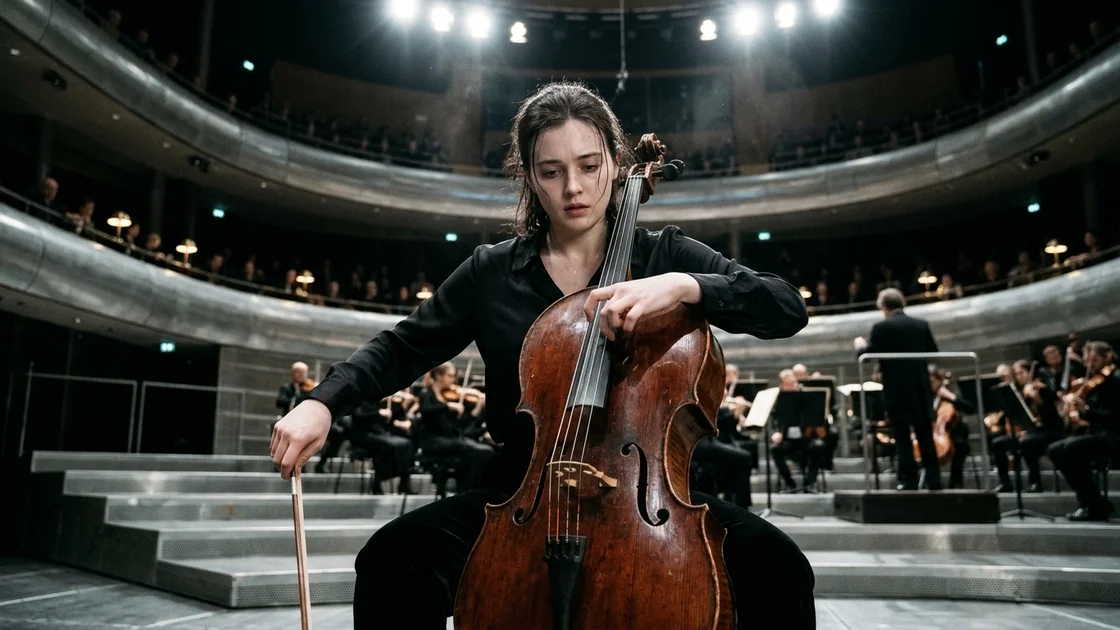
Clara Vance is a twenty-two-year-old cello prodigy whose entire identity has been forged in the relentless crucible of classical music, where her self-worth is measured solely by the flawlessness of her technique. During the final round of the prestigious International Rostropovich Cello Competition in Paris, the unimaginable happens when her left ring finger spontaneously curls into her palm, struck by musician's focal dystonia—a neurological betrayal born from twenty thousand hours of repetitive perfectionism. This story chronicles Clara’s public collapse on the world stage and her subsequent psychological unraveling as she is cast out from the elitist conservatory culture by her ruthless mentor, Julian Vane. Stripped of her primary voice and haunted by the phantom reflexes of her crippled hand, Clara must navigate the terrifying silence of an unscripted life, descending into the depths of grief and physical rebellion before discovering through the cracks of a broken instrument that she is more than the machinery of her body.
I. The Rosin and the Bone
The smell of pine resin had lived in Clara’s nostrils since she was five years old. It was a dry, sharp scent that clung to the inside of her nose, dusted the cuffs of her black velvet trousers, and settled into the microscopic valleys of her fingerprints. By twenty-two, she was convinced that if a surgeon were to split her sternum with a rib spreader, they would not find lungs grayed by metropolitan air, nor the pink, wet sponge of an ordinary youth. They would find a fine, pale layering of Pirastro Eudoxa dust, coating her alveoli like frost on dry grass.
She sat in the green room of the Philharmonie de Paris, six meters below the main stage, listening to the hum of the ventilation shafts. The room was not green; it was the color of skimmed milk, soundproofed with perforated maple panels that absorbed the nervous pacing of the six finalists until only the click of their heels remained.
Clara was not pacing. She sat on the edge of a straight-backed armless chair, her spine aligned in the Alexander Technique posture that had been drilled into her by three different somatic coaches in New York, Berlin, and Verbier. Her sits-bones anchored her weight; her shoulder blades floated wide like dormant wings; her chin was tucked just enough to lengthen the cervical vertebrae. Between her knees rested Il Lupo, a 1714 Matteo Goffriller cello lent to her by a Swiss syndicate of anonymous bankers whose only interaction with her consisted of quarterly insurance audits and a stiff holiday card signed by an executive assistant.
The Goffriller was worth two point four million euros. Clara’s father’s house in Ohio had been worth one hundred and eighty thousand before he mortgaged it twice to pay for her pre-college tuition at Juilliard. She had done the math once, during a feverish bout of influenza in her sophomore year: she was holding thirteen point three of her childhood homes between her thighs.
She looked down at her left hand.
It was not a pretty hand. A civilian’s hand was soft, symmetrical, the fingernails shaped into neat ovals. Clara’s left hand was an industrial instrument. It was noticeably wider than her right, the metacarpals thickened by seventeen years of lateral torque against an ebony fingerboard. The fingertips were square, flattened at the pads where the skin had died, hardened, peeled, and died again until the calluses were as thick and translucent as horn. They didn't feel heat the way her right hand did; she could touch the side of a boiling kettle with the tip of her left index finger and feel only a dull, distant warmth through the armor.
"Ten minutes, Mademoiselle Vance," the stage manager said. He was a thin Frenchman with a headset that left a red indentation across his temple. He didn't step fully into the room; he knew the etiquette of the slaughterhouse. Finalists were unstable creatures, vibrating at frequencies that could shatter if looked at too directly.
Clara didn't answer him with words. Her throat was dry, constricted by the beta-blockers—twenty milligrams of propranolol—she had swallowed dry forty minutes ago. The pill had done its job: her heart rate was locked at a mechanical sixty-four beats per minute, trapped behind a chemical dam while the adrenaline pooled uselessly in her stomach like cold grease. She simply inclined her head two centimeters.
She raised the bow—a Sartory, sixty-one grams of pernambuco wood and white horsehair from the tails of Mongolian stallions—and placed it on the C string.
Shostakovich. Concerto No. 1 in E-flat major, Op. 107.
It was a brutal piece of music. It was not the weeping, autumnal grief of Elgar, nor the aristocratic elegance of Haydn. Shostakovich had written it in 1959 for Mstislav Rostropovich, the very man whose bronze bust currently stared down at the lobby outside. It was four movements of manic, teeth-grinding irony, a cat-and-mouse game with the ghost of Stalin where the cello never stopped talking, shouting, whispering, and weeping until the strings threatened to snap under the sheer percussive weight of the right arm.
She played the opening four-note motif: G, F-sharp, C-flat, B-flat.
Bam. Bam-bam. Bam.
The Goffriller growled, the low F-sharp rattling the wooden panels of the small room, vibrating up through the endpin, through the floorboards, into the soles of her patent leather Ferragamo flats, and straight into her pelvic bone. There was no barrier between her and the wood. The cello was not an object she held; it was an externalized organ, a third lung made of Tyrolean spruce and Bosnian maple, varnished the color of dried arterial blood.
As she shifted up to the thumb position on the A string for the first run of double-stops, she felt it.
It was nothing. Less than nothing. A ghost of a snag.
On the transition from the high D to the E-flat, her third finger—the ring finger, the weakest link in the human hand’s evolutionary chain, tethered by shared tendons to its neighbors—seemed to hesitate. It didn't miss the note. Clara didn't miss notes; her intonation was so absolute that her peers at the Curtis Institute had nicknamed her The Tuner. The finger landed on the exact millimeter of gut-core string required to produce an E-flat at 442 Hertz.
Wait. No. It hadn't hesitated on the way down. It had hesitated on the way up.
When she lifted her hand to drop back into first position, the ring finger remained curved for a microsecond longer than the index and middle fingers. It felt as though the skin of her knuckle had momentarily caught on a microscopic burr of wood, or as if the synovial fluid in the proximal interphalangeal joint had briefly turned to molasses.
Clara stopped the bow. The silence of the room rushed back in, thick and suffocating.
She held her left hand up to the harsh fluorescent light. She flexed the fingers. Open, closed. Open, closed. She tapped the thumb against each fingertip in rapid succession: 1-2-3-4-4-3-2-1. She did it at the speed of a hummingbird’s wings, a drill she had performed while watching television as a child, while riding the subway, while sitting in lectures on eighteenth-century counterpoint.
The ring finger moved with the clean, oiled precision of a Swiss escapement. There was no pain. There was no stiffness.
It’s the air conditioning, she told herself, her internal voice sounding suspiciously like Julian Vane’s. The French keep their halls like meat lockers. The tendons are cold.
She reached into the pocket of her silk blouse and pulled out a small plastic packet of chemical hand-warmers, already activated and radiating a dry, iron-scented heat. She wrapped her left hand around the pouch, squeezing hard, forcing the blood into the capillaries.
The door opened again. Julian Vane stood in the threshold.
He did not look like a musician; he looked like a man who owned the bank that owned the cello. At sixty-five, Julian was tall, silver-haired, and wore bespoke charcoal suits that never wrinkled. He had been a legendary soloist in the seventies before a mysterious "retreat into pedagogy" at forty—a transition he framed as a noble sacrifice for the next generation, though rumors in the conservatories varied from a botched carpal tunnel surgery to an inability to handle the arrival of the digital recording era, where splices couldn't hide a shaky bow arm.
"You're pale," Julian said, not as an expression of concern, but as a critique of her stage presence. "The lighting in the big hall is cold. If you look like a corpse before you sit down, the jury will hear a corpse."
"I'm fine, Julian," Clara said. She dropped the hand-warmer back into her pocket. "The hall is dry. The C string is settling a little sharp."
Julian stepped into the room, closing the door behind him. He walked over to her, his eyes dropping immediately to her hands, then to the bridge of the Goffriller, checking the alignment of the feet with the f-holes. He never looked at her face first. Her face was merely the radiator grille of the vehicle; the engine was from the clavicles down.
"Kuznetsov just finished the Dvořák," Julian said, his voice dropping to that low, conspiratorial baritone that had made her weep with gratitude when she was fourteen and terrified her every year since. "He played like a butcher. Big sound, Russian school, plenty of grease on the shifts, zero architecture. The French judges hated it. I watched Morel’s face during the Adagio—he looked like he was smelling bad fish. It’s yours, Clara."
The words should have warmed her, should have pierced the propranolol haze. It’s yours. The First Prize. Fifty thousand euros, a recording contract with Deutsche Grammophon, and forty-two guaranteed engagements with major orchestras from Tokyo to Berlin over the next two seasons. It was the exit ramp from the purgatory of "promising young artist" into the pantheon. It meant she could pay off the second mortgage on the house in Akron. It meant Julian would finally nod, just once, with his chin tucked, the way he nodded when listening to his own 1978 recording of the Bach Suites.
"My third finger feels tight," she said. She didn't know why she said it. In Julian’s studio, you did not report physical sensations unless a bone was protruding through the skin, and even then, you finished the phrase first. Pain was an amateur’s excuse; tension was a moral failing.
Julian’s eyes flicked up to hers. They were pale gray, the color of sleet. "Tight?"
"Just... slow on the release in the high positions. On the A string."
Julian reached out and took her left hand. His palm was dry and cool. He pressed his thumb hard into the flexor digitorum superficialis in her forearm, right below the elbow, digging into the muscle belly. Clara didn't wince; she had been trained not to wince when physical therapists drove their elbows into her rhomboids.
"There's no knot here," Julian said, dropping her hand as if returning a piece of cutlery to the table. "It’s nerves. Your brain is trying to give you an exit clause because you know you’re going to win. It’s vulgar, Clara. Don't be vulgar. You’ve played that cadenza four thousand times since January. Your spinal cord knows it better than your cerebral cortex. Get out of the way of the hands."
"Yes, Julian."
"Don't press in the second movement," he added, already turning toward the door. "Let the harmonic at the end of the cadenza float. If you choke it, I’ll walk out of the box."
He wouldn't walk out, of course. Her victory was his victory; she was the crown jewel of his studio, the proof that the Vane Method still produced titans in an era of soft, media-friendly Mediocrities. He left the room, leaving the scent of his vetiver cologne to war with the pine resin.
Clara looked down at her hand again. The ring finger lay calmly beside the middle finger, slightly curved in its natural resting state.
"Two minutes, Mademoiselle," the stage manager said, opening the door and holding it wide.
Clara stood up. She lifted the Goffriller by the neck with her left hand and held the Sartory in her right. As she walked down the narrow concrete corridor toward the heavy acoustic doors of the stage wing, she could hear the murmur of two thousand four hundred people on the other side of the wall, mixed with the oboe’s A-442 as the Orchestre de Paris tuned.
She felt her left ring finger twitch against the maple neck of the cello. It wasn't a muscle spasm, not like the benign fasciculations one gets in an eyelid after too much espresso. It was a tiny, deliberate-feeling pull, as if an invisible nylon thread had been tied around the tip of her nail and someone behind her had given it a sharp, testing tug.
II. The Cadenza
The stage of the Grande Salle Pierre Boulez was designed to look like a swirling metallic tempest, with audience balconies floating like clouds around the central vineyard-style platform. To Clara, walking out from the dim cave of the wings into the sudden, violent glare of the overhead floods, it looked like the inside of a giant bleached skull.
The applause washed over her—a polite, pattering wave of sound that carried the distinct weight of Parisian skepticism. She walked with the rehearsed gait Julian had perfected for her when she was seventeen: long strides, no bobbing of the head, the cello carried effortlessly at her hip as if it weighed no more than a loaf of bread. She bowed to the concertmaster, bowed to Maestro Laurent on the podium, and turned to bow to the cavernous dark of the hall.
Somewhere up in the first balcony, behind the long mahogany desk covered in green baize and illuminated by eleven tiny brass reading lamps, sat the jury. Nine cellists, one conductor, one critic. They were the gods of her small, airless universe.
She sat. She adjusted the endpin, sliding the tungsten-carbide tip into a scarred divot in the blonde wood of the stage floor. She brought the cello back against her chest, feeling the familiar, cold kiss of the ebony C-peg against the hollow behind her left ear.
She looked at Laurent. The conductor raised his baton, his eyebrows lifting in an expression of polite inquiry. Ready?
Clara lowered her chin. Ready.
The baton fell, and she struck the G.
For the first four minutes, the machine worked. More than worked—it transcended. As the woodwinds chattered their sarcastic replies and the French horn bayed its lonely, haunted theme across the brass section, Clara disappeared into the grain of the Goffriller. This was the state she had chased every day of her life for seventeen years, the single justification for the lost childhood, the estranged friends, the curved spine, the eternal smell of rosin. In this state, time ceased to be linear; it became spatial, a vast cathedral of sound whose flying buttresses she was building in real-time with horsehair and gut.
Her left hand flew up and down the fingerboard like a white spider. The shifts were seamless, guided by a proprioceptive map so deeply etched into her basal ganglia that she could have played the Allegretto in a sensory deprivation tank. The double-stops bit into the air of the hall with a ferocious, ringing clarity that made the first-chair cellist of the orchestra, sitting two feet to her right, subtly lean back in his chair with widened eyes.
She was winning. She could feel the energy of the hall shifting, the collective posture of two thousand people leaning forward by three degrees. The air grew heavier, warmer, charged with that rare electricity that only happens when an audience realizes they are not witnessing a competition round, but a coronation.
The first movement ended without a pause, plunging directly into the Moderato. Here, the music turned inward, becoming a vast, frozen Russian landscape. Clara drew the bow across the A string with infinite slowness, producing a pianissimo so fragile and yet so penetrating that it reached the back row of the third tier without losing its core.
Then came the cadenza.
In the Shostakovich First, the cadenza is not an ornament; it is an entire movement unto itself—six minutes of solo cello that begins as a brooding meditation and accelerates into a demonic, frantic developmental storm of chords, pizzicato, and impossibly fast scales at the very bridge of the instrument. The orchestra went silent. Maestro Laurent lowered his arms and leaned against the brass rail of the podium. The sixty musicians on stage froze into statues, their eyes fixed on the twenty-two-year-old girl in the black velvet trousers.
Clara closed her eyes.
She began the slow plucking of the chords, her left hand stretching across the wide intervals at the base of the neck. The tone was dark, woody, resonant. She brought the bow back to the strings, beginning the long, climbing ascent of the più mosso.
Faster, the score demanded. Allegro.
Her hand climbed toward the rosin-white territory above the neck heel, where the string was three millimeters off the wood and the margin for error was measured in microns. Thumb on the harmonic A, first finger on B, second on C-sharp, third on D.
As her third finger came down on the D, the invisible nylon thread pulled again.
This time, it did not let go.
Instead of dropping onto the string with its flat, calloused pad and immediately rebounding to allow the second finger to take the C-sharp in the descending trill, the third finger curled.
It didn't just miss the string; it folded inward at both joints with a sudden, violent contraction, tucking itself tightly into the fleshy mound at the base of her thumb as if trying to hide from the light. Because the flexor tendons of the ring finger share a common muscle belly with the middle and fourth fingers, the violent retraction dragged her pinky down with it and locked her middle finger into a rigid, trembling claw.
The sound that came out of the two-million-euro Goffriller was not a D. It was a strangled, metallic skreek—the sound of her fingernail catching the winding of the A string and pulling it sideways off the fingerboard while the bow crushed the deadened metal.
Clara’s eyes snapped open.
For a fraction of a second, she experienced a profound sensory dissociation. She looked down at the white thing crabbed against the black ebony of the fingerboard and did not recognize it as part of her body. It looked like a dead bird. The ring finger was pressed so hard into her palm that the knuckle was white, trembling with the sheer isometric force of the spasm.
Open, she commanded.
She didn't think the word; she sent the motor signal down the corticospinal tract, the same electrical impulse she had sent ten million times since the age of five. Extensor digitorum: fire.
Instead of opening, the finger squeezed harder. Her brain had forgotten the difference between "flex" and "extend." In the hyper-mapped, over-trained cortex of her right hemisphere, the neural boundaries between the fingers had smeared together like wet ink, and the system had just short-circuited.
She tried to play around it. In the space of half a heartbeat—while the horrific skreek was still echoing off the aluminum clouds of the ceiling—she tried to refinger the passage on the fly, substituting the second finger for the third, jumping with her index and thumb like a one-legged acrobat.
It was impossible. The passage was a relentless, sixteen-note-per-second perpetuum mobile of thirds and sixths. With the third finger locked into her palm, her fourth finger was paralyzed by biomechanical sympathy, and her middle finger felt as though it had been injected with lead.
She hit a cluster of wrong notes—not just out of tune, but completely random pitches, the sound of a child banging a fist on a violin. Her bow arm, panicked by the sudden failure of its partner, stiffened at the shoulder. The Sartory bounced wildly across the D and A strings, producing a series of dry, hacking crunches.
Out of the corner of her eye, she saw the concertmaster’s head jerk up. She heard a single, sharp intake of breath from the front row of the parterre.
Keep going, the training screamed. Never stop in a performance. If the string breaks, retune on the fly. If the bridge falls, sing the part. Never stop.
She tried to shift back down to first position to reset the hand. It was a trick she didn't know was a trick—a sensory reset—and the moment her fingers left the tension of the strings, the ring finger popped open as if released by a spring. It looked completely normal.
Gasping for air through her nose, she slammed her hand back onto the fingerboard to catch the beginning of the Allegro molto section of the cadenza, skipping twelve bars of music in a desperate bid to reach the orchestra’s re-entry. If she could just get to the tutti, the brass would cover her.
Her hand touched the neck. The instant the calloused pad of her third finger registered the tactile sensation of the Pirastro string under tension, the trap sprung again.
Snap.
The finger curled straight back into the palm, harder this time, the tendon in her wrist standing out like a taut wire under the pale skin. Her fourth finger splayed outward at an unnatural, grotesque angle, sticking straight up into the air like a broken antenna while her index finger collapsed flat across all four strings.
The bow dragged across the muted, choked strings, producing a low, groaning wheeze that sounded shockingly like an animal dying in a ditch.
Clara stopped the bow.
You do not stop in the middle of the Shostakovich cadenza at the Rostropovich Competition. It is simply not within the realm of physical laws, like water flowing uphill or the sun rising in the west.
The silence that fell over the Grande Salle Pierre Boulez was not the warm, expectant silence of a musical rest. It was the silence of an aviation disaster. Two thousand four hundred people, eleven jurors, sixty orchestra musicians, and the live microphone feed of France Musique broadcasting to forty countries held their breath at the exact same moment.
Clara stared at her left hand. She brought her right hand—still holding the bow—up to the neck of the cello and physically pried her left ring finger out of her palm using her right thumb. It felt like bending a piece of cold iron. The moment she let go of it to bring the bow back to the strings, the finger snapped shut again against her palm with an audible thwack of skin on skin.
A drop of sweat, cold as ice water, detached itself from her hairline, rolled down the bridge of her nose, and fell onto the crimson varnish of the Goffriller’s belly.
She looked up toward the first balcony. Through the blinding haze of the stage lights, she couldn't see the faces of the jurors, only the eleven little brass lamps glowing like eyes in the dark. Then she looked slightly to the left, toward the private boxes near the stage.
A dark silhouette stood up in Box 4, turned its back to the stage, and walked out through the red velvet curtains. The heavy door of the box clicked shut. In the acoustic perfection of Jean Nouvel’s hall, that tiny metallic click sounded as loud as a gunshot.
Maestro Laurent whispered something to her from the podium, his face drained of color. "Mademoiselle? On reprend au chiffre 71?" Shall we pick up at rehearsal number 71?
Clara didn't answer him. She couldn't speak. Her tongue felt thick and dead in her mouth, as if the paralysis in her finger were already creeping up her brachial plexus into her jaw.
Slowly, with movements that belonged to an eighty-year-old woman, she loosened the frog of her bow, taking the tension off the horsehair. She stood up. Her legs were numb from the knees down. She did not bow to the conductor. She did not bow to the concertmaster. She picked up the Goffriller by its ribs—not even by the neck, because her left hand was still locked in its strange, three-fingered fist—and walked off the stage into the dark mouth of the wings. Nobody clapped. Nobody booed. The only sound in the vast hall was the rhythmic, hollow clack-clack-clack of her Ferragamo heels against the blonde wood, and the faint, metallic rattle of the cello’s C-string tuner vibrating in sympathy with her footsteps.
III. The Diagnosis of a Ghost
The neurologist’s office in the 13th arrondissement smelled of antiseptic and old paper, a stark contrast to the cedar-and-rosin perfume of the luthiers' shops on the Rue de Rome where Clara had spent the previous week.
It was two days after the finals. Kuznetsov had won. Clara knew this only because the hotel concierge had looked at her with the hushed, mournful pity usually reserved for recent widows when she handed over her room key that morning, while a copy of Le Figaro lay open on the counter showing the broad-shouldered Russian raising the trophy like a severed head.
Julian had not answered her calls. He had not answered her texts. When she had gone to his suite at the Hôtel de Crillon the night of the finals, the front desk informed her that Monsieur Vane had checked out four hours early and taken the Eurostar to London. He had left an envelope for her at reception. Inside was no note—only the return flight itinerary to Newark and the business card of the Swiss insurance broker who needed to collect the Goffriller before she left the Schengen zone.
"Play the scale again, please, Mademoiselle Vance," Dr. Moreau said.
He was an old man with liver spots on the backs of his hands and a neatly trimmed white beard. His office at the Pitié-Salpêtrière Hospital was cramped, stacked to the ceiling with journals on movement disorders and EMG printouts.
Clara sat on a vinyl examination table, her bare legs dangling over the paper sheet that crinkled every time she breathed. Between her knees was not the Goffriller—the Swiss broker’s courier had taken that at nine o'clock sharp yesterday morning, sealing it into its carbon-fiber Accord case like a body into a coffin. Instead, she held a cheap, factory-made Chinese student cello that Dr. Moreau kept in the corner of his office next to a battered upright piano and three tarnished brass trumpets. The varnish was thick, orange polyurethane; the strings were cheap steel that felt like barbed wire under her fingers.
She placed her hand in first position on the C string.
"Slowly," Moreau said, leaning forward on his rolling stool, his eyes behind thick spectacles fixed less than six inches from her knuckles.
Clara drew the cheap fiberglass bow. C. D. E-flat.
Her first and second fingers fell with their usual robotic accuracy. Then she reached for the F with her third finger.
The moment her brain initiated the command play F, the ring finger didn't drop toward the fingerboard. It jerked violently upward at the base knuckle while the middle joint snapped ninety degrees inward, curling the tip tightly into her palm. Simultaneously, her fourth finger—which wasn't even needed for the note—locked into hyperextension, trembling like a tuning fork.
"Stop," Moreau said gently. "Now, put the bow down. Turn the cello around so you are holding the back of the neck, like a baseball bat, and tap the fingers on the wood in the exact same rhythm."
Clara obeyed. She tapped the back of the cheap maple neck: 1, 2, 3, 4.
Her fingers moved effortlessly. The ring finger tapped the wood with a crisp, clean rhythm, free of any spasm, tension, or hesitation.
"Now," Moreau said, reaching into his lab coat pocket and pulling out a thin wooden tongue depressor. "Put your hand back in playing position on the strings. Do not play. Just let me touch the fingers."
She placed her hand over the strings. Immediately, the ring finger began to twitch, the tendons in her wrist tightening in anticipation of the task. Moreau took a pair of latex exam gloves from a box on his desk and handed one to her.
"Put this on your left hand."
Clara stared at the blue nitrile glove. "I can't play in a glove."
"Humor an old man."
She pulled the glove on. It was too large, bagging slightly at the fingertips, smelling of talcum powder. She put her hand back on the fingerboard and drew the bow across the C string.
C. D. E-flat. F. G.
She stopped, the bow freezing mid-air. Her heart gave a violent, sickening thud against her ribs.
With the latex barrier between her calluses and the steel string, her ring finger had dropped onto the F without a single tremor. The scale had been clean.
"It's not my tendons," she whispered, her voice cracking in the small room. "I thought I tore a pulley. I thought it was tendonitis."
Dr. Moreau sighed, rolling backward on his stool and stripping off his own glasses to rub the bridge of his nose. "If it were tendonitis, Mademoiselle, you would be a very lucky young woman. I would tell you to put ice on it, take anti-inflammatories, and not touch the cello for six weeks. Your muscles are healthy. Your tendons are like steel cables. Your peripheral nerves are conducting electricity at optimal velocities."
He gestured toward the gloved hand resting on the orange neck of the student cello.
"What you just demonstrated with the glove is called a geste antagoniste—a sensory trick. By altering the tactile input from the skin of your fingertips to your somatosensory cortex, we temporarily fooled your brain into thinking you were not playing the cello."
"Fooled my brain?" Clara looked at the blue glove, then ripped it off as if it were burning her skin. The moment the bare skin of her ring finger brushed the C string, it curled into her palm like a salted slug. "What is wrong with me?"
"You have focal task-specific dystonia," Moreau said quietly. "Specifically, musician’s cramp of the left hand."
The words hung in the sterile air. Clara knew the word. Every conservatory student knew the word, the way seventeenth-century sailors knew the word scurvy or Victorian prostitutes knew syphilis. It was spoken of only in whispers in the basement practice rooms at Juilliard and Curtis. Did you hear about the second oboist in Cleveland? His embouchure went. Dystonia. He’s selling real estate in Ohio now. Remember Fleisher? Lost his right hand at thirty. Thirty years of left-hand Ravel concertos.
It was the bogeyman of the virtuoso. And like all bogeymen, Clara had believed it only attacked those who practiced with bad technique, those who played with tension, those who were weak.
"No," she said, shaking her head sharply. "My technique is clean. Julian Vane built my left hand from the ground up when I was twelve. I don't squeeze with my thumb. My wrist is always flat. I do Alexander Technique twice a week."
"It is not caused by bad technique," Moreau said, his voice carrying the practiced patience of a doctor delivering a terminal oncology report. "In fact, it is almost exclusively a disease of perfection. For seventeen years, you have demanded that the fingers of your left hand execute movements of extreme speed, precision, and force, for six to eight hours a day."
"Eight to ten," Clara corrected automatically.
"Eight to ten," Moreau conceded with a sad smile. "The human brain is plastic, Mademoiselle Vance. In the homunculus—the map of the body inside your motor and sensory cortex—each finger is supposed to have its own distinct territory, separated by inhibitory borders that allow you to move your index finger without moving your ring finger. Because you have forced those fingers to fire together at millisecond intervals millions of times, under the high neurochemical pressure of adrenaline and perfectionism, your brain tried to become too efficient. The borders between the cortical maps of your fingers have broken down. They have fused."
He held up his own hand, crossing his middle and ring fingers.
"When you sit at the cello and your brain sends the signal to press the third finger down, the signal spills over into the surrounding cortical territory. It fires the flexors and the extensors at the same time. The brain is receiving corrupted sensory data from the fingertips, thinking the finger hasn't reached the string yet, so it sends more and more voltage to the flexor muscle until the finger locks into your palm. It only happens when you play the cello because the neural circuit for 'playing the cello' is the specific program that has become corrupted."
Clara felt the paper sheet crinkle beneath her palms as she gripped the edge of the examination table. "How do you fix it? Surgery? Cortisone?"
"You cannot cut into the motor cortex to separate the maps of two fingers," Moreau said. "There is no surgery. We can use botulinum toxin—Botox—injected directly into the flexor muscle of the forearm under ultrasound guidance. It will weaken the muscle enough that the finger cannot curl with such force, allowing you to play simple passages."
"Simple passages," Clara repeated. The phrase tasted like copper. "I am supposed to play the Dvořák with the London Symphony in October. Wait—no, I lost the finals." She blinked, her mind stuttering over the timeline of her own erasure. "I have the Elgar in Baltimore in November. Can the Botox get me through the Elgar by November?"
Moreau looked at her for a long time. The silence of the examination room was different from the silence of the Philharmonie, yet it pressed against her eardrums with the same crushing weight.
"Botox is a crutch, Mademoiselle. It dulls the strength and precision required for soloistic repertoire. The only true path to remapping the brain is sensory-motor retuning. You must stop playing completely to let the abnormal neural circuits weaken. Then, over the course of years—two, three, perhaps five years—you retrain the fingers from zero, starting with tapping exercises, using splints, playing single whole notes for five minutes a day without triggering the spasm."
"Five years," Clara said.
At twenty-two, in the classical music world, five years was a century. In five years, a new crop of fourteen-year-olds from Seoul, Moscow, and Kronberg would have swept the Tchaikovsky, the Queen Elisabeth, and the Rostropovich. In five years, the managers who hadn't returned her emails since Thursday would have forgotten how to spell her name.
"And after five years?" she asked, her voice barely audible. "Will it be back to one hundred percent?"
Moreau looked down at the desk. "In neurology, we consider a seventy to eighty percent recovery of function to be a clinical triumph. Enough to teach. Perhaps enough to play chamber music or sit in the back of a regional section, if the repertoire is chosen carefully."
Clara stood up. The cheap Chinese cello slipped from between her knees; she didn't reach out with her left hand to catch it. It clattered against the side of the metal table, the bridge knocking against the floor with a hollow wooden thud. A normal cellist would have gasped, would have dropped to their knees to check the soundpost and the varnish before checking their own pulse.
Clara just looked at the orange wood lying on the linoleum.
"You're telling me I'm dead," she said.
"I am telling you that your finger has a neurological disorder," Moreau said, stooping to pick up the instrument himself. "You are twenty-two years old, Mademoiselle. Your heart is beating. Your lungs are clear."
"You don't understand," Clara said, already reaching for her coat. She tried to button it with both hands, and for the first time, she noticed that when she pinched the horn button between her left thumb and index finger, her ring finger gave a tiny, sympathetic twitch. It was spreading. "I don't have anything else. There is nothing else inside me."
IV. The Phantom Limb
New York in late October was wet and smelled of rotting ginkgo fruit and hot subway grates.
Clara’s apartment on West 108th Street was a fourth-floor walk-up, a narrow railroad flat she had chosen solely because the pre-war plaster walls were thick enough that the retired Columbia professor downstairs didn't bang on his ceiling with a broom handle when she practiced scales at midnight.
The apartment was empty now, even with her in it.
For the first time since she was fourteen, there was no two-million-dollar Italian cello sleeping in its climate-controlled case in the corner of the bedroom, monitored by three digital hygrometers and two ultrasonic humidifiers that hissed day and night to keep the relative humidity at a precise forty-eight percent.
She still had her own cello—a contemporary American instrument made by a luthier in Ann Arbor that she had played before the Swiss syndicate had anointed her with the Goffriller. It sat in its black fiberglass case against the wall near the radiator, the latches snapped shut. She had unplugged the humidifiers three days ago. The digital readout on the wall currently showed twenty-nine percent humidity. The wood inside the case was drying out, the spruce belly shrinking fractionally across the grain, the seams tightening toward a crack. She didn't care. Let it dry. Let it turn into kindling.
Her phone lay face down on the kitchen counter. For the first forty-eight hours back in New York, she had checked it every ten minutes, waiting for Julian to call, or for Harrison, her junior manager at IMG Artists, to reply to her three-paragraph email explaining that she had suffered an "acute radial nerve inflammation" in Paris and needed to reschedule her November dates.
Harrison had called once, on Tuesday morning. The conversation had lasted ninety-four seconds.
"Look, Clara," he had said, the sound of an espresso machine hissing in the background of his midtown office. "Everyone saw the stream. France Musique archived it before we could issue a takedown notice, and somebody ripped the cadenza to YouTube. It has forty thousand views."
She had closed her eyes, leaning her forehead against the cold refrigerator door. "It’s a temporary nerve issue, Harrison. I saw a specialist in Paris."
"People don't use the word 'nerve issue' in the hallways here, Clara. They're using the D-word. Julian told the board at Curtis yesterday that he’s opening up your fellowship spot for the spring semester. He said you’ve been showing signs of focal collapse since August and refused to adjust your repertoire."
"That's a lie!" she had shouted, the first time she had raised her voice above a mezzo-forte in ten years. "I told him ten minutes before I went on stage and he told me it was nerves! He told me not to be vulgar!"
A brief, uncomfortable pause had followed on the line. "Julian Vane has forty years of institutional credibility, Clara. You’re twenty-two, and you locked up for four bars of the Shostakovich in front of David Geringas and Gautier Capuçon. We’re exercising the medical force majeure clause in your retainer. Take six months. Fix the hand. When you can play the Dvořák straight through for a panel without a hitch, call me directly."
Then the line had gone dead.
Now, it was Friday. Clara had not left the apartment in seventy-two hours. She hadn't showered. She sat on the worn IKEA sofa in an oversized gray sweatshirt, staring at the television with the volume muted, watching the silent, exaggerated mouths of daytime talk show hosts open and close like fish in an aquarium.
She couldn't stop doing the tests.
Dr. Moreau had warned her about this. "The worst enemy of a dystonic musician is compulsive checking," he had said at the door of his office. "Because the disorder is task-specific, your hand will feel completely normal when you are eating soup or brushing your teeth. This will convince you that you have been cured, or that it was all a bad dream. So you will go back to the instrument—or even mimic the posture of playing in the air—to check if the spasm is still there. Every time you trigger the spasm to 'check' it, you are reinforcing the corrupted neural pathway. You are practicing the dystonia."
She knew he was right. And yet, every twenty minutes, her left arm would rise of its own accord into the air beside her left ear, hovering over an invisible fingerboard.
She would close her eyes and imagine the weight of the Goffriller against her sternum. She would drop her fingers in the air, executing the opening run of the Haydn D Major—something sweet, something simple, something she had played when she was eleven years old in a velvet dress with white tights.
Air is safe, she thought. There’s no string tension in the air.
For two seconds, her fingers fluttered in the empty space beside her jaw like white moths. Then, the moment she imagined the specific tactile resistance of the gut-core A string under the pad of her third finger, the trap snapped shut. Even in empty air, without an instrument within ten feet of her, her ring finger curled violently into her palm, the tendon in her forearm standing out like a cord of wood.
She gasped, grabbing her left wrist with her right hand and slamming the whole arm down against her thigh, hitting the bone hard enough to leave a purple bruise through her sweatpants.
"Stop it," she hissed to the empty room. "Stop it, you stupid thing."
Who was she talking to? The hand? Or the lump of gray meat inside her skull that had betrayed her?
That was the horror of focal dystonia—the absolute ontological split it carved down the center of the self. If she had broken her arm in a taxi cab door, there would have been pain, casts, pins, a clear external enemy, and a timeline for bone callus formation. People would have sent flowers. Julian would have called it a tragic interruption and arranged a masterclass tour where she spoke bravely about resilience while wearing a silk sling.
Instead, there was no pain. There was no cast. There was only the grotesque realization that the thing she called "I"—the conscious will that had spent seventeen years whipping her body into submission—was a tenant in a house owned by a stranger. Her brain had decided, without consulting her, that the movement defining her entire existence was an error to be corrected by paralysis.
And because her entire identity was built on absolute motor control, the loss of that control triggered a cascade failure across her entire psychology.
Who was Clara Vance without the cello?
She tried to make a list in her head, staring at a water stain on the plaster ceiling.
- She had a high school equivalency diploma obtained through an online program for pre-professional athletes and performers, for which her mother had written half the history essays so Clara wouldn't lose practice time before the Tchaikovsky Junior Competition.
- She had never ridden a bicycle. Julian had forbidden it at age twelve because a fall on the pavement could fracture a scaphoid bone.
- She had never cooked a meal that required a chef's knife. She ate microwaved brown rice, steamed salmon from plastic trays, and pre-washed spinach.
- She had had sex twice, both times with a twenty-six-year-old violist at the Verbier Festival three summers ago. During the act, she had lain beneath him in the Swiss chalet, staring over his shoulder at her cello case, consciously keeping her left hand palm-up on the pillow so she wouldn't accidentally bear weight on her wrist when he shifted his hips. Afterward, when he tried to hold her hand on the walk to breakfast, she had pulled away because his palm was sweaty and softened her calluses.
- She did not know how to drive.
- She did not have a single friend who was not a string player, and every string player she knew was currently watching the forty-thousand-view video of her career suicide on YouTube with a mixture of horror and secret, darwinian relief that there was now one fewer predator competing for the New York Philharmonic solo slots.
At four in the afternoon, as the gray light outside the window turned the color of dirty dishwater, she stood up from the sofa.
She walked over to the black fiberglass case by the radiator.
"I won't play," she whispered aloud. Her voice sounded hoarse, unused. "I just want to hold it. Just to feel the wood."
She unlatched the six heavy metal clasps. They popped open with a series of loud, metallic snaps that echoed through the quiet apartment. She lifted the lid.
The smell hit her instantly—that ancient, sacred perfume of horsehair, pine resin, maple, and old hide glue. A Pavlovian wave of grief, so acute it felt like a physical blade pushed up under her floating ribs, doubled her over. She fell to her knees on the hardwood floor, pressing her forehead against the crushed blue velvet lining of the case, and wept.
She hadn't cried in Paris. She hadn't cried in Dr. Moreau’s office. She cried now with ugly, tearing sobs that racked her narrow chest, soaking the blue velvet with saliva and tears. She mourned for the five-year-old girl in Akron who had been given a quarter-size plywood cello and told she was special; she mourned for the fourteen-year-old who had sat in the bathroom of the Juilliard dorms with her fingers in a bowl of ice water at two in the morning so she wouldn't disappoint Julian; she mourned for the woman she was supposed to become on that stage in Paris five days ago.
When the tears stopped, her face was swollen and hot. Her eyes burned.
She reached into the case, lifted the Ann Arbor cello out by its neck, and spun the endpin out. She didn't bother with a chair. She sat right there on the edge of the unmade bed, pulling the instrument against her chest.
Just the contact of the upper bout against her sternum made her left ring finger twitch. The neural program was already loading. Cello detected. Prepare for failure.
She picked up the bow. She didn't care what Moreau had said about reinforcing the pathway. A junkie with a collapsed vein doesn't care about tissue necrosis; they just need the needle to go in one more time to see if there's any blood left.
She didn't play Shostakovich. She didn't play Bach.
She put her first finger down on the D string in first position—an E—and tried to play the opening of The Swan by Saint-Saëns. It was a piece every cellist learned at age nine. It was slow. It was lyrical. It required almost no finger speed, just a long, singing legato line and a warm vibrato.
She drew the bow. The E sang out, rich and melancholy in the small bedroom, though slightly flat because the cello had gone out of tune in the dry air.
She started to rock her left hand in the familiar, pendulum motion of vibrato.
Instantly, her ring finger—which wasn't even on the string—snapped shut into her palm like the jaw of a bear trap. The spasm was so violent that it jerked the entire metacarpal arch of her hand sideways, pulling her index finger off the E and dragging the nail of her middle finger across the D string.
Stop, Moreau’s voice said in her head.
She didn't stop. A red, blinding rage—the rage of a prisoner rattling the bars of a cell—erupted behind her eyes.
"Move!" she screamed at her hand.
She forced the bow harder into the string, sliding up the neck to the high B, trying to muscle through the dystonia by sheer force of will, the way she had muscled through fever, tendonitis, and exhaustion her entire life. She pressed her third finger down onto the A string with all the strength in her forearm, trying to pin the rebellious digit to the ebony by crushing it beneath the weight of her arm.
The finger refused the pad. Instead, because the proximal joint was locked at ninety degrees, she drove the hard knuckle of the middle joint straight down onto the steel string while her thumb clamped against the back of the neck with bone-crushing force to counteract the spasm.
The cello shrieked—a tortured, grinding noise of wood and over-pressed metal.
Her ring finger slipped off the side of the fingerboard, still curled tight, and wedged itself between the A string and the ebony wood, trapping the flesh of her knuckle under the taut wire while her bow arm kept sawing back and forth in a blind, hysterical frenzy. Skin tore against the steel winding of the string. A smear of bright red blood appeared on the black ebony of the fingerboard.
Still the finger stayed curled. It would break before it would unbend.
With a guttural roar that didn't sound like it came from a human throat, Clara stood up, lifted the cello above her knees by the scroll, and swung it like an axe against the cast-iron radiator under the window.
The impact was deafening.
A thirty-thousand-dollar piece of hand-carved Michigan maple and Sitka spruce exploded not with a musical chord, but with the dry, gunshot crack of splitting timber and the high, terrifying twang of four strings releasing three hundred pounds of collective tension at once. The bridge flew across the room and shattered the glass of her framed Curtis diploma on the opposite wall. The ribs caved in along the lower bout, jagged splinters of pale, unvarnished wood bursting outward through the amber finish like compound fractures through skin.
She didn't stop with one blow. Holding the neck in both hands—her left ring finger finally able to do its job now that the task was no longer music, but blunt-force destruction—she brought the mangled body of the instrument down onto the iron fins of the radiator a second time, and a third, until the neck snapped cleanly out of the mortise joint at the top block, leaving her holding only the ebony fingerboard and the scroll, tethered to the corpse on the floor by the tangled, twisted wire of the C and G strings.
She stood panting in the center of the bedroom. Dust—decades of trapped rosin dust shaken loose from the interior linings of the belly—hung in a pale cloud in the shaft of gray light from the window.
Her left knuckle was bleeding freely now, a bright crimson drop running down her wrist and dripping onto the shattered spruce top at her feet.
She looked at her left hand. Now that the neck of the cello was broken and the posture of playing was gone, the ring finger slowly, gracefully uncurled. It relaxed into a soft, natural curve, utterly serene, as if nothing had happened at all.
V. The Sound of Un-Making
For three weeks, the wreckage of the cello stayed on the floor by the radiator.
Clara stepped around it when she went to the window to close the blinds. She stepped over the broken bridge when she walked to the bathroom. Leaving it there was a form of defiance, or perhaps an autopsy that she wasn't finished conducting. Looking at the inside of the cello—the raw, unvarnished pale wood of the bass bar, the little cylindrical spruce soundpost rolling loose among the splinters like a disconnected bone—stripped the instrument of its sacred terror. It was just wood. Trees that had been cut down in a forest, glued together with boiled animal hooves, and strung with wire.
In the second week of November, her money began to run out.
Without the Curtis fellowship stipend and the monthly draw against her IMG retainer, her checking account was bleeding out into the pockets of her Upper West Side landlord. She couldn't teach; the mere thought of sitting in a studio watching a twelve-year-old child execute a clean shift on an A string made her stomach heave with bile, and besides, word had traveled fast through the Manhattan conservatory ecosystem. She was radioactive. In a superstitious profession where everyone is terrified of losing their hands, a dystonic player is treated like a leper, as if the neurological glitch might be contagious through eye contact.
She needed a job that used her hands in a way her brain had never mapped.
She found the listing on a bulletin board at the local hardware store on Amsterdam Avenue, where she had gone to buy heavy contractor trash bags to finally clear the floor.
BOOKBINDERY ASSISTANT WANTED. Part-time. Repair, re-backing, glue work. No experience necessary, must have steady hands and patience. West 112th.
The shop was in the basement of an brownstone near St. John the Divine, down four concrete steps behind a wrought-iron gate. A faded wooden sign hung by chains: K. Lindqvist — Fine Binding & Restoration.
When Clara pushed the door open, a brass bell gave a dull, flat clink.
The air inside made her stop dead on the threshold.
It smelled of wood shavings, linen thread, beeswax, and hot hide glue bubbling in a double-boiler pot at the back of the room. It was nine-tenths the smell of a luthier’s workshop—everything except the pine resin and the spirit varnish. Instead of spruce and maple, there was the heavy, vanilla-and-dust scent of old rag paper and vegetable-tanned goatskin.
A man stood at a massive oak workbench under a green-shaded industrial lamp. He was perhaps fifty, wearing a canvas apron stained with marbling inks and methylcellulose paste, his gray hair tied back in a short stub. He was using a flat, curved piece of white bone to fold a sheet of Japanese tissue over the spine of a massive leather ledger.
He looked up over half-moon reading glasses. "If you have a family Bible that went through a washing machine, the queue is four months."
"I'm here about the card in the hardware store," Clara said. She kept her hands in the pockets of her wool coat.
Lindqvist stopped the bone folder. He looked at her face—still pale from a month indoors, hollow around the cheekbones—and then, just like Julian, his eyes dropped to her pockets.
"Take your hands out," he said.
Clara pulled them out and held them at her sides.
Lindqvist walked around the bench, wiping his palms on his apron. He didn't touch her, just looked closely at her left hand. Even after a month without playing, the thick, square pads of horn on the four fingertips of her left hand were unmistakable, as was the fresh pink scar across the middle knuckle of her ring finger where the A string had bitten her.
"Violin?" he asked.
"Cello," Clara said, her jaw tightening. "I don't play anymore."
He looked at the scar, then up at her eyes. He didn't ask Why? He didn't ask Where did you study? In New York, every third waiter, bartender, and dog-walker had a conservatory degree rotting in a closet; the city was a graveyard of former prodigies. He simply nodded once and turned back to his bench.
"I pay eighteen dollars an hour, cash on Fridays," he said, picking up a stack of twenty-four old octavo volumes bound in crumbling brown calfskin. "A law library in New Jersey is having these re-backed. Before I can put new leather on them, somebody has to sit at that table in the corner with a blunt paring knife and scrape eighty years of dry animal glue and rotted paper off the backs of the signatures without cutting the sewing threads. It takes twenty minutes a book. It’s boring, it ruins your fingernails, and there is no music allowed in the shop because the radio annoys me."
"No music is fine," Clara said. "I prefer no music."
She started the next morning at eight.
Lindqvist gave her a canvas apron, a steel micro-spatula with a rounded tip, a jar of wheat starch paste, and a brush made of coarse hog bristles. He showed her how to clamp the text-block of a book into a wooden finishing press—two heavy blocks of beechwood tightened by twin wooden screws as thick as her wrists—until the spine of the book projected upward like the ridge of a roof.
"Brush the paste on," he said. "Wait three minutes for it to soften the old glue. Then scrape toward yourself with the spatula in your right hand, keeping your left hand flat on the clamp to steady the paper."
Clara sat on the high wooden stool. When she placed her left hand flat on the beechwood press, her heart rate spiked. She waited for the tug. She waited for the invisible nylon thread to yank her ring finger into her palm.
Nothing happened.
Her palm was flat. Her fingers were extended, resting on warm, rough beechwood, not curved over an ebony fingerboard. The sensory input was completely foreign to the corrupted circuit in her right motor cortex. To her brain, she wasn't "playing"; she was just leaning on a block of wood while her right hand scraped away brown, gelatinous sludge from the spines of nineteenth-century property disputes.
Scrape. Wipe on a rag. Scrape. Wipe on a rag.
For six hours that first day, the only sounds in the basement were the rhythmic shhh-shhh of her steel spatula against linen thread, the creak of the wooden screws as Lindqvist tightened his presses, and the muffled rumble of the 1 train passing deep beneath Broadway three blocks away.
It was the first time in her life that she had used her hands to make something that did not disappear the moment she stopped moving.
That was the curse of music, she realized around three o'clock on her fourth day, as she watched Lindqvist pare the edge of a piece of dark green morocco leather down to the thickness of onion skin with a razor-sharp English paring knife. Music was built out of time. You spent ten thousand hours perfecting a movement, you went out under the lights, you vibrated the air for forty minutes, and the instant the last harmonic died away into the acoustic panels of the hall, the object was gone. Nothing remained except a memory in the minds of strangers, and the terrifying obligation to go out the next night and build the exact same cathedral out of empty air all over again, without letting a single brick slip by a millimeter.
Here, when she finished scraping the spine of a book, glued a strip of unbleached Irish linen across the cords, and rubbed it down with the smooth, cool curve of a bone folder until the cloth adhered to every valley between the signatures, the thing stayed. She could put it on a shelf, walk out to buy a cup of coffee, come back twenty minutes later, and the linen was still glued to the spine. It did not care if her third finger had trembled while she held the brush. It did not care if she had paused for ten seconds to breathe. Imperfection was not catastrophic; if the paper wrinkled, you lifted it with the tip of a needle, brushed a drop more moisture underneath, and smoothed it out again.
Two weeks before Christmas, the first real snow fell on Morningside Heights, banking up against the basement windows of the bindery and turning the light inside the shop a soft, submarine pearl-gray.
Clara was at her bench, sewing the signatures of a seventeenth-century botanical treatise onto five raised hemp cords attached to a wooden sewing frame. It was the most complex task Lindqvist had given her yet. It required her right hand to pass a curved needle through the center of the folded paper from the outside, while her left hand reached inside the open pages, caught the needle, pulled the linen thread through, and passed it back out around the hemp cord.
It was a two-handed dance. Left, right, pull, ketchen-stitch, press down with the bone folder.
She had been doing it for two hours when she realized her left hand was pinching a thin steel sewing needle between the thumb and index finger while her middle and ring fingers gently held the brittle, three-hundred-year-old rag paper open at a forty-five-degree angle.
It was a fine motor task. It required independent finger control, tactile sensitivity, and sustained isometric tension.
She froze, the needle halfway through the gutter of page 144.
"Don't look at it," Lindqvist said from the other side of the room without raising his head from the gold leaf he was laying onto a spine title.
Clara’s breath caught. "What?"
"You stopped breathing," he said, carefully blowing a stray speck of twenty-three-karat gold leaf off his brass finishing wheel. "Every time you notice your left hand is doing something complicated, you stop breathing and stare at it until it locks up."
Clara looked down at the botanical engraving on the page before her—a woodcut of a winter hellebore, its roots drawn in obsessive, tangled detail. "You knew?"
"My brother played horn in the Stockholm Philharmonic in the eighties," Lindqvist said, pressing the heated brass wheel into the leather with a faint hiss of scorched sizing. "His upper lip started pulling to the left on every high F. They call it the yips in golf. They call it dystonia in the conservatory. He spent three years drinking aquavit and trying to play through a plastic mouthpiece before he figured out that the horn wasn't his soul, it was just six feet of brass tubing."
He lifted the wheel, inspected the gold letter M gleaming in the dark leather, and set the tool back on the stove.
"The needle isn't a cello string, Clara," he said quietly. "Your brain only thinks it is when you get scared and start grading yourself. Pull the thread through."
Clara looked back at her left hand inside the cradle of the paper. Her ring finger was resting against the margin of the hellebore root. The tendon in her wrist was slightly taut, hovering right on the edge of the cliff, waiting to see if she would panic and trigger the avalanche.
Instead of commanding the finger to stay flat—instead of fighting it with the iron discipline Julian had taught her—she exhaled. She let her shoulders drop out of the Alexander Technique cage, allowing her spine to slump slightly over the workbench like an ordinary human being who was slightly tired at four o'clock on a snowy afternoon.
She gripped the needle with her left thumb and index finger and pulled the waxed linen thread through the hole.
The thread made a quiet, satisfying zzt as it passed through the old paper. Her ring finger stayed still.
VI. The Kintsugi of Wood
In late January, a package arrived for her at the bindery. It had been forwarded from her apartment building by the super after she had failed to answer her buzzer.
The return address was in Zurich. Inside the padded manila envelope was a formal notice from the insurance syndicate that owned the 1714 Goffriller, along with a secondary letter from the secretariat of the Rostropovich Competition.
Because she had withdrawn mid-performance during the final concerto round due to "acute medical incapacitation," she was disqualified from the ranked prizes. However, the jury had voted unanimously to award her the Special Prize for the best performance of the commissioned contemporary work in the semi-final round—four thousand euros—which had been held in escrow pending the completion of her insurance clearance on the loaned instrument.
At the bottom of the competition letter, someone had added a handwritten postscript in blue fountain pen ink. She recognized the spiky, cramped script of Gautier Capuçon, who had sat in the center of the jury balcony.
Mademoiselle Vance—I do not know what happened to your hand in the Shostakovich, though I suspect I know its name. Please remember that the music that came out of you in the first movement did not originate in your tendons. We are waiting for you, however long it takes, and in whatever form you return.
Clara folded the letter, put it in the pocket of her canvas apron, and looked toward the back corner of the basement shop, behind the board shear, where two black contractor trash bags had been leaning against the brick wall since early December.
When she had finally cleaned her bedroom floor, she hadn't been able to throw the pieces of the Ann Arbor cello into the street dumpster. The garbage truck with its hydraulic crusher had seemed too obscene a burial, even for an enemy. She had carried the two heavy plastic bags four blocks north through the sleet and asked Lindqvist if she could leave them behind the coal chute.
"Karl," she said after they had locked the front gate at six o'clock. "Do you have hide glue that’s strong enough for spruce?"
Lindqvist was washing his paste brushes at the deep porcelain utility sink. He turned off the tap and wiped his hands on a towel. "Hide glue is hide glue. Three hundred and fifteen gram strength if you use the pearl granules in the blue jar. Lutherie grade. Why?"
Clara walked to the back corner, untied the knot on the first black plastic bag, and pulled out the shattered upper bout of her cello's belly.
In the warm, yellow light of the bindery, the destruction looked even more catastrophic than it had in her gray bedroom. The Sitka spruce top was broken into seven distinct pieces along the vertical grain lines, with two jagged diagonal fractures across the soundholes where the cast-iron radiator fins had punched through. The ribs were cracked in four places; the neck block had torn a chunk of the maple back out with it when the mortise failed.
Any luthier on Rue de Rome or West 54th Street would have looked at the pile of wood and told her that the labor cost of restoration would exceed the value of the instrument by twenty thousand dollars, and that even if it were glued back together with sixty internal cleats, the acoustic integrity of the top plate was ruined forever. It would be heavy, dead, wolf-toned, and scarred. It would never project over a symphony orchestra in a three-thousand-seat hall again.
"It's not going to play the Shostakovich," Lindqvist observed, picking up the broken scroll and turning the ebony pegs with his thumb.
"Good," Clara said. "Neither am I."
For the next six weeks, after her shift ended at five o'clock, she stayed at the back workbench until ten.
It was the slowest, most meticulous work she had ever done, and it bore no resemblance to practicing. When you practiced the cello under the Vane Method, you were at war with nature: you were forcing flesh and bone to behave like titanium and silicon. When you repaired broken wood with hot hide glue, you were negotiating with dead trees that still remembered how they had grown in the forest.
First, she had to steam the shattered fragments of the top plate off the remaining ribs using a thin palette knife dipped in hot water and heated over an alcohol lamp, sliding the blade into the seam with her right hand while her left hand supported the fragile, splintered spruce from underneath.
Sometimes, when she held the neck of the cello to scrape the old, crystallized glue out of the mortise joint with a quarter-inch chisel, her left hand would remember what that curve of maple meant. She would feel the phantom weight of the Goffriller, hear the phantom intake of breath from the front row of the Philharmonie, and her third finger would begin its slow, magnetic creep toward her palm.
When that happened, she didn't hit her hand against her leg. She didn't scream at it.
She did what Dr. Moreau had told her she would eventually have to learn to do, and what Lindqvist had shown her over the sewing frame: she put the chisel down, left the neck in the padded vise, and walked over to the radiator to watch the snow melt on the iron grating until her nervous system realized she wasn't on a stage. She treated the spasm not as a moral betrayal, not as a monster eating her identity, but as a frightened animal inside her skull that had been beaten with a stick for seventeen years and needed to be shown that the stick was gone.
She glued the seven pieces of the spruce belly back together one joint at a time, rubbing the hot, amber glue into the raw white grain and clamping the fractures with long-reach brass C-clamps lined with cork. Where wood was missing—little triangular slivers that had turned to dust on her bedroom floor—she didn't try to carve invisible spruce grafts and color-match the varnish the way a French restorer would have done to hide the shame of the accident.
Instead, she took scraps of dark purpleheart and black ebony from Lindqvist’s marquetry drawer, carved them with a pocketknife to fit the jagged holes in the pale spruce, and glued them in flush.
When she scraped the dried glue off with a cabinet scraper and brushed a coat of clear shellac over the raw scars, the belly of the cello looked like a map of lightning strikes. Dark, bruised lines of glue and black wooden splints zigzagged across the golden amber of the original varnish, holding the shattered face together without pretending it had never been broken.
On the second Sunday of March, she set the newly carved maple bridge—rough, unrefined, cut with a coping saw and shaped with a rasp by her own amateur hands—onto the scarred belly between the f-holes. She used the steel soundpost setter to fish the little spruce cylinder through the treble hole and wedge it upright behind the bridge foot.
It took her forty minutes. Her hands were shaking—not with dystonia, just with the ordinary, human clumsiness of someone doing something for the first time.
Then she wound four old strings onto the pegs. Not the two-hundred-dollar gut-core Pirastro Eudoxas she had used in Paris, which required constant fussing and punishing finger pressure, but a set of low-tension, flexible rope-core strings she had bought online for sixty dollars.
She didn't have a bow. She had left the Sartory in her apartment closet, its hair still slack from the night she had loosened it on the stage in Paris. She didn't want the bow yet. The bow meant projection; the bow meant the Philharmonie; the bow meant Julian standing in the doorway of Box 4.
She sat on the wooden stool in the empty bindery. Outside, the late winter sun was setting behind the apartments on Riverside Drive, throwing a single bar of orange light through the barred basement window onto the concrete floor.
She pulled the scarred cello between her knees.
The moment the upper bout touched her breastbone, she felt the familiar electricity hum down her left arm from her neck. Her ring finger twitched once against the air.
Wait, she thought. Not a command. Just an invitation.
Instead of bringing her left hand up to the neck in the standard conservatory posture—thumb centered behind the second finger, wrist flat, fingers arched like little hammers ready to strike the anvil of the ebony—she left her left arm hanging loosely at her side.
With her right thumb, she plucked the open C string.
Boum.
The sound was not the aristocratic, velvety roar of the two-million-euro Goffriller. The heavy ebony patches and the thirty cleats glued to the underside of the belly had dampened the high overtones; there was a strange, woody buzz around the wolf-note on the F, and the bass response was slightly boxy.
It sounded like a cello that had been beaten to death against a radiator and glued back together in a basement by a twenty-two-year-old girl who worked in a bookshop. It was dark, hoarse, scarred, and entirely hers.
While the C string was still vibrating, shaking the wooden ribs against her knees, she raised her left hand.
She did not curl her fingers. She didn't even put her thumb behind the neck. Instead, she laid the flat, soft underside of her fingers—not the calloused tips, which were already peeling away after four months of wheat paste and warm water, leaving new, pink, sensitive skin underneath—lightly across all four strings at the middle of the fingerboard, right at the octave node, the way one touches the forehead of a sleeping child to check for a fever.
With her right thumb, she plucked the A string.
Because her left ring finger was completely flat, resting passively on the wire without pressing it down to the wood, the corrupted motor circuit in her brain did not recognize the action. There was no force. There was no target millimeter to hit at forty-two notes per second.
A natural harmonic rang out—a pure, flute-like A, floating up toward the low ceiling of the basement, smelling of hide glue and old paper.
Her left ring finger lay flat and quiet against the vibrating steel, drinking in the tremor of the string without curling, without fighting, just feeling the sound pass through the skin and into the bone. Clara closed her eyes, leaned her cheek against the rough, unvarnished patch on the neck heel, and listened to the note until it became part of the silence.