The 6:15 from Oakhaven
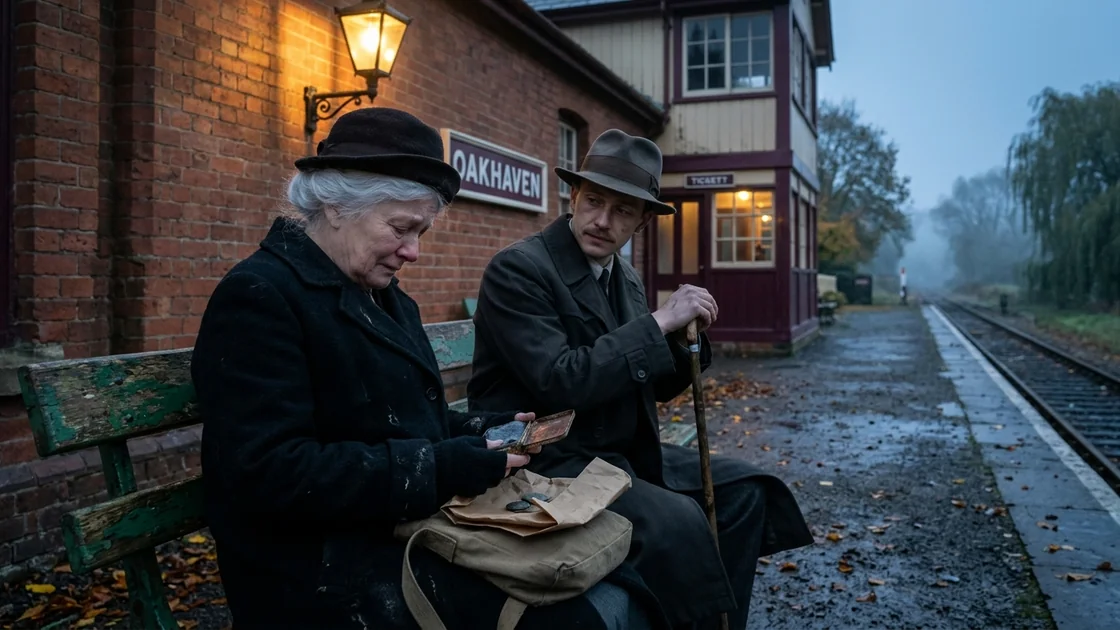
Every evening at six o'clock, Clara Vance walks the half-mile from her quiet cottage to the Oakhaven railway station, carrying a thermos of peppermint tea and a woolen scarf she finished knitting three years ago. She sits on the third bench from the ticket booth to wait for the 6:15 evening express, watching the passengers disembark with a quiet, unyielding attentiveness. Clara knows with complete certainty that her son, Julian, will not be on the train, as she received the official telegram confirming his death in the trenches of the eastern front three autumns ago. Yet, she continues her daily vigil not out of denial or madness, but because the station is the last place she saw him alive, and the act of waiting is the only vessel large enough to hold her grief and keep his memory tethered to the living world. Through the changing seasons, her silent presence transforms her from an object of pity among the townspeople into a quiet anchor for the entire community's unspoken sorrows.
The floorboards of the cottage always creaked in the exact same sequence when Clara prepared to leave. First came the long, low groan of the pine plank beside the kitchen stove as she lifted the kettle. Then, the sharp snap of the threshold timber between the scullery and the narrow front hall. Finally, there was the muted sigh of the floorboards beneath the coat rack, where Julian’s heavy tweed jacket still hung on the third peg from the left, its sleeves holding the phantom curve of his arms.
It was five-thirty in the evening. The October light was already thinning, turning the color of bruised plums over the western ridge that separated Oakhaven from the great sprawling plains beyond. Clara poured the boiling water over the dried mint leaves she had harvested from the garden behind the shed in late August. The steam rose, sharp and green, fogging the spectacles that rested on the bridge of her nose. She screwed the heavy cork stopper into the neck of the thermos, followed by the dented aluminum cup that served as its cap.
From the mahogany table by the door, she lifted the scarf. It was knitted in a simple fisherman’s rib, four feet of soft, slate-gray merino wool. When the telegram had arrived three years ago—brought by old Mr. Henderson, whose hands had shaken so violently he had dropped his bicycle into her hydrangeas—she had been three inches from casting off the final row. She had sat at the kitchen table until dawn that night, the yellow paper lying beside the butter dish, and she had finished the scarf. She had woven in the loose ends with a darning needle, washed it in rainwater, blocked it on a clean towel, and folded it into her canvas knitting bag. It had gone to the station with her every evening since.
Clara stepped out onto the front porch and locked the door with the heavy iron key. The air smelled of woodsmoke and rotting leaves, the universal perfume of an English autumn descending into the bone-chill of November. Her boots, sturdy leather things that she polished every Sunday night with beeswax and turpentine, made a rhythmic, resolute crunching sound on the gravel path.
High Street was beginning to settle into its evening hush. In the butcher’s window, Thomas Miller was washing down the marble slabs with a bucket of sudsy water. As Clara passed, he paused, his big red hands resting on the handle of the scrub brush, and nodded to her. She inclined her head in return. Farther down, outside the chemist’s shop, Mrs. Gable and her daughter were folding up the awning. They stopped talking as Clara’s shadow stretched across the pavement in front of them, offering her small, tight smiles that did not quite reach their eyes.
In the first year after the war ended, people had tried to stop her.
"Clara, dear," the vicar had said, intercepting her near the stone bridge one sleeting evening in January. He had placed a gloved hand on her forearm, his face creased with a professional, practiced sympathy that she found entirely unbearable. "Julian is with the Lord now. He isn’t on the railway. You’re catching your death out here in the wet, and it breaks the parish’s heart to see you."
She had looked at the vicar’s hand on her sleeve until he removed it. "I know where he is, Reverend," she had replied, her voice perfectly level, devoid of the tremor he clearly expected. "He is in a shallow trench four miles outside of Passchendaele, or whatever is left of it. And at six-fifteen, the train comes in from the junction. Good evening."
After six months, the interventions ceased. The town decided, with the collective, unspoken agreement common to small rural communities, that Clara Vance had simply slipped a cog. It was an understandable madness, they whispered over garden fences and across the counters of the post office. Her husband, Arthur, had died of pleurisy when Julian was only seven, leaving the boy as the sole axis around which Clara’s quiet universe turned. When the war took the boy, the axis snapped; it was only natural that the world should keep spinning in the last direction it knew.
They were wrong, of course, though Clara never bothered to correct them. It was much easier to be thought mad than to explain the architecture of her days. If they thought she was deluded, they left her alone. They did not ask her to join the Ladies' Auxiliary or sit in the front pew on Remembrance Sunday while the brass band played off-key dirges. Madness was a high stone wall, and behind it, Clara had found a strange, vast country of peace.
She knew Julian was dead. She knew it in the morning when she woke to the silence of the house, a silence that had a entirely different weight and texture than the silence of a house where someone is merely sleeping in the next room. She knew it when she bought a single pork chop from Thomas Miller instead of three. She knew it when she looked at the calendar and realized that Julian was still nineteen, while the boys he had grown up with—the ones who had come back with missing fingers or bad lungs or eyes that darted at the sound of a slamming door—were now twenty-two, marrying girls from the neighboring villages and taking over their fathers’ farms.
She did not go to the station because she expected to see him step down from the third-class carriage, his kit bag slung over his shoulder and that ridiculous, lopsided grin splitting his face. She went because the station was the only place where the past and the present touched without bruising one another.
The Oakhaven station sat at the bottom of a gentle incline, where the town gave way to the water meadows and the willow-lined banks of the River Ouse. It was a modest Victorian structure of red brick and cream-painted woodwork, with a slated roof that grew thick cushions of bright green moss on its northern side. A cast-iron canopy, supported by pillars decorated with ironwork ferns, extended over the single platform.
As Clara walked through the open archway that led from the gravel forecourt onto the platform, the station clock above the ticket window gave a metallic clack, its heavy black minute hand jerking forward to five minutes to six.
Behind the frosted glass of the ticket booth, the shadow of Thomas—not Thomas Miller the butcher, but Thomas Briggs, the stationmaster—shifted. A moment later, the side door opened, and Thomas stepped out. He was a man of sixty, his posture slightly stooped from forty years of lifting milk churns and mailbags, his uniform coat brushed until the navy serge shone at the elbows.
"Evening, Mrs. Vance," he said, touching the peak of his cap.
"Good evening, Thomas," Clara said. "Is she on time?"
"Lost three minutes at the junction, according to the telegraph," Thomas said, pulling a massive silver pocket watch from his waistcoat and consulting it with the gravity of a ship’s captain reading a sextant. "Heavy goods train out of Birmingham held up the main line. But Harry’s driving this evening, and he usually makes it up on the straight between here and Milford. She’ll be nigh on time."
"Harry always did have a heavy hand on the throttle," Clara remarked, walking toward the third bench.
"That he does, ma'am. That he does."
The third bench was situated directly beneath one of the hissing gas lamps attached to the brick wall of the station house. Its green paint was peeling in long, dry strips, revealing the gray, weathered oak beneath. Clara sat down, placing her knitting bag carefully to her right. She folded her gloved hands in her lap and looked out across the tracks.
Beyond the iron rails, which gleamed like twin ribbons of dull pewter in the dying light, the meadows stretched out toward the river. A thin mist was rising from the water, curling around the bases of the pollarded willows. A flock of starlings rose suddenly from a hawthorn hedge, wheeling into the darkening sky like a handful of black confetti thrown by an invisible giant, before settling back into the branches with a great, rustling chatter.
This was where they had stood. Not on the bench, for the platform had been too crowded that morning in April of 1916. There had been twelve boys from Oakhaven and the surrounding farms leaving on the 8:10 morning train to join the county regiment at the depot in the city. The platform had been a chaos of weeping mothers, red-faced fathers making gruff, awkward jokes about the Kaiser, and younger siblings chasing one another between the legs of the crowd.
Clara had not wept. She had spent the previous three nights sitting in her dark bedroom, staring at the ceiling while dry sobs tore at her ribs like claws, until she had nothing left inside her to spill. That morning, she had fried bacon and eggs, packed Julian’s lunch in a tin box—cold roast beef sandwiches with plenty of mustard, just as he liked them, and two Bramley apples—and walked beside him down the hill.
Julian had been so tall. That was what she remembered most clearly about that morning: the sudden, startling realization that her son was a grown man. He had his father’s broad shoulders, though he was still thin, with the gangly, slightly uncoordinated grace of a colt. His hair, the color of ripe wheat, had been cut absurdly short the day before by old Mr. Tibbs the barber, leaving the skin at the nape of his neck looking pale and vulnerable above the rough khaki collar of his new uniform.
"You'll remember to oil your boots, Julian?" she had asked, standing right where the shadow of the third bench now fell. "Your father always said that wet feet were the ruin of a man’s constitution. Use the dubbin I put in your side pocket."
"I will, Mam," he had said. He had been looking around the platform, his eyes bright with a terrible, eager excitement that made her heart shrink to the size of a walnut. He was nineteen. He had never been farther from Oakhaven than the market town twenty miles down the line. To him, the war was a grand, loud adventure happening in the pages of the illustrated papers, a thing of flags and bugles and fellowship, and he was terrified only that it might end before he got there.
"And write to me," she had said, reaching up to adjust the strap of his haversack, which was twisted. Her fingers had brushed the rough wool of his tunic. She could still feel the scratch of it against her knuckles if she closed her eyes. "I don't care if you only have time to write 'I am well' on a scrap of wrapping paper. Just put it in the post."
"Every week, Mam. I promise."
Then the 8:10 had come round the bend, a monstrous, roaring thing of black iron and white steam, smelling of sulfur and hot oil. The doors had been flung open. There had been a surge forward. Julian had bent down, wrapped his long arms around her, and lifted her nearly off her feet. He smelled of Pears soap, the brass polish he had used on his buttons, and the peppermint drops he always kept in his waistcoat pocket.
"Don't you fret," he had whispered into her ear, his voice cracking slightly on the last word, betraying the boy beneath the khaki. "I’ll be back before the apples are off the trees. You wait here for me."
"I will," she had said.
He had climbed into the carriage. He had leaned out the window, waving his cap until the train curved behind the signal box and the white steam swallowed him whole.
The apples had fallen from the trees in the orchard behind the cottage. They had rotted in the long grass because she hadn't the heart to pick them. Then the snow had come, and then the daffodils, and then the apples had grown and fallen again. And then Mr. Henderson had dropped his bicycle into the hydrangeas.
A low, rhythmic thrumming began in the soles of Clara’s boots. She looked down at the tracks. A tiny pebble resting on the wooden sleeper between the rails began to dance.
In the signal box fifty yards down the line, a bell rang twice—a sharp, clear ting-ting that cut through the evening damp. With a heavy, greased clatter, the iron wires running along the side of the tracks pulled taut, and the wooden arm of the semaphore signal dropped with a solid thud, its green glass lens glowing softly against the twilight.
Far off, beyond the bend where the willows grew thick by the old mill, a whistle blew. It was a long, mournful sound that echoed off the low hills, a sound that belonged to distances and departures.
Thomas Briggs came out of his office again, carrying a red-and-green hand lantern. Two other people had arrived on the platform while Clara was lost in the past: young Mary Jenkins, whose sister worked in a drapery shop in the junction town and often sent parcels of dress scraps home with the guard, and Mr. Sterling, the solicitor, who had been up to the county court for the day, or rather, his clerk had, and Mr. Sterling was waiting for the afternoon briefs to be delivered. They stood near the ticket booth, twenty feet away from Clara, leaving a respectful perimeter around her bench.
The headlight appeared first, a single yellow cyclops eye rounding the curve, cutting through the river mist. Then came the rhythmic, heavy panting of the locomotive—chuff-hiss, chuff-hiss—slowing as Harry applied the brakes. The rails sang a high, metallic song under the weight of sixty tons of steel.
The engine rolled past Clara in a blast of radiant heat and the sharp, acrid smell of burning coal. She looked up at the cab. Harry, his face streaked with soot under his flat cap, looked down from his perch and raised two fingers from the brass brake lever in salute. Clara nodded back.
Behind the tender came the four wooden carriages, their windows glowing like squares of warm amber in the blue dusk. The brakes screeched, a high, complaining whine of iron on iron, and with a final shudder and a sigh of escaping steam that momentarily engulfed the platform in a warm, wet cloud, the 6:15 came to a halt.
For three seconds, nothing happened. Then, a heavy brass handle turned, and the door of the second carriage swung outward.
This was the moment. Every evening, regardless of what her mind knew, Clara’s body remembered the shape of hope. Her heart gave a single, heavy thud against her ribs. Her hands tightened on the strap of her knitting bag.
A man stepped down onto the platform. He was wearing a dark gray overcoat and a bowler hat. It was Mr. Abernathy, the manager of the corn exchange, returning from his Tuesday meeting in the city. He turned to help an elderly woman down the high step—Mrs. Higgins, who had been visiting her daughter’s new baby.
Down the length of the train, three more doors opened. A pair of farm laborers in corduroy trousers and gaiters jumped down from the third-class smoking carriage, laughing loudly about something, their breath pluming white in the chill air. A young woman Clara didn’t recognize, carrying a leather valise and looking somewhat bewildered by the smallness of the station, stepped out near the guard’s van.
And that was all.
The guard, a portly man with a magnificent walrus mustache named Perkins, stepped down with a canvas mail sack and a small brown paper parcel tied with twine. He handed the parcel to Mary Jenkins, exchanged the mail sack with Thomas Briggs for the outgoing Oakhaven post, and pulled out his whistle.
Clara let her breath out. It was a long, slow exhalation that seemed to empty her lungs entirely. The tightness in her chest dissolved, replaced by the familiar, dull ache that was as much a part of her body now as her own bones.
She looked at the open doors of the carriages. Inside, she could see the other passengers who were continuing on to the end of the line at Crosskeys. A man reading an evening newspaper, his face hidden behind the broadsheets. A mother with a sleeping child leaned against her shoulder. And in the third carriage, sitting by the window, a young man in a faded khaki greatcoat.
Clara’s eyes fixed on him.
He was looking out at the platform, though his eyes were unfocused, staring right through the brick wall of the station house at something very far away. The gaslight from the platform fell across his face. He was not Julian. His hair was dark, almost black, and he had a long, jagged scar that ran from the corner of his left eye down into the collar of his coat, pulling the skin of his cheek tight. On the rack above his head sat a battered kit bag and a pair of crutches.
As the guard blew his whistle, the young soldier blinked, and his gaze dropped to the bench directly outside his window. His eyes met Clara’s.
For a fraction of a second, as the engine gave a great puff of steam and the couplings clanked taut, they looked at one another. There was no surprise in the boy’s eyes, only a profound, exhausted recognition. He knew who she was. He had seen her in a hundred stations between the coast of France and the hills of the midlands. She was every woman who had stood at a gate or a window with a shawl pulled tight around her shoulders, watching the columns march away. And Clara knew him. He was the boy who had stood next to Julian on the firing step; he was the boy who had shared his rations of bully beef and damp biscuits; he was the boy who had lived when hers had died.
Clara offered him a very small, gentle smile. Not the tight, pained smile the townspeople gave her, but the smile she used to give Julian when he came in from the rain, cold and hungry.
The soldier’s scarred face softened. Slowly, awkwardly, he raised his right hand—which was missing the last two fingers—and touched his brow in a quiet salute.
The train jerked forward. The window slid away, replaced by the next, and then the guard’s van, with its two red tail lamps glowing like rubies in the dark. Within a minute, the 6:15 was nothing more than a fading rumble in the floorboards and a smudge of pale smoke hanging over the willows.
The platform emptied quickly. Mr. Abernathy and Mrs. Higgins walked out to the forecourt where the station cab was waiting. The farm laborers set off down the lane toward the river road, their hobnailed boots ringing on the stones. Thomas Briggs wheeled his barrow into the office and shut the door against the cold.
Clara remained on the bench.
She did not leave immediately after the train departed. That would have felt rude, somehow, like slamming a door in a guest’s face. Instead, she opened her knitting bag, took out the thermos, and poured herself half a cup of peppermint tea.
The steam rose into the cold air. She sipped it slowly, letting the heat travel down into her chest. The platform was entirely silent now, save for the soft hiss of the gas lamps and the distant murmur of the river. She sat for fifteen minutes, watching the light fade completely from the sky until the stars began to prick through the velvet dark above the hills.
"Well, Julian," she murmured aloud, her voice no louder than the rustle of dry leaves on the platform. "Harry made up the three minutes after all. And the mint was very good this year, despite the dry spell in July. We shall have plenty for the winter."
She finished the tea, screwed the cup back onto the thermos, and packed it away beside the gray scarf. When she stood, her knees popped softly. She walked past the ticket window, tapping twice on the frosted glass with her knuckles. Inside, Thomas Briggs’s shadow raised a hand in farewell.
November arrived with a week of relentless, horizontal rain that turned the water meadows into a shallow lake and made the gravel path to the station a mire of yellow mud.
Clara bought a new ferrule for her umbrella and continued her walks.
On the second Tuesday of the month, the rain was so heavy that the gutters of the station canopy overflowed, creating a solid curtain of water along the edge of the platform. The wind was blowing from the north-east, straight off the fens, carrying the bitter, metallic taste of coming snow.
When Clara reached the third bench, she found it occupied.
A girl was sitting there, huddled at the far end where the brick buttress of the waiting room offered a few inches of shelter from the wind. She had no umbrella, only a thin, cheap wool coat that was already soaked dark at the shoulders, and a cloche hat pulled low over her ears. At her feet sat a battered cardboard suitcase, the kind held together with leather straps that looked as though it might dissolve if the rain reached it.
Clara paused, water dripping from the points of her umbrella. In three years, no one had ever sat on the third bench between six and six-thirty. It was an unwritten law of Oakhaven, as sacred as the boundary stones of the parish. The girl was clearly a stranger.
Clara walked to the other end of the bench, folded her umbrella with a sharp shake to shed the water, and sat down.
The girl startled, pulling her feet back under the seat as if afraid she were taking up too much room. She looked to be no more than twenty, with a pinched, pale face and dark circles under her eyes that looked like smudges of charcoal. She was shivering violently, her teeth chattering with a faint, rapid clicking sound.
Clara looked at the cardboard suitcase, then at the girl’s hands, which were bare and red, clutched tightly together in her lap. She noticed a thin gold band on the third finger of the left hand—a band so thin it looked as though it had been stamped out of tin foil.
"The 6:15 is going to the junction only as far as Crosskeys tonight," Clara said, her voice cutting through the roar of the rain on the iron roof. "If you are looking for the London connection, you’ve missed the 4:40. There isn't another heading south until seven tomorrow morning."
The girl looked at her, her eyes wide and frightened, like a rabbit caught in the beam of a poacher’s lantern. "I’m not going to London," she whispered. Her accent was from the industrial towns up north, flat and vowel-heavy. "I’m waiting for someone."
"On the 6:15?"
"Aye. Maybe." The girl swallowed hard, looking out at the rain-lashed tracks. "The stationmaster said this was the last train from the city tonight."
"It is," Clara said. She looked at the girl’s wet coat again. "Have you been here since the 3:10?"
The girl nodded miserably, pulling her collar tighter around her throat.
Clara didn't say anything else for a moment. Instead, she unclasped her knitting bag. She took out the thermos, unscrewed the aluminum cup, and filled it to the brim with steaming peppermint tea. The sharp, clean scent of the mint cut through the smell of wet wool and coal dust.
She held the cup out.
The girl stared at it. "I couldn't, missus. Thank you."
"Take it, child," Clara said, with the quiet authority of a woman who had once made a seven-year-old boy take cod liver oil every morning for a winter. "It’s only mint from my garden. It won’t cost you a penny, and if you sit there shaking much longer, you’ll shake the bolts right out of this bench."
Slowly, the girl reached out with both hands and took the cup. She wrapped her frozen fingers around the hot metal and lifted it to her lips, taking a small, tentative sip. A shudder ran through her, different from the shivering—the involuntary convulsion of a cold body meeting warmth.
"Thank you," the girl breathed into the steam. "That’s... that’s lovely."
"Who are you waiting for?" Clara asked, looking straight ahead at the semaphore signal, which was barely visible through the grey sheets of rain.
The girl took another sip before answering. "My husband. Arthur. Arthur Pendelton."
Clara’s fingers twitched slightly in her lap at the name, though her face remained still. "Pendelton. That isn't a local name."
"No. He’s from Leeds, like me. We were married in seventeen, when he came home on leave before his regiment went out to Italy." The girl stared down into the pale green liquid in the cup. "When the war finished, they didn't demob him right away. Kept him in Cologne with the occupation forces until six months ago. When he finally got back to Leeds, the foundry where he used to work had closed down. There was nothing for him. Just standing on street corners with three thousand other lads in dyed khaki coats, waiting for naught."
"It has been hard in the cities," Clara said softly.
"He heard there was work down here," the girl continued, the words coming faster now, loosened by the heat of the tea and the rare luxury of a listener who didn't know her shame. "Building the new reservoir up by the hills. He came down two months ago. Sent me thirty shillings the first month, and a letter from the post office here in Oakhaven saying the work was hard, living in huts up on the moor, but the pay was steady. Said he’d come down into the town on Tuesdays when they got their wages to send the money order."
She stopped, biting her lower lip until it went white.
"And you haven't heard from him this month," Clara said. It wasn't a question.
"Not a word for five weeks," the girl said, a tear finally spilling over her lower lashes to mix with the rain on her cheek. "The landlady in Leeds turned me out on Monday. I used my last ten shillings for the train ticket down here. I went up to the reservoir camp this afternoon—walked all the way up that dreadful mud road—and the foreman told me Arthur left three weeks ago. Said he went into the city to look for winter work at the railway yards, because they were laying men off at the dam once the frosts start. The foreman said... he said sometimes the men still come back through Oakhaven on payday to collect their back-time or their tools they left at the tavern."
Clara looked at the girl’s thin coat and the cardboard suitcase. She knew the reservoir camp. It was a rough, lawless place of corrugated iron shacks and mud, five miles up in the barren hills. Men came and went from it like driftwood on a tide. If Arthur Pendelton had gone to the city three weeks ago without writing to his wife, the chances of him stepping off the 6:15 tonight were nearly as small as the chances of Julian doing the same.
"My name is Clara Vance," Clara said. "What is yours?"
"Sarah," the girl said, wiping her cheek with the back of her wet sleeve. "Sarah Pendelton."
"Well, Sarah," Clara reached into her bag again and pulled out the long gray scarf. She didn't hesitate. She leaned across the bench and draped the thick merino wool around the girl’s neck, wrapping it twice so that it covered the gap of her soaked collar. "Put that on. The wind comes straight off the river here, and there is nothing between that river and the North Sea to stop it."
Sarah touched the wool with wondering fingers. It was incredibly soft, smelling faintly of lavender from the drawer where Clara kept her yarn, and of the warm cottage kitchen. "This is fine wool, Mrs. Vance. I’ll get it wet."
"Wool is meant to get wet," Clara said briskly. "It came off a sheep, didn't it? Sheep don't carry umbrellas."
A tiny, startled laugh escaped Sarah’s throat, quickly swallowed. She buried her chin in the gray folds. For the first time in three years, the scarf was doing what it had been born to do: keeping the cold away from a young neck. Clara looked at it and felt a strange, quiet shifting in her chest, like ice breaking up on a pond in March.
Down the line, the signal bell rang twice. Ting-ting.
Sarah stiffened, her hands gripping the aluminum cup so hard her knuckles turned white. "Is that it?"
"Yes," Clara said. "She’s on time tonight."
When the 6:15 rolled in, looking like a drowned black beast streaming water from its flanks, nobody got off at all. Not Mr. Abernathy, not the farm laborers. The doors remained shut, the windows blurred with condensation and rain. Only Guard Perkins opened his sliding door long enough to toss a single leather mailbag to Thomas Briggs before blowing his whistle from inside the van.
With a clash of buffers and a spin of its massive iron driving wheels on the wet rails, the train pulled out, vanishing into the black wall of the storm within seconds.
Clara didn't look at the carriages as they passed. She looked at Sarah.
The girl was sitting entirely still, staring at the empty space between the rails where the train had just been. The hope that had briefly animated her pale face drained away so rapidly it was as if a lamp had been blown out inside her skull. She looked smaller than she had five minutes ago, shrinking inside the wet coat and the oversized gray scarf.
"He’s not coming," Sarah whispered. The words were barely audible over the drumming of the rain on the canopy roof. "He’s left me. Just like my mam said he would."
She didn't cry. She simply sat there with the empty tin cup in her hands, looking at the dark water meadows beyond the tracks, where there was nothing at all to see.
Clara recognized that look. She had seen it in her own mirror in the hallway every morning during the winter of 1917. It was the look of a person who had walked to the very edge of the world and discovered that the ground simply stopped, leaving nowhere left to put a foot.
Clara stood up and picked up her knitting bag. Then she reached down and took the handle of the cardboard suitcase. It was pitifully light.
"What are you doing?" Sarah asked, looking up in alarm.
"The station closes at quarter to seven," Clara said, taking the empty cup from the girl’s cold hands and screwing it back onto the thermos. "Thomas Briggs will be turning out the gas lamps in five minutes, and I have no intention of leaving my good scarf out in the rain all night. Come along."
"I don't have money for lodgings, Mrs. Vance," Sarah said, her voice trembling with a mixture of pride and terror. "I told you. I used the last of it on the ticket."
"Did I say anything about lodgings?" Clara opened her large black umbrella with a decisive pop. "I have a kettle on the hob at home, and half a mutton pie in the larder that will go to waste if someone doesn't eat it. And there is a perfectly good bed upstairs with clean sheets that haven't been slept in since nineteen-sixteen. It’s damp, mind you, so we’ll have to put a hot brick in it, unless you want to catch the rheumatism."
Sarah stared up at her, her dark eyes shining in the yellow gaslight. "You don't know me."
"I know you're wet through and you drink your tea without sugar," Clara said, holding out her free arm. "In Oakhaven, that’s practically a letter of introduction from the bishop. Now get under this umbrella before we both drown."
Sarah stayed for four days.
On the first night, she ate two massive slices of the cold mutton pie, drank three cups of real tea with milk, and fell asleep at the kitchen table while Clara was heating the bricks in the oven to warm the bed in Julian’s room.
When Clara led her upstairs, carrying a brass candlestick, she paused for a second outside the closed door at the top of the landing. She had gone into Julian’s room every Saturday for three years to dust the furniture, beat the rug, and air the linens, keeping it in a state of suspended readiness, like a museum exhibit of a boy’s life. His fishing rods were still propped in the corner; his collection of birds' eggs—strictly speaking illegal, though the local constable had helped him blow out the shells of the kestrel eggs when he was twelve—still sat in its glass-topped case on the chest of drawers; his school prize copy of Treasure Island still lay on the bedside table.
Clara turned the brass knob and pushed the door open. The room smelled of beeswax and cold air.
Sarah was too exhausted to notice the boys' boots lined up neatly beneath the washstand or the framed photograph of the Oakhaven Junior Cricket Eleven on the wall. She simply sat on the edge of the narrow iron bedstead, let Clara pull off her sodden shoes, and curled beneath the patchwork quilt around the towel-wrapped hot brick, asleep before Clara had even blown out the candle.
The next morning, the rain had stopped, leaving the world washed in a pale, watery sunshine. Clara woke at six, as she always did, and went downstairs to light the range. Half an hour later, as she was slicing bread for toast, the staircase creaked—not with the ghost-creaks of her own solitary mornings, but with the real, hesitant weight of another human being.
Sarah stood in the doorway of the kitchen. She was wearing one of Julian’s old flannel shirts over her shift, as Clara had hung her dress and coat before the dying fire the night before to dry. The shirt swamped her, the cuffs rolled back four times to free her hands, the tails reaching nearly to her knees. In her hand, she held the framed photograph of Julian that usually sat on the mantelpiece in his bedroom—the one taken in the photographer’s studio in the city the day after he enlisted, where he stood very straight beside a painted backdrop of a Roman column, trying desperately to look fierce and succeeding only in looking painfully young.
"This is your lad," Sarah said quietly.
"Yes," Clara said, turning the bread on the toasting fork before the red coals. "That is Julian."
"He didn't come back."
"No. October of seventeen. Near a village in Belgium with a name I can never quite pronounce properly."
Sarah walked over to the table and set the photograph down gently beside the butter dish, just where the telegram had lain three years before. She looked at the gray scarf, which was draped over the back of the Windsor chair, dry and fluffy again from the kitchen heat.
"That’s who you were waiting for at the station last night," Sarah said. There was no pity in her voice—she was too poor and too broken herself to afford the luxury of pitying anyone else. There was only a flat, wondering comprehension. "You wait for him."
"I sit on the bench," Clara corrected mildly, buttering the toast and setting it on a warm plate. "Waiting implies you expect something to happen. I don't expect anything, Sarah. I just go to meet the train."
Sarah sat down, pulling the oversized flannel sleeves over her hands. "Why?"
Clara poured two cups of tea from the brown earthenware pot. She sat down opposite the girl, looking at the photograph between them. In the morning light, Julian’s eyes were very clear.
"Because when a person dies in a house," Clara said, choosing her words with the slow precision of someone laying stepping stones across a deep stream, "there is a body. You wash them, and you dress them in their Sunday best, and the neighbors come in to look and say how peaceful they seem. Then four men carry them up the hill to the churchyard, and you watch them go into the earth. You know where they are. When Arthur—my husband—died, I could walk up the hill on a Sunday afternoon and pull the weeds off his grave. It was something to do with my hands."
She took a sip of her tea.
"With Julian, there was only a piece of yellow paper. Twelve words written by a clerk in London who never saw his face. There was no body. There is a stone up by the church with his name carved on it, along with fourteen other boys from the parish, because the vicar raised a subscription for it last year. They call it a cenotaph. My brother-in-law, who reads the newspapers, told me the word comes from the Greek. It means 'an empty tomb.'"
Clara looked out the small kitchen window toward the garden, where the last of the Michaelmas daisies were bedraggled from the storm.
"An empty tomb is no use to a mother, Sarah. You can't tuck a boy into an empty tomb. The last place he was real—the last place he had weight, and smelled of peppermint, and had a loose button on his pocket that I didn't have time to sew properly—was the platform at Oakhaven station. When I sit there, it isn't three years ago. It’s just... quiet. It’s the only place in the town where people don't expect me to be done with being his mother."
Sarah looked down at the flannel cuff folded over her wrist. She touched the rough cloth with her thumb. "He was tall, wasn't he?"
"Six foot one," Clara said, and a genuine smile touched the corners of her mouth. "Grew four inches in the last year before he went. Ate me out of house and home. He could finish a whole loaf of bread between coming in from the fields and sitting down to supper."
For the next three days, Sarah followed Clara around the cottage and the garden like a quiet, dark-eyed shadow. She helped dig up the last of the maincrop potatoes before the frost could get them, her small hands working quickly in the cold, heavy soil. She helped Clara scrub the flagstones in the scullery and polish the brass fenders. In the evenings, at five-thirty, when Clara put on her coat and took down the knitting bag, Sarah didn't ask if she could come. She stayed by the range, mending the frayed lining of her own coat with Clara’s sewing basket, having supper ready on the table when Clara returned at quarter to seven.
It was astonishing, Clara thought as she walked back up the hill on Thursday evening, how quickly a house remembered how to hold two people. The silence when she opened the front door was no longer the dead, flat silence of an empty box; it was warm, smelling of toasted cheese and coal smoke, punctuated by the click of needles or the turn of a page.
On Friday morning, the postman brought a letter.
It was addressed to Mrs. S. Pendelton, c/o The Stationmaster, Oakhaven. Thomas Briggs had walked up the hill himself before his shift started to deliver it, handing it to Clara at the garden gate with a conspiratorial nod.
"Came in the early bag from Birmingham, Mrs. Vance," Thomas whispered, glancing toward the kitchen window where Sarah was washing up the breakfast dishes. "Postmarked from the hospital there."
Clara thanked him and carried the envelope inside.
Arthur Pendelton had not abandoned his wife. On his way into Birmingham to look for work at the railyards three weeks ago, he had been knocked down by a brewer’s dray in the fog outside New Street Station. His collarbone was broken, and he had taken a bad blow to the head that had left him confused and unable to remember the address of the lodging house in Leeds for over a fortnight. A nurse at the infirmary had written the letter at his dictation; he was mending, the brewery company had given him five pounds in compensation to avoid a magistrate's inquiry, and one of the draymen had promised him a job in the stables sorting oats as soon as his arm was out of the sling. He had written to Oakhaven in the desperate hope that the postmaster might forward it to the reservoir camp, or that Sarah might have inquired there.
Sarah read the letter three times at the kitchen table, her hands shaking so badly the paper rattled like dry leaves. Then she put her head down on her arms, right beside the loaf of bread, and cried for twenty minutes—great, tearing, noisy sobs that sounded entirely different from the silent leak of tears on the station platform.
Clara simply stood behind her, one hand resting firmly between the girl’s thin shoulder blades, waiting for the storm to pass.
That afternoon, there was a different kind of walking to the station.
They went down the hill together at four o'clock to catch the 4:25 local that connected with the Birmingham express at the junction. Sarah was wearing her own coat, neatly mended and brushed, and around her neck, she wore the gray merino scarf.
She had tried to give it back in the hallway. She had folded it into a neat square and held it out with both hands, her eyes shining.
"Keep it," Clara had said, buttoning her own black wool mantle.
"Oh, no, Mrs. Vance. I couldn't. Not... not his scarf."
"Julian doesn't need it, Sarah," Clara had said gently, folding the girl’s fingers back over the wool. "Where he is, the weather never changes. And Birmingham is a terrible, drafty place in the winter, by all accounts. If you don't take it, or give it to your Arthur when his shoulder heals, it will just sit in my canvas bag until the moths find it. Let it do some good."
On the platform, they stood near the third bench while Thomas Briggs pasted a luggage label onto the battered cardboard suitcase—which was considerably heavier now, as Clara had packed a jar of pickled walnuts, a fresh loaf of soda bread, and two pairs of Julian’s thick woolen socks into the corners.
When the 4:25 puffed in, Sarah threw her arms around Clara’s neck. She smelled of Clara’s lavender soap and the peppermint drops Clara had pressed into her pocket.
"I’ll write to you," Sarah said fiercely against Clara’s cheek. "Every month. I’ll let you know how we go on."
"You do that," Clara said, patting the girl’s back. "And tell Arthur to use goose grease on his chest if the stables are damp. There’s nothing worse for a man after a spell in hospital than a chill on the lungs."
Sarah climbed into the third-class carriage. She pulled down the leather strap to lower the window and leaned out, the long gray scarf fluttering in the breeze like a pennant. As the train pulled away, she waved until the curve by the willows took her out of sight.
Clara stood on the empty platform. The station clock clicked: four-thirty.
It was an hour and forty-five minutes until the 6:15.
Thomas Briggs came out of the ticket office, wiping his hands on a rag. "Seems a nice enough lass," he remarked, looking down the empty tracks. "Glad it worked out for her. There’s plenty it doesn't work out for, these days."
"Yes," Clara said. She looked at her knitting bag, which felt strangely flat and light hanging over her arm without the bulk of the scarf inside it. "I think I shall walk down by the river for an hour, Thomas, rather than going all the way up the hill and back down again. Will you keep my thermos in the office by the stove so it doesn't go cold?"
"Right you are, Mrs. Vance," Thomas said, taking the bag with the care of a sacristan receiving the altar vessels.
That night, when Clara returned to the cottage after the 6:15 had come and gone, she did not simply put the kettle on and sit down with her book.
Instead, she went upstairs to the small box room at the back of the house. She knelt before the deep cedar chest at the foot of the spare bed and lifted the heavy lid. Inside, wrapped in tissue paper and old linen pillowcases to keep out the dust, were six skeins of thick, heather-blue worsted yarn. She had bought them in the autumn of 1915, intending to knit Julian a fisherman’s jersey after she finished the gray scarf and the three pairs of socks he had taken with him in his kit bag.
She carried two of the skeins downstairs, along with her long bone knitting needles—size eight, with the little ivory knobs on the ends shaped like acorns.
After supper, she pulled her rocking chair closer to the kitchen range, wound the blue yarn into a tight, neat ball using the back of the Windsor chair as a swift, and cast on forty-eight stitches.
Click-clack, click-clack.
The sound filled the kitchen. It was a small, industrious noise, a rhythmic ticking that measured time not in hours or days, but in rows and inches.
The next evening, when she sat on the third bench at the station, she did not sit with her hands folded in her lap. While she waited for the 6:15, she took the blue wool from her bag and knitted in the yellow light of the gas lamp.
The townspeople noticed, of course. In Oakhaven, if a cat sneezed on High Street at noon, the vicar knew which paw it wiped its nose with by suppertime.
At first, they thought she was knitting another scarf for the dead boy, a fresh symptom of her quiet lunacy. But two weeks before Christmas, young Billy Carter—whose father had lost his leg at the Somme and couldn't work the forge anymore, leaving the family desperate for coal money—was walking past the station in the freezing dusk after delivering groceries for the co-op. He was twelve years old, his ears bright purple with the cold, his neck bare above a coat he had outgrown two winters back.
Clara was walking out of the station archway as the 6:15 rattled away over the river bridge. She stopped directly in front of the boy, set her basket on the frosted gravel, and took a newly finished, five-foot-long heather-blue scarf from her bag.
"Hold still, William," she said.
Billy, terrified of the "mad woman of the station," stood frozen like a gatepost while she wrapped the thick wool around his neck and tucked the ends securely into the front of his threadbare jacket.
"Tell your mother," Clara said, picking up her basket, "that I have half a sack of King Edward potatoes in my shed that are going to sprout if someone doesn't eat them before Twelfth Night. If you come round on Saturday morning with your barrow, you may have them."
She walked away up the hill before the boy could find his tongue.
When Billy got home to the cramped cottage behind the old smithy, his mother, Ellen Carter, fingered the heavy blue wool and burst into tears. The next morning in the baker’s shop, when Mrs. Gable made a sympathetic remark about "poor Mrs. Vance still waiting for that poor dead boy down at the tracks," Ellen Carter turned on her so fiercely that she nearly dropped her loaves.
"There is nothing poor about Clara Vance," Ellen said, her chin high, her voice ringing clear in the small shop. "She has more sense in her little finger than half this parish has in their whole heads. Leave her be."
That was the turning of the tide.
It did not happen all at once, for country habits are like oak roots, thick and slow to move. But as the hard winter of 1920 settled over the valley, locking the river in gray ice and piling snowdrifts against the hedgerows, the invisible fence that the town had built around the third bench at the station began to come down.
It started with Thomas Briggs.
On the night before Christmas Eve, the snow was falling so thick and fast that the 6:15 was delayed by forty minutes at the junction while the snowplow cleared the cutting at Milford.
At six-fifteen, Thomas came out of his office, his brass buttons gleaming in the snow-light. He walked over to the third bench, where Clara was sitting with her umbrella propped over her shoulder to keep the flakes off her knitting—a pair of thick mittens in dark green wool for old Mr. Henderson, the telegraph boy’s grandfather, whose hands were crippled with chilblains.
"Mrs. Vance," Thomas said, clearing his throat. "She won't be through until near on seven. The wind’s coming round from the north, and it’s twenty degrees of frost out here. I’ve got the stove roaring in the waiting room, and I’ve swept the hearth."
"I am quite warm enough, thank you, Thomas," Clara said, her needles clicking steadily despite her fingerless mittens. "I have my thick petticoat on, and my boots are lined with sheepskin."
Thomas shifted his weight from one foot to the other, the snow squeaking under his heels. He looked down at the tracks, then back at her. "Truth is, ma'am... it’s my boy’s birthday today. Edward’s."
Clara’s needles paused. She looked up at the stationmaster.
Everyone in Oakhaven knew about Edward Briggs. He hadn't died in the war. He had been in the Merchant Navy before the fighting started, a stoker on a tramp steamer out of Liverpool. In 1915, a German U-boat had torpedoed his ship in the Irish Sea. Edward had survived sixteen hours in an open lifeboat in December before a trawler picked him up. When he came home, his lungs were ruined by the freezing salt water and fuel oil, and his mind was worse. He had spent two years in the county asylum near the city, screaming whenever he heard the sound of running water, before dying of pneumonia in the spring of seventeen. Because he hadn't worn the King’s uniform, his name wasn't on the stone cenotaph up by the church. In Oakhaven, people rarely mentioned him at all, out of an awkward, misplaced sense of propriety regarding the asylum.
"He would have been twenty-eight today," Thomas said, his voice rough with the coal dust and the cold. "The missus is at home with her sister, having a bit of supper to take her mind off it. It’s... it’s mighty quiet in the office tonight, Mrs. Vance, with the telegraph not ticking on account of the snow on the lines. I’d take it as a kindness if you’d share that peppermint tea of yours."
Clara looked at the old man’s face. Beneath the peaked cap, his eyes were red-rimmed, not just from the wind.
Slowly, Clara wound her green yarn around the needles, stuck them through the ball, and placed the work inside her bag. She didn't go into the waiting room, however. Instead, she moved six inches to her left on the green bench and patted the dry spot where her knitting bag had been.
"The stove in the waiting room always smokes when the wind is in the north, Thomas," she said, unscrewing the thermos. "And I brought two cups tonight, as it happens. Sit down for five minutes. You can hear the bell from here if the signal box calls."
Thomas sat. It was the first time in his forty years on the railway that he had sat on a passenger bench while on duty. He took the tin cup she offered him—the one from her old picnic set that she had started carrying after the night she met Sarah—and Clara drank from the aluminum cap.
They sat side by side in the falling snow. The big white flakes drifted down through the yellow cone of light from the gas lamp, looking like sparks of cold fire before vanishing onto the dark iron of the tracks.
"Edward used to love the snow," Thomas said after a long silence. "When he was a little shaver, no bigger than my knee, he’d come down here with a wooden shovel his granddad made him and help me clear the platform. Used to charge me a ha'penny an hour. Hardest bargain I ever drove with a union man."
"Julian was terrible with a shovel," Clara said, taking a small sip of the hot mint tea. "He would clear three feet of the garden path, and then he would get distracted trying to build a fortress or tracking a hare into the copse. His father used to say the boy had plenty of steam, but no rails to run on."
Thomas chuckled, a low, rusty sound that ended in a sigh. "They were good lads, Mrs. Vance. Both of 'em."
"Yes," Clara said. "They were."
When the 6:15 finally came through at ten minutes past seven, plowing through the white drifts on the rails with its brass whistle screaming defiance at the blizzard, Thomas and Clara stood up together to meet it.
After that winter, the third bench was rarely hers alone, though it always remained hers.
The town never spoke of it openly during the daylight hours on High Street. In the morning, when Clara bought her tea and sugar at the grocer’s or paid her rates at the parish hall, everything was conducted with the same clipped, polite reserve that had always governed Oakhaven. Nobody asked her about the station; nobody mentioned the war, which everyone was trying so desperately to bury under talk of the new motor-bus route and the price of barley.
The evening was a different country.
As six o'clock approached, the light faded, and the rules of the daylight world softened in the dusk.
In February, old Mr. Miller, the butcher’s father, started walking down the hill at quarter to six to "smoke his pipe where the missus wouldn't nag him about the curtains smelling of shag tobacco." He would sit on the far end of the third bench, puffing away in the twilight while Clara knitted a gray cardigan for the vicar’s newest grandchild. Mr. Miller’s youngest nephew had gone down with the HMS Invincible at Jutland. For twenty minutes, between the lighting of his pipe and the arrival of the 6:15, he and Clara would talk about the boy—how he used to steal the sweetbreads off the butcher’s block to feed his stray terrier, how he had cried when he first went away to the training ship at Portsmouth because he was afraid of the dark in the hammocks.
In April, when the primroses were coming up along the railway embankment like splatters of pale butter, Mary Jenkins came and sat beside Clara for three nights running. Mary hadn't lost a brother or a sweetheart in the trenches; she had lost her fiancé, Jim, to the Spanish influenza in the November of the Armistice, three days after the church bells had rung themselves cracked celebrating the peace. Because he had died in his own bed at home while everyone else was hanging out bunting, Mary felt a strange, suffocating guilt about her grief, as if she had no right to mourn when the war was officially over.
She didn't say much at all on the first two nights. She simply sat beside Clara, watching the swallows dart under the iron canopy to inspect their old mud nests from the previous year, listening to the click-clack of Clara’s bone needles. On the third night, just as the distant whistle blew beyond the willow bend, Mary reached out and laid her hand over Clara’s wrist, stopping the needles.
"Does it ever get any lighter, Mrs. Vance?" Mary whispered, her eyes fixed on the gleaming rails. "In the mornings, when I wake up, for the first second I think I’m still going to marry him in June. And then I remember, and it feels like someone has dropped a millstone onto my chest. Every single morning."
Clara didn't pull her hand away. She turned her palm up and gave Mary’s fingers a firm, warm squeeze.
"No, my dear," Clara said honestly, because she had never believed in lying to people to make them quiet. "The stone doesn't get any lighter. It weighs the exact same amount until the day you die. Look at the tracks there."
She nodded toward the iron rails, where the dancing pebbles were already beginning to tremble with the approach of the 6:15.
"Sixty tons of iron comes down those rails every evening," Clara said. "The engine doesn't get any lighter. The coal tender doesn't weigh an ounce less than it did the day they built it in Swindon. If you laid that train across a meadow, it would sink right into the mud up to its axles. The only reason it doesn't crush the ground is because they laid down oak sleepers and iron rails to spread the weight out, and they braced them with gravel. The stone doesn't get lighter, Mary. You just build better rails underneath yourself to carry it."
Mary looked at the tracks as the yellow cyclops eye of the locomotive swung round the bend, lighting up the evening mist. When the train thundered past in its cloud of hot steam and sulfur, Mary didn't flinch. She stayed until six-thirty, drank half a cup of peppermint tea from the tin mug, and walked back up the hill with her shoulders just a fraction straighter than they had been at five-fifty.
Years in a place like Oakhaven do not march; they wheel, like the starlings over the water meadows, circling the same landmarks in the sky of the seasons.
The spring of 1921 turned into a scorching, dusty summer that dried the river to a trickle of green pools where the village boys caught minnows in jam jars. Then came the autumn gales, stripping the elms along the lane, and then the long, quiet dark of another winter.
Clara’s hair, which had been iron-gray with streaks of her old dark brown when the telegram arrived, turned entirely white, as pure and soft as the merino wool she bought from the draper’s in the city. The lines around her mouth deepened, though they were no longer the hard, pinched lines of a woman biting back a scream; they were the weathered creases of someone who spent an hour every day facing the wind off the fens.
She received letters.
Every month, without fail, a thick envelope arrived from Birmingham, written in Sarah Pendelton’s neat, cramped hand. Arthur was now the head stableman at the brewery, overseeing twelve Shire horses and three boys. They had rented a tiny house with a patch of garden behind it where Arthur was trying to grow runner beans, using the instructions Clara had sent him on the back of a seed packet.
In the spring of 1923, the letter contained a small, slightly blurry photograph taken with a Box Brownie camera. It showed Sarah standing on a brick doorstep, smiling so widely her eyes were nearly shut, holding a bundle of white shawls. Wrapped around Sarah’s shoulders, clearly visible even in the black-and-white print, was the long, ribbed fisherman’s scarf.
We have named him Julian Arthur Pendelton, Sarah wrote on the back in purple ink. Arthur said he wanted him named after a lad who knew how to grow tall, since both of us are so short. He weighs eight pounds and screams like a railway whistle when he wants his dinner.
Clara propped the photograph on the mantelpiece in the kitchen, right beside the studio portrait of her son in his khaki uniform. When she looked at the two pictures together while waiting for the kettle to boil, she felt a quiet, profound satisfaction. The name was back in the world. It was no longer just a word carved into cold Portland stone up by the church, getting moss in the letters that she had to scrub out with an old toothbrush before Remembrance Sunday. It was a word being shouted down a backyard in Birmingham; it was a word being whispered over a cradle; it was a word that would be called across a schoolyard in six years' time.
She immediately went upstairs to the cedar chest, found three balls of soft yellow lamb's wool, and began a matinee jacket on her finest steel needles.
By the autumn of 1925, the world had changed in ways both small and immense.
A wireless set had been installed in the parlor of the Red Lion tavern, and on Saturday nights men gathered to listen to voices crackling through the ether from London—dance bands from the Savoy Hotel and newsreaders speaking in clipped, immaculate accents about the gold standard and the League of Nations. Mr. Abernathy bought a Morris Cowley motorcar that backfired like a Lewis gun whenever it climbed the hill past Clara’s cottage, terrifying the vicar’s Labrador and leaving blue oil stains on the cobblestones.
Even the railway was changing. The small independent line that had run the Oakhaven branch for seventy years was swallowed up by one of the great new railway companies created by Parliament. That summer, a gang of painters arrived on a flatbed truck and spent a week scraping off the old cream-and-green paint from the station woodwork, replacing it with a uniform, institutional maroon and mustard yellow. They put up new enamel signs advertising seaside excursions to Skegness and soap powders that promised to wash clothes without boiling.
They tried to paint the third bench.
Clara arrived at five to six on a warm Tuesday in August to find a young man in white overalls setting down a bucket of maroon paint and a thick hog-bristle brush beside her seat. He had a cigarette behind his ear and was whistling a tune from a London musical review.
Before Clara could say a word, the door of the ticket office flew open so violently it banged against the brick wall. Thomas Briggs—who was sixty-five now, and walked with a slight limp from his sciatica—marched across the platform with the terrifying dignity of an admiral repelling boarders.
"What do you think you’re doing, lad?" Thomas barked.
The painter blinked, holding a sheet of sandpaper over the peeling green oak of the bench. "Orders from the district inspector, guv'nor. All platform furniture to be scraped and given two coats of company crimson. Did the two down by the water tank this afternoon."
"You leave that bench alone," Thomas said, stepping between the boy and the seat. "That bench is structurally sound as it is. The damp gets into the new paint down at this end of the platform on account of the river mist. Makes it tacky. Passengers’ coats stick to it."
"The inspector said—"
"I don't care if the King of England and the Board of Directors came down the chimney on a greased pole and said it," Thomas snapped, his white whiskers bristling. "I’m the stationmaster at Oakhaven until next Easter, and while I hold the keys to the signal box, that bench stays green. Take your bucket and go paint the coal shed. It needs it."
The boy looked at Thomas, then at the small, white-haired woman standing quietly with her canvas knitting bag and her black umbrella, and then at the two farm laborers who had just walked onto the platform to catch the 6:15 down to Crosskeys and were watching him with folded arms and stony faces.
The boy picked up his bucket. "Suit yourself, granddad. Less work for me."
Clara sat down on the peeling green slats. The oak was warm from the late afternoon sun, smoothed to a satin finish by ten years of her wool skirt brushing against it.
"Thank you, Thomas," she said as the stationmaster stumped past her to check the timetable board. "Though I wouldn't have minded the maroon, once it dried."
"Hmph," Thomas muttered, adjusting his spectacles to look at a poster he had read four thousand times. "Company crimson, they call it. Looks like dried blood to me. Ugly color. No business on a country platform."
It was in the eighth year of her vigil, in the late autumn of 1925, that the stranger got off the 6:15.
It was a Friday evening in late October—nine years to the week since the morning Julian had climbed into the crowded carriage with his kit bag and his tin of roast beef sandwiches; eight years since Mr. Henderson had dropped his bicycle into the hydrangeas.
The evening was remarkably still. There was no wind at all, and the yellow leaves of the ash trees by the station gate were dropping straight down through the twilight like gold coins falling through clear water. The river mist was low, lying like a white wool blanket over the meadows, while the sky above was a clear, cold apple-green, with the evening star already shining brightly over the western ridge.
Clara was sitting alone that evening. She had finished knitting a pair of knee-stockings for young Billy Carter, who was seventeen now and starting an apprenticeship with the wheelwright in the next village, and she was simply sitting with her hands resting on the handle of her umbrella, watching the star grow brighter as the sky darkened.
Ting-ting.
The signal bell rang. The wire rattled along the sleepers, and the semaphore arm dropped.
Two minutes later, the 6:15 rounded the willow curve. Harry had retired the previous spring to grow chrysanthemums in his cottage garden, and a younger driver named Charlie was on the footplate now. Charlie wasn't as smooth with the vacuum brakes as Harry had been; the train came in with a series of small, jerking shudders and a loud screech of iron shoes clamping onto the wheels.
Clara’s heart gave its customary, quiet thud as the carriages rolled to a stop in front of her. After nearly three thousand evenings, it was no longer a jolt of pain, nor was it the wild, irrational leap of hope from the first year. It was simply a knock at an interior door—a reminder that her heart was still in her chest, still keeping time with the world.
The door of the third-class carriage directly opposite the third bench swung open.
A man stepped down onto the platform.
He was tall—six foot one, perhaps six foot two—though he walked with a slight, rolling hitch in his hip, leaning his weight on a heavy ash walking stick with a rubber ferrule. He was wearing a decent, if slightly shiny, navy blue suit under a trench coat that had had its military epaulettes removed, leaving dark rectangles on the shoulders where the cloth hadn't faded as much as the rest. He wore a soft felt trilby hat, and carried no luggage at all, only a brown paper parcel tucked under his left arm.
Clara watched him as Guard Perkins blew his whistle and the train chuffed out of the station, leaving the platform to the sudden, immense quiet of the country dusk.
Usually, passengers walked straight toward the archway where Thomas Briggs stood by the gate to collect the tickets. This man did not.
He stood in the middle of the platform as the red tail lamps of the train vanished over the river bridge. He looked up at the iron canopy, with its cast-iron ferns painted in the new mustard yellow. He looked down toward the water meadows, where the mist was curling up over the embankment. Then he turned around and looked straight at Clara.
He was about twenty-eight or twenty-nine years old. He had hair the color of dark straw, thinning slightly at the temples, and a thin, neat mustache. His face was lined with the deep, vertical creases that Clara had seen on so many of the men who had come back from France—lines that didn't come from age or weather, but from months of squinting through chalk dust and cordite smoke while waiting for the sky to fall on their heads.
He took off his trilby hat, holding it against his chest with the hand that held the parcel, and limped slowly over to the third bench.
"Mrs. Vance?" he asked. His voice was quiet, educated—the voice of a schoolmaster or a bank clerk from one of the market towns down the line.
"Yes," Clara said, looking up at him without alarm. "I am Mrs. Vance."
"My name is Stephen Thorne," he said. He glanced down at the empty space on the bench beside her knitting bag. "May I sit down for a moment? My leg doesn't care much for the damp after an hour in a railway carriage."
"Of course," Clara said, moving her bag onto her lap to give him plenty of room. "The mist comes up very quickly from the Ouse at this time of year."
Stephen Thorne sat down with a small, involuntary grunt of relief, stretching his right leg out stiffness before him and resting both hands on the crook of his ash stick. For a moment, he didn't look at her; he looked across the tracks at the pollarded willows, which looked like old men crouching by the water in the twilight.
"So this is Oakhaven," he said softly. "He was right about the willows. He said they looked like rows of old witches waiting to catch crab-apples in their aprons."
Clara went entirely still. Even her breathing seemed to stop, suspended in the cold air between them.
"He said that to me when he was ten years old," Clara whispered. "We were walking back from the mill with a sack of flour, and the mist was rising just like this. Nobody else was there."
Stephen Thorne turned his head to look at her. In the yellow glow of the gas lamp above their heads, his eyes were a very pale, clear gray, and they were remarkably gentle.
"He talked a great deal about this place," Stephen said. "When the shelling was heavy and we were stuck in the dugouts at Ypres with the candles going out from the concussion, some of the men used to play pontoon, and some of them used to swear, and Julian used to talk about Oakhaven. By the second week of October, the whole platoon knew the name of every dog on High Street and the exact date the greengages got ripe against your south wall."
Clara’s hands tightened on her canvas bag until the bone needles inside pressed hard against her palms. She did not feel faint; she felt terrifyingly, blindingly awake, as if every nerve in her body had been wiped clean with cold water.
"You were with him," she said.
"I was his corporal," Stephen said. "Second Battalion, the County Regiment. C Company."
"Why have you come now?" Clara asked. Her voice didn't shake, though she could hear her own pulse beating in her ears like the pistons of the locomotive. "It has been eight years, Mr. Thorne."
Stephen looked down at the brown paper parcel lying in his lap. He traced the twine with his thumb.
"I didn't come back from Belgium in seventeen, Mrs. Vance," he said quietly. "The same morning we lost Julian—October the twelfth, during the push up the ridge toward Poelcapelle—I took a piece of shrapnel in the hip about twenty minutes after... after it happened. I lay in a shell-hole until dark, and the Germans picked me up when they counter-attacked. I spent the rest of the war in a prison camp in Silesia, working in a salt mine."
He paused, looking out at the dark meadows again as a barn owl drifted silently past the signal box like a large white moth.
"When they finally let us out in nineteen, my hip had set wrong, and I had a touch of the tuberculosis from the damp in the mines. They sent me to a sanatorium in Switzerland through the Red Cross, and then to a convalescent home down in Devon by the sea. I’ve been teaching Latin and arithmetic at a little preparatory school down in Torquay for the last three years. The doctors told me if I came back up north into the winter fogs, my lungs wouldn't last six months."
"Then why are you here in October?" Clara asked, looking at his pale face and the slight hollow beneath his cheekbones.
"Because last month I got a job at the grammar school in Exeter," Stephen said, a small smile touching his lips. "And I’m getting married at Christmas to the matron’s daughter. When we were packing up my things from the old trunk I’d left at my aunt’s house in Shrewsbury before the war—the trunk where the Red Cross sent the kit they took off me in the German field hospital—I found this."
He lifted the brown paper parcel and laid it gently on top of Clara’s knitting bag.
"I tried writing to you in twenty-one from Devon," Stephen said, "but I got the name of the village wrong. In my head, with the fever I had when I was wounded, I’d mixed up Oakhaven with Oakham over in Rutland, and the letter came back marked Not Known. It wasn't until last week, when I was looking at a railway map of the midlands to plan my wedding trip, that I saw the name of the river—the Ouse—and the junction at Crosskeys. I remembered Julian saying that if you missed the 6:15 at Crosskeys, you had to walk four miles along the towpath in the dark."
Clara looked down at the parcel. It was about the size of a thick prayer book, wrapped in heavy brown butcher’s paper and tied with ordinary hemp string.
"What is it?" she asked.
"When we went over the tape that morning," Stephen said, his voice dropping so low that Clara had to lean closer to hear him, though there was no one else within fifty yards of them, "the mud was waist-deep in the craters. The rain hadn't stopped for four days. We were advancing up a slight rise toward a line of concrete pillboxes the Germans had built into an old farmhouse. Julian was three yards to my left."
Stephen’s hand gripped the crook of his walking stick until the knuckles gleamed white in the gaslight.
"I want you to know the truth, Mrs. Vance, because I know what the officers write in the letters. They always say the same thing, and half the time the mothers don't believe them, and they torture themselves thinking their boy lay out in the wire for three days calling for water."
Stephen turned and looked straight into her eyes. His gray gaze did not waver.
"It was a rifle bullet, Mrs. Vance. Not a shell. He didn't get blown to pieces, and he didn't drown in the mud. He took it right through the collar of his tunic, into the big artery in the neck. He didn't even make a sound—just a little sigh, like a chap letting go of a heavy sack at the end of a long walk, and he sat down on the edge of the crater right beside me."
Clara closed her eyes. For eight years, the word Passchendaele had been a horror of liquid mud and screaming iron in her mind, a nightmare culled from the terrible whispers of the men who had come back to the Red Lion and drunk themselves stupid to forget what they had seen.
"I pulled him down into the lip of the hole so the machine guns wouldn't hit him again," Stephen continued softly. "He was gone inside of thirty seconds. He wasn't cold, Mrs. Vance, and he wasn't scared. In fact, ten minutes before the whistle blew, while we were waiting in the jumping-off trench with the rum ration going round, he was laughing because he’d found a dry peppermint drop stuck to the lining of his waistcoat pocket, covered in grey lint, and he made me take half of it after he scraped the fluff off with his thumbnail."
A single tear slipped from beneath Clara’s closed eyelids, tracking slowly down the deep crease beside her nose. It was hot against the October chill.
"Before I moved on—before I got hit myself twenty yards farther up the slope—I unbuttoned his breast pocket to get his paybook and his identity disc for the burial party," Stephen said. "This was in the pocket with the book. The German orderlies let me keep it in my haversack because it had no military value, and they thought it was mine."
Clara opened her eyes. With fingers that were remarkably steady, she slipped the knot of the hemp string and folded back the brown paper.
Inside, resting on a square of clean white cotton wool, was a flat tin box.
It was a rectangular tobacco tin—Player’s Navy Cut—with the blue-and-white paint almost entirely rubbed off the lid from months of friction against rough khaki cloth, leaving bare, rusted tin that had been polished smooth by a boy’s fingers. Across the corner of the lid, there was a deep, jagged dent, and a dried crust of pale gray Belgian chalk was still wedged into the hinge.
Clara lifted the lid. It opened with a tiny, familiar squeak.
Inside, there were no letters; the damp would have ruined paper in a week in the trenches. Instead, there were three objects.
The first was a small, flat white stone with a natural hole worn right through the middle of it—a "hag stone" that Julian had found in the gravel bed of the River Ouse when he was nine years old and carried on a string in his pocket for luck whenever he went fishing for perch.
The second was a tarnished brass button from a railway uniform, stamped with the crest of the old Oakhaven & Midland Line, which Thomas Briggs had given him off his old winter coat when Julian was twelve.
The third was a three-inch scrap of slate-gray merino wool, twisted into a tight little braid and tied at both ends with a piece of black sewing thread from Clara’s own workbasket.
Clara stared at the little braid of wool. She remembered the night before he left—how he had stood by the kitchen table while she was winding the skeins of gray yarn from the draper’s, how he had snipped off the loose tail after she tied the knot, wrapping it around his forefinger while he talked about the regiment’s horses.
He hadn't waited for her to finish the scarf. He had taken a piece of it with him.
"There was a grave registration unit moving up behind us the next day, after the Canadians took the ridge," Stephen Thorne said quietly beside her. "When I was in the hospital in Cologne after the Armistice, I checked the lists they were compiling for the War Graves Commission. They didn't find his disc—the shelling that afternoon buried the whole sector ten feet deep. That’s why they put his name on the Menin Gate at Ypres with the missing. He’s still right there on the ridge, Mrs. Vance, about four hundred yards west of the church at Poelcapelle. It’s pastureland again now. A fellow I knew at the school in Torquay went over on a bicycle tour last summer and took a photograph of the ridge for me. There are cows grazing over it, and the farmers have planted poplar trees along the road."
Clara picked up the little braid of gray wool. It was stiff with old sweat and dried mud, and it smelled faintly of rust from the tin and the sharp, unmistakable ghosts of tobacco and peppermint.
She held it in the palm of her hand, closing her fingers over it until it was warm.
For eight years, she had come down the hill to the station because her son was nowhere, and the platform was the only place where the nothingness had an edge she could hold onto. Now, sitting under the hissing gas lamp while the mist rose from the meadows, the world seemed to click back into its proper socket with a soft, noiseless finality.
He was in a pasture four hundred yards west of a village church, with poplar trees along the road and cows moving slowly through the grass above his head. And he was here, in the palm of her hand, in a rusted tobacco tin with a river stone and a railway button.
"Mr. Thorne," Clara said, turning to look at the young man with the walking stick. "The next train heading back toward the junction doesn't pass through here until the 8:40 mail train."
"I know," Stephen said, glancing toward the archway. "The stationmaster told me when I asked him where to find you. I thought I might get a bit of bread and cheese at the tavern up the road while I wait."
"The cheese at the Red Lion is like yellow soap, and the parlor is full of tobacco smoke that will do your lungs no good at all," Clara said, placing the tobacco tin carefully back onto the cotton wool and folding the brown paper over it. She tucked the parcel into her knitting bag, right beside the thermos and a half-finished pair of blue socks for Sarah’s little boy in Birmingham. "I have a beef stew in the oven at home with dumplings that I put in at five o'clock, and plenty of hot water for tea. Can you manage the hill with your hip if we walk slowly?"
Stephen looked at her—at the small, straight-backed woman in the black wool coat, her white hair gleaming under her hat, her face entirely calm, washed clean of the terrible, suspended waiting that had held it for nearly a decade.
"I can manage the hill just fine, Mrs. Vance," Stephen said, getting to his feet and offering her his free arm. "Thank you."
Clara stood up. She looked down the empty tracks one last time, toward the bend where the willows grew thick by the river. The mist had risen high enough now to hide the iron rails completely, making it look as though the green platform stood on the edge of a quiet white sea under the evening star.
Then she turned away from the tracks, walked past the ticket booth where Thomas Briggs stood watching from the doorway with his cap in his hand, and went up the hill toward the warm lights of the town.