Ten Minutes Past Forgiveness
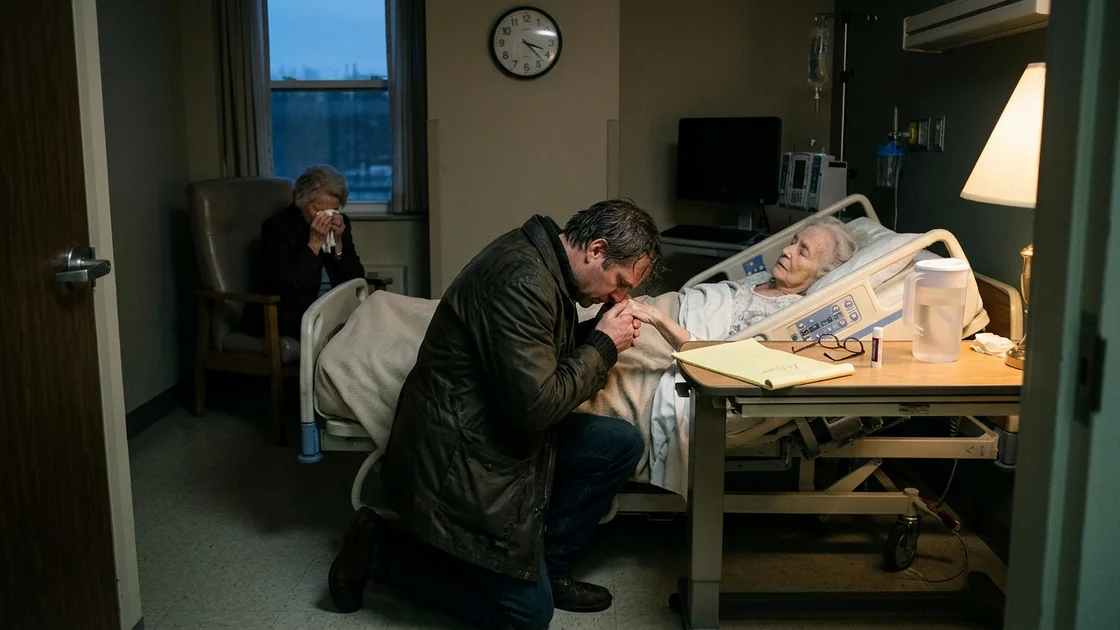
After twelve years of bitter silence, Arthur receives a frantic call that his estranged mother, Evelyn, is in her final hours at a small community hospital in Oregon. He races across two states through a relentless autumn storm, battling treacherous roads, mechanical failures, and the heavy ghosts of the past that drove them apart after his father's untimely death. Despite his desperate, white-knuckled sprint against the clock, a crucial delay at a flooded mountain pass costs him the only moments he had left. He bursts into her quiet hospital room at 4:22 AM, exactly ten minutes after her heart stops beating. Left alone in the sterile silence with her cooling hands and an unfinished letter resting on the bedside table, Arthur must navigate the crushing weight of words left unsaid and find a way to forgive both his mother and himself without the closure he so desperately sought.
The phone rang at 9:14 PM. Arthur knew the exact minute because the harsh blue light of the microwave clock was the only illumination in his narrow Seattle kitchen. He had been standing over the sink, eating cold Thai noodles straight from the cardboard carton, listening to the relentless October rain lash against the glass.
When the screen of his cell phone lit up on the granite countertop, it displayed an area code he had actively avoided for over a decade: 541. Central Oregon.
His stomach dropped, the food instantly turning to lead in his throat. He stared at the vibrating device, watching it dance slightly against the stone. He knew, with the cold, visceral certainty that only dread can provide, what the call meant. People from his past did not call to catch up. They did not call to wish him a happy birthday or ask how his architectural firm was surviving the economic downturn. A call from that area code at this hour was a flare sent up from the wreckage of a life he had abandoned.
He swiped the screen with a trembling thumb. "Hello?"
"Arthur?" The voice on the other end was papery, worn thin by age and exhaustion, yet instantly recognizable. It was Clara, his mother’s younger sister.
"Aunt Clara," Arthur said, his voice sounding foreign to his own ears, tight and defensive. "What's wrong?"
There was a sharp intake of breath, followed by the muffled sound of a sob being forcefully swallowed. "It’s Evelyn, Artie. She’s at St. Jude’s in Bend. They moved her to palliative care an hour ago."
Arthur gripped the edge of the sink. The cold stainless steel bit into his palm. "Palliative? I didn't even know she was sick."
"She didn't want you to know," Clara said, and beneath her grief, there was a faint, sharp edge of reproach that made Arthur wince. "Her kidneys have been failing for two years, Arthur. Last week she caught pneumonia, and her heart just can't take the strain anymore. The doctor says... he says it’s a matter of hours. Maybe less. She’s asking for you."
The kitchen seemed to tilt. The hum of the refrigerator grew deafeningly loud. She’s asking for you. Four words that dismantled twelve years of carefully constructed walls, of justified anger and stubborn pride.
"I'm in Seattle," Arthur said, his mind struggling to calculate distances, weather patterns, and the cruel physics of time. "That’s six hours, Clara. Minimum. With the storm, maybe seven."
"Then you had better hang up the phone and start driving," Clara replied, her voice breaking entirely now. "Please, Artie. Don't let her go thinking you still hate her. Just come home."
The line went dead.
Arthur stood frozen for three seconds, four, five. Then, a frantic, terrifying energy surged through his veins. He dropped the chopsticks into the sink, didn't bother to cap the soy sauce, and bolted down the hallway. He didn't pack a bag. What did a man need for a reckoning? He grabbed his heavy canvas coat, snatched his car keys from the ceramic bowl by the door, and shoved his feet into his boots without untying the laces.
By 9:22 PM, his aging Volvo was roaring out of the underground parking garage, its headlights slicing through the sheets of water pouring down onto the Seattle streets.
The drive south on Interstate 5 was a blur of red taillights and blinding spray. The windshield wipers fought a losing battle against the deluge, slapping back and forth at their highest setting with a frantic, rhythmic thud that matched the pounding of Arthur’s heart. Thump-thump. Thump-thump. Six hours. Five and a half if I push it.
He pushed it. He wove through the lumbering semi-trucks, hydroplaning slightly as he hit the deep ruts of standing water near Tacoma. His hands were clamped onto the steering wheel at ten and two, his knuckles bleached white in the dim glow of the dashboard.
Every mile marker he passed felt like a countdown, stripping away the layers of the man he had become and exposing the raw, wounded twenty-two-year-old who had walked out of his mother’s house in the summer of 2011.
He hadn't meant for it to be twelve years. In the beginning, the silence was a weapon, wielded with the righteous fury of youth. His father, Thomas, had died of a sudden massive coronary while out repairing the fence on their modest five-acre property outside of Sisters. Arthur had been in his final semester at the University of Oregon, studying design, dreaming of cities made of glass and steel.
When Thomas died, the grief had not bound Arthur and Evelyn together; it had magnetized them into opposing poles, repelling each other with violent force. Evelyn, terrified of being left entirely alone in the high desert, had demanded—not asked, demanded—that Arthur drop his job offer in Seattle and move back to run his father's small hardware store.
In the crucible of that terrible summer, grieving his father and suffocating under his mother’s panicked control, Arthur had discovered the secret that broke them. While clearing out his father’s desk at the store, he had found the letters. Dozens of them, hidden inside an old ledger box. They were from a man named David in Eugene, spanning five years, addressed to Evelyn. They were love letters. Deeply intimate, aching letters detailing a life Evelyn had been living in the shadows of her marriage, planning an escape she had been weeks away from executing when Thomas’s heart had given out.
The confrontation had been apocalyptic. Arthur, blinded by the idealized memory of his quiet, hardworking father, had thrown the letters across the kitchen table. He had called her a coward, a liar, a hypocrite who was trying to chain him to a life she herself had been desperate to flee.
Evelyn hadn't defended herself. She had just sat there, her face pale and carved from stone, absorbing his venom. And then, in a moment of defensive cruelty that would echo in Arthur’s ears for over a decade, she had said, “You know nothing about my marriage, Arthur. You only ever saw what suited you. You’re selfish, just like your father was in his silence. If you walk out that door, don't bother coming back when you finally grow up.”
So he hadn't.
He had missed her sixtieth birthday. He had missed the holidays. When she sent a Christmas card two years later with a simple I miss you, Artie written inside, he had thrown it in the trash without replying. Five years in, pride had calcified into habit. Eight years in, habit had turned into a quiet, pervasive shame—how do you pick up the phone after nearly a decade and say, I’m sorry I didn't let you be human? You tell yourself you’ll do it next month. Next year. There is always more time, until a voice on the phone tells you the clock has run out.
"Come on, come on," Arthur muttered to the empty car, pressing the accelerator harder as he crossed the Columbia River into Portland at 12:10 AM. The city was a neon smudge through the rain-streaked glass.
He bypassed the city center, swinging east onto Highway 26 toward Mount Hood. This was where the real test began. The four-lane highway narrowed into a winding two-lane ribbon of asphalt that climbed relentlessly into the Cascade Range.
As the elevation increased, the rain grew heavier, mixed with wet, heavy sleet that coated the pine trees lining the road. The dark forest pressed in on both sides, a suffocating tunnel of Douglas firs. There was virtually no other traffic now. Just Arthur, his headlights, and the ghosts riding in the passenger seat.
He remembered being eight years old, sick with the scarlet fever, burning up in his bed while the desert wind howled outside. He remembered Evelyn sitting beside him for forty-eight hours straight, bathing his forehead with cool washcloths, reading him The Wind in the Willows from cover to cover twice, her voice a soothing anchor that kept him from drifting away into the fever dreams. He remembered her hands—rough from gardening, perpetually stained with a bit of soil or paint—gently brushing the hair back from his eyes.
She’s asking for you.
A sob tore its way out of Arthur’s chest, harsh and dry. He wiped his eyes furiously with the sleeve of his coat. "Hold on, Mom," he whispered to the dashboard. "Just hold on. I'm coming. I'm right here."
At 1:45 AM, just shy of Government Camp, the Volvo shuddered.
It was a subtle vibration at first, felt through the floorboards, followed by a sudden, sickening loss of power. Simultaneously, the battery light flashed red on the instrument panel, and the headlights dimmed to a weak, jaundiced yellow.
"No. No, no, no!" Arthur slammed his hand against the steering wheel. The alternator. He had known the bearings were whining last month, had meant to take it into the shop, had put it off for a client presentation.
The car was dying, starved of electrical current. The windshield wipers slowed to a sluggish, agonizing crawl, barely pushing the sleet aside. If he stopped here, on the shoulder of the mountain pass in the dead of night, he was finished. He would never get a tow truck in time.
He clicked off the heater. Immediately, the cabin temperature plummeted. He turned off the radio display, the dash lights—every possible draw on the battery, leaving only the dying headlights and the slowest setting on the wipers. He leaned forward, his nose inches from the cold glass, squinting into the gloom as he crested the pass.
Gravity became his only ally. As the road tipped downward toward the Warm Springs reservation and the high desert beyond, Arthur shifted into neutral when he could, coasting down the long, sweeping grades to save the engine from stalling entirely. His breath plumed white in the freezing cabin. His fingers were numb, aching with the cold, but he didn't dare turn the heat back on.
Just outside of Madras, at 2:50 AM, the rain finally stopped, replaced by the vast, freezing clarity of the high desert night. And right at the edge of town, under the flickering fluorescent canopy of an all-night Chevron station, the Volvo finally gave up. The engine coughed, sputtered, and died as Arthur rolled it into the station lot.
He didn't waste a second mourning the car. He kicked the door open and ran toward the glowing box of the convenience store. Inside, a young attendant with a patchy beard and a faded Blazers cap was mopping the floor, listening to heavy metal through a single earbud.
"Hey!" Arthur’s voice cracked like a whip. The kid jumped, nearly dropping the mop.
"Whoa, man. We don't keep cash in the register after midnight—"
"I don't want your money," Arthur panted, leaning over the counter, his eyes wild and bloodshot. "My car just died outside. My mother is dying at St. Jude’s in Bend. I have less than an hour to get there. Is that your truck outside?"
He pointed a shaking finger toward a beat-up, rust-spotted Ford F-150 parked by the air pumps.
The kid blinked, taking in Arthur’s expensive wool sweater, his soaking-wet coat, and the sheer, unadulterated terror in his eyes. "Yeah, that's mine. Why?"
Arthur reached into his pocket, pulled out his wallet, and dumped its entire contents onto the counter, along with his keys and the title to the Volvo which he kept in his glovebox wallet. He unclasped the vintage Omega watch from his wrist—his father's watch, the only thing he had taken from the house—and laid it on top of the pile.
"There’s four hundred dollars there," Arthur said, his voice trembling so violently he could barely form the words. "That watch is worth three thousand. You can have the Volvo, too. It just needs an alternator. Let me take your truck to Bend. I swear to God, I’ll bring it back tomorrow, and you can keep everything on this counter. Just please. Please let me say goodbye to my mom."
The silence in the small store stretched for an eternity, broken only by the buzz of the beer coolers. The kid looked down at the watch, then up at Arthur’s face. Whatever he saw there—the raw, stripped-bare agony of a man on the brink of a lifelong regret—made him drop the mop handle against the counter.
He didn't touch the money or the watch. Instead, he reached into the pocket of his grease-stained jeans, pulled out a single brass key on a plastic ring, and slid it across the laminate counter.
"It pulls to the left when you brake hard," the kid said softly. "And the gas gauge is broken, so don't worry that it says empty. It’s got a full tank. Leave the watch, man. Just go."
Arthur grabbed the key. A sound escaped him—half-laugh, half-sob. "Thank you. Thank you."
He left the cash on the counter, snatched his father’s watch back up, and sprinted out into the freezing night.
The old Ford smelled of stale Marlboros, wet dog, and pine needles, and the engine roared to life with a deafening, muffler-less growl that sounded like salvation. Arthur threw it into drive, tires squealing on the wet pavement as he fishtailed out onto Highway 97.
Forty miles to Bend.
The speedometer needle climbed past seventy, then eighty, vibrating wildly. The steering wheel had three inches of play in it, requiring constant, frantic corrections to keep the heavy truck between the lines. The desert stretched out around him, dark and indifferent, illuminated only by the pale light of a waning moon breaking through the storm clouds.
At 3:15 AM, his phone rang again. He fumbled it out of his pocket, nearly dropping it onto the floorboards.
"Clara?" he yelled over the roar of the truck's engine.
"Artie, where are you?" Clara’s voice was a whisper now, hollow and terrifyingly calm.
"I just passed Redmond! I’m twenty minutes out! Put me on speaker, Clara! Put the phone by her ear!"
There was a rustling sound, the faint, rhythmic beep of a monitor in the background, and then a long, ragged rattle that made the hairs on Arthur’s arms stand straight up. It was the sound of fluid-filled lungs fighting for a fraction of oxygen. Cheyne-Stokes breathing. He knew the term from a documentary he’d watched years ago; it was the body’s final, mechanical reflex before the end.
"She can't talk, Artie," Clara wept softly. "The morphine... she’s deep under now. Go ahead. I have the phone right by her cheek."
"Mom?" Arthur screamed into the phone, tears blinding him as the lights of Bend finally crested the horizon. "Mom, it’s Artie! I’m right here! I’m on the parkway! Give me fifteen minutes, Mom, please! I’m sorry! Do you hear me? I’m so sorry!"
Only the terrible, wet rattling answered him, followed by a terrifyingly long pause of silence before the next breath came.
"Drive safe, Artie," Clara whispered, and hung up.
He didn't drive safe. He took the exit for Neff Road at sixty miles an hour, the truck’s suspension groaning in protest as he blew through a red light, checking the cross-streets only as an afterthought. The hospital loomed ahead on the hill, a sprawling complex of brick and glass glowing like a lighthouse in the dark.
4:16 AM.
He didn't look for a parking spot. He drove the F-150 straight up the circular driveway to the main Emergency entrance, jammed it into park right in the red fire lane, and left the engine running. He threw himself out of the cab, his knees nearly buckling as his numb feet hit the pavement after hours of driving.
He burst through the sliding glass doors into the sterile, over-lit warmth of the hospital lobby. A security guard looked up from a desk, startled.
"Sir, you can't park that—"
"Palliative care! Third floor, right?" Arthur shouted, already sprinting past the desk toward the elevator bank.
"Sir, wait!"
Arthur didn't wait for the elevator. He slammed his shoulder into the heavy fire door marked STAIRS and began to climb, taking the concrete steps three at a time. His lungs burned, starved of the thin high-desert air, his thighs screaming in protest. Second floor. Come on, come on. Third floor.
He burst out of the stairwell into a quiet, carpeted hallway. The lighting here was dimmed for the night shift, casting long, tranquil shadows. The air smelled of lemon disinfectant, wilted lilies, and the distinct, heavy scent of approaching death.
Room 312. Clara had texted him the number hours ago.
304... 306... 308...
Arthur wasn't running anymore; his legs felt as though they were wading through deep, freezing water. The silence of the hallway was absolute. There were no alarms chiming. No nurses rushing with crash carts. Just a profound, suffocating stillness.
He reached the doorway of 312 at 4:22 AM.
He stopped on the threshold, his hand gripping the wooden doorframe.
Inside, the room was bathed in the soft amber glow of a single bedside lamp. The monitors on the wall above the bed were dark, their screens black and silent.
A young nurse in navy blue scrubs was standing beside the bed, gently pulling the intravenous needle from the back of a pale, bruised hand, securing a small piece of gauze over the puncture with a strip of paper tape. In the corner, Aunt Clara sat in a vinyl armchair, her face buried in a wet handkerchief, her shoulders shaking in silent, exhausted grief.
And on the bed lay Evelyn.
She looked impossibly small. In Arthur’s memory, his mother had been a force of nature—tall, broad-shouldered, a woman who could haul fifty-pound bags of feed and argue down any contractor in the county. The woman on the bed looked like a sparrow made of tissue paper and chalk. Her hair, which had been a fierce, streaked iron-gray the last time he saw her, was pure, wispy white against the hospital pillow. Her eyes were closed, her mouth slightly open, the skin of her face drawn tight over her cheekbones.
She was entirely, unequivocally still.
The nurse looked up as Arthur’s shadow fell across the linoleum. She saw his heaving chest, his rain-soaked clothes, the wild, shattered look in his eyes, and her face softened with a practiced, devastating pity.
"Are you Arthur?" she asked, her voice barely above a whisper.
Arthur couldn't speak. He could only nod, a jerky, spasm-like movement of his chin.
The nurse glanced up at the institutional clock mounted on the wall above the door, then back at him. "I am so sorry," she said gently. "She passed at 4:12. Just ten minutes ago. It was very peaceful. She just... stopped breathing between one moment and the next."
Ten minutes.
The words didn't register as language; they registered as a physical blow to his sternum.
Ten minutes.
The red lights in Tacoma. The dying alternator on Mount Hood. The five minutes it took to convince the kid at the Chevron station. The forty seconds he had spent staring at the phone in his Seattle kitchen before answering it. Any one of them. If he had just answered on the first ring. If he had gotten the car fixed last Tuesday.
He had crossed three hundred and fifty miles of storm-ravaged mountains, and he had lost the race by six hundred seconds.
Clara looked up from her handkerchief. When she saw him standing there, a low keen escaped her throat. She stood up on shaky legs, walked over to him, and touched his cold, wet cheek.
"Oh, Artie," she whispered. "You tried. I told her you were coming. Right up until the end, I kept telling her you were on your way."
The nurse quietly gathered her tray of supplies and slipped past Arthur into the hallway. Clara squeezed his arm, murmuring something about giving them a moment alone, and followed the nurse out, pulling the heavy wooden door nearly shut behind her.
Arthur was alone with his mother.
For a long time, he couldn't move from the doorway. If he didn't step closer, perhaps it wasn't real. Perhaps the chest under the thin white blanket would rise again in that terrible, ragged way he had heard over the phone. He stared at her chest, willing it to move, praying to a God he hadn't believed in since he was twenty-two to rewind the earth on its axis by a fraction of a degree.
Nothing moved. The silence in the room was absolute, heavier than any sound he had ever heard.
Slowly, one leaden foot in front of the other, Arthur walked to the side of the bed. He sank down onto his knees on the hard linoleum floor, bringing his face level with hers.
Tentatively, terrified of what it would feel like, he reached out and took her right hand.
It was still warm.
That was the detail that broke him. The warmth had not yet left her skin. The life that had animated her for sixty-eight years was still radiating faintly into the room, a dying ember that had just extinguished moments before he walked through the door.
Arthur pressed her hand against his forehead and wept.
It was not the quiet, dignified weeping of a grown man; it was the raw, howling grief of a child who had gotten lost in the dark and realized no one was ever coming to find him. He sobbed into the coarse hospital blanket, his body wracked with tremors that seemed to tear at the very lining of his ribs.
"I'm sorry," he choked out, the words muffled against the mattress. "Mom, I’m so sorry. I was so angry. I didn't understand. I’m here now. Look, I’m here."
He kissed her knuckles—the swollen, arthritic knuckles that had once braided lanyards for him at summer camp, that had gripped the steering wheel while teaching him to drive in the high school parking lot, that had written letters to a man in Eugene because she was lonely in a way a twenty-two-year-old boy was too blind and arrogant to comprehend.
As the years had passed in Seattle, Arthur had experienced his own heartbreaks. He had lived through a five-year relationship with a woman named Sarah that had slowly starved to death in the quiet, polite silences between them. He had learned how two good people could love each other and still become prisons for one another. He had learned that life was not a series of black-and-white moral absolutes, the way he had thought at twenty-two, but a vast, messy expanse of gray where people did the best they could to survive their own despair.
He had understood her, finally, years ago. And he had kept that understanding locked in his chest like a miser, waiting for the "right time" to offer it to her, never once considering that time was not his to control.
After what felt like hours, the violent storm of his crying subsided into a hollow, aching exhaustion. He lifted his head, his eyes swollen and stinging, and looked at her face again. In death, the lines of tension and stubbornness that had defined her expression during their last summer together were gone. She looked younger. She looked tired, yes, but free of the heavy armor they had both worn for so long.
As he went to set her hand gently back on the blanket, his elbow brushed against the bedside rolling table, knocking a small stack of items slightly askew.
There was a plastic pitcher of water, a pair of reading glasses with one crooked temple, a tube of chapstick, and beneath the glasses, a folded piece of lined yellow legal paper.
Written across the outside of the fold, in a shaky, spider-web scrawl that barely resembled his mother’s once-neat cursive, was his name: Arthur.
His breath caught. With trembling fingers, he slid the paper out from under the glasses and unfolded it.
The ink was blue, smudged in places where her hand had rested heavily on the page, and the lines slanted downward toward the right margin, a testament to the weakness she had been fighting when she wrote it.
My dearest Artie, the letter began.
Clara is sitting by the window knitting, pretending she isn't watching me struggle to hold this pen, so I will make this brief before she takes it away and insists on writing it for me. There are things a mother must write in her own hand, no matter how ugly the penmanship has become.
First, do not be angry with Clara for not calling you sooner. I made her swear on your father’s Bible that she wouldn't bother you until the very end. You know how stubborn I am. I suppose I wanted to protect you from watching the slow part of this, or maybe I was just terrified that if she called while I still had months left, you wouldn't come, and I would have to live those months knowing for sure.
Arthur had to stop, squeezing his eyes shut as fresh tears spilled over his lashes, darkening the yellow paper where they fell. He wiped his face roughly and read on.
That summer after your father died, I was out of my mind with grief and guilt, Artie. You were right about everything you said to me in the kitchen. I was a coward. Your father was a good man, a quiet man, and we had been lonely together for twenty years. When I met David, it felt like waking up from a long winter. Does that excuse the deceit? No. And when Thomas died so suddenly, the guilt of what I had been planning to do nearly drove me mad. I thought if I could just force you to stay, if I could keep the store open and keep our family frozen in amber, it would erase my betrayal. I tried to use your life to pay for my sins.
When I told you not to come back, it was the biggest lie I ever told. I watched your car drive down the gravel road until the dust settled, and then I sat on the porch steps and cried until it got dark. Every single day for twelve years, I have hoped the phone would ring.
If you are reading this, it means you came. Even if I am already asleep, even if I am already gone when you walk through that door, please listen to me, my sweet boy: it counts. Do you hear me? The fact that you are standing in this room counts for everything. Do not torture yourself over the clock, or the years we wasted being proud. We are the MacKenzies; we have always been terrible at bending until we break.
I am not afraid, Artie. I am just very tired. For the last few days, when I close my eyes, I don't think about the store, or the fight, or the silence. I remember that day we drove out to Smith Rock when you were ten, and you found that hawk feather by the river, and we ate peach pie out of the tin with plastic forks on the tailgate. That is where I am going to wait for you.
Forgive me for being a flawed woman. And forgive yourself for being a young man who loved his father. Go back to your city, build your tall buildings, and have a loud, messy, wonderful life. I love you. I have always loved you.
Mom —
The line ended there, trailing off into a long, jagged blue scratch across the bottom of the page where the pen had slipped from her grasp.
Arthur stared at the paper. Even if I am already gone when you walk through that door, please listen to me, my sweet boy: it counts.
She had known. Even in her final hours, through the fog of renal failure and morphine, she had known her son well enough to anticipate the exact shape of the guilt that would crush him if he arrived too late. In her last coherent act on earth, she had reached forward through time to catch him before he hit the ground.
The crushing band of iron around Arthur’s chest didn't vanish—the grief was too immense, the loss too permanent for that—but it loosened just enough for him to draw a deep, shuddering breath of air.
He folded the yellow paper carefully along its creases and slipped it into his breast pocket, right over his heart.
Standing up, his knees popping in the quiet room, Arthur leaned over the bed and pressed his lips to his mother’s forehead. The warmth was nearly gone now, receding into the cool neutrality of the room, leaving behind only the faint scent of lavender soap that had always belonged to her.
"I remember the peach pie, Mom," he whispered into the quiet air. "I kept the feather for years."
He stood by the window for a few minutes more, watching the first faint bruised light of dawn begin to bleed over the eastern horizon, silhouetting the jagged peaks of the Three Sisters in the distance. The storm had passed completely. The sky above the high desert was vast, cold, and impossibly clear.
When Arthur finally opened the door of Room 312 and stepped back out into the hallway, Clara was waiting on a bench just outside, holding two styrofoam cups of black hospital coffee. He sat down beside her, took the warm cup from her hands, and leaned his head against her shoulder. He had a truck to return in Madras, a dead car to tow off a mountain, and twelve years of stories to tell the only family he had left. He was ten minutes late, yes, and he would carry the weight of those ten minutes for the rest of his days—but as the sun finally broke over the Cascades, flooding the hallway with pale gold light, Arthur knew he was no longer lost in the dark.