Miles Between Our Yesterdays
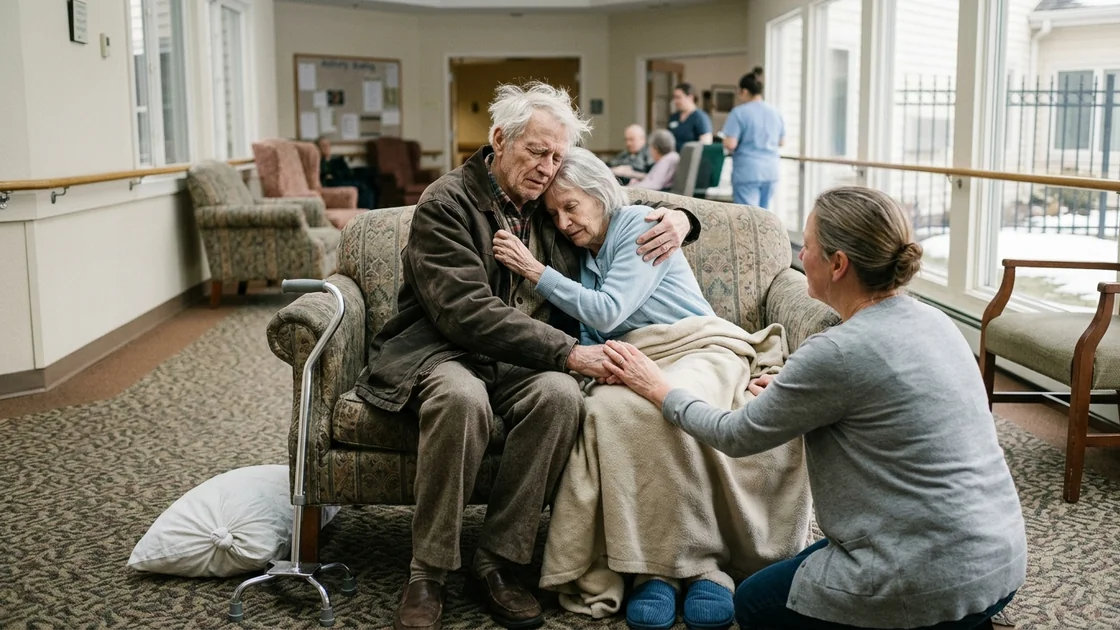
Arthur and Clara Pendelton spend sixty-two years sharing every breath, every meal, and every quiet evening in their small Ohio farmhouse, until a winter fall shatters their peaceful existence. Because Arthur requires specialized physical rehabilitation and Clara needs a secure memory-care unit for her advancing dementia, the healthcare system separates them into two different nursing facilities thirty-eight miles apart. While their well-meaning daughter struggles to manage the logistics of their decline, Arthur refuses to accept that his life with Clara is over. Through the agonizing silence of separation, the sterile routines of institutional living, and the fog of Clara's fading memory, the two octogenarians fight to bridge the physical and mental chasm between them, proving that six decades of devotion cannot be undone by locked doors and county lines.
The linoleum floor of Room 204 at Oak Creek Rehabilitation Center smelled aggressively of lemon bleach, a scent Arthur Pendelton had come to associate with loneliness. For sixty-two years, mornings had smelled of Clara. They smelled of the lavender talc she dusted over her collarbone, the dark roast coffee she brewed in the dented aluminum percolator, and the faint, sweet aroma of earth that clung to her cardigan from her hours tending the peonies.
Arthur shifted his weight on the edge of the twin mattress, wincing as the titanium rods in his left hip throbbed in protest. Outside the window, a bleak February rain drizzled over the asphalt parking lot of the facility in Miller’s Crossing. Thirty-eight miles due north, up Route 42, past the flat fields of frozen corn stubble and the rusted water tower of Delaware County, Clara was waking up at the Whispering Pines Memory Care Residence.
He looked at his watch. It was 7:14 AM.
At 7:15 AM, Clara would look for her slippers—the blue corduroy ones with the worn heels. If she didn't find them immediately beside the bed, she would become agitated. Her hands would flutter like trapped sparrows, and she would call out for him. “Artie? Artie, where did you put my feet?” That was how she phrased it now that the dementia had begun to scramble her nouns.
"Did they put her slippers on the left side of the bed?" Arthur asked aloud, though the room was empty.
He reached for the aluminum walker positioned beside his nightstand. His knuckles, swollen and knotted like the roots of an old oak, gripped the gray foam handles. Standing up was a negotiation with gravity. He counted to three, exhaled, and pushed upward. The hip held, though a dull fire radiated down to his knee.
The separation had happened with the terrifying speed of an avalanche. Four weeks ago, they were in their farmhouse on Old Mill Road. It had been a Tuesday. A glaze of black ice had coated the back porch steps. Arthur had gone out to fetch a split log for the woodstove; Clara had followed him out without her coat, holding a wooden spoon, wanting to ask if he preferred barley or rice in the soup. When Clara slipped, Arthur lunged to catch her. He cushioned her fall with his own body, his eighty-four-year-old femur snapping against the frozen concrete like dry kindling.
They had lain there in the freezing rain for forty minutes before the rural mail carrier spotted them. In the ambulance, Arthur had held Clara’s hand, ignoring the blinding agony in his pelvis, repeating over and over, "You're alright, Clary. I've got you. You're alright."
In the hospital, however, the system had taken over. The doctors examined Arthur's shattered hip, and the social workers evaluated Clara’s confusion, which had been amplified tenfold by the trauma of the fall and the unfamiliar fluorescent lights of the emergency room. Without Arthur there to seamlessly fill in the blanks of her sentences, to gently guide her toward the bathroom, to remind her what year it was, the extent of her cognitive decline became glaringly obvious to the medical staff.
Their daughter, Sarah, had wept in the hospital cafeteria as she explained the verdict to Arthur after his surgery.
"Oak Creek has the best orthopedic rehab in the county, Dad, and Medicare will cover your stay there until you can walk again," Sarah had said, shredding a paper napkin into tiny strips. "And Mom... Mom needs a locked ward, Dad. She wandered out of her hospital room twice last night looking for the chicken coop. Oak Creek doesn't have a memory care unit. And Whispering Pines doesn't have the physical therapy equipment or the surgical nurses you need."
"Then take us home," Arthur had rasped, his throat raw from the anesthesia tube. "I can manage from a wheelchair. I know how to take care of her."
"You can't even get yourself to the toilet right now, Dad," Sarah had cried, her voice breaking. "I work forty hours a week. The house has stairs. There are no beds together, Dad. I called fourteen places. Nobody has a rehab bed and a memory bed in the same building that takes your insurance. It's just for a little while. Just until you're strong."
A little while. In the language of the old, "a little while" was a polite euphemism for the rest of your life. Arthur knew it, even if Sarah couldn't bear to admit it.
A sharp knock broke Arthur’s reverie, followed immediately by the swinging open of the heavy wooden door. In walked Marcus, the morning Certified Nursing Assistant, carrying a plastic tray and wearing scrubs printed with cartoon superheroes.
"Morning, Mr. P!" Marcus boomed, his voice carrying the relentless, artificial cheer that seemed to be a job requirement in facilities for the dying and the broken. "How’s the bionic man doing today? Ready for some scrambled eggs that look suspiciously like yellow sponges?"
"I'm upright, Marcus," Arthur said, shuffling painfully toward the small round laminate table in the corner. "That's about all I can report."
Marcus set the tray down and watched with a practiced eye as Arthur maneuvered himself into the vinyl armchair. "Hey, you're moving better than you were on Monday. Physical therapy is paying off. Pretty soon you'll be running marathons."
"I don't need to run a marathon," Arthur said, staring down at the lukewarm oatmeal, a single square of foil-wrapped margarine, and a small carton of skim milk. "I just need to go thirty-eight miles north."
Marcus’s smile softened, losing its performative edge. He pulled the tab on the milk carton for Arthur, knowing the old man's arthritic fingers struggled with the stiff paper. "Your daughter bringing the tablet by today for a video call?"
"No. Sarah has to take her grandson to a dentist appointment in Columbus. We tried the telephone yesterday." Arthur picked up his spoon, then set it back down. His appetite had vanished weeks ago. "It didn't go well."
That was an understatement. The phone call had been torture. A nurse at Whispering Pines had held the receiver to Clara's ear. Hearing Arthur’s voice without being able to see him had terrified her. She had thought he was trapped inside the little plastic box. “Let him out!” she had screamed at the nurse, her voice cracking with panic. “Why do you have Artie in there? Let him out!” The nurse had abruptly ended the call to calm her down, leaving Arthur listening to the dead hum of the dial tone, weeping silently into his hospital gown.
"I'm sorry, Mr. P," Marcus said quietly. "My grandma had Alzheimer's. It’s a thief. A real dirty thief."
"She isn't gone," Arthur said fiercely, looking up at the young man. His watery blue eyes held a sudden, sharp intensity. "Everyone talks about her like she's an empty shell. She's not. When I'm with her, I hold the map. Do you understand? She loses the trail, and I point her back to it. Without me there, she's just wandering in the dark."
Thirty-eight miles north, the dining room at Whispering Pines was painted a soft, non-threatening peach, designed by behavioral psychologists to reduce sundowning and aggression. Soft big-band music played from speakers recessed into the acoustic ceiling tiles—Glenn Miller’s "In the Mood," a song Clara and Arthur had danced to in a VFW hall in 1958, though right now, to Clara, it was just confusing noise.
Clara sat at a table with three other women. None of them were speaking. One woman was methodically tearing her toast into tiny, uniform squares and arranging them in a circle around her plate.
Clara was looking at her hands. They were spotted with brown pigment, the skin thin as onion paper, the veins raised and blue. On her left ring finger sat a plain gold band, worn so thin on the palm side that it was nearly a crescent.
She twisted the ring. It was loose. She had lost weight.
"Artie?" she whispered.
A young woman in teal scrubs walked by, pausing to pat Clara’s shoulder. "Eat your eggs, Clara honey. They're getting cold."
Clara looked up at the girl. She didn't know her name. The faces here changed constantly, blurring together like fence posts seen from a speeding car. "Where is he?" Clara asked. "Did he go to the hardware store? He said he needed fence staples. The north pasture wire is down."
The aide, whose name tag read Brittany, offered a practiced, non-committal smile. They were trained in validation therapy—never correct the resident, never tell them their spouse is dead or gone, just redirect. "That's right, sweetie. He went to the hardware store. He'll be back soon. Why don't you have some orange juice while you wait?"
Clara frowned. A crease formed between her silver eyebrows. Something about the girl's voice was wrong. It was the voice people used on children when they were lying about a dead dog.
Clara looked around the peach-colored room. The windows were large, overlooking a courtyard surrounded by an eight-foot wrought-iron fence topped with curves that pointed inward. The snow on the patio furniture was melting in the rain. In her mind, the timeline was a deck of cards someone had dropped on the floor and shuffled together face-up and face-down.
Sometimes she was twenty-two, waiting for Arthur to come home from the Korean War, her stomach knotted with terror every time a Western Union boy rode his bicycle down the street. Sometimes she was forty, canning tomatoes in an August heatwave while Sarah played under the sprinkler.
But mostly, she just felt a profound, aching amputation. For sixty-two years, Arthur had been her external memory, her compass, the warm wall of muscle and bone at her back every night in the dark. Now, when she reached out in the night, her hand met only the cold metal rails of a hospital bed.
"He wouldn't go to the hardware store in the rain," Clara said to the empty air, her voice trembling. "His hip bothers him when it rains. I need to get his flannel shirt out of the cedar chest."
She pushed her chair back and stood up.
"Whoa there, Clara, where are we going?" Brittany asked, stepping over quickly.
"I have to get his shirt," Clara insisted, a flash of panic rising in her chest. Where was the cedar chest? Where was the staircase? Why were there so many doors, and why didn't any of them have doorknobs, just silver plates with buttons that buzzed when the girls in the colored shirts touched them? "Let me go home. Please. My husband is going to be cold."
"We'll get his shirtright after breakfast," Brittany said soothingly, taking Clara gently by the elbow and guiding her back into the chair. "Look, they brought you some warm peaches. You love peaches."
Clara sat down because her knees felt weak, not because she wanted peaches. She stared at the yellow fruit swimming in heavy syrup. A tear leaked from the corner of her eye, tracking slowly down the deep parentheses around her mouth.
He didn't forget me, she thought, holding onto the singular certainty with all the strength her fraying mind possessed. Artie wouldn't leave me in a hotel. He's looking for me. I just have to wait by the door.
At 10:00 AM, Arthur was in the physical therapy gym on the ground floor of Oak Creek. The room was bright, filled with parallel bars, stationary bicycles, and wooden staircases that led nowhere.
His therapist, a burly, bearded man in his thirties named Dave, stood beside him with a gait belt strapped securely around Arthur’s waist.
"Alright, Arthur. Today we're ditching the walker for twenty feet. We're trying the quad cane," Dave said, holding out an aluminum cane with four small feet at the base. "Put it in your right hand—opposite the bad hip. Remember the sequence: cane, bad leg, good leg."
Arthur took the cane. It felt precarious compared to the four-sided fortress of the walker. Fear, cold and sharp, pricked at the base of his skull. If he fell again, if he broke the other hip or dislodged the prosthesis, he would never leave this building alive. He would die under fluorescent lights, and Clara would die thirty-eight miles away, thinking he had abandoned her.
"You've got me on the belt," Dave assured him. "I bench press three hundred pounds, Arthur. You only weigh about a buck-forty soaking wet. If you go down, I'll just pick you up by your waistband like a suitcase."
A dry puff of air escaped Arthur’s nose—the closest he had come to a laugh in a month. "Just don't drop the luggage, Dave."
"Never. Eyes forward, not at your feet. Look at the clock on the far wall. Cane, left, right."
Arthur planted the cane. He shifted his weight, gritting his dentures together as he swung the injured left leg forward. When he put weight on it, the bone ached, a deep, structural complaint, and the surgical incision pulled tightly. He brought the right leg through.
"Good! Don't hitch your hip up. Walk through the heel. Again."
Cane. Left. Right.
In his mind, Arthur wasn't walking across a rubberized gym floor toward a wall clock. He was walking down the aisle of the First Methodist Church in June of 1961. Clara was walking toward him in a dress she had sewn herself from white satin bought on clearance in Mansfield. He remembered the way her hand had trembled when he took it at the altar, and how she had immediately steadied the moment their skin touched.
Cane. Left. Right.
He was walking the perimeter fence of their twelve acres in 1978, Clara beside him in oversized rubber boots, carrying a bucket of windfall apples for the neighbor’s horses.
Cane. Left. Right.
Sweat broke out on Arthur’s forehead, cold and clammy. His breathing turned ragged, whistling slightly in his chest. By the time he reached the fifteen-foot mark, his left leg was trembling violently, the muscles spasming from the effort.
"Alright, that's fifteen. Let's call it there," Dave said, reaching for a rolling wheelchair nearby.
"No," Arthur gasped, his knuckles white on the grip of the cane. "You said twenty."
"Arthur, your leg is shaking like a leaf. We don't want to overdo—"
"Twenty," Arthur snarled, a sudden, terrifying ferocity in his voice. He planted the cane. He dragged the screaming left leg forward. He stepped with the right. Twice more, through a haze of gray pain that made the edges of his vision sparkle, until the rubber tips of the quad cane tapped against the baseboard beneath the wall clock.
Only then did he allow himself to collapse backward into the wheelchair Dave shoved behind him.
Arthur sat hunched over, elbows on his knees, chest heaving as he tried to catch his breath. Dave knelt beside him, checking the pulse at Arthur’s wrist.
"Heart rate is up, old man," Dave said softly, though there was deep respect in his voice. "What are you trying to prove? You're eighty-four. Most guys your age with a subcapital femoral neck fracture are still refusing to get out of bed."
Arthur wiped his mouth with the back of a trembling hand. He looked up at the therapist. "How good do I have to be to get discharged?"
Dave sat back on his heels, sighing. "To go home? You have to be able to transfer independently—bed to chair, chair to toilet. You have to navigate four stairs with a rail, since your daughter said your house has steps at every entrance. And you have to walk fifty feet safely with an assistive device."
"And if I do that, the doctors have to let me go?"
"Well, medically, yes, you'd meet your PT goals. Assuming your vitals are stable and the wound is healed. Which it nearly is." Dave hesitated, rubbing the back of his neck. "But Arthur... Sarah told us in the care plan meeting yesterday that she's putting the farmhouse up for sale next month. She said even when you're discharged from rehab, you're moving to an assisted living apartment here on the Oak Creek campus."
The room seemed to tilt. The fluorescent lights hummed louder, a shrill, waspish sound in Arthur’s ears.
"She's what?" Arthur whispered.
Dave looked instantly guilty. "Shoot. I thought you knew. I'm sorry, man. That wasn't my place to say."
Selling the house. The house whose mortgage he had paid off in 1994, burning the bank note in the backyard grill while Clara poured two glasses of cheap champagne. The house where he had built bookshelves into the living room alcoves with his own hands, where the height marks of Sarah and her two brothers were still penciled on the pantry doorframe.
If Sarah sold the house, there was no home to take Clara back to. They would be permanent wards of two separate corporations, divided by thirty-eight miles of highway until one of them died. And if Clara died first, he wouldn't even be there to hold her hand. If he died first, she wouldn't understand why he never came to visit; she would spend her final years believing he had simply walked away.
"Wheel me back to my room, Dave," Arthur said. His voice was dangerously quiet. "I need to make a phone call."
Sarah arrived at Oak Creek at 4:30 PM, looking exhausted. At fifty-eight, she had Clara’s high cheekbones and Arthur’s stubborn chin, though lately her face was drawn and gray with caregiver fatigue. She wore a rumpled beige blazer from her job as an office manager at an insurance agency, and she carried a plastic grocery bag containing two ripe bananas and a fresh package of Arthur’s favorite peppermint patties.
She found Arthur not in his bed, nor in the recliner, but sitting fully dressed at the small laminate table. He was wearing his wool trousers, a plaid button-down shirt he had painstakingly buttoned himself despite his stiff fingers, and his sturdy leather loafers.
"Dad?" Sarah paused in the doorway, surprised. "You're dressed. Where did you get your clothes? They were in the closet."
"I walked to the closet, Sarah," Arthur said evenly. "Sit down."
Sarah closed the door and sat on the edge of the bed, setting the plastic bag on the nightstand. She knew that tone. It was the voice Arthur had used when she was sixteen and had brought the family Buick home with a dented fender at two in the morning.
"Dave told me about the house," Arthur said, not wasting a syllable on pleasantries.
Sarah closed her eyes for a long second, her shoulders slumping as if the air had been let out of her. When she opened them, they were bright with unshed tears. "Dad, please don't make this harder than it already is. I wanted to wait until the weekend to talk to you about it, when Tom could come down from Cleveland to help me explain."
"I don't need your brother here to explain basic arithmetic to me," Arthur said, his hands resting flat on the table. "The house is paid for. Property taxes are twenty-two hundred dollars a year. I have forty thousand dollars in savings, plus my pension from the tractor plant and our Social Security."
"And how much do you think Whispering Pines costs, Dad?" Sarah’s voice rose, sharp with desperation. "It’s seven thousand two hundred dollars a month! A month, Dad! Medicare doesn't pay for long-term memory care. Your savings and your pension will cover Mom for maybe six months. After that, in order for her to qualify for Medicaid, we have to spend down your assets, and eventually the state will put a lien on the estate anyway, or we have to use the equity from the house to pay for your assisted living here so you aren't out on the street!"
Arthur stared at her. The numbers were astronomical, obscene. Seven thousand dollars a month for a room painted peach and a girl who called Clara "honey" while feeding her canned fruit. In 1963, he had bought the entire twelve-acre farm and the house for eleven thousand dollars.
"Then take her out of there," Arthur said, his voice trembling slightly. "Bring her home. We'll hire a girl to come in during the day to help with the heavy lifting. I'll do the rest."
"Dad, stop it!" Sarah buried her face in her hands. Her shoulders shook. "Just stop! You're eighty-four years old! Before the fall, you were losing weight because you were forgetting to eat while you took care of her. I found the stove burners left on twice in January! Mom was up all night wandering the hallways, which meant you were up all night. You were killing yourself trying to keep her at home!"
"That is my right!" Arthur roared, slamming his palm against the laminate table. The sound echoed sharply in the small room. "I stood in front of God and everybody sixty-two years ago and promised in sickness and in health! There wasn't a footnote at the bottom that said unless you get old and your daughter gets worried! If taking care of Clara kills me, Sarah, then that is a fine way for me to die! It is a hell of a lot better than rotting in this bleached box while my wife cries for me in a locked room in another county!"
Sarah looked up, tears streaming freely down her cheeks. "And what if you fall again in the middle of the night when nobody is there, Dad? What if you break your neck on the cellar stairs, and Mom is trapped in that house with your body for three days because she doesn't know how to use a telephone anymore? Have you thought about that? Because that’s what actually happens!"
Silence fell over Room 204, heavy and suffocating. The only sound was the rhythmic ticking of the battery-operated wall clock and the distant chime of a call light out in the hallway.
Arthur looked down at his knotted hands. The terrible truth of Sarah’s words settled into his bones like the February chill. He was old. His body had betrayed him. The strength he had relied on his entire life—the strength that had cleared timber, pulled calves during blizzards, and carried a grown woman up a flight of stairs when she sprained her ankle—was gone.
When he spoke again, all the anger had drained out of him, leaving only a hollow, desperate plea.
"Sarah... have you seen her this week?"
Sarah wiped her cheeks with the sleeve of her blazer, sniffing. "I went up on Tuesday evening after work."
"How is she? Really. Don't lie to me."
Sarah hesitated, biting her lip. She looked out the window at the darkening parking lot. "She's thinner, Dad. They have her on a mild sedative in the evenings now because when the sun goes down, she gets very agitated. She packs her clothes into her pillowcase and stands by the keypad door waiting for you to pick her up."
Arthur made a sound in the back of his throat—a wounded, animal noise. He pressed his thumb and forefinger against the bridge of his nose, squeezing his eyes shut as hot tears spilled over his lower lids. She packs her clothes in a pillowcase. For sixty-two years, whenever they went on a trip—to Niagara Falls, to visit her sister in Indiana, to the state fair—Arthur had carried the bags.
"Does she... does she still know my name?" he whispered.
"Yes," Sarah said softly, reaching across the small table to cover his hand with hers. "She talks about you constantly. Sometimes she thinks you're at the tractor plant, or out in the barn. Yesterday, she asked me why you were mad at her."
Arthur’s head snapped up, his eyes wide with horror. "Mad at her? Why would she think that?"
"Because you haven't come to see her," Sarah said, her voice breaking again. "I told her you broke your hip, Dad. I told her ten times. I showed her a picture of you in your hospital bed on my phone. She understands it for about three minutes, and then it's gone, and all she knows is that she's in a strange place and you haven't come for her."
That was the moment something shifted inside Arthur Pendelton. The grief and helplessness hardened into something cold, clear, and diamond-sharp.
The healthcare system had rules. Insurance companies had actuarial tables. Sarah had practical realities. None of them mattered. Clara thought he was angry with her. Clara was standing by a locked door with a pillowcase full of clothes, waiting for her husband.
He pulled his hand gently out from under Sarah’s. He wiped his eyes with a paper napkin from the table and sat up straighter.
"When are you going up there next?" Arthur asked, his voice remarkably calm.
"Saturday morning," Sarah said, relieved that his outburst seemed to have passed. "And Dad... I talked to the social worker here. Once you can transfer into a passenger car safely—maybe in two or three weeks—I can check you out on a four-hour pass on a Sunday and drive you up there to visit her."
Two or three weeks. In the fog of dementia, three weeks was three centuries. By then, the woman who packed a pillowcase might stop waiting by the door altogether. She might retreat entirely into that quiet, unreachable interior where nobody could follow.
"Two or three weeks," Arthur repeated, nodding slowly. "That sounds reasonable, Sarah. I'm sorry I yelled at you. I know you're doing the best you can."
Sarah stood up and kissed the top of his thinning white hair. "I love you, Dad. I'm going to go home and get some sleep. Eat your dinner tonight, okay? Promise me."
"I'll eat every bite," Arthur lied. "Oh, Sarah? Before you go, could you hand me my wallet out of the top drawer of the nightstand? The nurses locked it up when I got here, and they finally gave it back yesterday, but I can't quite reach the back of the drawer from the chair."
"Sure." Sarah pulled open the drawer, retrieved the worn brown leather billfold, and handed it to him. "You don't need cash in here, though, Dad. Don't leave it lying out where someone might take it."
"I just like having it in my pocket," Arthur said, sliding it into his wool trousers. "Makes me feel like a man instead of a patient."
After Sarah left, Arthur opened the wallet. Inside were three twenty-dollar bills, two tens, and four ones. Eighty-four dollars. There was also his expired driver’s license, a Medicare card, and a faded Polaroid from 1985 of Clara standing beside a prize-winning rhubarb pie at the county fair, laughing with her head thrown back.
Arthur stared at the photograph for a long time. Then he looked over at the quad cane leaning against the radiator.
For the next six days, Arthur Pendelton became the model patient of Oak Creek Rehabilitation Center.
He ate every scrap of food placed in front of him—the rubbery eggs, the pureed squash, the dry pork chops—forcing the calories down his throat like coal into a furnace. He needed fuel. When Dave came to get him for physical therapy at 10:00 AM and 2:00 PM, Arthur didn't complain, didn't wince, and didn't ask for breaks.
"Show me the car transfer," Arthur demanded on Friday morning.
Dave blinked. "We usually wait until week five for the mock-car, Arthur. You're only at the end of week four."
"Show me today."
In the corner of the gym was the frame of an old Honda Civic door and passenger seat, mounted on a wooden platform to simulate getting in and out of a vehicle. For forty-five minutes, Arthur practiced backing up to the seat until the backs of his knees touched the upholstery, reaching back for the doorframe with one hand, holding the quad cane in the other, lowering himself down without bending his hip past the ninety-degree surgical precaution, and then swinging his legs inside one at a time.
It hurt so badly that he bit the inside of his cheek until he tasted copper. He smiled at Dave and did it four more times.
"Man," Dave said, shaking his head in amazement as he jotted notes on his clipboard. "I don't know what they're putting in your oatmeal, Arthur, but I've got sixty-year-olds who don't work half as hard as you."
At night, when the facility quieted down and the night shift nurses were busy charting at the desk down the hall, Arthur didn't sleep. He got out of bed, gripped his quad cane, and walked laps inside his tiny room. From the window to the bathroom door was fourteen steps. He walked it fifty times a night, counting under his breath in the dark, building the calluses on his right palm and forcing the muscles around the titanium joint to knit and strengthen.
In the quiet hours between 2:00 AM and 4:00 AM, he planned.
He needed to know the layout of the land between Miller's Crossing and Delaware County. He knew the roads, of course—he had driven them for sixty years—but he couldn't drive. He had no car, and even if he stole one, his reflexes were too slow and his left leg too weak to work a clutch or switch quickly to a brake pedal.
He needed transportation.
On Sunday afternoon, Marcus was in the room changing the linens on the empty bed next to Arthur’s—Arthur’s former roommate, a man with congestive heart failure, had been transferred back to the hospital two days prior.
"Marcus," Arthur said casually, pretending to do a crossword puzzle in the Sunday paper. "How do you get to work every day? You drive?"
"Me? Nah, my transmission blew up back in November," the young aide said, snapping a fitted sheet over the vinyl mattress. "Saving up for a used Camry. Right now I take the DATA bus."
Arthur’s pencil paused over the paper. "The county transit bus? I didn't know they ran out this far."
"Yeah, they started a rural connector route last year. Stops right down at the corner of Oak Street and Route 42, by the Dollar General. Takes me all the way up to the hub by the courthouse in Delaware, and then I walk four blocks to my apartment."
Arthur’s heart gave a heavy, erratic thud against his ribs. Route 42. The courthouse hub in Delaware was less than a mile from Whispering Pines; he knew because Sarah had mentioned passing the old jailhouse on her way to visit Clara.
"That sounds convenient," Arthur remarked, keeping his voice flat and uninterested. "Expensive?"
"Two bucks a ride," Marcus said, tucking in the hospital corners. "One dollar if you're a senior or disabled. Exact change only, though. Driver won't give you change for a five. Learned that the hard way."
Exact change. Arthur had four one-dollar bills in his wallet.
"Must run on a tight schedule," Arthur mused, looking back down at his crossword. "Seven-letter word for 'journey.'"
"Voyage," Marcus supplied instantly. "And nah, it runs every two hours on the odd hours. Seven, nine, eleven, one. I catch the three-fifteen going home right after my shift ends at three."
Every two hours on the odd hours. The Dollar General at Oak Street and Route 42 was about a quarter of a mile down the road from the nursing home. No sidewalk, just a gravel shoulder along a two-lane highway.
For a healthy man, a quarter-mile was a five-minute stroll. For an eighty-four-year-old man four weeks out from a total hip replacement using a four-pronged cane in late February, a quarter-mile might as well have been the Sahara Desert.
"Voyage," Arthur murmured, writing the letters carefully into the little squares. "Fits right in."
Monday dawned clear and bitterly cold. The rain of the previous week had given way to a high-pressure system from Canada, dropping the temperature to twenty-two degrees, though the sun was blindingly bright against the frost on the grass.
Arthur knew it had to be today. A new admission was scheduled to take the empty bed in his room that afternoon; once he had a roommate, getting dressed and slipping out unnoticed would be twice as hard. Furthermore, Sarah never visited on Mondays because it was payroll day at her office.
After breakfast, at 8:15 AM, the morning routine of Oak Creek hit its predictable bottleneck. Between 8:15 and 9:00 AM, the nurses were bogged down with the morning med pass, pushing their heavy computerized carts from room to room, while the CNAs were busy showering the total-care residents at the far end of the hall. Physical therapy didn't start collecting patients until 9:30 AM.
Arthur had forty-five minutes before anyone would realized he wasn't in Room 204.
Moving with methodical precision, Arthur dressed. He put on two pairs of thick wool socks—the hardest part of the ordeal, requiring him to use a long-handled reacher tool to hook the fabric over his left foot without bending his hip. He put on thermal long johns under his wool trousers, a undershirt, his flannel button-down, and a heavy knitted cardigan Clara had made for him in 1998. Over that, he pulled on his winter Barn coat, which Sarah had hung in the closet on the night he was admitted.
In the right pocket of the coat, he placed his wallet and two one-dollar bills folded neatly in half. In the left pocket, he put the foil-wrapped peppermint patties Sarah had brought him, along with a small plastic bottle of water from his nightstand.
He didn't have a hat, so he took a clean white washcloth from the bathroom sink, folded it, and tucked it into his pocket in case his ears got too cold.
At 8:28 AM, Arthur cracked open his door and peered into the hallway.
To his left, twenty yards away, the nurses' station was empty; the charge nurse was down the B-wing passing insulin. To his right, twenty feet away, was a heavy metal door marked with a glowing red EXIT sign. Below the sign was a small yellow placard: ALARM WILL SOUND IF OPENED.
Arthur wasn't a fool. He had watched the maintenance men and the smoking nurses for three weeks. Nobody used that door because of the alarm. Instead, directly across from the physical therapy gym on the first floor, there was a sliding glass patio door that led out to the staff smoking gazebo. Because the rehab wing wasn't a locked dementia unit, that patio door wasn't alarmed during daylight hours; it was only locked with a manual latch at sunset.
Arthur stepped out into the hallway. Cane. Left. Right.
He didn't hurry. Hurrying drew attention. In a nursing home, an old man shuffling slowly down the hall toward the lobby was part of the wallpaper. He passed a housekeeping cart. The woman mopping the floor outside Room 210 didn't even look up.
He reached the central elevator near the lobby. If he walked past the front reception desk to go out the main entrance, the receptionist, a sharp-eyed woman named Brenda, would immediately stop him.
He pressed the down button for the elevator—Oak Creek was built into a hillside, so the residential second floor was at street level in the front, while the first floor with the gym and the smoking patio opened out to the back parking lot at the bottom of the hill.
The elevator chimed. The doors slid open. It was empty.
Arthur stepped inside, pressed 1, and leaned heavily against the brass handrail as the car descended. His hip was already barking a warning, stiff from the cold morning air seeping through the building.
When the doors opened on the first floor, the hallway was quiet. The therapy gym was still dark, the therapists currently upstairs in a morning staffing meeting. Arthur walked twenty paces down the corridor to the small lounge area overlooking the back patio.
He gripped the metal handle of the sliding glass door. He prayed to a God he hadn't bothered much with lately that the night shift had remembered to unlatch it at 6:00 AM for the morning smokers.
He pulled. With a heavy shhh-clack, the door slid open along its track.
No alarm sounded. Just a blast of twenty-two-degree air that hit Arthur’s lungs like crushed ice.
He stepped over the aluminum threshold onto the concrete patio, pulled the glass door mostly shut behind him so the draft wouldn't alert anyone in the hallway, and walked past the empty wooden gazebo toward the asphalt driveway that wound around the building toward Oak Street.
He was outside. For the first time in twenty-nine days, there was no ceiling between Arthur Pendelton and the sky.
The quarter-mile to the Dollar General took Arthur thirty-one minutes.
Once he cleared the driveway of the nursing home and stepped onto the gravel shoulder of Oak Street, the true difficulty of his escape became apparent. A four-pronged quad cane is designed for flat, linoleum floors. On loose, frozen gravel that sloped downward toward a drainage ditch, the four little rubber feet couldn't find a level purchase. The cane wobbled dangerously with every step, twisting in his arthritic wrist.
Cars whipped past him at fifty miles an hour, the wind of their passing tugging at his heavy barn coat and blowing stinging grit into his eyes. A few drivers slowed down, gawking at the ancient man limping along the highway margin in the freezing cold, before accelerating away. Nobody stopped. In rural Ohio, people minded their own business, assuming he was just an old farmer walking down to check his mailbox.
By the time he reached the halfway point—a rusted culvert pipe running under the road—the pain in his left hip had transcended a dull ache and become a white-hot iron spike driven into his pelvis. His breath came in ragged, visible plumes of steam. His nose was running uncontrollably from the cold, and his bare ears felt like they were made of brittle glass.
Stop, his body screamed. Sit down on the guardrail. Wait for someone to find you.
She packs her clothes in a pillowcase, his mind answered. She thinks you're mad at her.
Cane. Left. Right.
He looked up. Up ahead, the bright yellow-and-black sign of the Dollar General rose against the pale blue winter sky. Standing twenty feet from the store's driveway entrance was a green metal signpost with a picture of a white bus on it.
He checked his watch with a violently shaking hand. It was 9:06 AM.
Panic surged through him, lending him a desperate, reckless burst of adrenaline. Marcus had said the bus ran on the odd hours. Depending on where the route started, the nine o'clock bus would be here any second—if he hadn't already missed it.
Arthur sped up, abandoning the careful gait Dave had taught him, lurching forward in a hitching, agonizing hop-step. Cane-drag, cane-drag.
Down the long stretch of Route 42, a quarter-mile south, a large white vehicle with a flashing amber light on its roof pulled away from the curb and began barreling toward him.
Arthur reached the green metal signpost just as the DATA transit bus hissed to a halt on the asphalt shoulder, its air brakes releasing with a loud pssssh. The folding glass doors ratcheted open.
Inside, warmth rolled out. The driver, a stout woman in her fifties with gray braids and a neon yellow safety vest, stared down from her elevated seat in utter disbelief at the trembling, pale octogenarian leaning on a medical cane in the gravel.
"Lord have mercy, Pop," the driver said, immediately hitting a switch on her dashboard. With a loud hydraulic whine, the entire front end of the bus kneeled, dropping six inches closer to the ground, and a metal ramp flipped out onto the gravel. "Don't you try climbing those steps. Walk up the ramp."
Arthur didn't argue. He shuffled up the textured metal ramp. The transition from the freezing wind into the seventy-degree interior of the bus was so shocking it made him dizzy.
"You okay, mister?" the driver asked, eyeing his hospital-issued quad cane, which still had a piece of white medical tape wrapped around the shaft with PENDELTON, A. written in black Sharpie. "Where you coming from?"
"My daughter's house," Arthur lied smoothly, pulling the two crisp one-dollar bills from his coat pocket. He had practiced the lie in the dark at 3:00 AM. "Going up to the Delaware courthouse hub. How much?"
"One dollar for seniors," she said, pointing to the plastic fare box. "Put one bill in the slot. Keep the other one for your trip back. Go sit right there in the front sideways seat so I can keep an eye on you."
Arthur fed the dollar bill into the machine, which sucked it down with a mechanical whir, and collapsed onto the blue fabric bench directly behind the driver. As the ramp retracted and the bus pulled back onto the highway, Arthur leaned his head back against the cold glass of the window and closed his eyes.
His left leg was throbbing in time with his heartbeat. He was terrified that when he got to Delaware, he wouldn't be able to stand back up.
On the bus, there were only three other passengers: a young mother with a sleeping toddler in a stroller, a man in paint-splattered overalls listening to headphones, and an elderly woman holding two bags of groceries. Nobody paid any attention to him. Once you were on a public bus, you were invisible.
Arthur looked out the window as the familiar landscape of central Ohio rolled past. They passed the tractor dealership where he had bought his John Deere in 1979. Around mile marker fourteen, the bus passed within three miles of Old Mill Road.
Arthur stared west across the flat, frost-bitten fields toward the treeline on the horizon. Somewhere behind those bare oak and hickory trees sat his empty house. The woodstove would be cold. Clara’s aprons would still be hanging on the wooden pegs behind the pantry door. Her reading glasses would still be sitting on the crocheted doily on the end table beside her rocker, waiting for her to pick up the book she had been reading on that Tuesday in January.
We had a good life, Clary, Arthur thought, a lump forming in his throat as the bus rumbled northward. It wasn't grand. We never went to Europe like your sister did. We never had a new car that didn't already have thirty thousand miles on it. But by God, I loved you every single morning I woke up next to you.
It took forty-five minutes for the bus to make all its stops along Route 42. By 9:55 AM, Arthur knew the nursing home would be in full panic mode. Dave would have gone to Room 204 at 9:30, found it empty, checked the bathroom, and alerted the charge nurse. By now, they would be searching the building, checking the closets and the stairwells. In another fifteen minutes, they would call the police and they would call Sarah.
He didn't have much time. And once they called Sarah, she would know immediately where he was trying to go.
"Delaware Courthouse Hub!" the bus driver announced over the intercom, pulling into a paved turnaround beside a brick municipal building. "End of the line. Transfer buses leave in twenty minutes."
Arthur gripped the chrome vertical pole beside his seat and pulled himself to his feet. His hip gave a sickening pop, followed by a wave of nausea so intense that black spots danced across his vision. He stood completely still for five seconds, waiting for his blood pressure to equalize, before taking a step toward the kneeling ramp.
"You got someone meeting you here, Pop?" the driver asked, watching him with deep concern in her rearview mirror.
"Yes, ma'am," Arthur said, offering her a polite nod. "My wife is right down the street. Thank you for the ride."
He stepped off the ramp onto the concrete sidewalk of downtown Delaware.
He stood at the intersection, orienting himself. Whispering Pines was located on Maplewood Avenue, a quiet residential street on the northern edge of town. From the courthouse, that was seven blocks north, two blocks east. About three-quarters of a mile.
At least here, there were sidewalks.
Arthur turned north and began to walk. Cane. Left. Right.
At Oak Creek Rehabilitation Center, at 10:02 AM, the facility administrator called 911 to report a missing vulnerable adult, and the director of nursing called Sarah Pendelton at her office.
"What do you mean he's not there?" Sarah screamed into her office phone, standing up so fast her rolling chair slammed into the credenza behind her. "He can't walk! He has a walker! How does an eighty-four-year-old man with a broken hip just vanish?"
"Mrs. Miller, I'm so sorry," the director of nursing said, her voice tight with professional panic. "His therapist went to get him at nine-thirty. His walker is still in his room, but his quad cane from the gym is gone, and his winter coat is missing from the closet. We reviewed the security cameras on the back parking lot—he walked out the first-floor patio door at eight-thirty-one this morning."
"Eight-thirty-one?!" Sarah grabbed her purse and her car keys, running past her startled coworkers toward the office exit. "That was an hour and a half ago! It's twenty degrees outside! He'll freeze to death!"
"The sheriff's department already has units searching the perimeter and the highway," the nurse assured her rapidly. "Does he have confusion? Would he be trying to walk back to his farmhouse?"
Sarah pushed through the glass doors of her office building into the bright, freezing sunlight, fumbling to unlock her SUV. She stopped dead in her tracks, one hand on the car door handle.
She thought of her father’s face the previous Monday when she had told him about the house. She remembered the terrible, quiet change in his voice when she told him that Clara thought he was mad at her. When are you going up there next? he had asked.
"He's not going to the farm," Sarah whispered.
"Excuse me, Mrs. Miller?"
"He's not going to the farm!" Sarah shouted into the phone as she threw herself into the driver's seat and jammed the key into the ignition. "He's going to Delaware! He's trying to get to Whispering Pines to see my mother! Check the bus routes!"
Five blocks north of the courthouse, Arthur’s body began to fail him.
The sidewalk along Sandusky Street was old, made of giant slabs of slate that had been heaved up at crooked angles by the roots of century-old maple trees. Twice, the toe of Arthur’s left loafer caught on an uneven lip of stone. The first time, he caught himself on a wrought-iron fence.
The second time, in front of a boarded-up Victorian house, he went down.
He didn't fall on the bad hip—Decades of working around heavy farm machinery had given him an instinct for falling—so he twisted in mid-air, taking the brunt of the impact on his right knee and his right elbow.
The quad cane clattered away across the concrete. The breath was knocked completely out of his lungs.
Arthur lay on his side on the freezing slate sidewalk for a long time. The cold seeped instantly through his wool trousers. His right palm was scraped raw, small beads of dark red blood welling up through the grey dust on his skin. His right knee throbbed furiously, joining the chorus of agony from his left hip.
Above him, the bare branches of a sugar maple rattled in the wind against a sky as pale and hard as porcelain.
It was so quiet here. If he just stayed down, the pain would eventually dull. The cold would make him sleepy. Someone would come along with a siren and a warm blanket, lift him onto a stretcher, and carry him back to the lemon-scented prison in Miller’s Crossing. He had tried. God knew he had tried. Nobody could blame an eighty-four-year-old man for not making it the last three blocks.
Arthur rolled onto his stomach, groaning aloud. His left hand brushed against the bulge in his coat pocket.
He reached inside and pulled out his wallet. It had popped open when he hit the ground. Looking up at him from the plastic sleeve was Clara, thirty-nine years ago, holding her rhubarb pie at the county fair.
In his mind, as clear as if she were standing right beside him on the sidewalk, he heard her voice from fifty years ago, the year the corn blight wiped out half their crop and he had sat at the kitchen table with his head in his arms, wondering how they would pay the bank.
“Get up, Artie Pendelton,” she had said, sliding a hot cup of coffee in front of him and kissing the back of his neck. “We aren't dead yet, and the cows still need milking.”
"Okay, Clary," Arthur rasped to the cold cement. "Okay. I'm getting up."
He crawled four feet on his hands and right knee, dragging the useless left leg behind him like a piece of driftwood, until he reached the trunk of the maple tree. Using the rough bark for leverage, he clawed his way upright, inch by agonizing inch, screaming silently behind his clenched teeth as his hip took his weight.
He leaned his forehead against the tree trunk, sobbing for air, before reaching down with his foot to hook the quad cane and drag it within reach.
Two blocks left.
He turned onto Maplewood Avenue at 10:42 AM.
There it was, at the end of the quiet cul-de-sac: a sprawling, single-story building with beige vinyl siding, fake green shutters, and a large sign planted in a bed of frozen mulch that read Whispering Pines Senior Living: A Memory Care Community.
A Delaware City Police cruiser was sitting at the stop sign at the opposite end of the street, its driver looking down at a computer screen mounted on the dashboard. The word hadn't quite trickled down from the county sheriff to the city police yet, or perhaps the officer was just starting to check the area.
Arthur didn't look back at the cop car. He pushed through the front portico of Whispering Pines and leaned against the handicap access button. The automatic doors slid open, welcoming him into a lobby that smelled not of lemon bleach, but of cinnamon potpourri and boiled cabbage.
The lobby was decorated like a wealthy grandmother's parlor, with wingback chairs, a fake fireplace with an electric log that flickered orange, and a reception desk made of dark mahogany. Behind the desk sat a young woman with blonde hair pulled into a high ponytail, typing rapidly on a keyboard. Behind her was a heavy wooden door with no handle, flanked by a black digital keypad on the wall.
Arthur limped up to the desk. He was a terrifying sight: his white hair was blown wild by the wind, his face was gray and slick with sweat despite the cold, the right knee of his wool trousers was torn and dusty, and his right hand was smeared with dried blood from the sidewalk.
The receptionist looked up, her polite greeting dying in her throat as she took in his appearance and the quad cane. "Oh! Sir, are you alright? Do you need me to call an ambulance?"
"I don't need an ambulance," Arthur wheezed, leaning heavily on the mahogany counter to keep from collapsing. "I'm Arthur Pendelton. I'm here to see my wife, Clara Pendelton."
The girl’s eyes widened slightly. She looked from his face down to a yellow Post-it note stuck to the bottom of her computer monitor. Sarah had called the facility ten minutes ago from the highway, hysterically telling them to watch out for her father.
"Mr. Pendelton!" the receptionist gasped, standing up and coming around the desk cleanly. "Oh my goodness, your daughter just called us! She said you walked away from Oak Creek! Sir, how on earth did you get here? Please, sit down in this chair right here, I need to get the nurse to look at your hand—"
"I am not sitting down in the lobby," Arthur said. His voice wasn't loud, nor was it angry. It was simply absolute, carrying the weight of eighty-four years of life and sixty-two years of marriage. He looked directly into the young woman's eyes. "Young lady, I have a broken hip with four titanium screws in it. I walked a mile in twenty-degree weather and took a county bus thirty-eight miles to see my wife. If you do not punch the code into that door right now and let me see Clara, I am going to fall down on this floor and die right in front of your desk. Do you understand me?"
The receptionist froze. She was twenty-three years old. They had trained her on HIPAA regulations, fire codes, and elopement protocols, but nobody had trained her on what to do when love showed up bleeding and half-frozen at the front desk.
Tears sprang to the girl's eyes. She looked at the phone, then back at the trembling old man clinging to her counter.
"She's... she's in the sunroom at the end of the hall," the girl whispered, stepping past him to the keypad. She punched in four numbers—1-9-5-5—and the magnetic lock released with a loud clunk. She pulled the heavy door open for him. "I have to call your daughter, Mr. Pendelton. And I have to have our nurse come check you."
"You call whoever you want," Arthur said, stepping past her through the doorway. "Thank you."
The hallway inside the locked unit was wide, with a wooden handrail running along both walls. Residents in wheelchairs and walkers drifted through the corridor or sat in doorways holding baby dolls or folding laundry from baskets that never emptied.
Arthur didn't need the quad cane anymore; he grabbed the wooden wall rail with his good hand and pulled himself down the hallway, ignoring the curious stares of the aides in teal scrubs.
At the end of the hall, double glass doors opened into a bright, octagonal sunroom surrounded by windows overlooking the fenced courtyard. The morning sun poured through the glass, warming the carpeted floor.
There were six people in the room. An activity director was sitting in the center with a colorful parachute, trying to get three women to hold the edges.
Clara wasn't near the parachute.
She was sitting alone in a high-backed floral armchair in the far corner by the window. On the floor beside her chair sat a white cotton pillowcase, knotted at the top, stuffed with a lumpy assortment of sweaters. She was wearing a pale blue cardigan—the one Arthur had bought her from the Sears catalog five Christmases ago—and she was staring out through the wrought-iron fence at the street beyond, her hands twisting the loose gold band around her left finger.
She looked so small. In the four weeks since the ambulance had taken them away from the farmhouse, she seemed to have shrunk, as if the water had been wrung out of her.
Arthur let go of the handrail at the entrance to the sunroom. He picked up his cane.
"Clary," he said.
His voice was a cracked, dry whisper, barely loud enough to carry over the big-band music playing from the ceiling speakers and the chatter of the activity director.
Yet across the twenty feet of carpet, Clara’s head went entirely still. Her hands stopped twisting the ring.
Slowly, as if afraid that moving too fast would shatter a dream, she turned her head away from the window and looked toward the doorway.
For three heartbeats, her pale blue eyes were blank, trying to process the apparition standing there in the familiar barn coat. Then, like the sun breaking through a heavy bank of winter clouds, recognition flooded her face. The confusion, the fear, the terrible, hollow loneliness of the last twenty-nine days vanished in an instant, replaced by a radiance that made her look twenty-two years old again.
"Artie!" she cried out.
She didn't wait for him. With a suddenness that startled the activity director, Clara stood up from her chair and hurried across the room, her blue corduroy slippers shuffling rapidly over the carpet.
Arthur dropped the quad cane. It clattered loudly to the floor, and he stood balanced precariously on his good leg, opening his arms just as she reached him.
She threw her arms around his neck, burying her face in the rough, freezing wool of his barn coat, smelling the fresh winter air and the unmistakable scent of him. Arthur wrapped his arms around her narrow waist, pulling her against his chest, burying his nose in the silver hair at her temple, which smelled not of lavender anymore, but of institutional shampoo—yet underneath it, faintly, was still Clara.
"Where were you?" she sobbed against his collarbone, her frail hands clutching the lapels of his coat with fierce, desperate strength, making sure he was real, making sure he wasn't a voice trapped in a plastic telephone. "I waited by the door! They wouldn't let me go to the road! Why did it take you so long? Was the tractor broke?"
"Traffic was terrible, Clary," Arthur wept, his knees finally buckling beneath him.
Before he could hit the floor, two nurses who had come running down the hall behind him caught him under the arms, guiding both of them gently down into a wide loveseat positioned against the sunroom wall.
Arthur didn't let go of her during the descent, and Clara refused to let go of his coat. On the loveseat, he pulled her tight against his right side—away from the screaming left hip—and held her face in both of his hands, his scraped, bloody right palm cradling her soft, wrinkled cheek.
"I wasn't mad at you, sweetheart," Arthur said fiercely, tears running down into the white stubble on his chin as he looked directly into her eyes, holding the map for her, pointing her back to the trail. "Listen to me, Clara. I was never mad at you. My hip was broke. They had me locked up down in Miller's Crossing. As soon as I could walk, I came for you. Do you hear me? I will always come for you."
Clara reached up, touching the deep lines around his eyes, wiping a tear from his cheek with her thumb. The panic in her chest was gone. The deck of cards in her mind settled neatly into a stack. When Artie was here, the world had walls and a roof.
"Your hands are freezing, Artie," she scolded gently, taking his scraped right hand and tucking it inside her warm cardigan, pressing it against her heart. "You didn't wear your mittens. You never listen to me about the cold. And look at your pants—did you kneel in the gravel again?"
"I tripped on the way in," Arthur said, letting out a wet, breathless laugh that turned into a sob. He leaned his forehead against hers, breathing her in. "God Almighty, I missed you, old woman."
"I packed my things," she whispered, nodding toward the knotted pillowcase by the window. "Can we go home now? I don't like this hotel. The girls are nice, but they put too much syrup on the peaches."
Ten minutes later, Sarah came running down the hallway of Whispering Pines, flanked by a Delaware police officer who had responded to the Oak Creek BOLO alert after spotting an elderly man matching the description entering the building.
Sarah burst into the sunroom, her face white with terror, expecting to find her father unconscious on a stretcher.
Instead, she stopped just inside the glass doors, her hand flying to her mouth.
On the loveseat in the corner, wrapped in two heated blankets provided by the facility nurse, sat her parents. A nurse was kneeling by Arthur’s side, cleaning his scraped palm with an antiseptic wipe while taking his blood pressure on the other arm.
Arthur had his left arm draped securely around Clara’s shoulders. Clara had her head resting in the crook of his neck, her eyes closed, her breathing slow, deep, and entirely peaceful for the first time in a month. She was holding a foil-wrapped peppermint patty in her lap that Arthur had pulled from his coat pocket for her.
The police officer stopped beside Sarah, looking at the scene, then down at the quad cane lying on the carpet with the hospital tape on it. He let out a low whistle.
"Ma'am," the officer said quietly, taking off his hat. "Did your dad really walk from Oak Creek to the bus stop on that hip?"
Sarah couldn't speak. She nodded, tears spilling over her eyelashes as the adrenaline drained out of her body, replaced by a profound, humbling awe. For a month, she had been managing her parents like two logistical problems to be solved—two chess pieces to be moved around a board of Medicare regulations, facility ratings, and real estate values. She had forgotten who they were. She had forgotten that before they were two frail diagnostics charts, they were Arthur and Clara, who had survived sixty-two winters by leaning against each other until the storm passed.
Arthur looked up and saw his daughter standing in the doorway. There was no defiance in his eyes now, only a bone-deep exhaustion and a quiet challenge.
Sarah walked over to the loveseat and knelt on the carpet in front of them, taking Arthur’s left hand and Clara’s right hand in hers.
"His vitals are actually pretty good, considering," the facility nurse told Sarah, pulling the stethoscope from her ears. "Blood pressure is 138 over 82. His hip incision isn't bleeding, though he's going to be terribly sore tomorrow. Honestly, Mrs. Miller... simultaneously, this is the calmest your mother has been since the day she was admitted. Her pulse is down twenty points from this morning."
"Dad," Sarah whispered, laying her cheek against her father's bruised knee. "You scared ten years off my life."
"I told you I could walk fifty feet, Sarah," Arthur said softly, his voice slurring slightly from sheer fatigue as the warmth of the blanket and the sunroom began to overtake him. "Just did it a few times in a row, that's all."
Clara opened her eyes and smiled down at her daughter. "Sarah, honey, tell your father to take his barn coat off. He's going to catch a chill when he goes back out to do the chores."
"He doesn't have any chores today, Mom," Sarah said, wiping her eyes and smiling back at her mother. "He's staying right here."
Arthur looked down at Sarah, his watery blue eyes sharpening with sudden hope. "What did you say?"
Sarah stood up, looking at the facility nurse, and then at the Whispering Pines administrator who had just arrived in the doorway.
"You met your physical therapy goals today, Dad," Sarah said, her voice steady and resolute. "I don't think Dave can argue that you can't navigate curbs or public transit anymore. I'm going to call Oak Creek and tell them to discharge you AMA if they have to, and we're going to hire an outpatient physical therapist to come see you twice a week."
She turned to the administrator of Whispering Pines. "Do you have a double room available on this unit? Or can we put a second twin bed into my mother's room?"
The administrator blinked, looking from Sarah to the old couple on the couch. "Well... this is a memory care unit, Mrs. Miller. Your father doesn't have a dementia diagnosis. Usually, spouses don't reside inside the locked ward unless they also require cognitive care."
"My mother requires him," Sarah said fiercely, channeling every ounce of the stubborn Pendelton chin she had inherited from the man on the couch. "Look at her. For three weeks you've been giving her Haldol and Ativan because she cries at the door every night. He walked through twenty-degree weather on a broken hip to stop her from crying. If we sell the farmhouse, we have the money to pay privately for a shared room for the next three years. You put a second bed in Room 112 today, or I am taking them both home to my living room tonight."
The administrator looked at Clara, who was currently trying to peel the foil off the peppermint patty and feed half of it to Arthur, who dutifully opened his mouth and took a bite, smiling at his wife like a boy at a box social.
The administrator smiled, softening. "Actually, the rooms in the east wing were built as semi-privates. Room 112 is plenty big enough for two twin beds, or... if you want to bring their full-size bed from their house, Mrs. Miller, our maintenance guys can take the hospital bed out this afternoon."
Arthur closed his eyes, letting his head fall back against the cushions of the loveseat as a wave of pure, warm relief washed over him, dulling the fire in his hip.
"The full-size bed," Arthur murmured, his fingers tangling tightly with Clara’s inside her blue cardigan. "Bring the quilt from the cedar chest, too, Sarah. And my flannel shirts."
"I'll go get them this afternoon, Dad," Sarah promised, leaning down to kiss his forehead.
Outside the sunroom windows, the winter clouds began to gather again, promising snow by evening. The thirty-eight miles of frozen highway, the county lines, and the sterile corridors of Miller’s Crossing were still out there, waiting for other people.
But in the warm corner of the sunroom, Clara leaned her head back down onto Arthur’s shoulder.
"Artie?" she whispered, her eyes fluttering shut as the big-band music played softly overhead. "Did you latch the chicken coop?"
Arthur turned his head and pressed his lips into her silver hair.
"It's latched, Clary," he whispered back. "Everything's taken care of. Go to sleep. I'm right here."