Echoes Beneath the Rubble
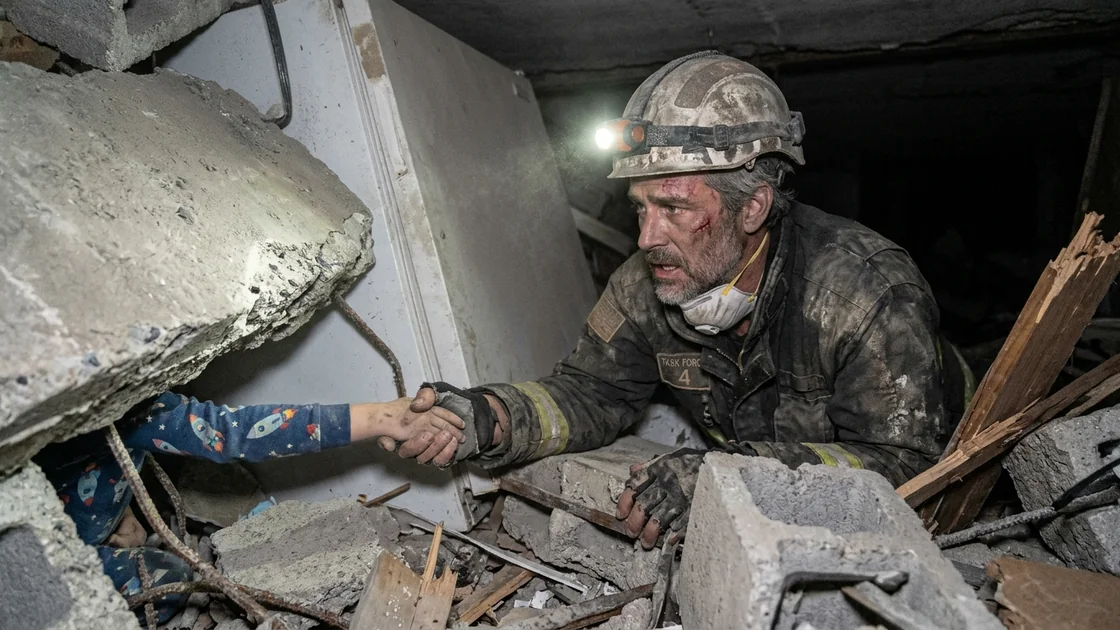
Arthur Pendelton is a veteran urban search and rescue specialist whose life unravels after the catastrophic collapse of the Oakhaven Residential Complex, where he fails to save a young boy named Toby trapped beneath the debris. Over the course of the narrative, Arthur is relentlessly haunted by the phantom sound of Toby's voice, driving him into isolation, substance abuse, and psychological torment as he abandons his career and marriage. Years later, when a secondary tremor at a nearby demolition site traps another child under terrifyingly similar circumstances, Arthur is forced out of his self-imposed exile to confront the crushing weight of his survivor's guilt, brave the shifting ruins one final time, and ultimately find a path toward redemption and peace.
The dust of a collapsed building does not settle like normal dust. It hangs in the air with a heavy, greasy malice, composed of pulverized concrete, shattered drywall, asbestos, fiberglass, and the atomized history of hundreds of human lives. To breathe it is to inhale ghosts. Arthur Pendelton knew this better than anyone in the metro division of Task Force 4, yet knowing the anatomy of the dust never stopped it from coating the back of his throat with the bitter taste of failure.
On the night the Oakhaven Residential Complex folded in on itself, the sky above the city was a bruised, starless purple, weeping a freezing November drizzle that turned the rising plumes of gray particulate into a thick, choking slurry. The twelve-story structure, built in the late seventies with substandard rebar and corners cut by long-dead contractors, had simply surrendered to a subterranean sinkhole caused by a ruptured water main. It was a pancake collapse. Floor upon floor had dropped vertically, stacking twelve levels of concrete slabs into a jagged, smoking mound barely thirty feet high.
Arthur was forty-two then, at the peak of his physical and professional prowess. He was a rescue specialist, a tunnel rat, the man they sent into the voids that made younger, broader men claustrophobic just looking at the entry points. He understood the physics of ruin. He knew how to read the tension in a bowed steel girder, how to listen to the groan of shifting weight, and how to carve a path through the belly of a concrete beast without waking it up.
"Command, this is Recon Two," Arthur had barked into his shoulder mic, his voice muffled by his N95 respirator. He was on his knees near the southwestern quadrant of the pile, where the stairwell had partially resisted the sheer drop, creating a series of triangular lean-to voids. "I've got an acoustic hit. Sector C. Deep."
Beside him, his canine handler, Sarah, pulled back on the leash of her golden retriever, Buster, whose tail was wagging with the frantic, high-pitched urgency that indicated live human scent.
"Copy that, Recon Two," crackled the voice of Battalion Chief Miller over the radio. "Structural engineers say that entire southwestern overhang is balanced on a sheared column. You've got thirty minutes before we have to pull everyone back to shore up the exterior with cranes. Do not breach deep without cribbing."
"Understood," Arthur lied.
He didn't have time for extensive wooden box-cribbing. When the canine alerted, and the acoustic listening devices—the DelSar seismic sensors—picked up rhythmic tapping, every second was measured in oxygen depletion and crush syndrome. Arthur stripped off his bulky turnout coat, keeping only his Kevlar knee pads, his helmet with its high-lumen headlamp, a crowbar, a reciprocating saw, and a snake camera.
He slid feet-first into a fissure no wider than a dishwasher.
The smell inside the void was an assault of ruptured sewage lines, leaking natural gas, and the metallic tang of wet iron. As he wriggled downward, the ambient roar of the rescue site—the diesel generators, the shouting firefighters, the wail of sirens—faded into a muffled, subterranean thrum. Here, in the dark, the building was still alive. It ticked and popped. Rebar pinged like over-tightened guitar strings. Concrete ground against concrete with the slow, tectonic inevitability of a glacier.
Arthur wormed his way twenty feet down an inclined plane of shattered kitchen tiles and splintered studs until the passage pinched off into a jagged bottleneck. He killed his headlamp to save battery and switched on the monitor of his fiber-optic snake camera, feeding the flexible black cable through a fist-sized gap in the cinderblocks ahead.
On the tiny, grainy LCD screen in his gloved hand, the infrared light illuminated a pocket no larger than a dog crate. There, pinned beneath a fallen refrigerator and a massive section of a precast concrete floor slab, was an arm. A small arm, clad in a blue pajama sleeve patterned with cartoon rockets.
Arthur’s heart hammered against his ribs, a familiar, icy adrenaline flooding his veins. He pressed his ear against the cold, damp concrete.
"Hello?" a voice piped up. It was reedy, thin, and terrifyingly polite. "Is somebody there? It’s very dark."
Arthur closed his eyes, steadying his breathing so his voice would carry absolute calm. In this line of work, panic was contagious; if the rescuer sounded scared, the victim went into shock. "Hey there, buddy. My name is Arthur. I’m a firefighter. I’m right on the other side of this wall. What’s your name?"
"Toby," the boy said. A cough rattled in the cramped space, wet and shallow. "I'm seven. My legs hurt, Arthur. Actually, I can't feel my feet anymore. Only the top part hurts."
Compartment syndrome. The crushing weight of the slab was cutting off circulation to the boy's lower extremities. Toxins—potassium, myoglobin, lactic acid—were building up in the starved muscle tissue. Even if Arthur got him out, the sudden release of pressure could send those toxins rushing back to Toby's heart, causing instant cardiac arrest unless paramedics were right there with sodium bicarbonate and massive IV fluids. They needed an open channel, and they needed it now.
"Recon Two to Command," Arthur whispered fiercely into his mic. "I have verbal contact. Male juvenile, seven years old, conscious and alert. Pinned by a primary slab, roughly twenty-five feet inside the Sector C void. I need a pneumatic strut, an airbag kit, and a rotary hammer brought to the hole immediately. And tell the medics to prep for severe crush syndrome."
"Arthur, negative," Miller’s voice came back, tight with tension. "The laser transits on the north wall just registered a two-inch shift. The whole pile is settling into the sinkhole. I’m sounding the air horns. Everyone off the pile."
"He’s seven, Chief! I’m looking at his hand!"
"If that slab drops another four inches, you’ll both be paste. Evacuate the void. That is a direct order, Pendelton."
Above him, muffled by tons of masonry, the three long blasts of the air horns echoed across the site—the universal signal for immediate abandonment of the Collapse Zone.
Arthur didn't move. He looked at the little LCD screen. The small hand in the rocket-ship pajamas was opening and closing, fingers grasping at the empty, dusty air.
"Arthur?" Toby’s voice trembled. "Did you go away? What's that loud noise?"
"I'm still here, Toby," Arthur said, ignoring the frantic screaming of his radio, which he promptly turned down to a whisper. "That noise is just the big trucks moving around outside. I’m going to make some noise of my own now, okay? I’m going to break this wall between us."
Using his crowbar and a short-handled sledgehammer he had dragged down by a rope, Arthur began to chip away at the cinderblock and tangled mesh blocking the passage. It was agonizingly slow work. He was lying on his stomach, unable to get any leverage, swinging the four-pound hammer using only the strength of his forearm and wrist. Sweat poured down his face, stinging his eyes, mixing with the gray paste on his skin. Every blow sent shockwaves up his arm, vibrating in his teeth.
"What's your favorite movie, Toby?" Arthur grunted between strikes. Clang. Crunch.
"Star Wars," the boy replied, his voice growing weaker, dreamier. "The one with the snow walkers. My dad has the Lego set, the big one, on the top shelf. He said when I turn eight we can build it together. Where is my dad? I yelled for him, but he didn't answer."
Arthur’s stomach knotted. On the crawl down, about ten feet back, he had passed a crushed bedroom. He had seen the unmistakable, grey-white pallor of an adult hand protruding from beneath a collapsed load-bearing beam, entirely devoid of life. He hadn't mentioned it on the radio.
"He's probably outside waiting for us with the doctors, buddy," Arthur lied, swinging the hammer harder. A chunk of cinderblock gave way. He dropped the hammer and tore at the jagged concrete with his Kevlar-gloved hands, ripping the fabric on the exposed wire mesh, slicing his own palms beneath. Blood mixed with the lime dust. "Keep talking to me, Toby. Tell me about the Legos."
"There's... there's four thousand pieces," Toby murmured. "You have to sort them by color first. That's the rule. Arthur? I'm getting really sleepy. And it's cold."
"Don't go to sleep, Toby! Hey, eyes open! Look at the little red light on my camera, can you see it?"
"Yeah. It looks like Rudolph."
Arthur finally tore a hole wide enough for his shoulders. He wriggled forward, the jagged teeth of the broken wall scraping against his ribs, tearing his shirt, until his head and arms were inside the tiny pocket. He switched on his headlamp at its lowest setting.
Toby was wedged at an impossible angle. The refrigerator had actually saved his upper body, acting as a rudimentary strut that held up a fractured beam, which in turn supported the massive floor slab. His lower half, from the waist down, was completely buried beneath the concrete. His face was covered in gray powder, bridged only by two clean tracks where tears had washed the dust away. His eyes were huge, brown, and terrifyingly trusting.
Arthur reached out and grabbed the boy’s small, cold hand. Toby gripped his thumb with surprising strength.
"See?" Arthur panted, trying to smile behind his dust mask, pulling it down so the boy could see his face. "I told you I was right here."
"You're bleeding," Toby whispered, looking at Arthur's torn gloves.
"Doesn't hurt a bit. Now, let me look at this heavy rock." Arthur assessed the geometry of the trap. It was a nightmare. Without hydraulic spreaders or high-pressure airbags, he couldn't lift the slab an inch. Even if he had them, the refrigerator was buckling. The metal casing was creased and groaning under the immense load.
Suddenly, a sound echoed through the ruins—a deep, resonant thrum, like a giant bass string being plucked underground.
The sinkhole was expanding.
Dust rained down from the ceiling of the void, blinding Arthur for a second. The refrigerator shrieked as its metal frame compressed another half-inch. Toby cried out, a sharp, high sound of pure agony.
"Arthur! Get out of there!" A voice wasn't coming from the radio anymore; it was coming from the tunnel behind him. Someone had crawled in after him. A heavy hand grabbed Arthur’s ankle. It was Miller himself, along with two guys from Squad 1. "The north crane just tipped! The whole pile is sliding into the crater! Pull him back!"
"No! I have him! I'm holding his hand!" Arthur screamed, bracing his free arm against the cinderblock wall as the men behind him began to haul on his boots. "Just give me a bag! Slide a flat-bag down here!"
"There is no time, the void is collapsing!" Miller roared.
The building gave another violent lurch. The concrete slab above them dropped two inches, hitting the top of the refrigerator with the sound of a cannon shot. The appliance buckled inward. The space was vanishing.
Toby’s grip on Arthur’s thumb tightened to a vise-like desperation. His wide brown eyes locked onto Arthur’s. The boy didn't scream anymore; the breath was being squeezed out of his lungs.
"Arthur," Toby gasped, a tiny, whistling whisper. "Don't let go. Please don't let me be in the dark."
"I've got you! I won't let go!" Arthur sobbed, his shoulder feeling like it was being ripped from its socket as the two burly rescuers behind him dragged him backward by his legs, using a webbing strap they had looped around his ankles.
"Pull!" Miller yelled.
Arthur’s fingers slipped. The sweat, the blood, and the greasy dust acted like lubricant. He hooked his fingers around Toby’s wrist, straining with every muscle in his back and neck, his fingernails digging into the boy's rocket-ship pajamas.
The building roared. A secondary pancake collapse initiated directly above Sector C.
With a violent yank from the men behind him, Arthur was ripped backward through the bottleneck just as the refrigerator finally failed. The multi-ton slab slammed down completely, sealing the breach with a deafening concussive blast of air that blew Arthur’s helmet off his head and filled his mouth with pulverised stone.
In the split second before the stone met the floor, before the darkness became absolute, Toby’s hand was torn from Arthur’s grasp.
The last thing Arthur heard, cutting cleanly through the roar of twenty thousand tons of falling concrete, was a faint, confused whisper: Arthur?
Three years later, the rain still sounded like shifting gravel.
Arthur sat at the kitchen table of his rented bungalow on the outskirts of the city, staring at a cup of black coffee that had gone cold two hours ago. The house was small, sparsely furnished, and obsessively quiet. He had removed all the ticking clocks during his first month there. He had unplugged the refrigerator because the hum of the compressor at night sounded too much like the groaning of stressed steel, choosing instead to live out of a cooler packed with ice he bought every two days from the corner gas station.
He was forty-five now, though the man reflected in the dark windowpane looked closer to sixty. He had lost thirty pounds, mostly muscle, leaving his frame gaunt and sharp-angled. A jagged white scar ran from his left temple down into his salt-and-pepper beard, a souvenir from the rebar that had grazed his skull when Miller dragged him out of the Oakhaven pile.
His wife, Elena, had lasted eighteen months after the collapse. She had tried everything—the department shrinks, the support groups for spouses of first responders, the quiet patience of a saint. She had held him when he woke up thrashing in the sheets, clawing at the drywall beside the bed until his fingernails bled, trying to dig through to the guest room.
She had endured the silence, the sudden rages, and the bottles of cheap bourbon hidden in the garage. What finally broke her wasn't his anger, nor his grief. It was his distraction. They would be sitting across from each other at dinner, or driving in the car, and Arthur would suddenly freeze, cocking his head toward an empty corner or a floor vent, his eyes wide with a terrifying, attentive alertness, whispering, “I’m right here, buddy. Keep talking.”
She left on a Tuesday in May. Arthur hadn't even heard the door close; he had been in the basement, listening to the water pipes.
A knock at the front door shattered the stillness of the bungalow.
Arthur flinched, his right hand instinctively gripping his left thumb—a nervous tic he hadn't been able to shake. He didn't answer. Nobody came here anymore. The guys from Task Force 4 had stopped dropping by with casseroles and six-packs a year ago, weary of being met by a deadbolt and drawn blinds.
The knock came again, louder, followed by the jingle of keys. The lock turned.
Arthur stood up, his chair scraping loudly against the linoleum, as Battalion Chief Miller stepped into the hallway, shaking out a wet umbrella. Miller had retired six months ago, though he still carried himself with the rigid, barrel-chested authority of a man used to commanding chaos.
"How did you get a key?" Arthur asked, his voice raspy from disuse.
"Elena gave it to me before she moved to Chicago," Miller said, his eyes sweeping over the dim, cold kitchen, lingering on the blue plastic cooler by the sink and the stack of unopened mail on the counter. Most of it was disability checks and medical bills. "She made me promise to check on you once a quarter. I’m a month late. Traffic was hell."
"You checked. I'm breathing. You can go, Frank."
Miller ignored him, walking over to the stove. He touched the kettle, found it cold, and sighed, leaning his heavy frame against the counter. "You look like hell, Artie."
"I sleep poorly."
"You sleeping at all?"
Arthur didn't answer. He looked down at his hands. The scars on his palms were pale, raised ridges. Whenever the barometric pressure dropped, they itched with a phantom heat.
"Today is November fourteenth," Miller said softly.
"I know what day it is."
"They dedicated the memorial park at the Oakhaven site this morning. The mayor was there. A lot of the families. I went." Miller paused, watching Arthur’s jaw clench. "Toby’s mother was there. She asked about you."
Arthur turned away, walking to the rain-streaked window. "She shouldn't even know my name."
"She knows you stayed in that hole when everyone else was ordered out. She knows it took four men and a winch to pull you out after the secondary collapse, and she knows you spent three days sitting on a folding chair in the mud while we dug down to recover his body." Miller took a step closer. "She doesn't blame you, Arthur. Nobody blames you. The engineers testified at the inquest—even with a twenty-ton crane right on top of that void, that slab was coming down. The sinkhole swallowed the foundation."
"I let go," Arthur said to the glass.
"You were pulled away. If I hadn't dragged you out, there would have been thirty-nine fatalities instead of thirty-eight."
"He asked me not to let him be in the dark, Frank. And I left him in the dark." Arthur turned around, his eyes bloodshot and fierce. "Have you ever thought about how long it took? What if the slab didn't kill him instantly? What if the refrigerator held just enough to keep his head clear, and he lay there in the pitch black, choking on dust, wondering why the firefighter lied to him?"
"The coroner said it was instantaneous," Miller said firmly, though it was a rehearsed line they had both heard a dozen times. "Blunt force trauma. He didn't suffer after the drop."
Arthur let out a bitter, hollow laugh. He tapped his temple. "Then why is he still talking to me, Frank? Huh? If it was instantaneous, why do I hear him every time it rains? Why is he under my floorboards at three in the morning telling me about his goddamn Star Wars Legos?"
Miller looked at his former friend with a mixture of profound pity and helplessness. "Are you taking the medication the VA doctor gave you?"
"It makes me deaf," Arthur muttered, pacing the small kitchen. "When I take the pills, everything gets foggy and quiet. What if he calls out and I can't hear him because I'm drugged up?"
"Artie, listen to yourself," Miller pleaded, grabbing Arthur by the shoulders. "He’s gone. The boy is at peace. You are the only one still trapped in that void. You never crawled out."
Arthur stared at Miller’s hands on his shoulders, then slowly reached up and pushed them off. "Thanks for stopping by, Chief. Lock the door on your way out."
Miller stood there for a long moment, the silence stretching between them, heavy with three years of unsaid things. Finally, the older man reached into his coat pocket and laid a laminated business card on the table next to the cold coffee.
"I'm consulting now," Miller said quietly. "Private sector. Teaching structural collapse safety and trench rescue to industrial demolition crews. It's easy work. Classroom stuff mostly, out at the training yard. I need an instructor who actually knows how to read a load path. Someone to teach these kids how not to get killed."
"I don't teach," Arthur said.
"Think about it," Miller replied, heading for the door. "The winter's coming, Artie. If you stay in this cold house much longer, you're not going to make it to spring."
The door clicked shut. Arthur waited until the sound of Miller’s pickup truck faded down the wet street before he looked at the card. He didn't touch it.
Instead, he walked down the narrow hallway to the basement door. He opened it and looked down into the unlit concrete stairwell. The smell of damp earth and old masonry rose up to meet him.
From the deepest, darkest corner behind the dead furnace, so faint it could have been the wind whistling through a cracked foundation vent, a small voice whispered.
Arthur? My legs hurt.
Arthur sat down on the top step, buried his face in his scarred hands, and wept.
December arrived with a brutal, dry freeze that locked the city in iron.
Arthur’s existence narrowed to a series of rigid rituals designed to minimize acoustic triggers. He wore noise-canceling headphones when he went to the grocery store at midnight, playing white noise—specifically the sound of ocean waves, as rain or wind sounded too much like falling debris. He avoided construction sites, rerouting his walks by miles if he saw the silhouette of a tower crane against the sky. He spent his days reading dense, utterly unrelated books—histories of eighteenth-century naval warfare, botany textbooks, anything that didn't involve architecture, engineering, or children.
Yet the auditory hallucinations, which his abandoned psychiatrist had clinically termed trauma-induced paracusia, were evolving.
At first, during the first year, it had just been the replay of the event: the tapping, the cough, the final cry. By the second year, it had become conversational, fragments of what Toby had said in the void repeating at random intervals. Now, in the dead of winter of the third year, the voice was improvising.
Arthur would be shaving in the bathroom mirror, the warm water running, and over the rush of the faucet, he would hear a distinct, muffled tapping coming from inside the medicine cabinet wall.
Tap. Tap. Tap.
Arthur would freeze, the razor poised against his jawline, a bead of blood welling up where his hand had twitched. He knew, intellectually, that it was the hot water expanding the copper pipes inside the wall studs. He knew the physics of thermal expansion.
Arthur? the pipe would whisper, resonant and metallic. Did you find my dad yet?
"You aren't there," Arthur would say aloud to his reflection, his voice trembling. "You're at Oak Ridge Cemetery. Plot 402. I went there. I saw the stone."
It's really cold in here, Arthur. You said the big trucks were just moving around outside. You said you wouldn't let go.
Arthur slammed his fist against the drywall beside the mirror, punching a jagged hole right through the plasterboard into the stud cavity. Insulation dust puffed out into the bathroom air, drifting down into the sink. He stared at the gray-pink powder settling on the porcelain. The sight of the dust triggered a visceral, Pavlovian wave of nausea. He dropped to his knees in front of the toilet and dry-heaved until his ribs ached.
When he finally wiped his mouth and leaned back against the cool tile wall, his eyes fell on the radiator.
Wedged deep between the cast-iron fins, where a previous tenant’s child must have dropped it years ago, was a tiny, dusty square of blue plastic.
A four-by-two Lego brick.
Arthur stared at it for ten minutes without blinking. His breathing grew shallow. Slowly, he reached out with two trembling fingers and plucked it from the radiator. It was real. It had weight and sharp corners. It was just a coincidence, a random piece of detritus in a fifty-year-old rental house.
He threw it in the trash can. Ten minutes later, he fished it out, washed the dust off it under the tap, and put it in his shirt pocket, right over his heart.
That night, he couldn't stay in the house. The walls felt like they were leaning inward, the ceiling bowing under an invisible, multi-ton weight. He put on his heavy wool coat, shoved his hands deep into his pockets, and walked.
His feet carried him, without conscious direction, across the river and into the old industrial district on the east side. It was two in the morning. The streets were deserted, coated in a thin glaze of black ice and road salt. He walked for five miles until his toes were numb, finally stopping in front of a newly landscaped square of land bordered by wrought-iron fencing.
Oakhaven Memorial Park.
Where the twelve-story monolith had once stood, there was now a sunken garden—an intentional design choice by the city architects to incorporate the stabilized sinkhole crater rather than pay to fill it in completely. Snow-dusted evergreens grew around the perimeter, and in the center stood a polished black granite wall inscribed with thirty-eight names in alphabetical order.
The gates were locked for the night, but the fence was only six feet high. With a flare of his old agility, Arthur hooked his fingers over the iron spikes and vaulted over, landing with a soft crunch in the frozen gravel path.
He walked down the gentle slope into the sunken garden. As he descended below street level, the ambient noise of the city—the distant hum of the highway, the wind in the power lines—dropped away, muffled by the earth berms surrounding the park.
His chest tightened. It felt like entering a trench.
He approached the granite wall, his breath pluming white in the freezing air. The moonlight glinted off the engraved letters. He didn't need a flashlight; he knew where the name was from the newspaper schematics he had memorized years ago. Third column, near the bottom.
TOBIAS JAMES VANCE. AGED 7.
Directly above it was ROBERT WILLIAM VANCE. AGED 36.
Arthur reached out, taking off his glove so his bare skin could touch the stone. The granite was fiercely cold, stealing the warmth from his fingertips instantly. He traced the grooves of the letters T-O-B-I-A-S.
"I tried," Arthur whispered to the stone. The silence of the park swallowed his words. "I broke my own fingers trying to hold onto your wrist. They had a strap around my legs, Toby. Four hundred pounds of pull. I couldn't anchor myself. There was nothing to hold onto."
The wind rustled the dry needles of the evergreens behind him.
For the first time in three years, there was no answer. No tapping. No phantom cough. Just the oppressive, monolithic silence of the dead.
Arthur sank to his knees in the snow in front of the wall, his forehead resting against the freezing granite below the boy's name. He stayed there as the frost crept into the knees of his jeans, numbing his legs—a dark irony that wasn't lost on him. He thought about staying there until he couldn't feel his feet either, until the cold slowed his heart and balanced the ledger. It would be so easy. A veteran rescue worker found frozen at the memorial site; the papers would call it a tragic postscript, the department would drape bunting over his station door, and the noise in his head would finally stop.
Suddenly, the ground beneath his knees vibrated.
Arthur’s head snapped up. It wasn't a hallucination. He placed both palms flat against the frozen earth.
Thump.
A low-frequency seismic wave rolled through the bedrock, rattling the iron fence around the park. Two seconds later, the sound wave arrived through the air—a deep, rolling boom coming from the south, down by the riverfront, followed by the unmistakable, cascading roar of thousands of tons of brick and steel surrendering to gravity.
Arthur stood up, his heart racing, his senses instantly sharpening with a terrifying, muscle-memory clarity. He climbed the earth berm to street level and looked south.
Three blocks away, rising above the silhouettes of the old textile warehouses along the river, a massive gray mushroom cloud of dust was billowing into the night sky, illuminated from beneath by the harsh amber glare of floodlights.
The old Pullman Grain Silos and the adjacent nineteenth-century foundry. They had been slated for demolition for months, a massive urban renewal project.
"Why are they blasting at two in the morning?" Arthur muttered to himself. You don't do controlled implosions in the middle of the night; OSHA regulations strictly forbade it due to visibility hazards for safety spotters.
Which meant it wasn't controlled.
Within sixty seconds, the distant wail of sirens began to stitch together from every quadrant of the city, converging on the riverfront. Fire engines, heavy rescue squads, ambulances, battalion chiefs.
Arthur stood on the outside of the memorial fence, shivering, watching the gray plume drift across the moon. His body was screaming at him to run the other way, to go back to his dark, quiet house, put on his headphones, and hide under the stairs.
Instead, he reached into his shirt pocket and felt the sharp plastic edges of the blue Lego brick.
He turned south and began to run.
When Arthur arrived at the perimeter of the foundry site ten minutes later, the scene was a chaotic mirror of his worst nightmares.
The six-story brick foundry, which had been undergoing selective interior gutting by a night crew of salvage contractors before the scheduled weekend implosion, had suffered a catastrophic premature failure. Someone had cut through a primary cast-iron tie rod on the third floor without realizing the entire eastern facade was leaning on it. Half the building had sheared away, collapsing inward and burying the lower levels in a mountain of nineteenth-century masonry, timber beams, and heavy industrial machinery.
The street was a sea of flashing red and blue strobe lights cutting through the thick brown fog of brick dust. Fire hoses were already being dragged toward the hydrants to set up dust-suppression misting lines.
Arthur stayed back behind the yellow police tape, pulling the collar of his coat up around his face, watching with the detached horror of a ghost observing his own funeral. He saw the big red rig of Heavy Rescue 4 pull up, air brakes hissing. Men he used to know—younger guys he had trained, now seasoned veterans themselves—jumped out of the cab, strapping on helmets and grabbing cribbing timber and paratech struts.
Near the mobile command post, a civilian in a high-visibility vest and a white hard hat was waving his arms frantically in the face of the incident commander, alongside a frantic woman clutching a torn jacket. And standing right beside the commander, wearing a civilian coat with a yellow "SAFETY CONSULTANT" vest thrown over it, was Frank Miller.
Miller must have been on site overseeing the night operations or lived close enough to catch the call on his scanner.
Arthur edged closer along the crowd line, drawn by the frantic pitch of the woman's voice.
"They're in the basement! The old boiler room!" the woman was screaming, tears carving mud tracks down her dusty face. She was dressed in the tattered clothes of the unhoused population that frequently camped in the abandoned industrial sectors along the river. "It was twenty degrees out, we went down through the coal chute to sleep by the old steam pipes! My son! My son and my brother are down there!"
"Ma'am, show me on the blueprint where the coal chute is," the Incident Commander—a guy named Vasquez who had taken over Arthur’s old squad—said urgently, spreading a laminated site map across the hood of his SUV.
"I don't know how to read a map!" she sobbed. "It's by the big green dumpster on the alley side! Please, Sammy is only nine! He has asthma!"
Arthur looked from the woman toward the alley side of the collapse.
The alley was gone. It was buried under thirty feet of twisted iron roof trusses and massive sandstone lintels that had fallen from the upper stories. Worse, the remaining half of the foundry—a towering, four-story sheer wall of unreinforced brick—was looming directly over that exact quadrant, swaying visibly in the river wind, completely detached from any lateral support.
"We can't put crews in the alley sector," the city engineer said, pointing up at the freestanding wall with a green laser pointer. "Look at the plumb line on that masonry. It’s four degrees off vertical and bowing at the second-floor ledger. One good gust off the river, or if we start vibrating the pile with heavy hydraulic tools, that entire curtain wall is going to peel off and drop five hundred tons of brick right on top of the basement."
"Then we shore it!" Vasquez barked.
"Shore a sixty-foot free-standing brick wall?" The engineer shook his head. "With what? We need a raker shore system the size of a bridge abutment, or we need to bring in the high-reach excavator to knock the wall down first."
"If you knock that wall down onto the pile, you’ll crush any void spaces in the boiler room!" Miller interjected, leaning over the hood. "If they're alive down there, dropping that wall kills them."
"And if I send my guys onto that pile right now and the wall comes down on its own, I lose a whole squad!" Vasquez countered, his face taut with the impossible calculus of command. "We wait for the heavy cranes to rig a catchment net or we breach from the north side and tunnel through the sub-basement foundation walls."
"Tunneling through four feet of nineteenth-century granite foundation will take six hours with core drills," Miller said grimly. "If the kid has asthma and that boiler room is full of pulverized lime mortar, he doesn't have six hours. He might not have sixty minutes."
Arthur stood ten feet away behind a police barricade, listening. His eyes traced the geometry of the ruin.
He didn't see chaos anymore. The fog in his brain, the three-year stupor of grief and whiskey, was burning away under the cold, bright light of a problem only he knew how to solve. He looked at the pile in the alley. The sandstone lintels hadn't pancaked flat like the concrete slabs at Oakhaven; they were massive, rectangular blocks that had tumbled against the heavy cast-iron boilers on the ground floor, creating a series of interlocking "A-frame" voids.
And he knew the foundry. Ten years ago, Task Force 4 had used the abandoned sub-basements of this exact building for confined-space training exercises before the developer bought it.
He ducked under the police tape.
"Hey! Back behind the line, pal!" a rookie patrolman shouted, reaching for Arthur’s arm.
Arthur sidestepped the grab with a fluid, practiced pivot and walked straight up to the command SUV.
"You don't go in from the alley, and you don't drill the north foundation," Arthur said.
Vasquez, Miller, and the engineer all spun around. Vasquez blinked, looking at the gaunt, bearded man in the wool coat, before recognition flashed in his eyes. "Pendelton? What the hell are you doing here?"
"Artie," Miller breathed, stepping forward. "Go home. Now. You shouldn't be near this."
Arthur ignored Miller's hand and pointed a scarred finger at the blueprint on the hood of the truck, right at the center of the building’s footprint. "In 1890, this foundry used water-powered trip hammers before they converted to steam. There’s a dry millrace—an arched brick culvert—that runs directly from the river seawall, underneath the main floor slab, and terminates at a drainage cistern right next to the old boiler room."
The engineer frowned, adjusting his glasses as he peered at the historical structural surveys attached to the demolition permit. He flipped through three pages of yellowed microfiche prints. "Son of a bitch. He's right. There's a thirty-six-inch brick storm drain running diagonally from the southwest retention wall. It bypasses the curtain wall fall-zone completely."
"Thirty-six inches?" Vasquez looked grim. "Wait—the main collapse dropped right on top of the center floor slab. That brick culvert is over a hundred years old. It’s gotta be crushed halfway through."
"Archways distribute load symmetrically," Arthur said, his voice dropping into the flat, hyper-focused cadence that used to earn him the nickname 'The Professor' on the pile. "Unless a point-load beam punched straight through the crown of the arch, the culvert will hold. Even if it's partially collapsed, a man without SCBA gear can belly-crawl a sixteen-inch clearance."
Vasquez looked at his rescue team standing by the rig—big guys in their twenties and thirties, built like linebackers, weighed down with fifty pounds of turnout gear, helmets, and harnesses. Then he looked at the blueprint. "A two-hundred-foot crawl through a partially collapsed, three-foot brick pipe under ten thousand tons of shifting rubble? If that curtain wall drops while someone is in that pipe, the shockwave will liquefy the brick. It's a coffin, Arthur. I can't order a man into an unshored, two-hundred-foot confined space with single-point egress."
"You don't have to order anyone," Arthur said. "I'm a civilian. You can't even stop me if I jump the seawall outside your perimeter."
"The hell I can't!" Miller roared, grabbing Arthur by the front of his coat and shoving him back against the side of the SUV. Miller leaned in close, his face inches from Arthur’s, speaking low so the boy's mother wouldn't hear. "Have you lost your mind? You haven't been in a hole in three years! You're forty-five, you're thirty pounds underweight, and the last time you were in the dark you lost your goddamned soul! If you get halfway down that pipe and freeze up, I can't send anyone in to get you!"
Arthur looked into Miller’s eyes. For the first time since the night in November, Arthur’s hands weren't shaking.
"Frank," Arthur said quietly. "If that boy dies in the dark while I stand out here in the cold, I’m going to go home and put a shotgun in my mouth. You know it, and I know it. Either way, I'm not surviving tonight unless I go down that pipe."
Miller stared at him, his grip tightening on the wool coat. The older man's jaw worked as he fought against every protocol, every regulation, and thirty years of command instinct. Behind them, the mother let out a wailing sob as the freestanding brick wall groaned in the wind, shedding a shower of loose mortar onto the pile with a sound like hissing snakes.
Miller looked back at Vasquez.
"He doesn't exist," Miller told the Incident Commander, his voice hard as iron. "He’s not on your accountability board. You didn't see him. Give me a portable radio on a tactical simplex channel, a snake cam, a Wonder Bar, and a pediatric trauma bag with two albuterol inhalers."
Vasquez hesitated for three seconds, looking from the leaning wall to the weeping mother, then nodded once toward the equipment tarp. "Tactical Channel 3. If the wall drops, we're not digging for you, Pendelton."
"I wouldn't ask you to," Arthur said.
Five minutes later, Arthur stood on the narrow, icy ledge of the river seawall, fifty yards southwest of the main collapse zone.
He had stripped off his heavy wool coat. He was wearing a borrowed Nomex flight suit that hung loosely on his thin frame, Kevlar gloves, knee pads, and a low-profile mountain climbing helmet with an LED headlamp. Strapped to his ankle by a six-foot tether of nylon webbing was a small canvas dry-bag containing a crowbar, a compact hydraulic bottle-jack, two dust masks, bottled water, an albuterol nebulizer, and an extra flashlight.
In front of him, set into the stone retaining wall six feet above the black, swirling water of the freezing river, was a rusted iron grate covering a dark circular opening.
Miller used a battery-powered angle grinder to slice through the rusted padlock and the two side hinges in a shower of orange sparks. Together, they yanked the heavy grate free and let it drop into the river with a dull splash.
A wave of stale, damp air rolled out of the pipe, smelling of river silt, centuries-old coal dust, and the sharp, unmistakable tang of freshly crushed limestone.
Arthur shone his headlamp into the aperture. The beam cut through the swirling dust, illuminating a curved tunnel of slimy red brick, barely three feet in diameter. About forty feet in, the floor of the tunnel sloped upward toward the foundations of the foundry, disappearing into a choke of fallen mortar and jagged stones.
Miller clipped a radio mic to the collar of Arthur’s flight suit. "Simplex Three. I’m going to stand right here on this ledge until you come out, Artie. Range through the dirt might be spotty, so keep transmissions short."
Arthur nodded, adjusting his respirator over his nose and mouth.
"Artie," Miller said, gripping his shoulder. "Listen to the building. Not your head. The building."
Arthur gave a single, sharp nod, dropped to his stomach on the icy stone, and slid headfirst into the pipe.
The transition from the freezing night air to the claustrophobic, damp interior of the millrace was instantaneous and suffocating. The brick walls were coated in a slick biofilm of frozen algae and soot, narrowing the space around his shoulders. As he pulled himself forward on his elbows and knees, the tether dragging the canvas bag scraped rhythmically against the masonry behind him.
Scrape. Thud. Scrape. Thud.
Fifty feet in, the ambient sounds of the sirens and generators outside vanished completely, swallowed by the earth. The darkness ahead of his headlamp beam was absolute—a thick, velvet black that seemed to push back against the light.
Arthur stopped at the fifty-foot mark, where the tunnel sloped upward beneath the footprint of the collapsed foundry. Here, the shockwave of the initial collapse had done its work. The crown of the brick arch had cracked laterally, dropping a mound of fractured masonry and frozen dirt that blocked two-thirds of the pipe's diameter.
A gap of barely fourteen inches remained at the very top of the arch.
Arthur lay still in the mud, his chest pressed against the cold brick, feeling the immense, crushing weight of the ruin directly above his spine. Ten thousand tons of iron and stone were resting on the soil just a few feet over his head. Every instinct in his hindbrain screamed that the arch was closing, that the bricks were pressing down on his shoulder blades.
His breathing sped up inside the respirator, hot and wet.
And right on cue, coming from the shadows of the rubble pile just ahead of him, he heard it.
Arthur?
Arthur froze, his fingers digging into the frozen silt between the bricks.
Arthur, it’s very dark in here. Why did you let go of my hand?
"Not now," Arthur whispered inside his mask, his eyes squeezing shut. Sweat broke out across his forehead despite the freezing cold. "Please, Toby, not now."
You have to sort them by color first, Arthur. That's the rule. My feet are cold.
Arthur opened his eyes and stared at the fourteen-inch gap at the top of the rubble choke. He looked at his left hand. He reached into the breast pocket of the borrowed flight suit, where he had transferred the small blue Lego brick before climbing down the seawall. He squeezed it through the fabric until the sharp corners bit into his palm.
"I'm coming for you," Arthur told the voice in his head, his tone firm, steady, and quiet. "I'm coming right now. So help me see."
The voice didn't vanish, but the panic receding from Arthur's chest took the sharp, paralyzing edge off the hallucination. He unclipped his helmet—it was too bulky to fit through the fourteen-inch gap—and held it in his left hand to use the light, pushing the tool bag ahead of him rather than dragging it behind.
He exhaled completely, collapsing his ribcage as much as humanly possible, and wriggled up onto the mound of broken brick, sliding into the narrow crescent at the top of the arch.
The bricks above scraped brutally against his back, while the jagged stones below dug into his stomach and chest. He was pinned. For a terrifying three seconds, neither his elbows nor his knees had enough purchase to move him forward or back. The earth groaned above him—a deep, settling shudder as the rescuers on the surface moved a piece of heavy equipment near the perimeter. Dust rained into his eyes.
Keep moving, he told himself, reverting to the cold, mechanical mantra he used to teach rookies in the training tubes. Inch by inch. Toes and fingers.
Using only the tips of his boots and the leverage of his fingertips hooked into the mortar joints of the ceiling, Arthur forced his torso through the pinch point, tearing the back of the flight suit and leaving a smear of skin and blood on the nineteenth-century brick. With a final, agonizing shove, his hips cleared the obstruction, and he slid down the far side of the debris mound.
He was directly beneath the foundry now.
The air here was noticeably warmer, heated by the residual warmth of the ruptured municipal steam lines that ran through the industrial district, and thick with the choking white fog of pulverized lime. He put his helmet back on and keyed the mic.
"Miller. I'm past the first choke. Roughly a hundred feet in. The arch is intact here, just spider-webbed."
A burst of heavy static answered him, through which Miller’s voice barely cut: "—copy—Artie—wind is picking up—wall shifted another half inch—hurry—"
Arthur crawled faster. The tunnel leveled out, and ahead of him, the brick culvert terminated at a heavy iron grate set into a thick stone wall—the old drainage cistern at the back of the boiler room.
Through the iron bars of the grate, Arthur didn't see an open room. He saw a tangled mountain of splintered floor joists, twisted steam pipes, and fallen brickwork that had filled the boiler room when the first floor collapsed into the basement.
He pressed his ear to the iron grate and held his breath.
Over the hiss of a leaking water pipe somewhere in the pile, he heard a sound. A high-pitched, rhythmic whistling.
Wheeze... cough-cough... wheeze.
Bronchospasm. That wasn't a ghost. No memory of Oakhaven sounded like an acute asthma attack.
"Hello!" Arthur called out, projecting his voice through the bars into the tangled mass of timber and stone. "Fire Department! Can you hear me?"
For a second, there was only the hiss of water. Then, muffled and coming from somewhere up and to the right inside the rubble pile, a man's voice answered, hoarse and weak.
"Down here! We're here! Help us, please, my nephew can't breathe!"
Arthur shone his headlamp through the grate. The iron bars were set into the stone mortar with lead caulking, rusted to the thickness of pencils at the base from a century of dampness. Arthur pulled the crowbar from his bag, wedged the flattened claw behind the bottom rail of the grate, and braced both boots against the curving wall of the tunnel.
He pulled with everything he had, his back muscles screaming, veins bulging in his neck. With a sharp crack of brittle cast iron, the bottom two hinges snapped. He kicked the grate inward; it fell with a clatter onto the rubble inside the boiler room.
Arthur crawled out of the pipe and into the belly of the collapse.
He was inside a triangular lean-to void created by one of the massive cylindrical cast-iron boilers. When the floor above had caved in, a giant wooden main beam—solid nineteenth-century old-growth heart pine, eighteen inches thick—had fallen across the top of the iron boiler, holding up the mountain of brick and machinery like the ridgepole of a tent.
Crawling ten feet up the inclined floor of rubble underneath the shelter of the massive beam, Arthur found them.
A man in his thirties was lying on his back, his right leg twisted beneath a fallen radiator and a mound of masonry. Cradled on top of the man's chest, keeping him out of the freezing mud and broken glass on the floor, was a small boy wrapped in an oversized, filthy puffer jacket.
The boy’s face was pale gray beneath the dust, his lips tinged with the bluish hue of cyanosis. Every breath he took was a desperate, sucking struggle as his chest retracted sharply against his ribs.
"Oh, thank God," the man sobbed, blinking furiously against Arthur’s headlamp. "Thank God. I'm Marcus. This is Sammy. His inhaler got crushed when the ceiling came down. He's fading out on me, man, he can't get any air in."
"I've got him, Marcus. My name is Arthur," Arthur said, immediately tearing open his canvas bag. He pulled out the pediatric mask and the albuterol MDI inhaler with a spacer chamber. "Hey, Sammy. Look at me, buddy. I know it feels like you're breathing through a straw right now, okay? We're going to fix that."
Sammy’s eyes were wide, terrified, and glassy with hypoxia. He looked so much like Toby—not in his features, for Sammy was dark-skinned with tight curls matted with white plaster dust, while Toby had been fair—but in the sheer, helpless fragility of a child trapped in a world of adult stone.
Arthur fitted the silicone mask over Sammy’s nose and mouth, depressed the canister twice, releasing a mist of bronchodilator into the spacer chamber. "Breathe that in for me, Sammy. Slow as you can. Just sip it. One, two, three... hold it... good boy. Again."
After four puffs over two minutes, the terrifying whistling in the boy’s chest began to soften. The cruel spasm in his airways relaxed under the medication, and Sammy took a deep, ragged, shuddering breath, followed by a coughing fit that brought up gray mucus. Color began to creep back into his lips.
"Is that better?" Arthur asked softly, wiping the boy's face with a clean corner of his sleeve.
Sammy nodded weakly, his small hand reaching out and grabbing the collar of Arthur’s flight suit. "Are we... are we gonna die down here?"
Arthur froze for a fraction of a second as the boy's fingers gripped him. The phantom voice in his ears whispered—Don't let me be in the dark—and then, for the first time in three years, the phantom voice went quiet, waiting to see what Arthur would do.
"Not tonight, Sammy," Arthur said, and he meant it with every fiber of his being. "Nobody's dying in the dark tonight. Now, sit tight right here on your uncle's chest while I look at his leg."
Arthur crawled down to examine Marcus’s entrapment. It wasn't a multi-ton concrete slab like Oakhaven. The radiator was heavy cast iron, maybe three hundred pounds, wedged down by a tangle of broken floor joists and loose brick that had spilled from the floor above. Marcus’s tibia was almost certainly fractured, judging by the swelling inside his boot, and the foot was pinned tight, but there wasn't enough weight or duration to cause lethal crush syndrome.
"Can you feel your toes, Marcus?"
"Yeah, they feel like they're on fire," Marcus grimaced, gritting his teeth.
"Good. Pain means circulation." Arthur pulled the compact hydraulic bottle-jack and the crowbar from his bag. He cleared away a dozen loose bricks by hand, careful not to disturb the keystones that were wedging the floor joists against the boiler. He positioned the base of the jack on a flat chunk of foundation stone directly beneath the corner of the cast-iron radiator and began to pump the handle.
With each stroke, the hydraulic ram rose a quarter of an inch. The iron radiator groaned against the wooden joists above it.
Suddenly, a massive concussive BOOM shook the entire subterranean world.
It wasn't an explosion; it was the sound of five hundred tons of brick hitting the pile forty feet above their heads.
The freestanding eastern curtain wall had finally fallen.
The shockwave slammed down through the rubble like a giant fist. The massive heart-pine beam resting on top of the boiler shrieked, bowing downward by three inches and splitting down the grain with a sound like a rifle shot. Tons of loose brick and lime mortar cascaded down the sides of the boiler, sealing off the upper end of the lean-to void and burying the iron cistern grate behind Arthur in a wall of fresh debris.
The air turned completely opaque with white dust. Arthur threw himself over Sammy and Marcus, shielding the boy's face with his own body as chunks of masonry rained down around them, one bouncing painfully off Arthur’s helmeted head, another smashing into his left shoulder blade.
For ten agonizing seconds, the world was nothing but roaring noise, shaking earth, and suffocating dust.
Then, the rubble settled. A sinister ticking sound filled the cramped pocket as the cracked wooden beam above them adjusted to the new, catastrophic load.
"Arthur!" Miller’s voice screamed over the radio, barely audible through a wall of static. "Arthur, the curtain wall just dropped straight onto the alley pile! The whole site just pancaked five feet! Do you copy?!"
Arthur coughed, spitting out grit, and raised himself off Sammy. His left shoulder felt like a hot poker was jammed into the joint—a dislocated clavicle or a cracked scapula, he couldn't tell—but his arm still worked. He quickly fitted one of the spare N95 dust masks over Sammy's face and handed the other to Marcus before keying his mic.
"I copy, Frank! We're alive! The main boiler took the brunt of the load, I have both victims in a secondary pocket!"
"Get out now! The engineers say the boiler room roof slab is shearing! You've got minutes before that timber beam snaps completely!"
Arthur shone his headlamp back toward the cistern grate—the entrance to the brick millrace pipe.
The collapse had dropped a cascade of broken joists and brickwork right in front of the opening, reducing the exit to a narrow, jagged chute. Worse, the bottle-jack under Marcus’s leg had been knocked sideways by the tremor, dropping the radiator right back down onto the man's ankle, pinning him deeper than before as the joists above compressed.
"My leg!" Marcus cried out, thrashing in panic as the space around them visibly shrank, the cracked pine beam above groaning under the shifting mountain of brick. "It's crushing my leg! Take the boy! Just take Sammy and go!"
"Uncle Marcus, no!" Sammy screamed behind his mask, grabbing his uncle’s coat.
Arthur looked at the beam overhead. A jagged fissure was widening along its underside, splintering fibers of hundred-year-old wood popping one by one. Ping. Pop. Crack.
It was Oakhaven all over again. The shrinking void. The ticking clock. The impossible weight.
For a split second, the terror threatened to paralyze him. His heart hammered against his ribs, and the walls of the boiler room seemed to rush inward. He could take Sammy right now, dive through the narrowing chute into the pipe, and save the boy. If he stayed to free Marcus, the beam could fail in thirty seconds and bury all three of them.
Then Arthur looked at Sammy’s terrified eyes above the white paper mask. If he left Marcus behind to be crushed to death two feet away from his nephew, Sammy would spend the rest of his life just like Arthur—living in a cold house, listening to the pipes, haunted by a voice in the dark.
"Nobody stays behind," Arthur snarled, a ferocious, defiant clarity flooding his veins.
He didn't bother resetting the slow hydraulic jack. There was no time. He grabbed the thirty-inch steel crowbar, jammed the chisel end underneath the radiator, using a chunk of broken granite as a fulcrum, and threw his entire body weight onto the bar, pressing down with both hands despite the blinding agony in his injured left shoulder.
"Marcus, when I yell, you pull your foot out of that boot!" Arthur roared, his face purple with strain behind his respirator. "Leave the boot! Unlace it now!"
Marcus fumbled frantically with his work boot laces with trembling hands.
Above them, the pine beam gave a loud CRACK, dropping another inch. A shower of brick dust poured straight down onto Arthur’s helmet.
"Now!" Arthur screamed, throwing his chest onto the crowbar, lifting his own feet off the ground so every ounce of his hundred-and-sixty-pound frame was levering against the iron radiator. Something in his left shoulder tore with a wet pop, a white-hot flash of pain exploding behind his eyes, but the radiator lifted two inches.
Marcus screamed as he wrenched his fractured ankle out of the unlaced leather boot, tearing his sock, and dragged himself backward toward the cistern grate.
Arthur let go of the bar. The radiator slammed down, flattening the empty leather boot completely.
"Into the pipe! Marcus, go headfirst, I’ll push Sammy behind you!" Arthur barked, shoving the injured man toward the jagged opening of the brick drain.
Marcus bellied through the rubble choke at the grate, groaning as he dragged his broken leg into the thirty-six-inch pipe. Arthur grabbed Sammy around the waist, lifting the seventy-pound boy with his good right arm while guiding him with his throbbing left.
Just as Sammy’s head and shoulders cleared the cistern grate into the pipe, the great heart-pine beam above the boiler finally surrendered.
With a sound like a thunderclap in a closet, the eighteen-inch timber snapped in half.
The roof of the boiler room came down.
Arthur didn't pull back. He lunged forward, throwing his upper body through the cistern grate on top of Sammy’s legs and shoving the boy forward into the brick tunnel with all the strength left in his right arm.
A massive chunk of sandstone lintel dropped squarely across the cistern opening behind Arthur, missing his hips by inches, while a cascade of loose bricks and fractured timber slammed down onto his lower legs from the knees down, pinning his boots right at the threshold of the pipe.
The air was blasted out of Arthur’s lungs. The world went black for a few seconds, replaced by a high, ringing silence.
When his vision cleared, his headlamp was flickering, the lens cracked. His head, torso, and thighs were safely inside the circular brick arch of the millrace pipe. From the knees down, sticking out into the boiler room, his legs were buried under a heavy avalanche of brick and splintered wood.
Ahead of him in the pipe, Sammy was crying, scrambling backward in the tight space to grab Arthur’s hands.
"Arthur! Arthur, move!" Sammy cried, pulling impotently at Arthur’s wrists.
"I'm stuck, buddy," Arthur wheezed, coughing up lime dust. He tried to pull his knees forward. Nothing moved. The bricks had wedged his calves tightly against the bottom iron lip of the broken grate. Thankfully, the sandstone lintel had bridged across the top of the grate opening, acting as a natural header that stopped the rest of the building from crushing his spine, but the debris beneath it had him locked like a badger in a trap.
And worse—the impact had ruptured a main water line in the boiler room.
Behind him, in the pitch-black ruin of the basement, he heard the unmistakable, roaring gush of a broken six-inch cast-iron water main. Freezing river water was pouring into the collapsed void, and since theboiler room was completely filled with rubble, the water had only one place to drain.
Into the thirty-six-inch millrace pipe.
Within seconds, a torrent of icy, black water mixed with coal slurry and plaster came surging around Arthur’s pinned legs, rushing down the floor of the brick tunnel beneath his stomach, four inches deep and rising fast.
"Marcus!" Arthur shouted down the pipe. "Take Sammy and crawl! The water main broke! The pipe is going to flood at the low point by the pinch!"
"We're not leaving you!" Marcus yelled back, twenty feet ahead in the dark tunnel, his voice echoing off the wet bricks.
"If that water fills the fourteen-inch gap at the rubble mound, none of us get out! You have to get Sammy through the pinch point before the water seals it!" Arthur looked at Sammy, whose face was six inches from his own in the flickering light of his cracked headlamp. The boy was shivering violently as the freezing water rushed under his chest. "Sammy, look at me!"
"I don't want to leave you in the dark!" Sammy sobbed, his small hands gripping Arthur’s scarred thumbs.
Arthur’s heart broke and healed all at once in the span of a single heartbeat. He looked down at the small brown hands holding his thumbs. He was forty-five years old, pinned in the dark beneath a collapsed building, freezing water rising around his chest, and a child was holding his hand, begging not to leave him behind.
"Sammy," Arthur said, his voice impossibly gentle, cutting cleanly through the roar of the rushing water. "You're not leaving me in the dark. You're going to lead the way out. Somebody has to show me where the light is, right? Can you do that for me? Can you help your uncle get through the tight spot up ahead?"
Sammy looked at him, tears mixing with the gray mud on his cheeks, then gave a jerky, brave nod.
"That's my partner," Arthur said, gently unclasping the boy's fingers from his thumbs and giving him a firm push down the tunnel toward Marcus. "Go! Fast as you can! Don't look back!"
Sammy scrambled backward on his elbows and knees down the brick slope, disappearing into the gloom where Marcus grabbed him and began the agonizing crawl toward the river seawall.
Arthur was alone.
The freezing water was now six inches deep, damming up against his body because his torso was blocking half the pipe's diameter. It washed over his chin, numbing his skin, stealing his body heat with lethal speed. His shoulder was throbbing with a dull, sickening ache, and he could no longer feel his feet beneath the bricks—though whether from the crushing weight or the forty-degree water, he didn't know.
He keyed the soaked radio mic on his collar. "Miller. Do you read me?"
Only a faint hiss of static answered, followed by a garbled fragment: "—Artie—say again—we see water pouring out of the culvert—"
"I've got both victims moving toward the exit!" Arthur shouted into the mic, praying the signal bounced down the wet brick tube. "Adult male has a fractured right ankle, juvenile is ambulatory! They’ll hit the rubble choke fifty feet from the seawall in two minutes! You might need to go in thirty feet from the river side to pull the man through!"
He paused, letting the cold water wash around his cheek as he laid his head down on his right forearm.
"I'm pinned at the cistern grate," Arthur added quietly into the mic, though he doubted it was transmitting anymore now that the battery pack at his waist was submerged. "Secondary collapse caught my legs. Don't send anyone past the pinch point, Frank. The water's rising too fast."
The radio died completely with a soft electronic pop as the water shorted the housing.
Then, the cracked LED headlamp on his helmet flickered twice, dimmed to a dull orange glow, and went out.
The darkness was instantaneous and absolute.
It was a blackness so total that opening or closing his eyes made no difference. There was only the roar of the freezing water rushing past his ribs, the smell of wet lime and ancient soot, and the immense, silent weight of the broken foundry resting above him.
Arthur lay there in the cold, waiting for the terror. He waited for the claustrophobia to claw at his throat.
And then, in the darkness right beside his ear, very clear and completely unafraid, the voice spoke.
You didn't let go this time, Arthur.
Arthur let out a long, shuddering breath in the pitch black, a tear rolling down his nose to drop into the rushing water.
"I tried not to let go of you either, Toby," Arthur said aloud into the dark pipe. "I'm so sorry I couldn't get you out."
I know, the boy's voice whispered, sounding warmer now, no longer cold, no longer coughing or in pain. It sounded the way a seven-year-old boy should sound when he's safe in bed on a rainy night. You stayed with me until the trucks came. You held my hand the whole time. You don't have to stay in the hole anymore, Arthur. We sorted all the pieces.
"I can't get my legs out, buddy," Arthur murmured, the hypothermia beginning to make him sleepy, a strange, floating warmth stealing over his limbs as the freezing water rose toward his mouth, forcing him to tilt his head back against the slimy brick ceiling of the arch. "I think I have to stay."
Look at your bootlaces, Arthur. Like you told Marcus.
Arthur blinked in the dark.
His boots. He was wearing his own heavy, steel-toed leather tactical boots—the ones he had laced up only halfway when he ran out of his house two hours ago to go to the memorial park, tucking the loose laces inside the tops rather than tying them all the way up the ankle hooks.
And the water rushing past his body wasn't just flooding the tunnel; it was eroding the mud, mortar dust, and loose gravel beneath the bricks that were pinning his calves against the grate.
A surge of pure, stubborn survival instinct—something he hadn't felt in over a thousand days—ignited in Arthur’s chest. He didn't want to die here. For the first time in three years, he wanted to see the sky.
Holding his breath as the rising water washed over his nose, Arthur reached back along his body with his good right hand, feeling blindly down his thigh in the icy current until he grabbed the waistband of his borrowed flight suit. He hooked his fingers under the heavy nylon belt.
He pointed his toes straight down inside the oversized leather boots, flexing his ankles to make his heels as narrow as possible, and pulled himself forward with his right elbow while kicking violently against the loosening bricks in the rushing water.
The wet mud and pulverized mortar acted like grease. With a agonizing wrench that tore the skin off his shins and sprained his left knee, his right foot slipped completely out of his half-laced boot.
Having one leg free gave him leverage. He brought his bare, freezing right foot up under his hip inside the pipe, braced his heel against the iron lip of the broken grate, and shoved forward with every last reserve of strength in his quadriceps.
His left foot tore free from its boot, leaving both shoes buried under the rubble in the boiler room.
Arthur shot forward into the tunnel, carried along by the surging current of the broken water main.
He couldn't see a thing. He was completely blind, missing both boots, his left shoulder useless, crawling on one knee and one elbow through a pitch-black, three-foot brick pipe that was now half-full of forty-degree water. He didn't need to see. He knew the topography of the hole by touch and memory.
He scrambled down the hundred-foot straightaway, the rushing water actually helping push his light frame toward the river. Within two minutes, his outstretched right hand hit the upward slope of the rubble choke—the fourteen-inch pinch point.
And here, just as he had feared, the water was pooling at the base of the mound before trickling through the rubble, leaving only six inches of air space below the cracked brick ceiling at the approach.
Suddenly, a bright beam of white light stabbed through the fourteen-inch gap at the top of the mound, illuminating the swirling, muddy water.
"Artie!" Miller’s voice boomed down the narrow cylinder, echoing off the water. "We got the kid and the uncle out! They're on the seawall! Are you in there?!"
"Here!" Arthur gasped, tilting his head back so his mouth stayed in the shrinking pocket of air at the roof of the pipe. He pulled himself up onto the submerged pile of jagged bricks, his bare feet slicing open on the sharp masonry beneath the water without him even feeling it.
He reached the fourteen-inch gap at the top of the mound. Two hands encased in heavy structural firefighting gloves reached through the gap from the other side, grabbing the collar of Arthur’s flight suit and his good right wrist. It was Vasquez, who had crawled fifty feet in from the seawall himself to meet him at the choke.
"Hold your breath, Artie, I'm gonna yank you through the mud!" Vasquez yelled.
Arthur took one last gulp of dusty air, flattened himself against the slimy stones, and let Vasquez and the rope team behind him haul him brutally through the narrow slot. Bricks ground against his broken shoulder, sending stars exploding across his vision, and muddy water filled his nose and mouth for three terrifying seconds before his head and chest popped out into the wider, dry slope on the river side of the mound.
Hands grabbed his belt, his arms, his legs, passing him backward down the remaining fifty feet of the pipe like a human conveyor belt until, all at once, the brick walls disappeared.
Arthur was pulled out onto the icy stone ledge of the seawall beneath the vast, open expanse of the winter sky.
He rolled onto his side on the snow-covered concrete, coughing up muddy river water, shivering so violently his teeth rattled like castanets. Around him, the world was a symphony of noise and light—rotors of a news helicopter thumping overhead, the roar of diesel engines, paramedics shouting as they strapped thermal blankets around him and lifted him onto a Stokes basket to hoist him up to street level.
As the crane hoist lifted the stretcher up the side of the seawall and onto the street beside the ambulances, Arthur turned his head through the mist of an oxygen mask they had strapped to his face.
Ten feet away, sitting on the back bumper of an ambulance wrapped in a foil space blanket, was Sammy. The boy was breathing steadily into a nebulizer mask, his mother holding him so tightly she was practically lifting him off the bumper, sobbing into his dusty hair while paramedics splinted Marcus’s leg on a gurney beside them.
Sammy looked over across the chaotic street, past the flashing red lights and the hurrying firefighters. His dark eyes locked onto Arthur’s on the stretcher.
The boy raised one small hand from beneath the foil blanket and gave a weak wave.
Arthur tried to wave back, couldn't lift his strapped-down arms, and instead gave a slow blink and a nod.
Miller walked alongside Arthur’s gurney as they wheeled him toward the back of Medic 7, the older man's face streaked with mud and sweat, his "SAFETY CONSULTANT" vest ruined from where he had crawled halfway into the pipe behind Vasquez.
"You're an idiot, Pendelton," Miller said, his voice cracking as he squeezed Arthur’s bare, bleeding foot through the thermal blanket. "A complete goddamn lunatic."
Arthur pulled the oxygen mask down an inch with his right hand. His lips were blue, his face covered in gray lime paste and blood from his forehead, but his eyes were clear. Clearer than they had been in three years.
"Listen to that, Frank," Arthur whispered hoarse and weak.
Miller frowned, leaning down as the paramedics lifted the gurney into the warm cab of the ambulance. "Listen to what? The sirens?"
"No," Arthur said, closing his eyes as the ambulance doors swung shut, sealing out the roar of the city and leaving only the steady, rhythmic beep of his own heart monitor. "The quiet."
Spring came early that year, arriving in late March with a week of warm, gentle rain that washed the gray salt spindles and winter grit from the city streets into the storm drains.
Arthur stood in the middle of the concrete training yard at the Regional Fire Academy on the outskirts of town, wearing a clean blue work shirt, heavy boots—a brand new pair, laced all the way to the top hooks—and a white instructor’s helmet. His left arm was out of the sling now, though the doctors told him he would never have more than eighty percent range of motion in the shoulder again, and a slight limp lingered in his left knee when the weather turned damp.
In front of him stood twelve young firefighters in fresh turnout gear, their faces eager and unlined, standing around a massive training pile of broken concrete slabs, twisted rebar, and timber beams designed to simulate a commercial building collapse.
"Before you ever pick up a rotary saw or a hydraulic spreader," Arthur said, his voice carrying clearly across the wet asphalt without him needing to shout, "you shut off your engines, you tell everyone on the pile to freeze, and you listen. A collapsed building isn't dead. It's a machine under tension. If you don't respect the load path, it will kill you and the person you're trying to save."
He walked over to a triangular lean-to void at the base of the concrete pile and tapped a wooden box-cribbing stack with a steel crowbar.
"Who can tell me where the primary shear point is on this slab?"
As two of the recruits stepped forward to debate the angle of the concrete, Arthur stepped back, letting the gentle April rain patter against the brim of his helmet.
He had moved out of the dark bungalow in February, moving into a bright, second-floor apartment near the park with big windows that let in the morning sun. He had bought a new refrigerator; the hum of the compressor at night didn't bother him anymore. Two weeks ago, he had even met Elena for coffee when she came into town to visit her sister. They hadn't talked about getting back together—some structures, once collapsed, had to be rebuilt into something entirely new rather than forced back into their old blueprints—but she had held his scarred hand across the table and smiled when she saw that he wasn't looking at the corners of the room anymore.
Arthur reached into the pocket of his work shirt as the recruits argued over where to place the pneumatic struts. His fingers brushed against a small, smooth square of blue plastic. He kept it there, right next to his metro transit pass and a newspaper clipping of a nine-year-old boy named Sammy smiling from a hospital bed.
The rain fell harder, drumming against the concrete slabs of the training pile, trickling down through the dark voids and crevices beneath the rubble.
Arthur closed his eyes for a moment and listened to the sound of the water running through the stones. There was no tapping. There was no coughing, and no voice calling his name in the dark. There was only the rain washing the dust away, and the steady, quiet beat of his own heart.
"Alright," Arthur said, opening his eyes and stepping back up to the pile alongside the young rescuers. "Show me how you build a shore that won't let go."