Beneath the Covered Glass
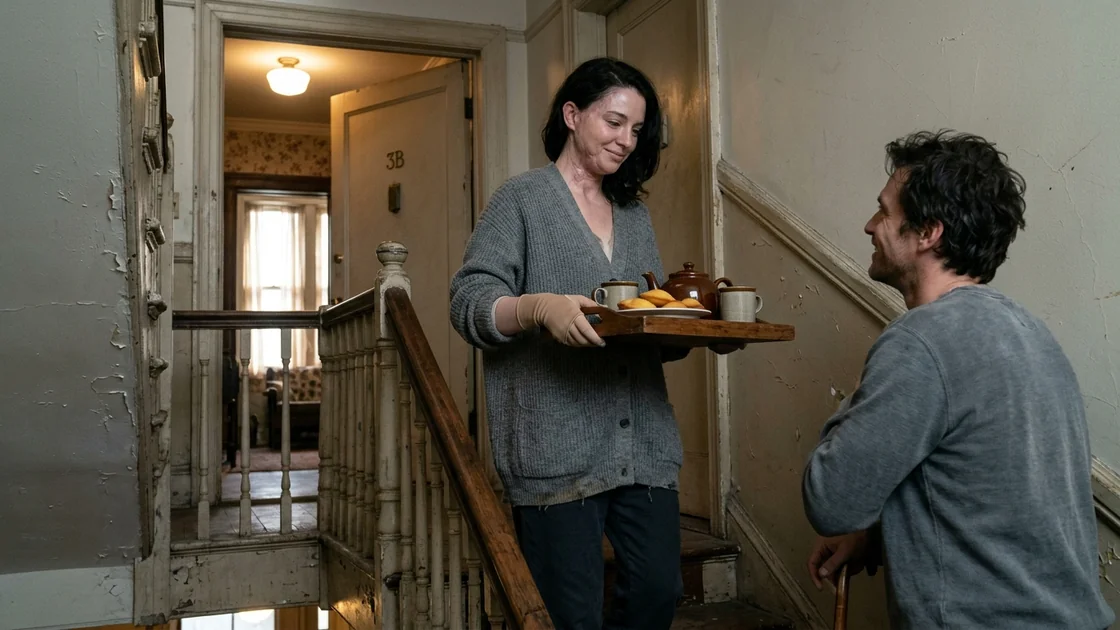
Clara Vance survived the catastrophic kitchen fire that destroyed her culinary career, but the physical and emotional scars left behind have trapped her inside her third-floor apartment for fourteen months. Terrified of her own reflection and the inevitable stares of strangers, she has systematically covered every mirror and reflective surface in her home, existing in a twilight world of deliveries and faded memories. Through the persistent, gentle intrusion of a new neighbor who communicates through music and shared solitude, and the grueling routines of her physical therapy, Clara slowly confronts the trauma of the blaze. Her journey takes her from the suffocating safety of her darkened rooms to the terrifying threshold of her front door, culminating in the moment she finally removes the linen sheets from the glass and steps out into the unforgiving light of the autumn afternoon.
The apartment existed in a perpetual state of dusk. Clara preferred it that way, not because the light hurt her eyes, though the lingering photophobia from the smoke inhalation sometimes made them ache, but because light had a habit of bouncing. Light was treacherous. It hit the glass of the framed botanical prints in the hallway, the black screen of the television, the polished stainless steel of the toaster she no longer used, and the brass doorknob of the front door. Wherever light went, it tried to give her back to herself, and Clara had spent the last four hundred and twenty days refusing the gift.
She moved through the living room with the practiced, shuffling gait of someone navigating a space by memory rather than sight. Her left hand, encased in a beige compression glove that extended up past her elbow to disappear beneath the loose sleeve of a cotton cardigan, trailed along the floral wallpaper. The texture of the paper was familiar—slightly raised, peeling near the baseboards where the radiator hissed during the winter months. The radiator was cold now. It was October, that crisp, transitional middle ground where the air outside smelled of decaying leaves and exhaust fumes, a scent that seeped through the imperfect seal of the sash windows.
Clara stopped in front of the mantlepiece. Above it hung a large, ornate frame that had once held a beveled mirror inherited from her grandmother. Now, it held a double layer of heavy navy-blue flannel, pinned tightly to the wooden backing with brass thumbtacks. She reached up with her right hand—her unblemished hand, the one that still looked like it belonged to a thirty-two-year-old sous-chef—and adjusted the corner of the fabric. It hadn't slipped, not even a millimeter, since she had checked it two hours ago, yet the compulsion to ensure its security remained the central anchor of her morning routine.
In the bathroom, the medicine cabinet was swathed in an old linen tablecloth secured with grey duct tape. The silver faucet had been dulled with a thick coat of matte grey primer she had ordered online during her second week home from the burn unit. Even the toaster had been banished to the bottom cupboard beneath the sink, wrapped in a plastic grocery bag. She ate things that did not require shiny appliances. She ate bread warmed in a cast-iron skillet, soup heated in dark enamel pots, and fruit she peeled with a ceramic paring knife whose blade was a dull, non-reflective white.
The skin on the left side of her face pulled tight as she swallowed. It always felt too small for her skull, a patchwork of grafted tissue taken from her thigh that lacked the elasticity of the original design. When the barometric pressure dropped, as it was doing today ahead of an autumn rainstorm, the scar tissue itched with a phantom, subterranean heat—a cruel somatic echo of the grease fire that had erupted in the cramped galley kitchen of L’Orage.
She walked into her own kitchen, a narrow room with yellow linoleum floors that had seen better decades. She filled the dark blue kettle from the tap, listening to the change in pitch as the water rose. She didn't look down into the basin; a pool of standing water was just another mirror waiting to settle.
Setting the kettle on the gas burner, she hesitated, her thumb hovering over the plastic igniter. This was her daily penance, recommended by Dr. Aris, her therapist, whom she spoke to exclusively via audio-only calls twice a week. Exposure, Aris called it. Small, controlled negotiations with the enemy.
Clara pressed the button. The igniter clicked—tick, tick, tick—and then the crown of blue flame bloomed with a soft whoosh.
Her heart immediately hammered against her ribs, a frantic bird trapped in a cage. The muscles in her neck contracted, pulling her chin slightly toward her left shoulder, the defensive posture her body had adopted during the three months she spent wrapped in gauze at Saint Jude’s. Her breath came shallow and fast, tasting of copper.
It is three inches tall, she told herself, gripping the edge of the laminate counter until her fingernails turned white. It is contained by cast iron. It is fed by a valve I control. It is blue, not orange. There is no grease.
She stared at the blue ring for a mandatory ten seconds, counting the beats of her racing pulse, before stepping back to lean against the refrigerator. The appliance was covered in overlapping sheets of construction paper—menus, calendars, old receipts, anything to break up the gloss of the white enamel.
While the water heated, she began her physical therapy. She sat at the small wooden table by the window, keeping the shear curtains drawn so the glass wouldn't catch the dim light of the room and throw her silhouette back at her. She pulled a tub of thick, unscented emollient from her pocket and began the slow, methodical process of removing the compression glove.
She peeled it back inch by inch. The fabric was tight, designed to flatten the keloids and prevent the skin from contracting further as it matured, though after fourteen months, the doctors had gently informed her that what she had now was largely what she would keep. The skin beneath was a landscape of ridges and valleys, a shiny, hairless expanse of mottled pink and violet that stretched from the base of her thumb, up the entirety of her forearm, over her shoulder, and up the left side of her neck, terminating in a jagged crescent across her cheek and temple. Her left ear was smaller than the right, the cartilage melted and reshaped by the surgeons into something approximate.
She scooped a dollop of the heavy cream with her right fingers and touched it to her left wrist. Even now, the nerve endings were confused. Sometimes a light touch felt like sandpaper; sometimes hard pressure registered as nothing at all, a dead zone in her geography. She began to massage the tissue in small, firm circles, working against the grain of the tightness.
She looked at her arm while she worked. She could look at the arm. The arm was a tool, an appendage, a thing that belonged to her body the way a shovel belonged to a shed. It was the face she could not bear. The face was her—or rather, it was the stranger who had replaced her in the three seconds it took for five gallons of clarifying butter and stock to catch a faulty pilot light and turn the air into liquid sun.
Only once had she seen it. It was the day before her discharge from the inpatient unit. A well-meaning nurse, thinking Clara had already undergone the standard psychological mirror-introduction protocol, had left the bathroom door ajar while wheeling a stainless-steel supply cart past her bed. In the polished side of the cart, distorted and stretched by the cheap metal, Clara had caught sight of a creature with half a shaved head, a raw, weeping terrain of stapled flesh where a cheek should have been, and a left eye held open only because the lower lid had been pulled down by the healing scar.
She had thrown her water pitcher at the cart, screaming until her vocal cords tore, and had spent the next forty-eight hours sedated. Before her sister, Elena, brought her home to the apartment, Clara had made her swear an oath on their mother's memory: cover every inch of glass, or Clara would find a way to end it before the lease was up. Elena, weeping and terrified, had bought six yards of flannel and three rolls of duct tape before picking her up at the hospital curb.
The kettle whistled, a sharp, thin sound that cut through the quiet apartment. Clara wiped her right hand on a dish towel, left her left arm bare to let the skin breathe for an hour, and poured the water over a bag of chamomile tea.
As the silence settled back over the kitchen, another sound rose from below.
It started, as it did every Tuesday and Thursday at ten in the morning, with the low, resonant vibration of an open C-string. The floorboards beneath Clara’s slippered feet hummed with it. The sound traveled up through the old radiators and the hollow cavities of the plaster walls, filling her dusky living room with a warm, wooden melancholy.
The man in 2B was practicing his cello.
He had moved in three months ago, replacing Mrs. Gable, an eighty-year-old widow whose only auditory contribution to the building had been the muffled roar of game shows at six o'clock. Clara had watched the moving truck from a tiny, two-inch gap at the edge of her bedroom curtains—her only permitted vantage point, angled steeply downward so there was no risk of catching her own reflection in the double-paned glass. She had seen a man in his late thirties, wearing a faded green flannel shirt, carrying a hard-shell cello case up the front stoop as if it contained the bones of a saint. He had dark, unruly hair salted with grey at the temples and walked with a slight limp in his right leg.
Now, he was playing Bach. The First Suite in G Major, Prelude.
Clara knew nothing of classical music before July, when the man had moved in, except what was played in the dining room of L’Orage to make wealthy patrons spend more on wine. Now, she knew the architecture of his mornings. He began with scales—long, bowed notes that sounded like someone sighing in a cathedral. Then came the exercises, repetitive and percussive, where he would stop, curse softly (a muffled thud through the floor), and repeat a four-bar phrase twelve times until the transition was seamless. Then, around ten-thirty, he played the Bach.
Clara carried her mug into the living room and sat not on the sofa, where the cushions were soft, but on the hardwood floor next to the radiator pipe, where the acoustics were purest. She drew her knees to her chest, resting her unburned cheek against the fabric of her sweatpants, and closed her eyes.
In the dark behind her eyelids, she was whole. When the cello spoke, she wasn't a collection of skin grafts and contractures; she was just an ear, a vessel receiving vibration. The music had a texture she could almost taste—nutty and browned, like noisette butter just before it turns bitter, rich with the tannin of old oak.
The cellist reached the climbing arpeggios near the middle of the piece, where the tension builds and builds, climbing the fingerboard toward a resolution that feels both inevitable and hard-won. And then, right on the high B-flat, the bow slipped. It produced a dry, scratching screech, followed by the sudden death of the resonance.
"Dammit," a voice came faintly through the floor register.
Clara smiled. It was a small, lopsided movement; the left corner of her mouth didn't rise as high as the right, tethered down by the thick band of scar tissue running to her jaw, a detail she knew by feel rather than sight. Without thinking, she reached out with her right hand and tapped twice on the iron radiator pipe with her fingernails. Tick-tick.
It was the first time she had ever acknowledged him. For ninety days, she had been a ghost in the attic, absorbing his labor in absolute silence. Immediately, she pulled her hand back as if the cold iron had burned her. Her breath caught. Why had she done that? If he knew she was listening, he might stop. Worse, he might come upstairs.
Silence hung heavy between the floors for ten seconds. Twenty.
Then, from below, the cello answered. Not with the Bach, but with two short, plucked notes—pizzicato—matching the exact rhythm of her tap. Plink-plink.
Clara pressed her good hand over her mouth to stifle a gasp that was half-terror, half-laugh.
Downstairs, the cellist didn't return to the Prelude. Instead, he began to play something entirely different—a slow, wandering melody that sounded improvised, full of minor chords and long, questioning pauses. It felt conversational. It felt like someone knocking gently on a locked door and then sitting down in the hallway to wait, without demanding that the bolt be slid back.
She sat by the pipe until her tea went cold, listening until the cello finally fell silent at noon, followed by the distant, heavy click of the apartment door below her opening and closing as he went out into the world.
At two o'clock, the intercom buzzed. It was a harsh, mechanical wasp of a sound that always made Clara flinch.
She didn't press the button to speak. She knew who it was. Tuesday at two was Elena.
She pressed the ‘Door’ button to release the downstairs lock and then retreated from the entryway. The ritual of Elena’s visits was as strictly choreographed as a military handover. Clara unlocked the deadbolt on her apartment door, opened it a crack, and then walked into her bedroom, closing the door behind her until it almost latched, leaving a one-inch gap for voice transmission.
Five minutes later, she heard the heavy tread of her sister’s boots on the stairs, accompanied by the rustle of paper grocery bags. The front door creaked open, then shut. The deadbolt slid back into place.
"Hey, Clary," Elena called out, her voice bright with that forced, exhausting cheerfulness that family members of the traumatized wear like armor. "It’s freezing out there. The wind coming off the river has teeth today."
"Hi, El," Clara said, standing just behind the bedroom door, her forehead resting against the painted wood. "Did they have the leeks?"
"Got 'em. Three big ones, lots of white on the stalks, just like you wrote down. Though the kid at the register thought they were giant scallions and tried to charge me ninety-nine cents for the bunch. I didn't correct him. Consider it a small victory against corporate grocery chains."
Clara listened to the familiar sounds of her sister unpacking her life into the kitchen. The heavy thud of potatoes hitting the counter. The crinkle of cellophane around a package of chicken thighs. The opening and closing of the refrigerator door, muffled by the layers of paper Clara had taped to its front.
"How’s the arm?" Elena asked, raising her voice over the sound of running water. She was washing the produce, something Clara could do herself, though Elena needed to feel useful, and Clara didn't have the heart to take the chore away from her.
"Tight," Clara said. "It’s going to rain."
"Yeah, the sky looks like a wet wool blanket. Dr. Aris call this morning?"
"Yesterday. We’re doing the stove exercises."
"And?" The running water stopped. In the silence, Clara could hear the anxiety tightening her sister's throat. Elena had been the one they called when the ambulance took Clara to the trauma center. Elena had been the one who sat by the plastic tent of the burn unit while Clara was in a medically induced coma, watching the machines breathe for her.
"I did ten seconds today," Clara said softly. "Blue flame. Medium-high."
"That's great, Clary. That's really good." Elena’s footsteps approached the bedroom door, then stopped a respectful four feet away, right at the edge of the hallway runner. That was the boundary. In fourteen months, Elena had not seen her sister’s face without bandages, and since the bandages had come off ten months ago, she hadn't seen her sister at all, save for the occasional glimpse of a slipper or a pale right hand reaching out to retrieve a forgotten item after she thought Elena had left.
"I brought you something else," Elena said, her tone dropping its artificial brightness, becoming tentative. "It’s on the dining table. You don't have to do anything with it. I just... I saw it at the thrift store on 4th, and I thought of you."
Clara’s stomach knotted. "Elena, you know the rules. No glass. Nothing shiny."
"It’s not shiny. I swear. I checked it from every angle under the fluorescent lights. It’s matte." Elena sighed, the sound heavy and frayed around the edges. "I have to get back across town to pick up Leo from soccer. He scored a goal on Saturday, by the way. With his knee, mostly, by accident, because he was looking at a dog on the sidelines, but it counted."
"Tell him auntie says congratulations," Clara whispered. "Tell him I'll make him the lemon bars next week."
"He’d love that. Call me tonight, okay? Even if you just want to listen to the TV over the phone."
"Okay. Thank you, El. Love you."
"Love you too, Clary."
The footsteps retreated. The front door opened and closed. Clara waited at her bedroom door until she heard the downstairs vestibule door slam shut, and then she counted to sixty, just in case Elena had forgotten her keys or her umbrella.
When the silence was absolute again, Clara pushed open the bedroom door.
The apartment smelled of Elena’s perfume—something floral and sharp with bergamot—and the earthy scent of damp leeks from the kitchen. Clara bypassed the groceries and walked into the living room, toward the small wooden table by the window.
Sitting next to her tub of emollient was a wooden box, roughly the size of a dictionary. The wood was old mahogany, scratched and worn so thoroughly that any varnish it once possessed had long since vanished, leaving it dull and thirsty-looking. The brass clasps on the front were green with verdigris, completely non-reflective.
Clara approached it as if it might contain a venomous snake. Using her right hand, she flipped up the small oxidized latches and lifted the lid.
Inside, nestled in faded velvet that had gone bald in patches, was a collection of vintage wooden pastry molds and butter stamps. There were six of them, hand-carved from boxwood and pearwood, darkened by decades of milk fat and lye soap. One was shaped like a sheaf of wheat; another was a stylized thistle; the largest was a deep, intricate carving of a swan gliding over reeds.
Clara picked up the swan. The wood was satin-smooth against her thumb, the carving deep and precise. Springerle molds. Or perhaps speculaas. Her grandmother had owned one similar to the wheat sheaf, using it at Christmas to press patterns into heavy, anise-flavored dough that dried overnight before baking so the image remained crisp and white on top while the bottom browned.
She stood by the veiled window, turning the wooden swan over in her hands. Her left hand, now back inside its beige compression glove, came up to support the weight of the block. For the first time in over a year, a recipe didn't feel like a trigger; it felt like an equation waiting to be solved. Anise seed. Baker's ammonia—or baking powder if she couldn't get it. Confectioners' sugar. Eggs. Lemon rind.
A fierce, sudden ache bloomed behind her eyes, sharper than the photophobia. She hadn't baked since the fire. The oven felt too much like a tomb of heat, a box designed to contain the very element that had unmade her. She had lived on stovetop assembling—soups, stews, boiled things, steamed things.
She carried the wooden swan into the kitchen. She put away the chicken, the potatoes, the leeks. She took a pad of yellow lined paper and a pencil from the junk drawer and wrote, in her neat, slanted script: Unsalted butter (4 sticks). Superfine sugar. Whole star anise. Organic lemons.
She tore the page off and left it on the counter for Thursday’s list.
That night, the rain finally came, lashing against the covered windows with the sound of thrown gravel.
Clara couldn't sleep. The drop in pressure had turned the scar tissue along her collarbone and neck into a tight, hot band that restricted her breathing whenever she lay flat. She sat propped up on four pillows in the dark, rubbing the thick cream into the ridge along her jawline, her fingers navigating the strange topography of her own face.
She knew every millimeter of it by touch. She knew where the normal, porous skin of her chin ended and the sudden, slick ridge of the graft began—a raised border like the coast of an island on a relief map. She knew the hollow beneath her left cheekbone where the subcutaneous fat had been burned away, leaving the bone feeling closer to the surface. She knew the stubby, scarred curl of her left ear, and the bald patch of scalp behind it, roughly the size of a plum, where the hair follicles had been destroyed. She wore her remaining dark hair long and unstyled, combed constantly over to the left to curtain that side of her face, even though there was no one here to see it, not even herself.
Around two in the morning, she gave up on the bed. She wrapped herself in a heavy wool blanket and went into the living room.
The apartment was cold. The building's boiler wouldn't kick on until six. She sat on the floor near the radiator pipe, her back against the wall, listening to the rain drum against the brick exterior.
And then, beneath the sound of the storm, she heard a thump from downstairs. Not the cello. The heavy, uneven rhythm of pacing. Step, drag. Step, drag. The limp she had noticed from the window three months ago.
He couldn't sleep either. It was the rain. Bad joints and burn scars—they were both barometers, human instruments calibrated to measure approaching misery.
He paced the length of his living room, directly beneath hers, for twenty minutes. Back and forth, back and forth, a caged animal in a parallel universe separated by twelve inches of oak beams and plaster lath.
Clara reached out in the dark and found the cold iron of the radiator pipe. She hesitated, her heart doing its familiar, anxious flutter, and then she tapped. Not the two sharp clicks of the morning, but a slow, three-beat rhythm. Waltz time. One, two, three. One, two, three.
The pacing below stopped instantly.
She waited, holding her breath, feeling foolish. What was she doing? She was thirty-two years old, tapping on pipes in the middle of the night like a prisoner in a Victorian melodrama.
Five minutes passed. She pulled her hand back, drawing the blanket tighter around her shoulders, preparing to go back to her room.
Then the cello spoke.
It was played very softly—he must have put a heavy rubber practice mute on the bridge to keep from waking the people on the first floor—so the sound that came up through the floorboards was veiled, intimate, and ghostly. It sounded like a human voice humming under a blanket.
He played a waltz. It was Chopin’s Waltz in A Minor, the posthumous one, transcribed down into the deep, aching register of the cello. One, two, three. One, two, three. Slow, halting, almost conversational in its rubato.
Clara let her head fall back against the floral wallpaper. A single tear leaked from her right eye, tracking warm down her unblemished cheek. Her left eye, whose tear duct had been partially reconstructed and never quite worked right, remained dry and tight.
He played the waltz through twice, the muted notes rising through the floor like warm smoke, wrapping around her in the dark. When the final chord faded into the sound of the rain, she didn't tap again. She didn't need to. The silence that followed wasn't empty anymore; it was shared. She fell asleep right there on the hardwood floor, her cheek pressed against the wool blanket, and for the first time since the fire, she didn't dream of the orange ceiling.
On Friday, she turned on the oven.
It was a terrifying escalation. The stovetop was visible; she could see the blue ring of gas, monitor its behavior, snuff it out with the flick of a wrist. The oven was a concealed chamber, a roaring belly behind a heavy metal door. Worse, the oven door had a small rectangular window in it—greasy and browned with years of baked-on splatter from previous tenants, which had spared it from Elena’s duct-tape purge, because when the oven light was off, the glass was simply a dull, opaque brown square.
Clara knelt on the linoleum in front of the stove. She had already mixed the dough in a large ceramic bowl, her right arm aching from the effort of creaming the butter and sugar by hand with a wooden spoon, refusing to use the chrome-plated beaters of her hand mixer. She had ground the star anise in a cast-iron mortar and pestle until the kitchen smelled like a German bakery in December, completely banishing the stale, institutional scent of her barrier creams.
Now, the dough was rolled out and pressed with the wooden swan. Twelve pale, rectangular cookies sat on a dark, non-stick baking sheet, the raised image of the bird sitting proudly on each one, drying slightly to form the crust that would trap the leavening gas beneath.
To bake them, she had to light the pilot. It was an old stove; the oven didn't have an electric igniter.
She held a long cardboard safety match in her right hand. Her left hand gripped the oven dial. Her pulse was in her throat, thick and suffocating. The phantom smell of burning hair—a smell that lived permanently in the olfactory bulb of her brain, triggered by stress—rose up to choke her, cutting through the anise and lemon.
"It is just gas," she whispered aloud to the empty kitchen. Her voice was raspy, slightly hoarse; the intubation tube had left a small granuloma on her vocal cords that made her sound like she had been smoking for forty years. "It is a controlled reaction. Three hundred degrees. Fifteen minutes."
She struck the match against the strip on the box.
The flare of sulfur made her flinch so violently she dropped the match into the cast-iron skillet sitting on the counter, where it burned itself out harmlessly against the seasoned metal. She stood there, panting, her forehead pressed against the paper-covered refrigerator, tears of frustration pricking her eye.
You are a chef, she told herself, anger suddenly cutting through the panic. It was a clean, sharp emotion, something she hadn't felt in months, buried as she was under the grey sludge of grief and terror. You ran a line on Saturday nights for eighty covers. You pulled duck breasts out of five-hundred-degree convection ovens with a dry towel. It is a box with a pipe in it. Do it.
She grabbed a second match. She didn't give herself time to think. She struck it, pulled open the bottom broiler drawer, turned the knob to 300, and thrust the flame toward the small metal hole at the back of the burner assembly.
Whump.
The main burner ignited, a long ribbon of blue fire running the length of the iron tube.
Clara scrambled backward across the linoleum on her knees until her back hit the cabinets beneath the sink. She stayed there, chest heaving, watching the narrow line of orange-blue light glowing beneath the closed oven door.
Ten seconds. Twenty. Nothing exploded. The ceiling didn't turn into a rolling wave of flaming grease. The air remained cool against her face, smelling of sulfur and licorice.
Slowly, her breathing steadied. After ten minutes, she crawled forward, stood up on shaky legs, opened the oven door—turning her face away from the rush of dry heat—and slid the baking sheet onto the center rack.
Twenty minutes later, she pulled them out. They were perfect. Pale ivory on top, the swan preserved in sharp relief down to the individual feathers on its wing, with a lightly golden, cakey foot at the base.
She let them cool on a wooden cutting board. When they were room temperature, she took a brown paper lunch bag—left over from one of Elena’s deliveries—and placed four of the swan cookies inside. She folded the top over twice.
Then she took her yellow notepad and wrote on a fresh sheet:
Thank you for the Chopin. And the Bach. Your tempo on the Prelude is getting much steadier, though you’re still rushing the sixteenth notes before the fermata. — 3B
She stood in her hallway, staring at the front door. The brass doorknob was covered in a thick woolen sock held on by a rubber band, another one of Elena’s inventions to hide the curved metal reflection.
To put the bag outside his door meant going down the stairs. Going down the stairs was impossible; there was a skylight above the second-floor landing, and a brass mailbox unit in the vestibule below, and the terrifying possibility that the front door of the building—which was half glass—would be visible from the turn of the banister.
She didn't need to go down the stairs. She just needed to put it on the top step of the flight leading down from her landing. He would see it if he looked up, or she could make sure he knew it was there.
Her hand trembled on the deadbolt. She hadn't opened this door while awake and standing there since she walked through it with a blanket over her head fourteen months ago.
She checked the peephole first. Even the tiny glass lens of the peephole had a piece of masking tape over it, which she peeled back just enough to look through with her right eye. The hallway was empty. The walls were painted a flat, institutional beige. Light came from a frosted glass globe on the ceiling—no reflections there.
She slid the bolt back. It made a loud, metallic clack in the quiet apartment.
She cracked the door three inches. The air in the hallway smelled different from her apartment; it smelled of dust, pine cleaner, and the faint, sweet scent of pipe tobacco from the man on the first floor. It was the smell of the outside world, diluted by one degree.
Keeping her body entirely behind the heavy wood of the door, she reached her right arm out around the jamb and set the brown paper bag, with the note tucked under its fold, on the top step of the staircase, five feet away.
She pulled her arm back inside, shut the door, and threw the deadbolt.
Then she went to the radiator pipe, picked up a heavy metal butter knife she kept wrapped in painter's tape, and tapped twice. Clink-clink.
Downstairs, the cello wasn't playing, so she wasn't sure if he was even home. She sat by the pipe and waited.
Two minutes later, the door of 2B opened. She heard his footsteps—step, drag, step, drag—come out into the second-floor hallway and pause at the bottom of her stairs.
Silence. He was looking up. He saw the bag.
Slowly, he began to climb. It took him a long time; the stairs were steep, and she could hear the soft intake of his breath each time he hauled his bad leg up to meet the good one, accompanied by the heavy grip of his hand sliding up the wooden banister.
Clara’s heart was hammering again, that frantic bird, though this time it wasn't entirely terror. She stayed frozen by the radiator in the living room, twenty feet from the front door, listening as his footsteps reached her landing.
The paper bag rustled. A pause of thirty seconds while he read the note.
Then, a soft, low laugh came through the wood of her door. It was a warm sound, slightly rusty, as if he didn't use his voice much more than she used hers.
"Rushing the sixteenths," he murmured to himself, just loud enough for her to catch the cadence, if not every word, before he turned and began the slow, careful descent back to the second floor.
Ten minutes later, the cello started up. He didn't play the Prelude from the beginning; he started four bars before the fermata, playing the sixteenth notes at an absurdly, comically glacial pace, dragging each note out with exaggerated drama before landing on the held chord with a triumphant flourish.
Clara buried her face in her arms and laughed until her stomach hurt.
That was how the correspondence began.
It was a conversation conducted entirely in ink, pastry, and horsehair drawn across rosined gut.
The next morning, when Clara checked the peephole at seven a.m., there was a piece of cream-colored manuscript paper folded into a square sitting on the top step where she had left the bag. She waited until she heard his shower running downstairs—a distinct thrumming in the cold-water pipes—before she cracked the door, snatched the paper with her right hand, and retreated.
Dear 3B, he had written in a cramped, angular hand using a fountain pen with black ink. First: these cookies are extraordinary. What is the spice? Anise, obviously, and lemon, yet there is a texture to the crumb I’ve never encountered outside of a bakery in Basel ten years ago. Second: you have an infuriatingly good ear. My teacher at Juilliard spent four years trying to get me to stop rushing that build-up, and here I thought I was finally getting away with it in the privacy of my own living room. In my defense, the G-string on this instrument is stubborn in damp weather. Yours in rhythmic correction, Julian (2B)
Clara read the note six times while drinking her tea. Julian. He had a name. He had been to Basel and Juilliard. He noticed the texture of the crumb—the specific lightness caused by whip-creaming the eggs for twenty minutes by hand before folding in the dry ingredients. Nobody at L’Orage had ever talked to her like that; the head chef, Marcus, only cared about speed and plating geometry, and the customers only cared about whether the dish looked good under the amber Edison bulbs of the dining room.
She baked again on Sunday. Madeleines, using a dark, dull-gray silicone mold she hadElena buy at a kitchen supply store. She browned the butter in her black enamel pot—a massive hurdle, standing over a bubbling fat while it foamed and crackled, watching the milk solids turn the color of hazelnuts without running from the room. She flavored them with rosemary and orange zest.
She left six of them on the step with a note:
The secret to the crumb is hartshorn—baker’s ammonia—though I had to substitute a specific ratio of baking powder and cream of tartar because nobody sells ammonia anymore unless you look like you’re making explosives. If your G-string is stubborn in the damp, why don't you use a dampit? Or is the humidity too high rather than too low? Also, what was the piece you played on Tuesday night during the storm? No, not the Chopin. Before that, at 4 p.m. It sounded Russian.
On Monday morning, the manuscript paper returned, weighted down with a small, green glass jar of specialty wildflower honey—he had thoughtfully, or perhaps accidentally, chosen one with a wrap-around paper label that covered ninety percent of the glass, and the lid was white painted tin.
Shostakovich, he wrote. Cello Sonata in D minor, Op. 40. The second movement. It’s a piece about trying to run on ice while wearing lead boots, which feels appropriate most days. As for the humidity—this building is a swamp in October and a desert in January. My cello, a 1924 German make with a temperamental personality, hates both. The rosemary in the madeleines is heresy, by the way, and completely brilliant. Are you a chef? You write like someone who understands chemistry.
Clara stared at the question at the bottom of the page. Are you a chef?
I was, her mind supplied automatically. The past tense was a heavy iron door slamming shut.
She sat at her table by the veiled window, the compression glove on her left hand resting next to the fountain-pen script. If she told him what she was, the next logical question would be Where do you work? And then Why are you always home? Every question was a thread that, if pulled, would eventually unravel the navy-blue flannel pinned over the mirrors and reveal the grotesque thing hiding in the dark on the third floor.
She didn't write back on Tuesday. Or Wednesday.
Downstairs, the cello grew tentative. He played the Shostakovich, then the Bach, then the Chopin waltz, leaving long silences between them, listening for the tap on the pipe that didn't come.
On Thursday afternoon, Elena came over with the groceries.
"Who’s Julian?" Elena asked from the hallway while unpacking the bags.
Clara froze behind the bedroom door, her hand gripping the edge of the wood. "What?"
"There’s a folded piece of music paper on your counter next to the stove. I wasn't snooping, Clary, I went to put the olive oil away and it was right there." Elena’s voice had lost its brittle cheer; it sounded breathless, almost reverent. " Is he the guy downstairs? The one with the cello?"
"We just... I gave him some cookies," Clara said defensively, feeling a hot flush creep up the right side of her face, while the left side remained cool and numb, unable to blush because the capillary beds were gone. "He plays very loudly. It was just a neighborly thing. Don't make it into something, El."
"I'm not making it into anything!" Elena said quickly, though she was clearly lying. "I just... you baked? You used the oven?"
"I made springerle. With the molds you bought."
There was a long silence from the kitchen. Clara heard a soft sniffling sound and realized with a jolt of guilt that her sister was crying.
"Elena?"
"I'm fine," Elena choked out, wiping her nose audibly. "I'm sorry. It’s just... it smells like butter and orange in here, Clary. It smells like you again. For a whole year it’s smelled like hospital ointment and boiled cabbage. I missed you so much."
Clara closed her eyes, leaning her weight against the bedroom door. In her obsession with her own survival, with managing her four hundred square feet of shadow, she had rarely let herself consider the rubble the fire had left in Elena’s life. Elena, who had lost her sister in everything except the strictly biological sense, reduced to talking to a strip of painted pine twice a week while delivering leeks.
Clara looked down at the doorknob of her bedroom.
"El," she said, her voice shaking. "Go sit on the couch. Facing the window."
The sniffling stopped. "What?"
"Go sit on the couch. Look at the curtains. Don't turn around. Just... I want to come make tea."
Elena didn't say a word, terrified of spooking her, moving quickly and quietly into the living room until the springs of the old sofa creaked. "I'm sitting," she whispered. "Looking at the curtains."
Clara pulled the hood of her oversized grey sweatshirt up over her head, tugging it forward so it cast a deep shadow over the left side of her face, her dark hair pinned inside it like a curtain. Slowly, she pulled the bedroom door open and stepped out into the hallway.
She could see the back of Elena’s head over the sofa cushions—her familiar chestnut hair pulled into a messy bun, the shoulders of her wool coat rising and falling with rapid, shallow breaths.
Clara walked into the kitchen. She was fifteen feet away from another human being with no wall between them. Her skin prickled with a cold sweat, her scarred neck pulling hard to the left, trying to tuck her ruined cheek into her collarbone like a turtle retreating into its shell. Yet she kept walking. She filled the kettle. She clicked the igniter. Whoosh. She didn't even count to ten; her mind was too occupied with the woman in the next room.
While the water boiled, she stood in the kitchen doorway, looking at her sister's back.
"Leo really scored with his knee?" Clara asked softly.
Elena let out a wet, trembling laugh, her hands gripping her knees so hard her knuckles were white, obeying the rule not to turn around with religious devotion. "Right off the kneecap. The ball hit him, went straight into the net, and he didn't even know until the other kids tackled him. He was watching a golden retriever eat a hot dog off the grass."
"That sounds like my nephew," Clara said. She poured the tea into two ceramic mugs, set Elena’s on the edge of the dining table, and then retreated back down the hall to the bedroom doorway before speaking again. "Tea’s on the table, El. Stay as long as you want."
That night, she wrote back to Julian.
She didn't lie, and she didn't tell the whole truth. She navigated the narrow channel between them.
I used to be a sous-chef, she wrote on the yellow lined paper. Before that, a pastry cook. I was in an accident a little over a year ago. A fire in the kitchen. I don't work anymore, and I don't go out. That is why I'm always here to critique your tempo. You don't need to tiptoe around the Shostakovich; I like the sound of lead boots on ice. It’s honest.
She left it on the step at midnight, accompanied by a small loaf of sourdough brioche she had spent thirty-six hours fermenting.
The reply was there at eight the next morning. No honey this time. Just the cream manuscript paper, covered on both sides in his spiky black ink.
I knew a percussionist in Boston who lost three fingers in a car wreck on I-90, Julian wrote. Everyone kept sending him flowers and telling him how brave he was, which made him want to put his fist through the drywall. So I won't tell you that you're brave, or that I'm sorry, because I know how little use those words have when your life gets sawed in half. I used to sit second chair in the philharmonic. Three years ago, a drunk driver ran a red light while I was crossing the street after a performance. Crushed my right femur and my pelvis. Two surgeries, four titanium rods, and a permanent introduction to chronic pain. I couldn't sit under the stage lights for three hours anymore without my leg going into spasms that made me drop the bow. And the truth is, even if I could sit through it, I couldn't stand the way the rest of the section looked at me when I limped out from the wings. That awful, polite pity. So I quit. Now I teach three private students via Zoom, do transcriptions for a publishing house, and play Bach for the mice in 2B—and for a retired sous-chef in 3B. The brioche is absurd, by the way. I ate half the loaf standing over the sink like a feral animal. — J.
Clara sat on the floor by the radiator pipe, holding the paper against her chest.
That awful, polite pity.
Yes. That was part of it. She had feared the revulsion, the children pointing on the sidewalk, the instinctive recoil of the cashier when she handed over her money. Yet underneath that was the fear of the people who wouldn't recoil—the ones whose eyes would go wide and soft with horror disguised as sympathy, who would look at her and see only the fire, reducing thirty-two years of living, cooking, loving, and existing down to a single three-second catastrophe.
Downstairs, the cello began its morning scales. C major. Long, steady, resonant notes that vibrated through the soles of her feet.
She reached out and tapped the pipe. Not twice. She tapped out the rhythm of the opening phrase of the Shostakovich sonata.
Downstairs, the scale stopped mid-octave. A beat of silence, and then he launched into the sonata, playing with a ferocious, joyful intensity that rattled the floorboards.
November arrived, stripping the last of the leaves from the sycamore trees outside Clara’s veiled windows and bringing a sharp, metallic chill that kept the radiator clanking and hissing all day.
Their lives settled into a strange, vertical symbiosis. Clara cooked; Julian played.
Because she was cooking for someone who had a palate—someone who wrote three paragraphs analyzing the caramelized garlic notes in a bowl of potato-leek soup she left in a thermos on the stairs—Clara’s kitchen came entirely back to life. The terror of the stove receded into a manageable, respectful caution, the way a sailor treats a winter sea. She ordered heavy cast-iron Dutch ovens and dark stoneware baking dishes through Elena. She braised short ribs in red wine and star anise for six hours; she made cassoulet, laminated puff pastry by hand on the cold marble slab she had Elena haul out of her bedroom closet, and poached pears in spiced Riesling.
In return, Julian took requests, and more than that, he began to talk to her—not through the door, which remained an unspoken taboo, a boundary he respected with the instinct of a fellow wounded animal, but through the floor.
The radiator pipe in the corner of the living room had a two-inch gap around its base where the old oak floorboards had shrunk away from the iron over the decades, leading directly down into the ceiling cavity above Julian’s living room. They discovered, quite by accident when Julian dropped a metal music stand and cursed loudly, that if they sat directly next to the pipe, they could hear each other's voices without shouting.
In the afternoons, when the grey November light began to fade around four o'clock, plunging Clara’s apartment from dusk into true darkness, they would sit on their respective floors, separated by plaster and lath, and talk.
"Tell me about L’Orage," Julian’s voice rose from the floor, slightly muffled and resonant, as if he were speaking from the bottom of a dry well. "Was the food actually good, or was it foams and tweezers?"
Clara sat with her back against the wall, her knees pulled up, massaging her left forearm without the glove on, her routine now automatic. "No foams," she said toward the pipe. "Marcus—the chef—hated molecular gastronomy. It was classic Lyonnaise, mostly, just lightened up so people didn't have coronary events at the table. Sweetbreads with morels. Pike quenelles. Lots of butter, lots of reductions."
"And what was your station?"
"Everything, eventually, since I was the sous. Though before I got promoted, I ran garde manger and pastry. I liked the cold side and the ovens. There’s a precision to it. The hot line is all improvisation and crisis management—the fire is too high, the fish is sticking, table four wants their lamb medium-well in six minutes. Pastry is architecture. If you respect the ratios and the temperature, it never betrays you."
"Until the grease trap does," Julian said quietly.
Clara paused, her fingers stilling on the thick ridge of scar tissue near her elbow. In anyone else's mouth, the comment would have been cruel. In Julian’s, it was simply a statement of fact, no different from mentioning his own titanium rods when the weather turned freezing.
"It wasn't the grease trap," she said, and for the first time, she spoke the mechanics of it aloud to someone who wasn't a doctor or a trauma psychologist. "It was the stockpot. The forty-quart rondel. One of the new line cooks—a kid named Toby, nineteen years old, terrified of Marcus—was supposed to strain the duck fat out of the confit pan and move the stockpot to the back burner before cleaning the hood vents. He tried to move the pot by himself instead of asking for help. The handle was greasy. It slipped."
Her voice dropped to a whisper, the granuloma in her throat making it catch. "I was bending down to check the pilot light on the low-boy oven right next to him. Five gallons of boiling stock and rendered fat hit the open burner, atomized in the air, and went straight down over my left side."
In the silence that followed, the radiator hissed, a long, mournful release of steam.
"Did the kid survive?" Julian asked from below.
"Burned his hands. Second-degree. He was standing behind the splash guard of the range, so most of the wave came my way." Clara looked down at her mottled, hairless forearm in the dim light. "Elena told me he came to the hospital every day for a month, sitting in the waiting room, even though they wouldn't let him in the ICU. I never saw him. I didn't want to."
"Because you were angry at him?"
"No," Clara said, realizing the truth of it only as the words left her mouth. "Because if I saw how sorry he was, I wouldn't be able to hate the accident anymore. I’d just have to live with it being nobody’s fault. Just gravity and a slippery handle. Somehow it’s easier when there’s a monster in the story, even if the monster is just a nineteen-year-old kid who was scared of getting yelled at."
Downstairs, she heard the shift of Julian’s weight, the slight scrape of his bad leg extending across his floorboards.
"The guy who hit me was sixty-two," Julian said. "An accountant. His wife had died of ovarian cancer three weeks earlier, and he went to a bar, drank four scotches, and drove home in the rain. At the sentencing, he looked like a hollowed-out gourd. I wanted him to be some arrogant bastard in a sports car so I could spend the rest of my life wishing him dead. Instead, I just sat there in my wheelchair feeling nauseous because there wasn't enough rage in the room to fix my leg."
"What did you do with it?" Clara asked. "The rage."
"Put it into the Shostakovich, mostly," he said wryly. "Broke two bows the first year I was out of rehab. And I hid. Just like you’re doing, 3B. I didn't leave my old apartment in Boston for eight months except for physical therapy, and even then, I wore sunglasses in the winter and looked at the pavement. I moved here in July because nobody in this neighborhood knew me before the limp. Here, I'm not 'Julian who used to be in the symphony.' I'm just the guy in 2B with the cane and the big instrument case."
Clara rested her forehead against her knees. "A cane doesn't make children cry on the bus, Julian."
"How do you know you make children cry?" His voice was gentle, yet there was a firm edge to it, the voice of a teacher correcting a lazy student. "Have you been on a bus?"
"No."
"Have you been on the sidewalk?"
"No."
"Have you even looked in a mirror, Clara?"
It was the first time he had used her name; she had signed it to a note the week before, replacing 3B.
"Once," she whispered. "At the hospital. On the side of a steel cart."
"In the burn unit? Before the grafts even settled?" Julian let out a low exhale. "Clara, when they took my cast off after the second osteotomy, my leg looked like a shark had chewed on a piece of raw beef and then someone had closed it with a staple gun. If I had thrown a blanket over my lower half that day and never looked again, I’d still think I was walking around on a butcher shop floor. Now, it’s just an ugly purple line and a dent in my thigh. Tissue changes. Swelling goes down. The brain adjusts to new geometry."
"A leg isn't a face," she said, the old terror rising up like bile, making her pull away from the pipe. "You don't understand. You can wear pants over a leg. People look at your eyes when they talk to you, Julian. If someone looked at me, they’d look at the cheek, and the ear, and the eye that doesn't close right. I don't want to talk about this anymore."
She stood up abruptly, her slippers scuffing loudly on the wood so he would know she was leaving, and walked into her bedroom, shutting the door behind her.
She didn't speak to him through the pipe for four days.
Yet she couldn't stand in her darkened apartment without his words echoing against the navy-blue flannel over the mantlepiece. If I had thrown a blanket over my lower half that day and never looked again...
What did she actually look like?
Her fingers knew the terrain, yes, yet fingers have no sense of color, and fingers always exaggerate scale—the way a tiny chip in a tooth feels like a canyon to the tongue. In her mind's eye, the image she carried of herself was the monster from the hospital supply cart: raw, wet, crimson, stapled, inhuman. A creature from a horror film whose face had been melted away to expose the muscle beneath.
Was it still that? When she touched her cheek, it wasn't wet. It had been dry and closed for a year. When she massaged the ridge along her jaw, it was softer than it had been in July; the relentless application of the emollient and the pressure garments had flattened the worst of the keloid ropes.
On Wednesday afternoon, the apartment was very quiet. Julian had a student on Zoom downstairs—she could hear the faint, halting sound of a beginner playing Vivaldi through his computer speakers, followed by the low murmur of his voice offering encouragement.
Clara walked into the bathroom.
It was the smallest room in the apartment, lit by a single sixty-watt bulb behind a yellowed plastic diffuser above the sink. The medicine cabinet in front of her was wrapped in the old white linen tablecloth, the edges gray and furry where the duct tape had gathered dust over fourteen months.
Her heart wasn't racing like a trapped bird today; it was beating with a slow, heavy, sickening thud, the way it had right before the orderlies wheeled her into the operating theater for her third skin graft.
She reached up with her right hand and pinched the corner of the grey duct tape on the bottom right edge of the cabinet.
The adhesive was old and dried out by the steam of four hundred showers taken in the dark. It came away from the metal frame of the cabinet with a dry, ripping sound—scritch.
She didn't take the whole cloth down. She couldn't do that. Instead, she folded back a small triangle of the linen at the bottom corner, exposing a four-inch wedge of silvered glass.
At this height, standing upright, the triangle of glass only reflected the white porcelain rim of the sink and the grey-primed faucet.
To see herself, she would have to bend down.
Clara gripped the edges of the sink with both hands—the smooth, unscarred right hand with its neat oval nails, and the mottled violet-and-pink left hand with its shiny, hairless knuckles. Her breath fogged the tiny triangle of glass, and then cleared.
Slowly, centimeter by centimeter, she bent her knees, lowering her head until her reflection slid down into the four-inch frame.
First, she brought her right side into view. She hadn't seen that in fourteen months either. She stared at her own right eye—dark brown, framed by thick lashes, with fine lines at the corner that hadn't been there before the fire. Her right cheek was pale, almost translucent from over a year without sunlight, and hollower than she remembered; she had lost twenty pounds in the hospital and never quite put it all back on. Yet it was her. It was Clara Vance.
She stayed there for a long moment, anchoring herself in the familiar.
Then, slowly, she shifted her weight three inches to the right, bringing the center of her face, and then the left side, into the small triangle of glass.
She gasped, her eyes squeezing shut instantly, her head jerking back up out of the frame. She stood upright, trembling violently, her knuckles white on the porcelain.
Look again, a voice inside her head commanded—a strange amalgam of Dr. Aris, Julian, and her own chef’s voice from the kitchen. You didn't look. You flinched. Look at the plate before it goes to the pass.
She lowered herself back down, keeping her eyes open by sheer force of will, and looked into the glass.
The monster from the stainless-steel cart was gone.
In its place was a woman who had been through a fire.
The boundary line began at the left corner of her chin, running up past the corner of her mouth across the center of her cheek to her temple. The grafted skin was not weeping, nor was it crimson. It was a pale, pearlescent pink, slightly darker than her natural skin, with faint, crosshatched white lines like tiny silver webbing where the mesh graft had healed. It was entirely smooth, devoid of pores or vellus hair, giving it a slightly taut, waxy sheen under the bathroom light.
Her mouth was pulled slightly downward on the left by the scar band on her neck, giving her expression a permanent, pensive asymmetry, as if she were considering a difficult question. Her left eye—the part she had dreaded most—was open and clear. The lower lid was pulled down perhaps two millimeters more than the right, showing a sliver of white beneath the iris and revealing the pink inner rim, yet it wasn't the horrifying, inside-out wound she had carried in her nightmares. And when she parted her dark hair with her trembling fingers, the small left ear was simply... small, the top helix blunted and smooth, like an old marble statue that had been weathered by centuries of rain.
It was severe. No one looking at her on the street would miss it. Every stranger would know, within a tenth of a second of glancing at her, that something catastrophic had happened to her body.
Yet she looked human. She looked like Clara Vance, translated into a different, harder dialect.
She stayed bent over the sink for ten minutes, staring into the four-inch triangle of glass. She turned her head slightly to the left, then the right. She watched the muscles work when she swallowed. She tried to smile, watching the right side lift normally while the left side rose halfway and stopped, pulling the skin of her cheek taut. It looked like a wry, crooked grin—almost cynical, almost tough.
Slowly, she stood up.
She didn't tape the corner of the linen back down. Instead, she reached up to the top of the medicine cabinet and pulled.
The old duct tape shrieked as it gave way along the top edge, bringing flakes of bathroom wall paint with it. The heavy white tablecloth fell forward into the sink like a shed skin, exposing the entire rectangular mirror to the sixty-watt bulb.
Clara stood back, looking at the whole picture—her narrow shoulders in the oversized cardigan, the long dark hair, the pale face split between the woman who had walked into L’Orage on an August Tuesday and the woman who had been carried out.
She reached up with her right hand and touched the glass over her scarred cheek. The glass was cold and solid. The reflection didn't shatter, and neither did she.
When Julian’s student finished the lesson downstairs, Clara went to the radiator pipe and sat down.
"I took the cloth off the bathroom mirror," she said into the gap around the iron pipe.
Downstairs, she heard the sudden scrape of Julian’s chair against the wood, followed by the quick, rhythmic thud of his cane as he crossed the room to sit in his spot beneath her.
"Clara?" His voice was breathless, close to the ceiling.
"You were right," she said, her voice thick with tears, though for the first time in a year, both of her eyes were wet, a tiny, miraculous bead of moisture gathering in the reconstructed corner of her left lid. "The swelling went down. It’s just... it’s just scar tissue, Julian. It’s pink and tight and my mouth is crooked, and my ear is small. Yet I’m still in there."
Silence rose from below, warm and heavy. She could hear him breathing.
"Of course you're still in there," Julian said softly. "I’ve been talking to you for two months. Did you think I was talking to a ghost?"
Clara wiped her right cheek with her sleeve, laughing softly through her tears. She looked around her twilight living room—at the navy-blue flannel pinned over the mantlepiece mirror, the dark sheets taped over the framed botanical prints, the double curtains drawn tight against the late November afternoon.
The apartment didn't look like a sanctuary anymore. It looked like a mausoleum. It looked dusty, suffocating, and small.
She stood up from the floor.
"Where are you going?" Julian called up, a sudden note of alarm in his voice.
"Wait a second," she said.
She walked over to the mantlepiece. She didn't hesitate. She grabbed the bottom edge of the heavy navy-blue flannel with both hands and yanked downward.
The brass thumbtacks popped out of the dry wood of the frame like gunfire, scattering across the hardwood floor with bright, metallic clicks. The flannel dropped into a heap on the hearth.
For the first time in four hundred and fifty days, the great beveled mirror of her grandmother’s house caught the room.
Then she walked to the two large sash windows overlooking the street. She took hold of the heavy velvet blackout curtains she had lived behind since the previous autumn and pulled the cord. The brass rings rattled loudly along the rod as the curtains parted, flooding the room with the pale, pearly, unforgiving light of a late November sky just before sunset.
The light hit the beveled mirror above the mantle, bounced off the glass of the botanical prints once she ripped the black construction paper from their frames, and filled the corners of the room, chasing the perpetual dusk back into the closets where it belonged.
Clara stood in the center of the rug, blinking against the brightness, looking at herself from ten feet away in the mantle mirror. In the natural grey light of the window, the pink of the graft looked even softer, more integrated into the pale skin of her neck and face.
Downstairs, Julian was calling her name through the floor, confused by the sounds of ripping paper and falling tacks.
Clara didn't go back to the radiator pipe.
Instead, she walked into her kitchen, picked up the brown ceramic teapot she had just brewed—infused with fresh ginger and the wildflower honey he had given her—and placed it on a wooden tray along with two mugs and a plate of the rosemary-orange madeleines she had baked that morning.
She carried the tray into the front hallway.
She set it down on the small table by the door, reached out, and pulled the woolen sock off the brass doorknob, letting the metal gleam in the light coming from the living room.
Her heart was beating hard, right up against her ribs, yet her hands were steady. She was a sous-chef walking out into the dining room after the rush.
She slid the deadbolt back, turned the cold brass knob, and pulled the door wide open.
She didn't stop at the threshold. She picked up the wooden tray, stepped out onto the beige landing under the frosted ceiling globe, and looked down the steep flight of wooden stairs toward the second floor.
"Julian!" she called out, her raspy voice echoing in the stairwell, no longer muffled by oak beams and plaster. "Stop yelling at your ceiling and come open your door. The tea is getting cold."
Below her, the silence was instantaneous and absolute.
Then, she heard the heavy, rapid thump-drag, thump-drag of his footsteps crossing his hallway. The lock on 2B clicked, and the heavy wooden door swung inward.
Julian stepped out into the second-floor landing and looked up the stairs.
He was wearing a faded grey sweater with the sleeves pushed up, his dark, grey-templed hair messy where he had been running his hands through it during his lesson, his right hand resting heavily on the curved wooden handle of an ash cane.
Clara stood at the top of the stairs under the direct light of the ceiling fixture. She hadn't pulled her hood up. She hadn't even combed her hair forward over her cheek; she had tucked it behind her small, scarred left ear so she could see the steps clearly as she carried the tray down. The whole geography of the fire was laid bare to the hallway light.
Julian looked up at her. His dark eyes took in her face—all of it, from the pale, unblemished right side to the taut, pink crescent of the graft on the left—and he didn't flinch. More than that, his eyes didn't go soft with that awful, polite pity they had both run away from.
Instead, the corners of his eyes crinkled, and a slow, genuine smile broke across his face, warm as the first C-string vibration of the morning.
"So that’s what you look like," he said softly, his voice carrying clearly up the open stairwell. "Come on down, 3B. Don't drop the madeleines."
Clara smiled back—her new, crooked, wry grin—and took the first step down into the light.